
Coffee Machine Care
Coffee Charcoal Filters for Better Brews

Sep
You bought better beans, cleaned the brewer, and maybe even adjusted the grind. Yet the first cup still tastes flat, bitter, or faintly metallic. Before replacing your grinder, check the water sitting in the reservoir. Coffee charcoal filters can adsorb chlorine, odors, and some trace metals before brewing, but their value depends heavily on your incoming water, how often you brew, and whether you maintain the cartridge properly.
The Hidden Reason Your Morning Coffee Tastes Flat
A home brewer can do almost everything right and still produce a disappointing cup. The beans may be fresh, the grind may suit the machine, and the brew cycle may run normally. If your tap water carries noticeable chlorine or odor compounds, however, those characteristics can compete with the coffee's aroma and flavor.
A small charcoal cartridge in the reservoir offers a practical response. Activated carbon adsorbs chlorine and odor-causing compounds, which can make the water taste cleaner before it reaches the coffee grounds. The filter doesn't transform an average machine into a café setup, but it can remove a water-quality variable that often gets blamed on the beans or the brewer instead. This overview of water and paper filters in single-serve brewing describes charcoal cartridges as compact reservoir components designed primarily to improve taste.
Why tap water changes the cup
Water varies between households, and the same machine can produce different-tasting coffee after moving from one kitchen to another. Chlorine and odor compounds may be obvious in a glass of water, or they may be subtle enough that you only notice them in a hot, aromatic drink. Your coffee exposes those differences because brewing extracts flavor from the grounds and carries the water's own sensory profile into the cup.
The cartridge has a limited working life. Activated carbon adsorbs compounds onto its surface, and the media gradually becomes saturated. That means performance usually declines rather than stopping suddenly, so a filter can remain in place long after its taste benefit has become difficult to notice.
Practical rule: If filtered water tastes noticeably better than water straight from the tap, a charcoal cartridge has a clearer job to do. If both taste similar, the cartridge may add more maintenance than flavor improvement.
The solution starts with a realistic expectation. A coffee charcoal filter is a taste-management component, not a complete purification system and not a substitute for cleaning the machine. It can help tap-water users protect the sensory quality of a brew, while the sections below address the limits, installation details, replacement timing, and machine fit that determine whether the improvement is worth the upkeep.
How Activated Carbon Cleans Your Brew Water
Activated carbon cleans water through adsorption rather than simple sieving. Its millions of tiny pores create a large surface where chlorine, odor compounds, and certain impurities can attach before the water reaches the brewing path. Breville's explanation of its water filters describes activated carbon adsorption and ion-exchange resin as the core technologies in its cartridges.
Water moves through the cartridge while selected compounds interact with the carbon surface and remain there. The result can be a cleaner-tasting cup, especially when tap water carries noticeable chlorine or odors. The cartridge still has limits, and those limits depend on the water source and how often the machine runs.
What carbon handles well
A charcoal cartridge mainly targets chlorine, taste and odor compounds, and some trace metals. Cuisinart-compatible cartridges may combine coconut-shell activated carbon with ion-exchange resin. The carbon addresses organic compounds and odors, while the resin can target some hardness-related minerals. The Cuisinart replacement filter listing describes this combined design and links a lower mineral load with slower scale accumulation.
That distinction matters inside a coffee machine. Heated water travels through narrow passages and contacts internal components, so reducing some mineral content may help. It does not make the cartridge complete scale protection.
What carbon doesn't remove
Standard activated carbon does not meaningfully remove calcium and magnesium, the minerals associated with limescale. A basic charcoal cartridge can make water taste cleaner while leaving much of its hardness unchanged. Hard-water users therefore need to separate taste improvement from scale control, as explained in this coffee-machine filter guide.
Breville provides a model-specific example. Its cartridge combines activated carbon with ion-exchange resin and is intended to reduce chlorine, heavy metals, and minerals for improved espresso quality. That description applies to the specified Breville product, not automatically to every generic cartridge.
The practical trade-offs are clear:
- Taste improvement: Carbon can reduce chlorine and odors that interfere with coffee aroma.
- Scale control: Resin-containing cartridges may target minerals, while charcoal-only cartridges will not fully soften hard water.
- Machine maintenance: Descaling remains necessary when the water contains hardness minerals.
- Filter replacement: Saturated carbon gradually loses adsorption effectiveness, even when the cartridge looks intact.
Brewing frequency changes the value calculation. A machine used several times a day may deliver a noticeable taste benefit before a lightly used machine does, while also consuming its cartridge sooner. For a broader explanation of how water characteristics affect flavor, this guide to water filter taste is a useful companion. Test the filtered water on its own, then decide whether the cup improvement justifies another maintenance task.
Installation and Replacement Best Practices
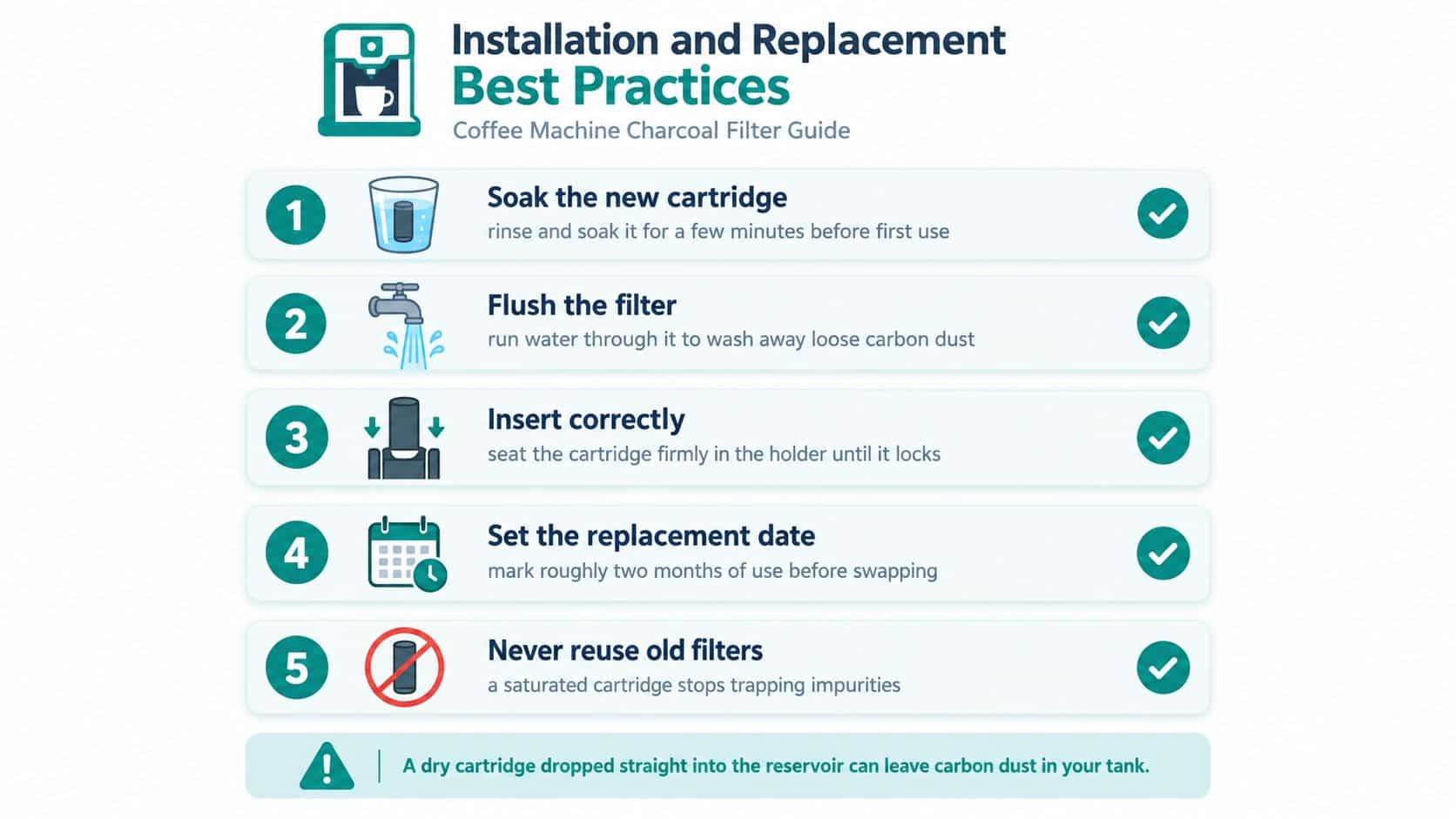
A new cartridge can make the first brew worse if you install it dry. Loose carbon fines may escape into the reservoir, and the filter may not be fully wetted or seated. The preparation is simple, but skipping it creates the exact dusty taste and debris that users often blame on the replacement filter.
Prepare the cartridge first
Remove the new filter from its packaging and inspect it for damage. Soak it in clean water for about two to five minutes, then flush it under running water for roughly 60 seconds, following the preparation guidance in these replacement-filter instructions.
The soak wets the carbon medium and helps prime its pores. The flush carries away loose carbon dust before the cartridge enters the machine. Afterward, place it in the holder and press it into position firmly. A cartridge that sits crooked or loosely can allow water to bypass the media or leak around the holder.
For machine-specific installation advice, this coffee filter installation guide can help you check the holder, orientation, and seating method before you run a brew cycle.
Track time and usage
Replacement schedules vary because households use different amounts of water. Industry guidance commonly places coffee-machine charcoal filters at around 60 brew cycles or roughly two months, while other instructions recommend replacement about monthly or after around 30 tank refills. The Mr. Coffee filter guidance provides the 60-cycle or two-month reference, while the cited replacement instructions give the shorter monthly or refill-based schedule.
Use the machine manual as the primary rule. If the manufacturer specifies a number of uses or tank fills, follow that schedule. If it gives only a time interval, mark the replacement date on your calendar or on a label near the reservoir.
Breville provides a clear example for its own system, recommending replacement every 60 days or after about 120 uses to help maintain water quality and reduce scale buildup. That schedule belongs to the specified Breville filter system, so it isn't a universal rule for Keurig, Cuisinart, Ninja, or other machines.
A cartridge can look clean after saturation. Replace it based on the machine's schedule and your usage, not on appearance.
Heavy users may reach a usage limit quickly, while occasional brewers may leave water standing in the reservoir for long periods. Empty stagnant water, rinse the reservoir, and avoid treating an old cartridge as a permanent component. The filter's performance declines gradually, which makes a simple written replacement date more reliable than taste memory.

Machine Compatibility and Premium Versus Generic Options
The right filter is the one that matches the holder, shape, and water path in your machine. Coffee makers don't share a universal cartridge standard. A filter made for a Keurig reservoir may not lock into a Cuisinart basket, and a Breville espresso cartridge may use a pull-out holder that bears little physical resemblance to a drip-machine insert.
Keurig systems often use a removable filter holder inside the reservoir. Ninja DualBrew machines use their own compatible filter arrangement, while Breville espresso machines typically use dedicated cartridges designed for the machine's water tank. Check the model number, holder design, and manufacturer instructions before buying a multipack. Owners comparing equipment for a larger workplace or hospitality setup may also find this guide to coffee machines for cafés useful for understanding how machine format affects maintenance decisions.
Comparing cartridge choices
| Feature | OEM Manufacturer Filters | Premium Third-Party, such as PureHQ |
|---|---|---|
| Fit | Designed for the manufacturer's listed machines | Designed around stated compatible models |
| Media | May combine activated carbon with ion-exchange resin | Product specifications should identify carbon type and any resin |
| Replacement guidance | Usually supplied by the machine brand | Must be checked against the product instructions and machine use |
| Main buying advantage | Direct brand alignment | Compatibility options and potentially broader accessory bundles |
| Main risk | Higher replacement cost may discourage timely changes | Poor fit can cause bypass, looseness, or leakage |
The customer objection I hear most often concerns leaking. A third-party filter shouldn't be judged only by its external shape. If the cartridge doesn't seat firmly, if the holder is warped, or if the machine uses a different model-specific connector, water can bypass the media or escape around the assembly.
A second objection involves durability. Activated carbon is consumable media, so a cartridge that lasts indefinitely isn't a realistic expectation. A well-fitting replacement can still require regular changes because saturation, not visible wear, determines adsorption performance.
Fit before price: Confirm the exact machine family and holder style, then compare media, replacement guidance, and return support.
PureHQ Inc. offers compatible charcoal filters and holders for selected Keurig, Ninja, Cuisinart, and Breville-style systems, including options that use activated carbon to reduce chlorine and odors. For Keurig K-Supreme owners, this K-Supreme water-filter guide provides model-focused installation context. Treat any third-party listing the same way you'd treat an OEM listing, verify the models and the fit before opening the package.
Do You Actually Need a Charcoal Filter
Not every coffee drinker needs one. The filter's usefulness depends on what enters the reservoir, not on the machine's brand alone.
Tap water with a noticeable chlorine taste or odor gives activated carbon a clear target. If your home uses water that already passes through reverse osmosis, a refrigerator dispenser, or another effective treatment system, the additional cartridge may produce little sensory change. Bottled spring water can also vary in mineral content, so “bottled” doesn't automatically mean ideal for every coffee machine.
Match the cartridge to your household
Consider three variables before buying:
- Incoming water: Taste the water plain. A strong chlorine or odor note makes potential benefit easier to detect.
- Existing filtration: If another system already reduces those compounds, a second carbon stage may add limited value.
- Brewing frequency: Frequent brewing consumes cartridge capacity faster, while occasional use increases the importance of clean storage and timely replacement.
Independent and retail-facing guidance describes these filters as tools for removing chlorine, odors, and some impurities. Replacement advice ranges from every 30 tank refills to about 60 days or 60 tank refills, depending on the source and product instructions, as summarized by Food & Wine's discussion of charcoal coffee-maker filters.
That range exposes the practical issue. Water source quality, brewing frequency, and storage conditions determine whether a cartridge delivers a noticeable improvement or adds another maintenance task. If your water already tastes clean and your machine receives little use, test before committing to recurring replacements. Brew comparable coffee with and without the cartridge, keeping the beans, grind, and brew settings consistent.
Upgrading Your Daily Brewing Routine
A charcoal cartridge works best as one part of a simple maintenance routine. Use it to address chlorine, odors, and selected impurities, then use descaling to address mineral deposits that ordinary activated carbon may leave behind. Breville's own guidance connects its filter system with reduced scale buildup and recommends regular replacement to support taste and the longevity of internal heating elements. Breville's product information describes the model-level claims, while the machine's instructions should determine the exact care schedule.
Keep the reservoir fresh, install each cartridge correctly, and write down the date of installation. Pair replacement filters with a compatible descaling solution or cleaning tablets when your machine's maintenance instructions call for them. If you brew with ground coffee in a pod system, a reusable K-Cup can also reduce dependence on disposable pods, but it still needs thorough rinsing after use.
Maintenance decision: Choose filtration for your water's taste and chemistry, choose descaling for mineral deposits, and choose accessories that fit the machine rather than the other way around.
PureHQ's range includes compatible water filters, reusable K-Cup-style pods, gold-tone carafe baskets, paper liners, descaling solutions, and cleaning tablets for selected home and small-office machines. Stock the cartridge that matches your model, add descaler if hard water leaves deposits, and keep the routine visible so replacement doesn't depend on memory.
PureHQ Inc. offers compatible charcoal water filters, reusable filter holders, descaling solutions, and coffee-machine maintenance accessories for selected Keurig, Ninja, Cuisinart, and Breville systems. Visit PureHQ Inc. to match the right filter to your machine and build a maintenance setup for cleaner-tasting, more consistent daily brews.

