
Coffee Machine Care
Keurig Single Serve and Carafe: Which Brewer Fits

Sep
You're halfway out the door with one hand on a travel mug when someone else needs a full pot. A dedicated pod brewer gets one person moving quickly, but it turns the next several cups into a queue. A traditional drip machine handles the pot, but it asks the person who wants one cup to wait.
That's the appeal of a Keurig single serve and carafe brewer. One machine can handle a quick cup and a larger batch, but the compromise is easy to miss. Temperature can fall during back-to-back brewing, carafe output may taste weaker than coffee from a dedicated drip brewer, and replacement parts aren't automatically interchangeable.
The right question isn't whether a dual-brew machine is convenient. It is. The better question is whether your household values flexibility more than maximum extraction quality, and whether you're willing to follow the model's compatibility and maintenance rules.
The Morning Rush Dilemma
At 6:45, one person needs a small coffee before leaving, while another wants a full carafe for the kitchen table. A third may want an iced drink later. Separate machines consume counter space, while a single-serve brewer forces several cycles when the household needs more coffee.
A dual-brew machine keeps those jobs on one appliance. One user can select a single-serve size, and the next can start the carafe without changing machines. Newer K-Duo configurations provide 6, 8, 10, and 12-ounce single-serve settings, plus 6, 8, 10, and 12-cup carafe brewing from a shared 72-ounce reservoir, according to independent K-Duo workflow testing.
The time split matters during a rushed morning. One person can brew a cup in roughly 60 to 90 seconds, while a full carafe generally takes about 6 to 14 minutes, depending on the model and brew mode. A cup can leave with the early riser while the machine continues preparing coffee for everyone else.
Back-to-back brewing exposes the first hidden compromise. Drawing hot water for a quick cup leaves less thermal headroom for the carafe cycle, so the second brew may run cooler than expected. That can affect flavor and makes a dual brewer less predictable than two dedicated machines.
Practical rule: Use the single-serve side for urgency and the carafe side for volume. Expecting specialist-level performance from both modes sets the wrong benchmark.
The shared reservoir reduces refills, but it also makes water quality and capacity common concerns. Scale or mineral buildup can affect both brewing paths, and households with other water appliances can compare maintenance routines in Ring Hot Water chilled tap maintenance.
Carafe compatibility adds another constraint. Replacement pots, lids, and thermal components are not automatically interchangeable, so confirm the exact model before buying accessories. The machine solves a real scheduling problem, but its value depends on accepting these temperature and fit limitations.
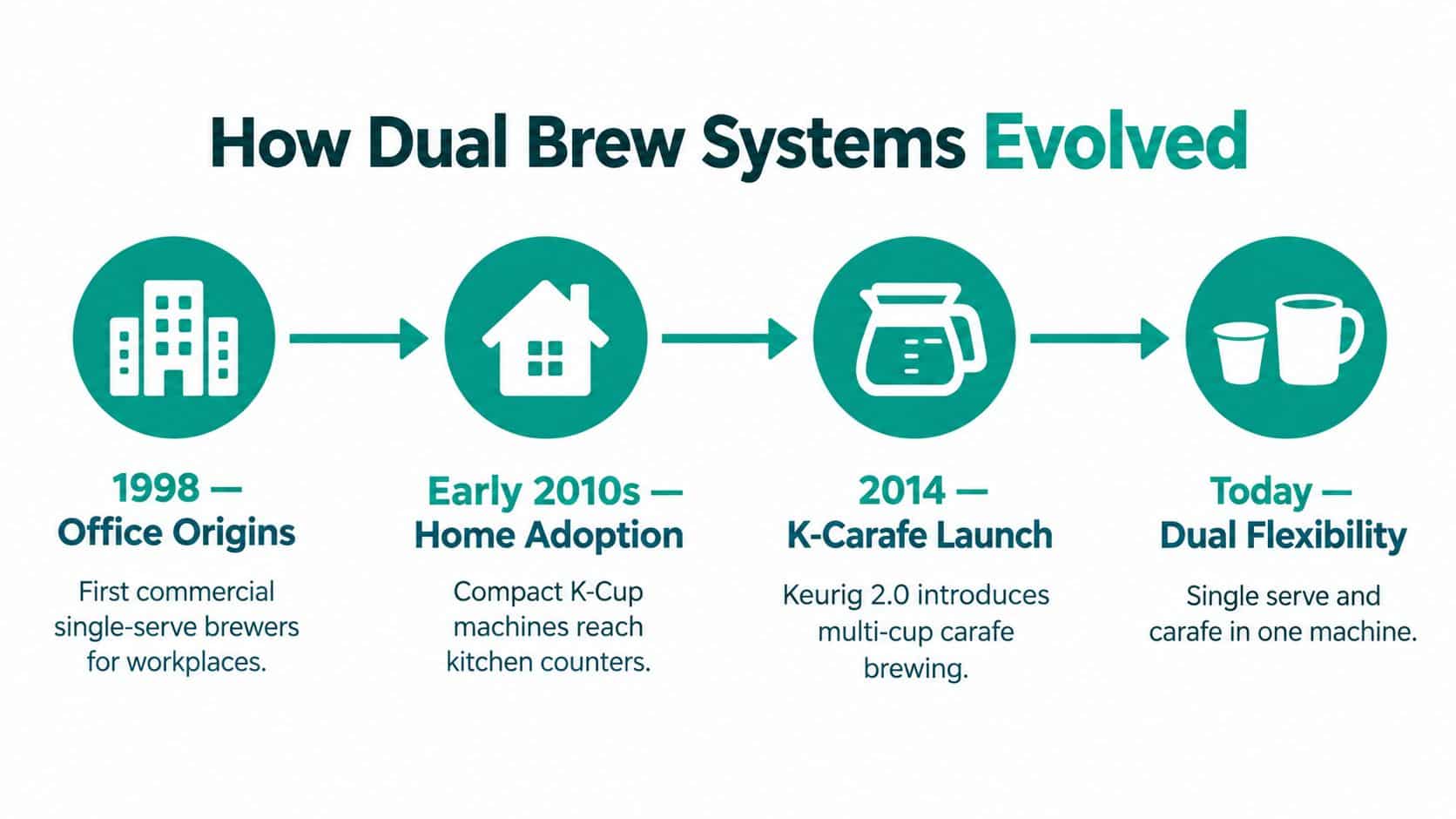
How Dual Brew Systems Evolved
Keurig started with a practical office problem: serve consistent portions quickly without brewing a full pot. The company was founded in Massachusetts in 1992, then reached a major commercialization milestone in 1998, when it delivered the B2000 brewing system for office use. According to the Keurig entry on Wikipedia, Green Mountain Coffee Roasters became the first roaster to offer coffee in the K-Cup format in 1997, helping establish the pod ecosystem that supported later adoption.
That office origin still explains the format's main advantage. Offices needed repeatable servings, quick preparation, and less waste from an open pot. Keurig introduced home brewers in 2004, shifting the concept from workplace equipment into a household appliance category.
From a carafe add-on to a product family
The carafe function arrived as an extension of the single-serve platform. In 2014, Green Mountain and Keurig introduced Keurig Carafe capability for the Keurig 2.0 system. Users could brew either one cup or a full carafe from the same machine, using Keurig-branded packs.
The K-Duo portfolio formalized that combination for a broader home audience. Keurig Dr Pepper announced it on September 16, 2019, describing brewers that combined single-serve and drip coffee functions. The company's K-Duo portfolio announcement listed models shipping that fall with a $169.99 MSRP.
The sequence matters. Carafe brewing began as a capability attached to a pod-focused machine. K-Duo made the two-mode format a distinct product family for households, breakrooms, and other shared settings.
A 2024 report noted in the same Keurig history said just under 40 million households used its coffee brewing system, while brand recognition was reported above 90%. Those figures indicate reach, not specialist-level extraction from every dual brewer.
Dual-brew machines are mature and practical, but their shared hardware creates real compromises. One reservoir, heating system, control setup, and countertop footprint must serve two different brewing jobs. After a quick single-serve cycle, the heater may have less thermal headroom for the carafe, so back-to-back brewing can produce a cooler second cycle. Carafe fit is another overlooked constraint: replacement pots, lids, and thermal components are model-specific rather than universally interchangeable.
Check the exact brewer model before buying a replacement carafe or expecting identical performance across both modes. The format solves a scheduling problem, but its usefulness depends on accepting temperature variation and strict accessory compatibility.
Comparing Workflows and Brew Speeds
At 6:30 a.m., one person may want a single cup while everyone else expects a full pot. A dual brewer handles both requests, but the fastest workflow depends on the order of brewing, the accessories already in place, and how quickly the heater recovers between cycles.
A dedicated single-serve brewer keeps the routine simple: add water, insert a pod or reusable filter, choose a size, and brew. A dedicated drip machine follows a slower batch routine. The K-Duo combines both formats, yet each mode has different setup demands. The single-serve side suits one drink, while the carafe side makes better use of time when several people want coffee together.
Single-Serve vs. Dual-Brew Workflow Comparison
| Feature | Dedicated Single-Serve | Dual-Brew (Single & Carafe) |
|---|---|---|
| Primary use | One cup at a time | One cup or a larger batch |
| Single-serve sizes | Depends on model | K-Duo configurations support 6, 8, 10, and 12 oz sizes |
| Carafe sizes | Not available | K-Duo configurations support 6, 8, 10, and 12-cup brews |
| Water management | Usually focused on cup brewing | Shared reservoir supports both modes |
| Single-cup timing | Quick, model-dependent | Around 60 to 90 seconds in independent testing |
| Full-batch timing | Not applicable | Roughly 6 to 14 minutes, depending on model and mode |
| Counter footprint | Smaller when used alone | One appliance replaces two, but the brewer is more complex |
| Switching modes | Not applicable | Requires correct basket, pod, grounds, and carafe setup |
| Best fit | Solo drinkers and single-cup routines | Households or offices with mixed coffee demand |
The shared reservoir saves space and eliminates a second water tank. It also creates a single bottleneck. If the reservoir runs low, both brewing modes stop. The heater is shared too, so brewing a cup immediately before a carafe can reduce the temperature available for the second cycle.
Timing figures need context. A single cup may finish in around 60 to 90 seconds in independent testing, while a full batch can take roughly 6 to 14 minutes, depending on the model and selected mode. Those figures describe the brew cycle, not the time required to change accessories, add grounds, position the carafe, or let the system recover.
What switching modes feels like
The carafe side uses ground coffee in a basket. The single-serve side uses a compatible K-Cup or reusable pod setup. Switching therefore requires removing the previous format, checking the basket, placing the carafe correctly, and confirming the selected setting. A rushed setup can produce a weak cup, a messy brew, or a cycle that cannot start.
Carafe compatibility adds another constraint. The pot, lid, and thermal components must match the exact brewer model. A generic replacement may sit incorrectly or fail to engage the machine's safety mechanism, so confirm the model before buying accessories.
For a household, the routine becomes manageable once each person uses a familiar mode. In a small office, label the carafe basket and store compatible filters beside the brewer. That reduces mistakes during busy mornings.
One dual brewer can free counter space compared with two appliances, but it brings more parts and cleaning points. Keep the carafe basket, reusable pod, paper filters, and cleaning supplies together. The best setup is the one that makes mode changes predictable without sacrificing the correct accessory or brewing order.
The Hidden Temperature and Quality Trade-Offs
A dual brewer can make a pod quickly, then struggle when asked to produce a full carafe immediately afterward. One heating system serves two extraction jobs, so the convenience of switching modes comes with thermal trade-offs. Those differences become noticeable when several people expect the same strength and heat from both brewing options.
Consumer testing placed K-Duo output around 176 to 181°F (K-Duo temperature testing). That result should not be treated as a universal rating for every cycle, but it shows why single-serve coffee and carafe coffee may perform differently. Dedicated drip brewing is generally designed around the 195 to 205°F industry guideline during extraction, creating a useful point of comparison.
Back-to-back brewing exposes the limitation more clearly. Independent performance testing found that the machine is not ideal for consecutive cycles without a noticeable water-temperature drop, with some carafe results landing in the mid-150s to mid-160s Fahrenheit. A batch in that range can taste less satisfying than coffee from a dedicated drip brewer, especially when the second cycle follows a pod brew.

Why the second brew can disappoint
The first cycle draws on the heater's available capacity. The next cycle then has to bring another volume of water to brewing temperature while distributing it through a different coffee bed. A single cup creates a smaller demand than a carafe, whereas the carafe mode needs sustained heating across a larger batch. Switching modes immediately can leave the second brew cooler before extraction is complete.
Lower heat affects flavor as well as serving temperature. Cooler water may produce a weaker or flatter cup, particularly when the carafe already spreads the brew across a larger volume. Reviews also report that the carafe side can taste weaker than a dedicated drip brewer, and that special single-serve settings do not apply consistently to both modes, as discussed in K-Duo Gen 2 performance testing.
Control the variables that remain available:
- Use fresher grounds: Fresh coffee can preserve more aroma when thermal performance is uneven.
- Adjust the ratio: A slightly stronger ground-coffee ratio can offset a batch that tastes diluted.
- Filter the water: Cleaner water reduces mineral interference and supports more predictable heating.
- Avoid immediate mode changes: Allow recovery time between a pod brew and a carafe cycle when flavor matters.
- Preheat the serving setup: A warm mug or carafe reduces the temperature shock that makes coffee seem cooler.
The carafe heating plate stays on for 2 hours after brewing, according to the same K-Duo heating-plate testing cited above. That helps households and small offices serve coffee gradually, although a glass carafe will not retain heat like a well-insulated thermal vessel.
For maintenance context, PureHQ's guide to temperature stability explains how equipment condition and mineral buildup can affect temperature consistency. Cleaning will not change the brewer's design, but it can prevent scale and residue from making uneven heating worse.
Quality expectation: Choose the K-Duo for speed and flexibility first. If peak carafe extraction and heat retention matter more, a dedicated drip setup remains the more focused tool.
Navigating Filters and Reusable Pod Compatibility
Accessory fit causes many dual-brew failures. A carafe can look right yet miss the brewer's sensor or drip-stop position. A reusable pod can sit in the holder while restricting flow, leaking grounds, or triggering an error. These problems are especially frustrating during back-to-back brewing, when a small restriction can slow the second cycle.
Start with the exact model number, not just the K-Duo family name. Keurig lists model-specific replacement carafes, including one for the K-Duo Essentials Single Serve & Carafe Coffee Maker Gen 1. That listing shows why K-Duo carafes should not be treated as universally interchangeable. Check the official K-Duo Essentials replacement-carafe listing/p/Replacement-Carafe-K-Duo-Essentials-Coffee-Maker) before buying a spare.

Check carafe fit before troubleshooting leaks
The K-Duo Essentials Gen 1 parts documentation says the brewer works only with Keurig carafes. It also explains that the unique Keurig carafe was designed for the Keurig Plus Series brewer. The restriction affects more than capacity. The carafe must sit correctly against the brewer's positioning and sensor components, so a generic vessel can leak or interrupt brewing even when its size appears similar. Review the official K-Duo parts document before substituting another vessel.
If coffee collects around the carafe area, check these points first:
- Confirm that the carafe matches the exact brewer variant.
- Seat it fully beneath the brew outlet.
- Clear grounds or residue from the lid, basket, and drip-stop area.
A leak does not automatically indicate a failed machine. Compatibility and positioning often explain it.
Choose reusable filters by brewer technology
Keurig describes the current My K-Cup Universal Reusable Filter as its reusable filter designed for use across Keurig home brewers. It also describes MultiStream Technology compatibility and the filter's intended flow pattern. The My K-Cup Universal Reusable Filter product listing appears on a site using the Keurig name, but it is not Keurig's main official store, so verify the model details before ordering.
Compatibility still varies by brewer generation. Compare the model number, pod holder, and MultiStream requirements. For ground coffee on the single-serve side, the K-Duo reusable K-Cup brewing guide provides a relevant brewing reference while the carafe basket remains separate.
Descale every three to six months, depending on water hardness, and rinse the reusable pod's mesh after every use. Trapped grounds restrict flow long before mineral scale noticeably affects heating. Use filtered water if your supply leaves deposits, and follow the brewer's maintenance instructions for the descaling cycle.
Choosing the Right Setup for Your Household
A dual brewer earns its counter space when the morning starts with different coffee needs. One person may want a single cup before work, while others need a carafe for breakfast. The right setup depends on how often the household changes modes, how much cleanup it accepts, and whether small differences in temperature or strength matter.
Busy households
Families with mixed schedules generally get the most value from the K-Duo format. The shared reservoir avoids switching between appliances, and the available single-serve and carafe sizes support both individual drinks and group servings. That convenience is practical, but it comes with a timing requirement.
Back-to-back brewing can expose the machine's thermal limits. After one cycle, the next brew may run cooler, especially when the household alternates quickly between a cup and a carafe. Leave a short pause between cycles, keep the carafe basket clear, and treat the dual brewer as a flexible convenience machine rather than two fully independent brewers.
Carafe compatibility also deserves attention before purchase. Replacement carafes must match the brewer's shape, lid, sensor, and drip-stop arrangement. A generic glass pot may look suitable yet fail to seat correctly, interrupt brewing, or leak.
Small offices and breakrooms
Small offices often value flexible serving more than specialty-coffee precision. A K-Duo can handle an individual cup and a shared pot without requiring separate machines, which keeps the counter simpler. Its heating plate can keep coffee available for staggered drinking, but a glass carafe will not retain heat like a thermal carafe.
Label the approved carafe, grounds basket, filters, and descaling supplies. This simple step prevents staff from treating a model mismatch as a machine failure. It also makes routine maintenance easier when several people use the brewer.
Solo drinkers and coffee purists
A solo drinker who rarely makes a batch may be better served by a dedicated single-serve machine. It requires less setup and cleanup, while avoiding a carafe function that sits unused. For larger batches, a dedicated drip brewer may also suit coffee purists who prioritize consistent temperature, strength, and flow over having two brew formats in one appliance.
Use the dual brewer when both sides will see regular use. For a broader comparison, this guide to Keurig coffee makers with carafes explains how different configurations fit household routines.
Choose separate equipment when one mode dominates or when every carafe must match dedicated-drip performance. That decision usually matters more than saving counter space.
Final Verdict and Next Steps
A dual-brew machine earns its counter space when one household needs both a quick cup and a shared pot. A Keurig single serve and carafe setup handles that routine with one reservoir and one appliance, which suits busy kitchens and small offices.
The convenience has performance limits. Brewing a cup immediately before a carafe can lower the available heat, so the second brew may not match the first for temperature. Carafe coffee can also taste lighter than coffee from a dedicated drip brewer, and results vary by brew mode, batch size, and starting water temperature. These differences matter more to drinkers who prioritize consistent extraction than to users who value flexible serving.
Carafe compatibility requires equal care. Use the carafe specified for the exact brewer model. A generic replacement may sit incorrectly, fail to trigger a sensor, or leak. The same rule applies to reusable filters and carafe baskets. PureHQ Inc. offers reusable K-Cup filters, K-Duo carafe baskets, paper liners, water filters, and descaling supplies for compatible systems.
Clean the water path, follow the manufacturer's descaling guidance, and keep approved accessories together. Labeling the carafe and baskets helps prevent avoidable fit errors in shared spaces.
Choose the K-Duo when both brew modes receive regular use and convenience outweighs small temperature and flavor compromises. Choose dedicated machines when one mode dominates or carafe consistency matters more than saving counter space. For accessory matching, see PureHQ Inc. and this guide to Keurig coffee makers with carafes.

