
Coffee Machine Care
Reusable Coffee Cups Amazon: The Complete Buyer’s Guide

Sep
A reusable cup doesn't become environmentally useful the moment you buy it. Depending on its material, washing method, and design, it may need at least 20 uses, with some lifecycle studies placing the breakeven range between 20 and 100 uses, before it performs better environmentally than disposable alternatives. Huhtamaki's review of reusable and disposable coffee cups makes the practical point clear: the cup only earns its footprint through repeated use.
That matters when shopping for reusable coffee cups on Amazon, where the choice is vast but the useful information is often shallow. A high star rating won't tell you whether a lid will survive a crowded work bag, whether the vacuum insulation will keep working, or whether the cup is easy enough to wash that you'll use it for years.
Navigating the Massive Amazon Reusable Cup Market
Amazon's reusable-cup category is already crowded, with over 40,000 listings for reusable cups and more than 1,000 results for eco-friendly cups in the marketplace search results (Amazon's reusable-cup category). That volume creates a familiar trap. Buyers filter by stars, choose an attractive color, and discover later that the lid seal is the weak point.
The search term reusable coffee cup covered 133 products across the first three pages of U.S. results in April 2026, according to independent Amazon analytics reported alongside the marketplace results. The top-ranked ASIN recorded more than 20,000 orders in that month, while the keyword showed a weekly search volume of 1,450 and a Brand Analytics search rank of 131,969 during March 22 to 28. The same analysis found that 42.01% of ASINs sat in the $20 to $50 price band, and nearly 73.71% of listings held ratings between 4.3 and 4.7 stars (Amazon's reusable coffee cup results).
Those figures describe a competitive, review-driven market, not a category with one universally reliable design. A cup can collect praise for its appearance, comfortable grip, or first-week insulation while still developing a failing gasket after repeated washing. Review volume also can't answer your specific use case. A desk user may tolerate a lid that isn't safe in a backpack, while a commuter can't.
What the ratings don't reveal
The most useful buying question isn't “Which cup has the highest rating?” It's “What happens after months of heat, washing, pressure, and careless handling?”
A widely reviewed KeepCup listing contains mixed feedback about durability, lid sealing, spills, and staining. Another heavily rated tumbler has review complaints involving cracking, a broken lid after two uses, and double-wall failure within a week (customer feedback on the KeepCup listing). These reports don't prove that every unit fails, but they expose the failure modes that product pages tend to hide.
Practical rule: Treat “leak-proof” as a design claim to verify, not as a guarantee that replaces testing.
Before buying, check whether the lid has a removable gasket, whether replacement seals are available, whether the body is vacuum insulated, and whether the product page identifies food-contact materials. If you brew at home as well as commute, keep the two purchases separate. A guide to reusable coffee pods on Amazon addresses the brewing side, while a travel mug must handle heat, sipping, and transport.
A useful source of design inspiration is scalable growth design showcases, particularly if you're interested in how product form, material, and everyday handling influence perceived quality. For the cup itself, prioritize reliable sealing, durable construction, cleanability, and a realistic reuse habit over decorative features.
Material Science and Thermal Retention Performance
The material determines more than appearance. It affects thermal performance, weight, break resistance, flavor retention, and the amount of care the cup needs.
For a commuter, double-wall vacuum-insulated stainless steel remains the most dependable general-purpose construction. The vacuum gap suppresses conductive and convective heat transfer, so the inner wall loses heat more slowly than a simple single-wall body. In one comparative test, a vacuum-insulated model retained about 78% of its initial 95°C liquid temperature after 60 minutes, compared with roughly 66% for a glass reusable cup and 62% for a collapsible cup (comparative reusable cup test).
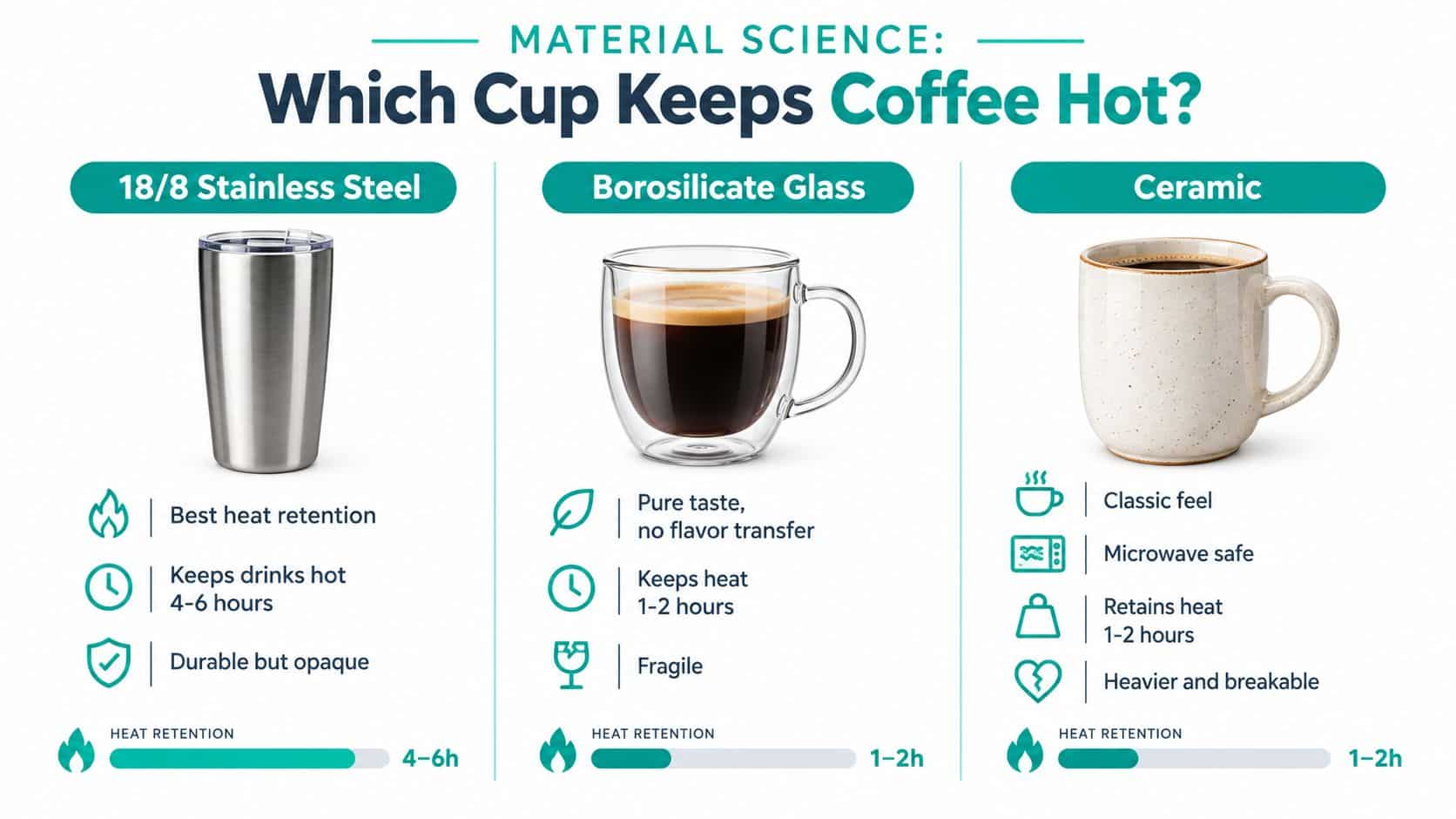
Stainless steel, glass, and collapsible silicone
Amazon specifications commonly highlight 18/8 stainless steel, BPA-free plastics, lead-free materials, and dishwasher-safe construction (Amazon reusable coffee cup listings). The 18/8 designation describes a stainless-steel composition associated with corrosion resistance and durable food-contact use. It won't make a poor lid reliable, but it gives the body a strong foundation for daily handling.
Glass has a different advantage. It doesn't create the same metallic association that some drinkers notice with unlined steel, and it lets you see the drink level. Borosilicate glass handles temperature changes better than ordinary glass, but it remains vulnerable to drops. A glass cup that works well at a desk or café may be a poor choice for a backpack that gets placed on floors and car seats.
Collapsible silicone solves a different problem. It stores easily and weighs less than many rigid designs, but the flexible walls and folds can make cleaning, stability, and heat retention less satisfying. It suits occasional use and limited storage better than long commutes with a hot drink.
| Material Type | 60-Min Heat Retention | Durability and Drop Resistance | Best Use Case |
|---|---|---|---|
| Vacuum-insulated 18/8 stainless steel | About 78% of the initial 95°C temperature in the cited comparison | Strong body, though lids and coatings remain vulnerable | Commuting, long workdays, car travel |
| Glass | Roughly 66% in the cited comparison | Fragile when dropped | Desk use, flavor-focused drinking |
| Collapsible silicone | Roughly 62% in the cited comparison | Flexible and storage-friendly, but less rigid | Travel backup, limited storage |
Reading the specification sheet
Look for double-wall vacuum insulation, not merely “double wall.” The latter can describe an air gap that provides some protection but doesn't necessarily deliver the same retention as a vacuum chamber.
Then inspect the parts that touch the beverage. Product listings that identify BPA-free and lead-free materials give you more useful information than pages that only describe a color or finish. Dishwasher compatibility can reduce cleaning friction, but repeated heat and detergent exposure can still affect coatings, seals, and printed surfaces. A cup that needs careful hand washing may last well, yet a cup with a complicated lid may accumulate residue if you don't disassemble it.
The premium-versus-generic choice is therefore not just steel versus plastic. A premium cup should justify itself through consistent insulation, a serviceable lid, durable seals, and practical cleaning. A generic cup can perform well, but you need stronger evidence than a polished product image and a rounded star rating.
The Leak-Proof Myth and Lid Mechanism Reality
A travel mug can have an excellent body and still ruin your laptop. The lid carries the moving parts, gasket, drinking aperture, locking mechanism, and pressure points. Those components determine whether “leak-proof” survives real use.

The most common failure begins with a seal that shifts slightly during assembly. If the silicone ring doesn't sit evenly in its channel, tightening the lid can create the appearance of security while leaving a narrow path for liquid. Heat, coffee oils, detergent, and repeated compression then make the problem worse.
Three lid designs worth comparing
Screw-on or lock-on lids usually provide the strongest barrier for bag storage because the lid engages with the cup body rather than relying only on a push fit. They take longer to remove and often need two hands, but that inconvenience can be worthwhile when the cup will travel horizontally.
Push-button lids offer quick, one-handed drinking. Their advantage disappears if the button becomes stiff, the locking tab is easy to trigger, or the internal gasket can't be cleaned properly. A lock that prevents accidental activation improves the design, but it doesn't eliminate wear.
Slide-lock lids provide simple access and fewer moving parts than some button systems. They can be pleasant for driving or desk use, yet the slider and its channel still need regular cleaning. A lid that feels secure during upright use isn't automatically safe loose in a bag.
Test the seal before trusting it
Run a simple home test with cool water. Fill the cup, close the lid carefully, turn it upside down over a sink, and inspect the seam. Then place it on its side for a while and check the outside of the body and the lid. Don't begin with coffee. A failed test using cold water is much cheaper than a failed test over paperwork.
Use these checks before committing to a mug:
- Inspect the gasket: Confirm that the silicone ring sits flat and isn't twisted, stretched, or pinched.
- Check the lock: Engage every latch or slider and see whether it can move without deliberate pressure.
- Examine the drinking port: Look for a cover or internal closure that blocks the opening rather than merely redirecting liquid.
- Plan for cleaning: If you can't remove the lid parts, residue can build around the seal and affect both taste and reliability.
- Protect high-value items: Until the mug passes repeated tests, carry it upright or place it inside a separate leak-resistant pouch.
A generic cup often fails because the seal is poorly fitted or difficult to replace, not because stainless steel is fundamentally weak. A premium design earns its price only if it makes the sealing system easier to align, clean, lock, and maintain. The core objective isn't a marketing phrase. It's a lid that remains dependable after the novelty has gone.
Choosing Between Reusable K-Cups and Travel Mugs
Amazon search results blur two different products under the same broad coffee language. A reusable K-Cup holds ground coffee inside a compatible brewer. A travel mug holds the finished drink while you move through the day. Buying one won't solve the problem addressed by the other.
A Keurig or Ninja DualBrew owner should start with compatibility. The pod must sit correctly in the brew chamber, allow the machine's needle or puncture system to work as designed, and present a filter area that supports steady water flow. A pod that fits loosely can produce grounds in the cup, weak extraction, or messy removal.
Match the pod to the brewer
Stainless-steel mesh pods generally offer a more durable alternative to thin generic plastic, but the mesh pattern, rim, lid, and dimensions still matter. “Universal” doesn't always mean compatible with every brewer generation. Check the product listing against your machine model and confirm how the pod closes before filling it.
A travel mug needs a different checklist:
- For home brewing: Choose a refillable pod that fits the brewer and seals without obstructing the machine's puncture path.
- For commuting: Choose a cup with an insulated body, secure lid, and dimensions that suit your car holder or bag.
- For both routines: Brew into a cup that is easy to empty and wash, then transfer only if the drinking vessel offers a meaningful advantage.
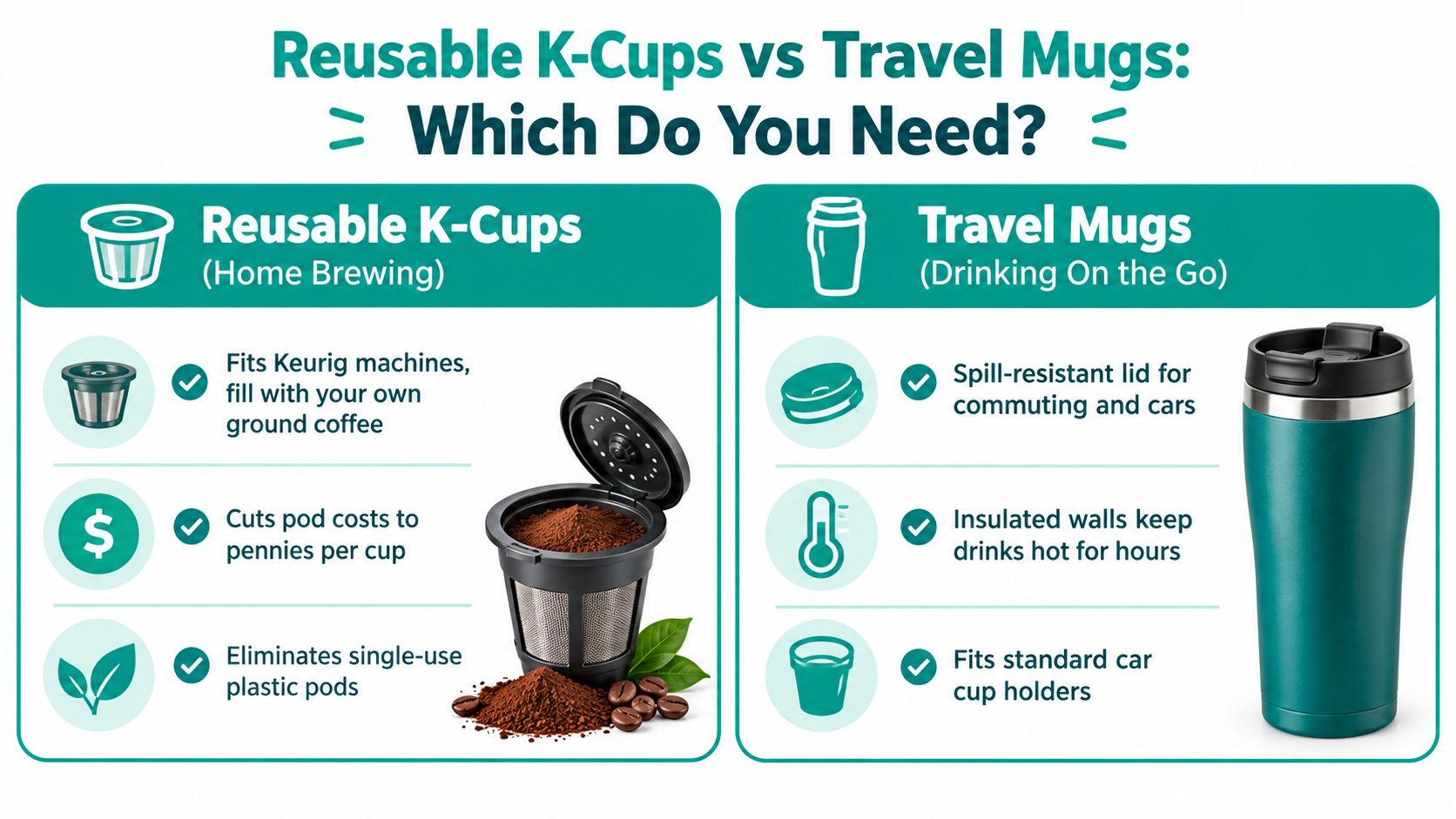
The distinction matters for sustainability too. A travel mug replaces a disposable drinking vessel. A reusable pod replaces a single-use capsule. They may support the same low-waste routine, but they have different materials, cleaning demands, and failure points.
Avoid the wrong upgrade: A durable reusable pod won't keep coffee hot, and a well-insulated mug won't improve extraction from a poorly fitting pod.
Mineral buildup creates another connection between the two products. A reusable pod can reduce disposable waste, but the brewer still needs routine cleaning and descaling to prevent deposits from affecting flow and flavor. A compatible universal descaling solution and cleaning accessories belong in the same maintenance routine as the pod, not as an afterthought.
For a more detailed compatibility guide, see reusable K-Cups for Keurig brewers. The video below can also help visualize the difference between a brewing accessory and a drinking vessel.
Calculating the True Sustainability Breakeven Point
Reusable doesn't mean lower impact by default. Manufacturing a durable steel or glass cup creates an upfront footprint, while washing adds water and energy use. The cup becomes the better environmental choice only when your repeated use offsets those inputs.
The broad benchmark is practical rather than absolute. Reusable cups generally need at least 20 uses to minimize climate impacts versus disposables, while some studies place the breakeven range between 20 and 100 uses, depending on material, washing method, and cup type (Huhtamaki's lifecycle overview). A separate environmental evaluation found that a reusable cup needed at least 10 uses before its impact fell below that of a single-use cup (environmental evaluation of reusable cups).
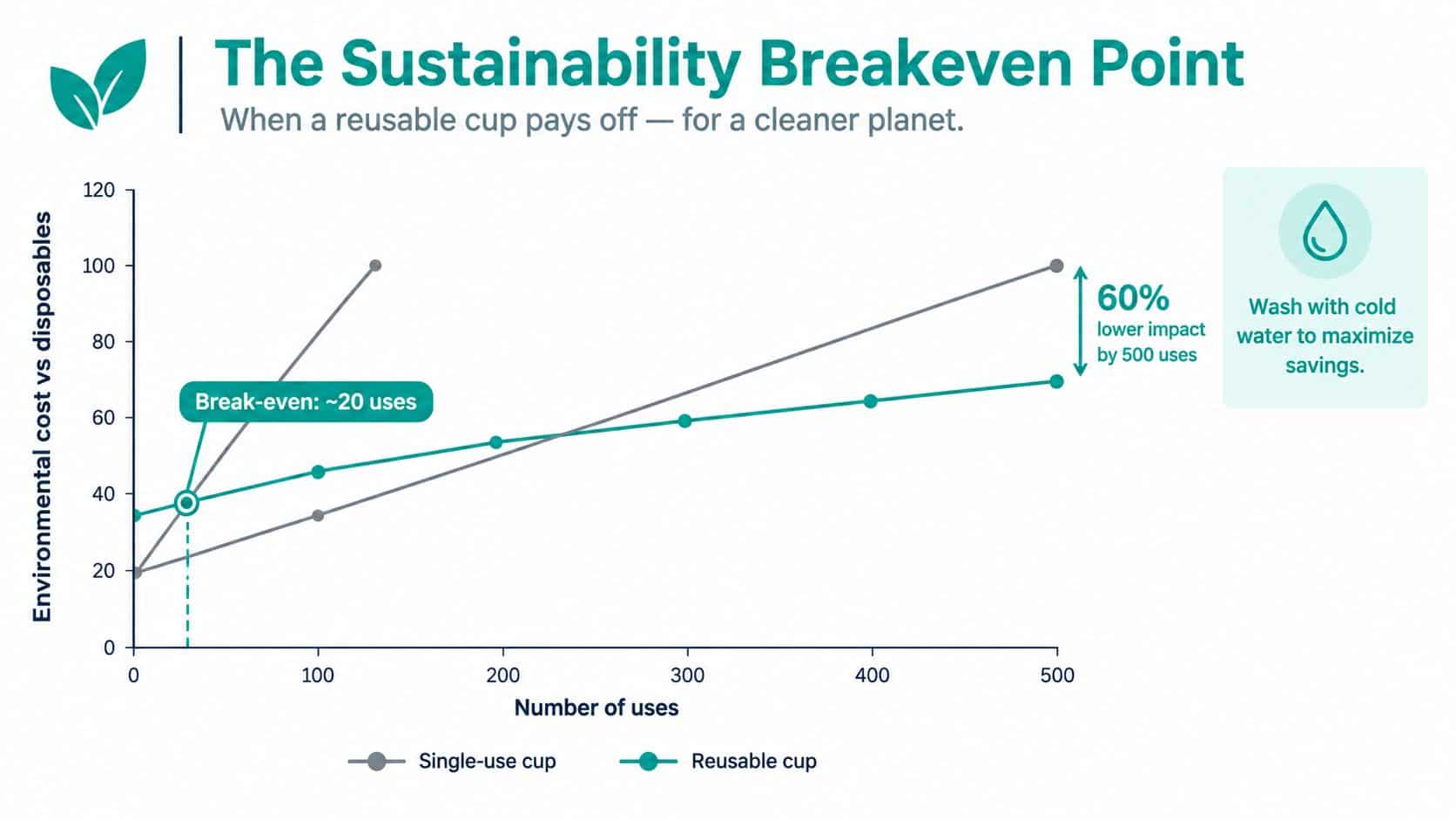
What the lifecycle figures actually mean
For cold drinks, the Scottish Government cites an impact of 0.07 kg CO2e per use for a single-use plastic cup, compared with 0.0084 kg CO2e per use for a reusable equivalent over 75 uses, producing a reported net saving of 61.6 g CO2e per use (Scottish Government environmental assessment). The same government analysis also describes reusable-cup lifecycle scenarios based on roughly 75 to 500 uses, showing why the answer changes with assumptions.
Water use can move the result in the opposite direction. That analysis cites annual water use of 0.33 to 0.41 m³ for a reusable cup versus 0.05 to 0.12 m³ for certain single-use alternatives, depending on the scenario and washing assumptions (Scottish Government environmental report). Washing a cup under running hot water after every coffee creates a different footprint from washing it efficiently with other dishes.
A comparative study found reusable cups had the lowest annual impact at 0.09 Pt, assuming 260 uses per year over a two-year lifetime (comparative reusable beverage-system study). The Government of Western Australia also reports that reusable food and drinkware had the lowest lifecycle impact for climate change and particulate matter in bring-your-own or dine-in scenarios (Western Australia lifecycle assessment).
Turn the breakeven into a habit
If you use a cup only occasionally, the environmental case takes longer to mature. If you use it repeatedly for coffee bought on the way to work, the initial manufacturing footprint gets distributed across more drinks. Durability matters because a broken lid or failed vacuum chamber ends the reuse period early.
Wash the cup in the way its instructions permit, avoid leaving coffee residue around the gasket, and don't buy a design so awkward that it stays in a cupboard. For home brewers considering a lower-waste setup, reusable coffee pods can address the capsule side of the routine, while the mug handles the finished drink.
Final Buying Checklist and Premium Recommendations
The right Amazon cup isn't necessarily the one with the most reviews or the most dramatic insulation claim. It's the one whose construction matches your routine and whose weak points you can manage.
Use this checklist before buying:
- Choose the body carefully: Prefer 18/8 stainless steel when you need durability and strong thermal retention.
- Confirm the insulation: Look for double-wall vacuum construction, not just a generic double-wall description.
- Inspect the lid: Favor a screw-on or positively locking design when the cup will travel in a bag.
- Verify materials: Check for BPA-free and lead-free food-contact components in the specification.
- Plan cleaning: Make sure the lid and gasket can be separated, washed, and reassembled correctly.
- Check the fit: Confirm that the base works with your car holder and that the height suits your bag.
- Be honest about use: A cup left unused cannot reach its sustainability breakeven point.
For home brewing, PureHQ Inc. offers reusable K-Cups, stainless-steel mesh filters, water filtration, cleaning tablets, and universal descaling solutions for compatible Keurig and Ninja DualBrew setups. Those accessories solve a different problem from an insulated travel mug, but they can support the same repeat-use routine by making ground-coffee brewing and machine maintenance more practical.
Choose a premium travel cup when you need reliable transport, long heat retention, and a lid that can be serviced. Choose a simpler reusable cup when you drink quickly, carry it upright, and value lightness or visibility over maximum insulation. The best purchase is the one you'll still use after the first seal needs cleaning and the first attractive finish loses its novelty.
PureHQ Inc. offers reusable K-Cups, stainless-steel mesh filters, water filters, and descaling products for home and small-office coffee setups. Visit PureHQ Inc. to shop compatible brewing accessories and build a lower-waste coffee routine that complements your reusable travel mug.

