
Coffee Machine Care
Best Reusable Coffee Pods Amazon Finds 2026
Jun
You bought a reusable pod on Amazon because the idea makes sense. Use your own coffee. Cut down on waste. Stop paying for single-use convenience every morning. Then the first brew comes out thin, the lid spits water into the chamber, and the pod that said “universal” suddenly doesn't look so universal.
That's the trap with reusable coffee pods on Amazon. Most failures don't happen because reusable brewing is a bad idea. They happen because shoppers buy for the word “reusable” instead of buying for brewer compatibility, seal quality, and flow control.
The Reusable Pod Promise vs The Messy Reality
If you're shopping reusable coffee pods on Amazon right now, you're probably trying to solve a very specific problem. You want to stop throwing away single-use pods, but you also don't want to turn your morning coffee into a maintenance project.
The common failure pattern is easy to recognize. The pod fits into the machine, but the brew is weak. Or it closes with too much resistance. Or the machine starts, then leaks around the top and leaves wet grounds where they don't belong. The product page calls it a fit issue. In practice, it's usually a geometry issue.
Amazon demand shows this isn't a niche frustration. Amazon search analytics for “reusable coffee pods” recorded a recent weekly search volume of 10,580, with a stronger ranking trend, which tells you plenty of shoppers are still looking for a reusable setup that functions properly.
What shoppers expect
Customers generally expect three things:
- A clean fit: Drop the pod in, close the handle, brew normally.
- A stronger cup: Use fresh grounds and get better coffee than a disposable pod.
- Simple cleanup: Rinse, refill, repeat.
What they often get
The problem starts when a listing treats every machine like it works the same way.
- “Universal” language: Many unsatisfactory purchases originate here.
- Weak extraction: Water moves through too fast, or not evenly.
- Messy cleanup: Grounds stick in the mesh, residue builds up, and flavor gets stale fast.
Practical rule: If a reusable pod page talks more about “fits most machines” than about exact brewer families, keep scrolling.
This mismatch is one reason broad Amazon listings can outperform better-engineered products in clicks while underperforming in real kitchens. If you work on product positioning or marketplace content, it's worth seeing how teams elevate your brand on Amazon AI to make compatibility and buying guidance clearer before shoppers hit the return button.
Anatomy of a Great Reusable Pod
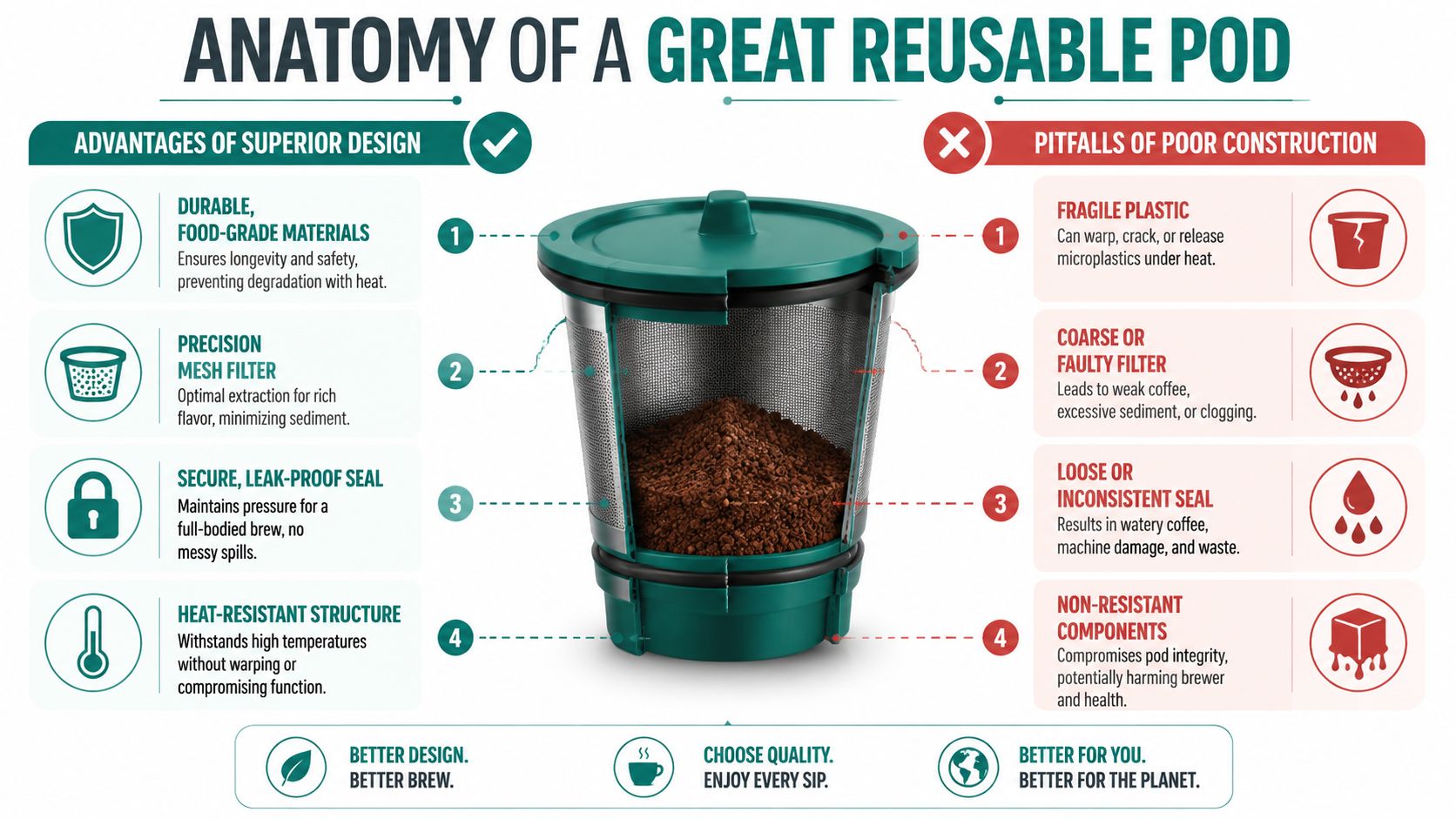
A reusable pod isn't just a little cup with holes in it. It's a pressure-sensitive brewing chamber. When it works, water enters the pod, moves through the grounds at a usable rate, and exits cleanly enough to give you body without sludge. When it doesn't, the pod either leaks, chokes, or produces coffee that tastes hollow.
Material matters more than the listing admits
On Amazon, the first comparison usually looks simple. Plastic versus stainless steel. In real use, the question is whether the pod keeps its shape, seals consistently, and stays easy to clean after repeated brews.
Reviews and demonstrations of refillable pods note that the user takes on more process control, and success depends on preventing residue buildup and keeping the lid seal intact, because both factors change hydraulic resistance and flavor over time. That's why stainless-steel construction and robust lid seal integrity stand out as the key differentiators.
A stainless design usually gives you a more stable brew chamber. A flimsy plastic body can still work, but it gives you less margin for error when heat, hinge wear, or repeated opening and closing start affecting fit.
Filter design decides cup clarity
Filter mesh gets less attention than it should. A coarse mesh can let fines through and leave sediment in the cup. An overly restrictive filter can slow the brew too much and make cleaning annoying.
A good listing should show the filter closely enough that you can judge whether it looks like a fine metal mesh or a crude screen. If the photos avoid close-ups, that's usually not an accident.
Look for these details:
- Fine, even mesh: Better odds of clean extraction.
- Stable basket walls: Less flex during brewing.
- Easy-rinse interior: Grounds should release without scraping.
The lid is where most pods fail
The lid is the part that decides whether the machine can build proper brewing pressure. A weak hinge, sloppy closure, or inconsistent gasket turns the whole pod into a bypass system. Water escapes where it shouldn't, and your coffee tastes watered down.
Cheap generics often disappoint. The body might look acceptable in product photos, but the seal tells the truth after a few uses.
A reusable pod can survive bad design almost everywhere except the lid. If the seal fails, the brew fails.
For everyday use, the best reusable coffee pods Amazon shoppers should consider have three things in balance: rigid body, precise mesh, and a lid that closes the same way every time.
Choosing the Right Pod for Your Coffee Machine
You buy a reusable pod that claims to fit Keurig, Ninja, and half a dozen other brewers. It drops into the chamber, so you assume you're fine. Then the first cup runs thin, the second leaks, and the Amazon reviews start making sense.
The main buying mistake is treating reusable pods like universal accessories. They are machine parts. If the pod does not match your brewer's chamber, lid contact points, and water entry pattern, the result is usually weak extraction, bypass, or a messy brew. That machine-fit problem gets overlooked in generic roundups, including this machine-fit discussion on reusable K-Cups, where compatibility is often the underlying reason a pod disappoints.
Keurig owners need to shop by model family, not just by brand
“Keurig compatible” is too broad to trust on its own.
Different Keurig families handle reusable pods differently. Some older brewers are more forgiving. Newer compact and slim models often have tighter tolerances, different needle alignment, or less room for a taller lid. I've tested pods that physically fit into a Keurig chamber but still produced a flat, under-extracted cup because the brewer never sealed against the pod correctly.
Use the listing to confirm your machine family first:
- Classic Keurig-style brewers: Check for pods built for the older chamber and puncture format.
- K-Slim, K-Mini, and other compact units: Check height clearance and how the lid closes under pressure.
- Newer Keurig families: Look for exact model naming, not broad “works with Keurig 1.0 and 2.0” language.
For a machine-by-machine breakdown, this guide to choosing the right reusable K-Cup for different Keurig models is useful because it treats compatibility as a fit issue, not a marketing claim.
Ninja owners should pay closer attention to seating
Ninja brewers fail in a different way. The pod can look almost right and still sit badly enough to cause uneven flow or leaking around the holder.
What matters with Ninja-style systems is less about brand labeling and more about how the pod sits once the brewer closes. A reusable pod with the wrong bottom profile or a soft rim can shift during the cycle. That movement changes water flow through the bed and makes one cup acceptable and the next one watery.
Check these details before buying:
- Bottom shape: It needs to sit flat in the holder, not wobble.
- Overall height: Too tall can interfere with closing. Too short can weaken sealing.
- Rim rigidity: A flexible rim often causes inconsistent seating.
Don't put much weight on listings that group Keurig, Ninja, and “other single-serve machines” together. That usually means the seller is prioritizing search traffic over real fit.
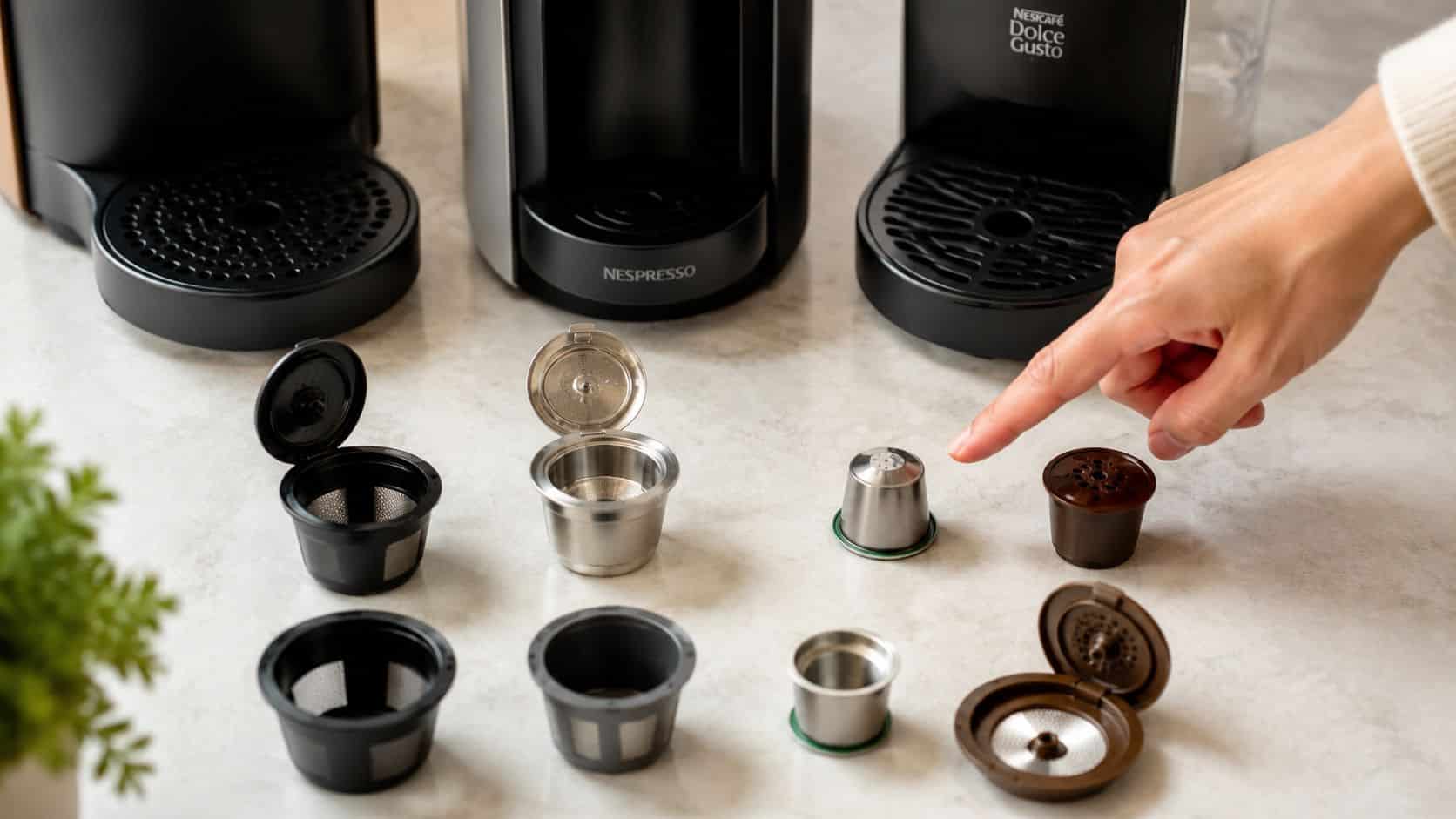
A quick visual helps if you're comparing capsule shapes and machine families:
Nespresso-style refillables belong in their own bucket
Nespresso refillables are not interchangeable with K-Cup style reusable pods, and they are less forgiving.
With these capsules, small changes in grind and flow resistance matter a lot more. A stainless refillable that works in one OriginalLine machine may still behave differently in another if the capsule shape, top seal, or outlet pattern is off. Listings that narrow compatibility to specific models are usually more trustworthy than listings that promise support across the whole Nespresso range.
Use a simple filter before you buy
Amazon listings get easier to sort once you ask the questions in the right order:
- Does the listing name my exact machine family or model line?
- Does the pod shape clearly match the chamber I'm using?
- Do the photos show how the lid and rim are built?
- Does the seller give any brew guidance, or just compatibility claims?
If the fit claim is vague, skip it. With reusable pods, compatibility is usually the difference between a solid daily brewer and a drawer full of stainless steel mistakes.
PureHQ vs Generic Pods A Head-to-Head Comparison
Cheap multi-packs look attractive on Amazon because they lower the risk at checkout. But reusable pods don't fail at checkout. They fail at 6:45 a.m. when your machine leaks and you're already late.
The most common objection in this category is simple: “Why pay more for a premium pod if a generic one looks the same?” Because they often don't behave the same once hot water, pressure, and repeated use enter the equation.
One machine-specific option in this category is PureHQ's stainless steel reusable pod, which the publisher positions for specific brewer families rather than broad universal use. That matters because fit claims are where many generic pods overpromise.
Where generic pods usually lose
Generic pods can work. Some do. The issue is inconsistency.
Common weak points include:
- Thin plastic hinges: They loosen or flex faster.
- Loose gasket fit: Water bypasses the coffee bed.
- Vague compatibility: The pod enters the chamber but doesn't brew cleanly.
- Inconsistent puncture interface: The brewer and pod don't meet cleanly cycle after cycle.
Side-by-side comparison
| Feature | PureHQ Pod | Generic Amazon Pod |
|---|---|---|
| Material | Stainless steel construction | Often plastic construction |
| Compatibility approach | Sold around specific brewer families | Often marketed with broad “universal” language |
| Lid design | Built around seal consistency | Often the first failure point |
| Leak resistance | Depends on correct use and brewer match, but engineered around lid integrity | More likely to vary from pod to pod |
| Long-term cleanup | Steel body usually rinses cleanly when maintained | Plastic mesh and hinges can become annoying to clean |
| Best fit for | Shoppers who know their machine model and want a pod matched to it | Shoppers taking a low-cost trial-and-error approach |
Buyer check: If your last pod leaked, don't assume all reusable pods leak. Assume the seal, fit, or machine match was wrong.
If you brew daily, paper liners can also make cleanup easier with some reusable K-Cup-style baskets, especially when oily dark roasts stick to mesh. A descaler also earns its place fast if you're troubleshooting weak flow and want to separate pod issues from machine scale.
Mastering Your Brew How to Use and Maintain Your Pod
A reusable pod can brew a solid cup, then turn your counter into a mess the next morning with the exact same coffee. In my experience, that usually comes down to setup, not luck. The machine, the grind, and the fill level have to work together, and brewer differences matter more here than Amazon listings usually admit.
Keurig-style brewers tend to punish overfilling and fine grinds faster because water flow is tighter and the pod chamber is less forgiving. Ninja systems and other pod-compatible machines can behave differently, especially around how firmly the pod seats and how fast water moves through the basket. If a pod “fits” but your brewer starts sputtering, dripping around the rim, or producing a weak cup, treat that as a brew-matching problem first.
Start with grind and dose
Reusable pods are sensitive to flow resistance. A grind that runs fine in one brewer can choke another, especially if the mesh is tighter or the machine already brews on the slower side.
A practical starting point works like this:
- Use a medium to medium-fine grind: If the cup is weak, go slightly finer.
- Fill below the rim: Many pods brew better with a little restraint.
- Leave headspace under the lid: The grounds should not press hard into the top when closed.
That last point matters. If the lid closes against a packed coffee bed, water has fewer paths through the grounds. The result is usually one of three problems. Slow brewing, overflow, or a flat-tasting cup.
Don't tamp like espresso
This is one of the most common user errors. Reusable pods are small, but they are not espresso baskets.
Use a light, level fill. If you press the coffee down hard, you increase resistance and force the brewer to work outside the conditions it was built for. That is why one person says a pod leaks and another says the same pod works fine. They are not really using it the same way.
Use the pod like a small drip basket with a lid, not a compacted puck.
If you want a solid day-to-day process, this reusable K-Cup tips guide covers the simple adjustments that fix most weak cups and messy cleanups.
Clean right away
Coffee oils dry quickly, especially on fine mesh and around the gasket. Once that residue builds up, flow gets less consistent and stale flavor shows up faster than many people expect.
Rinse the pod immediately after brewing. Open the lid fully. Clear the mesh from both sides if grounds are stuck, then let the pod dry before you snap it shut for storage. A quick rinse takes seconds. Scrubbing dried coffee paste out of the hinge and seal does not.
If performance drops with both reusable and disposable pods, check the brewer before blaming the capsule. Scale buildup often looks like a pod problem because it reduces flow and throws off extraction.
One side note for sellers in this category. If you compare margins across pod types, bundles, or accessory add-ons, tools that help you optimize your Amazon profit can make the math easier to sanity-check.
Calculating Your True Savings Cost and Waste Reduction
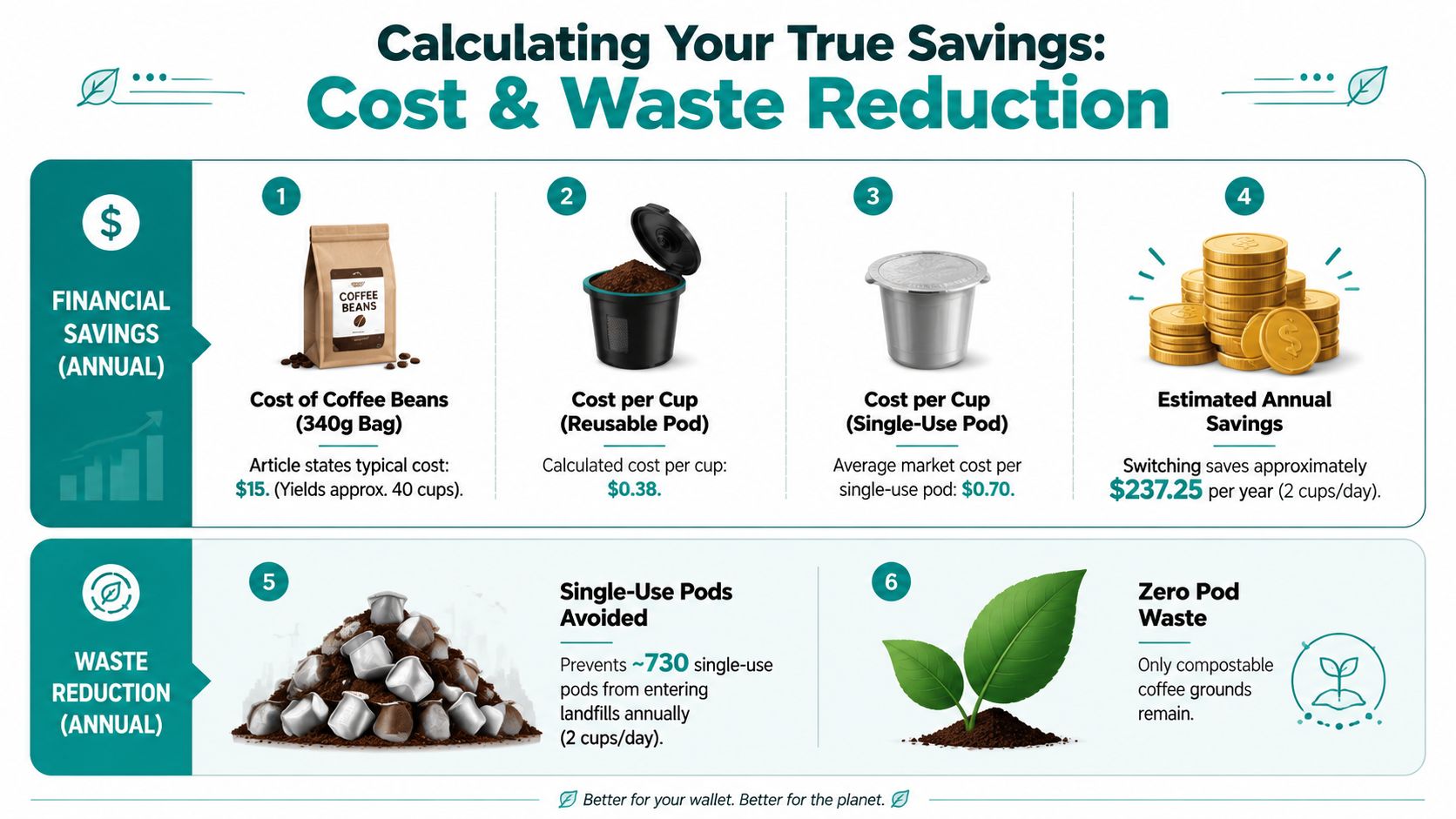
The case for reusable pods is still strong even without making up neat little savings formulas. You don't need invented math to see the appeal. You reuse one brewing vessel instead of tossing a single-use pod after each cup. That changes both buying habits and waste output over time.
What you can say with confidence
Reusable pods can reduce waste because the same pod can be used many times when you keep it clean and maintain the seal. That's the core trade. You give up some convenience and take on more process control.
The shopping interest is clearly there. Earlier Amazon search data showed that people are actively looking for alternatives in this category. If you want a broader practical overview of how reusable pods fit into everyday coffee routines, this guide to reusable coffee pods gives a useful product-category view.
The real cost question
Your actual savings depend on three things:
- What coffee you buy: Whole bean, pre-ground, supermarket, or local roaster.
- How often you brew: A weekend user and a daily office drinker won't see the same payoff.
- How many failed pods you buy first: Trial-and-error costs more than buying the correct fit once.
That last point matters. A cheap pod that leaks, clogs, or gets returned is not the budget option. It's the detour.
For sellers and operators who think in margin instead of just unit cost, tools that optimize your Amazon profit are useful because they make it easier to see how small product decisions affect long-term economics. The same mindset applies as a buyer. The cheapest pod isn't the cheapest if it never earns a place in your routine.
Waste reduction only counts if the pod stays in rotation
A reusable pod doesn't help much if it ends up in the back of a drawer after a week. The useful metric isn't “can this pod be reused?” It's “will this pod make coffee reliably enough that I keep using it?”
That's why compatibility deserves so much attention. Good fit keeps the pod in service. Bad fit sends you back to disposables.
Your Questions Answered and Your Next Step
You buy a reusable pod on Amazon, it drops into the brewer, and the first cup is watery, gritty, or leaking onto the drip tray. In my experience, that usually starts with a compatibility mistake, not bad coffee.
Why is my coffee weak
Start with the machine, not the beans. A pod that works in one Keurig family can underperform in another because the puncture pattern, water flow, and basket depth are different. Ninja brewers can be just as picky. If the pod is shallow or the lid geometry is off, water moves through too quickly and the cup tastes thin.
Grind size still matters. So does brew size. But if you are using a so-called universal pod, brewer mismatch is often the reason you keep chasing adjustments that never quite fix the cup.
Why am I getting grounds in my cup
Fine grounds usually point to one of three problems: the mesh is too coarse for your coffee, the pod is overfilled, or the lid is not closing squarely under brew pressure.
Cheap generic pods on Amazon often look identical in photos and behave very differently in the machine. I have tested pods that held a decent seal by hand but shifted once the brewer closed, which let fines slip past the rim. That is why exact brewer fit matters more than a broad compatibility claim.
Why does the pod fit but still leak
Because physical fit is only part of the job.
The pod also has to line up with the brewer's needle, seal against the chamber, and let water enter and exit at the rate that machine expects. Keurig owners run into this a lot. A pod may sit in the holder perfectly well and still fail once pressure builds. Ninja users see a similar issue with adapters and lids that look right but do not mate cleanly during brewing.
Should I trust Amazon listings that say universal
Usually, no. “Universal” is often shorthand for “close enough in several machines.” Close enough is how you end up with weak coffee, leaks, or a pod that works for three days and then gets shoved in a drawer.
The listings worth considering name specific machine families, show the lid and seal clearly, and explain fill level, grind type, and any brewer limitations. If you sell in this category, clear compatibility language does a lot of the heavy lifting. Brands that optimized my listings on Amazon usually make those fit details obvious before purchase, which cuts down on returns and confused reviews.
You do not need another pod that almost works. You need one built for your brewer.
Shop PureHQ Inc. if you want reusable coffee pods, liners, and maintenance accessories matched to specific brewer families instead of broad “universal” claims. That approach cuts the guesswork and gives you a better chance of finding a pod you will keep using.

