
Coffee Machine Care
Temperature Stability: The Secret to Better Coffee
May
You use the same beans, the same mug, and the same machine. One morning the cup tastes sweet and balanced. The next morning it comes out sharp, flat, or oddly bitter. It is common to blame the coffee.
Often, the actual problem is temperature stability.
A brewer doesn't need to be merely hot. It needs to stay controlled while water moves through the coffee. Small swings in heat can change what gets pulled from the grounds, and that changes what lands in your cup. Once you understand that, inconsistent coffee starts to look less mysterious and much more fixable.
Why Your Coffee Tastes Different Every Day
A common home coffee story goes like this. You finally dial in a cup you love, then try to repeat it the next day and get something completely different. Same scoop, same pod, same button. Different result.
That kind of inconsistency usually points to a variable you can't see. In many kitchens, that hidden variable is how steadily your brewer holds heat from the start of the cycle to the end.
Hot enough isn't the same as stable
Many people think temperature works like an on-off switch. If the machine gets water hot, the job is done. Brewing doesn't work that way. Water can start too cool, overshoot, dip, and recover, all within one cycle.
That matters because coffee extraction happens in sequence. Early water contact pulls one set of flavors. Later contact pulls others. If the temperature drifts during that short window, your cup can taste confused even when everything else stayed the same.
Stability matters more than a single headline number. A machine can reach the right heat and still brew inconsistently.
A useful way to think about this comes from outside coffee. A long-range temperature reconstruction published in Science found that Earth's global mean surface temperature ranged from 52°F to 97°F (11°C to 36°C) over 485 million years, with shifts often linked to atmospheric changes, as described in the Science study on deep-time global temperature. The scale is obviously different, but the lesson is familiar. A system can look stable for long stretches, yet small shifts can still have major effects.
Your brewer may be more sensitive than you think
Coffee machines are compact thermal systems. They heat water, move it through tubing, push it across coffee, and do all of that while sitting in a room that may be cold in the morning and warmer later in the day. Add mineral buildup, a partially clogged path, or a reusable pod packed a little too tightly, and stability gets even harder.
If you've been chasing better flavor by changing beans every week, it may help to first learn how to make coffee taste better by controlling the brew itself. The machine is often telling the story.
How Water Temperature Unlocks Coffee Flavor
Coffee extraction is a lot like baking. If the oven runs too cool, the center stays underdone. If it runs too hot, the outside finishes before the inside has a chance. A brewer does something similar to ground coffee, except the process happens in moments instead of minutes.
Different flavors come out at different moments
When water meets coffee grounds, it doesn't pull every flavor at once. Bright, sharp notes tend to show up quickly. Sweeter and rounder flavors follow. Heavier, harsher compounds arrive later if the brew keeps pushing.
That's why unstable heat creates messy cups. If water starts cool, the brew may pull more sour, thin flavors at first. If the machine then runs hotter later in the cycle, it can start dragging out bitter notes too. Instead of one clear profile, you get a cup that tastes both weak and rough.
Here's a practical way to read the cup:
- Sour and watery: the brew likely spent too much time on the under-extracted side.
- Dry and bitter: the brew likely pushed too far.
- Muddled or hollow: the temperature may have swung during the brew, so different parts of the cup extracted unevenly.
Stability has a technical meaning
In engineering, stability isn't just a casual word. Team Wavelength explains in its temperature controller application note that temperature stability is often specified as 3 times the standard deviation of error over time, and that this 3-sigma band covers 99.73% of the control interval. In plain language, a stable system keeps the load very close to the target almost all the time.
For coffee, that idea is useful even if your brewer doesn't publish a technical spec. You're looking for water delivery that behaves like a calm hand, not a twitchy one. A machine that surges and drops changes extraction chemistry while the coffee is still brewing.
Practical rule: The best-tasting cup usually comes from a machine that changes heat smoothly, not one that simply gets hot quickly.
Why ratio and temperature work together
Temperature stability won't rescue a brew that uses the wrong amount of coffee. But it does determine whether your chosen recipe performs the same way tomorrow as it did today. If you're adjusting dose and cup size, it helps to pair that with a solid understanding of water to coffee ratio, because recipe and thermal behavior work together.
A stable brewer gives your recipe a fair chance. An unstable brewer keeps moving the goalposts.
Not All Coffee Makers Are Created Equal
Two brewers can make drinkable coffee and still behave very differently with heat. That's why one machine seems dependable while another gives you a good cup only when everything lines up just right.
The difference usually comes from design. Some machines control heat tightly and recover smoothly. Others rely on simpler heating behavior, which can be more vulnerable to ambient conditions, mineral scale, and wear.
Why machine design changes the cup
Single-serve pod brewers often prioritize speed and convenience. Drip machines have to heat a larger water path and keep flow steady across a basket. Espresso machines work under tighter demands because small changes feel bigger in a concentrated shot.
That doesn't mean one category is always better than another. It means each category tends to have its own weak points.
Advanced Energy notes in its discussion of IEC thermal safety testing for products that appliances are tested under specified ambient and worst-case thermal conditions to prevent burn or fire risk. That's important, but it's not the same as promising stable brewing performance over years of daily use. A brewer can pass safety requirements and still drift in the cup as scale builds or parts age.
Brewer Temperature Stability Comparison
| Brewer Type | Typical Stability | Key Weakness | Improvement Focus |
|---|---|---|---|
| Basic single-serve pod brewer | Often more variable during short brew cycles | Scale in the water path, fast heating swings, pod packing sensitivity | Descaling, filtered water, proper pod fill |
| Drip coffee maker | Often steadier across larger batches, but can drift at startup or late in the cycle | Uneven heating, clogged spray head, warming plate side effects | Cleaning, preheating, basket and water-path maintenance |
| Higher-end espresso machine | Usually designed for tighter thermal control | Sensitive to maintenance neglect and scale | Routine care, water quality, warm-up habits |
| Premium controlled brewer | Better repeatability when components stay clean | Performance still drops when mineral buildup or blocked flow develops | Preventive maintenance and consistent accessories |
Reusable pods raise one important question
A common objection sounds like this: “If I use a reusable pod, won't that make temperature consistency worse?”
It can if the pod fits poorly, seals unevenly, or restricts flow. It doesn't have to if the pod is made well and matched to the brewer. Water needs a predictable path through the coffee bed. If a reusable pod leaks around the edge or packs grounds into an awkward shape, the machine's thermal behavior becomes harder to judge because flow and heat are now changing together.
That's one reason compatibility matters as much as material. A reusable pod should fit the machine cleanly, allow repeatable filling, and be easy to rinse fully so old oils don't interfere with the next brew.
A stable brew needs two things at once. The machine has to deliver steady heat, and the accessory has to let water move through the coffee in a repeatable way.
Putting Your Coffee Maker to the Test
You don't need a lab to learn whether your brewer runs steady. You need a simple method and a little patience.
The goal isn't to produce a perfect scientific paper. The goal is to build a rough brew profile so you can see whether your machine behaves like a flat line or a roller coaster.
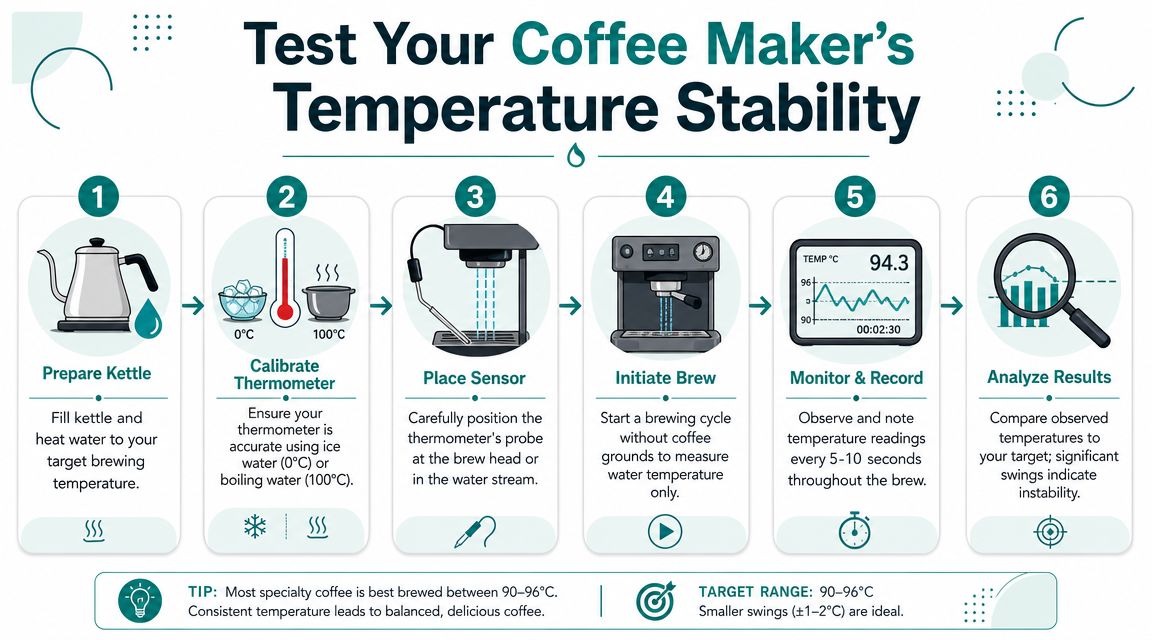
Method one with a kitchen thermometer
A basic digital kitchen thermometer can tell you a lot if you use it carefully.
- Run a water-only brew cycle so coffee grounds don't interfere with the reading.
- Catch the brew water in a cup and measure in short intervals during the cycle.
- Write down the pattern, not just one number. You're looking for spikes, dips, or a slow decline.
- Repeat the test another day at roughly the same room conditions.
If the readings bounce around a lot from one moment to the next, the machine may have trouble holding stable heat. If the machine starts very hot and then fades quickly, that can also explain why the first part of your cup tastes different from the last.
Method two with an infrared thermometer
An infrared thermometer is less direct because it reads surfaces, not the water itself. Even so, it can still help you compare one brew to another.
Use it to check the brew head area, the outside of the cup during dispensing, or the stream's landing zone. The absolute reading may not tell the whole story, but the pattern can. If one cycle looks smooth and the next looks erratic, you've learned something useful.
Track the pattern first. Precision matters less than consistency when you're diagnosing a home brewer.
NOAA reports in its global temperature overview that Earth's temperature has risen by about 2°F since 1850. Climate scientists learn from trends over time, not from one isolated reading. Your coffee maker works the same way. One snapshot can mislead you. A repeated pattern tells you what the machine is doing.
What to do with the result
If your brewer shows a jagged pattern, the next step usually isn't replacement. It's maintenance. Mineral buildup and restricted flow are common causes of unstable brew behavior in home machines, especially single-serve units. If you own a pod brewer, this guide on how to descale a Keurig gives you a practical starting point.
A simple before-and-after test often gives the clearest answer. Run a profile, clean the machine, then run it again.
Practical Steps for Better Temperature Stability
The good news is that temperature stability often improves when you fix ordinary maintenance issues. You don't need to turn your kitchen into a workshop. You need to remove the things that make heat control harder.
Start with the water path
Mineral scale acts like an unwanted layer between the heater and the water. It can also narrow internal passages, which changes how water moves and how the machine responds during a brew cycle. If your coffee has become less consistent over time, descaling is one of the first things worth doing.
Filtered water helps on the prevention side. It won't make a weak machine magical, but it can reduce the buildup that pushes performance off course.
A useful kitchen parallel is fermentation. In both coffee and yogurt, consistent process conditions shape the final result. If you're curious how controlled temperature affects another everyday food, this guide to achieving bakery-grade goat yogurt shows the same principle in a different form.
Five habits that improve consistency
Descale on a routine basis
Don't wait for the machine to taste terrible. If your brewer runs daily, buildup can subtly change heat transfer and flow before the problem becomes obvious in the cup.Use filtered water when possible
Cleaner input helps the heating system stay cleaner for longer. That gives you a better chance of keeping brew behavior repeatable.Preheat the machine and the mug
A water-only cycle warms internal parts and reduces the shock of cold surfaces. A warm mug also helps preserve what the brewer just achieved.Choose accessories that support repeatable flow
Reusable pods, carafe baskets, and liners should fit cleanly and rinse cleanly. If an accessory traps old grounds or warps under heat, it adds a new variable you don't need.Keep the brew head and outlet clean
Old coffee residue and partial clogs can change both water distribution and contact time.
Here's a visual walkthrough that pairs well with those habits:
Standard accessories versus more durable options
| Option | What usually happens over time | What to look for |
|---|---|---|
| Generic reusable pod | Fit can vary, cleanup can be uneven, flow may become less predictable | Match to your exact brewer model and check seal quality |
| Better-built stainless reusable pod | Holds shape well and is easier to clean thoroughly | Look for stable fit, repeatable fill, and easy rinsing |
| Untreated tap water | More likely to encourage scale depending on local water | Use filtration if your machine shows buildup quickly |
| Routine maintenance setup | More consistent brewing behavior over time | Pair descaling with regular rinsing and filter changes |
One practical option in this category is PureHQ Inc., which sells compatible reusable pods, filters, and descaling products for Keurig and Ninja systems. In this context, those products matter because they address the two everyday causes of unstable brewing at home: inconsistent accessory fit and mineral buildup.
The objection most people have
Some people worry that more maintenance means more hassle than it's worth. In practice, a neglected brewer creates its own hassle. You waste beans, chase recipes that aren't the problem, and never know whether the next cup will be good.
A short maintenance routine is easier than constant guesswork.
Take Control of Your Morning Brew
Good coffee doesn't come from luck. It comes from repeatable conditions, and temperature stability sits near the center of that.
When your cup changes from day to day, the issue often isn't your beans. It's the path the water took through the machine. If the brewer heats unevenly, drifts during the cycle, or struggles against scale and restricted flow, the cup will reflect that in sourness, bitterness, or a muddled finish.
What matters most
The big takeaway is simple:
- Stable heat supports repeatable extraction
- Maintenance protects that stability
- Well-matched accessories reduce extra variables
- A quick home test can reveal problems you can't taste clearly yet
You don't need perfect instrumentation to improve your coffee. You need to notice patterns, clean the machine, use better water, and remove weak links in the brewing setup. That's how you turn a frustrating brewer into a dependable one.
Better coffee starts when you stop asking only “How hot is it?” and start asking “How steady is it?”
If your brewer has been giving you random results, this is a fixable problem. Treat temperature stability like part of the recipe, not background noise, and your cup gets easier to trust.
If you want more consistent coffee from your Keurig, Ninja, or home brewer, shop the reusable pods, water filters, and descaling supplies from PureHQ Inc.. The right maintenance tools and compatible accessories can help you brew with fewer variables and better repeatability every morning.

