
Coffee Machine Care
Filter for Keurig Classic: A Complete 2026 Guide
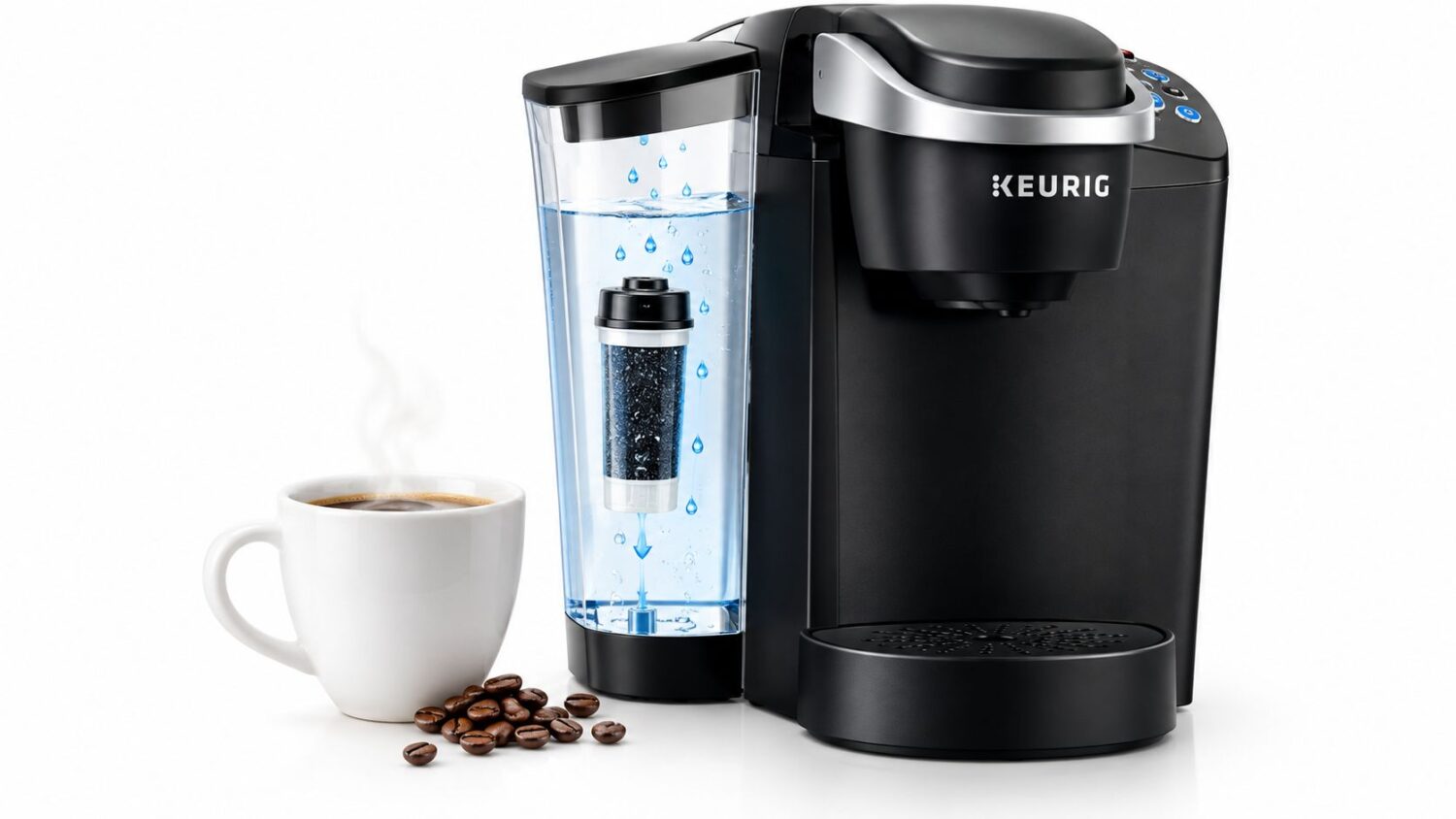
Oct
You pour water into your Keurig K-Classic, press brew, and get coffee with a faint chlorine note, a metallic edge, or less aroma than yesterday. Before blaming the pod, inspect the reservoir. A tired carbon cartridge can affect taste, while mineral scale can restrict flow and interfere with heating. Those are different faults, and they need different fixes.
A practical filter for Keurig Classic should improve taste and odor without being mistaken for a descaler or a drinking-water purifier. The right cartridge must fit the reservoir holder, carry a meaningful reduction claim, and follow a replacement schedule based on how much you brew.
Why Your Keurig Classic Coffee Suddenly Tastes Off
The first cup usually gives you the clue. Your familiar pod tastes flat, the water smells faintly chlorinated, or the finish has a hard mineral character. The brewer still turns on, so owners often swap pods or assume the machine is failing. I check the water path first.
A reservoir filter primarily addresses taste and odor. Activated carbon can reduce chlorine-related notes and other compounds that make coffee smell dull. The cartridge doesn't remove every dissolved mineral, and it won't undo deposits that already formed inside the brewer. NSF explains that Standard 42 covers aesthetic effects such as chlorine, taste, and odor, while Standard 53 covers contaminants associated with health effects.
Read the symptoms correctly
A sudden flavor change usually points toward the water entering the brew system. An exhausted cartridge, stale reservoir water, or untreated tap-water odor can all make a good pod taste wrong. If the reservoir looks cloudy, clean the tank and inspect the holder rather than assuming the coffee itself changed.
Slower output tells a different story. Mineral deposits can form on heated internal surfaces when calcium and magnesium bicarbonates precipitate as calcium carbonate. That buildup can reduce heat-transfer effectiveness and contribute to less consistent extraction temperature, even when the machine still completes a brew. This peer-reviewed coffee-water review explains the relationship between water hardness, heating, and scale formation.
Practical rule: Taste and odor problems point first to filtration. Slower flow, inconsistent heat, and visible white deposits point toward descaling.
Remove the reservoir filter before washing the tank. Keurig's official K55/K-Classic care guide separates those jobs and directs owners to reinstall the filter only after rinsing and refilling the reservoir. That simple order prevents you from cleaning around an old cartridge and then treating it as fresh.
How a Reservoir Carbon Filter Works
A K-Classic reservoir cartridge uses activated carbon to improve water taste and odor. Carbon has a highly porous internal surface. As water passes through the granules, some compounds adhere to that surface through adsorption. The cartridge does not neutralize every substance, and it does not convert hard water into soft water.
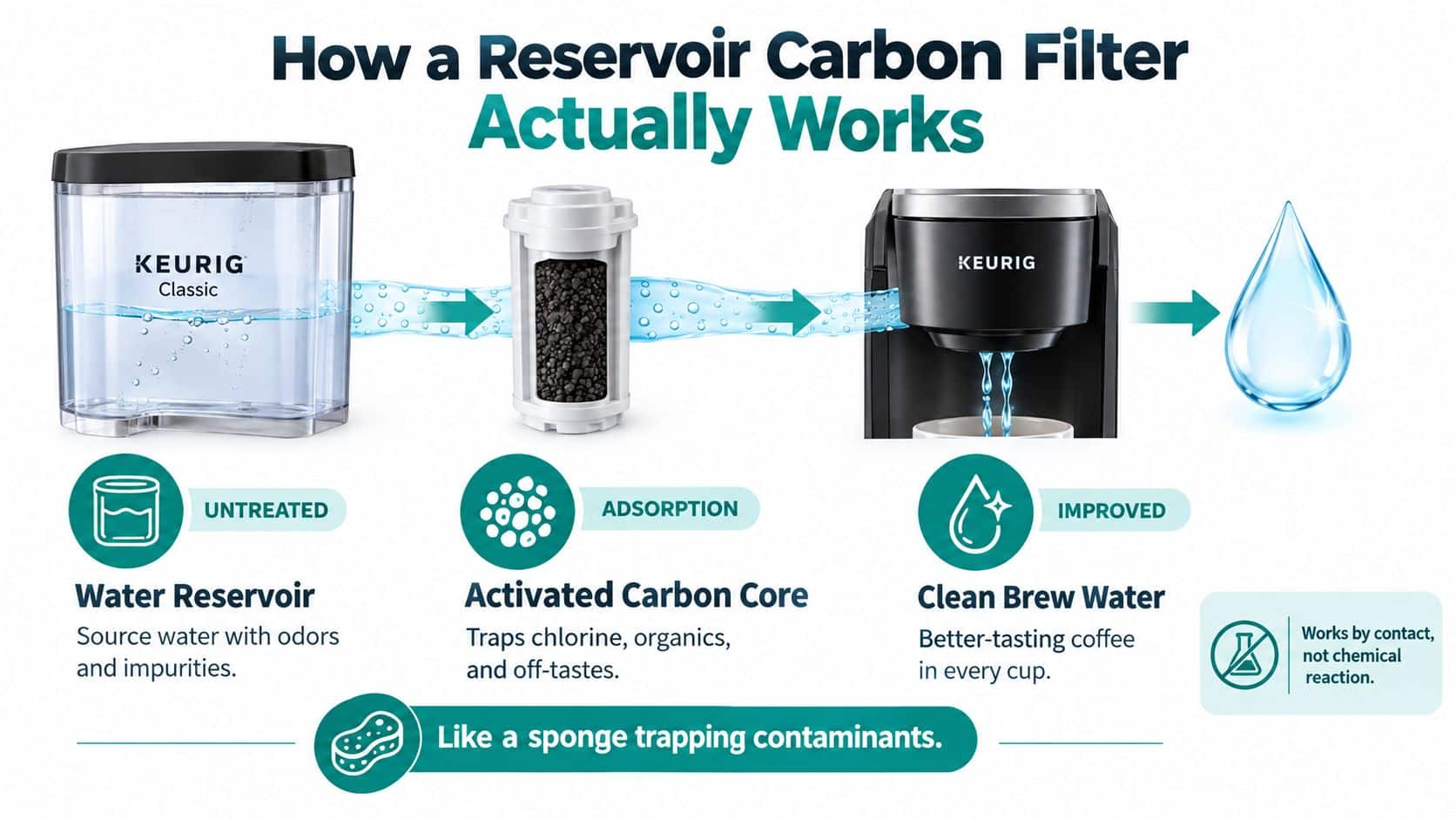
The filtration path is straightforward:
- Water enters the reservoir holder. Tap water may contain chlorine taste, odor, and other aesthetic impurities.
- Water contacts activated carbon. As water moves through the cartridge, the media holds some compounds on its surface.
- Filtered water reaches the brewer. Coffee may taste cleaner because the incoming water carries fewer compounds that interfere with its aroma.
For a closer explanation of carbon media in coffee equipment, read this guide to coffee charcoal filters.
What the cartridge can and can't claim
Choose a cartridge with a specific certification and reduction claim. The word “compatible” only describes fit. NSF/ANSI 42 addresses aesthetic effects such as chlorine, taste, and odor. It does not automatically mean the cartridge reduces hardness, chloramine, metals, or every other substance in your water. The packaging must identify the relevant reduction claim.
NSF/ANSI 53 covers claims involving contaminants associated with health effects. A K-Classic cartridge carrying a Standard 42 claim should not be presented as a general-purpose purifier. As the NSF article linked above notes, residential treatment claims are voluntary. Check the individual cartridge's certification, carbon media, rated capacity, and replacement instructions.
Carbon filtration also leaves the calcium and magnesium responsible for most coffee-machine scale. Use a reservoir carbon cartridge for taste and odor control. Use a genuine hardness-reduction system or descale the brewer when mineral removal is the goal. A filter improves incoming water. Descaling removes deposits that have already formed inside the machine.
Which Filters Fit the Keurig Classic
A K-Classic uses a filter holder in the removable water reservoir. It does not take a cartridge inside the pod assembly. Open the tank and look for the handled holder, then match the replacement cartridge to its shape and handle configuration. Correct fit is only the first test. The cartridge must remain seated and force water through the carbon media.
The Keurig-branded starter kit is the simplest match. It includes the intended holder setup and cartridges associated with this brewer family. Compatible third-party cartridges can work, but fit varies between products and batches. A loose cartridge can let water bypass the media. One that fits too tightly makes removal and replacement unnecessarily difficult.
If you cannot identify the holder, use this Keurig water filter location guide to distinguish it from the reservoir intake.
Keurig Classic reservoir filter comparison
| Cartridge Type | Reservoir Fit | Certified Media | Rated Capacity | Replacement Interval | Approx. Cost |
|---|---|---|---|---|---|
| Keurig-branded starter kit | Designed for the matching Keurig holder | Check the package for its carbon and certification claims | Follow the package rating | Follow the manufacturer schedule and workload | Usually higher than generic multipacks |
| Compatible premium replacement | Must match the K-Classic holder and handle | Choose activated carbon with a stated claim | Verify the cartridge rating before purchase | Use the stated capacity or earlier if taste declines | Varies by pack size |
| Generic universal cartridge | Fit can vary and may be loose | Claims may be unclear or absent | Often requires verification | Avoid guessing when no rating is provided | Often lower per cartridge |
Price alone does not show value. Compare fit plus verified claim plus rated capacity, rather than the number printed on the package. Filter manufacturers and the EPA recommend using only a compatible cartridge and tracking time or gallons when the brewer has no replacement indicator. Follow the cartridge label for its stated capacity, and replace it sooner if taste or odor returns.
The leak and fit objection
A reservoir cartridge does not normally leak like a pressurized plumbing fitting. The usual fault is a loose cartridge or holder that fails to sit securely. That points to a compatibility problem, not proof that every third-party filter is unsafe.
Check the holder model, insert the cartridge evenly, and confirm that the assembly sits firmly in the reservoir. If it still wobbles after proper installation, stop using it and choose a cartridge designed for the K-Classic holder. A secure fit matters because bypassed water receives less contact with the filter media.
Installing the Filter Without the Usual Mistakes
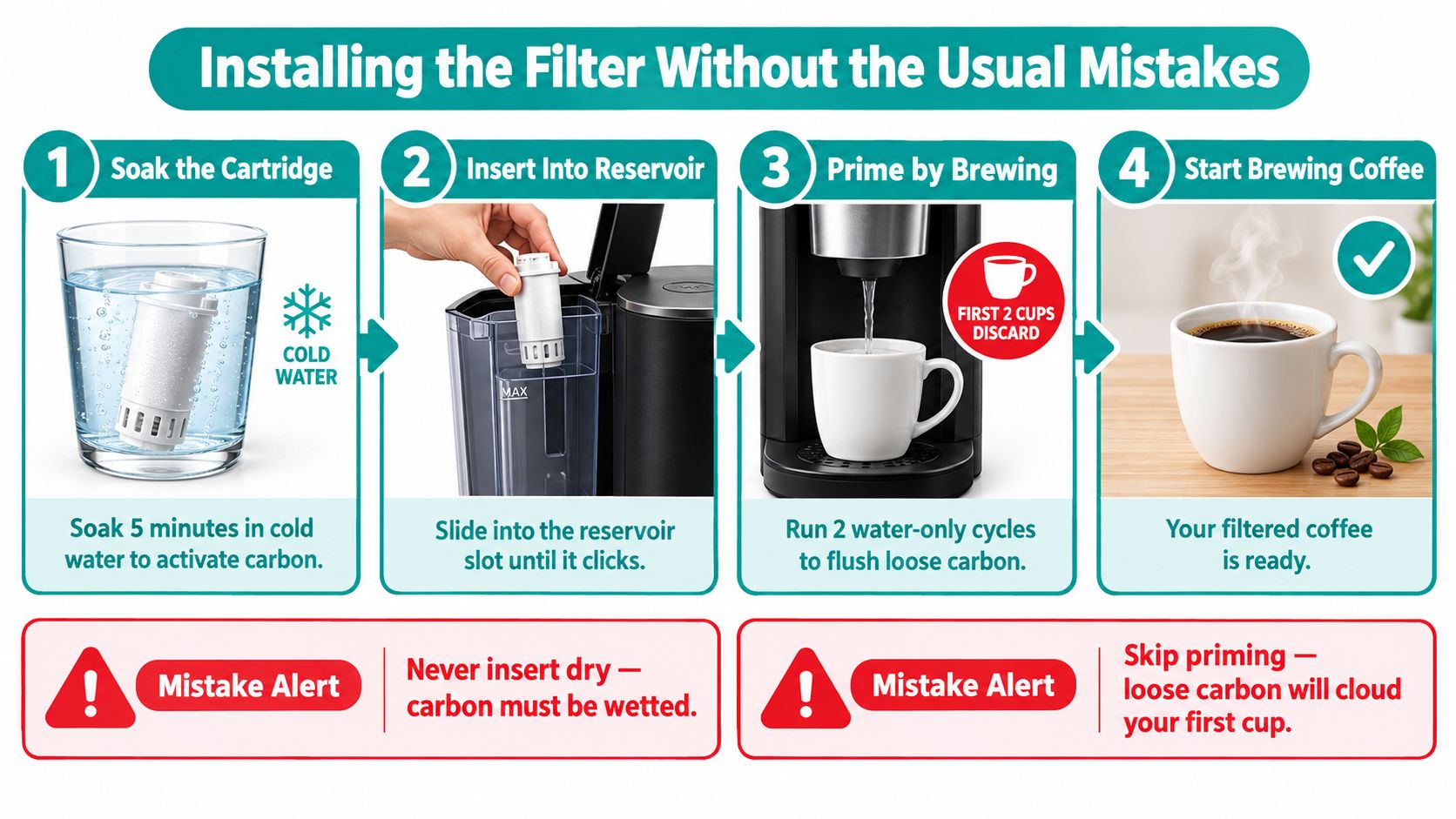
Most installation failures happen before the cartridge enters the machine. Owners insert a dry filter, skip rinsing, or leave the cartridge in place while scrubbing the reservoir. The fix is simple: prepare the cartridge, seat it correctly, flush it, and keep it out of the tank during cleaning.
Prepare the cartridge
Soak the new cartridge in cold water for five minutes, then rinse it thoroughly under cool water. The soak wets the carbon and helps remove loose carbon dust before the cartridge enters the holder. Don't install it dry.
Place the cartridge in the lower part of the holder, keep it level, and close the handle until it snaps securely. Then put the complete assembly into the reservoir slot. The holder belongs in the reservoir, not in the pod holder or brew head.
Refill with cold water to the MAX FILL line. EPA guidance says hot water can damage a filter, so filter cold water before the brewer heats it.
Avoid the cleaning mistake
Remove the filter assembly before cleaning the tank. Wash and rinse the reservoir separately, fill it to the MAX FILL line, and reinstall the filter only after the tank is clean. Keurig's official care guide gives this sequence for the K55/K-Classic setup.
Run water-only cycles after installation to flush loose carbon before brewing coffee. The infographic recommends discarding the first two water-only cups, which is a sensible way to clear residual dust and confirm that flow remains normal.
If the brewer slows immediately after replacement, remove the cartridge and check that it was soaked, rinsed, and seated flat. Black specks usually indicate loose carbon that needs more rinsing, not a failed brewer.
Replacement Timing That Matches How You Brew
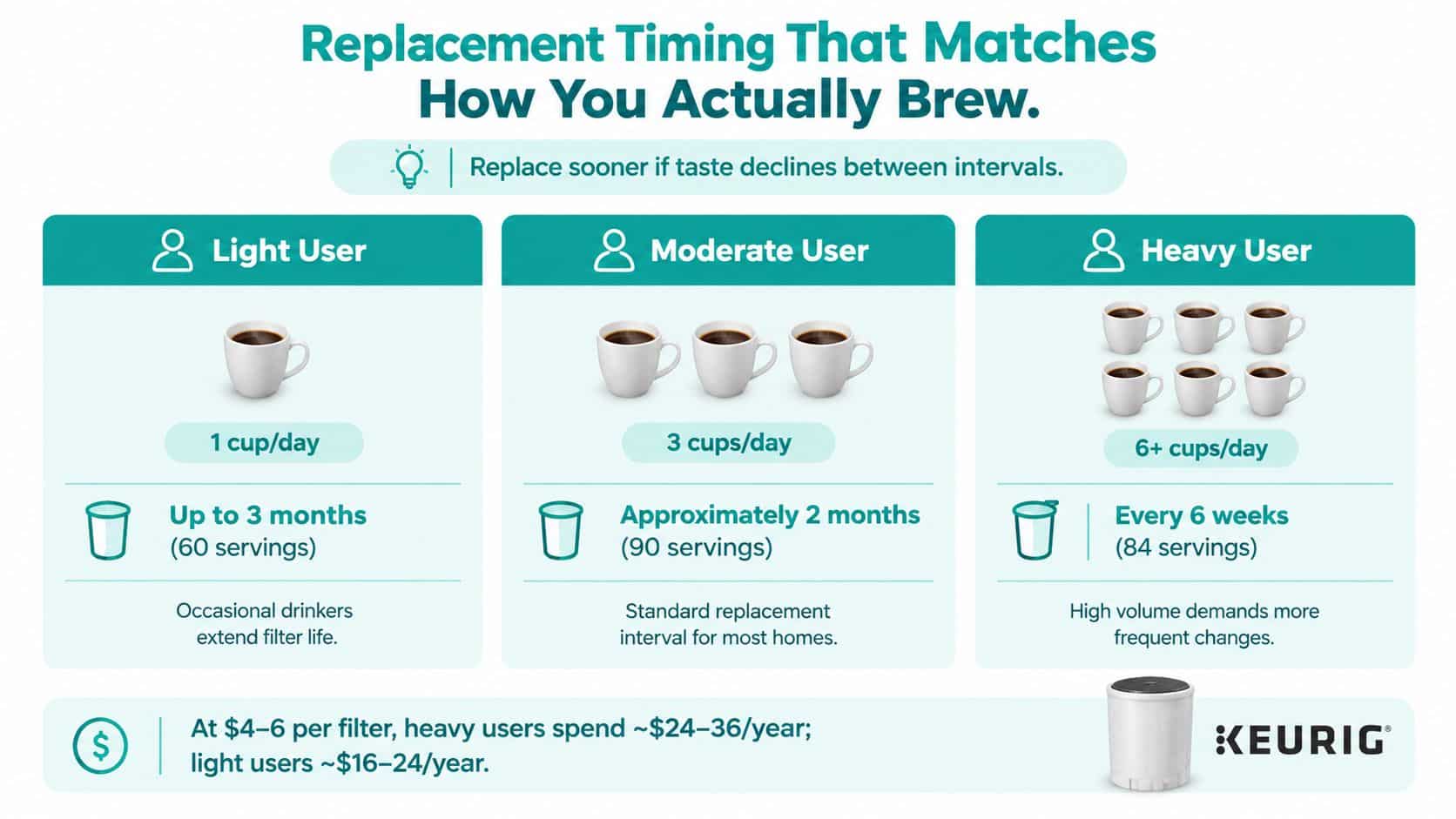
A K-Classic used once a day and one serving a family all day do not load their filters at the same rate. Keurig's familiar guidance is two months or roughly 60 reservoir refills, whichever comes first. Follow that limit, then adjust your reminders to the brewer's workload.
Match the schedule to your routine
| K-Classic workload | What to track | Practical replacement approach |
|---|---|---|
| One cup daily | Brew days and noticeable taste changes | Track the calendar and refill count, since the calendar interval may arrive first |
| Family brewing six cups daily | Reservoir refills and cup count | Expect to reach the usage limit much sooner than a single-cup household |
| Busy office breakroom | Daily refills and shared responsibility | Assign a maintenance owner and replace by capacity, not memory |
The refill limit matters more than a generic calendar reminder. A low-volume home may take longer to reach that threshold, while an office can use the cartridge's capacity quickly. EPA explains that activated-carbon media has a defined treatment capacity and can become clogged or ineffective after filtering its rated amount of water.
Consumer Reports also identifies a hygiene reason to avoid leaving a neglected cartridge in service indefinitely: its guidance on water-filter hygiene supports replacing filters on schedule to help limit bacterial buildup. A full cup does not prove that the cartridge remains sanitary or effective.
Write the installation date and approximate workload on the holder or a maintenance card. Replace the cartridge when it reaches the specified refill limit, or sooner if coffee tastes flat, the water develops an odor, or flow changes. A reservoir filter controls taste and odor. It does not remove mineral scale, so pair replacement with a separate descaling routine when hard-water deposits are the problem.
Why a Filter Will Not Fix Hard Water Scale
A carbon cartridge improves the water entering the K-Classic, but it generally leaves calcium and magnesium largely unchanged. When hard water heats, those minerals can form calcium carbonate deposits on internal thermal surfaces. The result can include restricted flow, weaker heat transfer, and less consistent extraction.
A coffee-water review identifies approximately 50 to 175 mg/L as CaCO3 as a broad reference range for filter coffee, while also noting that carbon filtration often doesn't materially reduce hardness. Test your source water instead of guessing from taste.
Use two separate maintenance tools
A reservoir filter addresses chlorine, odor, and other aesthetic concerns. Descaling addresses accumulated mineral deposits inside the brewer. Neither task replaces the other.
- Soft municipal water may need a reservoir cartridge mainly for flavor, followed by routine cleaning.
- Harder water needs both a cartridge for taste and a separate descaling routine.
- Persistent white deposits, slower brewing, or inconsistent temperature justify testing hardness and reviewing your descaling interval.
For a plain-language overview of hard water problems, focus on the mineral symptoms rather than assuming a taste filter will solve the machine's internal buildup. Then follow a dedicated guide to descaling a Keurig for the cleaning procedure appropriate to your brewer.
Don't buy marketing that calls a standard carbon cartridge “scale protection” unless the product provides a specific, credible hardness-reduction claim. A normal reservoir filter can make coffee taste cleaner while scale continues to accumulate.
A Complete K-Classic Maintenance Routine
Start by testing your source-water hardness. The result tells you whether the reservoir cartridge will mainly serve taste and odor control or whether you also need a disciplined descaling plan.
Use a simple cadence
- Weekly: Empty stagnant water, rinse the reservoir, and check the holder for residue.
- Monthly: Inspect the cartridge's installation date, taste the brewed water, and check whether the holder still sits firmly.
- By workload: Replace the cartridge when it reaches its rated capacity or when taste declines, following the manufacturer's schedule.
- Every three to six months: Descale according to water hardness and machine condition. Harder water and visible deposits justify the shorter end of that range.
- As needed: Use a reusable K-Cup when you want to reduce dependence on individually discarded single-use pods.
A reusable pod changes the coffee format, not the water-maintenance requirement. Keep the reservoir filter and pod accessory as separate decisions. The filter manages incoming taste and odor, while descaling removes mineral buildup that has already formed.
PureHQ Inc. offers compatible reservoir filters, reusable K-Cups, and universal descaling products, so you can assemble those parts of the routine from one coffee-accessory range. Choose based on your K-Classic holder, water hardness, and actual brewing volume rather than buying a bundle you won't use.
Quick Answers and Where to Shop
Are K-Classic and Keurig 2.0 filters interchangeable?
Don't assume they are. Match the cartridge and holder to the exact reservoir design, handle style, and compatibility statement. A cartridge that fits one Keurig family can sit poorly in another.
Do I need a reservoir filter if I use bottled or faucet-filtered water?
Not automatically. If your water already has acceptable taste and odor, the cartridge may add little value. It still doesn't remove the need to manage scale, and bottled or filtered water shouldn't be treated as proof that your machine has no mineral deposits.
How can I tell whether a third-party cartridge is NSF-tested?
Look for the specific NSF/ANSI standard, the contaminant or aesthetic claim, the certified product listing, the media description, and the rated capacity. “NSF tested” without a standard or claim tells you very little. Standard 42 supports aesthetic claims, while Standard 53 addresses health-effect contaminant claims.
What if coffee still tastes off after a fresh cartridge?
Clean and rinse the reservoir, flush the new cartridge with water-only cycles, check the pod holder, and assess scale. If flow is slow or the brewer heats inconsistently, descaling is the next step. If the water itself has a persistent odor or quality concern, use appropriate water testing or treatment rather than relying on a coffee-machine cartridge.
The core rule is simple: filtration improves taste, descaling protects the machine, and workload determines replacement timing. Treat those as separate maintenance tasks and your K-Classic will be easier to troubleshoot.
PureHQ Inc. offers K-Classic compatible reservoir filters, reusable K-Cup accessories, and descaling supplies for a scheduled maintenance routine. Visit PureHQ Inc. to choose the filter and maintenance accessories that match your brewer, water conditions, and brewing workload.

