
Coffee Machine Care
Reusable K Cup BPA Free: Safety and Buying Guide
Oct
A hot-water test reported particle release from polypropylene rising from approximately 0.6 million to 55 million particles per liter as water temperature increased from 25°C to 95°C. That result concerns particle shedding, not BPA, and it doesn't prove that every reusable pod creates the same exposure or a demonstrated health risk. It does expose the weakness in treating “BPA-free” as a complete safety answer.
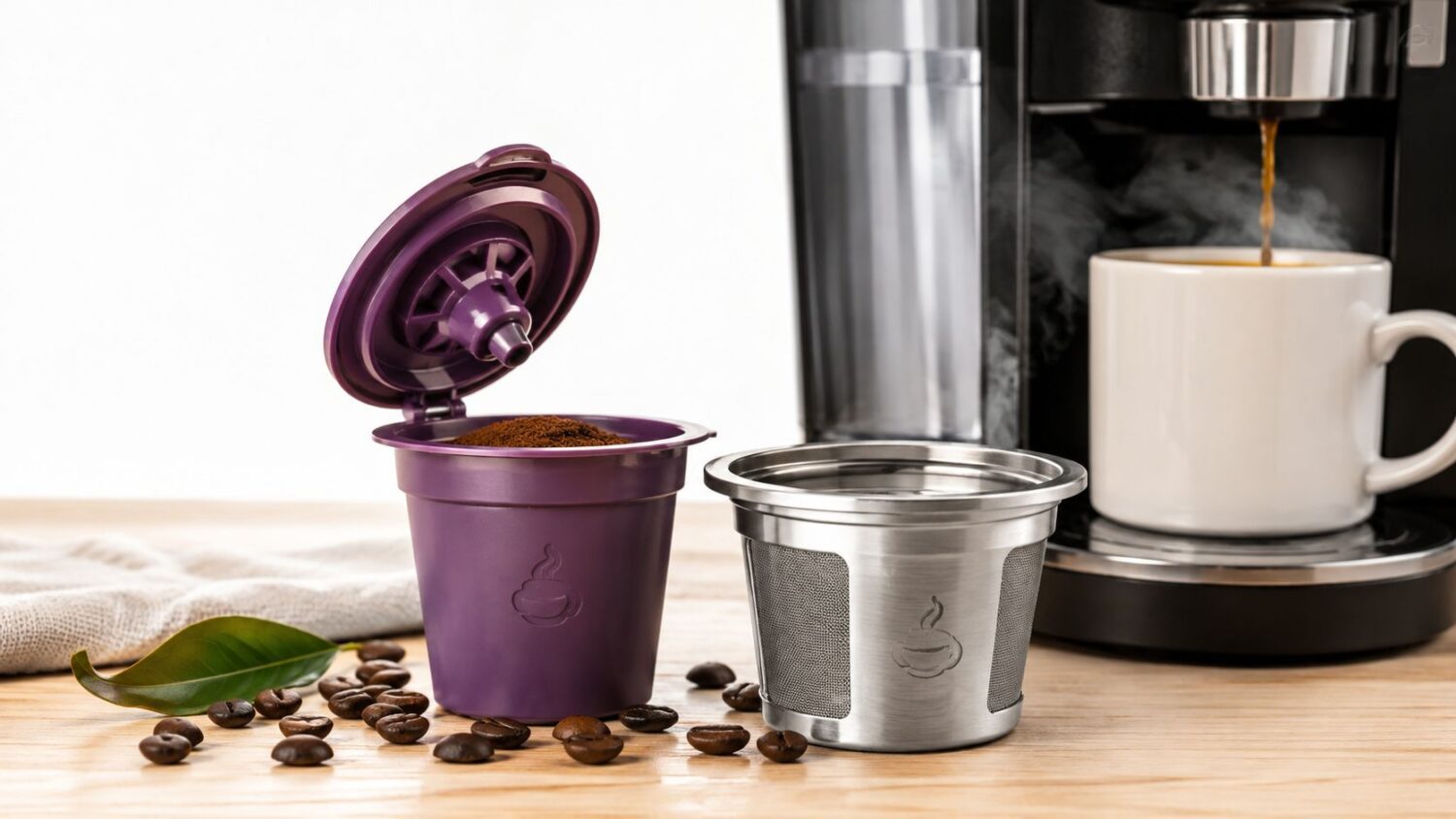
A reusable K-Cup can save disposable packaging, give you control over your coffee, and work reliably for years. It can also leak, fit poorly, retain coffee oils, or use a plastic whose material and heat guidance are unclear. The practical question isn't only whether a pod says BPA-free. You need to know what touches the coffee, how the pod handles repeated hot-water contact, whether it fits your brewer, and whether you'll maintain it properly.
The Hidden Reality Behind BPA Free Labels
The polypropylene result is easy to misunderstand. The cited experiment measured particles in water after hot exposure, not BPA migration, and it didn't establish that every polypropylene reusable pod behaves identically. Still, the temperature change provides a useful warning for anyone shopping for a reusable K-Cup BPA-free product: hot brewing places greater demands on materials than cold storage does. The experimental discussion of particle release from coffee-pod materials explains why temperature deserves attention.
“BPA-free” means that intentionally used bisphenol A isn't present in the relevant plastic component. It doesn't mean plastic-free, chemical-free, or automatically suitable for repeated hot-food contact. It also doesn't tell you whether the pod will resist warping, retain odors, or keep its seal after regular brewing.
Why heat changes the buying decision
A pod sits in a hot, wet environment, then gets exposed to coffee oils and repeated cleaning. A smooth stainless-steel basket limits polymer contact with hot coffee, while a plastic pod requires clearer information about its resin, temperature range, and intended food-contact use. A generic declaration that says only “BPA-free” leaves important questions unanswered.
The same principle applies to household cleaning. If you're trying to reduce unnecessary chemical exposure across your kitchen routine, a practical guide to eco home cleaners can help you assess products by ingredients and use rather than by broad marketing language. The pod deserves that same level of scrutiny.
Practical rule: Treat BPA-free as one screening criterion, not as a complete product-safety certification.
What actually matters
Look for a clearly identified material, food-contact suitability for hot use, cleaning instructions, and a stated compatibility list. A manufacturer that won't identify the pod material or explain its temperature guidance gives you little basis for judging repeated brewing.
You should also separate particle shedding from chemical migration. They aren't the same measurement, and evidence about one doesn't automatically prove the other. For a closer look at how plastic filtration and coffee preparation overlap, see this coffee plastic filter guide.
The safer decision is therefore practical rather than absolute. Choose stainless steel when minimizing hot-plastic contact matters most. If you choose plastic, select a product with transparent food-contact information, inspect it regularly, and replace it when heat or cleaning has visibly degraded the material.
Decoding Food Contact Safety and Materials
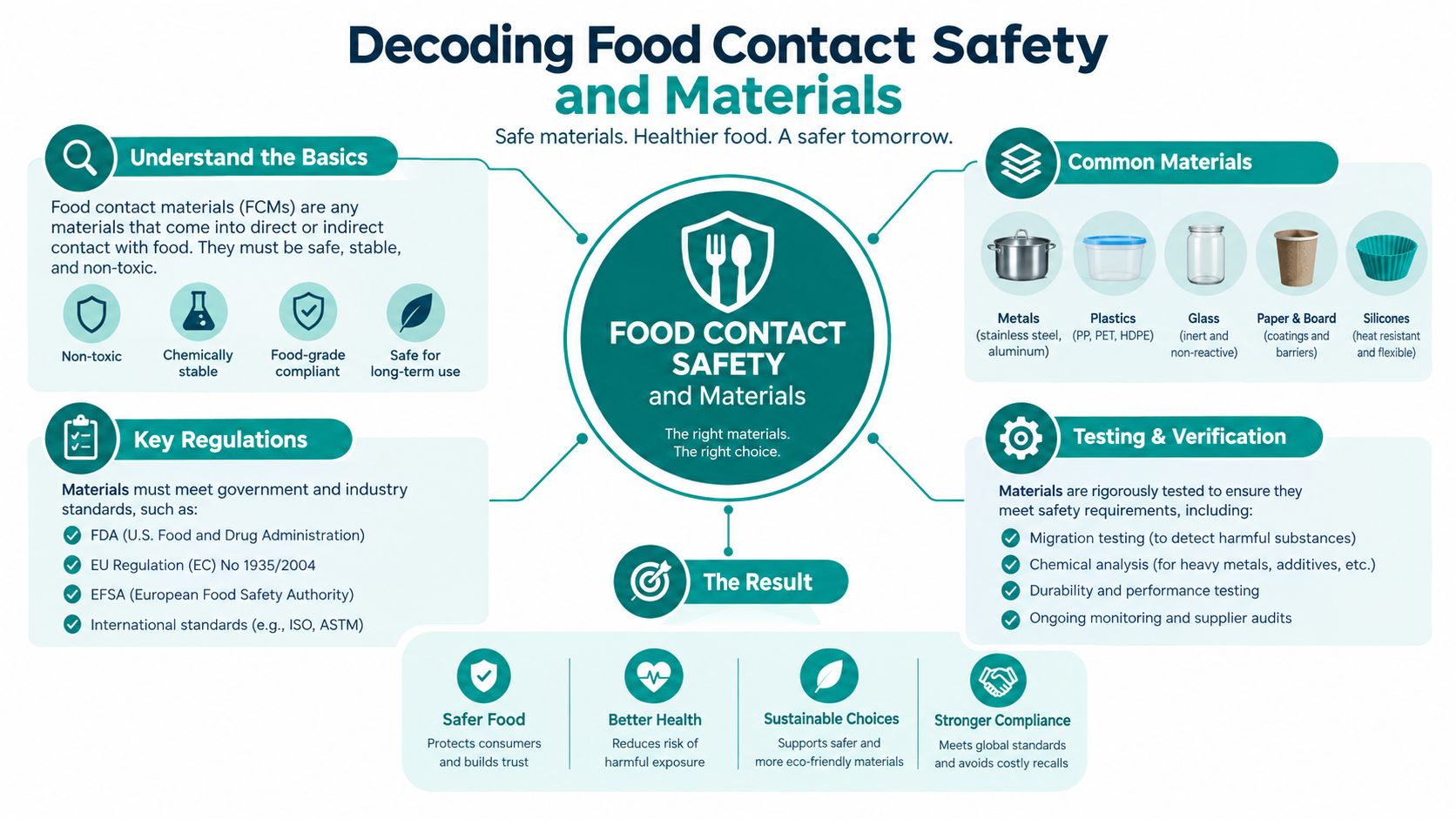
The U.S. Food and Drug Administration explains that measurable migration from food-contact packaging can occur and evaluates materials according to expected migration, packaging components, intended use, and cumulative exposure. Its current position supports the safety of BPA for approved uses at the levels occurring in food. That context matters because BPA-free labeling doesn't describe a pod's entire chemical composition, heat resistance, or brewer suitability. FDA's consumer explanation of BPA in food-contact applications provides the relevant regulatory framework.
Read the label as a starting point
A useful product description should identify whether the basket uses stainless steel, polypropylene, nylon, Tritan, or another specified material. It should also explain whether that material is intended for repeated food contact at high temperatures. “BPA-free” tells you what the product claims not to contain, but it doesn't automatically resolve questions about other additives or substitute bisphenols.
Alternatives such as BPS and BPF are less studied, so BPA-free shouldn't be interpreted as chemical-free or proven safer in every respect. That doesn't make every plastic pod unsuitable. It means the label needs supporting information.
Ask four direct questions before buying:
- What is the pod made from? A named material is more useful than an unspecified plastic label.
- Is it rated for repeated hot contact? Brewing conditions differ from ordinary food storage.
- What documentation exists? Look for food-contact compliance or testing information tied to the actual product.
- What cleaning limits apply? Instructions should address heat, abrasives, dishwashers, and replacement.
Stainless steel and plastic serve different priorities
A stainless-steel filter basket minimizes polymer contact with hot coffee and generally offers a durable surface for repeated use. It still has parts to inspect, including the mesh, gasket, and any polymer lid. A food-contact-rated plastic basket may be lighter and less expensive, but its performance depends more heavily on resin selection, heat stability, and condition over time.
FDA migration guidance uses time and temperature to simulate intended food-contact conditions. That logic applies directly to reusable pods. A material declaration designed for room-temperature storage doesn't automatically answer what happens during repeated hot-water brewing.
The useful question isn't “Is this BPA-free?” It is “What material is exposed to hot coffee, under what conditions, and what evidence supports that use?”
Don't use an unknown pod in a microwave, and don't assume a recycling code explains the full safety profile. Choose transparent documentation, follow the manufacturer's temperature instructions, and discontinue any pod that develops damage or a persistent smell.
Comparing Premium Stainless Steel and Standard Plastic Pods
The premium-versus-generic choice isn't only about price. It affects the amount of polymer that contacts hot coffee, how easily you can inspect the filter, and how much patience you'll need when the brew starts tasting weak. Stainless steel offers a straightforward material advantage, but it doesn't excuse poor lid design or an incompatible shape.
A plastic pod can work well when its material is clearly specified and intended for high-temperature food contact. It may also be easier to handle and less expensive to replace. The trade-off is that you need to monitor the basket for clouding, warping, cracks, and retained odors.
| Feature | Premium Stainless Steel Pod | Standard BPA-Free Plastic Pod |
|---|---|---|
| Hot-coffee contact | The basket can minimize direct polymer contact | The plastic basket contacts hot coffee during brewing |
| Material transparency | Stainless steel is easy to identify, though seals and lids still need review | The resin and heat suitability should be explicitly documented |
| Durability | Resists ordinary staining and warping when properly maintained | Can degrade, cloud, warp, or retain odors over time |
| Cleaning | Mesh and gaskets need thorough rinsing | Smooth surfaces can be easy to rinse, but scratches and buildup complicate sanitation |
| Brew performance | Fine mesh can produce a clean cup when the grind suits it | Performance depends on mesh design, seal quality, and material stability |
| Best fit | Users prioritizing low polymer contact and long-term inspection | Users prioritizing lighter weight or a lower initial commitment |
Premium doesn't mean maintenance-free
A stainless-steel basket can still produce a thin cup if you use an unsuitable grind, overfill the filter, or leave the lid poorly seated. Fine mesh can also clog when coffee is too finely ground. The material solves one concern, not every extraction problem.
Plastic isn't automatically a failure either. A clearly identified, food-contact-rated plastic pod can be a reasonable choice when you inspect it and follow the cleaning guidance. The weak option is the pod that makes broad safety claims while withholding material details, fit information, or replacement guidance.
Coffee quality also starts with the grounds. If you're choosing beans with a focus on flavor and ingredient transparency, you can browse natural coffee for metabolism support, then adjust the grind and fill level to the pod rather than forcing the pod to accommodate an unsuitable grind.
A practical decision
Choose stainless steel if you want to minimize plastic in the hot path, prefer a more inspectable basket, and expect frequent use. Choose BPA-free plastic if the product provides explicit food-contact information, fits your brewer, and meets your cleaning and durability expectations.
Either design needs a sound gasket and lid. A premium basket with a loose seal still creates bypass flow, weak coffee, and leaks. The right purchase combines material clarity, mechanical fit, filter design, and maintenance access.
Solving Compatibility and Leaking Issues
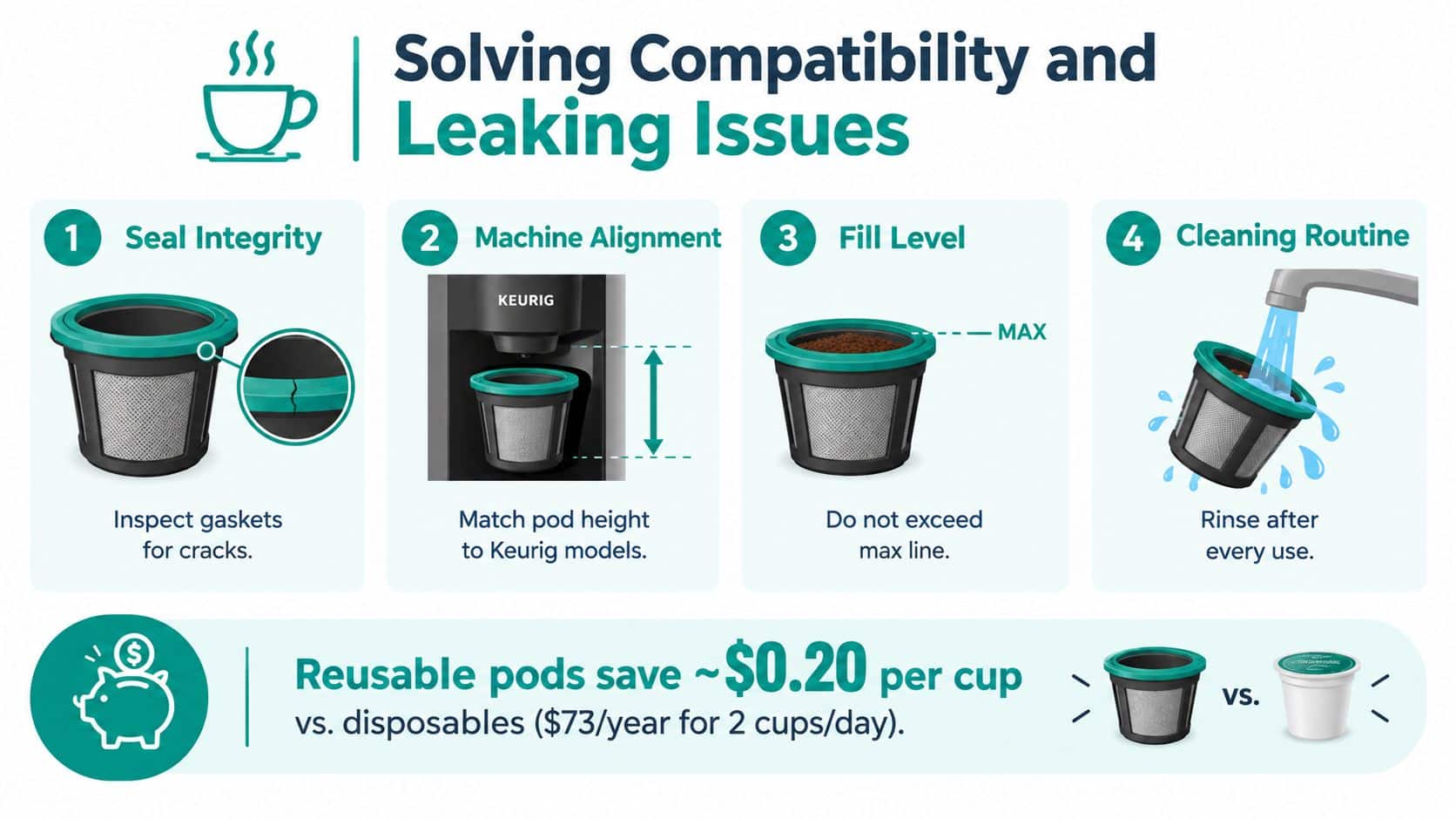
A reusable pod can be cup-shaped and still fail inside your brewer. The rim, lid height, needle clearance, holder interface, and adapter arrangement all determine whether the machine closes and pierces correctly. Keurig's official My K-Cup Universal Reusable Coffee Filter listing identifies a reusable filter, but it doesn't establish that every third-party pod fits every Keurig model.
Match the pod to the brewer
Start with the exact machine family, not a vague “Keurig compatible” claim. Check whether you own a K-Classic, K-Slim, K-Supreme, or K-Duo, and verify whether the product listing distinguishes single-needle and MultiStream designs. Ninja DualBrew owners should also confirm that the pod is designed for their specific brewer arrangement.
A pod may require removal of the original holder or an adapter. If you leave a holder in place when the reusable filter requires its removal, the lid may not close correctly. If the pod sits too high or too low, the needles may miss their intended points or compress the seal unevenly.
Use this fit check before brewing:
- Confirm the model family. Read the label on the brewer and match it to the product's compatibility chart.
- Inspect the holder arrangement. Remove or retain the original holder only as the product instructions specify.
- Check rim and lid clearance. The lid must close without force, and the pod must sit level.
- Examine the needle path. The top and bottom piercing points need unobstructed clearance.
- Test with water first. A water-only cycle reveals leaks without wasting coffee.
The most common objection is simple: “My reusable pod leaks and leaves grounds in the mug.” That usually points to a poor seal, excess grounds on the rim, an overfilled basket, or a pod that doesn't align with the brewer. It isn't always a material problem.
Fix the brew after the fit works
Once the pod sits correctly, fill it loosely and keep the rim clean. A grind that's too fine can slow water flow and push pressure toward the seal, while an overly coarse grind can produce a thin cup. Don't force a pod into a chamber that resists closing. That risks damaging the machine or the pod's lid.
A model-specific compatibility chart is more valuable than the word “universal.” If the listing doesn't name your exact brewer family, treat the fit as unconfirmed and choose a product with clear return or exchange terms.
Essential Cleaning and Maintenance Practices
A reusable pod doesn't become hygienic just because its label says BPA-free. Coffee oils remain on mesh, gaskets, lids, and seams, and those residues can affect flavor and make the next rinse less effective. Immediate rinsing is the simplest habit that prevents yesterday's coffee from becoming today's stale aftertaste.
Build a routine that protects the pod
Empty the grounds soon after brewing, rinse the basket from both sides, and wash the lid and gasket separately when the design allows it. Use a soft brush for the mesh rather than a harsh abrasive tool. Scrubbing can damage surfaces, while trapped residue can obstruct flow and encourage leaks.
For deeper cleaning, follow a repeatable schedule:
- After each brew: Remove grounds, rinse the filter, and clear the lid and seal.
- When oils remain: Use a suitable mild cleaning method that won't damage the material.
- During machine maintenance: Pair pod cleaning with a compatible descaling solution or cleaning tablet according to the brewer's instructions.
- Before storage: Let every part drain and dry rather than closing a damp pod.
A paper liner can simplify grounds removal, especially in a shared kitchen or office. A suitable water filter can also support cleaner-tasting coffee, while descaling supplies help address mineral buildup in the brewer. These accessories won't replace pod cleaning, but they can make the overall routine easier to maintain.
Know when replacement is sensible
Replace a pod showing cracks, clouding, warping, or persistent odor. FDA guidance explains that food-contact materials can migrate under intended conditions, and damaged surfaces can retain oils and complicate sanitation even when the original product was BPA-free. This FDA discussion of BPA and food-contact applications supports treating visible deterioration as a replacement signal rather than trying to extend the pod indefinitely.
Don't mask a persistent smell with stronger detergent. Odor that remains after proper washing suggests that the material or gasket has retained residue. Clouding and warping also indicate that the pod's condition has changed, which can affect fit as well as cleanliness.
For a practical rinse, brush, and deep-clean workflow, use this guide to cleaning reusable coffee pods. The goal isn't a complicated ritual. It's consistent removal of grounds and oils before they harden in the filter.
Evaluating the True Environmental Impact
Reusable pods reduce reliance on disposable shells, but they don't remove every environmental cost. Manufacturing the pod uses materials, washing consumes water, and some users replace liners or filters. The strongest case belongs to people who brew frequently, maintain one durable pod, and consistently avoid disposable capsules.
The broader waste context is substantial. The U.S. Environmental Protection Agency estimated that plastic containers and packaging generated 14.5 million tons in 2018, while only 1.98 million tons were recycled, for a 13.6% recycling rate. More than 10 million tons were landfilled. These figures cover plastic containers and packaging generally, not single-use coffee pods specifically, but they show why avoiding disposable packaging can matter. The EPA's containers and packaging data provides that category-level context.
Measure the benefit by behavior
The reusable option works best when the pod survives repeated use and replaces disposable pods rather than sitting unused in a drawer. Frequent users gain more from the avoided shells. Occasional users may gain less because the manufacturing and cleaning footprint receives fewer uses.
Coffee grounds still need handling. Remove them before washing, clean the filter thoroughly, and don't assume that any worn-out pod will enter a local recycling stream. The EPA advises that recyclable food containers generally need to be empty and rinsed clean, and local programs can reject small or mixed-material items. EPA recycling guidance explains why “recyclable” doesn't mean “accepted everywhere.”
A reusable pod is a waste-reduction tool, not a free environmental pass. Its value depends on repeated use, careful cleaning, and responsible disposal.
Shared offices need an additional standard. A pod that multiple people handle should be easy to open, rinse, inspect, and dry. If nobody owns the cleaning routine, the theoretical waste benefit won't compensate for poor hygiene or inconsistent coffee.
For most regular home brewers, a durable reusable K-Cup makes practical sense when compatibility is confirmed and maintenance becomes part of the morning routine. Choose stainless steel if minimizing hot-plastic contact is your priority, or choose a documented BPA-free plastic model when weight, cost, and convenience matter more.
PureHQ Inc. offers reusable K-Cup pods, stainless-steel refillable options, paper liners, water filters, and descaling products for supported Keurig and Ninja systems. Visit PureHQ Inc. to match a pod to your brewer and build a maintenance setup that supports cleaner, more consistent coffee with less disposable packaging.

