
Coffee Machine Care
Paper Basket Liners for Fit, Brew, and Cleanup
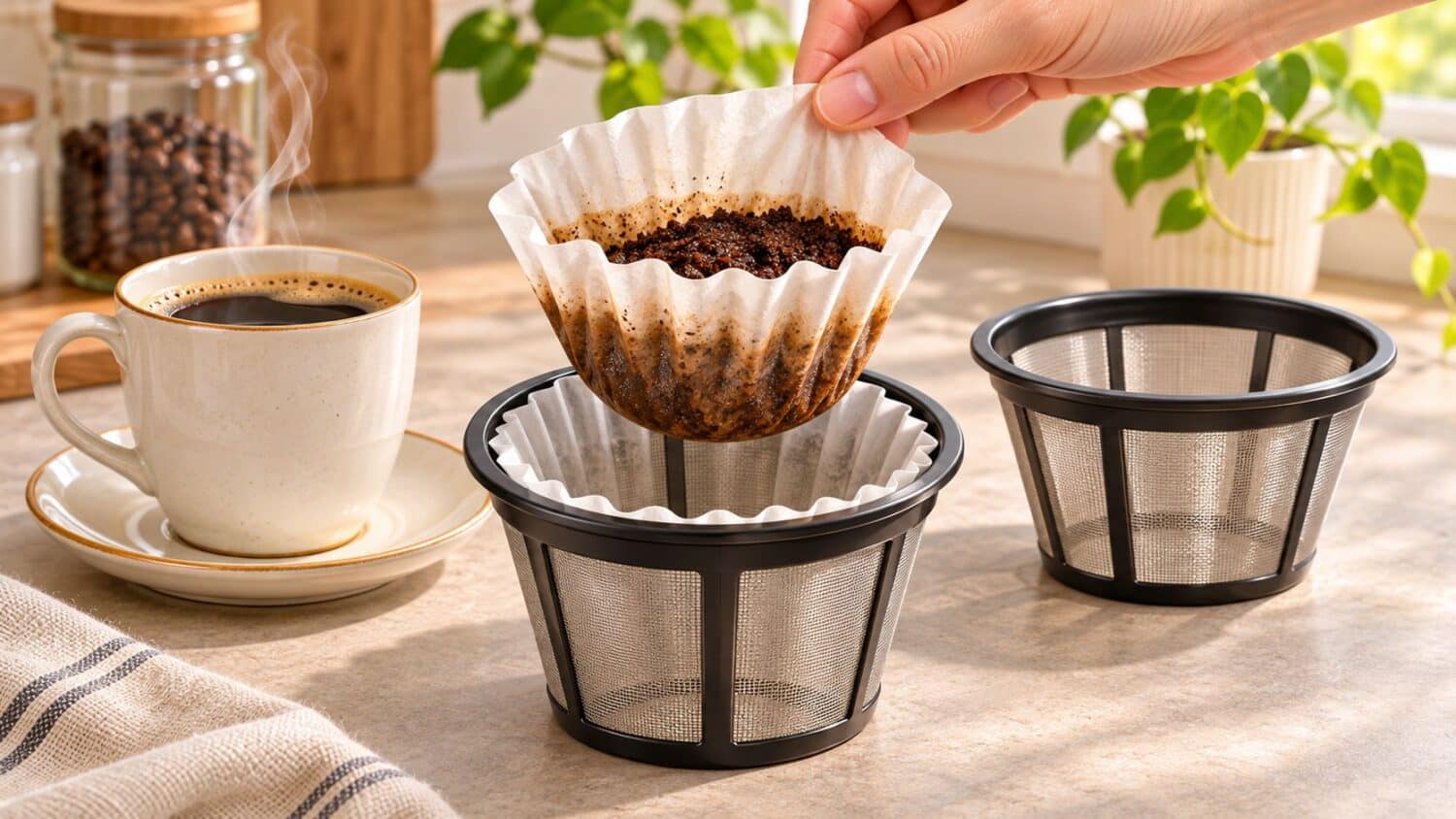
Nov
An 80.9% recycling rate sounds reassuring, but it doesn't mean your used coffee liner belongs in the recycling bin. The U.S. Environmental Protection Agency's packaging figures report that rate for U.S. paper and paperboard packaging in 2018, a category heavily influenced by corrugated boxes, not small, coffee-soiled filters.
That distinction captures the problem with buying paper basket liners by material alone. A sheet can be paper and still fit badly, split during brewing, or require a disposal route your neighborhood doesn't offer. Choose by the basket, the paper's strength when wet, and the finished liner's documented food-contact and disposal claims.
Which Paper Basket Liner Fits the Basket
Grounds in the mug and sludge caught in reusable mesh are good reasons to consider a liner. But start with the basket's model, not the pack count. A coffee liner belongs between the grounds and the reusable basket, with enough coverage to catch grounds without interfering with the brewer.
Paper basket liner fit by brewer basket
| Liner shape | Basket it fits | Seating rule | If the fit is wrong |
|---|---|---|---|
| Single-serve disc | Reusable K-Cup or Ninja DualBrew pod | Lies flat below the rim and clear of the needle | Grounds bypass the wall or the lid will not close |
| Flat carafe disc | Mesh carafe basket such as K-Duo style | Covers the floor without folding over the outlet | Wet grounds clog the mesh and the brew slows |
| Flat drip basket paper | 8–12 cup flat-bottom drip basket | Edges stay inside the wall | Channeling at the rim makes a weak, gritty cup |
| Cone paper | Cone dripper only | Matches the cone number | Collapses or leaves a gap in a flat basket |
Treat these as shape-matching rules, not promises that every disc fits every reusable pod. Check the liner's compatibility list against both the brewer and the insert you own. Our coffee pot filter basket guide can help you distinguish the basket from the paper that sits inside it.
Match the holder before the refill
Dry-fit the liner before adding coffee. Close the empty pod or seat the carafe basket without forcing anything, then inspect the rim and outlet.
Disposable coffee filter cups accounted for 41.6% of the global coffee filter cup market in 2025, according to Dataintelo, but category popularity isn't evidence of compatibility. The named basket matters more than a broad claim on a package.
Buying rule: Identify the reusable basket first. Choose the liner quantity only after you've confirmed its shape and seating.
If you also brew loose-leaf tea, Pep Tea's infuser kettle brewing guide offers a useful companion resource for choosing and using that separate brewing setup. Don't treat a coffee liner as an interchangeable refill for every beverage holder.
How Wet Paper Holds a Hot Brew
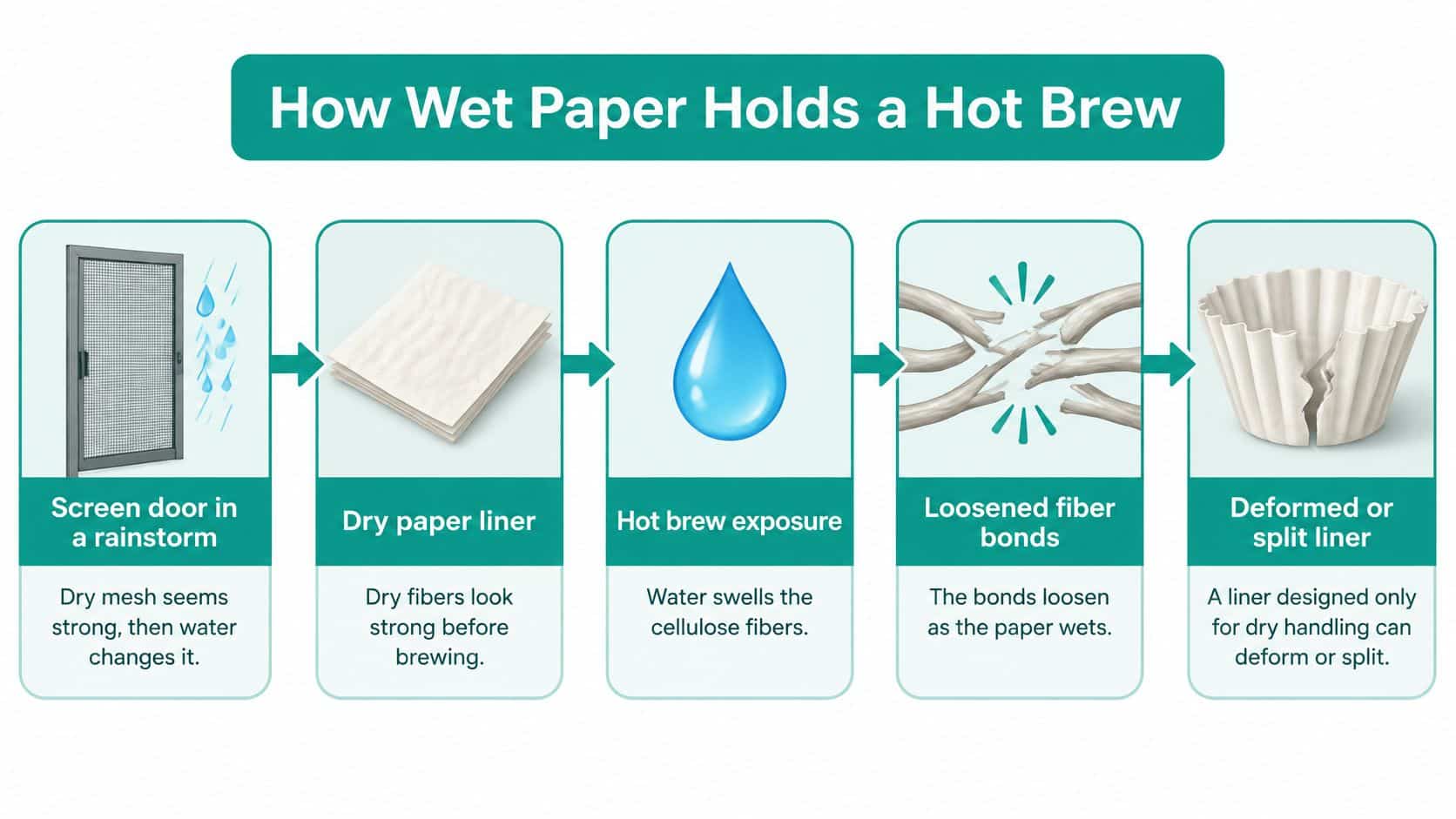
A dry liner works like a screen door in a rainstorm: how it looks before exposure tells you little about how it performs during exposure. Water swells the cellulose fibers in paper and weakens the bonds between them. A sheet that feels sturdy between your fingers can sag, deform, or split once it is saturated.
Wet-strength filter paper treats or bonds its fibers so the sheet keeps its integrity under flowing water. That label alone does not make a grade right for a coffee pod. The manufacturer still has to balance strength against permeability: the paper must hold together while letting water pass through the coffee bed.
The diagram below shows the failure path a suitable brewing paper must resist.
Read the specifications together
Published wet-strength filter-paper specifications list 80–85 g/m² grades at roughly 0.18–0.25 mm thick and 265–275 g/m² grades at roughly 0.65–0.70 mm thick, with listed flow times spanning about 4–80 seconds under a 6 mL water-flow test through 100 cm² and wet bursting strength spanning about 40–250 kPa.
Filter paper grades and what they do when wet
| Grade | Basis weight | Thickness | Flow time | Wet burst |
|---|---|---|---|---|
| Light filter paper | 80–85 g/m² | 0.18–0.25 mm | Toward the fast end of 4–80 seconds | Toward about 40 kPa |
| Heavy filter paper | 265–275 g/m² | 0.65–0.70 mm | Toward the slow end of 4–80 seconds | Up to about 250 kPa |
These are typical filter-paper ranges, not specifications for PureHQ liners and not a formula for predicting brew time. Basis weight alone sets neither flow nor strength; fiber structure and treatment carry part of the load too.
Read the trade-off, not just the numbers. A heavier sheet tolerates a loaded coffee bed and rougher handling, but excessive thickness or tight pores can stall a short pod cycle. A lighter sheet passes water faster, but weak wet strength lets the saturated bed rupture the paper. Judge a liner by how it behaves wet inside your basket, not by which direction it sits on this table.
Test the saturated liner, not its dry feel
Ask for evidence that addresses the actual failure:
- Saturated burst: Does the wet sheet withstand the load inside the supported basket?
- Edge tear: Does the edge survive filling, closure, and removal?
- Shape retention: Does hot-water exposure leave the liner seated?
- Coffee-fines flow: Does the paper pass water with actual grounds present, rather than only clean test water?
Packaging language adds one more trap. Greaseproof paper is built to block oil and moisture, while a brew liner must let water through, so two products can both claim moisture resistance and do opposite jobs in hot water. Packaging Panda's guide to choosing grease-resistant bags for takeaways covers that wrapping task, which is a separate problem from filtration.
At home, the cheapest evidence is the used sheet itself. Pull the liner after the brew and look for a tear, a distorted edge, or a liner that shifted off its seat. Any of those failures tells you more than how substantial the dry paper felt between your fingers.
Why a Shaped Liner Leaks Less Than a Generic Sheet
“Paper still lets grounds and coffee leak” is a reasonable objection. First, separate normal filtration from bypass. Brewed liquid should pass through the filter; grounds escaping around its edge are the failure you're trying to prevent.
The FDA describes grease-proofing treatments as substances applied to paper and paperboard to resist oil and grease leakage and provide water resistance. That describes packaging treatments, not a reason to seek a grease-proof coating for your coffee filter. In a brewer, the paper must pass water while retaining the coffee bed.
A shaped liner addresses geometry. It can follow the intended basket without improvised folds, but shape alone doesn't prove suitable strength, flow, or food-contact compliance.
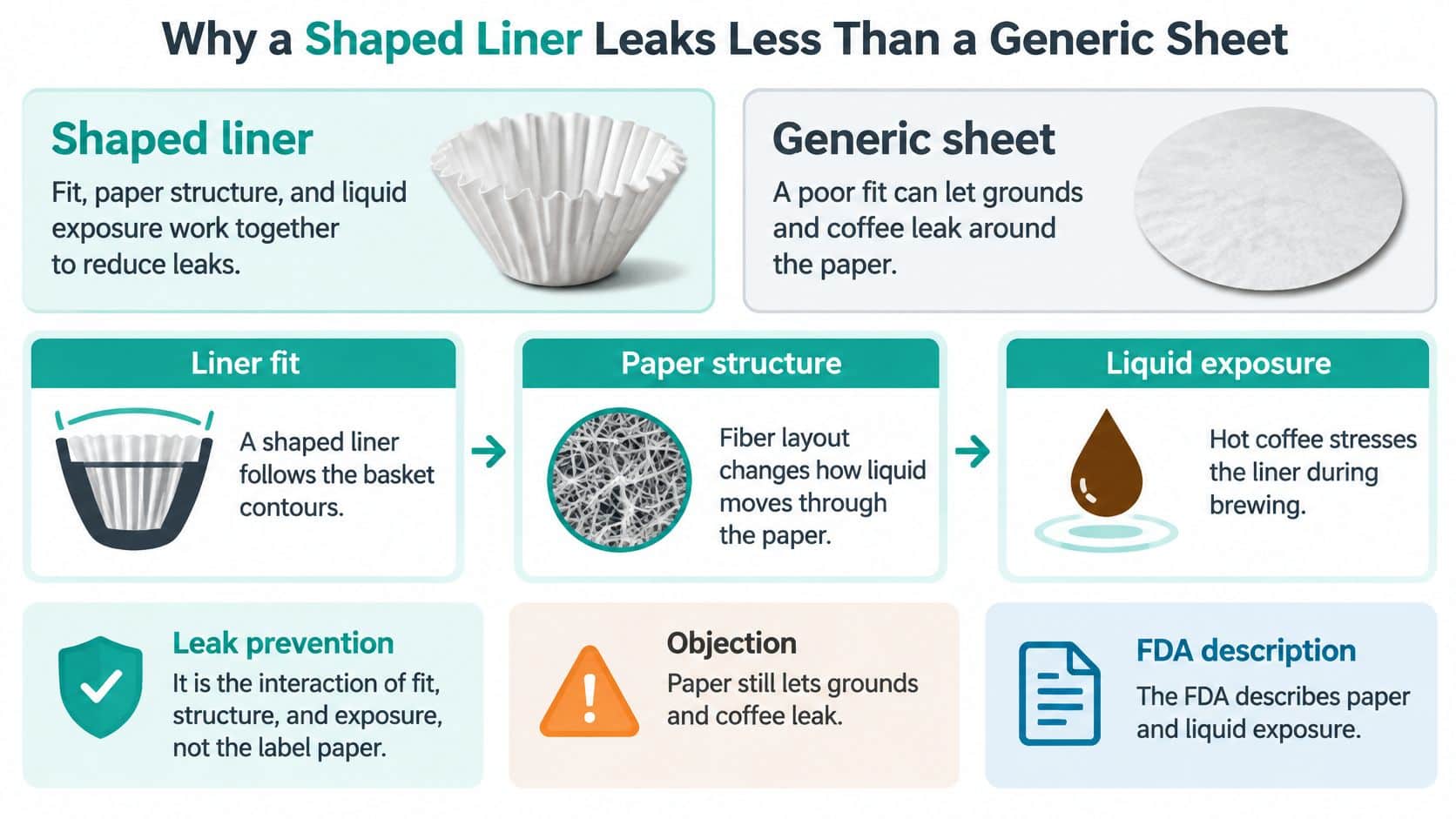
Compare the premium claim with observable checks
A premium, basket-specific liner should justify its positioning through compatibility and performance, not an adjective on the bag. Use the comparison below as an acceptance checklist. The generic-sheet column describes the problems to look for, not an inevitable outcome for every alternative.
Basket-specific liners versus generic paper sheets
| Check | Basket-specific liner | Generic sheet |
|---|---|---|
| Named basket | Lists the pod or carafe family | Claims a universal fit |
| Rim and outlet | Stays inside the wall and clear of the outlet | Folds over the rim or blocks the hole |
| Wet strength | Holds saturated fines through the cycle | Can split once the fibers swell |
| Brew flow | Pores suit a short pod or carafe cycle | Too thick slows the cup or too thin tears |
| After the brew | Grounds lift out with the sheet | Grounds bypass into the mesh |
A generic sheet may look economical until you have to trim it, tuck its corners, or clean grounds from beneath it. Before buying, compare the package's stated basket family with your actual insert. Reject an unsupported universal-fit claim if the seller gives you no usable dimensions or compatibility information.
Diagnose where the escape happens
Check the liner's perimeter if you find grounds between the paper and basket wall. An exposed section or folded edge gives you a specific seating problem to correct. Don't respond by adding another sheet, which introduces another variable into the flow path.
Check the outlet if the cycle slows. Remove the used liner and look for an edge pulled across the opening, then inspect the basket's seating in the machine. If the paper is torn, evaluate the liner and loading method rather than assuming the brewer is defective.
A coffee filter isn't supposed to stop coffee. It's supposed to retain grounds while the brewer moves water through the bed.
For a practical trial, keep the coffee and brew setting consistent. Change only the liner, inspect the paper afterward, and compare the grounds left in the basket. You're looking for an intact sheet and little grounds residue, not an unsupported promise of a completely maintenance-free brewer.
How to Check a Food-Contact Claim
Paper is a material description, not a complete safety statement. For a liner that contacts hot water and wet coffee, ask what the finished product contains and what use its manufacturer supports.
The FDA's PFAS market phase-out notice states that PFAS-containing grease-proofing substances were no longer being sold for U.S. food-contact use in February 2024, and that 35 related food-contact notifications became ineffective in January 2025. The notice also explains that smaller PFAS molecules can migrate from grease-proofing materials into food under certain conditions.
That change doesn't certify every paper product or every imported liner. A 2025 peer-reviewed investigation published by the Royal Society of Chemistry found PFAS in 1 of 15 paper food-service samples and described mixtures involving plastic dyes, adhesives, and PFAS across product types. Those samples weren't a test of all coffee liners, so use the finding to support document checks, not assumptions about a particular brand.
Separate material claims from disposal claims
These labels answer different questions:
- Uncoated cellulose: Identifies the substrate and absence of a coating, but doesn't fully describe processing additives.
- Waxed paper: Identifies a treated paper. Don't substitute it for brewing paper without documented suitability.
- Plastic-lined paper: Includes a barrier layer that needs its own use and disposal assessment.
- Industrial compostability: Refers to performance under specified commercial composting conditions.
- Home compostability: Requires evidence appropriate to home composting, not merely an industrial claim.
A compostable label doesn't independently establish PFAS-free status, recyclability, or home-compost suitability. Ask for a current manufacturer declaration covering the complete liner, including wet-strength resins, sizing, inks, and coatings, with suitability for the intended hot-water food-contact use.
Request evidence you can identify
Useful documentation names the product and the test or declaration's scope. Our testing procedures guide provides a place to begin evaluating how product claims are supported. Broad words such as green, natural, or biodegradable aren't substitutes for that information.
For a workplace that serves drinks, FSS training through TP Training is a separate resource for understanding food-safety supervision. Keep staff training and product documentation distinct: neither replaces the other.
What Changes in the Cup and the Sink
Use a trial brew to judge the liner in your own routine. These worked examples describe what to inspect, not guaranteed taste improvements. Follow the reusable basket's loading instructions, especially its fill limit and closure requirements.
The preparation step should leave the liner seated before you add grounds.
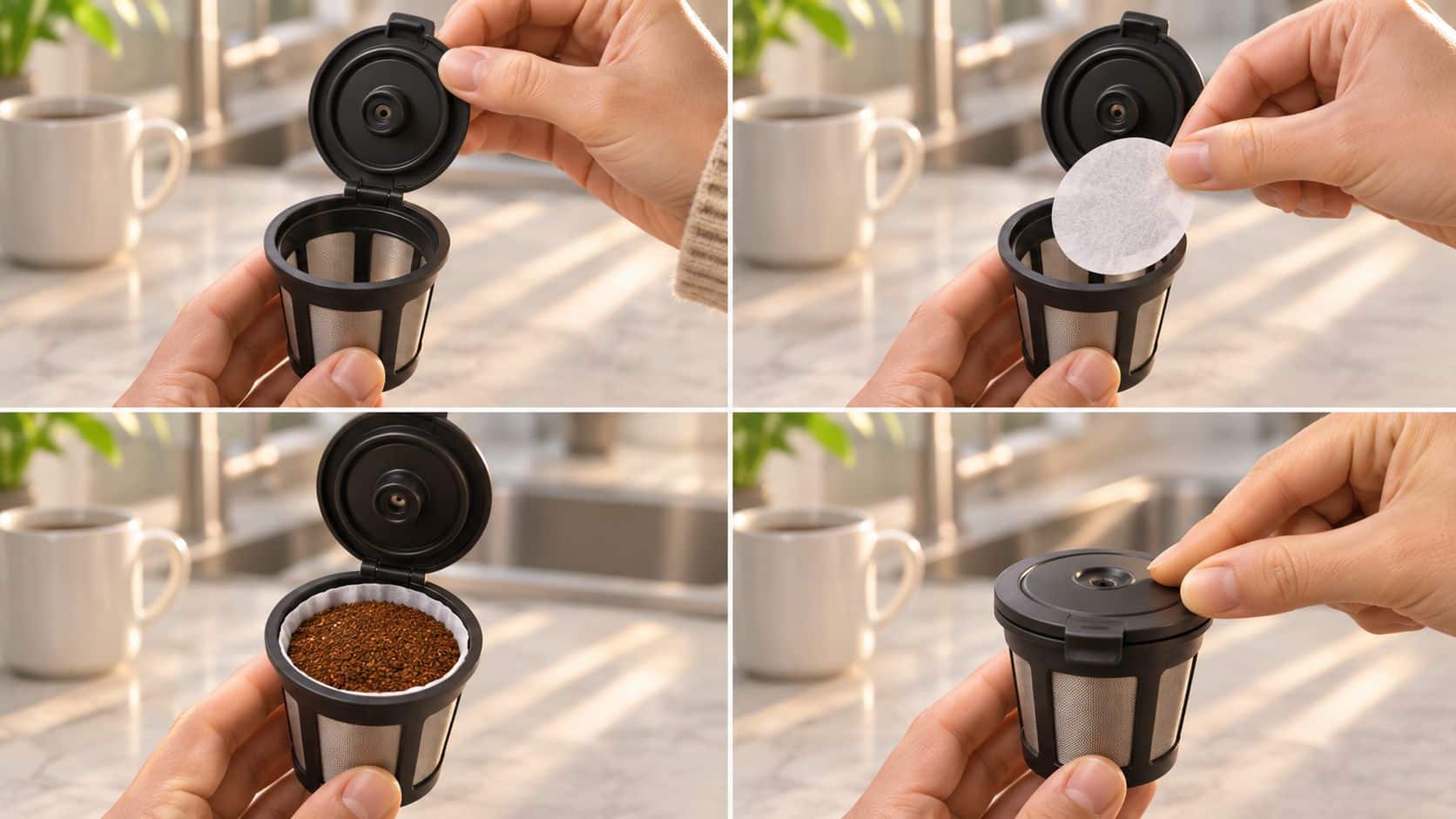
A reusable K-Cup before work
Say you place a matching disc in your reusable K-Cup and add a medium grind without exceeding the basket's fill mark. Keep the paper below the closure and away from the needle path. Don't pack extra coffee into the lid space.
After brewing, let the pod cool enough to handle, then lift out the grounds with the sheet. Inspect the exit area and rinse the pod. Your acceptance checks are a cup without noticeable grit, an intact liner, and no packed grounds lodged beneath it.
If the cup tastes unexpectedly weak and the paper has folded away from the wall, correct the seating before changing the coffee dose. If the sheet has ruptured and the cup contains sediment, investigate that failure before adjusting your recipe.
A mesh carafe basket at breakfast
For a mesh carafe basket, lay the matching disc across the floor and spread the grounds evenly. Don't press a loose edge into the outlet to make it stay put. After the cycle, compare the exposed mesh and the area beneath the disc.
A useful result is a grounds packet you can remove without scraping the basket floor. Still wash the basket rather than treating a clean-looking surface as proof that no coffee residue remains. The liner should simplify grounds removal, not replace cleaning.
Use the demonstration below as a visual companion, then check the directions for your own basket.
A flat-bottom drip basket for a shared pot
In a flat-bottom drip basket, open the basket paper fully before filling it. After brewing and cooling, gather the edges gently and lift the damp grounds out together. Inspect the basket wall and carafe for residue instead of assuming the paper eliminated it.
Use the failure pattern to guide your next attempt:
- Fast, weak cup: Inspect for a bypass channel before increasing the dose.
- Grit in the mug: Look for a tear or exposed basket wall.
- Stalled cycle: Check whether the paper obstructed the outlet.
A liner isn't a treatment for mineral buildup. Keep a brewer-compatible descaler available for the machine's prescribed maintenance, and use cleaning tablets only for their stated purpose. Judge the liner separately by the cup, the used sheet, and how readily the basket rinses clean.
Where a Used Liner Should Go
The EPA's recycling guidance says recyclable paper must be empty, clean, and dry; wet or food-soiled paper may be compostable instead. Your damp coffee liner therefore needs a different decision from a clean, unused sheet.
Don't put a used liner in curbside paper recycling just because its package says paper. Check your municipality's accepted-material list, including any separate food-scrap collection rules.
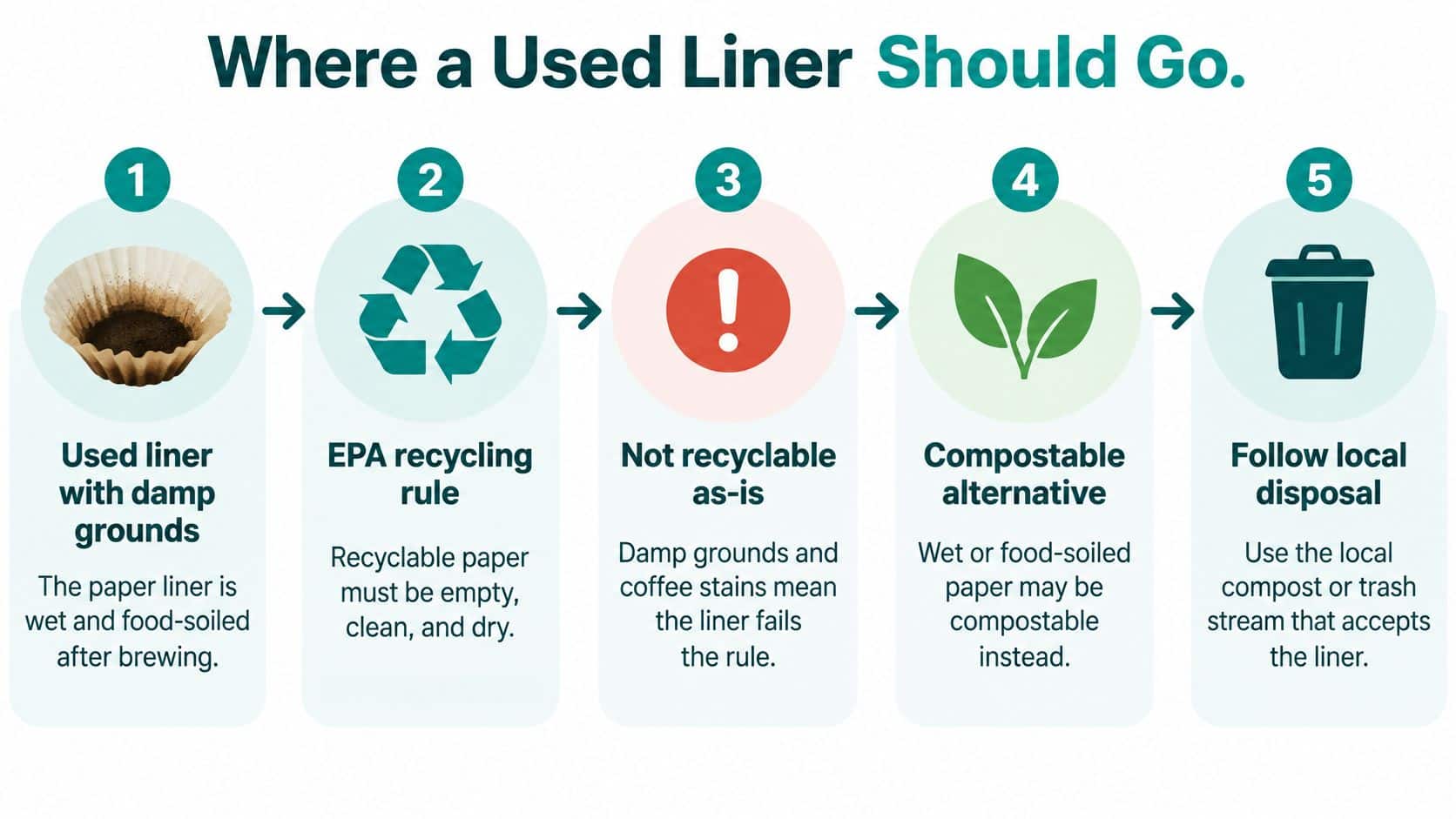
Make the disposal decision in order
- Separate the grounds. Shake them into trash or a compost stream that accepts coffee grounds. A program's acceptance of grounds doesn't automatically include the liner.
- Check the sheet's condition. If it's wet or oily, keep it out of paper recycling unless your local authority explicitly accepts it.
- Verify the compost route. Compost the liner only when the maker documents the complete product and the facility or home-compost system accepts it.
- Use trash when neither route qualifies. Don't place an unsuitable liner in compost or recycling to avoid the trash bin.
Clean, unused sheets are a separate case. Their eligibility still rests on material composition and local collection rules, but they don't carry the same coffee contamination as a brewed filter.
Understand what compostability proves
ASTM D8410-22 covers predominantly cellulosic packaging, including coated and uncoated paper, intended for aerobic municipal or industrial composting. It addresses disintegration, biodegradation, and avoidance of harmful effects on finished compost, and requires labeling qualifications where suitable facilities aren't available.
The whole product matters. A cellulose substrate doesn't settle whether its coatings, binders, or other additives meet the relevant requirements. Nor does an industrial composting claim establish that a backyard pile will provide suitable conditions.
Disposal check: Match the finished liner's documentation to the actual collection program, not just to the symbol on the package.
An independent Melitta coffee-filter lifecycle commentary notes that trapped coffee oil makes single-use filters difficult to recycle and estimates roughly 6–8 months for decomposition under composting conditions. Treat that as a conditional estimate, not a deadline for your own pile.
Our guide to biodegradable coffee filters can help you examine the terminology before choosing a disposal route. The useful outcome is correct sorting: moving a liner from the basket into the wrong bin doesn't establish a waste-reduction benefit.
Order the Liner That Matches Your Brewer
Choose the liner for the machine and reusable basket already on your counter. Don't buy a large pack first and then try to fold the sheets into compliance. A clear model match gives you a more useful starting point than a premium label or universal-fit claim.
For a compatible carafe mesh basket, our Keurig K-Duo Paper Filters for Mesh Basket come in a 100-pack for $18.95 and fit K-Duo, K-Duo Plus, and K-Duo Essential. For reusable pods, our Disposable Paper Filters for Reusable K-Cups come in a 100-pack for $12.95 and fit Keurig and Ninja DualBrew coffee makers. These are different formats, so select by the basket you intend to line.
Check the pack before checkout
- Read the machine name. Match the listed family to your brewer rather than relying on its appearance.
- Identify the insert. A carafe mesh basket and a reusable K-Cup need different liner shapes, even when they belong to the same brewing setup.
- Plan the disposal route. Know whether your local program accepts the used liner before making compostability part of your buying decision.
When the pack arrives, load a single liner for each brew and keep it off the rim and outlet. Use the basket's fill instructions rather than forcing in extra grounds. Afterward, inspect the cooled sheet and dispose of it according to your local rule for soiled paper.
Buy for the routine you actually use
If you mainly make a carafe, choose the mesh-basket format. If you refill a pod for individual cups, choose the reusable K-Cup format. Don't order both unless you use both brewing methods.
Shop the matching pack on our website or through our Amazon Store. Keep maintenance separate from liner selection: a clean basket with persistent slow flow calls for the brewer's troubleshooting and descaling procedure, not automatically a different paper.
PureHQ Inc. offers paper liners for compatible K-Duo mesh baskets and reusable K-Cups, alongside coffee-machine maintenance accessories. Visit PureHQ Inc. to shop the liner pack that matches your brewer and make your next grounds cleanup simpler.

