
Coffee Machine Care
Best Cleaning Tablets for Coffee Machines in 2026
Nov
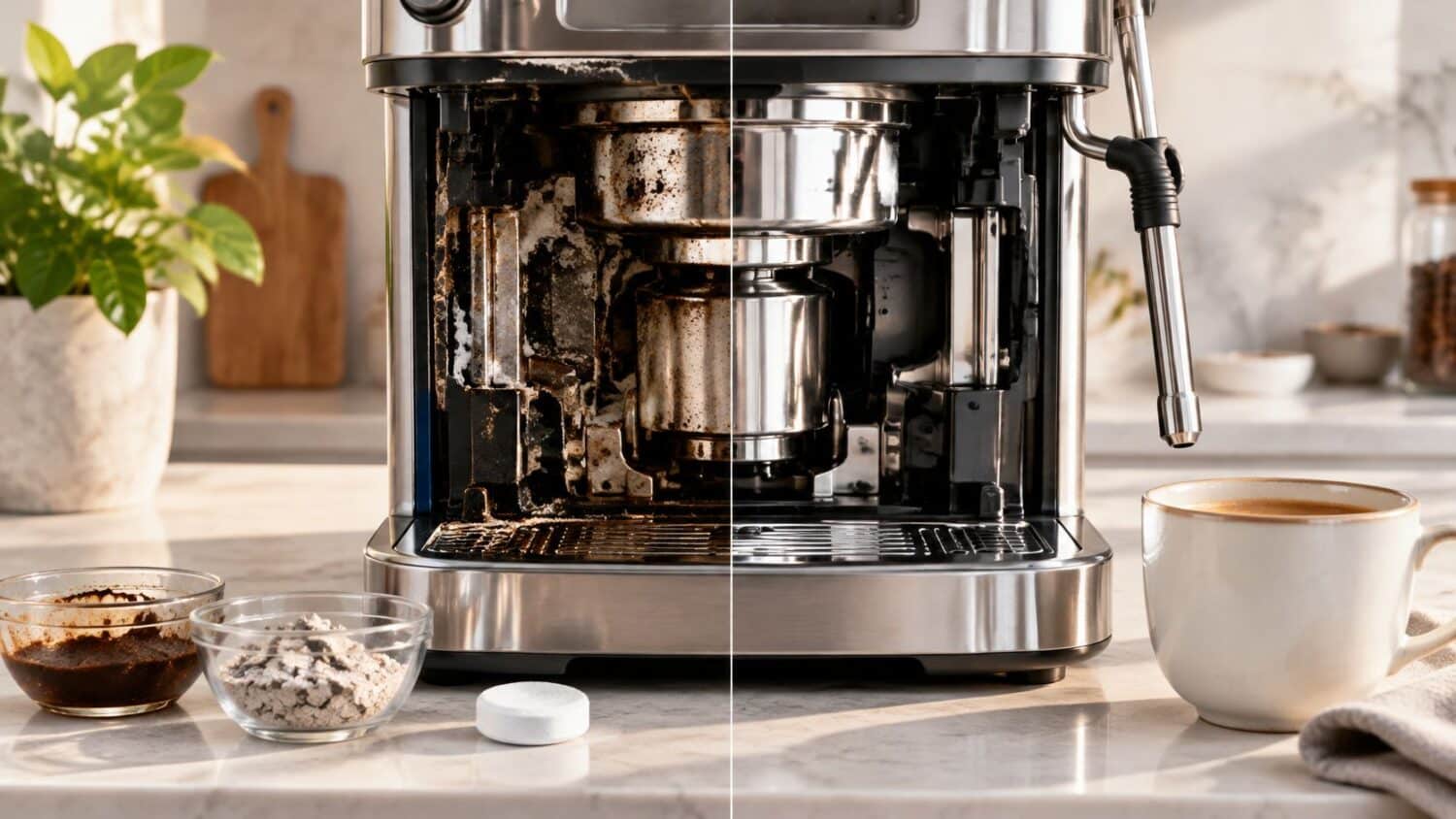
The global coffee-machine cleaning-tablet market was estimated at about $1.8 billion in 2025 and is projected to reach $3.2 billion by 2034, which works out to roughly a 6.6% compound annual growth rate from 2026 through 2034, according to DataIntelo's coffee-machine cleaning tablet market estimate. Universal tablets already held the largest slice in 2025, a 38.4% revenue share, about $691 million. That money isn't being spent on a niche gadget. Owners are buying tablets because the cup keeps getting worse and they don't know which tablet matches the mess inside the machine.
Best cleaning tablets aren't one product. A bitter, oily cup and a machine that dribbles white crust are different failures. One calls for a cleaner aimed at coffee oils. The other calls for an acid descaler aimed at mineral scale. Pick by the symptom, then by the machine family, and you'll stop wasting a cycle on the wrong chemistry.
Why Coffee Machine Residue Builds Up Faster Than You Expect
A 2011 NSF International household study found yeast or mold in 50% of tested coffee-machine water reservoirs, which put those reservoirs among the more contaminated kitchen and bathroom items sampled, as reported by Wirecutter's guide to how often to clean a coffee maker. That is a maintenance problem, not a cosmetic one. The reservoir and the internal water path need real cleaning on a schedule, not a quick rinse once the machine starts to smell.
Three residues show up in nearly every coffee machine that goes unmaintained.
Coffee oils coat the brew path, the needle or shower screen, and the spout. Grounds stick to that film. After a few days the cup tastes bitter, stale, or oily even when the beans are fresh.
Mineral scale is calcium and magnesium carbonate left behind as hard water is heated again and again. It narrows passages, slows flow, and makes the heater work through a crust. The cup comes out cooler or weaker, and a white film often shows on the reservoir wall.
Biofilm grows where water sits. Damp reservoirs, drip trays, and used-pod bins stay wet between brews. A sour smell from the tray is the usual giveaway, sometimes with a visible slime.
Why a hot-water rinse fails
Most owners rinse the reservoir with hot water and call the machine clean. Hot brewing water does not dissolve scale, and it does not lift the film off a reservoir wall. The same Wirecutter reporting draws a hard line between cleaning and disinfection: vinegar can remove much of the mold and yeast, but the U.S. Environmental Protection Agency does not recognize vinegar as a disinfectant. Follow the appliance maker's cleaning instructions, and wash removable parts by hand when the manual says to.
Practical rule: If the reservoir hasn't been soaped, the drip tray hasn't been emptied and washed, and the machine hasn't been descaled on the manual's schedule, a tablet cycle is only half the job.
Sort the residue first, then match a tablet to that residue and to the machine. Three questions tell you where the machine stands before you buy anything. When did you last wash the reservoir with soap? When did you last empty and wash the drip tray? When did you last descale? Any answer of "never" or "I can't remember" means a single tablet cycle will not catch the machine up.
Cleaning Tablets and Descaling Tablets Target Different Residue
Descaling is a mineral-removal job. Acids such as citric, lactic, or sulfamic acid dissolve the calcium- and magnesium-carbonate deposits that hard water leaves when it is heated, as Coffee Studies explains in its descaler guide. Scale changes heat transfer and water flow. Those two conditions decide whether the machine extracts the same way from cup to cup.
A 2020 study, summarized in that same guide, found that when brew strength and extraction were held constant, temperature alone had limited influence on how the coffee tasted. The practical problem isn't "cooler water." Scale throws off flow and extraction, so the cup changes even when you didn't change the beans.
Cleaning tablets go after coffee oils and organic residue. They don't replace an acid descale, and a descaler doesn't replace an oil cleaner. One industry forecast in that guide valued the overall descaler market at $1.8 billion in 2025, with a projection to $2.6 billion by 2033 (a 4.6% compound annual growth rate). Tablets were projected as the fastest-growing form, at 5.5% a year. Owners are already splitting the two jobs. The machine manual still sets the dose and the cycle.
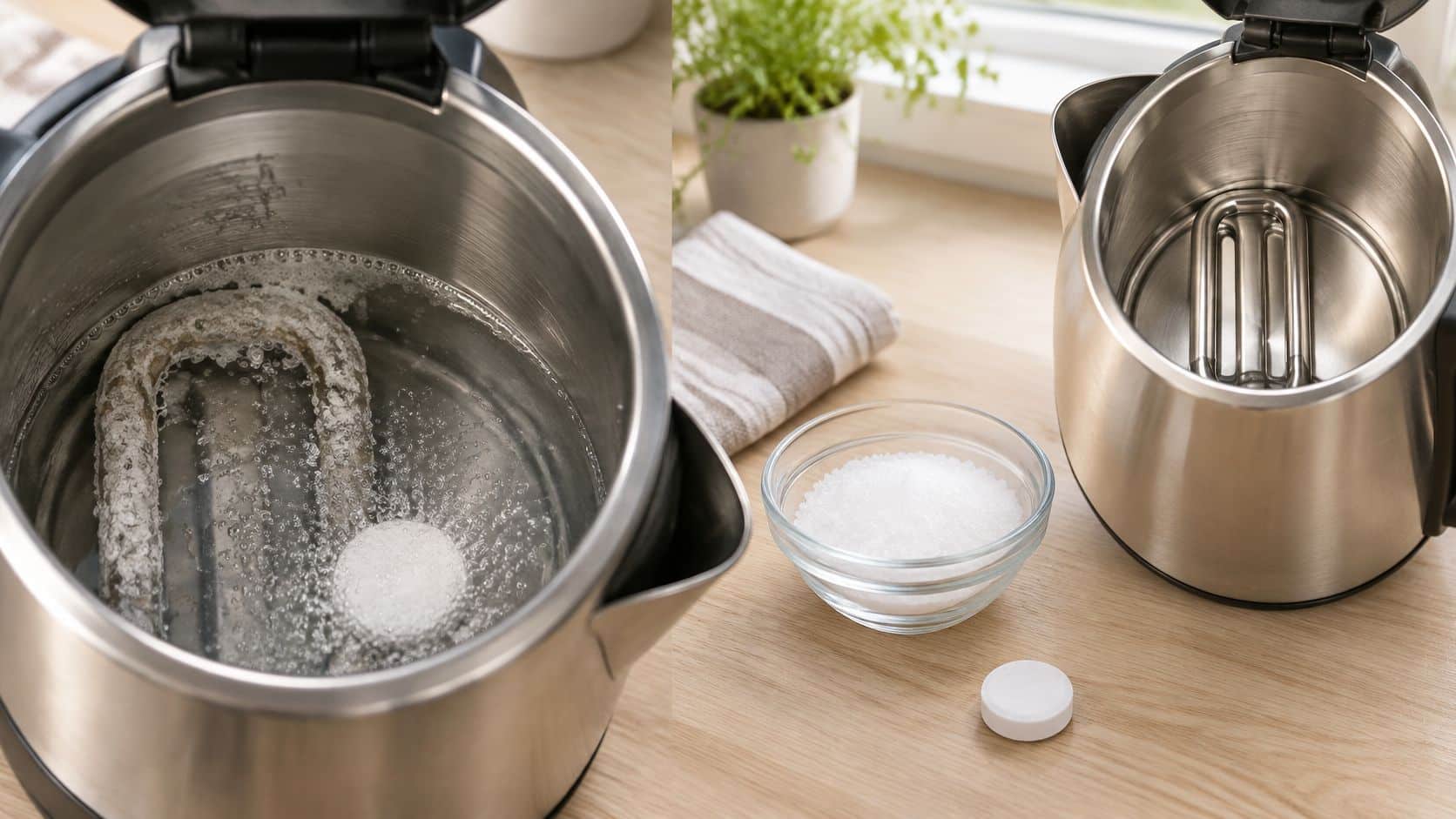
The same split shows up on metal parts outside coffee. If you're comparing how acids and detergents behave on scale versus oily film, the guide to ultrasonic cleaning for machinists from Evo Dyne Products walks through chemical choice for a tank, which is a useful parallel when a label only says "cleaner."
Two machines, two residues
Say a Breville owner sees slow flow and a white crust around the group or inside the tank. That's scale. A descaling product is the match, and our guide to the best descaler for a coffee machine lays out how to choose one for that job.
Say a Keurig owner gets oily, stale cups after a busy week, with no crust and no descale light. That's coffee oil in the brew path. A cleaning tablet fits. Running another descale won't strip that film.
A sour odor or slime in the reservoir is a third case. Use a cleaning tablet for the internal path, then wash the reservoir, lid, and drip tray by hand. Another descale doesn't scrub a tray.
| Symptom | Residue behind it | Tablet type |
|---|---|---|
| Bitter, stale, or oily-tasting coffee | Coffee oils and grounds in the brew path | Cleaning tablet |
| Slow water flow, weak heating, or white crust | Mineral scale from hard water | Descaling tablet or descaler |
| Sour odor or slime in the reservoir or drip tray | Biofilm and mold in wet areas | Cleaning tablet plus hand washing of removable parts |
Name the symptom first. Pick the tablet type in that row. Then run the cycle for your machine, not a generic soak you saw for a different brewer.
Best Cleaning Tablets at a Glance by Machine
Once the symptom tells you cleaner versus descaler, the machine family narrows the pack. I start with the machine you own, then with whether you need one routine or a mixed fleet.
| Machine or need | Recommended tablet | Count and price | Best fit for |
|---|---|---|---|
| Keurig and Breville, one pack for cleaning and descaling | Keurig & Breville Descaling and Cleaning Tablets | 24 count, $19.95, includes 6 compatible water filters | Owners of Keurig and Breville machines who want one routine |
| Mixed brands: Keurig, Nespresso, Breville, and espresso | Coffee Machine Descaler | 10 uses, $23.95, made in the USA | Homes and small offices running several machine types |
| Machine named in the manufacturer's manual | The tablet the manual names for that model | Count and price printed on the approved pack | Owners who need a warranty-safe choice |
One pack for Keurig and Breville
The Keurig & Breville Descaling and Cleaning Tablets come as a 24-count pack and include 6 compatible water filters, at $19.95. That pack suits a household that wants cleaning tablets and descaling tablets in one box, plus filters so scale has less raw mineral to build on between cycles. It isn't a reason to skip the symptom check. If the only complaint is oily taste, you still run the cleaning side of the routine, not a full descale every week.
One descaler across several brands
Our Coffee Machine Descaler is a universal descaling solution for Keurig, Nespresso, Breville, and espresso machines. It gives 10 uses, costs $23.95, and is made in the USA. A small office with a pod brewer in the breakroom and an espresso machine at the counter can keep one descaler on the shelf instead of four brand-specific bottles. It is a descaler. It doesn't replace a cleaning tablet when the complaint is stale, oily coffee.
Warranty-safe picks
Check the manual and confirm the product lists your model family before you drop a tablet in the tank. If the machine is under warranty, I would use the manufacturer-approved tablet the manual names. That is the safest choice when a service center can refuse a repair over an unapproved chemical.
Go back to the symptom row before you check out. Slow flow and white crust point at the descaler. Bitter, oily cups point at a cleaning tablet. Sour slime means a tablet plus a sink wash of the removable parts.
How to Run a Cleaning Tablet Cycle Step by Step
Effective tablets stack several jobs in one dose. Alkaline builders loosen coffee oils. Oxygen-releasing persalts oxidize organic residue. Chelating agents bind calcium and magnesium. Scale inhibitors help keep loosened mineral from settling back onto hot surfaces. A documented unit-dose formula in a European patent publication on coffee-machine cleaning compositions specifies 10–40 wt.% sequestering agent, 15–50 wt.% persalt or peracid, 0.1–10 wt.% scale inhibitor, and enough alkaline material for a solution pH of at least 10.
That same disclosure describes a hot cycle at about 90–95 °C, about 10 seconds for the tablet to start dissolving, and about 40 seconds of solution contact. Those times belong to one formulation. Your machine manual overrides them. Water volume, temperature, materials, and flow paths differ across Keurig, Ninja, drip, and espresso machines, so don't copy an espresso procedure onto a pod brewer.
Alkaline detergent chemistry and acid descaling hit different soils. A tablet built to lift oily coffee film is not a stand-in for an acidic descaler.
The four-step flow below is the shape of the cycle. The numbered list under it is what you do, including the mistakes that leave a chemical taste in the first cups.
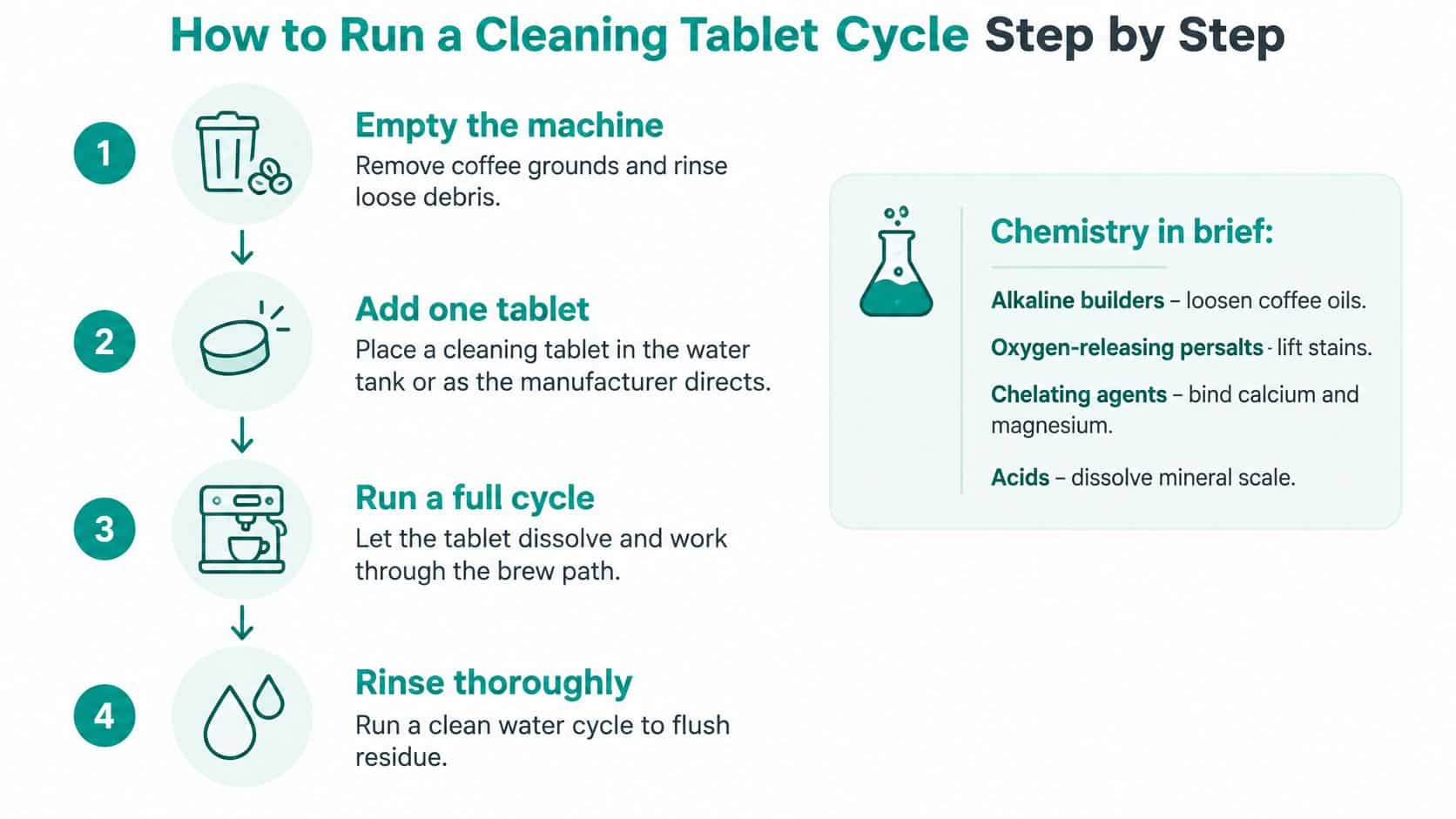
The cycle, with the usual slip at each step
- Empty the reservoir and rinse it with fresh water. Leftover water dilutes the tablet, so the dose the label assumes never reaches the brew path. The common slip is topping up a half-full tank and wondering why the cycle smells weak.
- Pull the drip tray, grounds bin, and filter basket, and wash them in warm soapy water. The tablet solution never scrubs those surfaces. Skipping this step leaves the sour tray smell in place after a "successful" cycle.
- Place one tablet in the reservoir, or exactly where the manual says. Some machines want the tablet in a dedicated brew position, not floating in the tank. Guessing the spot can leave a half-dissolved disk jammed at the outlet.
- Start the programmed cleaning cycle and let it finish. Stopping early flushes a partly dissolved tablet before the oils have had contact time. If you have to walk away, walk away. Don't cancel it to make a cup.
- Empty the drip tray and the waste container. They now hold used solution. Pouring that liquid back into the reservoir is how a chemical taste survives the rinse.
- Run at least two full cycles with fresh water until odor, taste, and foam are gone. One short rinse is the slip that makes the next three cups taste like soap.
If the cup still tastes of cleaner after two rinses, run one more fresh-water cycle and check that the reservoir and drip tray were fully emptied. If flow is still slow after a proper cleaning cycle, the residue left behind is scale. A descaling product is the next step, not a second oil-cleaning tablet.
A short walk-through of a tank fill and cycle helps if you'd rather see the order than only read it.
Rinse until a plain water brew smells like nothing. Taste is the test, not the timer on the first rinse.
Premium Tablets Versus Generic Packs Side by Side
Price on the shelf is a weak comparison until you know the count, the filters in the box, and whether the label names your machine. I check five lines on any pack, premium or generic, before I care about the brand story.
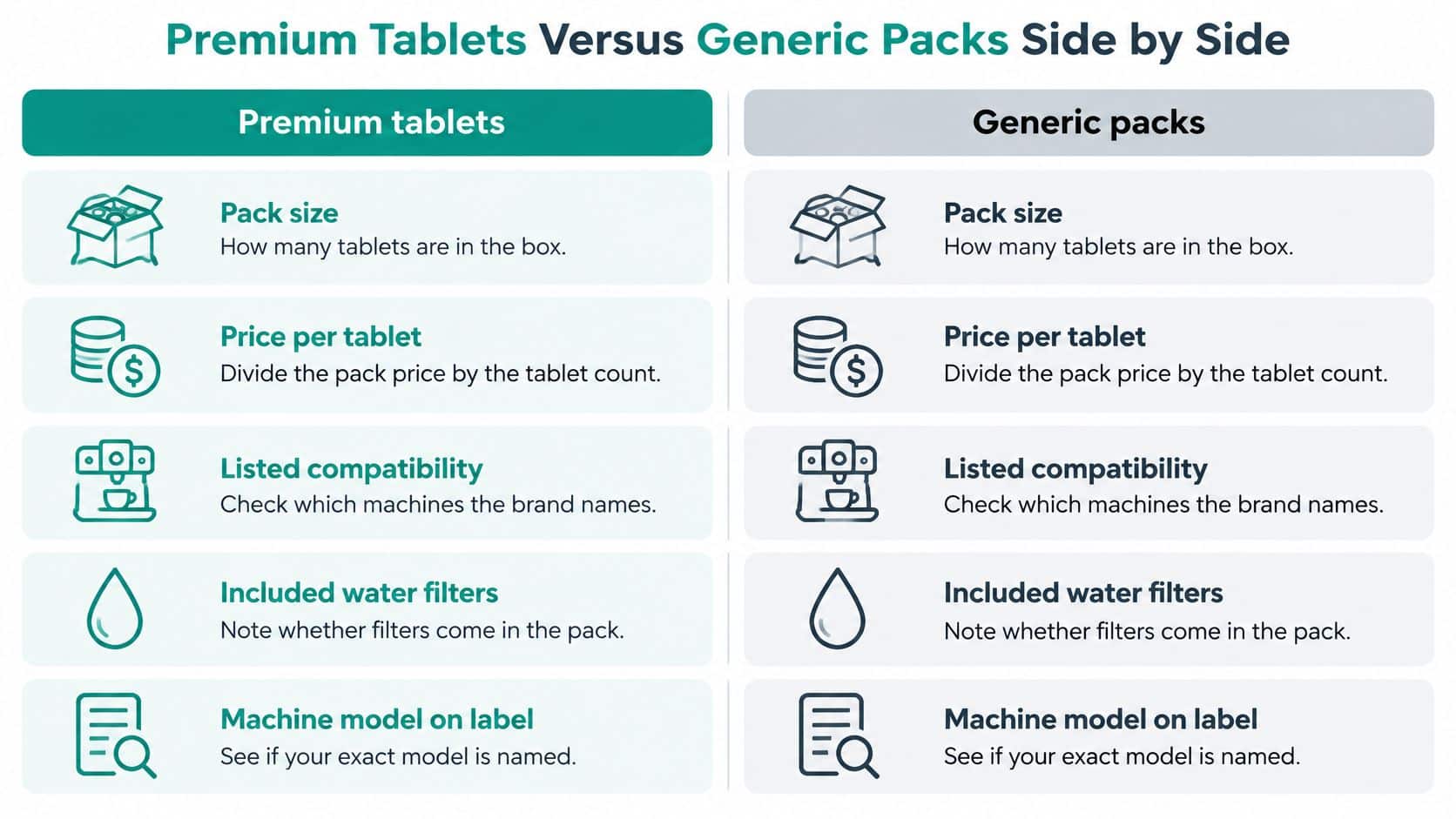
| Criterion | PureHQ Keurig and Breville tablets | How to check a generic pack |
|---|---|---|
| Pack size | 24 count | Count the tablets printed on the box |
| Price | $19.95 | Read the shelf or listing price |
| Cost per tablet | $0.83 | Divide the pack price by the tablet count |
| Included water filters | 6 compatible filters | Check whether the listing includes any filters |
| Listed compatibility | Keurig and Breville | Match the list against your machine manual |
$19.95 divided by 24 tablets is about $0.83 each, and that pack also includes 6 compatible water filters. A generic 12-count at a lower shelf price can cost more per tablet once you do the same division, and it often includes no filters. If the generic listing doesn't state count, machine family, or filters, read the box. Don't guess from a star rating.
Will a third-party tablet void the warranty?
This is the objection I hear most. A tablet that lists your machine family, used on the manufacturer's cycle and followed by a full rinse, doesn't need special handling beyond what the manual already asks. A product the manual forbids should stay out of the machine. If the warranty text names an approved cleaner, use that named product while the warranty is active. After the warranty period, compatibility on the label plus the correct cycle is the practical test, not the word "universal" by itself.
Do the included filters actually get used?
A customer who uses spring water in a Keurig, Joun Gaudioso, said the filter doesn't need replacing as often and that it works as described. Softer or already-filtered water slows scale, so the charcoal filters in the pack earn their place between descale cycles rather than as a substitute for one. If your tap is very hard, filters stretch the time between descales. They don't cancel the descale light.
Put both packs on the same math. Count, price per tablet, named machines, and whether filters are in the box. Then buy the pack that lists your model family.
What Tablets Cannot Clean and What to Do Instead
A 2023 investigation of 25 coffee machines, including capsule, automatic, and espresso models, found microbial growth on every machine, with 360 strains isolated from hospital machines and 135 from home machines, according to MedPage Today's report on that infection-control study. The researchers' conclusion was regular, thorough cleaning to reduce contamination. A tablet cycle cuts residue inside the brew path. It doesn't sterilize the machine.
Hot water is not a wash
A study summarized by the American Chemical Society ties control of coffee-machine bacteria to regular washing with water and soap. Most organisms in the hospital-machine work were considered harmless, so the aim isn't panic. The aim is cleaner contact surfaces, less buildup, and a better-tasting cup. Washing the reservoir, lid, drip tray, and brew head with soap does work a tablet solution never touches.
Roundups that rank tablets by price and stars rarely say whether the tablet targets scale, coffee oils, or microbial residue. A descaler can dissolve mineral deposits and still leave oily film. A cleaning tablet doesn't replace a periodic descale. Slow flow points at scale. Bitter cups point at oil. Odor or visible slime means the reservoir, tray, and removable parts, not another tablet dropped in the tank.
The waste tray grows back
A peer-reviewed study in Scientific Reports examined household capsule machines and found that the used-capsule waste tray can be recolonized quickly after a rinse. The researchers advised bacteriostatic cleaning compounds and keeping waste liquid off other components, because that liquid can carry contamination toward parts that touch the drink.
A tablet-only routine creates false confidence. Shared office machines see more hands, more pods, and longer gaps between anyone washing the tray. Hand-wash the reservoir, drip tray, lid, and brew components weekly. A coffee machine cleaning brush reaches the gasket and needle areas a tablet stream only rinses.
A clean internal cycle plus a dirty drip tray is still a dirty machine.
For Breville owners, a 12-pack of compatible replacement water filters costs $15.95 and limits how fast scale returns between cleaning cycles. Filters don't wash the tray. They just give scale less to work with.
Choose Your Tablet and Start Your Cleaning Schedule
A schedule beats a rescue cycle after the coffee already tastes off. Split the work so washing doesn't depend on whoever remembers.
Weekly, with soap. Wash the reservoir, drip tray, lid, and removable brew parts in warm soapy water. Air-dry them before they go back on the machine. A wet tray snapped into place is how the sour smell returns by Friday.
When the cup complains. Run a cleaning-tablet cycle when cups taste bitter or oily, or when a sour odor shows up and the tray wash alone doesn't clear it. Don't run that cycle every morning. Oils build over days of brewing, not over a single pod.
On the manual's descale clock. Descale when the manual says, or sooner if the descale light comes on or flow slows. White crust means you're already late.
In a shared office, post the three lines on the machine and give each task a name. One person owns the weekly wash. One person owns the tablet cycle. One person owns the descale. Memory fails when six people all assume someone else did it. A written coffee machine maintenance checklist keeps those names and dates in one place instead of in a group chat.
I would buy the 24-count Keurig & Breville Descaling and Cleaning Tablets for $19.95, which include six compatible water filters, and run the first cycle this week. Match the tablet to the symptom you have, rinse until the water tastes like water, and wash the tray the same day.
PureHQ Inc. makes cleaning tablets, descalers, and water filters for Keurig, Breville, Nespresso, and espresso machines so the tablet you run matches the residue in the cup. If oily taste, slow flow, or a sour tray is what you're fixing, start with a pack sized for that machine and a filter that slows the next round of scale. Visit PureHQ Inc. to pick the 24-count tablets or the descaler and put the first cycle on this week's schedule.

