
Coffee Machine Care
USDA Organic Coffee Certification: What It Really Means
Jul
A lot of shoppers treat the USDA seal like a purity guarantee. It isn't. One of the most jarring facts in this category is that independent testing summarized by AboutCoffee.org found AMPA in 100% of the organic coffee samples tested, even though glyphosate use is banned in organic production.
That doesn't make USDA organic coffee certification meaningless. It makes it worth understanding properly. In coffee, the seal tells you the farm and supply chain followed a regulated production and handling system. It does not mean the world around that farm is chemically sterile, and it does not mean every bag was easy or cheap to produce.
The Truth Behind the Green Seal
Organic shoppers often treat the USDA seal like a zero-contaminant promise. In coffee, that assumption causes more confusion than the certification itself.
The seal is a process standard. It governs approved inputs, handling, recordkeeping, and traceability across the chain. It gives buyers a regulated framework to audit. It does not seal off a farm from drift, old residues in the environment, shared transport equipment, or sloppy downstream handling.
Organic means documented control, not a sterile product
One hard truth in coffee is that environmental exposure can still show up in certified lots. As noted earlier, independent testing found AMPA in organic coffee samples even though glyphosate is prohibited under organic rules. That should reset expectations for anyone buying organic as if it were a lab-grade purity claim.
A better way to read the seal is more practical. Certified organic coffee tells you the producer and handler agreed to follow a stricter system, keep records, and submit to inspection. It does not tell you the surrounding world stopped being messy.
Practical rule: USDA organic coffee certification verifies compliance with a production and handling standard. It does not guarantee the coffee avoided every outside contamination pressure.
For readers sorting through residue questions in more detail, this guide on pesticide in coffee and what to watch for as a buyer adds useful context.
What the seal solves, and what it doesn't
The primary value of certification is discipline. A farm, mill, importer, or roaster cannot just print "organic" on a bag and hope nobody asks questions. They need approved practices, supporting paperwork, and enough traceability to survive an audit. That is far more meaningful than loose terms like "clean," "natural," or "responsibly sourced," which can be stretched to fit almost any label copy.
The blind spot is assuming certification removes all risk. It doesn't. Coffee moves through farms, washing stations, dry mills, warehouses, containers, importers, roasters, and packing lines. Every transfer point creates another chance for mix-ups or contamination. Roasters know this in very practical terms. If an organic run follows a conventional coffee on shared equipment, purge volume, extra cleaning, downtime, and recordkeeping all become real costs. Consumers rarely see that part, but it affects pricing, scheduling, and sometimes whether a small roaster bothers to keep certified organic status at all.
A useful reading of the seal looks like this:
- It verifies practices: certified operators have to follow specific organic rules and document them.
- It improves traceability: inspections and paperwork make false claims harder to hide.
- It does not guarantee perfect purity: environmental contaminants and handling risks still exist.
- It does not guarantee quality in the cup: roast execution, storage, water, and freshness still matter more than the badge.
Experienced coffee buyers treat USDA organic as one strong signal, not the whole story. That is the honest read of the green seal.
What USDA Organic Certification Guarantees
When USDA organic coffee certification is done correctly, it guarantees process discipline. That starts at the farm, long before a coffee cherry is picked.
The core requirement is blunt: land must go through a three-year chemical-free transition period, then the farm submits an Organic System Plan and undergoes annual re-inspections to stay compliant. That structure is why the seal means more than a casual sustainability claim.
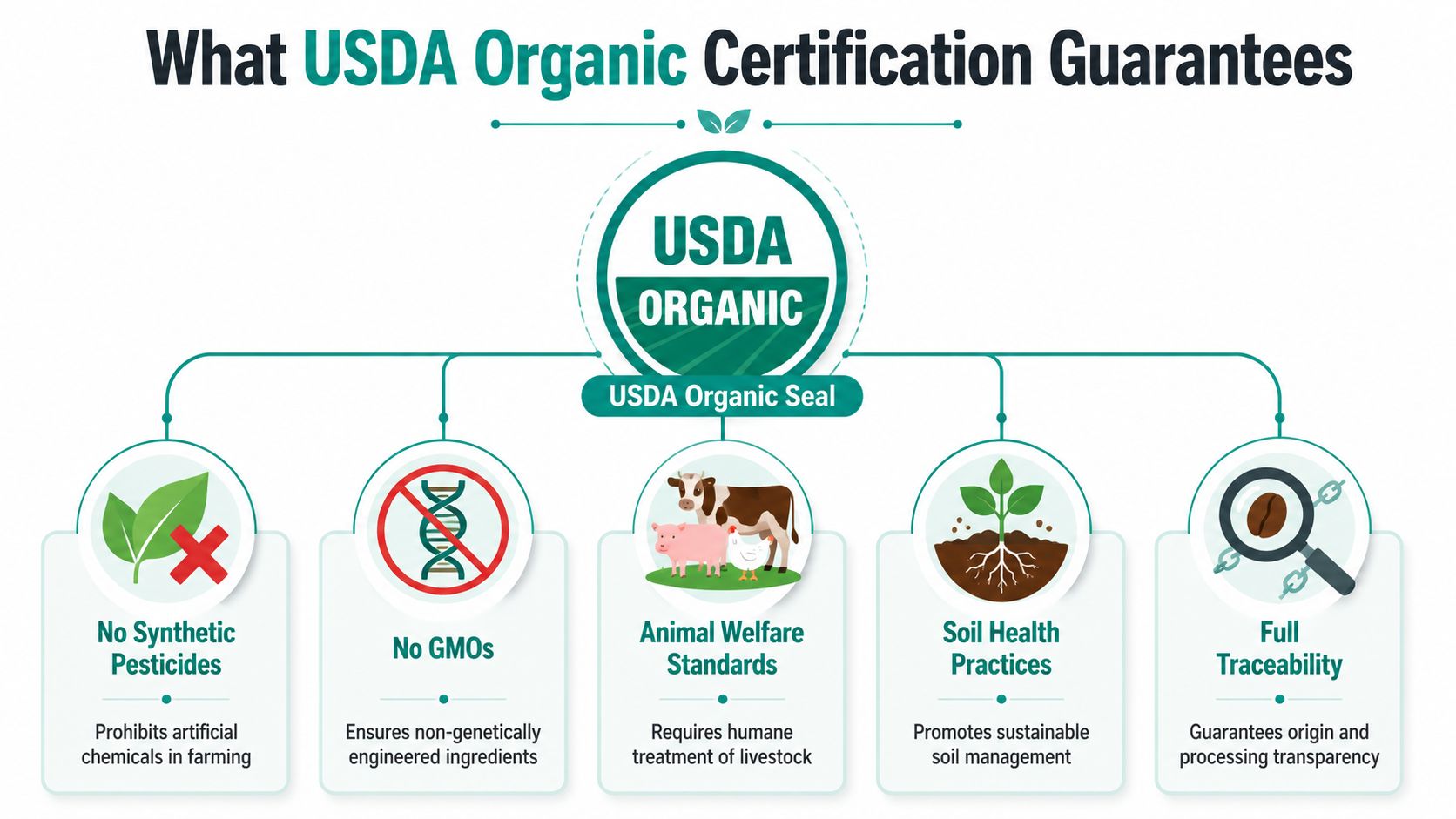
The three commitments behind the seal
The first commitment is land history. A farm can't decide on Monday to go organic and sell certified coffee on Friday. The transition period exists because prohibited substances can persist in the production environment, and the standard is trying to put distance between prior chemical use and certified harvest.
The second commitment is documentation. The Organic System Plan, often called the OSP, lays out how the operation handles inputs, pest management, recordkeeping, and contamination prevention. If the farm changes practices, the plan has to change too. That's one reason experienced operators treat organic certification like compliance work, not branding work.
The third commitment is ongoing oversight. Annual inspections matter because certification isn't a lifetime badge. It's a status that has to be maintained.
For readers who like to compare quality frameworks more broadly, this guide to coffee quality standards and what they actually indicate helps put USDA organic rules in context.
What that means in practice
USDA organic coffee certification gives you a narrower and more defensible claim than most package copy. In practice, that means:
- Prohibited synthetic substances can't be part of the approved system: the farm has to work within organic input rules.
- The operation needs a written playbook: the OSP tells inspectors how the coffee is being produced and protected.
- Compliance stays active: annual re-inspections check whether the operation still meets the standard.
- Market access depends on compliance: if an operation falls out of compliance, it risks losing the right to sell into the organic market.
Organic works best when buyers understand it as a managed system. The value is in the discipline, the audit trail, and the repeated verification.
That's the part many consumer-facing guides skip. The seal isn't magical. It's administrative, agricultural, and operational. That's exactly why it has value.
The Certification Journey from Farm to Cup
A certified organic coffee bag doesn't come from one compliant farm and a bunch of loosely supervised middlemen. That old weak point in the system got much harder to exploit.
The current rule is stricter. The USDA's Strengthening Organic Enforcement rule requires 100% of handlers, including traders and brokers, to be certified, and foreign exporters plus U.S. importers must secure an NOP Import Certificate for every shipment.
A simple process map helps.
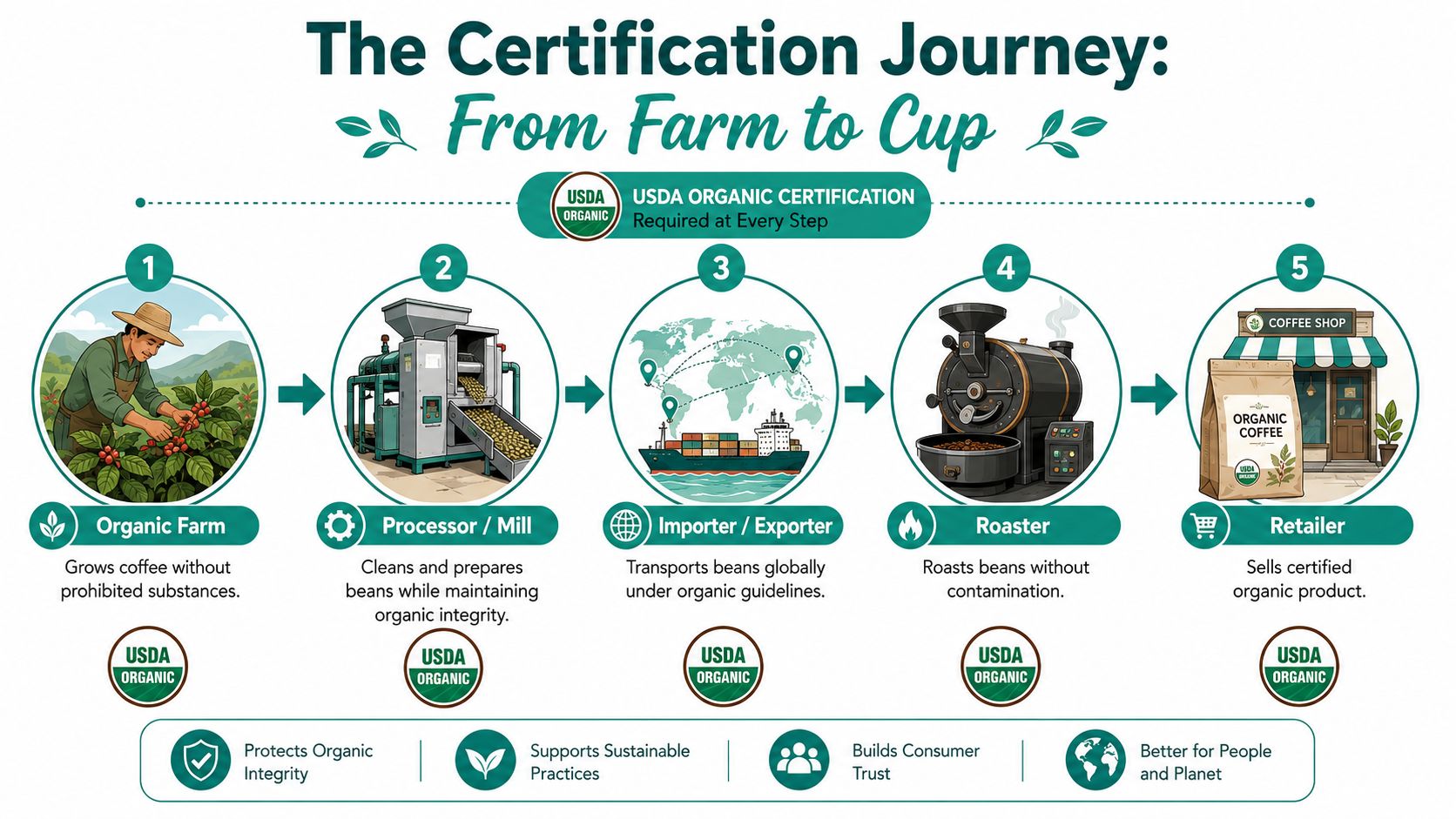
Every handoff matters
Start at origin. The farm grows the coffee under organic rules. Then a processor or mill receives, cleans, and prepares the coffee for export. After that, exporters, importers, traders, and brokers may all touch the transaction or the physical product before it ever reaches a roaster in the United States.
That matters because coffee fraud often hides in handoffs. If too many middle steps operate outside the certification net, paperwork gets fuzzy and substitutions get easier.
For anyone who wants a broader logistics lens, Snappycrate's e-commerce logistics guide is a useful primer on why custody, warehousing, and shipment controls matter so much in product integrity.
What the new enforcement changes for coffee businesses
Older supply chains often relied on trust, documents, and selective certification points. The tighter rule changes the operating reality:
- Traders and brokers need certification: they're no longer background actors if they handle certified organic coffee.
- Import paperwork became more consequential: shipments need the proper NOP import documentation.
- Traceability got stronger: each step is expected to preserve organic status instead of treating it as a farm-only issue.
Later in the chain, the roaster also has to protect integrity during production and packaging. That's where a lot of practical headaches begin, especially for businesses roasting both conventional and organic lots in the same week.
Coffee buyers who care about farming style beyond certification often pair this with knowledge of shade-grown Arabica coffee and how canopy systems affect growing conditions.
A short visual explainer helps if you want to see the chain in motion.
The takeaway is straightforward. USDA organic coffee certification follows the bean, not just the farm. If one link in the chain gets sloppy, the whole claim gets weaker.
Decoding the Different Organic Coffee Labels
Shoppers often read labels too casually. “Organic,” “certified organic,” and “made with organic” are not interchangeable, and the package shouldn't be read that way.
The cleanest way to shop is to look at the exact claim and then check whether the USDA Organic seal appears. Those two signals tell you a lot.
The label language that actually matters
That has real shopping value. If a bag says “made with organic coffee” but shows no USDA seal, that isn't necessarily deceptive. It may be using a lower organic-content labeling tier that follows different rules.
USDA Organic labeling tiers
| Labeling Term | Organic Content Requirement | Can it Use the USDA Seal? |
|---|---|---|
| Organic | At least 95% certified organic ingredients | Yes |
| Made With Organic | At least 70% organic ingredients | No |
One practical complication is that coffee products aren't always just roasted beans. Ready-to-drink drinks, flavored coffees, and blended products can include additional ingredients. That's where label literacy matters most, because the final product category may not match what a shopper assumes from the word “organic” alone.
If you're paying for the seal, check for the seal. If the package avoids it, read the claim more carefully.
A common shopper objection
A lot of buyers say, “If the coffee itself is organic, why should I care about the rest?” Fair question. The answer is that labeling rules apply to the whole product claim on the package, not just the headline ingredient you care about.
That's why certified handlers matter. The legal right to print the USDA seal sits with operations that are certified to do so. In other words, the seal on the bag isn't just about the beans. It's also about whether the company packing and marketing that coffee has the authority to make that claim.
The Hidden Costs and Burdens of Certification
Organic coffee often costs more, and not only because farming under stricter rules can be harder. A lot of the premium shows up after the coffee arrives at the roaster.
The least discussed example is the purge roast. A source detailing USDA handling practice explains that roasters working with both conventional and organic coffee must perform a purge roast after a non-organic run, roasting and then discarding a batch of organic beans to prevent commingling.
Where the extra friction shows up
That requirement hits small and mid-sized roasters hardest when they don't have dedicated organic production lines. If the same machine handles both categories, scheduling gets tighter and waste goes up. You can't just switch hoppers and keep moving.
The other burden is cleaning discipline. Every bin, cooling tray, transfer path, and packaging touchpoint needs tighter controls if the operation wants to avoid contamination issues. In real roasting plants, the challenge isn't theory. It's labor, timing, and paperwork.
What works and what doesn't
Here's the practical split I've seen across coffee operations.
- Dedicated organic production windows work better: roasters reduce headaches when they cluster organic runs together instead of alternating all day.
- Dedicated equipment works best when volume supports it: fewer changeovers mean fewer chances to create compliance problems.
- Loose recordkeeping fails fast: if a certifier asks how a lot moved through the plant, vague answers won't help.
- Treating certification like a marketing sticker backfires: the operations team ends up paying for shortcuts later.
Roasters don't struggle with organic because the idea is flawed. They struggle because mixed production is messy, and compliance exposes every weak habit in the plant.
Consumers usually see only the final shelf price. They don't see discarded coffee, extra sanitation, audit prep, lot segregation, revised run schedules, or the admin load of maintaining current records.
That doesn't mean every premium is justified. Some brands absolutely overcharge. But in legitimate programs, USDA organic coffee certification creates real operational drag. The higher ticket often reflects more than a green logo.
Organic Versus Conventional Coffee Compared
Organic and conventional coffee are not two flavor categories. They are two operating systems with different rules, costs, and blind spots.
For buyers, the main question is what kind of assurance matters enough to pay for. USDA organic coffee gives you a regulated claim with documented standards behind it. Conventional coffee can still be farmed responsibly and roasted well, but the proof usually depends on the producer, exporter, importer, or roaster telling that story clearly.
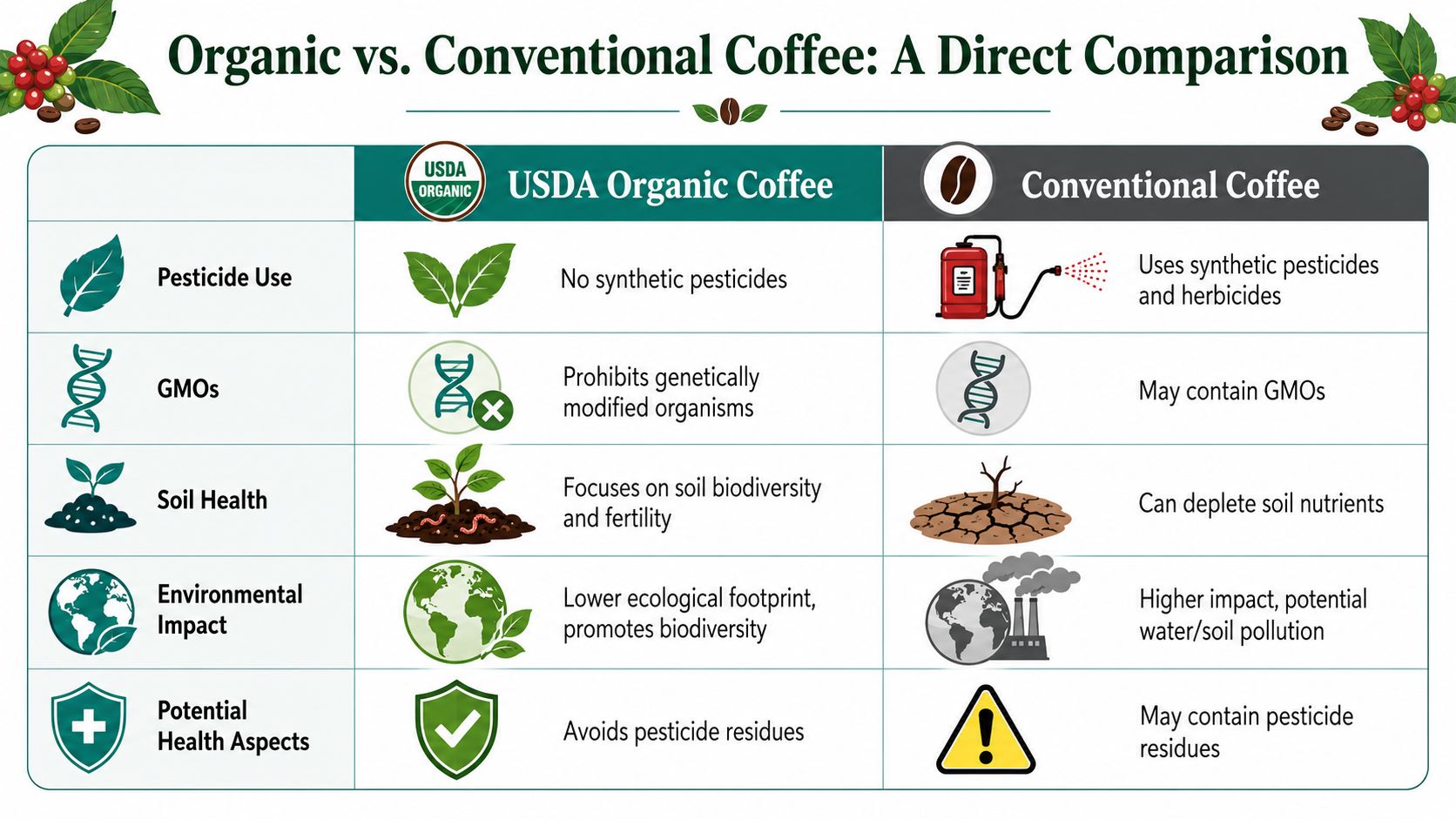
Side-by-side practical differences
| Category | USDA Organic Coffee | Conventional Coffee |
|---|---|---|
| Farming inputs | Prohibited synthetic substances are restricted under organic rules | Synthetic pesticides and fertilizers may be part of the production system |
| GMO position | Organic rules prohibit GMOs | The same blanket prohibition does not define the category |
| Documentation | Certified operations maintain formal compliance records | Recordkeeping varies by producer and buyer requirements |
| Chain-of-custody control | Certified handling is built into the claim | Oversight depends on the company and sourcing model |
| Consumer trade-off | Higher assurance, usually higher price | More flexibility, often lower price |
The strongest case for organic is verification. The strongest case for conventional is flexibility.
That flexibility matters more than a lot of marketing copy admits. A skilled conventional producer may use targeted inputs, manage land well, and deliver excellent coffee at a lower cost. An organic-certified lot may check every box on paper and still taste flat if picking, processing, storage, or roasting are handled poorly. Certification does not rescue weak execution.
The price question is fair. Organic coffee usually carries a premium because the system adds real friction across the supply chain. Farms have compliance costs. Exporters and importers need tighter lot controls. Roasters often absorb purge loss, longer scheduling constraints, and more paperwork. Consumers see one higher number on the shelf. The business sees margin pressure in several places at once.
There is another trade-off that gets skipped in simple organic versus conventional comparisons. Organic certification reduces exposure to certain prohibited inputs, but it does not create a sterile world. Coffee grows outdoors. Soil, water, drift from neighboring land, and environmental contaminants still exist. That distinction matters because some shoppers read "organic" as "zero contamination risk," and that is not what the seal promises.
For consumers, the practical choice is straightforward. Buy organic if third-party verification matters to you and you are comfortable paying more for that chain of controls. Buy conventional if price matters more, or if you trust a specific coffee company that publishes meaningful sourcing details and quality standards without using the organic label.
For businesses, the decision is tighter. Organic can open demand and strengthen shelf appeal, but the added claim only pays off if the operation can protect lot integrity without wasting coffee, time, and labor.
Good coffee exists in both categories. Bad process exists in both too.
Enhance Your Organic Coffee Experience
A lot of the work behind certified organic coffee happens long before the bag hits your counter. The part you control starts at brew time, and that part matters more than many buyers realize. Poor water, scale inside the machine, and old coffee oils in brew parts can flatten a good coffee fast.
From a practitioner's standpoint, this is the same basic principle as certification. Control the variables you can control. The USDA seal helps define the chain of custody and input standards upstream. Your brewer, water, and cleaning habits decide whether any of that effort shows up in the cup.
Single-serve machines make this especially obvious. Keurig and Ninja systems are convenient, but convenience comes with a trade-off. Small brew volumes and tight contact times leave less room to hide chlorine taste, stale residue, or temperature problems caused by scale buildup.
Protect the cup you paid for
If you are spending more on certified organic coffee, a few maintenance habits do more for flavor than chasing another gadget:
- Use cleaner brew water: better water reduces flavor interference so sweetness and origin character have a chance to come through.
- Descale on schedule: mineral buildup affects heat transfer and can push extraction out of range.
- Clean reusable pods and baskets thoroughly: trapped oils turn rancid and make fresh coffee taste dull.
- Use reusable brewing options where they make sense: that creates less waste and fits the environmental priorities that often drive organic purchases.
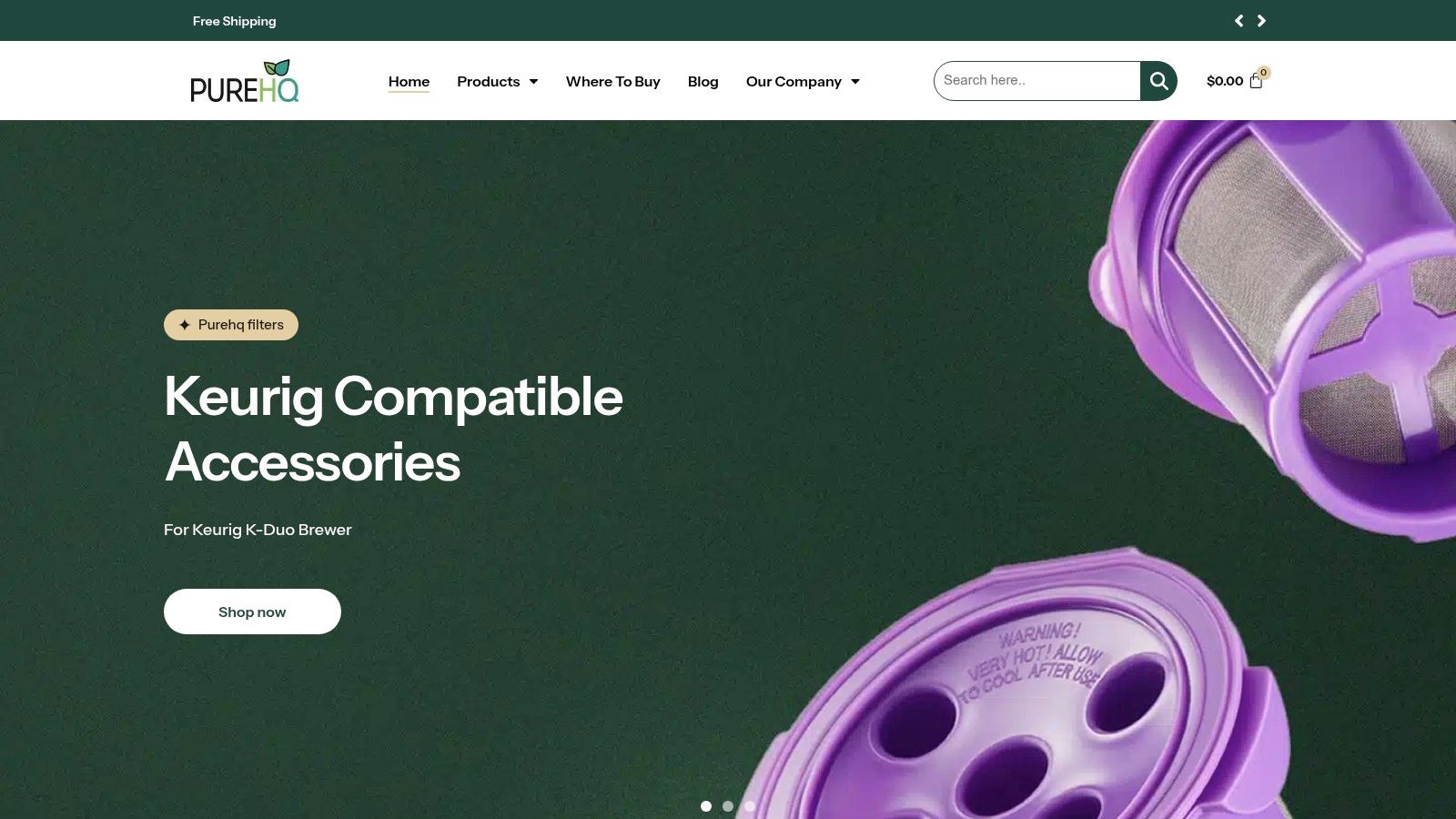
Here's a look at the kind of coffee accessory setup many home brewers use to keep flavor and machine performance consistent.
Small changes that make a real difference
I would fix water and maintenance before upgrading the brewer itself. In real cup quality terms, that usually gives a better return. A simple filter routine and regular descaling schedule often do more than a more expensive machine running with hard water and dirty components.
Reusable K-Cups and refillable pods can work well, but they need attention. Paper liners help with cleanup and reduce oil buildup, which makes daily brewing more consistent and less messy.
Better coffee does not survive sloppy brewing. Water quality and machine maintenance decide whether the cup tastes clean or flat.
Organic certification gives you a more accountable starting point, not a guaranteed great cup. If you want the coffee to taste the way it should at home, your setup has to stop working against it.
If you want practical tools for that last step, shop PureHQ Inc. for reusable K-Cups, Keurig and Ninja-compatible water filters, paper liners, and descaling supplies that help improve consistency and keep brewing equipment cleaner.

