
Coffee Machine Care
Food Grade Cleaning Products for a Better Brew
Jul
You buy fresh beans. You clean the outside of the machine. You still get a cup that tastes flat, sour, or faintly chemical.
That usually isn't the coffee's fault.
In home brewers, the hidden problem is often inside the machine: old coffee oils in the brew path, mineral scale on the heating side, or residue from the wrong cleaner. Hot water pushes through all of it. If the inside of a Keurig, Ninja, or Breville isn't cleaned with the right product and rinsed correctly, your machine can add an invisible off-note to every cup.
Grind size, roast date, or water quality are often the primary focus. Those matter. But the cleaner you use matters too. The wrong product can leave behind taste, attack seals, or solve one problem while creating another.
The Invisible Ingredient in Your Morning Coffee
You descale a Keurig, wipe down the counter, load fresh beans into a Ninja or Breville, and the cup still comes out dull, harsh, or faintly chemical. In home machines, that last layer of flavor often comes from inside the brewer itself.
I see the same pattern over and over. The machine looks clean from the outside, but the brew path tells a different story. Coffee oils cling to pod holders, needles, and carafe pathways. Scale forms on the heating side. A general-purpose spray or soap used on the wrong part can leave behind residue that hot water carries straight into the cup.
That changes taste fast. It also changes how the machine ages.
A cleaner used around food-contact parts has to do two jobs at once. It has to remove the right kind of buildup, and it has to rinse away cleanly without attacking plastics, seals, or tubing. That matters more in compact home brewers than many owners realize, because small water volumes and tight internal pathways make leftover residue easier to notice in the finished coffee. Material compatibility also matters, especially in machines built with mixed plastics, silicone seals, and metal heating components. If you want a practical reference on why that matters, this guide to material selection in filtration and appliance components is useful context.
Commercial kitchens already treat food-contact cleaning as a separate category from general surface cleaning. The same logic behind specialized commercial kitchen cleaning applies at home, even if the scale is smaller. A coffee machine is not just another countertop appliance. It is a hot-water food-contact system.
The biggest real-world trade-off is simple. Stronger is not always better. A harsh cleaner may cut residue quickly but leave taste behind, cloud removable parts, or shorten the life of gaskets and valves. A weak cleaner may feel safer but leave oils and scale in place, which slowly drags down flavor and brew performance.
Common clues point to the cleaner or cleaning method:
- Stale bitterness: old coffee oils in the brew path can leave a dirty, lingering finish
- Flat aroma: scale on the heating side can interfere with temperature stability and mute the cup
- Chemical or soapy notes: household cleaners or poorly rinsed products can show up directly in taste
- Slower flow or odd sputtering: buildup inside narrow passages can restrict water movement
Good coffee can taste bad for boring reasons. In many homes, the invisible ingredient is residue from buildup, the wrong cleaner, or both.
What Food Grade Actually Means for Your Coffee Maker
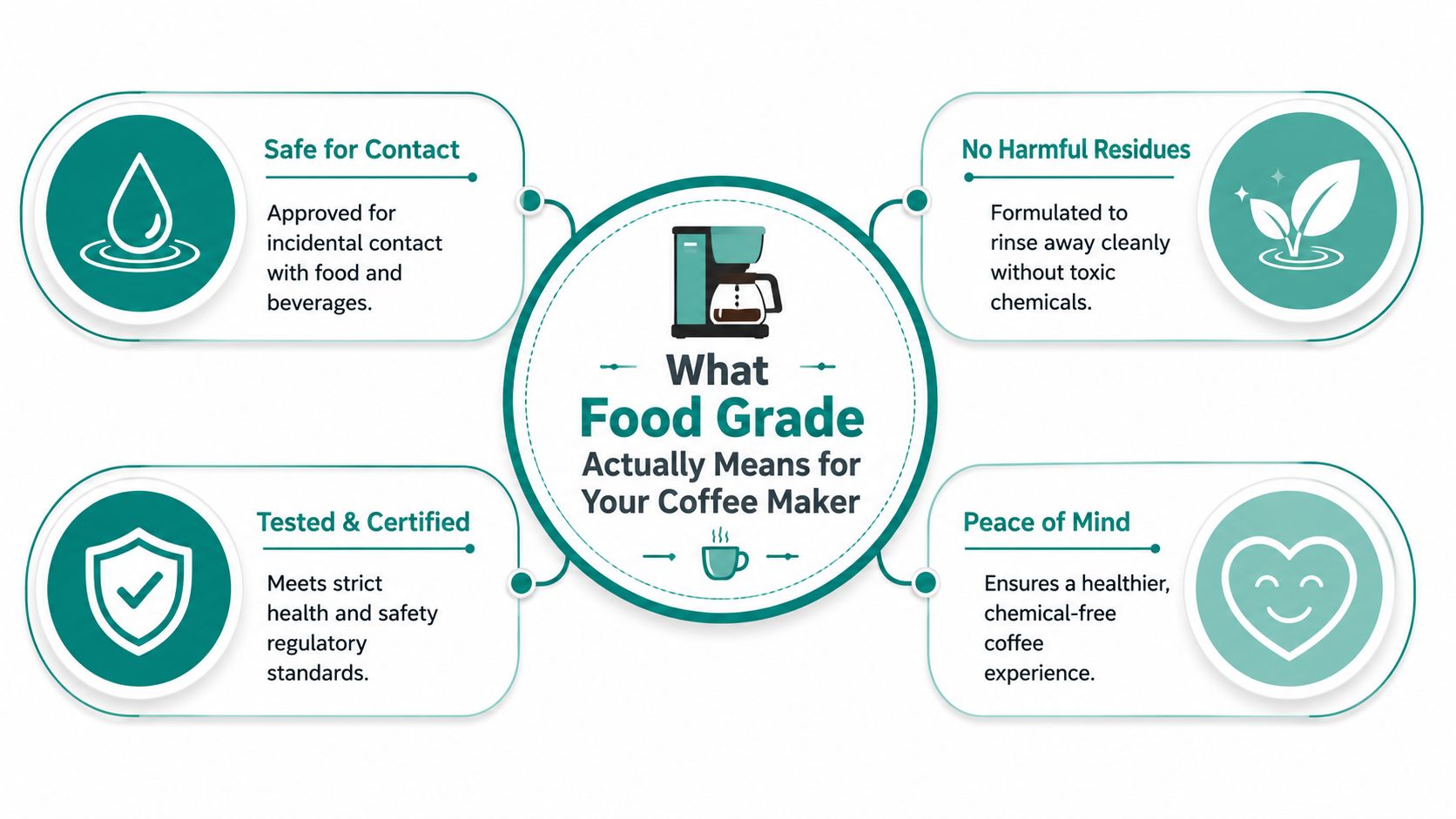
For a coffee maker, food grade means a cleaner is suited to a job where reservoirs, tubes, valves, brew chambers, and exit needles come into direct contact with the water that becomes your coffee. That matters for two reasons at home. The wrong product can leave behind flavor, and it can wear out parts that are expensive or annoying to replace.
The practical version, beyond the label
A coffee machine can look clean and still brew bad coffee. I see this a lot with pod machines and fast drip brewers. A product may cut grime well on a sink or counter, but hot-water pathways inside a Keurig, Ninja, or Breville ask for something more specific. The cleaner has to remove coffee oils and mineral buildup without leaving taste behind or stressing seals, plastic fittings, and small internal passages.
As noted earlier, food grade cleaners are made for food-contact cleaning. In practice, that means the product is intended for surfaces and components tied directly to what you consume, and it is designed with residue control in mind. For coffee equipment, that point matters more than the front label language.
Here is how that shows up inside a brewer:
- Coffee oils cling to brew heads, pod holders, carafes, and outlet areas, then turn stale.
- Mineral scale collects in heating paths, thermoblocks, and narrow tubing, which can throw off brew temperature and flow.
- Cleaner residue can end up in the cup if the product is not suited to food-contact use or if rinse instructions are poor.
Taste is the fast test. If coffee starts carrying a faint chemical note, a plasticky aftertaste, or a flat finish right after cleaning, the product or process was wrong.
What labels should make you read more carefully
Terms like "natural," "plant-based," and "non-toxic" do not tell you enough by themselves. Home users need clearer signals. Good brands explain where the cleaner can be used, how much to dilute, how many rinse cycles are required, and which machine materials need caution.
Support documents help too. If a company provides SDS and COA paperwork, that gives you more to work with than vague claims on the front of the bottle. The same mindset shows up in specialized commercial kitchen cleaning, where food-contact hygiene is treated differently from general surface cleaning because appearance and safe contact are not the same job.
Material compatibility matters just as much as cleaning strength. This overview of material selection for coffee accessories and appliance components is useful because it frames the issue from the perspective of the part itself, rather than just the cleaner bottle.
A cleaner can remove buildup and still leave you with worse coffee if it affects flavor, roughs up internal parts, or is a poor fit for food-contact surfaces.
What this means at home
At home, "food grade" is really about cup quality and machine life. A suitable cleaner helps your next brew taste like coffee instead of last week's residue or yesterday's descaling session. It also lowers the odds of swollen gaskets, brittle plastic, and premature wear in the small parts that keep single-serve and drip machines working properly.
That is the standard to judge by.
Decoding Labels and Certifications on Cleaning Products
The label on a cleaning bottle often creates more confusion than clarity. "FDA compliant" sounds official. "Certified" sounds final. "Natural" sounds safe. Those terms don't all mean what buyers think they mean.
What FDA compliant actually means
One of the biggest misunderstandings is around FDA wording. According to this explanation of FDA 21 CFR food-contact requirements, FDA-compliant materials must meet FDA 21 CFR requirements for food contact, but the FDA does not officially approve or certify products. In other words, a material can comply with the rules without the FDA handing out a consumer-facing badge.
That matters when you're shopping for coffee accessories and cleaners. A seller may talk about compliant materials, but that doesn't mean every use claim on the bottle has been independently blessed by the FDA.
Terms that help and terms that don't
Here's the fast way I sort labels when comparing cleaning products for coffee machines:
- Useful signals: clear food-contact language, detailed instructions, support documents, and manufacturer directions for rinse steps.
- Needs context: "FDA compliant," because it often refers to materials rather than the whole product being certified by the FDA.
- Weak signals: "green," "natural," "gentle," or "eco," because those words don't tell you enough on their own.
If you like process-driven checklists, this resource on structured cleaning for commercial kitchens is useful because it shows how professionals reduce mistakes with repeatable cleaning routines.
Vinegar versus a formulated product
A lot of confusion starts when people compare a pantry staple with a purpose-built cleaner as if they're interchangeable. They're not.
| Feature | Formulated food-grade descaler | White vinegar |
|---|---|---|
| Label clarity | Usually gives machine-use directions and rinse steps | Household use is familiar, but coffee-machine guidance is often improvised |
| Smell after cleaning | Typically designed to rinse cleaner | Odor can linger |
| Flavor impact risk | Lower when used exactly as directed and rinsed well | Higher chance of a leftover smell or taste |
| Material compatibility confidence | Designed for appliance descaling applications | Broad household acid use doesn't guarantee it's the best fit for machine internals |
The main takeaway is simple. Ignore vague feel-good wording. Read the instructions, understand what the claim covers, and pick products made for coffee equipment rather than repurposing whatever is already in the pantry.
Why Vinegar Is Not the Best Choice for Your Machine
Vinegar became the default coffee-machine advice because it's cheap, easy to find, and acidic. That doesn't make it the best option.
It does remove some mineral buildup. The problem is everything that comes with it: smell, taste carryover, and inconsistent results across different machines and materials. In pod brewers especially, the lingering vinegar note can stick around far longer than people expect.
The hidden cost of the cheap fix
I've tested enough home brewers to treat vinegar as a last resort, not a first choice. Keurig-style machines have narrow pathways and small-volume brewing. If vinegar isn't flushed out completely, you taste it. Ninja brewers can hold onto odor in reservoirs and tubing. Espresso-style machines add another layer because seals, valves, and internal water paths punish bad maintenance choices over time.
The bigger issue is control. Vinegar is a household acid, not a purpose-built coffee machine descaler. A formulated product gives you a cleaner maintenance routine because it's designed around appliance descaling, not salad dressing and countertop hacks.
If the machine smells like the cleaner after rinsing, I don't trust the cup that comes next.
Descaling Solution vs. Vinegar for Coffee Machines
| Feature | PureHQ Food-Grade Descaler | White Vinegar |
|---|---|---|
| Mineral scale removal | Purpose-built for coffee machine descaling | Can remove some scale, but results are less consistent |
| Risk to internal parts | Intended for appliance descaling use when used as directed | Household acidity can be a rougher choice for repeated use |
| Lingering taste or odor | Lower risk when rinsed properly | Higher risk of a sour smell or flavor remaining |
| User experience | Clear appliance-focused directions | Often relies on DIY ratios and trial-and-error |
| Best fit | Routine maintenance for Keurig, Ninja, Breville, and similar brewers | Backup option when nothing else is available |
The safety objection people raise
The most common pushback is obvious: "A chemical descaler sounds worse than vinegar."
That's understandable, but it's also too simplistic. Water is a chemical. Vinegar is a chemical. The better question is whether the product is formulated for the machine and whether you follow the directions exactly.
A proper descaler is usually safer for the machine because the manufacturer designs it for descaling use, rinse performance, and appliance materials. Vinegar wins on familiarity, not on precision.
If you're still using the DIY route, it's worth reading this guide on cleaning a Keurig with vinegar just to see the practical limitations and cleanup headaches. Even when vinegar works, it often creates extra rinse cycles and extra guesswork.
Where vinegar fails by machine type
- Keurig: Small internal passages make smell carryover especially annoying.
- Ninja: Reservoir and tubing can retain odor, which affects multiple brews after cleaning.
- Breville and espresso machines: Precision parts reward purpose-built maintenance and punish casual shortcuts.
The machine doesn't care that vinegar is traditional. It cares what reaches the internal components and what remains after rinsing.
Choosing the Right Cleaner for Keurig Ninja and Breville
Once you separate descaling from coffee-path cleaning, picking the right product gets much easier. Most home users mix those jobs together and then wonder why the machine still tastes stale after a descale.
A descaler targets mineral buildup. A cleaning tablet or brew-path cleaner targets coffee oils and residue. Some machines need both.
Match the cleaner to the machine
The broader market tells you this category isn't niche anymore. A Future Market Insights projection for food and beverage industrial cleaning says the market is projected to reach USD 6.1 billion by 2035, with food industry applications accounting for 68.0% of the market. For home coffee users, the practical takeaway is simple: specialized cleaning products exist because generic cleaning doesn't solve food-contact maintenance well enough.
Here's how I break it down by machine type:
- Keurig and other pod brewers: Use a descaler for mineral scale, then use a coffee-machine cleaning tablet or pod-compatible cleaner for coffee oil residue in the brew area.
- Ninja DualBrew and drip systems: Descaling handles the water side. Removable baskets, carafes, and brew-through parts often need separate cleaning for oils.
- Breville and espresso machines: Water-path descaling is one job. Group-head and coffee-path residue are another. Don't assume one bottle handles both.
A simple buying rule
If your machine is brewing slowly, making extra noise, or running hotter and weaker, think descaler.
If your machine brews at normal speed but the coffee tastes stale, bitter, or dirty even with fresh beans, think brew-path cleaner.
This is also where accessories matter. To keep your brew tasting fresh, pairing a regular descaling routine with good water filtration is one of the smartest maintenance habits you can build. Clean water slows scale formation and gives your beans a fair shot.
A practical maintenance setup
For most homes, the routine looks like this:
- Run a descaling cycle when scale symptoms show up or when your machine's maintenance alert appears.
- Clean removable brew parts separately so oils don't keep recirculating flavor problems.
- Use a machine-safe coffee cleaning tablet for brew residue that descaler won't touch.
- Replace filters on schedule so the water going in doesn't speed up the next round of buildup.
If you're comparing cleaner formats, this article on cleaning tablets for coffee machines is worth a read because it explains where tablets help and where liquid descalers still do the heavy lifting.
The compatibility concern
A fair objection is compatibility. People worry a universal cleaner won't fit their exact model.
In practice, compatibility comes down to use case, not branding. Universal descalers usually work across Keurig, Ninja, Breville, Cuisinart, and similar home brewers because mineral scale is the same problem in all of them. A key area of caution involves coffee-path cleaners and tablets. Those should be used in the way the machine design allows, especially with espresso systems and specialty brew heads.
How to Use Food Grade Cleaners Safely and Effectively
The right product helps. The right process matters just as much.
A lot of bad cleaning experiences come from rushing the rinse, guessing the dilution, or treating every cleaner like it's interchangeable. That's how people end up with chemical taste in the cup and then blame the product when the underlying problem was the method.
Rinsing is not optional most of the time
According to 3M's food-contact cleaning guidance, most cleaning products used on food-contact surfaces must be thoroughly rinsed with potable water to remove residual chemicals. The same guidance notes that specific exceptions exist for registered no-rinse food-contact sanitizers when they're used exactly as directed.
For home coffee machines, the safe working assumption is simple: rinse thoroughly unless the product explicitly says otherwise and is approved for that use.
A cleaning routine that works
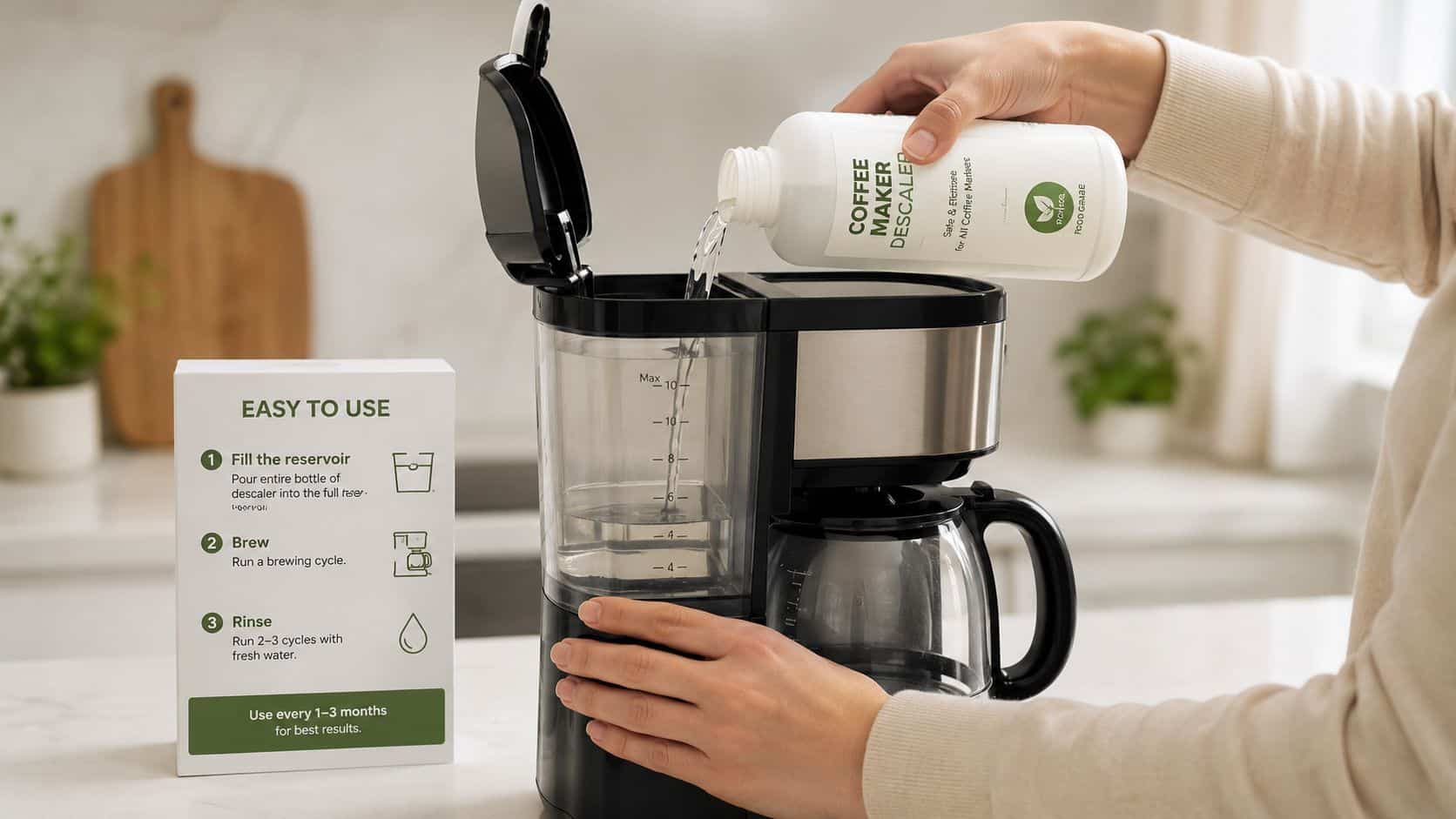
Follow the directions on the label first. After that, this general sequence keeps most home brewers in good shape:
- Empty the machine first. Remove pods, grounds, old water, and any loose residue.
- Mix only as directed. Don't eyeball concentrated cleaners. Too weak and they won't work well. Too strong and you'll spend forever rinsing.
- Run the cleaning or descaling cycle fully. Stopping halfway leaves loosened deposits inside the machine.
- Give the product its contact time. Some sanitizing and cleaning products need a specific exposure period to work properly. The Alsco overview of food-safe sanitizer use notes that food grade sanitizers must be used for the manufacturer-recommended contact time to reduce harmful bacteria on food-contact surfaces.
- Rinse with fresh water until there's no smell or taste left. This is the step people cut short.
- Clean removable parts separately. Reservoir lids, drip trays, pod holders, and baskets often hold onto the residue that ruins the next brew.
A lot of people also look for lower-odor options. This summary of eco-friendly cleaning benefits is useful if you're comparing citric-acid based approaches with harsher-smelling household options.
Common myths that cause bad results
- "If it's natural, I don't need to rinse much." Wrong. Rinse based on product directions and food-contact rules, not branding language.
- "More cleaner works better." Usually false. Overconcentration can make cleanup harder and create more residue risk.
- "Descaling and cleaning are the same." They solve different problems.
- "If I can't smell it, it's gone." Smell helps, but visible rinse cycles matter too.
This walkthrough gives a good visual of the process in action:
Cleaners fail most often when users improvise. Machines reward boring, exact maintenance.
Frequently Asked Questions About Coffee Machine Cleaning
Do organic or natural cleaners get a free pass on rinsing
No. The USDA National Organic Program guidance on cleaners and sanitizers states that no cleaner residue may remain on food-contact equipment regardless of the cleaner's organic status. For coffee machines, that's the end of the debate. "Natural" doesn't mean "leave it in the brew path."
How often should I descale my machine
Follow your machine maker's directions and pay attention to what the brewer is telling you. If brew time slows down, the machine gets louder, or the taste turns dull even with good beans and clean removable parts, scale is a likely suspect.
Water hardness changes the schedule a lot. A machine in a hard-water kitchen needs attention sooner than the same machine using filtered water.
Can I use cleaning tablets in my espresso machine
Sometimes, but only when the tablet is intended for that use and the machine's cleaning routine supports it. Espresso machines have different internal designs than pod brewers and drip machines. A tablet that's fine for one setup may not be the right choice for a group head, backflush routine, or specialized espresso cleaning cycle.
When in doubt, separate the jobs. Use a descaler for the water side and a coffee-residue cleaner meant for espresso components on the brew side.
Why does my coffee still taste bad after descaling
Because descaling doesn't remove coffee oils well. It removes mineral deposits. If stale oils remain in the pod holder, needle area, basket, carafe path, or brew head, the machine can still produce a dirty-tasting cup.
That usually means you fixed the water side but skipped the coffee side.
Are food grade cleaning products worth it for a small home machine
Yes, if you care about taste and want the brewer to last. Small machines are often more sensitive to residue and clogged pathways because they use tighter internal passages and brew smaller volumes. Minor buildup shows up faster in the cup.
The best maintenance routine isn't complicated. Use a machine-safe descaler for scale, use a coffee-path cleaner when flavor goes stale, replace filters on time, and rinse thoroughly every time.
If you want cleaner-tasting coffee and fewer maintenance headaches, shop PureHQ Inc. for descalers, cleaning tablets, reusable pods, and filters built for Keurig, Ninja, Breville, and other home brewers.

