
Coffee Machine Care
Paper Filters for Coffee Machines: Types, Sizes and Taste
Oct
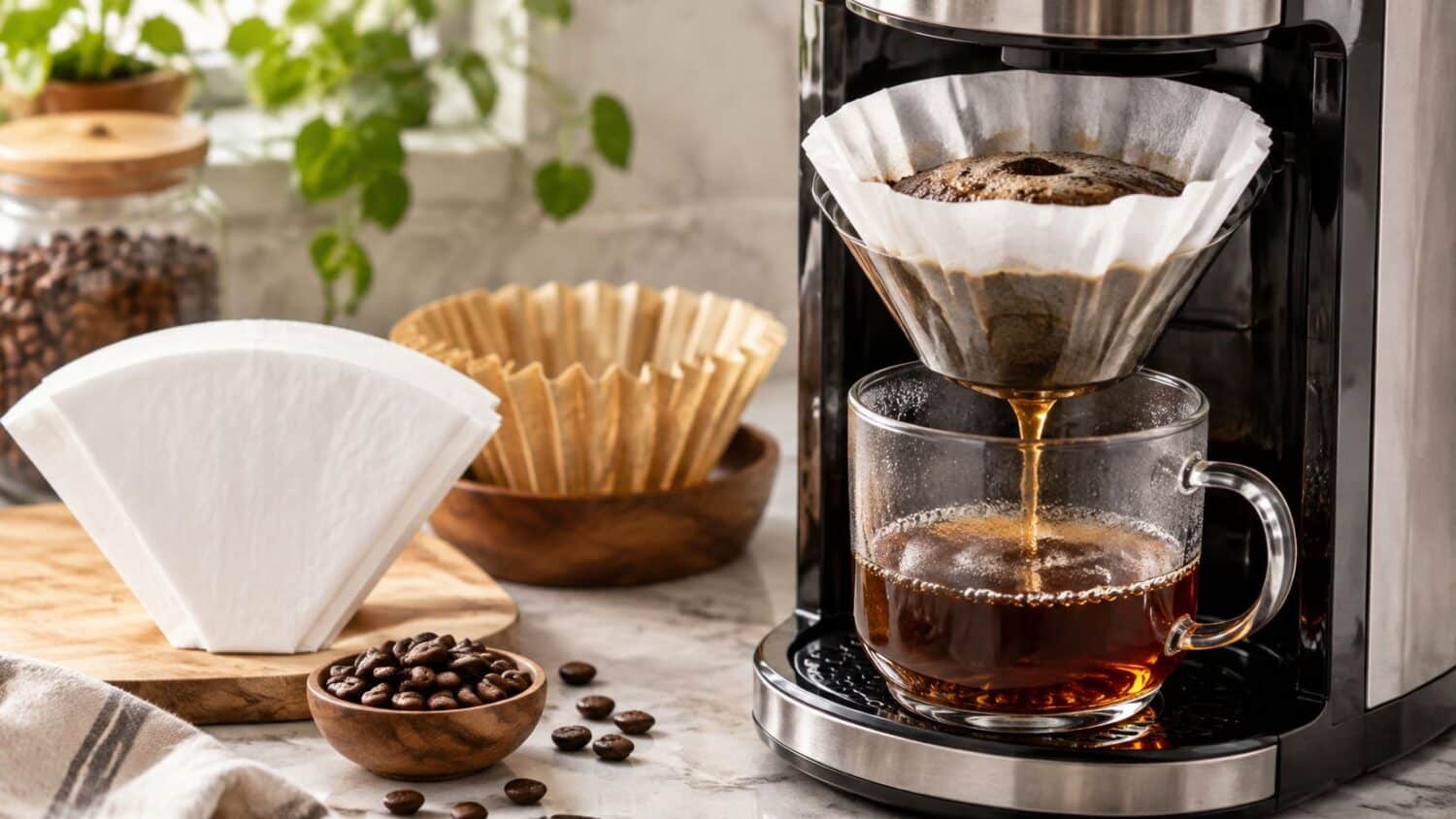
A paper filter that sits crooked does more than look untidy. Water finds the gap, grounds ride into the mug, and the brew turns thin or harsh even when the beans were sound. Many buyers of paper filters for coffee machines stop at white versus brown. Fit and flow decide the cup. A liner that collapses, a cone that stands above the rim, or a basket sheet that leaves a side gap changes both sediment and extraction in the same brew.
Why a Paper Filter Changes More Than the Grounds
In a controlled study, 64 healthy volunteers drank six cups of boiled coffee a day for 17 days, then switched to unfiltered boiled coffee, paper-filtered boiled coffee, or no coffee for 79 days. Compared with paper-filtered coffee, unfiltered coffee raised total cholesterol by 0.42 mmol/L, or 16 mg/dL, and LDL cholesterol by 0.41 mmol/L, also 16 mg/dL. Apolipoprotein B rose by 8.6 mg/dL. In that trial, the paper-filtered group showed no significant lipid change compared with the no-coffee group, but the result depends on how many cups are drunk each day, as discussed below. Paper holds back much of the oily fraction that carries cafestol, though results can vary with the paper used. The American Heart Association journal record reports the study findings.
Paper holds back fine grounds and oil droplets while dissolved flavor passes into the cup. Filter fit and flow affect what gets through: a gap can let water bypass the grounds, while a sheet that collapses can slow drainage and contribute to overflow.
A poor fit can leave coffee gritty and thin at the same time. Grounds escape through gaps, while bypassing water extracts less from the coffee bed. A sheet bunched above the rim can send brew over the edge.
Practical rule: Seat the paper fully before you blame the beans.
Choose a filter that matches the holder, then check that it stays in place as water flows through.
Paper Filter Sizes Matched to Each Machine
Size follows the basket or the pod, not the logo on the front. Cone filters in the Melitta numbering system are sold by cup capacity, and Keurig lists pod specs on its support pages. Check those charts before you trust a box that only says "fits most." A four-cup drip maker from one brand can use a different holder than a four-cup maker from another.
Read the holder, then the pack
Small drip makers, up to about four cups, usually take a size 1 cone. Eight- to twelve-cup makers usually take a size 4 cone. A flat basket needs a basket filter cut to that basket's diameter and depth. A reusable K-Cup needs a disposable liner cut for that pod cup. A U-shaped size 4 is not a V02. The numbers look related. The holders are not, and the papers are not interchangeable.
Measure diameter and depth with a ruler. Ignore the cup count printed on the machine. That number is a serving size the brand chose, not a paper size.
| Machine or Brew Type | Filter Form | Size or Fit | What to Check |
|---|---|---|---|
| Single-serve or small drip maker up to 4 cups | Cone filter | Size 1 cone (1-4 cups) | Confirm the cone angle matches the holder |
| Drip maker 8-12 cups | Cone filter | Size 4 cone (8-12 cups) | Confirm the cone sits fully inside the holder |
| Basket-style drip maker | Flat basket filter | Matched to basket diameter | Measure diameter and depth before buying |
| Keurig reusable K-Cup pod | Disposable paper liner | Sized to the pod cup | Check the pod model before buying |
| Ninja DualBrew or other pod-and-grounds machine | Paper liner or basket filter | Sized to the pod or basket | Match the liner to the pod cup, or the basket paper to the grounds basket |
If your holder is a wedge rather than a flat tray, a note on how cone filters sit in a coffee maker shows the angle you are trying to match.
Two ways the wrong size fails
Too small: The paper leaves a gap at the sides. Grounds and water bypass the sheet, so you get sediment and a fast, weak draw.
Too large: The paper folds on itself or sits above the rim. Water climbs the fold and spills onto the counter or into the machine.
Brewing fewer cups than the basket was built for doesn't call for a smaller filter. Keep the full-size paper and use less coffee. A short sheet in a wide basket is a bypass path. It still has to cover the floor and the walls, or the water never meets the dose you measured.
Bleached, Unbleached and Cone Versus Basket Filters
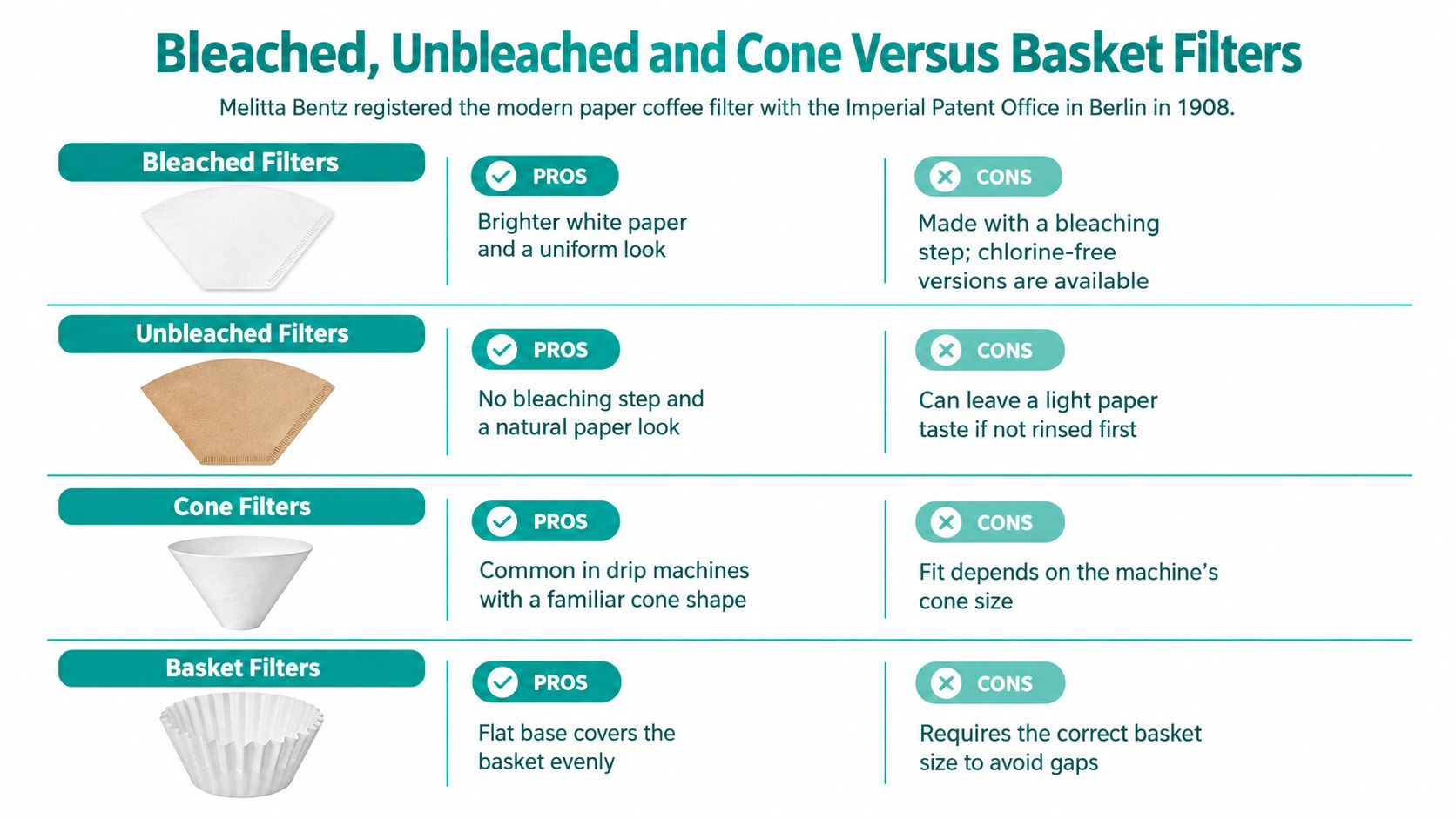
On June 20, 1908, Melitta Bentz registered a paper coffee filter with the Imperial Patent Office in Berlin, and the German Patent and Trade Mark Office account records that the protection was entered on July 8, 1908. She wanted the grounds out and less of the bitterness that comes from stewing the coffee.
Bleached paper is white because the mill whitened it. Unbleached paper stays brown because that whitening step was skipped. Color doesn't show how well a sheet holds grounds or oils. Pore pattern and how the paper sits do that work.
Shape changes the flow
A cone funnels the grounds toward a point. Flow depends on the cone angle and how far the paper drops into the holder. A basket is flat and wider, so the grounds spread in a shallow bed. That shape suits many automatic drip machines, where the shower head wets a broad surface instead of a narrow tip.
- Cone filters: Pour-over cones and small drip makers whose holder tapers.
- Basket filters: Larger drip machines with a flat-bottomed basket.
- Disposable liners: Reusable pods, one brew, then the bin.
Choose the form your machine was built for, then choose the paper.
A bright white cone stuffed into a flat basket will crease along the floor. A brown basket sheet dropped into a steep cone will not seal the point. Rinse an unbleached sheet with hot water if the first cup tastes like wet cardboard. Skip that rinse on a white sheet when you don't notice a paper note.
What Paper Filters Hold Back and What Reaches the Cup
A paper sheet does two jobs at once. It is a particle barrier and a lipid trap. Fine grounds and oil droplets stay on the sheet while dissolved flavor compounds pass into the cup. How well it does both depends less on color or brand than on whether the paper seats flat and holds its shape through the brew.
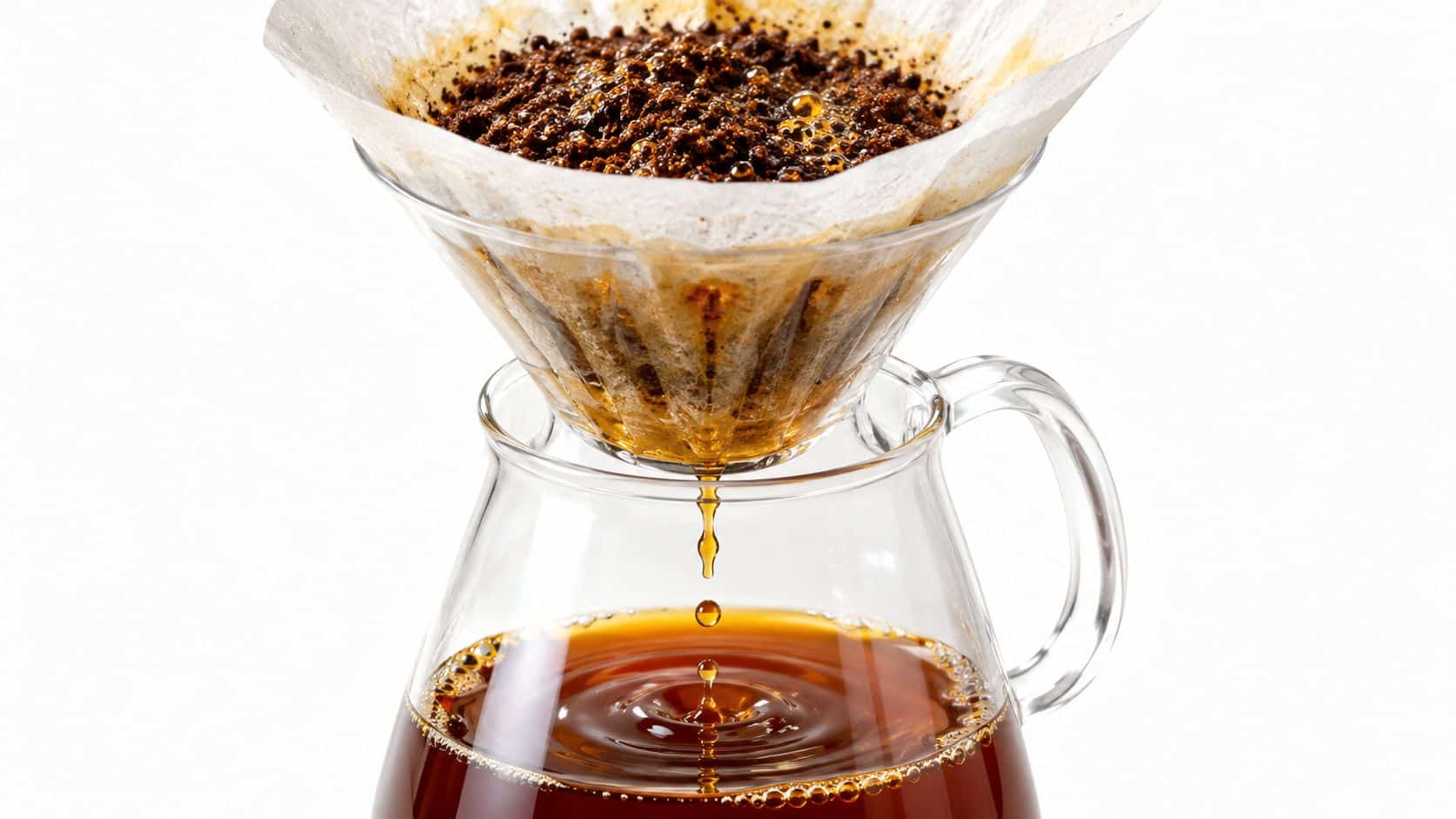
A 2023 peer-reviewed review reported that paper filtration allowed only about 8.1 mg/L of diterpene esters and 4.4 mg/L of diterpene alcohols to percolate, well below boiled coffee, because the paper keeps roasted particles and those compounds don't readily wash back off the retained grounds, as described in the Nutrients review on PubMed Central.
That retention is exactly what a collapsed or creased filter gives up. A sheet that folds under the water load opens channels along the holder wall, and fines and oil take that path straight into the carafe.
Taste shifts with the material
The same beans don't taste the same through every barrier. In a comparison brewed with water at 93 °C, paper-filtered samples, including V60 and AeroPress methods, held higher shares of caramel- and floral-associated compounds. Metal-filter methods produced more fruity and roasted notes, according to the Foods journal comparison. Temperature and paper worked together, so the sheet was acting as more than a grounds net.
Sediment is usually a seating problem
Grit in the mug usually means the paper tore, folded, or never sat flat. It is rarely proof that the brand is bad. Three checks tell you whether the sheet did its job:
- The cup is free of sludge. A thin line of fines at the bottom points to a tear or a gap at the wall.
- The stream stayed steady. A gush in the first seconds means water found a channel around the paper rather than through the bed.
- The body is lighter than metal-mesh brewing. Less oil in the cup reads as a cleaner, thinner feel against the same coffee through a mesh screen.
Frequent cups are not a free pass
Paper filtering removes much of the oily fraction, but it does not make coffee cholesterol-neutral for everyone. How much reaches the cup still depends on the paper, the dose, and how many cups you drink each day. If you already track cholesterol, treat your daily intake as a question for your clinician rather than assuming every paper-filtered mug is identical.
Choosing a Paper Filter for Keurig and Other Machines
Origin and a bleached stamp are weak buying signals. Pore structure, grind size, and dimensional fit decide the cup.
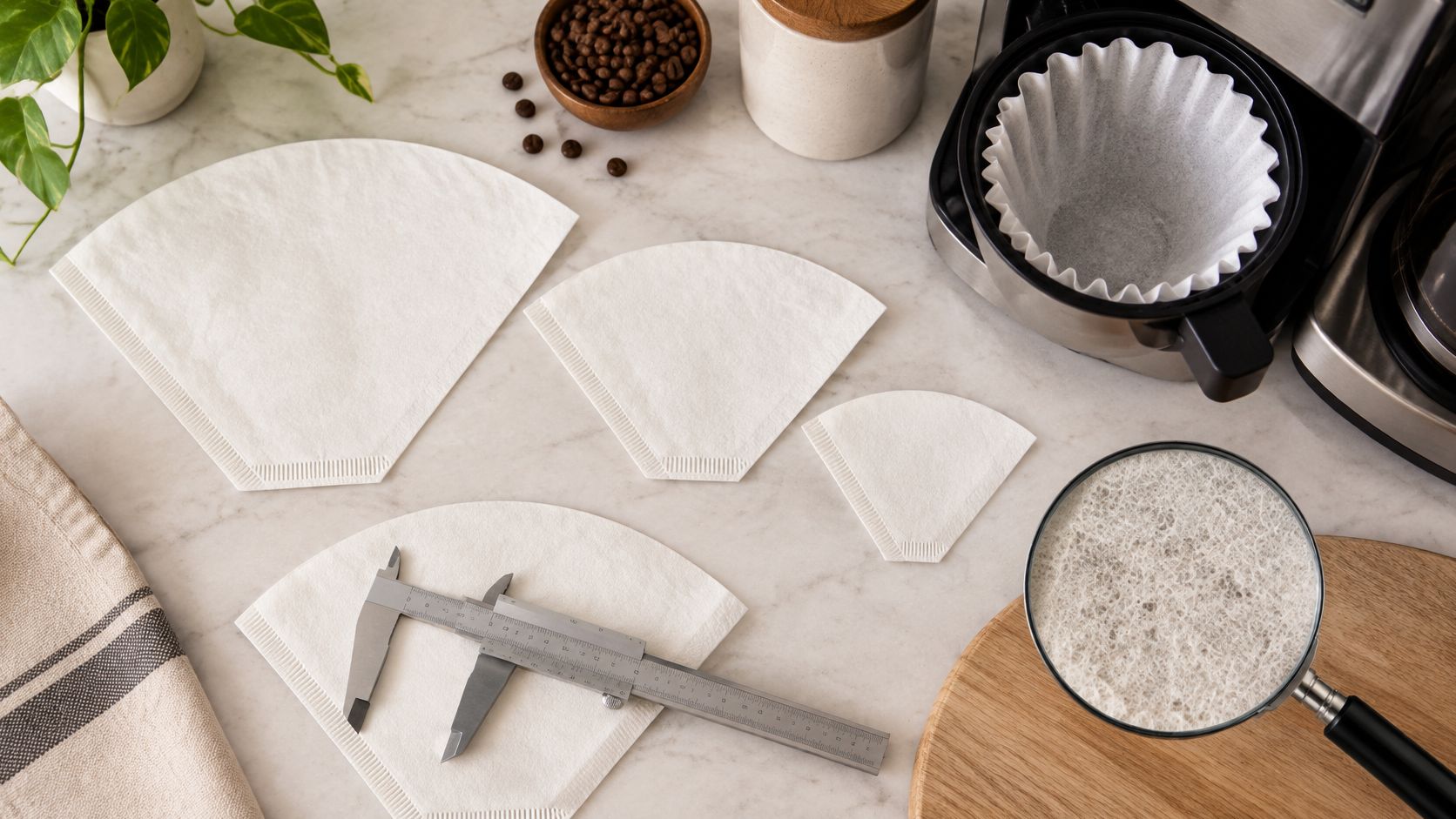
A 2018 comparative study measured filters from Brazil, Japan, the United States, Germany, France, and the Netherlands. Basis weights ran from 50.46 to 67.48 g/m². Brewed cafestol ranged from 1.62 to 2.98 mg/L and kahweol from 0.73 to 1.96 mg/L. Papers from different countries had broadly similar diterpene retention, while pore structure and grind size were the decisive variables, according to the FAO AGRIS record of that comparison. Micro-perforated filters produced the highest diterpene concentrations among sheets of similar size. A shortcut hole for faster flow is a path for coffee oil.
What to check before you order
- Machine and model: Name the brewer and the exact pod or basket. "Keurig" alone is not a size.
- Exact fit: Match the form to the holder you measured, cone, basket, or liner.
- Paper weight: Prefer a pack that states a consistent basis weight. Many don't.
- Seams: Reject crushed rims and split seams in the store or on arrival.
- Returns: Keep a seller that accepts a wrong model.
A walk-through of disposable filters for K-Cups covers liner use on a reusable pod without turning into another size chart.
| Criterion | PureHQ Paper Liners for Reusable Pods | Generic Paper Filters |
|---|---|---|
| Fit to the pod or basket | Made for reusable K-Cup pods (confirm the model list on purehqfilters.com) | Set by each listing and brand |
| Paper specification (basis weight, pore pattern) | Not stated on the product page | Rarely published |
| Leak or overflow risk when fit is correct | Low when the liner matches the pod model | Higher when the seam or basket fit is poor |
| Sold as | Disposable liners in packs | Loose sheets or cone and basket packs |
| Price per brew | Shown at checkout on purehqfilters.com | Shown by the seller |
| Return and warranty policy | Straightforward return and warranty policy (see purehqfilters.com) | Set by the seller |
Leaks, labels, and scale
Most leaks come from a liner that doesn't match the pod, not from the fiber itself. Check the model list before you order. A machine marked "filtered" doesn't state the material, the pore size, or the paper weight. Read what the maker specifies before you assume the brew matches a full paper wall in a drip cone.
A descaling solution belongs next to a paper-lined routine. Scale narrows the path through any sheet, and a slowed stream can push water over the rim.
The clip below shows a liner going into a reusable pod with the rim kept inside the cup.
How to Load a Paper Filter Without Leaks or Overflow
Match the model first. Check the filter against the basket or pod model, because a mismatch is the top cause of leaks. The usual slip is a box labeled universal that is neither your cone angle nor your pod.
Open every pleat. Unfold the paper fully and press it into the holder with a fingertip so the sides lie flat. A folded edge is a channel, and water will use it to skip the grounds.
Dose for the sheet. Add only the amount of coffee the filter is sized for. An overfilled basket swells as it wets and rises over the rim. That is the Saturday-morning pot that floods the warming plate.
Level, don't tamp. Spread the grounds with a light shake. Packed coffee slows the flow and shoves water sideways, out through a seam or over the lip.
Keep the rim inside. Confirm the seam or the top edge sits below the holder edge. A filter standing proud of the rim is the usual overflow. Tuck it before you close the lid. On a pod, the liner's wall should meet the cup all the way around, with no ear of paper sticking up into the puncture needle's path.
Watch the first minute. Start the brew and stay for the first cycle. A liner that floats, or a cone that tears, shows up before the carafe has an inch of coffee. Stop and reseat if you see a muddy streak racing down one side.
Pull the paper out. Remove the used sheet when the brew ends. Soggy paper left in the holder smells stale by the next morning and often tears when you drop a fresh one on top of it.
If the cup is wrong
Grounds in the cup: Look for a tear or a wall that never touched the holder. Swap the sheet. Don't stir the mug and call the grit body.
Weak coffee: Check grind and dose before you blame the paper. A coarse grind in a fast basket under-extracts even when the filter is perfect. If the flow was a flood in the first seconds, the seat failed and the water bypassed the bed. I would start with the cheapest fix, a fresh sheet pressed flat, before I changed beans.
Environmental Impact and Disposal of Paper Filters
A life-cycle assessment of pour-over coffee modeled a paper filter weighing 1.7 grams. In one scenario, filter paper disposal accounted for more than 60% of the total impact in the freshwater and marine ecotoxicity categories, as set out in that life-cycle assessment. A separate comparative life-cycle assessment found that end-of-life disposal contributes a small share of a coffee system's total impact.
Why both numbers belong in the same decision
A light sheet doesn't make the bin irrelevant. Disposal may not be the largest slice of a cup's footprint either. The result moves with how much coffee you brew, the energy behind the machine, how the paper was made, and whether spent grounds sit inside the boundary.
The practical reading: the grams matter less than how many sheets you throw away unused. A filter that collapses or seats badly costs you the paper and the brew that went through it.
Three habits that actually cut waste
Buy the size you measured. Extra paper crammed into a small holder is waste, and a short sheet that overflows wastes the coffee with it.
Stop the bad brews. A torn liner you dump and remake costs more coffee than the sheet ever weighed.
Follow the local rule. Compost only where the facility accepts unbleached paper and coffee grounds. Otherwise the used filter goes in household waste. Cafés sorting takeaway waste can use this packaging disposal guidance for UK cafés to separate compostable claims from biodegradable ones. At home, a closer look at biodegradable coffee filters helps when a pack's wording is doing more work than the fiber.
Pick the Right Filter and Shop PureHQ Liners
Measure the basket or the pod cup first. That single measurement settles most fit problems, because the paper has to touch the walls, not merely share a brand name with the machine.
Pick the form the machine was built for. A drip maker wants a cone or a basket. A reusable pod wants a disposable liner, not a cone torn down until it sort of fits.
Choose a paper that seats fully and keeps a consistent weight, and check that the pack names your exact model. PureHQ disposable paper liners for reusable K-Cup pods, sold at purehqfilters.com, are built for that pod path. Confirm your pod model against the model list on purehqfilters.com, then add the matching liner pack to your cart before checkout. PureHQ also sells through its Amazon Store, and the brand offers a straightforward return and warranty policy if the fit is wrong.
PureHQ Inc. sells disposable paper liners for reusable pods, along with descaling solutions and other accessories for Keurig and Ninja brewers. If the next pot depends on a liner that matches the cup rather than a generic sheet, visit PureHQ Inc., confirm the model, and add the matching pack before you check out.

