
Coffee Machine Care
Lining Paper Thickness Explained: Grades, Fit and Brewing
Nov
Two packs of pod liners sit side by side on a shelf. One promises 0.15 mm. The other advertises 50 gsm. Neither number tells you which one will split when you tamp, which one will let grit into the cup, and which one will choke the drip so your mug fills at half speed.
That's the trouble with lining paper thickness as it's usually sold. Thickness, weight and grade are three separate measurements, and product listings mix them freely. Once you know what each number measures, the choice stops being guesswork.
Why Liner Thickness Decides Your Cup
Your pod is full, the lid is on, and the brew button is lit. The mug fills, and there's a film of coffee grounds across the bottom. Or the machine sputters and delivers half a cup in twice the usual time. The coffee is the same bag you finished last week. The grind hasn't changed. What changed is the paper.
Thickness controls three things in a reusable pod, and they're easy to separate once you name them. It sets how the liner sits in the basket, because a sheet that's too thick for the rim won't seat flush and water finds a path around it. It sets how well fine particles are filtered, since the fibre network behind the sheet decides what stays in the basket. And it sets whether the liner holds its shape through a cycle of hot water, pressure and a firm tamp.
A liner that's too thin tears and lets grounds through. A liner that's dense and heavy can do the opposite damage: it slows drainage, stretches the brew, and leaves you with a bitter cup and a soggy basket. Both failures look like machine problems and neither one is.
The frustrating part is the packaging. Most listings give one figure, either a thickness or a weight, and leave the buyer to infer the rest. A single number can't carry that much information.
What follows is the working knowledge that fills the gap: what caliper and grammage mean, how thickness changes fit, filtration and brew speed, how premium and generic liners differ on paper, what food-contact documentation should show, and how to match a liner to the way you brew.
Caliper, Grammage and Grade Numbers Explained
Two packs can carry the same printed number and still feel nothing alike in the hand. One sheet stands up, bulky and open. The other lies flatter and denser. The label has not told you which property changed.
Grammage is mass per unit area, written in grams per square metre (gsm). Caliper is the physical depth of one sheet, reported in micrometres, millimetres or mils. The unit conversions are exact, as DS Smith's paper conversion factors set out: one mil equals 25.4 micrometres, and one millimetre equals 1,000 micrometres. What does not exist is a universal conversion from gsm to thickness, because fibre density, coating, compression and bulk differ between paper grades.
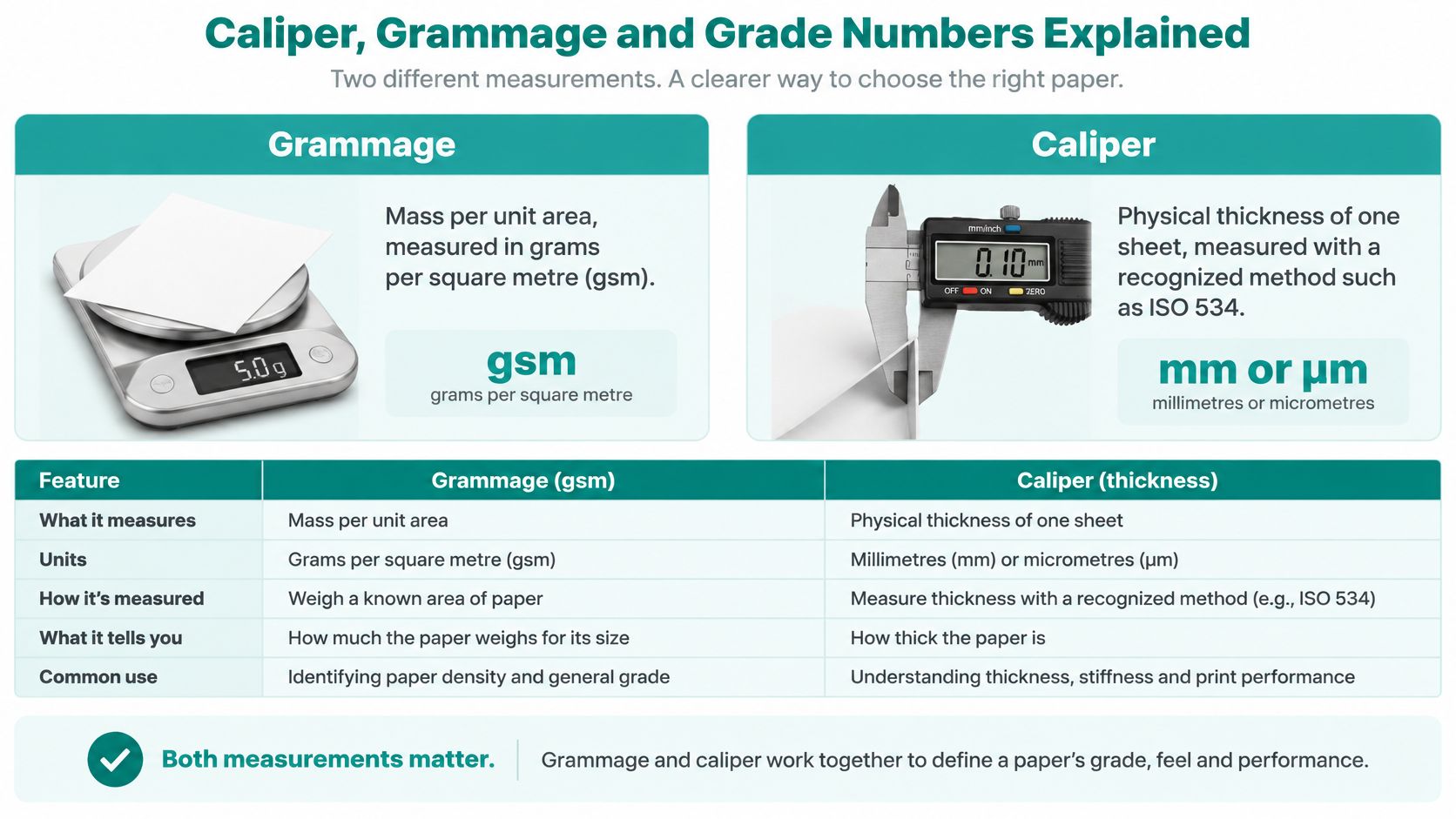
Grammage works like the weight of a folded blanket. Caliper works like the height of that same blanket once you press it. A compressed blanket and a lofty one can share a weight and still differ in height. A dense sheet can be heavy and thin at once. A bulky sheet can fill a basket or cover a wall without carrying proportionally more mass.
| Paper or board | Thickness | Basis weight |
|---|---|---|
| 75 gsm copy paper | about 102 micrometres | 75 gsm |
| 118 gsm text paper | 132 micrometres | 118 gsm |
| 216 gsm cover stock | 241 micrometres | 216 gsm |
Weight climbs from 75 to 216 gsm, and thickness climbs with it, but not in a straight line you could calculate from one figure alone. Read each row as a pair. The table is a set of examples, not a formula that turns gsm into micrometres.
Why the same weight can give two thicknesses
Caliper should be measured to a recognised method, such as ISO 534 for single-sheet thickness, with results reported in micrometres or mils, as Britannica's overview of paper properties explains. Consistency across the sheet matters as much as the average. Local thin and thick spots later show up as ridges, uneven joints or patchy absorption. Measure several points across a roll and compare the spread with the supplier's declared tolerance.
What a grade number such as 1200 actually tells you
Wall decorating uses another language. As the DIY.com guide to hanging lining paper notes, UK lining paper runs through numbered grades, from 800 grade, described as the thinnest commonly available option, up through 1000, 1200, 1400, 1700 and 2000 grade, the thickest standard grade. These are trade classifications tied to rising paper weight, not fixed thickness values set by a single British Standard.
A 1200 from one mill can differ from a 1200 from another. The number ranks the paper inside that trade scale. It does not state micrometres, and it does not state gsm.
The grade follows the job. 1200 and 1400 do the general-purpose work on ordinary walls, while 1700 and 2000 get specified for rougher surfaces because the extra body masks pitting and bridges fine cracks.
Practical rule: If a listing gives you one number, you do not have a specification yet. Ask for caliper and grammage together.
How Thickness Changes Fit, Filtration and Brew Speed
A liner can fit the basket yet still let grounds through, drain slowly, or lose its shape. Paper varies in both physical thickness and weight per area, so a single figure cannot predict how it will behave. Check the caliper and grammage on the product's own datasheet, then consider the liner's fit and filtration information.
A liner that tears during filling, tamping, or removal can release grounds through the split. At the other extreme, a thick or dense liner may slow water flow. Similar caliper readings do not guarantee similar performance: papers can differ in fibre density, porosity, and strength.
| Symptom | Likely cause | Thickness fix |
|---|---|---|
| Grounds in the cup | Liner tears during tamping or removal | Choose a tear-resistant liner that seats flush |
| Brew runs slow or long | Liner is too thick or dense for the flow | Choose a lighter liner with a more open structure |
| Fine particles in a cloudy cup | Fibre network allows particles through | Look for stated filtration or porosity information |
| Liner will not seat in the basket | Thickness or diameter does not suit the basket | Check the liner's dimensions against the basket |
| Liner goes soggy or loses shape | Paper does not hold up under the brewing load | Compare the stated grammage with caliper and fit |
Reading a symptom instead of a number
Use the cup and the basket as clues. A cloudy, gritty cup can indicate that the filter is too open for the grind. Slow drainage may point to a dense liner, while a liner that bunches or will not lie flat suggests a fit problem.
A repeated change matters more than one brew. If cups stay cloudy, look for a liner with filtration information that suits your grind. If the brew slows, check that the liner is correctly seated and compare its paper specifications.
Fit comes first: a sheet cut too large or too small can fold, bunch, or leave gaps. For pod brewing, choose disposable filters made for K-Cups in the right shape for the holder. Then compare caliper, grammage, dimensions, and any stated filtration performance on the product's own datasheet.
Premium Liners Compared With Generic Paper
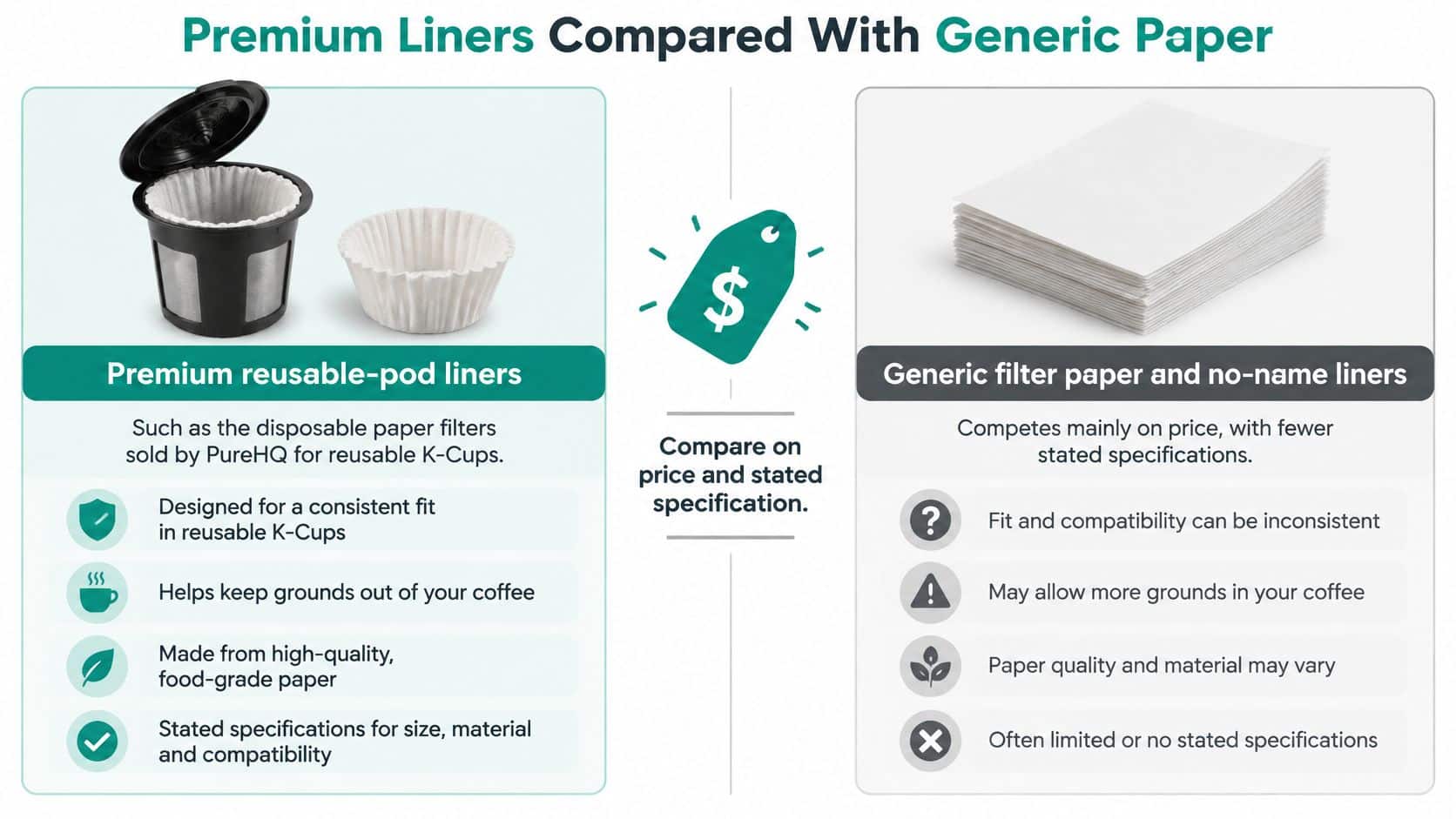
A premium reusable-pod liner and a generic sheet of filter paper can look identical through the plastic. The difference lives in what the seller is willing to state, which is why four checks do more work than any marketing claim.
| Check | Premium liner | Generic liner |
|---|---|---|
| Caliper reported in micrometres | Ask the seller for the measured figure | Rarely stated on the listing |
| Basis weight reported in gsm | Ask for the figure alongside caliper | Sometimes stated, without caliper |
| Porosity or filtration data | Request pore or porosity data | Seldom offered |
| Explicit food-contact statement | Ask for the document, not the word "safe" | Rarely supplied with the pack |
Thickness and pore size are not the same measurement. One published filter paper specification pairs 50 g/m² paper at approximately 0.15 mm thickness with a stated filtration porosity of 15 to 25 micrometres, per the V60 filter paper specification. A thicker sheet can still have open pathways if it's lightly formed, and a thinner sheet can filter tightly if its fibres are packed densely.
A missing figure is information too. When a seller can't tell you the caliper, ask why before you assume it's fine.
The leak objection
Leaks are the complaint that sends many buyers back to a branded capsule. The check is caliper plus any stated tear or fill test result. A stated thickness tells you how much material sits between the grounds and the wall of the pod; it can't prove that every pod seals, because seating depends on how the sheet meets your basket rim.
The fit objection
A liner that's too thick may sit proud of the basket and stop the lid closing properly. Compare the stated thickness and diameter against your basket before ordering, and treat "universal" as a claim to verify rather than a specification.
The durability objection
Durability under tamping and removal is largely a basis weight question. A heavier sheet carries more fibre into the same area, which is what resists a tear at the rim. What a basis weight figure can't tell you is how the sheet behaves wet, and that's where the testing procedures behind a liner matter more than any single number on a pack.
The honest summary is that spec sheets narrow the field and your own first three brews settle it. Buy a small pack, watch the cup and the clock, then commit.
Checking Food-Contact Safety Beyond Thickness
A liner may have the right caliper and still raise a separate question: what materials can contact the coffee? Thickness describes the sheet's physical depth. It does not describe its composition or establish that it is suitable for food contact.
The FDA defines a food-contact substance as a material that contacts food without being intended to produce a technical effect in it. A substance that qualifies as a food additive generally needs authorization before it is marketed in the United States, as the FDA explains its regulation of food-contact substances. Paper, coatings, adhesives, colorants, antimicrobials and antioxidants may all be relevant to that review. Manufacturers are responsible for ensuring their materials meet applicable authorizations and limits.
FDA guidance connects the Threshold of Regulation pathway with a dietary concentration level of 0.5 parts per billion and describes a 120-day review period for a Food Contact Notification. The notification applies only to the substance, supplier and conditions it names, according to FDA guidance on premarket submissions for food-contact substances. A clearance for one formulation does not automatically cover another mill's materials.
When asking about a liner, focus on the components that may touch the coffee:
- Fibres and bleaching agents: These make up the base sheet and its contact surface.
- Binders and wet-strength additives: These help the paper hold together when saturated.
- Dyes and adhesives: These matter where a seam or printed mark meets hot liquid.
Look for a clear statement that the paper is intended for food contact, compliance information from the manufacturer, and details about the materials used. Whiteness, grammage and a “natural paper” label do not establish compliance. Food businesses document the materials that contact their products, as illustrated by food safety standards for craft chocolate.
Choosing between unbleached paper coffee filters and white paper comes down to processing preference. Neither choice replaces food-contact compliance information.
Choosing the Right Liner for Your Brewing Habits
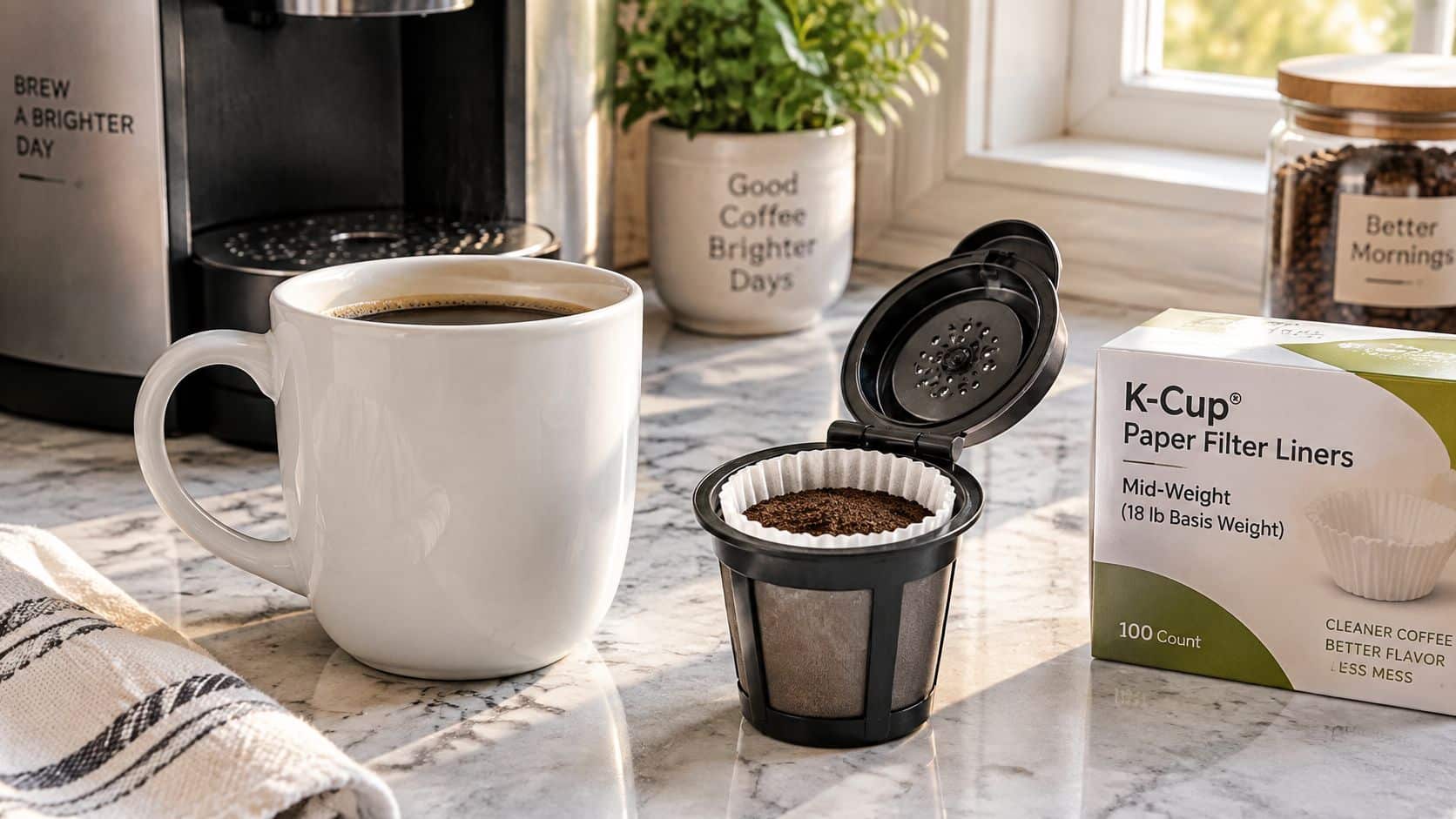
Four brewing patterns cover most households, and each points to a different thickness profile. The two numbers to check first are always the same: caliper and basis weight.
One cup a day, light tamp. A mid-weight liner with a stated basis weight and a diameter that seats flush in your basket is plenty here. You're not stressing the sheet, so extra thickness buys nothing. If the cup turns cloudy in the first week, the filtration is too open for your grind.
A household brewing large cups several times a day. Repeated filling and removal wears a liner faster than a single daily cycle. Step up in basis weight so the sheet keeps its shape through the third and fourth pod of the morning.
A firm tamper who fills pods high. Choose the thickest liner that still lets the lid close, and look for tear resistance at the rim. Overfilling a dense sheet is how splits start. Watch for a liner that bulges above the basket after brewing; that's your sign the load is past what the paper handles.
A breakroom or small office. Consistency across a batch beats peak performance in one box. Confirm the caliper is stated and holds steady between packs, because a wobbly liner makes every pod brew differently and nobody can tell whether the machine or the paper is at fault.
One limit applies to all four. A thicker liner isn't automatically better. Extra density can slow drainage and stretch the brew, and a slow cup tastes bitter regardless of how premium the paper is.
Buying check: the right liner is the thinnest one that survives your tamp and still gives a clear cup at your normal brew time.
Choose Your Liner Thickness and Order Now
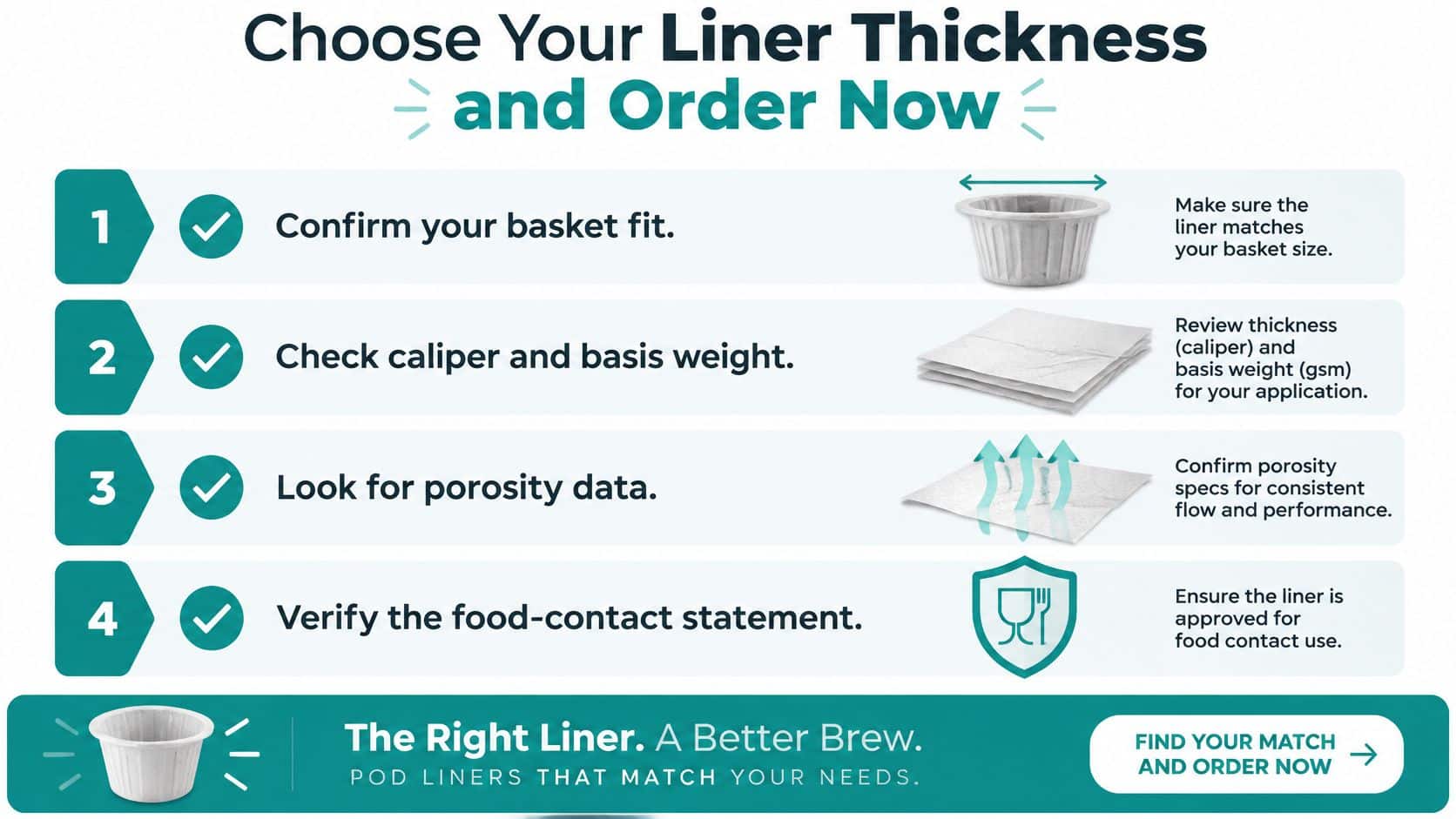
Four checks settle the purchase, in this order. Confirm your basket fit against the stated diameter, because no paper performs well if it doesn't seat. Check caliper and basis weight together, since either number alone leaves performance undefined. Look for porosity or filtration data, which predicts clarity in the cup. Verify the food-contact statement, because a compliance document is the only thing that speaks to hot liquid passing through the sheet.
For Keurig K-Duo owners, the Keurig K-Duo Paper Filters for Mesh Basket come in a 100-pack and fit the K-Duo, K-Duo Plus and K-Duo Essential machines. For reusable K-Cup users, the Disposable Paper Filters for Reusable K-Cups (100 pack) are priced at $12.95.
Whichever liner you run, keep the brew path clean. A descaler or a cleaning tablet used on the schedule your machine asks for keeps flow consistent, so you're judging the paper rather than a scaled-up pump.
Shop the Disposable Paper Filters for Reusable K-Cups (100 pack) from PureHQ and read the spec and fit notes for your machine before you order.
PureHQ Inc. supplies disposable paper filters for reusable K-Cups and K-Duo mesh baskets, along with the descalers and cleaning tablets that keep a brew path running at a steady rate. Those products exist for the reason this guide keeps returning to: a liner only performs well when it fits the basket, holds together under a tamp, and carries a documented food-contact statement. If you'd rather compare real figures than guess from a grade or a single weight, visit PureHQ Inc. and check the fit notes for your machine before your next order.

