
Coffee Machine Care
Office Coffee Maker Guide: Choosing by Team Size
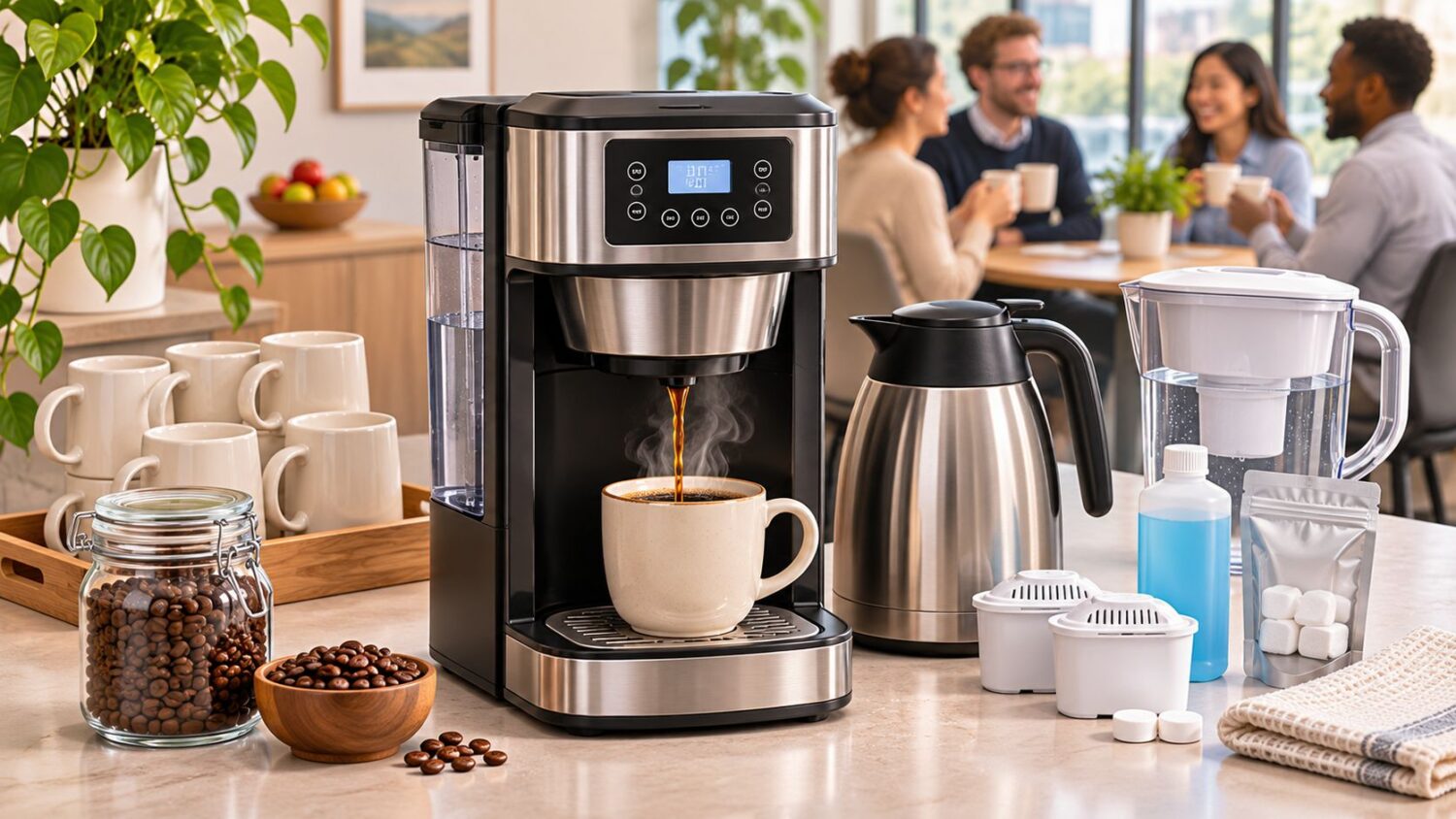
Nov
Thirty-six percent of Americans had access to a coffee station at work in July 2022, up from 30% in 2021, according to National Coffee Association research reported by Vending Times. That's six percentage points in a year, a 20% relative rise, and every one of those points landed on a machine that most offices buy once and then leave alone. The same reporting found 85% of employees surveyed rated workplace coffee breaks important, which tells you the break room isn't a fringe perk.
Headcount is the wrong unit for sizing that machine. Cups per occupied day is the unit that works, and once you have that number, every other decision follows from it: which class of brewer to buy, how often to descale, how many pods or filters to keep on the shelf. The plan below sizes the equipment to real use and ties each cleaning interval to actual brewing load rather than a date on a wall calendar.
Why Break Room Coffee Needs a Maintenance Plan
Half of the full-time employed daily coffee drinkers who had consumed coffee at work in the previous week used coffee brewed from a conventional office coffee pot, making it the most common workplace preparation method in a 2012 Packaged Facts analysis reported by Vending Market Watch, which put the U.S. office-coffee market near $4 billion in annual sales in 2011. That same research found 40% of coffee-drinking workers strongly agreed coffee helped them stay productive, with another 43% somewhat agreeing.
A shared machine carries a load a home appliance never sees. A household brewer makes two or three cups a day for one person who knows how it behaves. An office brewer makes thirty to sixty cups for a rotating cast of people, most of whom have never read the manual. The water sits in the reservoir overnight. The carafe gets rinsed but not washed. The descale light comes on in March and blinks until August.
The usual break-room failure follows a predictable order. First the coffee goes bitter or weak because nobody has adjusted dose since the last brand change. Then brewing slows to a trickle as scale narrows the water path. Then the pod drawer is empty on a Monday morning and everyone stands around waiting for a delivery.
The rule that governs everything else: size the machine to cups per occupied day, not headcount, and time every maintenance task to actual use rather than a fixed calendar date.
Three decisions drive the whole plan: how many people you're serving, how they brew (a shared pot, single-serve pods, or both), and what the room itself can support in counter space, drainage and proximity to a sink. Get the placement right before the machine arrives, because layout constraints are much harder to fix later. The Slone Brothers Furniture office furnishing advice covers break-room layout and counter planning before you commit to a footprint.
By the end you'll be able to name a machine class for your team, set a cleaning cadence from attendance rather than habit, and list the supplies to keep on hand so a cleaning cycle never stalls.
Matching a Coffee Maker to Your Team Size
Take a 14-person team with hybrid attendance. Nine people are in the office Tuesday through Thursday, and roughly 40 cups get poured on a typical occupied day. That falls in the 25 to 75 cup planning range, which points to a 10 to 12 cup programmable drip brewer with a thermal carafe. The timer starts the first batch at 7:30, someone owns batch two at 9:45, and the carafe holds temperature without a hotplate cooking the coffee into tar.
Forty cups against a 12-cup carafe means four batches across the day, which a drip brewer handles comfortably. The constraint isn't total volume, it's the 8:30 to 10:00 window when the carafe empties faster than it refills. If your rush is more than about 20 cups in that window, step up to a twin brewer or a larger batch model rather than telling people to wait.
Count cups per occupied day, not people
Count what gets poured on a day when the office is full, then count how many of those days a week exist. An office of 30 people with two days of attendance can use less coffee than a 12-person office that sits five days. Average across a typical week before you pick anything.
Office coffee maker class by team size and daily cups
| Team size | Typical daily cups (planning range) | Machine class | Feature priority |
|---|---|---|---|
| 1-5 people | 10-25 | Single-cup pod brewer or 4-6 cup drip brewer | Fast startup and small footprint |
| 6-15 people | 25-75 | 10-12 cup programmable drip brewer | Thermal carafe and programmable timer |
| 16-30 people | 75-150 | Twin 12-cup brewers or a plumbed batch brewer | Recovery time between batches |
| More than 30 people | 150+ | Plumbed commercial batch brewer or bean-to-cup | Plumbed water line and a service contract |
These ranges are planning estimates, not manufacturer ratings. Check them against your own cup count for a fortnight before you buy, and treat the band as a starting point for the conversation rather than a verdict.
Two edge cases that break the table
A small team with a concentrated rush. Five people who all drink two cups between 8:30 and 9:30 need a bigger carafe than their daily total suggests. Buy for the peak half hour, not the daily average, or accept that someone is always waiting on the second batch.
A pod team on a budget. Pods turn coffee into a recurring line item that scales with every cup. If you go single-cup, price the pod supply as a monthly cost before you commit, because 70% of workplace pod users in the 2012 analysis relied on employer-supplied pods, and that supply runs out. Honest reviews of the equipment itself are worth reading before you choose a format, including these single-serve coffee maker reviews.
The one-morning test
Multiply average daily cups by the number of occupied days to get weekly demand. Then ask a sharper question: does one full batch cover the morning rush without a second brew? If the answer is no, you have two options, add a batch owner to the routine or size up. Both are cheaper than the daily friction of an empty carafe at 9am.
Single-Serve Pods Versus Drip Waste and Running Cost
A pod habit looks weightless cup by cup. At office scale it isn't. A University of Tennessee life-cycle assessment published in the National Library of Medicine estimated the campus used 112,500 coffee pods a year, based on about 750 pods a day, with conventional plastic pods representing roughly 340 kilograms of material annually. In the same study, compostable pods completely degraded within 46 days in the tested industrial composting setting and reduced waste-disposal costs by 21% in that case.
The volume grows at regional scale. A comparative life-cycle assessment from the University of Waterloo estimated Ontario consumed about 2 billion single-serve coffee pods a year, generating roughly 30,000 tons of landfill waste, about 0.3% of the province's total landfill waste in 2014.
Weigh the whole system, not the brewer:
- Count the pods. Pods per day multiplied by working days gives the annual figure your office is committing to.
- Estimate packaging weight from the supplier's documentation rather than guessing.
- Price both paths over a year: pods plus disposal against bulk grounds and a reusable filter.
- Check the waste stream. Confirm with your hauler whether compostable pods are accepted before you count on them.
Reusable pods cut consumable waste but add a cleaning step, and a pod nobody rinses leaves oil in the basket. The full accounting of coffee pods versus ground coffee is worth running before you decide. Pods suit a small team with irregular attendance. A drip brewer with bulk grounds suits a steady daily pot.
Premium Versus Standard Brewers and Common Objections
A 40-person roster that occupies 18 desks three days a week does not need the same brewer as a 40-person roster that is in every day. Size the machine to cups per occupied day, not to names on the org chart.
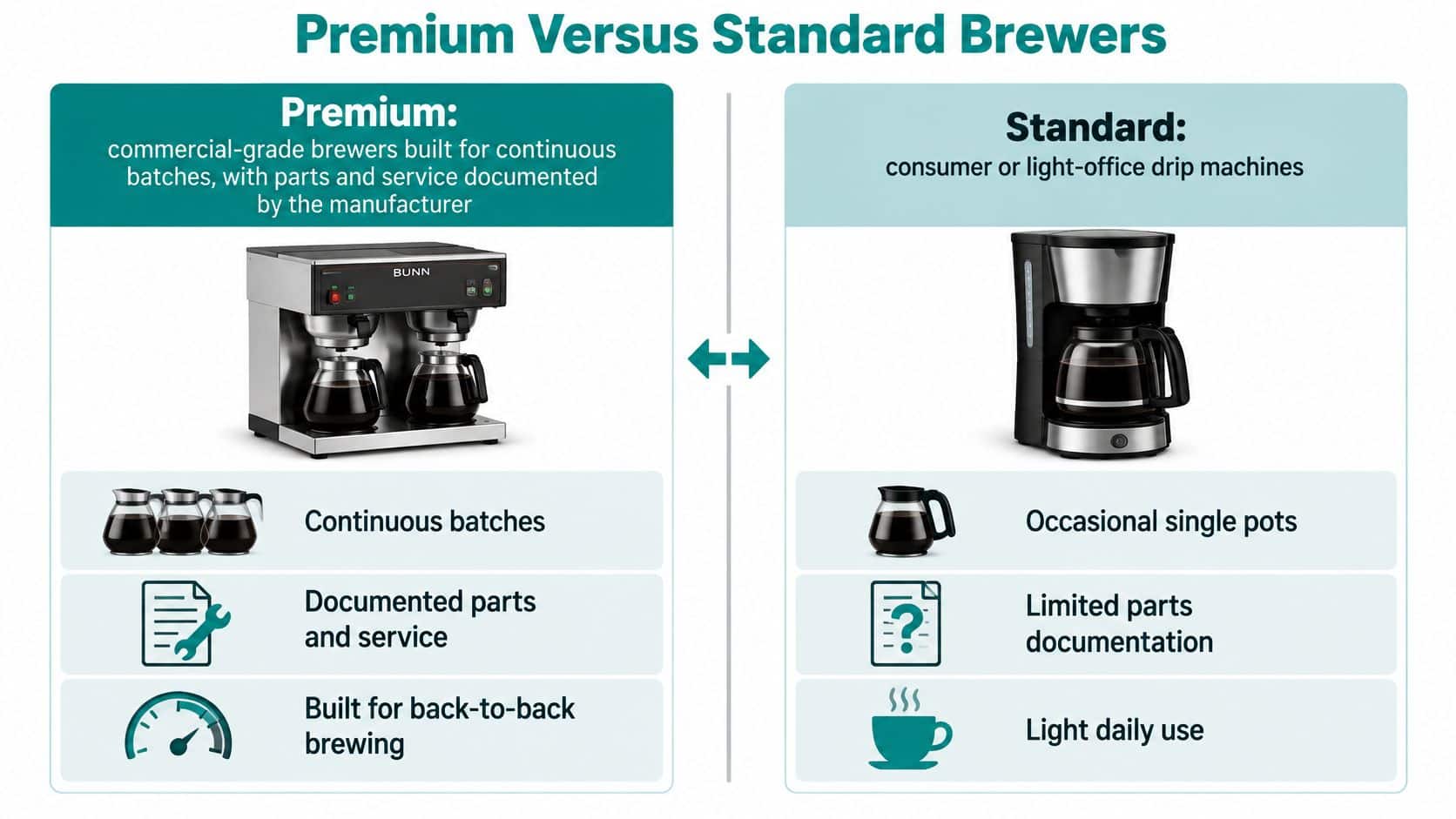
Premium means a commercial-grade brewer built for continuous batches, with gaskets, carafes and valves documented and stocked by the manufacturer. Standard means a consumer or light-office drip brewer chosen for price, footprint and the fact that it is in stock.
| Factor | Premium commercial brewer | Standard office drip brewer |
|---|---|---|
| Sustained output | Built for continuous batches across the day | Best for short bursts with rest between brews |
| Replacement parts | Gaskets, carafes and valves stocked over the long term | Often limited to the current model line |
| Descaling | Manufacturer interval, tightened when occupied days stack | Set from cups actually poured, not a calendar reminder |
| Warranty coverage | Commercial terms with service options | Consumer warranty, usually shorter |
| Upfront cost | Higher purchase price | Lower purchase price, with the savings absorbed by pods, filters and descaler over the first two years |
The cost objection
Hybrid attendance changes the purchase. A six-person office that is rarely all in on the same day stays under 25 cups on a typical occupied day. A standard brewer run inside its rated capacity is a sound buy there. The premium case strengthens when occupied days regularly climb toward 60 cups, because a stalled machine then blocks a shift. Downtime in a 12-cup office is an inconvenience someone solves with a cafetière.
I would not buy commercial output for a light hybrid week just to look prepared. Pay for parts availability and documented service when the volume is there.
The leak, fit and durability objections
Reusable pods leak for three reasons. The gasket sits misaligned in the lid. The pod gets overfilled, so water cannot pass and finds the seam instead. Or a cracked hinge stops the lid closing flat. Consistent fill levels and a quick check that the pod seats square before you close the machine fix all three.
Cleaning should follow use. Reusable pods and filters need regular washing because trapped coffee oils and residue affect flavor and hygiene even after the brewer's internal system has been descaled. A busy week of back-to-back occupied days calls for more washes than a quiet one. After a chemical descale, rinse the machine thoroughly, and run a water-only rinse before the first brew of the day.
Keep one spare pod and a sleeve of paper liners in the drawer. A single failed pod shouldn't stop a break room, and a liner turns a gritty basket into a two-second rinse.
New hires tend to drink from whatever mismatched mug is left in the cupboard, which is how break rooms end up with eleven chipped promotional cups and no lids. Custom mugs for staff onboarding kits give each person one cup they'll wash, which improves hygiene at the same time.
Under 25 cups on an occupied day, buy standard and maintain it to the volume you pour. Above that, or wherever a stalled machine blocks a shift, the premium brewer earns its price through parts availability and service intervals written against throughput.
Water Quality and How It Drives Scale Buildup
Water does two jobs in an office brewer. It carries flavor compounds out of the grounds, and it leaves minerals behind in every heated passage it touches. Both jobs depend on your local supply, which is why copying another office's maintenance schedule rarely works.
Hardness and alkalinity decide how fast that mineral film becomes scale. Higher calcium hardness and higher bicarbonate alkalinity raise the chance of calcium-carbonate scale in heated water paths. Water that is very soft, with little alkalinity to buffer it, can raise corrosion risk instead. Soft water is not a free pass. Treating it as one is how heating elements fail early.
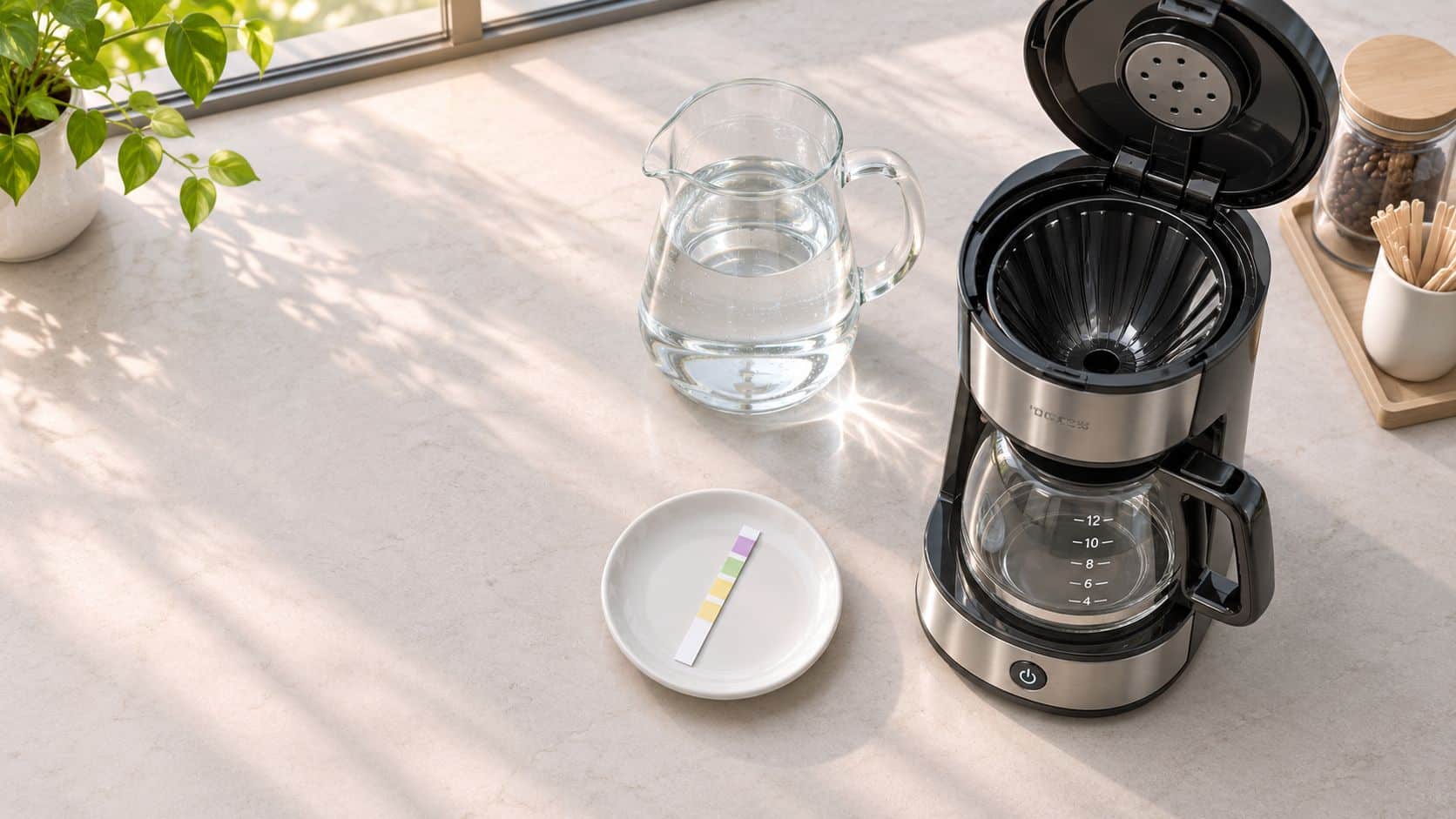
Scale hurts performance before it causes a breakdown. Deposits cut heat-transfer efficiency and restrict valves and water passages. Brewing slows, flow turns uneven, and every part downstream of the boiler works harder.
Filtration and descaling solve different halves of that problem. Filtration lowers the mineral load coming in. Descaling removes what has already baked onto the element. Hard water needs both, and the interval should follow cups poured on occupied days, not a date printed on the brewer.
Pull the water quality report your utility publishes. Note the hardness and alkalinity figures, then set filter changes and descaling from those numbers plus real use. An office brewing 40 cups on a fully occupied day, on hard water, needs a shorter descale cycle than a sister office running the same machine on moderate water. A hybrid week with half the desks empty stretches that same cycle. The sticker on the brewer cannot see either difference.
Matching filtration to what comes out of the tap is the practical half of the job.
If the utility report reads badly, or you cannot find alkalinity at all, improving the water going into the machine costs less than replacing a scaled boiler. Start with a carbon filter matched to your cartridge change interval, then descale on a schedule set by cups brewed on occupied days and local hardness together.
Brewing Quality Depends on Temperature and Extraction
Brew temperature gets blamed for bad office coffee far more often than it deserves. A peer-reviewed study in Scientific Reports tested drip brewing at 87°C, 90°C and 93°C while adjusting grind size and brew time to hold total dissolved solids (TDS) and percent extraction (PE) comparable. Once TDS and PE were controlled, temperature produced no appreciable sensory difference, and both TDS and PE had substantially greater effects on flavor.
Translation for a break room: the coffee tastes wrong because the dose, grind or contact time is wrong, not because the heater runs a few degrees cool. Turning the temperature up is the last dial to touch, not the first.
Work the diagnosis in order when the pot tastes thin or harsh:
- Check dose and ratio. Standardize the coffee-to-water ratio with a scoop or a scale and stop eyeballing it. Inconsistent dosing is the most common cause of a pot that tastes different every day.
- Check grind and flow. An uneven grind or a filter basket with a partially blocked outlet makes water channel through one side of the bed. Watch the brew run. If it finishes far too fast or stalls, fix that before touching the heater.
- Check temperature last. The tested 87-93°C range produces comparable sensory results when extraction conditions are properly controlled, so a machine inside that band has no temperature problem worth chasing.
Features that make consistency easier to hold: an adjustable brew-strength setting, a timer that brews a fixed batch size at a fixed hour, and a clear water-level window so nobody guesses at the fill line. On a shared machine, one agreed house setting posted on the wall beats five people changing strength to suit themselves.
Run a cup test on the first morning after any change to dose, grind or filter. Compare the new pot against the known standard while everyone still remembers what the old one tasted like.
Maintenance Schedules for Quiet and Busy Weeks
A fixed daily, weekly and monthly cleaning schedule assumes the machine works at a steady rate. Hybrid offices don't. Recent market analysis identifies hybrid scheduling as a reason offices need machines with rapid startup and minimal cleaning, because usage now arrives in short bursts rather than a gentle daily rhythm, as the office coffee machine market analysis from Research and Markets sets out. A brewer can sit untouched from Friday afternoon to Tuesday morning and then serve a full floor in ninety minutes.
That gap is where most problems start. Water sits in the reservoir and goes stale. Residual coffee dries into a film on the brew head and inside the carafe. The drip tray fills during the one busy morning and nobody empties it until Thursday.
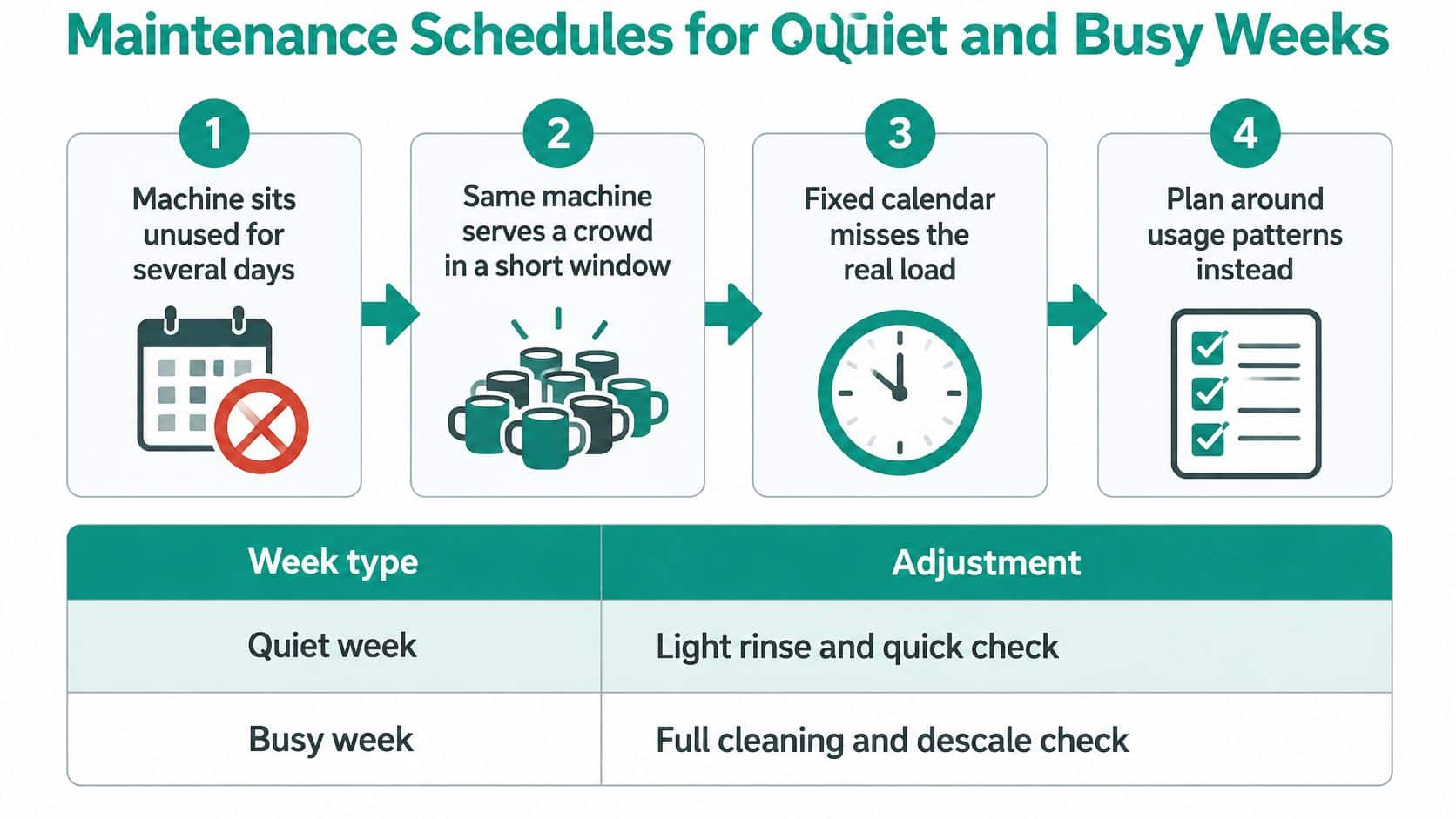
Maintenance tasks by attendance pattern
| Task | Low attendance (2-3 days a week) | Peak attendance (daily, 50+ cups) | Continuous use (all day) |
|---|---|---|---|
| Empty drip tray and grounds bin | After each brewing day | Twice a day | Every shift |
| Refresh reservoir water | Before any gap of two or more days | Each morning | Each morning |
| Clean carafe and filter basket | Weekly | Daily | Daily |
| Wipe brew head and drip area | Weekly | Daily | Daily |
| Descale and rinse with clean water | Per manufacturer cup count or schedule | Per manufacturer cup count, checked monthly | Per manufacturer cup count, checked monthly |
The pre-opening routine
Run these four steps before the first person reaches for a cup on any occupied morning:
- Confirm the water is fresh. If the reservoir has held water since before a weekend or a two-day gap, empty it, rinse it and refill.
- Empty the drip tray so a busy morning doesn't overflow onto the counter.
- Run a clean-water cycle through the brew path to flush stale water and loose residue.
- Check the grounds bin and pod drawer so the first rush doesn't stall on a full bin or an empty drawer.
At the end of a brewing day, empty the carafe, rinse the filter basket and wipe the brew head. This overlaps with the daily kitchen wipe-down routine that keeps the surrounding counters hygienic, so fold it into that sweep rather than treating it as a separate job.
Who owns it when nobody is on site
An automatic cleaning cycle supplements manual care, it doesn't replace it. Plenty of small offices without a managed coffee service assume the machine's self-clean light means the work is handled, and that assumption is how a brew head ends up with a season's worth of oil in it.
Keep a short responsibility log taped inside a cupboard door: one named owner per task, plus a backup for days that person is out.
Ownership rule: if two people think they own the descale, nobody does. Write the name down and set the interval by cups brewed since the last cycle, not by the month.
Keep a universal descaling solution, spare filters and a spare carafe on the shelf so a cleaning cycle never waits on a delivery. The parts are cheap; the delay is what costs you a machine.
Order Your Descaler and Supplies Before the Next Cleaning Cycle
Turn the decisions into a shopping list. Match the brewer to the band your cups-per-occupied-day count landed in. Set the cleaning interval from the attendance pattern rather than the calendar. Pull your utility's hardness number and use it to fix both the filter change and the descaling frequency.
Backup consumables belong on the shelf before you need them: a spare reusable pod or two, a sleeve of paper liners, a spare filter cartridge. Descaling solution is the item that stops a cycle dead when the bottle runs out, and that's how a two-month interval stretches into six.
Our Coffee Machine Descaler is a universal descaling solution for Keurig, Nespresso, Breville and espresso machines, gives 10 uses, costs $23.95 and is made in the USA. Run the clean-water rinse until the water runs clear before the machine goes back into service, and don't hand a half-rinsed brewer to a room of people at 8am.
PureHQ Inc. supplies the maintenance parts a break-room brewer needs between service visits, from universal descaler and replacement water filters to reusable K-Cups and disposable paper liners built for Keurig, Ninja DualBrew, Cuisinart and Breville machines. If this week's job is getting a descaling cycle back on schedule, the Coffee Machine Descaler covers Keurig, Nespresso, Breville and espresso machines, gives 10 uses and costs $23.95. Visit PureHQ Inc. to stock the shelf, and note that new email subscribers get a coupon code for 10% off Coffee Machine Accessories on their next order.

