
Coffee Machine Care
Coffee Pods vs Ground Coffee: Taste, Cost and Waste
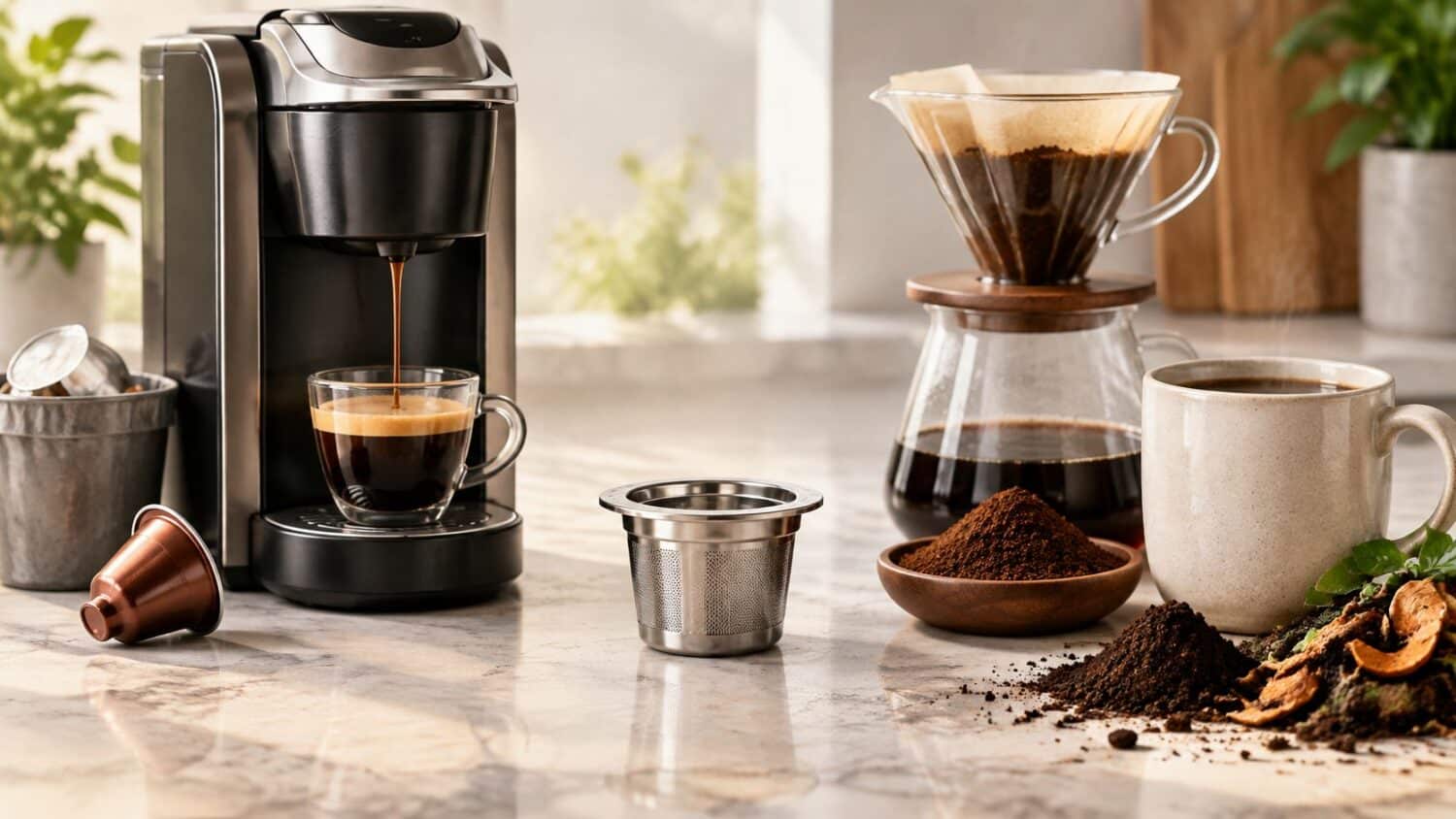
Nov
A 2025 comparison of eight formats found coffee from multilayer bags scored 613 ± 10 nPt per cup compared with 2,777 ± 23 nPt for polypropylene capsules, a gap reported in Ethical Consumer's ethical coffee guide. That spread reframes coffee pods vs ground coffee. The winner isn't decided by the label on the box. It's decided by how much coffee you dose, how often you discard a failed cup, what your machine accepts, and what your local waste service takes.
Why the Pod or Scoop Choice Costs More Than You Think
Most buyers choose a format for speed and stop there. They don't compare the price of a drinkable cup, the consistency of the brew, the waste left behind, or whether the brewer suits the coffee they're putting in it. That shortcut creates costs that don't appear on a receipt.
You feel those costs quickly. A weak cup gets brewed twice, so one morning drink consumes two servings. A pod box runs out midweek and forces an emergency purchase at a higher price. A bin fills with single-use containers your recycler may reject. A brewer slows or clogs because the grind, fill level, or mineral buildup doesn't match how the machine moves water.
Pricing a Cup You Actually Drink
The fair test isn't cost per nominal serving. It's cost per usable cup, including failed brews, filters, descaling, and the accessories that keep the system running. A cheap scoop that produces a thin cup you pour away isn't cheap. A convenient pod that you brew correctly every time may waste less coffee, even though its container costs more.
Judge each format by the cups you finish, not by the servings printed on the package.
This comparison tests three routes on taste, cost, waste, and machine compatibility. Single-use pods set the standard for repeatability. Ground coffee in drip or pour-over equipment gives you control over dose and grind. Reusable pods sit between them, putting your own ground coffee into a pod brewer without a new container for every cup.
Your verdict will depend on four local facts. Your brewer model decides which pods fit. Your water and cleaning routine decide whether flow stays steady. Your waste collection decides whether a pod is recycled, composted, or landfilled. Your actual dose decides how far a bag stretches and how much coffee you waste.
Coffee Pods vs Ground Coffee at a Glance
| Criterion | Single-use coffee pods | Ground coffee in a drip or pour-over brewer | Reusable pods filled with ground coffee |
|---|---|---|---|
| Consistency from cup to cup | High, because each capsule holds a set dose | Varies with grind, dose, packing and fresh coffee | High when fill level and grind are controlled |
| Cost per cup | Highest of the three | Lowest when coffee is bought in bulk | Middle, depends on the bulk coffee and the one-time pod purchase |
| Preparation and cleanup | Fastest, one used capsule per cup | More steps, grounds and paper filter to dispose | Quick, rinse the pod and empty the grounds |
| Packaging per cup | One pod or capsule container per cup | Bag shared across many cups | No container per cup beyond the bulk bag |
| Machine compatibility | Only machines that take that pod system | Any drip or pour-over brewer | Only machines with a matching reusable pod, such as single-needle Keurig brewers |
| End-of-life route | Often landfill unless local recycling accepts the pod | Grounds and paper filter can go to home compost | Grounds can be composted and the metal pod is reused |
Three findings matter most. First, pods deliver the most repeatable cup because the factory fills each capsule to a set dose and your machine runs a fixed routine. You press a button, and the variables you could get wrong have already been decided.
Second, ground coffee gives you the lowest ingredient cost when you buy in bulk, but technique controls the result. A change in grind, dose, or water flow shows up directly in strength and balance. Ground coffee rewards a consistent routine and punishes guesswork.
Third, reusable pods keep the shape and speed of a pod system while removing per-cup packaging. You choose the coffee and control the fill, so you gain flexibility. You also take responsibility for grind, packing, rinsing, and matching brew size to dose.
What the Table Can't Decide for You
These ratings describe typical use, not every product on the shelf. One pod system isn't automatically compatible with another, and a reusable pod must match your brewer's needle layout. Check the model before you compare prices, because an incompatible pod has no usable-cup value at all.
How Taste and Consistency Change Between Formats
You'll notice consistency before you notice subtle flavor notes. A factory-filled pod repeats because dose, grind, and packing stay fixed from capsule to capsule. In a peer-reviewed capsule-extraction study, three certified Q Arabica Graders rated flavor, acidity, body, and balance on a 5–10 scale, and sensory attributes were not significantly affected by the measured ground-coffee properties and extraction-variable differences within the tested capsule set. That supports the repeatability standardized capsules offer.
Loose ground coffee behaves differently. It's sensitive to grind age, particle-size distribution, dose, packing density, and brew-water flow. Change one variable and water takes a different path through the grounds, extracting a different balance from the same coffee.
The Four Variables You Control
- Grind size: Use a medium grind suited to your brewer, since powder that's too fine can restrict flow through a reusable pod.
- Dose: Fill to the intended level so the coffee mass matches the brew volume you've selected.
- Packing: Keep the fill level rather than compressed, because overpacking can restrict flow and cause channeling or bypass.
- Freshness: Use fresh coffee and seal the bag between uses so aroma doesn't fade before brewing.
Overpacking is the most common reusable-pod fault. Water can't move evenly through a compressed bed, so it finds a weak channel or bypasses part of the coffee. The result is paradoxically weak and uneven, not stronger. Underfilling creates the opposite problem, a thin cup with too little coffee for the water volume.
Brew size matters just as much. A larger volume drawn through the same pod generally reduces concentration unless the machine recipe compensates. If you want a bigger mug at the same strength, you need more coffee, a stronger setting, or a second brew, not more water.
Reusable-pod checklist: Medium grind, level fill, fresh coffee, and a brew size matched to the dose gets you closest to a standardized pod.
Caffeine doesn't stay fixed across formats either. The USDA Agricultural Research Service lists 103 mg of caffeine in 6 fluid ounces of regular brewed coffee, compared with 57 mg in 6 fluid ounces of instant coffee and 2 mg in 6 fluid ounces of brewed decaffeinated coffee. Your dose depends on the coffee's caffeine content, the quantity of grounds, the water volume, and extraction conditions. A pod and a scoop don't guarantee an identical amount.
What Each Format Really Costs per Cup
Start with dose, because dose decides how many cups a bag produces. A comparative life-cycle analysis reported in Euronews coverage of coffee pod research modeled filter coffee at approximately 25 g of ground coffee to produce 280 mL, compared with 14 g for capsules. The same bag therefore yields different serving counts depending on how you brew.
Run your own math before you trust a headline price. Divide the bag price by its weight in grams to get price per gram, then multiply by the grams you use per cup. If you're unsure what your scoop holds, our guide to how much ground coffee per cup helps you measure a repeatable dose instead of guessing.
Accessories That Change the Total
| Item | Price | Uses or units | Cost per use |
|---|---|---|---|
| Reusable K-Cups, 2-pack for single-needle Keurig brewers | $19.95 | 2 pods | about $9.98 per pod |
| Disposable paper filters for reusable K-Cups, 100-pack | $12.95 | 100 filters | about $0.13 per filter |
| Coffee Machine Descaler, universal | $23.95 | 10 uses | about $2.40 per use |
The reusable pod is a one-time outlay spread across every refill. At $19.95 for a 2-pack, each pod costs about $9.98 before its first brew, and its share of each cup falls as your brew count rises. The more consistently you use it, the smaller that purchase becomes in your per-cup total.
Paper filters work differently. At about $0.13 per filter, they add a small recurring cost to every paper-filter cup. They can make cleanup faster and keep fine sediment out of the drink, but they're not free, so include them if your routine depends on them.
Descaling is recurring maintenance, not an optional extra. PureHQ's Coffee Machine Descaler gives 10 uses for $23.95, or about $2.40 per use, and it's a universal descaling solution for Keurig, Nespresso, Breville and espresso machines. Mineral buildup restricts flow and changes taste, so skipping descaling can create failed cups that cost more than the treatment.
Add these lines to your coffee cost and divide by cups you drink. If poor technique makes you add extra coffee, run a second cycle, or discard a cup, count that loss too. Keeping paper filters in stock and descaling on schedule helps both reusable-pod and drip routines stay clean and consistent between replacements.
Environmental Footprint and Waste per Cup
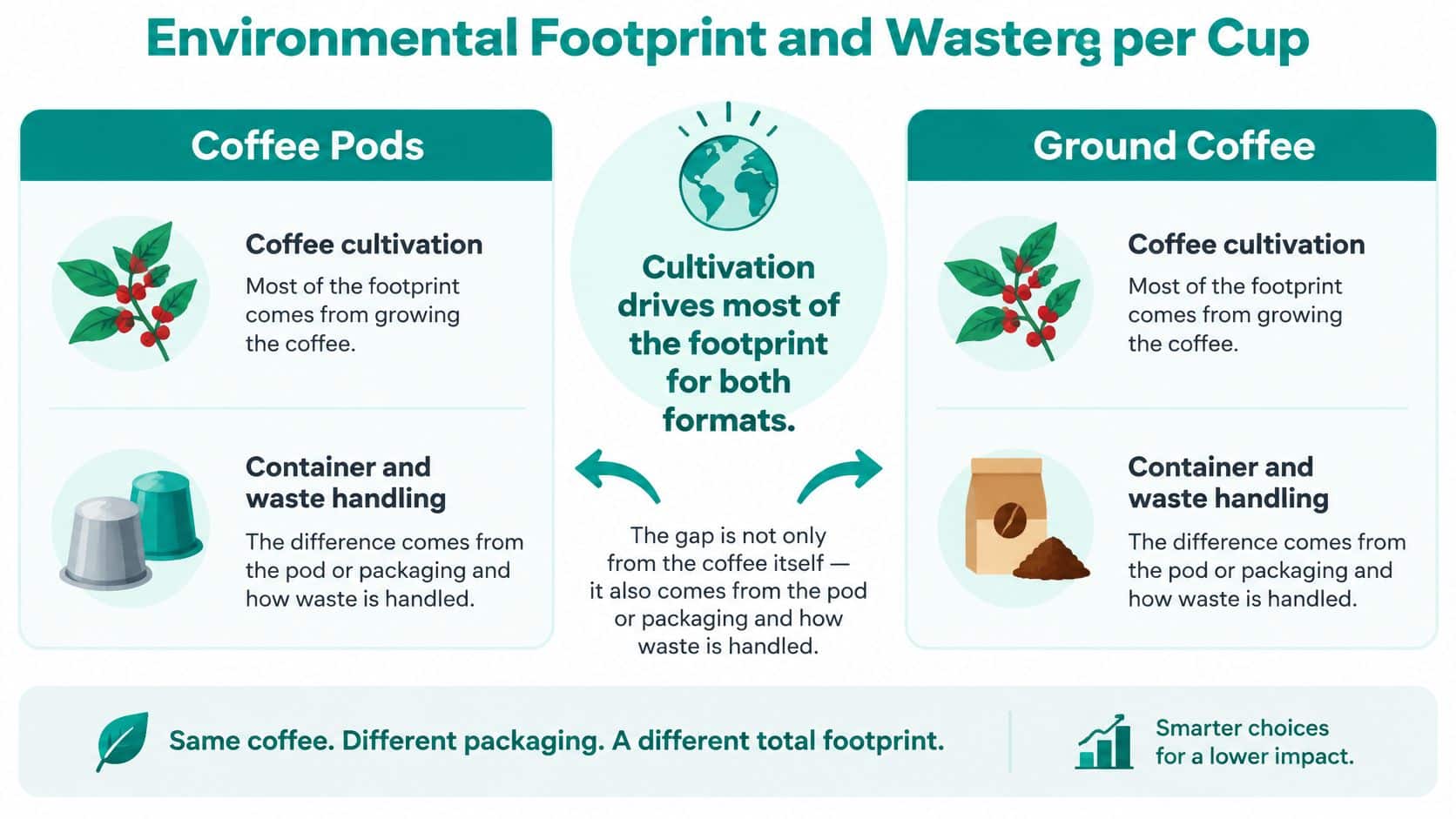
Coffee growing drives most of the footprint before packaging enters the picture. A 2024 life-cycle review compiled by Chéron-Bessou and colleagues compiled 34 life-cycle studies and reported impact ranges of 0.03–1.2 for single-pod coffee and 0.09–0.13 for ground coffee, with exact values depending on each study's functional unit and impact method. The same review reports green-coffee production contributed 85–99% of assessed impact categories in one study.
That wide pod range is the key lesson. Packaging and waste management make pod coffee materially different, and press-based and instant coffee generally had lower impacts than pod coffee because of waste management. A pod adds a container burden to every cup that ground coffee brewed through a reusable device can avoid, but overdosing or discarding brewed coffee can erase ground coffee's advantage.
Where Each Format Ends Up
Ground coffee has a clearer home end-of-life route. The U.S. Environmental Protection Agency home composting guide identifies coffee grounds and paper filters as nitrogen-rich "green" materials suitable for home composting. You separate the grounds and accepted filter from the brewer, add carbon-rich browns and water, and the brewing waste leaves the trash stream.
A single-use pod usually combines coffee with a container and sometimes additional materials. It may need disassembly, a brand program, or a local facility that accepts small items. Our guide to K-Cup recycling explains why technically recyclable pods can still be rejected and why compostable pods may be landfilled where industrial composting isn't available.
Don't treat any score as universal. The reviewed studies used different boundaries, serving sizes, machines, materials, and disposal assumptions. Check your municipality's rules, measure your dose, and brew only the volume you'll drink. Those three habits matter more than a generic claim that one format is always greener.
Leaks, Fit and Durability Concerns with Reusable Pods
Reusable pods solve packaging and coffee-choice problems, but buyers raise three practical objections. Each one has a visible cause you can check before you blame the format.
Leaks and Grounds in the Cup
Grounds escape when you overfill the pod, the lid doesn't seal, or residue keeps the rim from closing cleanly. Fill only to the level line, wipe the rim, and check that the lid sits flat before brewing. A quick rinse after each use stops old grounds from building up around the seal and screen.
If a cup suddenly turns gritty after weeks of clean brews, inspect the pod before you change coffee. Look for a bent rim, a lid that rocks, or a gap on one side. Our reusable K-Cup tips cover fill and cleaning checks that prevent most leaks without extra tools.
Fit for Your Exact Brewer
A pod has to match the brewer's needle system. Our stainless steel reusable K-Cups, 2-pack at $19.95, are refillable pods for Keurig single-needle brewers, including Classic, 2.0, K-Elite and K-Mini series. PureHQ oversees its own manufacturing of its water filters and reusable coffee pods, which supports consistent fit and quality control.
Dual-needle MultiStream models such as K-Supreme, K-Slim and K-Crema need their own listed pods. Don't force a single-needle pod into a different system and don't rely on a similar model name. Confirm the exact model on your brewer before ordering, because fit decides both sealing and water flow.
If a correctly filled new pod leaks on its first brew, suspect the pod seal or brewer fit first, then use the return or warranty route.
Durability Checks That Take Seconds
- Rim check: Run a finger around the rim after washing and feel for dents that could break the seal.
- Lid check: Close the empty pod and confirm the lid sits evenly with no raised corner.
- Screen check: Hold the pod to light and clear any clogged mesh before the next fill.
A damaged seal can leak even when your fill is correct. Replace a pod that no longer closes evenly instead of pressing harder or overfilling to compensate. That protects the brewer and keeps your cost-per-drinkable-cup calculation honest.
Which Coffee Format Fits Your Routine
| Your brewing situation | Best format | Main reason |
|---|---|---|
| Daily drip or pour-over at home | Ground coffee | Lowest cost per cup and no pod containers |
| Single-needle Keurig owner who buys ground coffee | Reusable pods | Removes per-cup packaging and works with your own beans |
| Office or breakroom that needs speed and steady cups | Single-use pods | Fastest preparation with the most repeatable dose |
| Home with compost access and a paper-filter brewer | Ground coffee with paper filter | Grounds and filter can go to home compost |
For most daily Keurig drinkers who already buy ground coffee, reusable pods offer the best balance of convenience, waste reduction and cost.
That verdict is conditional, and you should test it against your routine. A drip drinker who brews a full batch and drinks all of it already has low packaging waste and low ingredient cost. Switching that household to pods would add containers without solving a real problem.
An office makes the opposite calculation. Several people with different preferences and skill levels need fast, steady cups and minimal cleanup. Single-use pods remove scooping, grinding, and dose disputes, so the repeatable serving can outweigh higher ingredient and packaging costs.
A Keurig owner who dislikes prepackaged flavors sits in the middle. One customer captured that preference directly. "Love This Product, I do not especially like prepackaged coffee pods, I like using the coffee that I buy and these are perfect." Reusable pods let that drinker keep the machine while choosing the roast, grind, and dose.
Run Your Own Four-Part Check
- Machine: Confirm whether your brewer is single-needle or MultiStream before you buy any reusable pod.
- Dose: Weigh or measure your usual scoop for one week so your cost calculation uses real grams, not package servings.
- Waste route: Confirm whether your compost, recycling service, or pod program accepts the materials you'll generate.
- Failure rate: Count cups you discard or brew twice, because those cups raise your true cost faster than a small price gap.
Apply the compost test next. If you have a paper-filter brewer and reliable compost access, ground coffee gives your grounds and filter a direct route out of landfill. If you use a Keurig and compost only food scraps, reusable pods still let you empty grounds into compost while reusing the container.
Apply the taste test last, with the same coffee and brew size for several days. Change one variable at a time. Adjust grind before dose, dose before brew volume, and clean the brewer before concluding that a coffee tastes flat. That order tells you whether technique, maintenance, or format caused the problem.
The Reusable K Cups for Keurig single-needle brewers are stainless steel refillable pods sold as a 2-pack for $19.95. They're the practical choice when your model matches, you already buy ground coffee, and you'll rinse and refill consistently. If you won't do that small cleanup, single-use pods fit your behavior better. If you don't own a pod brewer, ground coffee in drip or pour-over equipment remains the simpler and cheaper route.
Choose the format you'll execute well every morning. A well-run reusable pod beats a poorly measured drip batch you'll throw away. A fully consumed drip batch beats a pod habit your local recycler rejects. The format wins only inside a specific machine, routine, and waste system, which is why your own numbers should make the final call.
Shop our reusable K-Cups for compatible Keurig brewers, paper filters, and universal descaler to brew your own ground coffee with less per-cup packaging and a cleaner machine. Check your exact brewer model before ordering, then visit PureHQ Inc. to choose the reusable pod and maintenance supplies that fit your routine.

