
Coffee Machine Care
Keurig Water Filter Target
Oct
The Keurig is humming at 6 a.m., the familiar K-Cup is brewing, and everything about the routine looks normal. Then the first sip tastes faintly of chlorine, old pipes, or metallic well water. You change the pod, rinse the mug, and blame the coffee, while the overlooked variable remains in the reservoir.
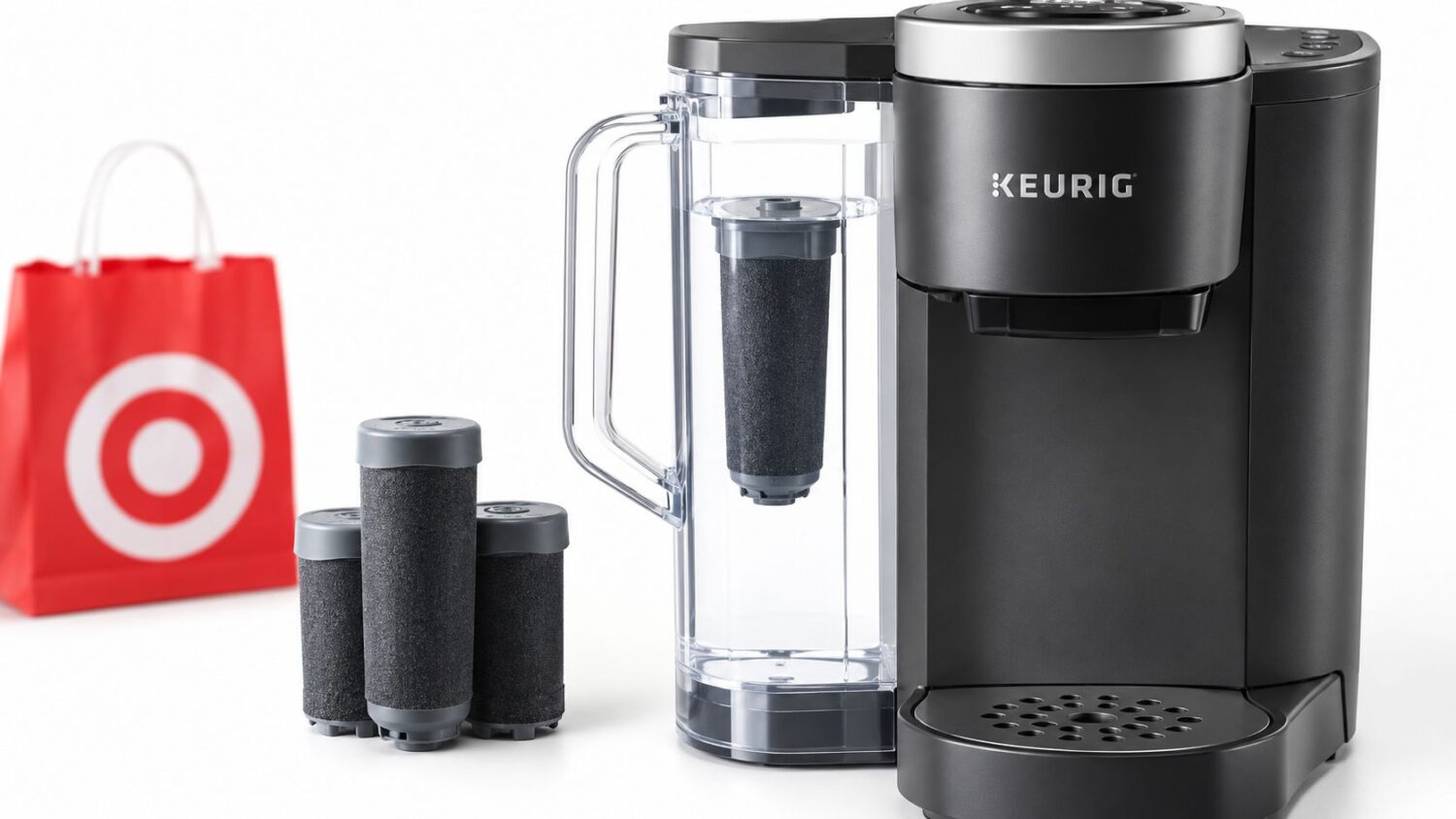
A Keurig water filter from Target is one of the simplest upgrades for that problem. The cartridge sits in a water-filter handle inside the tank and treats the water before the brewer sends it through the coffee system. It doesn't change your pods or add another complicated step, but you do need to buy the correct format for your brewer.
The Morning Cup That Tastes Off
A bad cup doesn't always come from stale coffee. Tap water can carry flavors and odors that show up clearly in a lightly roasted pod or an otherwise familiar blend. Chlorine can make coffee taste flat, while old plumbing or well water can add a metallic note that no change of K-Cup can fix.
That's why I check the reservoir before I start blaming the brewer. If the tank smells slightly chemical or the water tastes unpleasant on its own, the machine is working with poor-tasting input. A reservoir filter can't transform unsafe water into purified water, but it can address common taste and odor complaints associated with chlorine and some organic compounds.
The low-effort fix
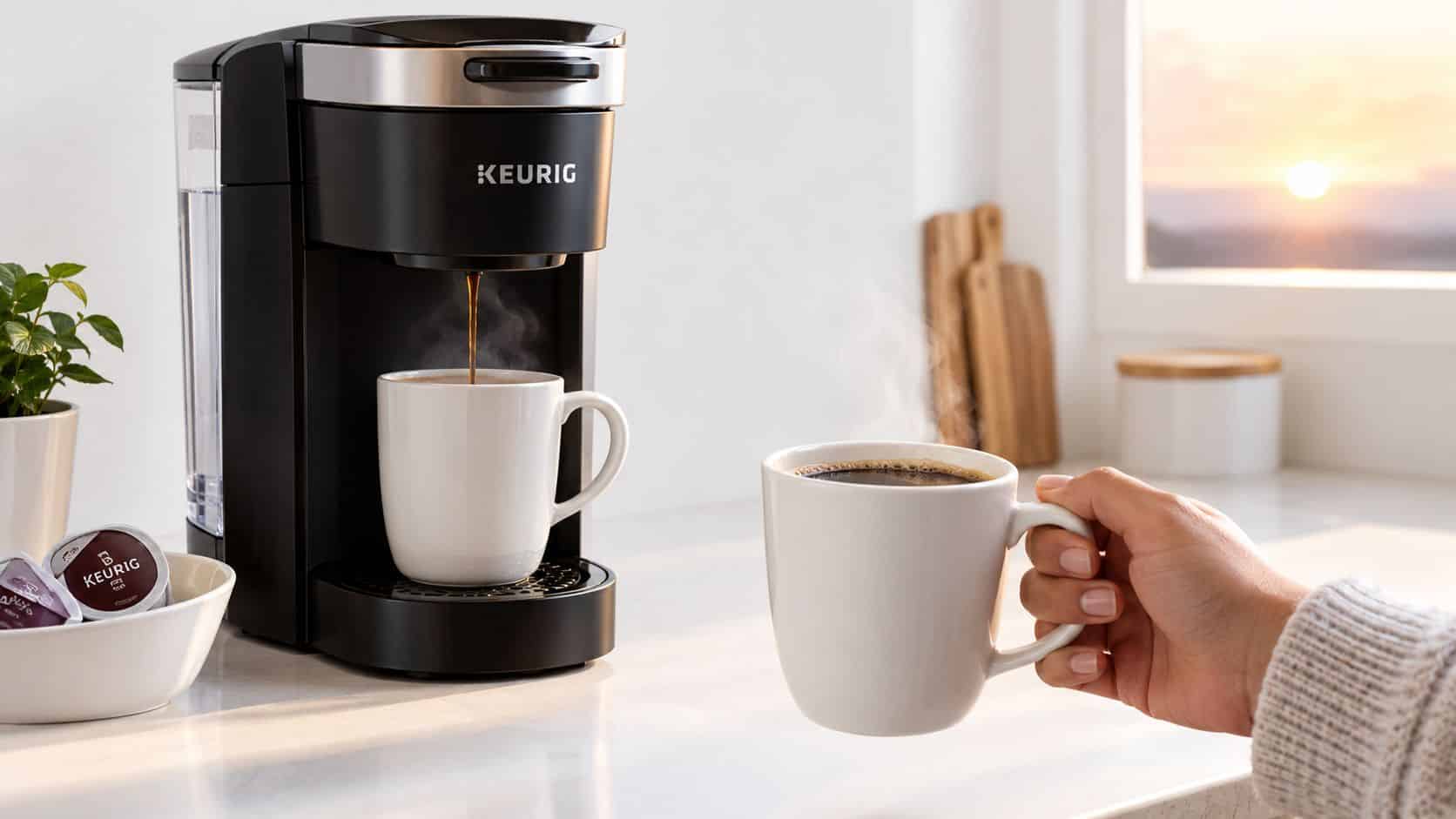
The filter is a small cartridge that fits into a separate holder. Once the holder sits in the reservoir, the brewer draws water through the cartridge during normal operation. You don't need to change the K-Cup system, measure anything for each brew, or install a filter on the household water line.
Keurig's official K-ELITE user guide treats the water filter as an accessory installed during setup if you have one. That wording matters. A filter is useful, but it isn't a universal component built into every Keurig model.
My practical rule: If the water tastes bad before brewing, filter it before you spend money on different coffee pods.
For a broader checklist covering other ways to improve the water going into your brewer, use this guide to improving water quality. The filter itself is the starting point, but the right cartridge and holder determine whether the upgrade fits.
What a Keurig Water Filter Actually Does
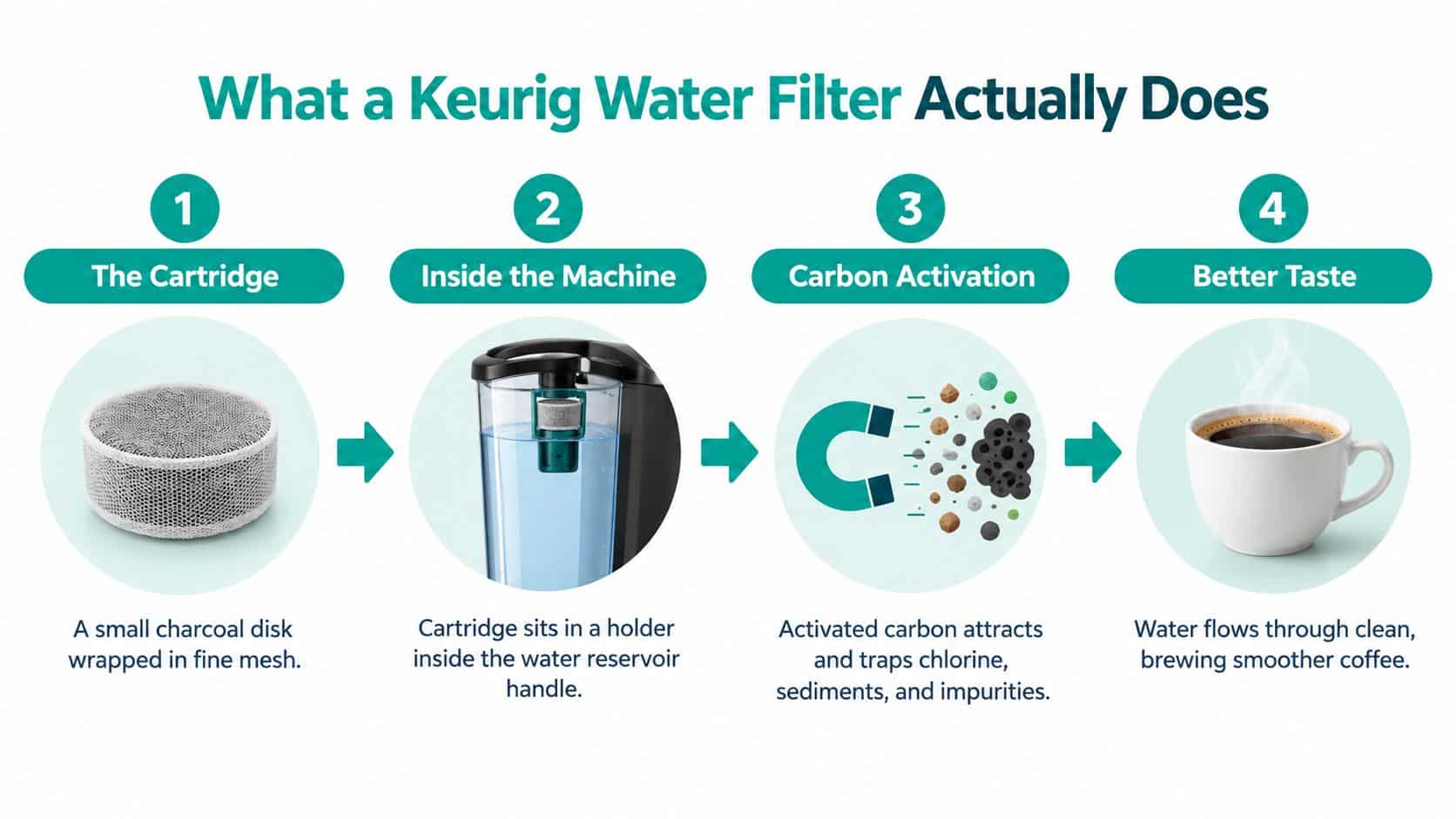
A Keurig reservoir filter is usually a small activated-carbon cartridge enclosed in mesh. The cartridge drops into a filter holder, and the holder clips or slots into the water reservoir. As the brewer pulls water toward the heating and brewing system, the water passes through the carbon material.
Activated carbon works mainly through adsorption. In practical terms, the carbon captures or holds certain substances on its surface as water moves through it. That can reduce chlorine-related taste and odor, along with some organic compounds that make stored water smell stale.
What carbon filtration can improve
A carbon cartridge can make reservoir water smell fresher and make the finished coffee taste cleaner when chlorine or similar taste defects are the problem. It may also reduce the amount of chlorine-related residue that reaches internal surfaces, which gives the machine-care routine a modest supporting benefit.
The filter is not a water softener or a purification system. It doesn't remove the dissolved calcium and magnesium minerals that create limescale, and it doesn't serve as a substitute for descaling. The Specialty Coffee Association water guidance summarized here places desirable brew-water calcium hardness in roughly the 50 to 175 ppm as CaCO3 range, with some espresso-focused testing narrowing the practical sweet spot to about 50 to 80 ppm as CaCO3. Above that range, flavor gains diminish while scale risk rises.
The same limitation applies to other dissolved substances. A Keurig carbon filter isn't designed to remove sodium, fluoride, total dissolved solids, or microorganisms. If your household water has a safety issue, use a treatment method appropriate to that issue and follow local water guidance.
The honest benefit
Think of the cartridge as a taste-and-odor filter. It can make a noticeable difference when tap water is the reason a familiar pod tastes wrong, but it can't correct hard-water scale. Use filtration for the cup and descaling for the minerals.
Matching the Right Filter to Your Keurig or Ninja
The biggest Target-shopping mistake is buying a refill cartridge when the brewer has no filter handle. Target's cartridge listing says the refills are designed for use with a separate Keurig Water Filter Handle, while the tall-handle starter kit includes the handle and cartridges. The starter kit applies to reservoirs greater than 8 inches tall and lists compatibility with families including K-Supreme, K-Duo Plus, K-Café, K-Elite, K-Select, K-Classic, and K-Slim in its product information.
That doesn't make every Keurig cartridge universal. Check the reservoir, identify whether a handle is already present, and confirm the model's guide before ordering. Keurig's K-Supreme Smart use-and-care guide also shows why model-specific instructions matter, because that brewer has strict compatibility rules for its reusable coffee filter.
Compatibility at a glance
| Machine Family | Filter Type Needed | Filter Format at Target | Notes |
|---|---|---|---|
| K-Classic family | Confirm the existing water-filter handle first | Cartridge refills if the handle is present, otherwise a compatible starter kit | Target lists K-Classic among the families covered by its tall-handle kit, but verify the reservoir and model before purchase. |
| Keurig 2.0 family | Confirm the brewer guide and holder design | Don't assume a refill fits without the matching handle | The Target listings supplied here don't establish one universal 2.0 format, so match the cartridge to the actual holder. |
| K-Supreme family | Use the holder and cartridge specified for the exact brewer | Starter kit or replacement format only after model verification | K-Supreme models can have model-specific accessory rules. The K-Supreme Smart guide should take priority over a shelf label. |
| K-Duo family | Check whether the reservoir accepts the listed handle | Tall-handle kit for qualifying reservoirs, or refills for an existing compatible handle | K-Duo Plus appears in Target's tall-handle compatibility information. Confirm the exact brewer before buying. |
| Ninja DualBrew | Use only a Ninja-specified filter where the brewer provides a filter slot | Don't buy a Keurig cartridge by assumption | The verified Target information doesn't establish Keurig-cartridge compatibility for Ninja DualBrew models. If there is no filter holder, skip the Keurig format entirely. |
The useful rule is simple: a reservoir greater than 8 inches can qualify for the tall-handle system, but height alone isn't enough. A short handle, a missing handle, or a proprietary newer design changes what you should buy.
What Target Stocks and How the Options Compare
Target presents the Keurig water-filter category in three practical forms: a 2-pack refill, a 6-pack refill, and a starter kit containing the tall handle and cartridges. The choice isn't really about which box looks cheapest. It's about whether you already own the holder and how often you want to revisit the purchase.
The Target Keurig filter category lists the 2-pack at $6.59 and the 6-pack at $25.49. Target describes the 2-pack as a 2-month supply and the 6-pack as a 12-month supply, with replacement recommended every 2 months or after 60 tank refills, whichever comes first.
The refill packs
Choose the 2-pack when you already have the correct handle and want to test whether carbon filtration improves your coffee. It keeps the initial purchase small and gives you a defined maintenance interval without committing to a larger bundle.
Choose the 6-pack for a shared kitchen, office brewer, or household that wants to keep replacements on hand. The pack is positioned as a year-long supply by Target, so it removes repeated shopping from the routine. It also makes more sense than buying a starter kit when the handle is already installed and intact.
The Target cartridge listing notes compatibility with Keurig water-filter handles and nearly all Keurig multi-cup reservoir brewers, while excluding K-Mini, K-Mini Plus, and K15 for the 2-pack. That exclusion is exactly why I don't buy from the pack size alone.
| Product | Pack Size | Typical Price | Supply Duration | Best For |
|---|---|---|---|---|
| Keurig water-filter cartridge refills | 2 cartridges | $6.59 at Target | 2 months | First-time testing when the correct handle is already present |
| Keurig water-filter cartridge refills | 6 cartridges | $25.49 at Target | 12 months | Regular home use, offices, and buyers who want fewer reorders |
| Keurig Tall Handle Water Filter Starter Kit | One handle plus 2 cartridges | $14.99 at Target | 2 months | A qualifying brewer with no handle or a damaged handle |
The starter kit is the right purchase when the holder is missing, not a clever way to get a better cartridge. Its product listing includes one filter handle plus two cartridges, and it is described as a 2-month supply. Target search results also show strong customer engagement for these products, including the 6-pack at 4.7 out of 5 stars with more than 1,400 ratings and the starter kit at 4.2 out of 5 stars with more than 870 ratings. Those signals indicate active demand, but fit remains more important than the rating.
Buying at Target Versus Direct From the Brand
Target is the better choice when you know the format and need a straightforward purchase. You can compare the refill packs and starter kit in one retail channel, use store pickup when available, and return a wrong purchase through a familiar retailer. That convenience matters more than a small per-cartridge difference when your brewer is waiting on the counter.
The main advantage of buying direct from Keurig is confidence in the source and a repeat-order routine. A direct purchase can suit someone who already knows the exact cartridge and wants recurring delivery, while Target works better for a one-time replacement or a same-day errand.
Where third-party packs fit
Generic cartridges can look attractive, but the risk isn't just cosmetic. A loose fit can allow water to bypass the carbon, and an incorrectly shaped cartridge can make the holder difficult to close or remove. The product page may use broad compatibility language even though your specific handle has a different shape.
I wouldn't choose a third-party pack solely because it has more cartridges in the box. I'd first confirm that the cartridge matches the holder, then check the seller's return terms. If the package lacks clear fit information, the apparent saving isn't worth troubleshooting a leaking or poorly seated filter.
Buying advice: Target is strongest for known, standard replacements. Direct purchase is stronger when authenticity and repeat ordering matter more than immediate availability.
For a more detailed retailer comparison, see this guide to where to buy Keurig water filters. The decision is simple: buy the 6-pack when you already have the handle and use the brewer regularly, buy the 2-pack for a low-commitment trial, and buy the starter kit only when the holder itself is missing or unsuitable.
Installing the Filter and Keeping Your Machine Healthy
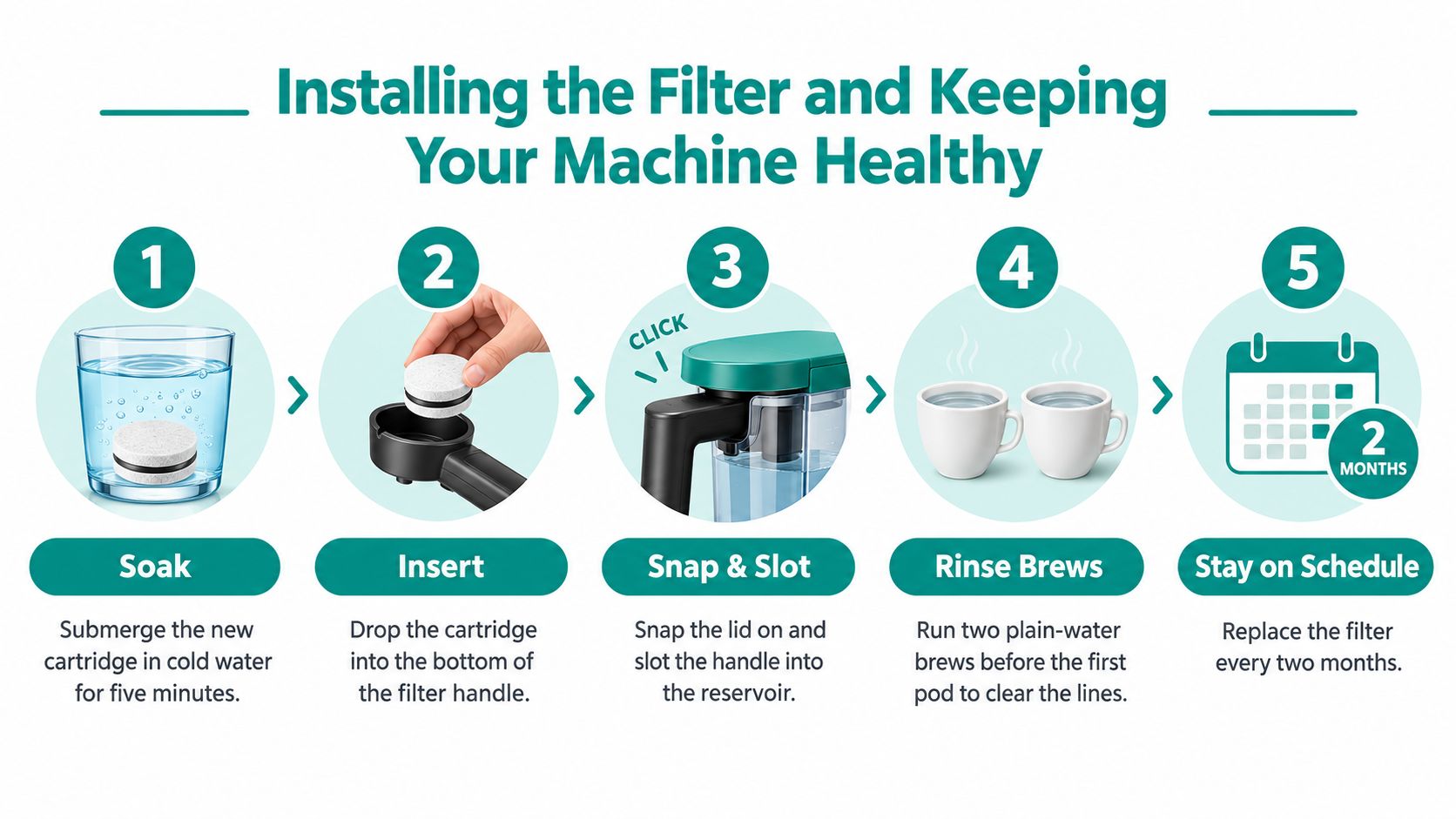
Installation takes a few deliberate steps, and skipping the rinse is the mistake I see most often. New carbon cartridges can release loose dust, so the first brews should clear the cartridge before coffee passes through the system.
- Soak the cartridge. Submerge the new filter in cold water for 5 minutes.
- Insert it correctly. Place the cartridge into the bottom of the filter handle.
- Close and install. Snap the lid onto the handle, then slot the handle into the reservoir.
- Rinse the water path. Run 2 plain-water brews before using a pod.
- Record the replacement date. Use the two-month or 60-refill standard from the Target product information, whichever arrives first.
The water-filter installation guide can help if the handle feels awkward or the cartridge won't seat properly. Don't force the lid. Remove the cartridge, check its position, and make sure the handle matches the reservoir.
Filtration isn't descaling
Carbon filtration handles taste and odor. It doesn't remove the calcium and magnesium minerals that form limescale, so a filter cannot replace a descaling routine. Use a compatible Keurig descaling solution or universal descaler according to the brewer's care instructions and your local water conditions.
A practical maintenance schedule pairs filter replacement with descaling every 3 to 6 months, but the interval should follow the brewer's guidance and the hardness of your water. A filter can improve the cup while scale still restricts the water path, slows heating, and burdens the pump.
Keep the reservoir clean between cartridge changes, and don't leave old water sitting indefinitely. The filter and descaler perform different jobs, so the healthiest routine uses both where the machine and water conditions call for them.
Your Quick Decision and Where to Buy
Start with the brewer, not the search result. Look inside the reservoir and determine whether you have a removable Keurig water-filter handle. If you have a compatible handle, buy refills. If the reservoir qualifies for the tall-handle system but the handle is missing or broken, buy the starter kit. If your Ninja DualBrew or Keurig model has no compatible filter slot, don't force a Keurig cartridge into it.
The Target format is clear once you separate those decisions. The 2-pack suits a trial, the 6-pack suits regular brewing, and the starter kit solves a missing-handle problem. Target's product information sets the replacement cadence at every two months or after 60 tank refills, while descaling remains a separate maintenance task.
| Your Machine | Buy at Target | Best Channel | Replace Every |
|---|---|---|---|
| Compatible Keurig with an existing handle | 2-pack or 6-pack refill | Target for convenience and bundle shopping | 2 months or 60 tank refills |
| Qualifying Keurig with a reservoir greater than 8 inches and no handle | Tall Handle Starter Kit | Target when you want the handle and cartridges together | 2 months or 60 tank refills |
| Keurig with an uncertain or model-specific holder | Don't guess from the package | Manufacturer documentation first, then the matching retailer listing | Follow the confirmed cartridge instructions |
| Ninja DualBrew without a Keurig-style filter slot | Skip the Keurig cartridge | Use the Ninja-specified maintenance format | Follow the Ninja model guide |
| K-Mini, K-Mini Plus, or K15 when considering the listed 2-pack | Don't buy that 2-pack | Confirm the model's accessory requirements | Follow the confirmed model instructions |
Buy at Target when you want easy pickup, a simple return path, or a filter and descaler in the same cart. Buy direct from the manufacturer when you need model-specific certainty or a repeat-order routine. Either way, check the handle before you pay.
PureHQ Inc. offers Keurig-compatible water-filter starter kits, replacement charcoal filters, and descaling and cleaning accessories for home and small-workplace brewers. Visit PureHQ Inc. to match your machine with the right filter setup and keep the next cup tasting cleaner.

