
Coffee Machine Care
Keurig B40 Water Filter: Compatibility and Buying Guide
Sep
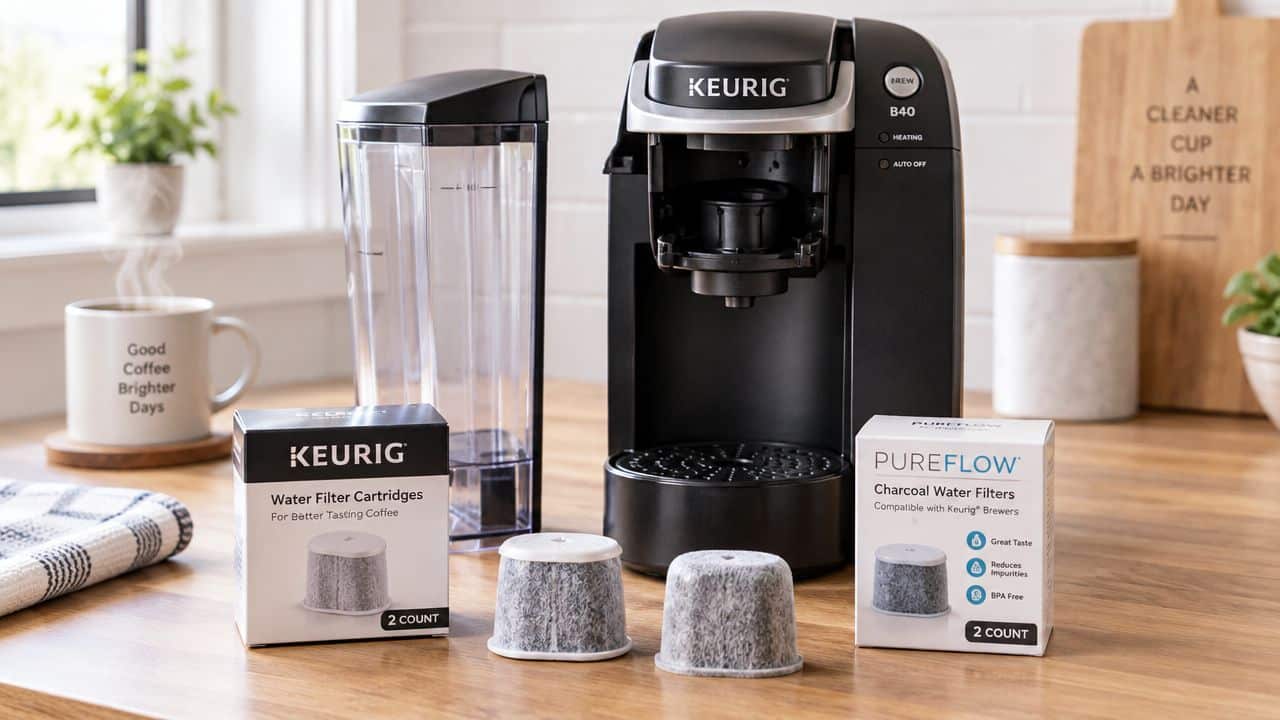
You lift the lid on your Keurig B40, press brew, and the first sip tastes flat, faintly metallic, or just a little too much like the tap. Before blaming the pod, check the water path. The Keurig B40 water filter sits inside a broader legacy filter system, so the questions are whether your cartridge is exhausted, whether the holder matches the brewer, and whether the machine also needs descaling.
The B40, also marketed as the Elite Single Cup Brewer, uses a 48-ounce removable reservoir, offers 8-ounce and 10-ounce brew sizes, and measures about 14.93 by 12.5 by 16.75 inches, according to its B40 product listing. That compact, reservoir-based design is convenient, but it also makes filter fit and water maintenance easy to overlook.
When Your Morning Cup Starts Tasting Off
A B40 owner usually notices the problem in a familiar way. The coffee still comes out hot, the brewer still sounds normal, and the pod hasn't changed, but the cup tastes muted. Sometimes the flavor has a faint chlorine edge. Sometimes it seems slightly metallic. In a small office, someone eventually asks whether the machine is failing.
The filter is a sensible first suspect, but I check three causes in order.
Start with the cartridge
A charcoal cartridge past its replacement window can stop improving taste, even when it looks clean. The B40's compatible replacement market commonly treats two months as the practical swap point, while the brewer's owner guidance separately emphasizes periodic descaling. A tired cartridge won't reliably control the taste and odor compounds that make coffee seem dull.
The second common mistake is installing a dry cartridge without properly rinsing it. Charcoal needs water moving through it before the first brew. If you skip that preparation, the first cup can taste dusty or show fine black particles.
Practical rule: If the bad taste appeared gradually, replace and prepare the cartridge before you replace anything else.
Finally, look at the reservoir itself. Water left sitting in sunlight or for too long can taste stale, even when the filter is serviceable. Empty the tank, rinse it, and refill it with fresh water before judging the new cartridge.
Recognize the taste pattern
Filtered and unfiltered water don't always produce a dramatic difference. With municipal water containing chlorine or chloramine, the change often appears as lost brightness rather than an obvious chemical flavor. The coffee's acidity seems quieter, its aroma weaker, and the finish less clean.
A cartridge won't correct every water problem, and it won't remove mineral scale already inside the brewer. It can, however, improve the incoming water's taste and odor profile. The rest of this guide focuses on the decisions that cause the most trouble, including shared compatibility, holder checks, replacement timing, installation, and descaling.
Why the B40 Shares Its Filter With a Whole Family of Brewers
The B40 isn't an orphan model with a one-off cartridge. It belongs to the older Keurig 1.0 filter-holder format, a compatibility family that includes models such as the B44, B50, B60, B70, B145, and several K-series brewers. Replacement listings continue to name the B40 alongside these machines, which is why owners can still find charcoal cartridges through multiple retail channels.
That shared format changes how you should shop. Search by the holder and cartridge style first, then confirm the model list. A listing that says only “B40 filter” may be using a packaging label for a cartridge that also fits other legacy brewers. Conversely, a listing that says “Keurig filter” without identifying the holder can be too vague to trust.
The B40-compatible charcoal filter listing places the model among a wider replacement category that includes B44, B50, B60, B70, B145, and later K-series machines. Other replacement cartridge compatibility details also identify the B40 as part of Keurig 1.0 and 2.0 compatibility sets, so the product description still matters more than the marketing headline.
The practical family tree
| Keurig Model | Filter Format | Notes |
|---|---|---|
| B40 | Keurig 1.0 charcoal cartridge | Elite Single Cup Brewer format |
| B44 | Keurig 1.0 charcoal cartridge | Shared legacy holder family |
| B50 | Keurig 1.0 charcoal cartridge | Common early-series match |
| B60 | Keurig 1.0 charcoal cartridge | Holder variants require visual checking |
| B70 | Keurig 1.0 charcoal cartridge | Confirm the existing holder before ordering |
| B145 | Keurig 1.0 charcoal cartridge | Office-oriented legacy brewer |
| Early K-series models | Keurig 1.0 charcoal cartridge | Compatibility varies by holder assembly |
The B40 predates later filter designs associated with newer Keurig systems. Don't assume a cartridge designed for a Keurig 2.0 redesign or a newer K-Elite reservoir will fit because the box carries the Keurig name.
Buying advantage: The B40's shared format leaves you with more replacement choices, not fewer.
That availability also creates the main hazard. Generic sellers may use “universal” language while excluding Keurig-Cuisinart systems or requiring a particular holder. The starter replacement compatibility list is useful because it groups the B40 with a broader set of legacy models instead of treating it as a unique machine.
How to Confirm Your B40 Filter Holder Before You Order
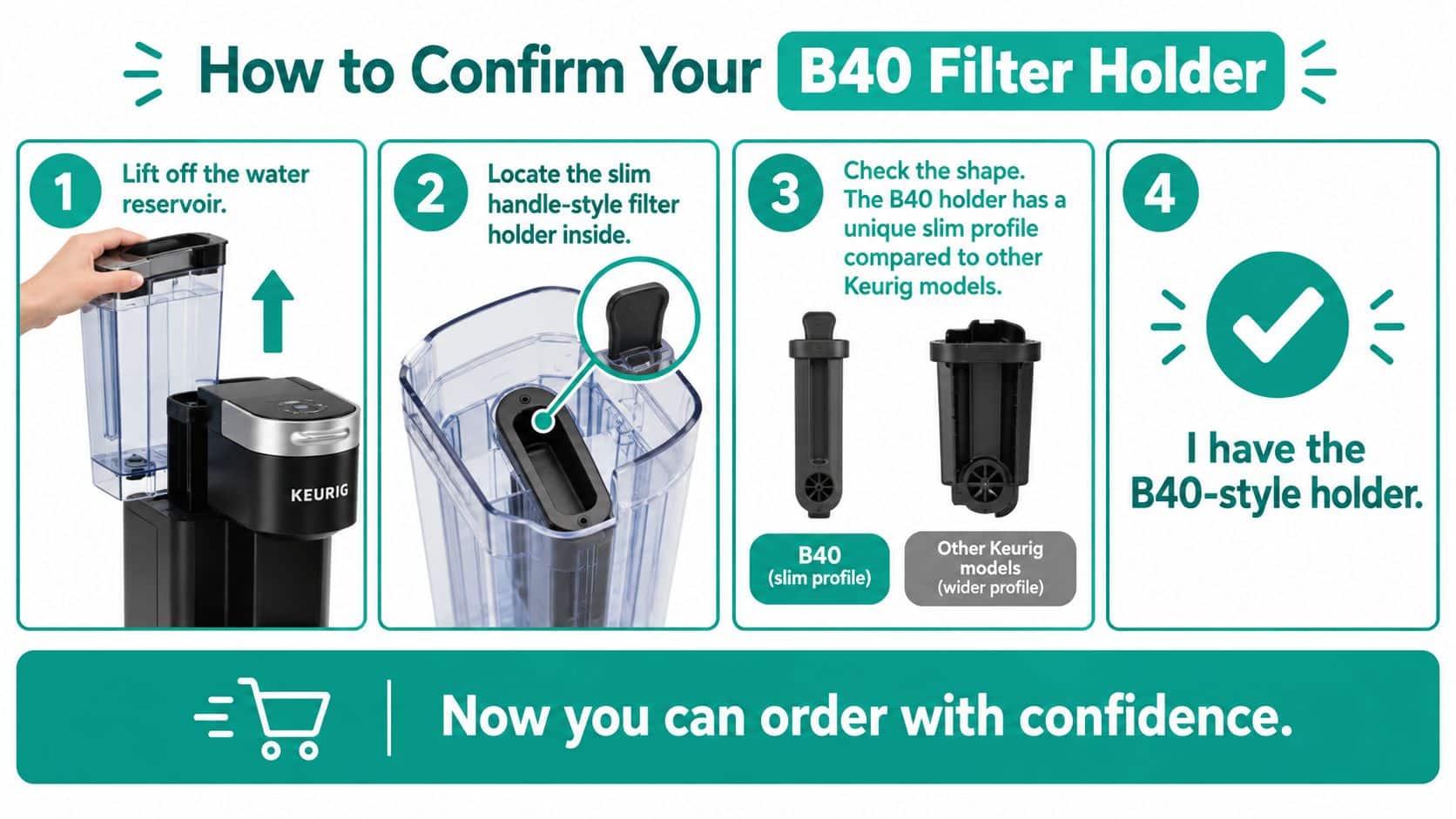
A product page can claim compatibility, but your reservoir provides the final check. Remove the water tank from the brewer and inspect the interior, usually near the bottom or side of the reservoir. You're looking for the slim, handle-style filter holder, not just the small mesh disc or intake screen at the tank base.
Use the old assembly as your reference
Lift the holder out carefully and keep the existing cartridge beside you while shopping. Check the cartridge's shape, the handle orientation, and any model or part markings stamped into the plastic. The old piece is more reliable than a generic product photograph because it shows exactly what your brewer currently accepts.
Some B40 units use the taller handle-style holder associated with the large reservoir arrangement. Other legacy models, including some B60 and B70 configurations, use a shorter handle. The holders themselves aren't interchangeable, even though both holder styles can accept the same cartridge format. Don't order a complete holder assembly based only on the cartridge description.
The visual inspection should answer four questions:
- Holder presence: Is a removable filter holder installed?
- Handle orientation: Does the replacement cartridge sit in the same direction as the old one?
- Cartridge shape: Does the new cartridge match the old cartridge's profile?
- Water flow: After reinstallation, does water enter the holder and reservoir normally?
The small mesh disc at the reservoir base isn't the charcoal cartridge. It controls water entry and can remain visible even when the removable filter assembly is missing. Confusing those two parts leads many first-time buyers to order a cartridge when they need a holder kit as well.
For a closer visual reference, compare your assembly with this guide to Keurig water filter holder replacement. If the holder doesn't sit securely, stop before brewing. A loose assembly can let water bypass the charcoal or prevent the reservoir from seating correctly.
Charcoal Replacement Filters vs Generic Alternatives
The useful comparison isn't branded versus generic. The choices are a standard disposable charcoal cartridge, a third-party cartridge made to the same holder format, or a reusable mesh-style filter. Each option changes taste control, maintenance effort, and fit risk.
A standard charcoal cartridge is the least complicated choice. It drops into the holder, requires regular replacement, and targets the taste and odor compounds that filtered water can reduce. Third-party cartridges can perform similarly when their dimensions match the holder, but quality varies between sellers. A reusable mesh filter avoids recurring cartridge disposal, yet it doesn't provide the same charcoal-based treatment unless it includes a compatible carbon medium.
| Filter Type | Taste Impact | Lifespan | Approx. Monthly Cost | B40 Fit |
|---|---|---|---|---|
| Keurig charcoal cartridge | Cleaner water taste when the incoming water carries chlorine or odor | Replace on the stated schedule | Depends on pack price and replacement frequency | Designed for the matching Keurig holder |
| Third-party charcoal cartridge | Can provide a similar improvement when the carbon and fit are sound | Replace on the seller's stated schedule | Often lower than branded options, but varies | Confirm B40 and holder compatibility |
| Reusable mesh filter | Limited taste change without charcoal media | Reusable with ongoing cleaning | Lower recurring cartridge cost, with more cleaning work | Only fits if designed for the B40 holder |
What actually works
The generic cartridges I keep in a small-office supply cabinet are the ones that drop into the B40 holder without trimming, wedging, or forcing. A cartridge that requires modification isn't a bargain if it cracks the holder, sits too high, or leaves an unfiltered bypass path. The charcoal replacement guide provides useful context on replacing carbon cartridges without treating every Keurig model as identical.
Local water quality should guide the decision. If your tap water has a noticeable chemical taste, charcoal is worth considering because the taste problem is obvious in the cup. If you already use good-quality filtered water, a reusable option may be adequate for your priorities, but it doesn't remove the need to clean the brewer.
Don't confuse coffee-water filtration with household air filtration. If you're also comparing home HVAC filters, this explanation of home AC filter MERV ratings covers a separate filtration standard and shouldn't be used to select a B40 cartridge.
Replacement Timing and the Actual Install Steps
The practical replacement rule for a B40 charcoal cartridge is every two months, with heavier-use offices changing cartridges sooner based on how quickly the reservoir cycles through water. Retail compatibility guidance also identifies the B40 among single-serve reservoir systems sold after August 2007, a cutoff that can help owners compare replacement listings before buying. Check the aftermarket compatibility description when a seller uses a purchase-date qualification.
A cartridge may be overdue before it looks dirty. Watch for slower flow, weaker aroma, a returning chlorine taste, or visible sediment. Those signs don't prove the cartridge is the only problem, but they justify replacing it and cleaning the holder.
Install the cartridge cleanly
- Remove the reservoir: Lift the tank away from the B40 and empty any remaining water.
- Lift out the holder: Pull the handle gently and remove the old cartridge.
- Rinse the new cartridge: Run it under cold water for 60 seconds so the carbon becomes wet and loose fines rinse away.
- Seat the cartridge: Lower it into the holder until it sits flush, without force.
- Reassemble and flush: Return the holder and reservoir, fill with fresh water, and run a water-only brew cycle without a K-Cup.
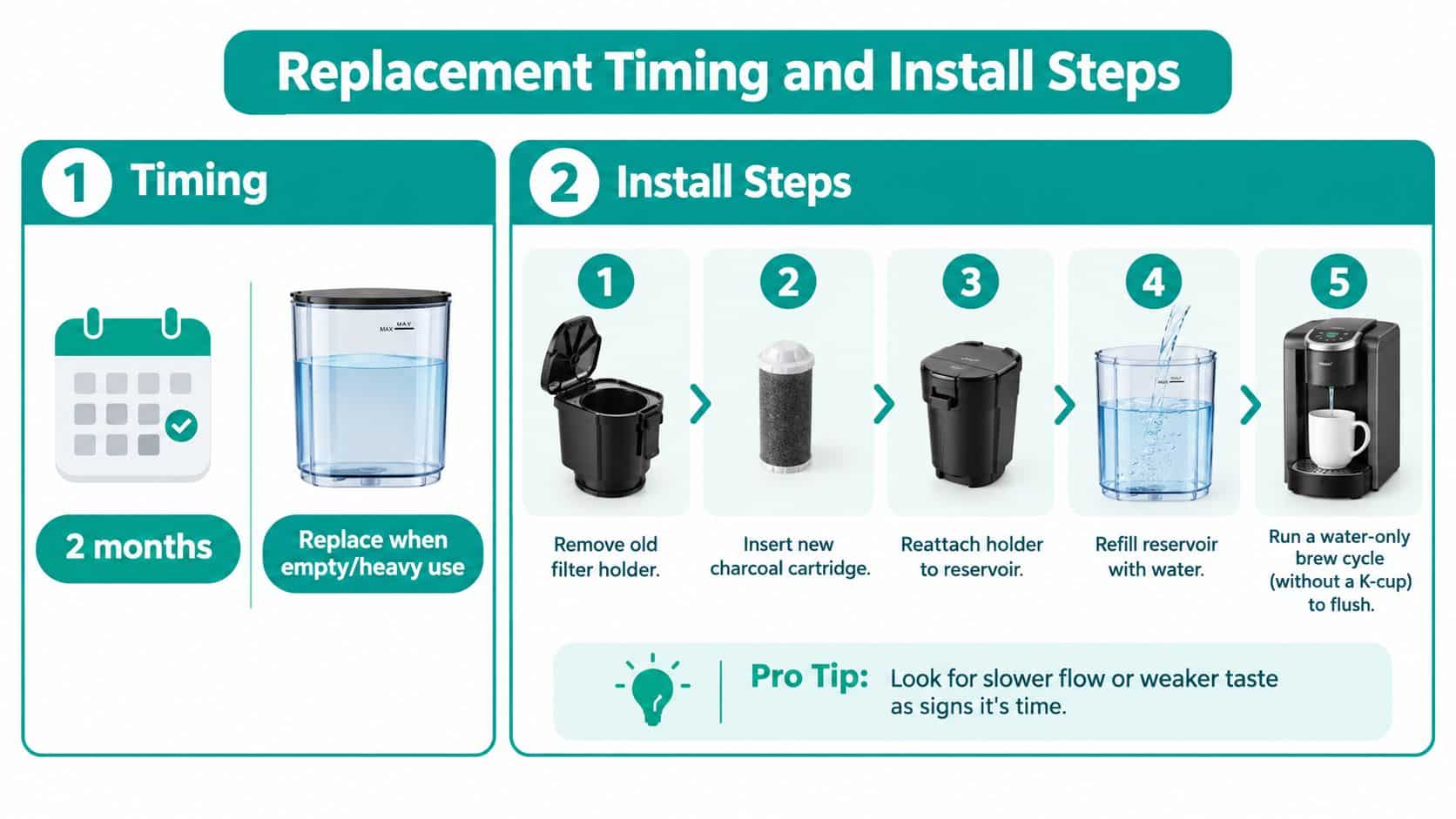
The most common first-time mistake is skipping the rinse. Dry carbon can release black fines into the first cup and may contribute to blockage at small internal screens. Hold the cartridge under the tap until the water runs clear, then install it.
For broader maintenance habits, SouthRay Kitchen & Bath's water filtration system maintenance tips offer useful reminders about keeping filter components clean and properly seated.
Before you brew coffee, check that the holder is fully lowered, the handle doesn't obstruct the lid, and the reservoir sits flat on the brewer. Run water through the machine once, discard it, and judge the next coffee rather than the first post-install rinse.
Water Filtration and the Descaling Routine Your B40 Still Needs
A charcoal filter and descaling solve different problems. The cartridge improves incoming water's taste and odor profile, while descaling removes calcium deposits that build up inside the heater and water paths. Keurig's descaling instructions tell owners to descale every few months and repeat the procedure if the red descale light remains on. The same B40 guidance says the cycle may require at least 48 ounces of undiluted white vinegar.
Two maintenance jobs, two outcomes
Filtered water can reduce taste and odor problems and may slow fouling, but it doesn't eliminate mineral scale. Calcium and magnesium can still precipitate on internal heating and flow surfaces, particularly where water repeatedly heats and evaporates. A cartridge can't reach those deposits.
Descaling also doesn't refresh stale water in the tank or replace exhausted charcoal. Treating the descale cycle as a substitute for a cartridge leaves the incoming water problem unresolved. Treating the cartridge as a substitute for descaling leaves mineral buildup in place.

The B40's owner guidance is the safer authority for the actual procedure. Use the machine-specific instructions, remove the water filter before descaling if directed, and rinse thoroughly before brewing coffee again. For a plain-language walkthrough, see this guide to how to descale a Keurig.
A simple routine works well in practice: replace the charcoal cartridge on schedule, empty and rinse the reservoir regularly, and treat a persistent descale light as a maintenance signal rather than something to reset and ignore. Owners in hard-water areas should pay closer attention to the brewer's symptoms and instructions.
Fit, Leaks, and the Compatibility Confusion Worth Clearing Up
Compatibility listings create unnecessary anxiety because sellers don't always use the same model families. One Keurig-branded box may omit the B40 even when the cartridge physically matches the holder. Another listing may group the B40 with B30, B31, B44, B50, B60, B66, B70, B77, B100, B130, B140, B145, B150, B155, K40, K45, K50, K60, and K70 series.
That long list reflects shared holder geometry, not a claim that every complete reservoir or holder assembly is interchangeable. The compatibility warning for replacement filters is especially relevant because some cartridges exclude Keurig-Cuisinart systems or require the correct water-tank holder.
Why leaks and height problems happen
A cartridge that arrives too tall can press against the reservoir lid. This usually indicates a different holder family, not a defective B40. Don't trim the cartridge or force the lid closed. Return it and choose a replacement whose dimensions and compatibility list match your installed holder.
A post-install drip often comes from an assembly problem rather than the charcoal itself. Check the holder's seating, the cartridge's position, and the reservoir connection before assuming the tank has cracked. The cartridge should be properly rinsed, the holder should sit in its original orientation, and the reservoir lid should close without pressure.
Use this short check before ordering:
- Confirm the holder: The tank must contain the removable holder, not only the base mesh screen.
- Match the cartridge: Compare the new piece with the old one and verify the B40 appears in the compatibility list.
- Check the fit: Reject cartridges that require trimming, force-fitting, or lid pressure.
- Flush after installation: Run water through the brewer before inserting a pod.
- Keep the packaging: Save the old cartridge until the replacement proves its fit.
A listing that says “not compatible with B40” isn't automatically wrong, but it should explain why. It may refer to a different holder style, a complete assembly, or a Keurig-Cuisinart format. If it gives no reason, choose a listing that identifies the cartridge family and holder requirements clearly.
PureHQ Inc. offers compatible Keurig water-filter cartridges, reusable brewing accessories, and descaling supplies for home and small-office setups, with product information intended to help owners match accessories to their machine. Visit PureHQ Inc. to check the B40-compatible filter options, compare cartridge formats, and choose the maintenance supplies that fit your brewing routine.

