
Coffee Machine Care
Inexpensive K Cups That Still Taste Great

Sep
A single-serve coffee habit can look inexpensive one pod at a time, yet the true cost includes more than the label. In the United States, about 50 million to 60 million used coffee pods are thrown out or recycled every day, according to Consumer Reports' analysis of K-Cup recycling. That scale changes the question. The cheapest K-Cup isn't automatically the cheapest satisfying cup if it brews weak coffee, creates extra disposal work, or contributes to machine buildup.
Why Your Daily K Cup Habit Feels So Expensive
A daily pod feels harmless because the purchase happens in small increments. Suppose one pod costs $0.50. One cup every day adds up to more than $180 over a year, before water, filters, cleaning products, or the occasional wasted cup enter the calculation. The arithmetic is simple, but it becomes easy to overlook when pods arrive in a large box or through an automatic delivery.
The habit became mainstream quickly. Stanford Magazine reported that single-serve machines were found in about 27% of U.S. homes, while 8.3 billion pods were sold in 2013. By the following year, Waste Dive reported that Keurig had sold 9.8 billion K-Cups in a single year. Consumer Reports later noted that 27% of U.S. coffee drinkers used a single-serve machine on a given day in 2023.
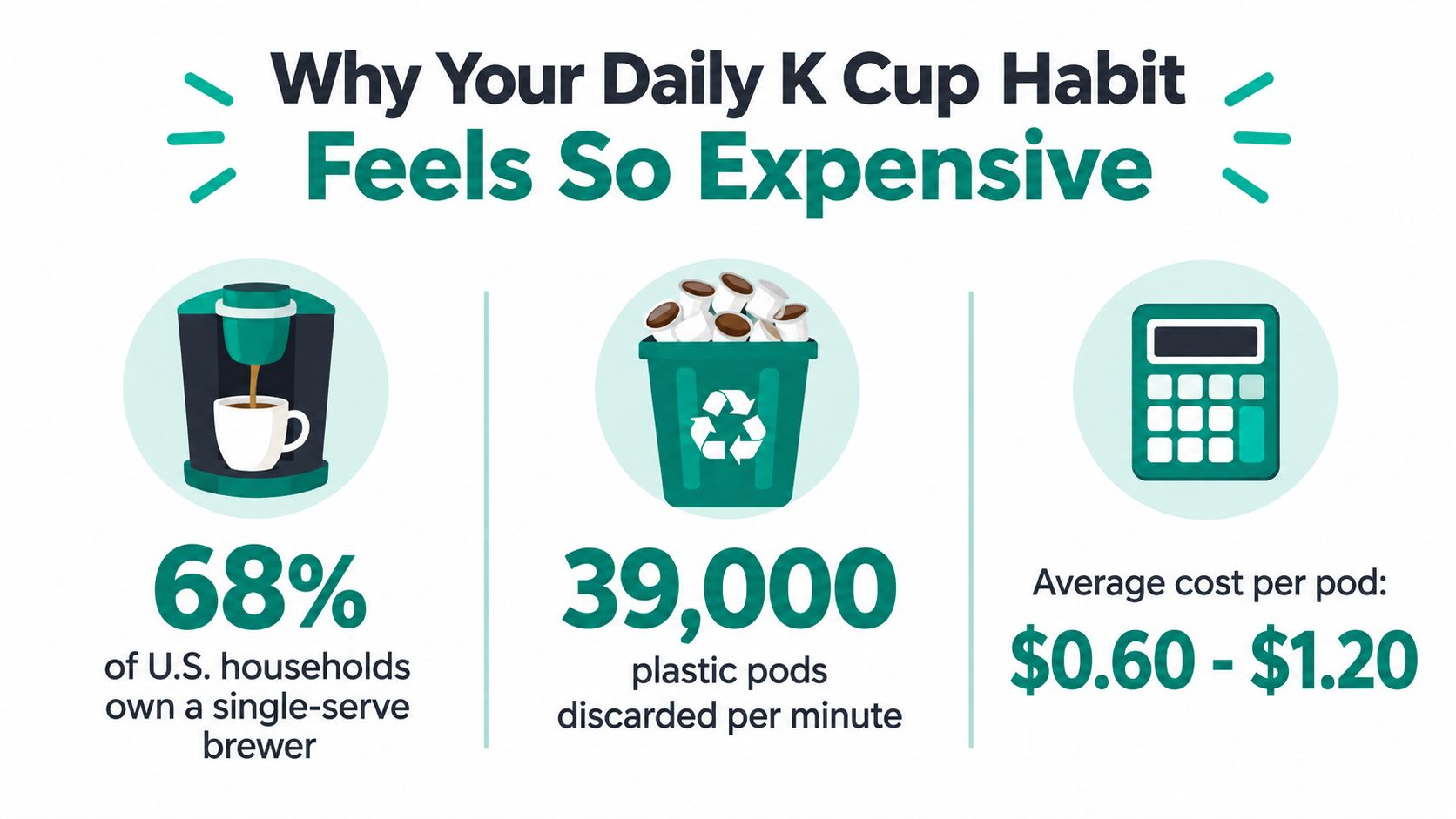
Those figures explain why shoppers now compare price per pod, compatibility, flavor strength, and waste instead of choosing only by brand reputation. A household that brews several cups daily can feel the difference between a dependable budget pod and a disappointing bargain. An office breakroom feels it even faster because every weak cup encourages employees to brew another.
The useful question: What does each satisfying cup cost after coffee, waste, cleanup, and machine care?
The solution isn't always to abandon disposable pods. Store brands, bulk packs, and compatible options can lower the shelf price. Reusable pods can reduce packaging and let you use coffee you already enjoy. The smart choice depends on how often you brew, how much control you want, and whether your local recycling system accepts prepared K-Cups.
This guide treats inexpensive K-Cups as a total-cost decision, not a race to find the smallest number on a package. You'll learn how pod design affects taste, how to compare disposable and reusable formats, and when filters and descaling help protect the savings.
What Really Drives the Price of a K Cup
K-Cup pricing follows a familiar grocery pattern. A small box sold for convenience usually carries a different per-cup cost than a large multipack, a store brand, or a refillable pod used with ground coffee. Retailer promotions, variety packs, subscriptions, roast style, and packaging all change the shelf price.
The first calculation is straightforward:
Total pod price ÷ number of usable cups = disposable cost per cup.
If a pack costs $30 and contains 60 pods, the pod cost is $0.50 per cup. That result is useful, but it isn't the final answer. Add the cups you discard because they taste thin, the pods that don't fit your brewer, and the maintenance supplies needed to keep water moving through the machine. A low price can lose its advantage when the product doesn't deliver a cup you want to drink.
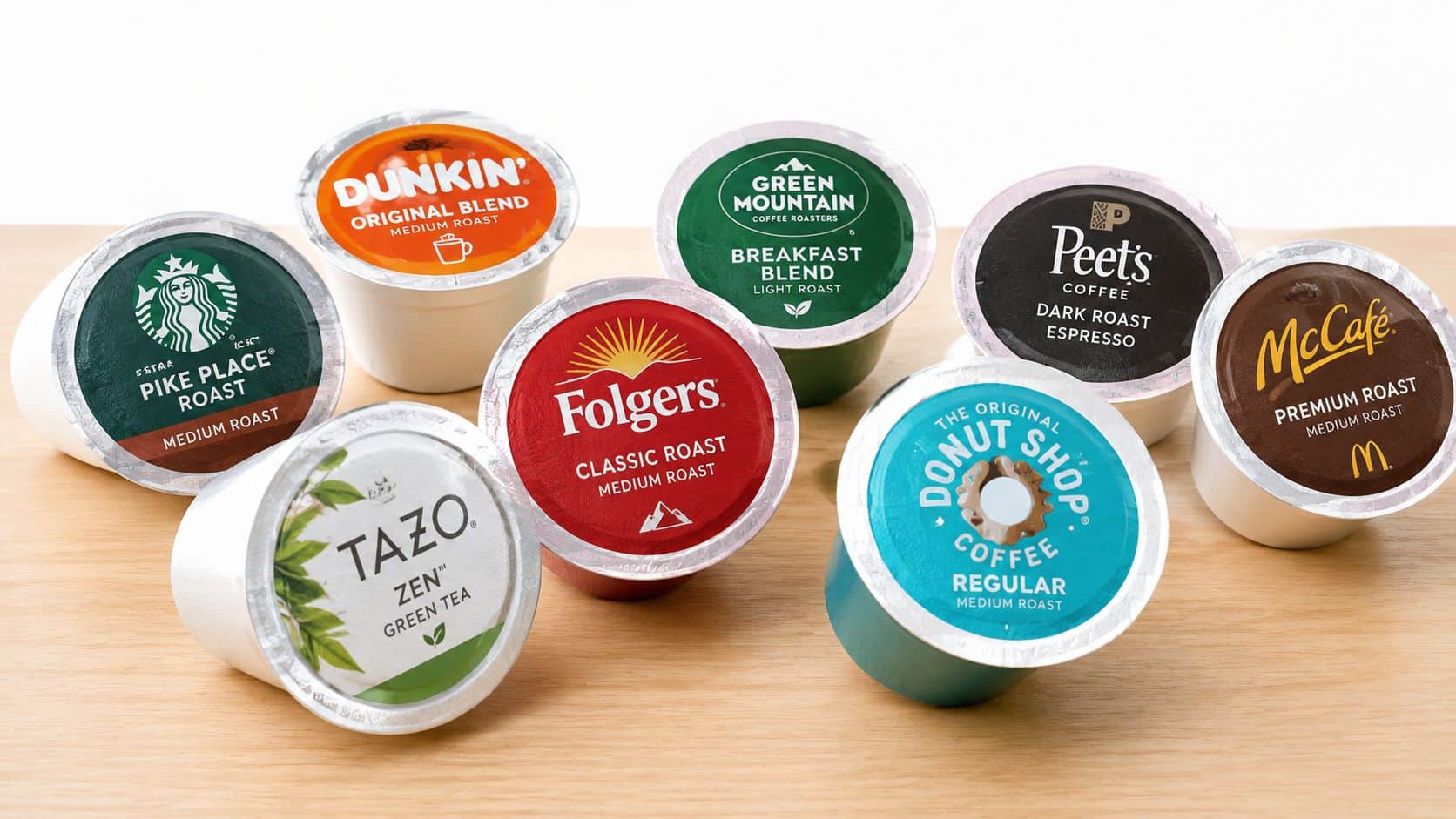
Mass adoption makes small price differences meaningful. Once a pod brewer becomes part of a daily routine, consumers start comparing per-cup cost and compatibility as carefully as roast labels. A large household or small office doesn't need a dramatic price difference to notice the effect. It needs a repeatable system that produces the intended number of drinkable cups without extra fuss.
Price isn't the same as value
A pod can be inexpensive because it contains less coffee, uses a less costly blend, or comes from a generic manufacturer. None of those facts automatically makes it poor. They create reasons to inspect the product rather than assume that a familiar logo guarantees better value.
Check the package for:
- Count: Divide the full purchase price by the actual pod count, not the number of servings suggested by the box.
- Compatibility: Confirm that the format works with your brewer before buying in volume.
- Dose and construction: A pod that is underfilled or poorly packed may produce watery coffee.
- Use frequency: A reusable system may make more sense for someone who brews repeatedly at home or in an office.
This video can help visual learners understand how pod brewing fits into a wider coffee routine.
A practical comparison treats each pod like a single-serving package of coffee, not like a portion of a larger bag. That mindset helps you identify false savings without needing complicated calculations.
How K Cup Design Affects Flavor and Value
A pod may cost less yet produce a satisfying cup only when its dose, grind, and construction work together. Standard pods generally hold about 7 to 12.5 grams of coffee, while Keurig-style brewers use roughly 1.5 bars of pressure and brew in about 60 seconds at around 192 to 197°F. Saneu's explanation of K-Cup brewing explains why those limits make the pod's internal design important.
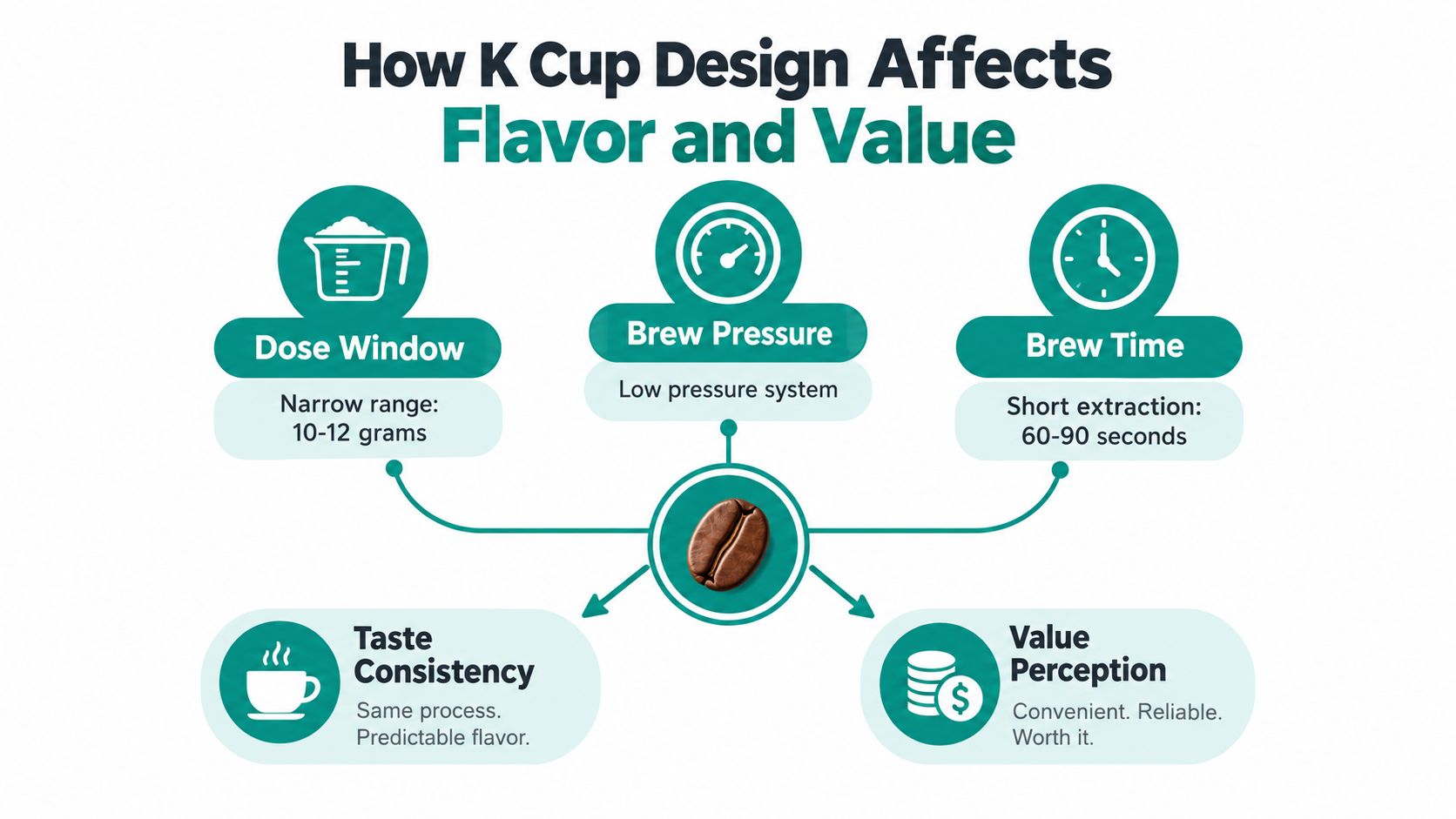
The pod functions as a small filter bed. Water needs to contact the grounds evenly, move through them at a workable speed, and carry enough flavor into the cup. A shallow bed can let water rush through, producing weak coffee. Grounds packed too tightly can force water through narrow channels, leaving some coffee under-extracted while other areas taste harsh.
Three design details to inspect
Dose affects strength. A pod near the lower end of the usual fill range may taste thin, particularly at a larger brew size. A fuller pod can provide more flavor, but only if it leaves enough room for water to pass through the grounds.
Grind affects flow. A medium-fine grind in the 400 to 600 micron range is commonly associated with balanced extraction for this type of pod. Coarser grounds may let water pass too quickly. Very fine grounds can slow the flow and contribute to bitterness or a harsh cup.
Packing affects consistency. Reusable pod grounds should not be tamped like espresso. Keurig-style brewers are not designed for espresso-like compression, and pressing the coffee down can restrict flow and encourage channeling. Fill the pod evenly, leave the required headspace, and close the lid without forcing it.
A bargain pod that produces a weak cup is not inexpensive if you need a second pod to get the flavor you expected.
Reusable pods make these variables visible. You choose the coffee, dose, and grind, while also handling the fill level and closure. Disposable pods hide that work, so judge them by the drink they produce and the amount you finish, not just the printed price.
Repeatability provides the clearest test. Brew the same pod at the same setting and note whether the cup tastes watery, bitter, or balanced. Check for leaking grounds as well. A consistent cup lowers the practical cost because less coffee ends up unfinished, and reusable pods can beat the lowest sticker price when their reduced waste and controllable extraction make each cup satisfying.
Comparing Premium Pods Budget Pods and Reusable Options
Different pod formats solve different problems. Premium branded pods emphasize familiar flavor profiles and convenience. Store-brand and bulk disposable pods usually target a lower shelf price. Stainless steel reusable K-Cups shift the work to the brewer, who supplies the coffee and cleans the pod afterward.
| Option | Cost Per Cup | Flavor Control | Waste and Maintenance |
|---|---|---|---|
| Premium branded pods | Usually the highest disposable price in the comparison | Limited to the selected blend and pod dose | Simple disposal, but every serving creates packaging waste |
| Budget or store-brand pods | Often lower than premium pods, especially in larger packs | Depends on the blend, fill, and grind | Convenient, but compatibility and recycling acceptance require checking |
| Stainless steel reusable K-Cups | Depends on the ground coffee you use | High control over coffee, grind, and fill | Less single-use pod waste, but requires emptying, rinsing, and occasional replacement |
| Reusable pod with a paper liner | Depends on the coffee and liner supply | High control with easier grounds removal | Adds a liner step while simplifying cleanup |
A reusable pod can leak if the grounds are overfilled, the lid doesn't close completely, or the pod isn't seated correctly. The fix is mechanical, not mysterious. Use a level fill, avoid tamping, inspect the rim for stray grounds, and confirm that the pod sits squarely in the holder.
Compatibility deserves a careful check
Keurig's official compatibility guidance says most K-Cup pods made today work with current Keurig brewers, but some older Keurig 2.0 machines used DRM that rejected non-Keurig-branded pods. Nespresso capsules, E.S.E. pods, and Senseo pods are separate formats and won't fit a Keurig brewer.
Before buying a reusable option, match the product listing to your brewer family. K-Classic, K-Slim, K-Supreme, K-Mini, K-Express, and K-Duo models can have different pod-holder requirements, so a product described only as “universal” deserves extra scrutiny. PureHQ Inc. offers reusable pods, stainless steel refillable pods, paper liners, water filters, and descaling products for several Keurig systems, making those accessories relevant when fit and cleanup are the main objections.
You can also read this guide to reusable K-Cups for Keurig brewers before choosing a format. Match convenience to your routine. Disposable pods suit people who value speed above all else, while reusable pods suit drinkers who want control and brew often enough to make cleanup worthwhile.
Smart Ways to Buy Inexpensive K Cups for Less
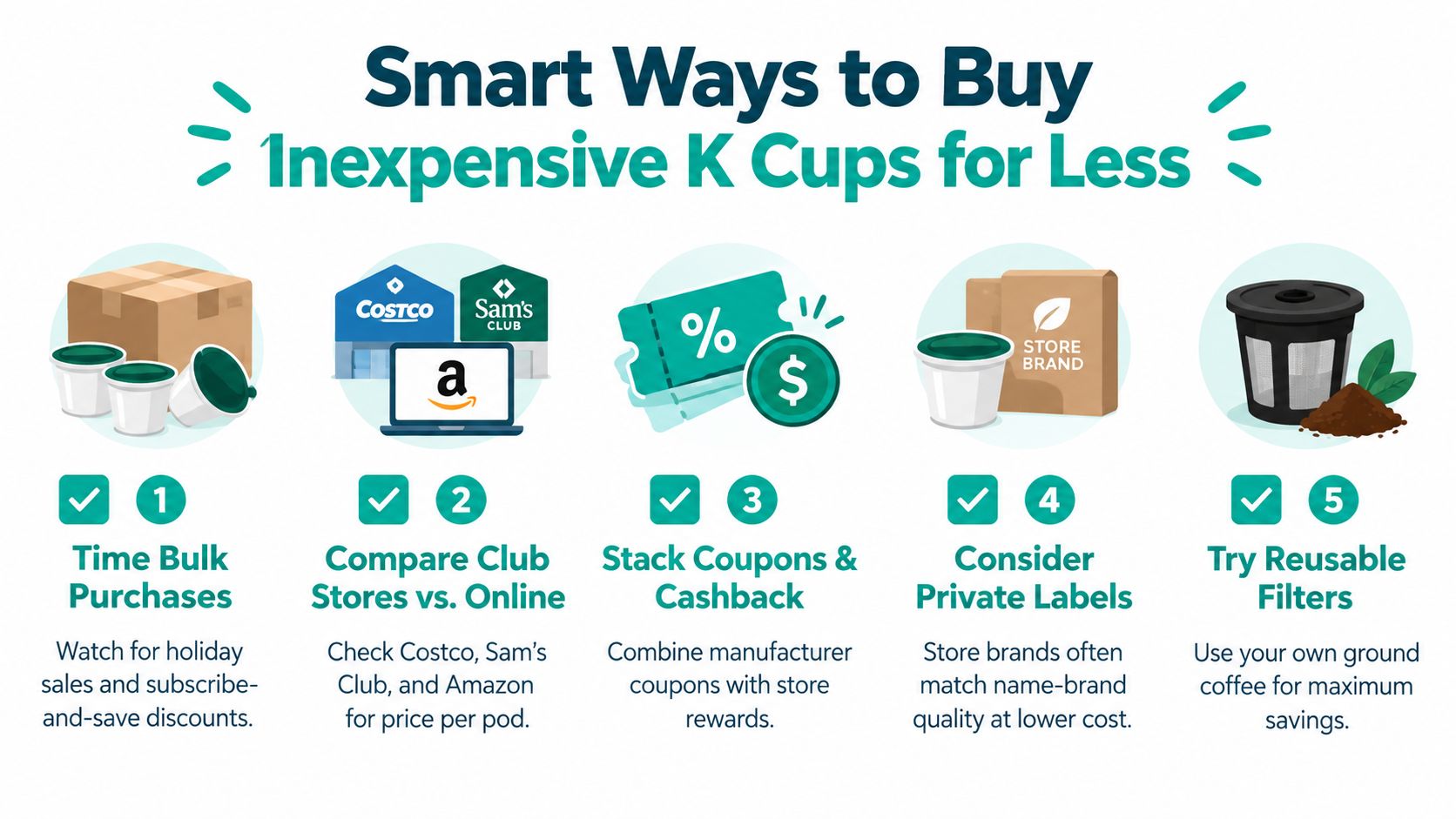
Shopping for inexpensive K-Cups works best when you compare equivalent products. A mixed variety pack may contain flavors you won't drink, while a large box of one roast may become boring or stale before you finish it. The lowest visible unit price only helps when the pods match your brewer and your taste.
Use a repeatable buying routine
Calculate the usable price. Divide the final checkout total by the number of pods you'll realistically brew. Include delivery charges, membership costs, and any pods in the box that nobody in your household drinks.
Compare like with like. Check club-store packs, online marketplaces, grocery promotions, and subscriptions using the same roast style and pod count. A subscription may reduce the purchase price, but it isn't a saving if it sends coffee faster than you use it.
Inspect compatibility before volume buying. Look for the exact brewer family in the product description. If you own an older Keurig 2.0, pay particular attention to whether the pod is accepted by that machine.
Check freshness information. Coffee quality can decline with time, heat, and poor storage. Choose a seller that provides clear product details, and store unopened pods away from heat and moisture.
Test before committing. Buy a small quantity of an unfamiliar store brand or generic pod. Taste it at your normal brew setting before purchasing a larger case.
A reusable pod changes the shopping calculation. Instead of repeatedly buying pre-portioned coffee, you buy ground coffee in a format you prefer and portion it at home. That can give high-volume households and small offices more control over flavor and supply, although it adds a short cleanup task after brewing.
Don't confuse variety with savings
Variety packs can help you discover a preferred roast, but they can also hide the true cost of unwanted flavors. Use a tasting period to identify what you finish, then direct future purchases toward those profiles. If you want broader choice without accumulating disposable packaging, a refillable pod lets you switch among grounds as needed.
This Keurig variety-pack guide can help you think through selection, but the core rule remains simple. Buy enough to match your consumption, verify fit, and judge the cup after brewing rather than trusting the front-of-box claim.
The Hidden Costs of Cheap Pods and Recycling Realities
“Recyclable” describes the material and intended pathway. It does not guarantee that your local facility accepts the pod, separates its parts, or processes it successfully. Earth911's guide to K-Cup recycling pathways explains the gap between a pod that can be recycled in theory and one that makes it into a recycling stream.
Keurig says that, since the end of 2020, 100% of the K-Cup pods it produces are recyclable, and its instructions tell users to peel off the lid, remove or compost the coffee grounds, and recycle the empty cup through an accepted program. That is more work than tossing a used pod in the trash or a bin. Local acceptance still varies, and independent coverage has reported that some major recycling companies do not accept K-Cup pods. For a broader look at the options, see K-Cup recycling pathways and what to check first.
The volume makes the workflow matter
Consumer Reports estimated that 50 million to 60 million used coffee pods are discarded or recycled each day in the United States. Earth911 also cited an estimate of 56 billion pods entering landfills annually, while a University of Waterloo life-cycle study estimated that Ontario consumes 2 billion single-serve pods each year and generates 30,000 tons of landfill waste.
Those figures do not tell you which option suits your home, but they show why end-of-life handling belongs in the cost calculation. If recycling asks you to peel, empty, rinse, dry, and sort each pod, that effort becomes part of the overall price. A reusable pod creates less single-use pod waste, but it asks you to deal with coffee grounds after each brew.
Water and machine care add another layer. Mineral buildup can affect brewing performance and shorten the useful life of a brewer, so filtration and regular descaling belong in the household budget whether you use disposable or refillable pods. Keurig's commercial Grounds to Grow On program describes an office process in which 75% of collected pod material is composted and the remaining 25% is recycled.
For a high-volume office with weak curbside acceptance, reusable pods may be easier to justify than disposable pods plus a separate recycling workflow. For a low-volume household that values speed, compatible disposable pods may still be reasonable. Track your pods by waste type, then decide whether reusable pods, a compatible disposal program, or a different brewer fits your routine best.
Your Next Step to Better Coffee for Less
The cheapest satisfying cup begins with a better definition of cheap. Start with the disposable pod price, then account for whether the coffee tastes strong enough, whether the pod fits your brewer, and whether its end-of-life instructions work in your area. A pod that forces a second brew or creates an inconvenient recycling routine may cost more than its package suggests.
Reusable K-Cups offer a different path. You choose the coffee, adjust the grind, fill the pod evenly, and reuse the hardware. That control can help you avoid the narrow-dose problems that make some bargain pods taste thin, while a paper liner can make spent grounds easier to remove.
Compatibility remains the practical concern. Keurig brewers differ, and older Keurig 2.0 machines may reject some non-Keurig-branded pods. Check the exact model before purchasing, especially if you use a K-Classic, 2.0, K-Supreme, K-Slim, K-Mini, K-Express, or K-Duo system.
Filtered water and descaling support the savings by helping you maintain the brewer rather than replacing it early. A reusable pod is only a good value when it fits, closes securely, brews evenly, and can be cleaned without becoming a daily annoyance. Start with a small test, record which coffee and fill level produce the cup you enjoy, and repeat that setup.
PureHQ Inc. offers reusable K-Cups, stainless steel refillable pods, paper liners, water filters, and descaling supplies for compatible coffee systems. Visit PureHQ Inc. to shop reusable pods and maintenance bundles that can help you brew satisfying coffee for less.

