
Coffee Machine Care
Choosing Water Filters Refrigerator: A 2026 Guide
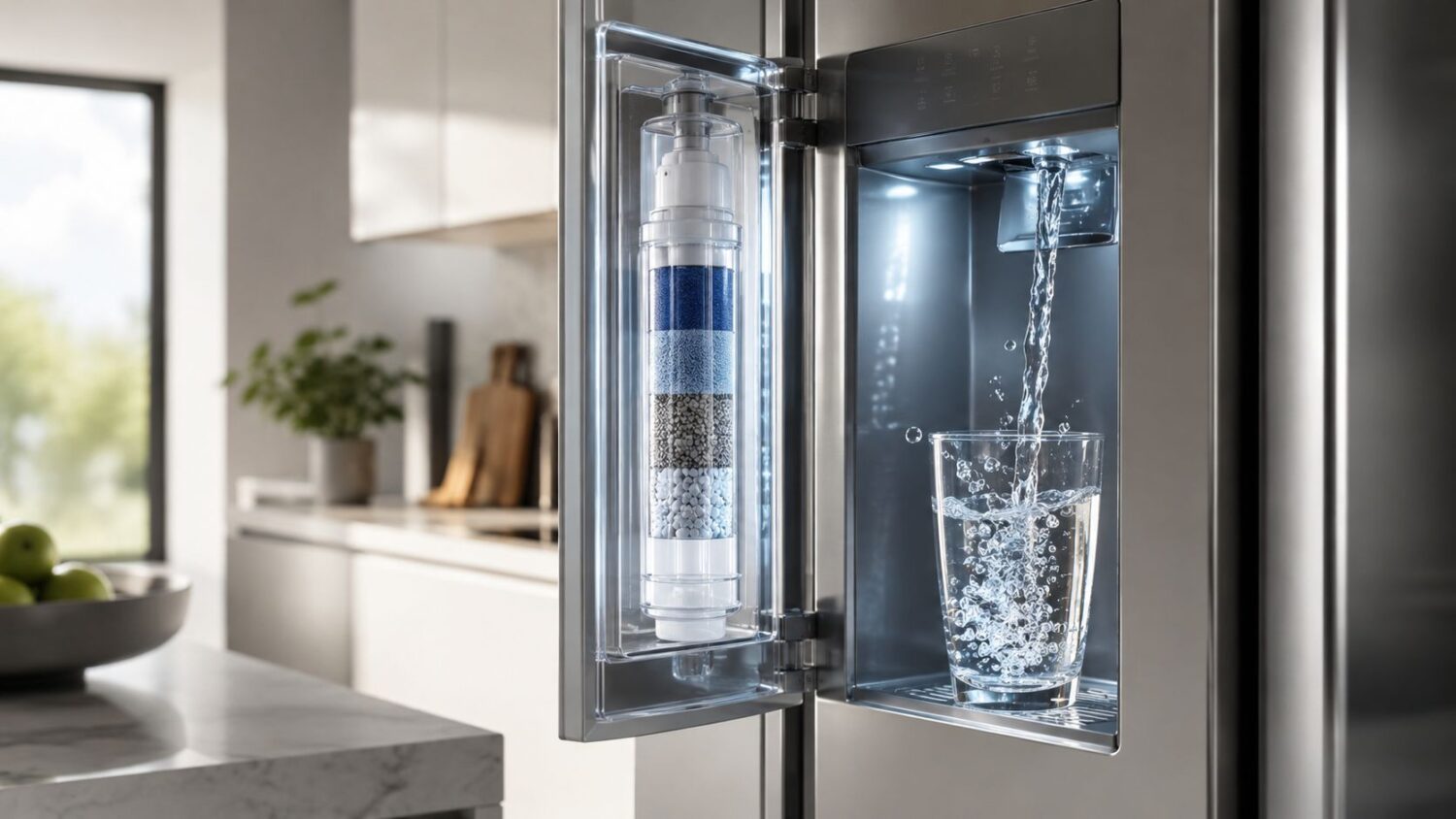
Jun
A lot of people trust the water from the fridge dispenser more than the water from the tap. That confidence isn't always earned.
The bigger issue is simple: a refrigerator filter can improve water, but it can also create a false sense of safety when the cartridge is generic, poorly certified, or long overdue for replacement. That matters in a market that's already massive. The global refrigerator water filter market was valued between $2.5 billion and $3.9 billion in 2025, with one estimate at $3,913.4 million, and it's projected to reach about $6,942.5 million by 2035 at a 5.9% CAGR, according to Frizzlife's market overview. Big market or not, the core buying mistake stays the same: many households assume any cartridge that fits the slot must also protect their water.
It doesn't work that way. In practice, certification, contaminant coverage, and replacement timing decide whether your fridge is delivering cleaner water or just colder water.
That Filtered Water Might Not Be as Clean as You Think
The word “filtered” is often heard and mentally translated to “safe.” That's the trap.
A standard fridge filter can do useful work, especially for taste and common chemical reduction, but that doesn't mean it covers every meaningful risk. Culligan notes that standard refrigerator water filters using activated carbon are not designed to remove germs such as parasites, amoebas, bacteria, or viruses like norovirus or Hepatitis A. If your household has immune-sensitive family members, old plumbing concerns, or questionable source water, that limitation matters.
The second problem is confusion about what your cartridge is even targeting. Some filters are built mainly to improve taste and odor. Others target specific contaminants. Some do very little beyond basic chlorine reduction. If the package doesn't clearly state what it's certified to reduce, you shouldn't assume broad protection.
Convenience can hide the real question
The dispenser makes water feel easy and automatic. That convenience is exactly why people stop asking whether the filter is still effective.
Filtered water from a refrigerator is only as good as the cartridge's tested capabilities and its current condition.
This is also why people often discover the same issue in other kitchen appliances. If you're thinking more broadly about water quality in your home setup, this guide on water filters for Mr. Coffee machines is a useful companion because it shows how water quality affects flavor, maintenance, and appliance performance outside the fridge too.
Some contaminants need targeted treatment
A fridge filter is not a universal purifier. It's one treatment step. If you're specifically trying to evaluate harder questions, such as fluoride removal for Australian wellness, you need to match the filter technology to the contaminant instead of assuming one cartridge handles everything.
That's the mindset that prevents expensive mistakes. Don't buy based on fit alone. Buy based on what the filter has been tested to remove.
How Refrigerator Water Filters Actually Work
A refrigerator filter cartridge can give people more confidence than it deserves. The dispenser feels built-in and trustworthy, but the cartridge inside is still a small point-of-use filter with clear limits. Its job depends on the media packed inside, how long that media has been in service, and whether the filter was tested for the contaminant you care about.
Activated carbon does the heavy everyday work
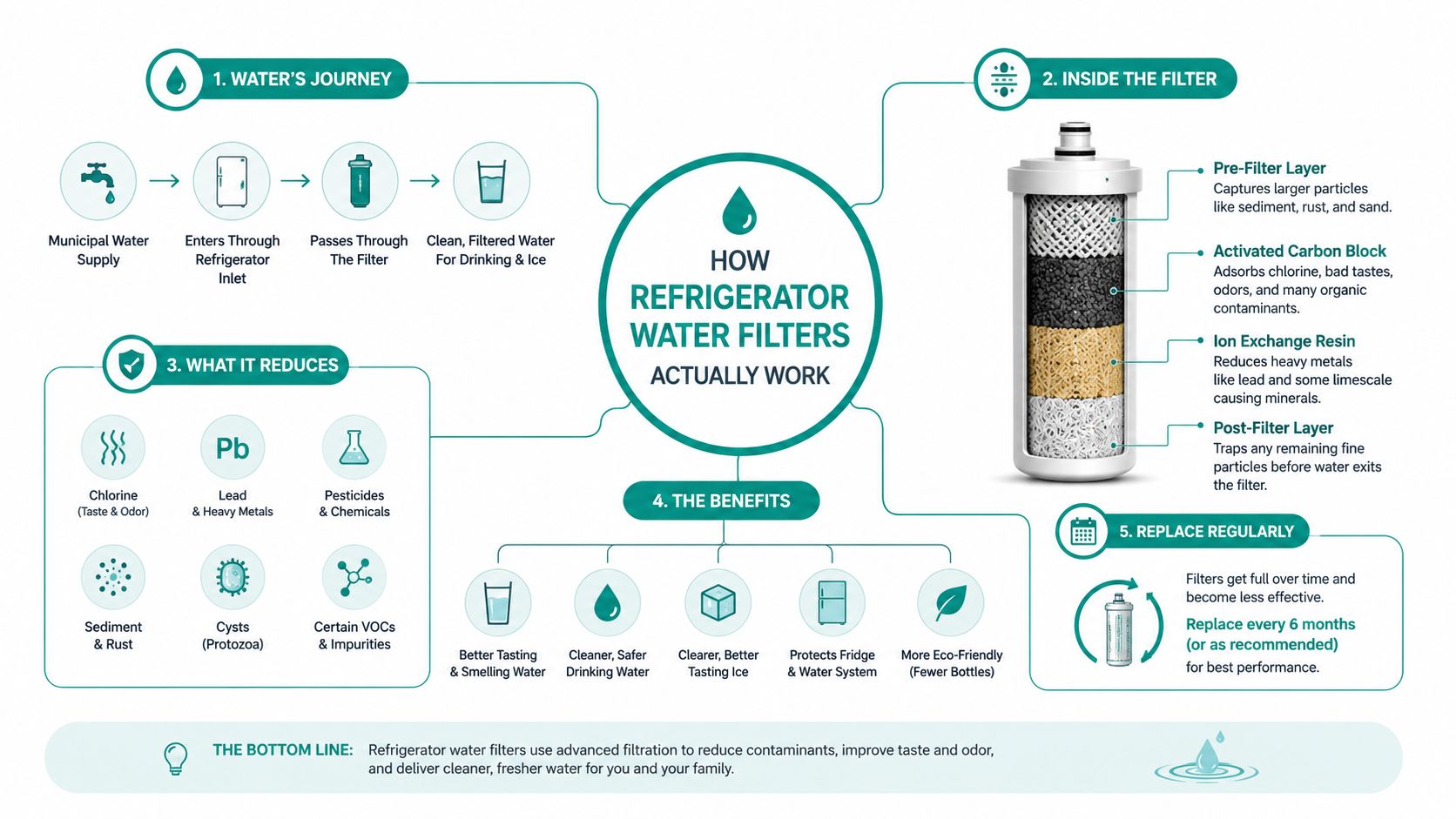
Most refrigerator filters rely on activated carbon block to reduce chlorine, some volatile organic compounds, and the stale taste or smell that makes tap water unpleasant. The mechanism is adsorption. Contaminants cling to the carbon's surface as water passes through, which is why carbon is so effective for taste and odor problems.
That improvement can be misleading.
Water that tastes better is not automatically water that is safer. Carbon is strong at aesthetic cleanup, but it does not cover every health concern, and its performance drops as the cartridge loads up with use.
Ion exchange targets some dissolved metals
Better refrigerator filters often add ion exchange media alongside carbon. The U.S. Environmental Protection Agency explains that ion exchange treatment can remove contaminants such as lead and copper by exchanging ions in the water with ions on the resin. That added media is one reason some fridge filters can make tested reduction claims for metals while lookalike cartridges cannot.
This is the practical difference homeowners miss. Two filters may fit the same fridge, restore flow, and make water taste similar, yet only one may have media suited for a contaminant like lead. If lead is your concern, it helps to understand how water filter pitchers reduce lead for safer coffee and drinking water because the same rule applies. The media and the certification matter more than the marketing.
Contact time and flow rate shape performance
A refrigerator filter has to clean water while keeping the dispenser usable. If water moves too quickly, the media gets less contact time. If the cartridge is packed too tightly or built cheaply, you get slow pours, sputtering, or reduced ice production.
That balance is why fridge filters are compromise devices by design. They are built for convenience first, with moderate treatment in a compact cartridge. For readers comparing higher-purity systems, lab water purifiers are a useful contrast because they are engineered for far stricter output than a refrigerator filter can deliver in normal kitchen use.
What fridge filters usually do not remove
This is the part that prevents false confidence. A refrigerator filter is not a catch-all barrier for every contaminant that might be in your water. Depending on the cartridge, it may do little or nothing for dissolved salts, many industrial chemicals, or contaminants that require membrane filtration, specialty media, or a more targeted treatment setup.
So the cartridge matters, but the replacement schedule matters just as much. Once carbon and ion exchange media are spent, performance falls off even if water still comes out clear and cold. A filter that is generic, overdue, or lightly labeled can leave you with cleaner-tasting water and very little proof of meaningful contaminant reduction.
Decoding Filter Certifications and What They Mean for You
Many purchasing decisions are misguided. People shop by refrigerator brand, by price, or by whatever listing appears first. They should start with certification.
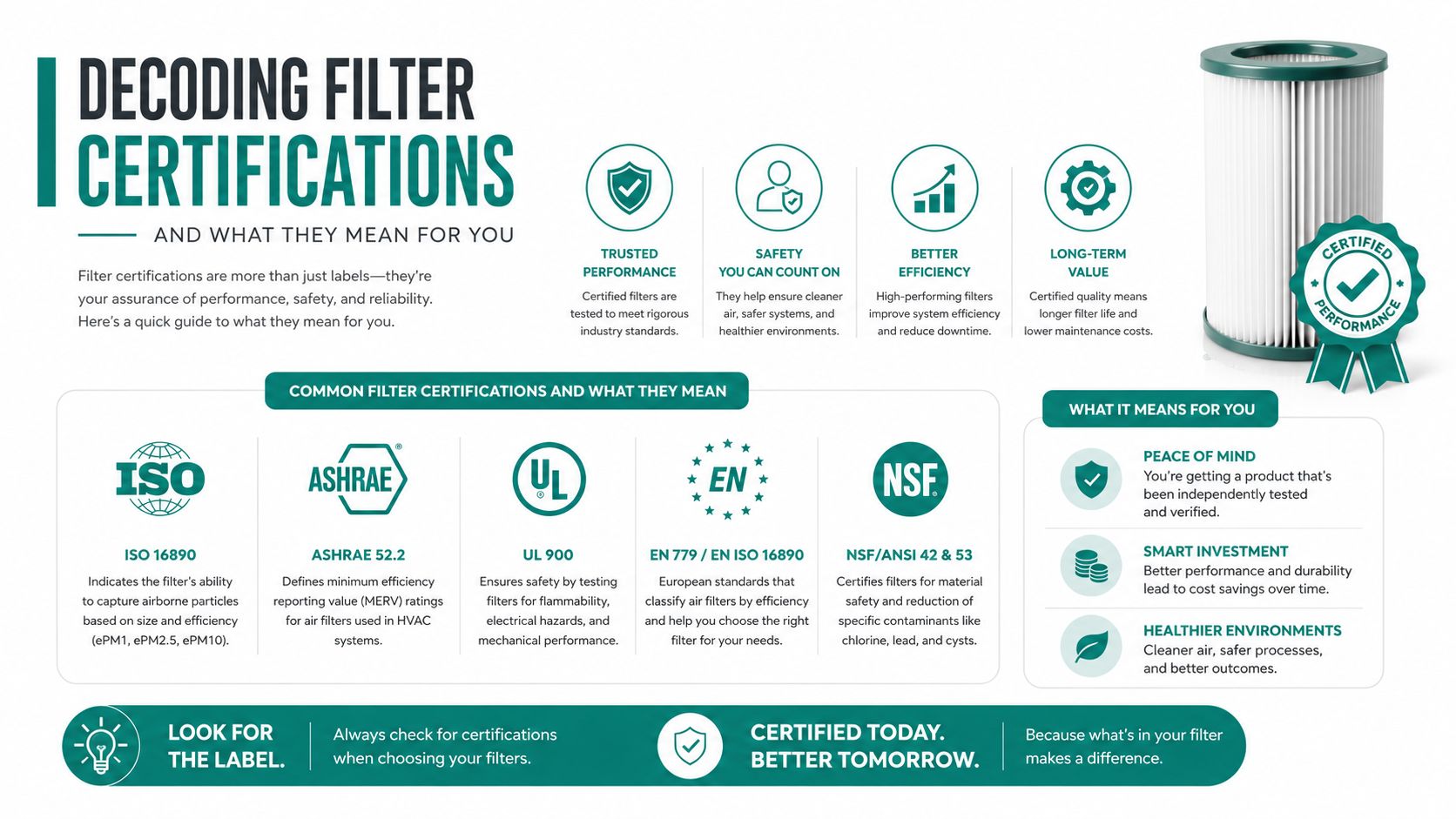
A refrigerator filter only deserves trust for the contaminants it has been tested to reduce. If the manufacturer doesn't show clear certification or performance claims, the cartridge may still fit your fridge while giving you very little confidence about what's coming out of the dispenser.
The label matters more than the marketing
In plain terms, certification tells you what a filter was asked to do in testing. That's much more useful than vague words like “premium” or “advanced.”
Here's the practical way to read it:
- Aesthetic claims: These usually focus on taste and odor issues such as chlorine.
- Health claims: These matter more when you care about contaminants such as lead or other harmful substances.
- Targeted contaminant claims: These are the claims to check when your local water concern is more specific, such as PFAS, cysts, or microplastics.
If a product page talks broadly about “clean, pure water” but avoids a detailed contaminant list, treat that as a warning sign.
Broad claims need proof
Some modern filters do go beyond older baseline performance. Hydroviv states that modern refrigerator filters are engineered to filter microplastics down to 0.2 microns and can demonstrate more than 99% removal of PFAS (PFOA/PFOS), Chromium 6, and arsenic through a multi-barrier system combining particle filtration, micro-filtration, and advanced adsorption.
That kind of claim is meaningful because it names the contaminants and the mechanism. It also shows why certification and test data matter. A buyer comparing two cartridges that both claim “fresh tasting water” could be looking at products with very different real-world capabilities.
What to check before you buy
When you review a filter listing or box, look for these specifics:
| What to check | Why it matters |
|---|---|
| Exact contaminant list | It shows what the filter is actually built to reduce |
| Named certification standard | It separates tested performance from marketing language |
| Refrigerator compatibility | It helps prevent bypass, poor sealing, and leaks |
| Replacement guidance | It tells you whether the manufacturer treats performance seriously |
A lot of shoppers also care about how water treatment affects coffee flavor, especially when lead and off-tastes are part of the conversation. This article on water filter pitcher lead removal for safer, better coffee is worth reading because it connects contaminant reduction to the taste and consistency you notice in the cup.
The safest assumption is this: if a filter isn't clearly certified for a contaminant, it isn't your solution for that contaminant.
Certification doesn't remove the need for judgment
A certified cartridge is the starting line, not the finish line. You still need the right filter for your water concerns, the right fit for your refrigerator, and the discipline to replace it on time. Certification tells you the product has earned a claim. It doesn't give you permission to ignore maintenance.
Premium vs Generic Filters A Direct Comparison
The cheapest replacement filter usually wins on search pages. It often loses in the kitchen.
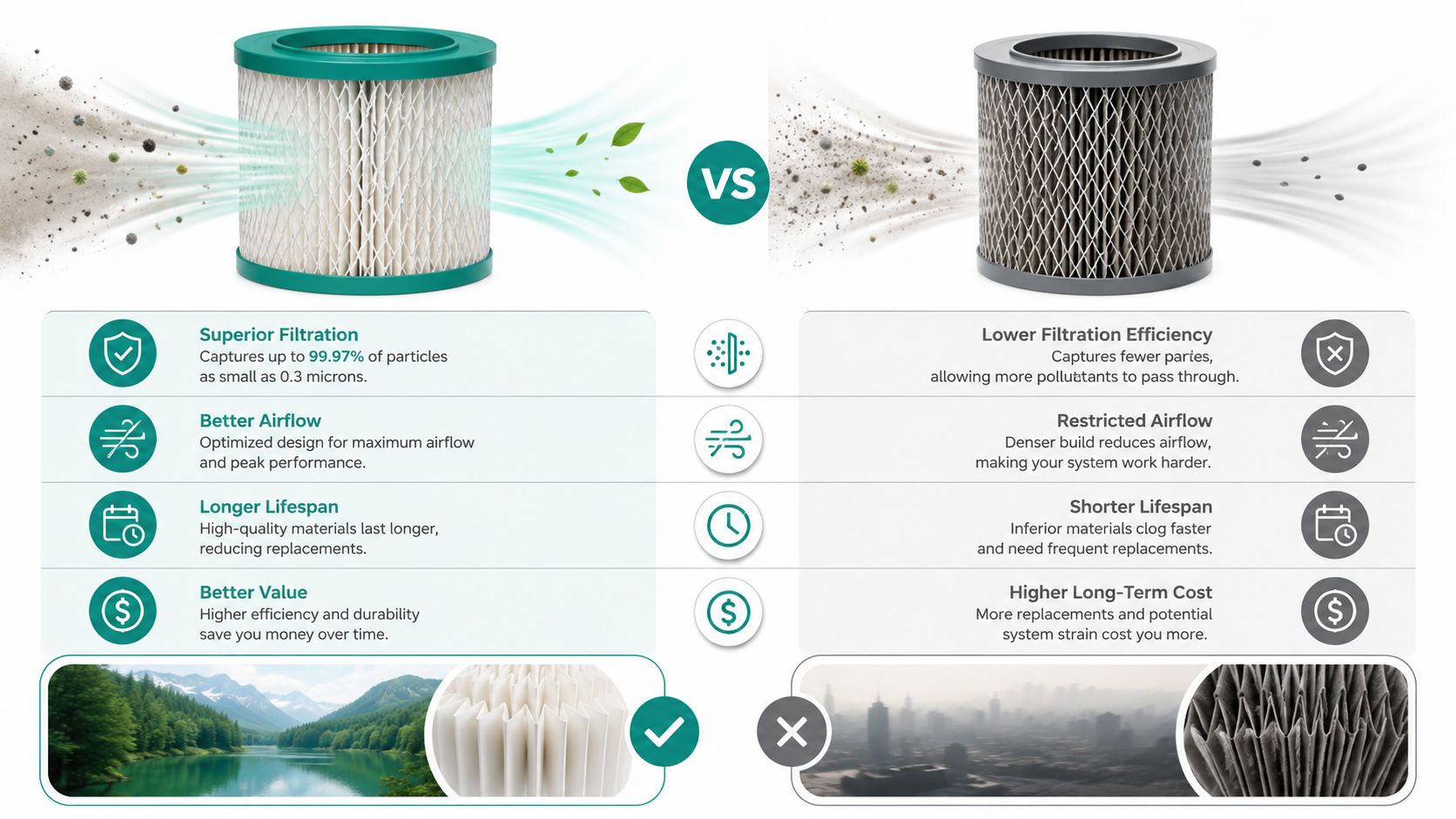
The biggest mistake I see is assuming that “compatible” means “equivalent.” A generic cartridge can physically lock into place and still fall short where it matters most: contaminant reduction, seal quality, and consistent water flow.
What the cheap option often leaves out
Aqua Clear points out that many people assume fridge filters remove all harmful contaminants, but most generic filters only reduce about 90% of chlorine while failing completely against arsenic, fluoride, and nitrates unless specifically certified. That's the false-security problem in one sentence. The water may taste better while still missing contaminants that matter to you.
That gap matters even more if you're buying for a family kitchen, a breakroom, or any home with old plumbing and high daily use. The water doesn't need to taste bad to be under-treated.
Side-by-side buying reality
| Category | Premium certified filter | Generic low-cost filter |
|---|---|---|
| Contaminant claims | Specific and test-based | Often broad or unclear |
| Fit and seal | Usually designed for reliable seating | More likely to have tolerance issues |
| Leak risk | Lower when housing match is precise | Higher if O-rings or dimensions are inconsistent |
| Water taste | More consistent over the service life | Can improve taste at first, then fade quickly |
| Buyer confidence | Based on stated performance | Based mostly on price and reviews |
Answering the common objection about fit and leaks
A lot of shoppers say, “If it fits, it's fine.” That's not a safe assumption.
Small differences in cartridge dimensions, O-ring quality, or plastic tolerances can cause bypass or leaks. Even a minor leak near the filter housing can create cabinet damage, floor damage, or a hard-to-trace drip that gets blamed on the refrigerator itself. I'd rather pay for a filter with clear testing and better fit control than save a little money and gamble on water where I cook, drink, and make ice.
Cheap filters often sell convenience. Better filters sell verified performance.
The same logic applies across kitchen maintenance. If you're already paying attention to water and scale, it makes sense to keep a descaling solution on hand for coffee makers and espresso equipment too. Mineral buildup doesn't stop at the refrigerator, and dealing with it early usually means fewer taste problems and fewer service headaches later.
Finding and Installing Your Replacement Filter
Buying the right replacement starts before you add anything to your cart. You need the refrigerator model number and, when possible, the existing filter part number. Without that, you're guessing.
Many refrigerators place the model label inside the fresh food compartment, behind a crisper drawer, or along the interior wall. The old cartridge usually has a printed code too. Match both whenever you can. That extra minute is worth it because most filter problems come from ordering a cartridge that “looks right” but isn't the exact match for the housing.
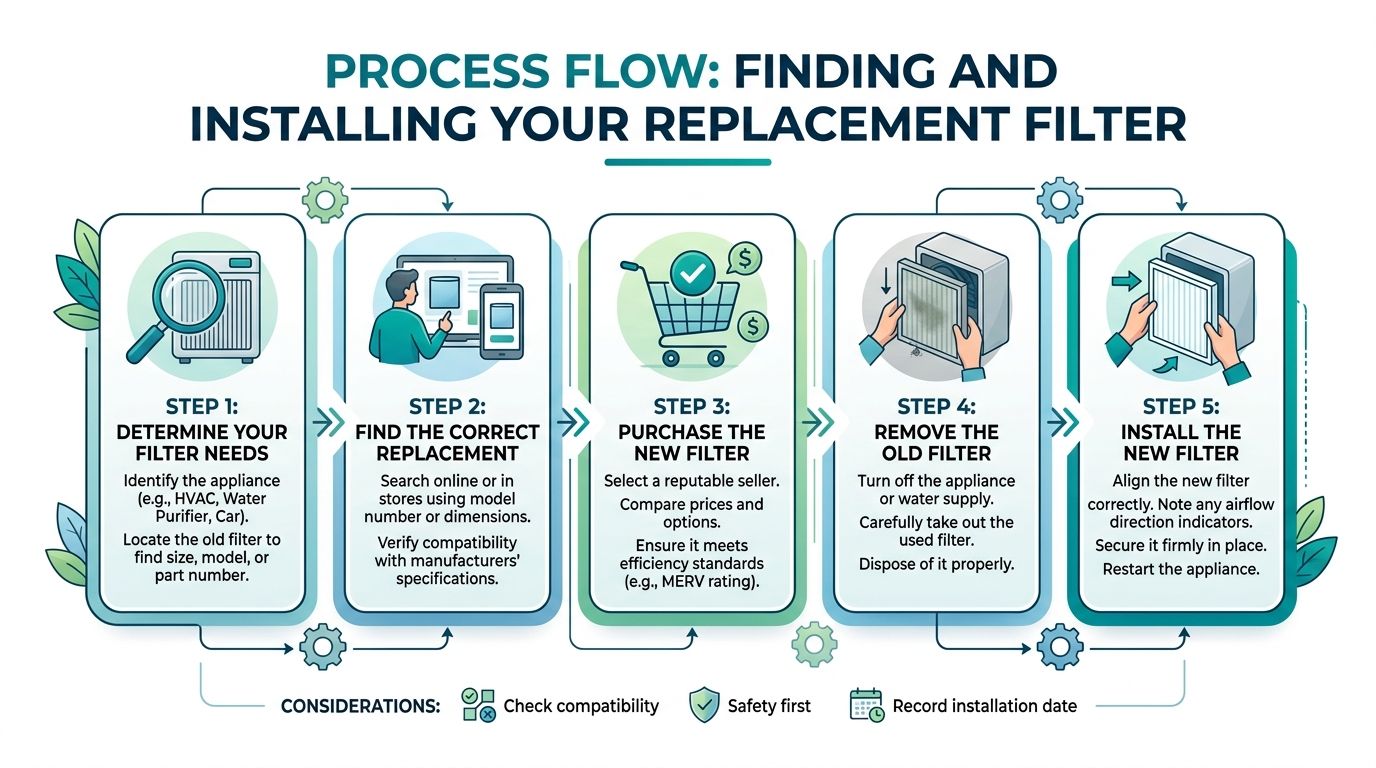
A simple way to identify the correct filter
Use this order:
- Start with the fridge label: Find the full refrigerator model number, not just the brand.
- Check the old cartridge: Compare the printed filter code if it's still readable.
- Confirm the filter style: Most units use a twist-in, push-in, or drop-down cartridge design.
- Read the compatibility list carefully: Don't rely on thumbnail photos alone.
If you want a deeper walkthrough, this guide on how to install water filters can help you verify fit and avoid the common mistakes that cause poor seating and leaks.
Installation is easy when you don't rush it
Have a towel ready before you remove the old cartridge. Some housings release a little water, and that's normal.
After that, the process is usually straightforward:
- Remove the old filter carefully: Twist or release it according to the housing design.
- Inspect the seating area: Look for debris, damage, or an old gasket left behind.
- Insert the new cartridge fully: Push or twist until it locks naturally. Don't force it.
- Reset the filter indicator if your refrigerator has one: The reset method varies by model.
- Flush the new filter thoroughly: This clears trapped air and carbon fines.
Here's a visual example of the process in action:
Two installation mistakes that cause trouble fast
Watch this first: Hand-tight is enough. Over-tightening can distort seals and create the very leak you were trying to prevent.
Another common issue is skipping the flush. New cartridges often need several minutes of water flow before the taste settles and the media is fully wetted. If the first glasses look cloudy or carry a faint carbon taste, keep flushing according to the refrigerator's guidance.
While you're doing maintenance, it's also a good time to check other brew gear in the kitchen. A fresh filter in the fridge won't fully solve stale-tasting coffee if a machine is carrying scale or residue internally.
Filter Lifespan Maintenance and Troubleshooting
A filter light is easy to ignore when the water still tastes normal. That's where people push too far.
The problem is that filter performance doesn't always fail in a dramatic way. Water can seem fine while the cartridge is slowly clogging, restricting flow, and putting more strain on the dispenser system and ice maker. Delayed replacement can also leave captured material sitting in the filter longer than it should.
The six-month rule exists for a reason
SpringWell explains that refrigerator water filters remove contaminants such as chlorine, lead, mercury, pesticides, and pharmaceuticals through particle filtration, micro-filtration, and adsorption filtration, but their effectiveness depends on maintenance and replacement every six months to prevent bacterial growth. That's the part many people miss. A filter isn't a static part. It's a working media bed that gets used up.
At the same time, some households do stretch usage because their demand is low. The mechanical risk is what often catches up with them first.
What overdue filters do to the appliance
That lines up with what many owners experience in real kitchens. They think the refrigerator has a failing valve or a dispenser problem, but the cartridge is the bottleneck.
Watch for these warning signs:
- Slow dispenser flow: The filter may be loaded with sediment or mineral scale.
- Weak ice production: Restricted water flow often shows up here early.
- Bad taste returning: Chlorine or stale flavors can mean the media is exhausted.
- Noisy dispensing or sputtering: Air or restriction inside the cartridge can be the cause.
A better maintenance habit
Replace based on certification guidance, household usage, and actual symptoms. Don't wait for bad taste alone. If your area has harder water or heavier sediment, your filter may need closer attention.
Keep one spare on hand. That small habit prevents the common cycle where people delay replacement because they don't have the right cartridge ready.
The Final Verdict on Your Refrigerator Water Filter
A refrigerator filter is not just a convenience part. It's a water treatment device with limits.
That distinction changes how you shop. Don't assume any cartridge that fits your fridge will protect your water the same way. Don't assume better taste means full contaminant coverage. And don't assume a filter is still doing its job just because the dispenser still runs.
The smart approach is straightforward:
- choose a filter with clear contaminant claims and certification
- avoid generic cartridges that hide behind vague marketing
- replace on schedule instead of waiting for obvious failure
- treat leaks, slow flow, and weak ice output as filter warnings first
The best water filters refrigerator buyers choose aren't the ones with the cheapest price tag or the loudest packaging. They're the ones that match the refrigerator correctly, show tested performance clearly, and stay on a real maintenance cycle.
If you want cleaner water from the fridge, confidence comes from proof, not assumptions.
If you're ready to replace an old or questionable filter setup, shop PureHQ Inc. for dependable water filtration and maintenance products that help your appliances perform better and your drinks taste the way they should.

