
Coffee Machine Care
What Is Medium Grind Coffee: Guide to Perfect Brews
Jun
You buy good coffee. You fill the machine correctly. You press brew. Then the cup tastes thin one day and harsh the next.
That's the part that throws people off. Most home brewers assume the beans or the coffee maker must be the problem, when the underlying issue is often much smaller. The size of the coffee grounds.
If you've been asking what is medium grind coffee, you're really asking a more useful question. What grind gives me a balanced, reliable cup without turning breakfast into a science project? For most daily brewers, especially drip machines and reusable Keurig pods, medium grind is the setting that solves the most common coffee problems.
The Secret Variable Ruining Your Morning Coffee
Weak coffee and bitter coffee can come from the same kitchen, using the same machine, with the same bag of beans. That's why grind size confuses people so much. Everything else can look right while the flavor still comes out wrong.
When coffee grounds are too coarse, water moves through them too easily. The cup can taste flat, watery, or sour. When the grounds are too fine, water struggles to pass through evenly. The coffee can turn bitter, heavy, or muddy. If that sounds familiar, this guide on why coffee tastes bitter helps connect flavor problems to brewing choices.
Why this problem keeps happening
The focus is often placed on the bean origin, roast level, or machine brand. Those things matter, but grind size controls how water interacts with the coffee.
Imagine cutting vegetables for cooking. Huge chunks and tiny bits won't cook at the same rate. Coffee works the same way. If the grounds aren't the right size for your brewer, the water either doesn't pull enough flavor out or pulls too much.
Practical rule: If your coffee swings between weak and bitter, check the grind before you blame the beans.
One change that fixes a lot
You don't need barista training to improve your coffee. You need a grind that matches the way your machine brews.
For a lot of home setups, that answer is medium grind. It's the middle ground that works well with common drip brewers and many reusable pod systems. Once you understand what medium grind looks like and where it works, you can troubleshoot most everyday coffee issues fast.
The Goldilocks Grind Explained
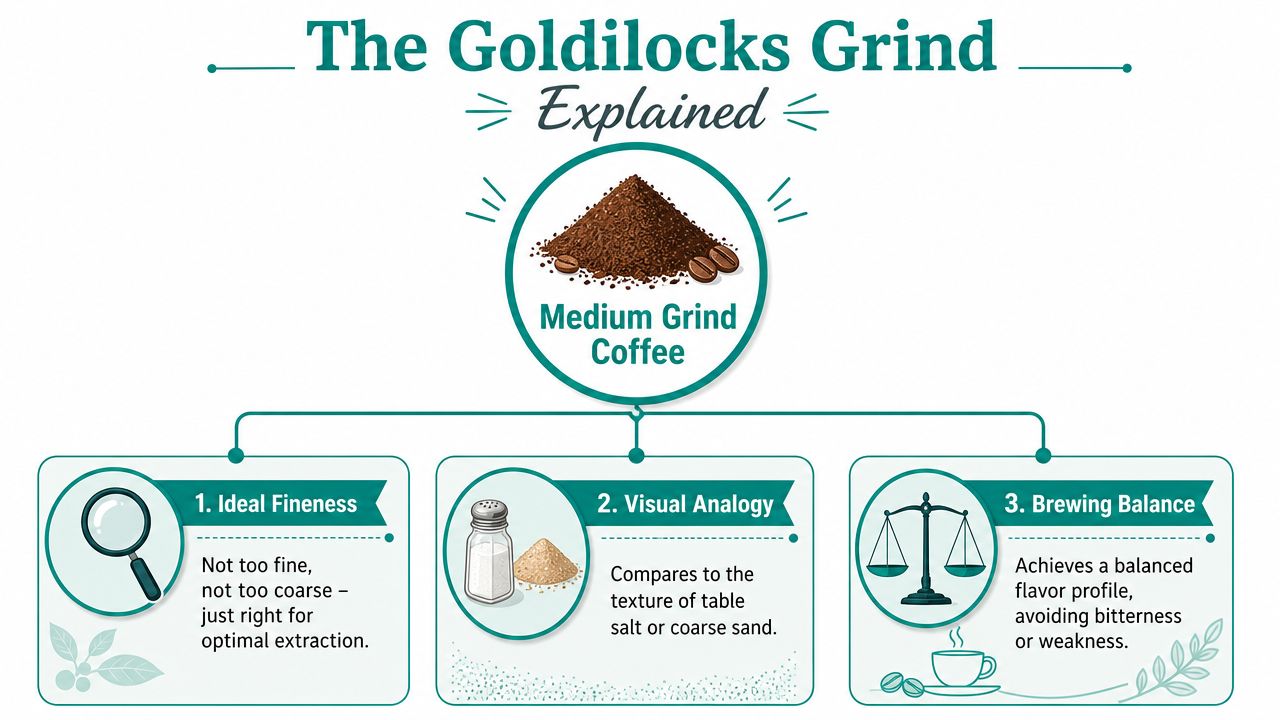
Medium grind coffee sits in the middle of the grind spectrum. It isn't powdery like espresso grind, and it isn't chunky like French press grind. The easiest way to picture it is beach sand.
One widely used brewing reference says a medium grind for drip coffee lands at about 800 to 1000 µm, and it works because it matches the usual 4 to 5 minute brew cycle of automatic drip machines. That same reference also notes coffee tends to taste best around 18 to 22% extraction, which helps explain why medium grind became the standard starting point for this style of brewing. You can read that guidance in Genuine Origin's coffee grind size guide.
What medium grind looks and feels like
If you're rubbing coffee between your fingers, medium grind should feel gritty but not dusty. It should look more like sand than flour.
That texture matters because smaller coffee particles expose more surface area to water. More surface area means faster extraction. Medium grind gives automatic brewers a practical balance, enough extraction for flavor, without pushing into the bitterness and clogging risks that come with finer grounds.
For a brewer-specific overview, this explainer on drip grind coffee shows why medium is the default for so many daily machines.
Medium grind is the coffee equivalent of a middle lane. Water doesn't rush through too quickly, and it doesn't get stuck.
Why it became the default
Drip coffee remains a core home brewing method, so the grind that fits drip naturally became the everyday standard. Medium grind isn't "perfect" for every brewer, but it is the safest starting point for many people who want balance instead of guesswork.
That's why the answer to what is medium grind coffee isn't just a definition. It's a practical brewing choice.
Visualizing the Full Coffee Grind Spectrum
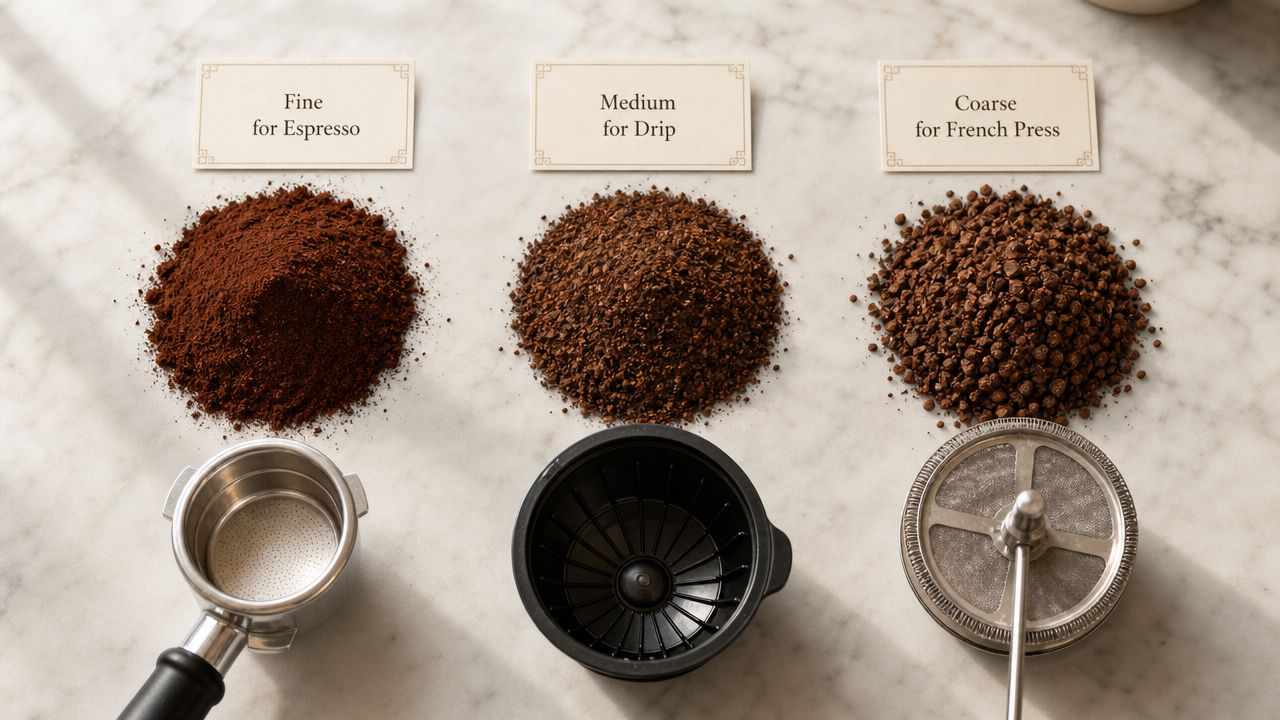
Medium makes more sense when you compare it to the grinds on either side of it. Coffee Bean Corral describes medium as the practical midpoint, often compared to beach sand, and notes that moving from coarse to medium increases surface area and raises extraction if brew time stays the same. Their grind size guide also explains why coarser grinds suit longer immersion methods while finer grinds fit short-contact brewing.
What changes when the grind changes
Coarse grounds slow extraction because each piece has less surface area exposed to water. Fine grounds do the opposite. They speed things up.
That one shift changes flavor fast:
- Too coarse can leave coffee weak, sour, or hollow.
- Too fine can create bitterness, a heavy body, or a clogged filter.
- Medium usually lands in the balanced zone for brewers with moderate contact time.
Coffee grind size and flavor impact
| Grind Size | Texture Analogy | Resulting Flavor Profile | Common Brewing Method |
|---|---|---|---|
| Coarse | Chunky sea salt | Can taste weak or under-extracted if water passes too quickly | Long immersion methods |
| Medium | Beach sand | Usually more balanced when matched to moderate brew time | Drip coffee and many pour-over brewers |
| Fine | Powdery or very soft sugar-like texture | Can taste bitter or muddy, and may clog filters | Short-contact methods like espresso |
The middle row is where many people should start. If you use a standard countertop coffee maker, medium usually gives water enough resistance to extract flavor without choking the flow.
To understand where the next adjustment sits, this guide to medium-coarse grind coffee helps show how a small move coarser changes the cup.
A simple way to remember it
Use the brew method to predict the grind:
The longer water sits with coffee, the coarser the grounds can be. The faster the brew, the finer the grounds usually need to be.
That isn't a strict rule for every machine, but it's a useful mental shortcut when your coffee tastes off and you need a starting point.
Perfect Pairings for Medium Grind Coffee
Medium grind works best when the brewer uses a moderate flow rate and a filter that doesn't require ultra-fine coffee. That covers a lot of home setups.
Where medium grind usually shines
Start with the most familiar option. Automatic drip coffee makers are the classic match. Medium grind lets water flow through the bed at a steady pace, which is why it became the everyday default for this category.
It also works well for many pour-over brewers, though some setups want a small adjustment finer or coarser depending on the filter shape. More on that in the next section.
For reusable Keurig pods, medium grind is often the most practical choice. Keurig machines push water through a small coffee bed and mesh filter. If the coffee is too fine, the mesh can clog and slow the flow. In some setups, that can also lead to messy overflows or a cup that tastes harsh. If the coffee is too coarse, the brew can taste weak and watery.
Why Keurig users struggle with grind size
A reusable pod changes the brewing equation. You're no longer relying on a sealed, prefilled capsule. You're choosing the coffee, filling the pod, and controlling the grind.
That's good news because it gives you more flavor control. It also means a bad grind becomes obvious fast.
- Fine grind in a reusable pod can pack too tightly and restrict water flow.
- Coarse grind in a reusable pod can let water race through before enough flavor is extracted.
- Medium grind usually gives the pod enough resistance to brew a fuller, cleaner cup.
Some home brewers use stainless steel reusable pods because they can fill them with their own ground coffee instead of depending on prepacked pods. One option in that category is PureHQ Inc., which sells reusable K-Cups and related coffee accessories for Keurig-style systems.
A quick visual can help if you're setting up your reusable pod for the first time.
Medium grind compared with common alternatives
| Option | Main advantage | Main drawback | Good fit for Keurig reusable pods |
|---|---|---|---|
| Pre-filled single-use pod | Fast and simple | Less control over freshness and grind | Sometimes, but limited flexibility |
| Pre-ground medium coffee | Convenient | Loses freshness sooner than freshly ground beans | Often yes |
| Blade-ground coffee at home | Cheap entry point | Inconsistent particle size can affect flavor | Can be frustrating |
| Burr-ground medium coffee | Better consistency | Requires more effort and equipment | Usually the easiest path to repeatable results |
If you use a reusable pod often, adding paper liners or replacing worn filters can help keep cleanup easy and flow more predictable. Descaling your machine also matters because mineral buildup can make any grind choice harder to judge.
How to Dial In Your Grind for Perfect Flavor
A lot of coffee advice makes medium grind sound like one exact setting. It isn't. Poverty Bay Coffee's guide to coffee grinds and brewing methods points out an important gap in a lot of coffee content. Reputable brewing guides separate medium, medium-fine, and medium-coarse based on brew method and filter geometry.
That matters more than is often underestimated.
Why the filter shape changes the answer
A cone-shaped pour-over often works better with a slightly finer medium. A flat-bottom filter can use a slightly coarser medium. The coffee is still in the medium family, but the exact spot shifts.
That's why two people can both use "medium grind" and still get different results.
Try to think in ranges, not labels. Medium-fine, medium, and medium-coarse are all useful adjustments, not contradictions.
Simple flavor fixes
Use taste as your guide:
- If the cup tastes weak or sour, grind a little finer.
- If the cup tastes bitter or harsh, grind a little coarser.
- If the machine drains too slowly, especially with reusable pods, move away from fine grounds.
- If the coffee feels thin, tighten the grind slightly before changing everything else.
Make one small adjustment at a time. That keeps you from chasing your tail and changing three variables at once.
Why Your Grinder Matters More Than You Think
The grinder decides whether your "medium" grind is medium. That's the missing piece for many home brewers.
Verena Street notes that many buyers want to know when pre-ground medium is good enough and when a burr grinder is worth it. Their guidance highlights two practical tradeoffs in medium ground coffee choices. Blade grinders can create uneven extraction because the particle size is inconsistent, while pre-ground coffee loses freshness.
Blade grinder versus burr grinder
A blade grinder chops beans unevenly. You can end up with dust-like particles mixed with larger chunks. When you brew that mix, the tiny bits over-extract while the bigger pieces under-extract. The result often tastes confused. Bitter in one sip, weak in the next.
A burr grinder mills beans into a more uniform size. That consistency makes your brewer easier to dial in, especially if you're using a drip machine or a reusable K-Cup and want the same taste tomorrow that you got today.
| Grinder type | How it processes beans | What it means in the cup | Best for |
|---|---|---|---|
| Blade grinder | Chops unevenly | Mixed extraction, less predictable flavor | Convenience on a budget |
| Burr grinder | Grinds more uniformly | More even extraction and clearer flavor | Repeatable daily brewing |
| Pre-ground medium coffee | Already prepared | Convenient, but freshness drops over time | Fast, simple brewing |
When pre-ground is good enough
Pre-ground medium coffee isn't useless. It can be a practical choice if you want speed and your brewer already performs well with it.
The upgrade to a burr grinder makes more sense when:
- You keep getting mixed flavors from the same coffee
- You use reusable pods often and need more consistency
- You want to fine-tune between medium-fine and medium-coarse
- You buy whole beans and care about freshness
Fresh grinding gives you more control. A burr grinder gives you more consistency. Together, they make troubleshooting much easier.
Store whole beans in a sealed container away from heat and light. Grind close to brew time when you can. If you use pre-ground coffee, buy amounts you'll finish while it still tastes lively.
Now that you know what medium grind coffee is and how it affects flavor, pair the right grind with the right brewing tools. If you use a Keurig or similar machine, browse PureHQ Inc. for reusable K-Cups, filters, descalers, and maintenance accessories that help you brew ground coffee more consistently at home.

