
Coffee Machine Care
Water Filter Calcium Removal: Complete Guide for Coffee
Aug
You notice it at the worst time. The brew starts tasting flat, the machine sounds slower, and a white crust appears where clean water used to sit. In coffee gear, that usually means calcium is building up inside the system, and the problem is bigger than a cosmetic stain.
For home brewers, water filter calcium removal matters because the minerals that create scale also shape flavor, flow rate, and long-term reliability. The right treatment can keep a Keurig, Ninja, or Breville closer to its intended performance, while the wrong filter can leave you descaling on repeat and still drinking dull coffee.
Why Calcium in Your Water Ruins Coffee and Your Machine
A coffee maker often tells you there's a water problem before you ever test the water. The reservoir gets cloudy, the stream slows down, and the first thing you taste is not brighter coffee, but a flatter cup with a bitter edge.
Scale starts where heat and minerals meet
Calcium and magnesium are dissolved in tap water, so they don't just rinse away with a quick flush. When your machine heats water, those minerals can come out of solution and stick to internal parts, especially heating elements, valves, and narrow tubes. That's how a little hardness turns into scale, and scale turns into maintenance.
The CDC notes that home reverse osmosis systems may reduce calcium, which matters because source-water treatment works before the minerals ever reach your brewer. That's the key point many owners miss. If you only clean after buildup starts, you're always chasing the problem instead of preventing it. The practical version of that advice lines up with broader home-water guidance from PureHQ's water quality overview.
Practical rule: if your machine keeps asking for descaling, the water is usually part of the problem, not just the machine.
Coffee flavor and machine wear are linked
Hard water can mute the parts of coffee that make it taste sweet and clear. It can also force the machine to work harder, because mineral deposits narrow flow paths and interfere with heat transfer. That is why a brewer can go from “works fine” to “barely drips” without a dramatic warning.
Source treatment beats reactionary cleaning. A descaler can clear the buildup that already exists, but it can't stop the next round of minerals from arriving. For home coffee gear, calcium control has to happen at the water source if you want stable flavor and fewer service headaches.
How Different Water Treatment Methods Remove Calcium
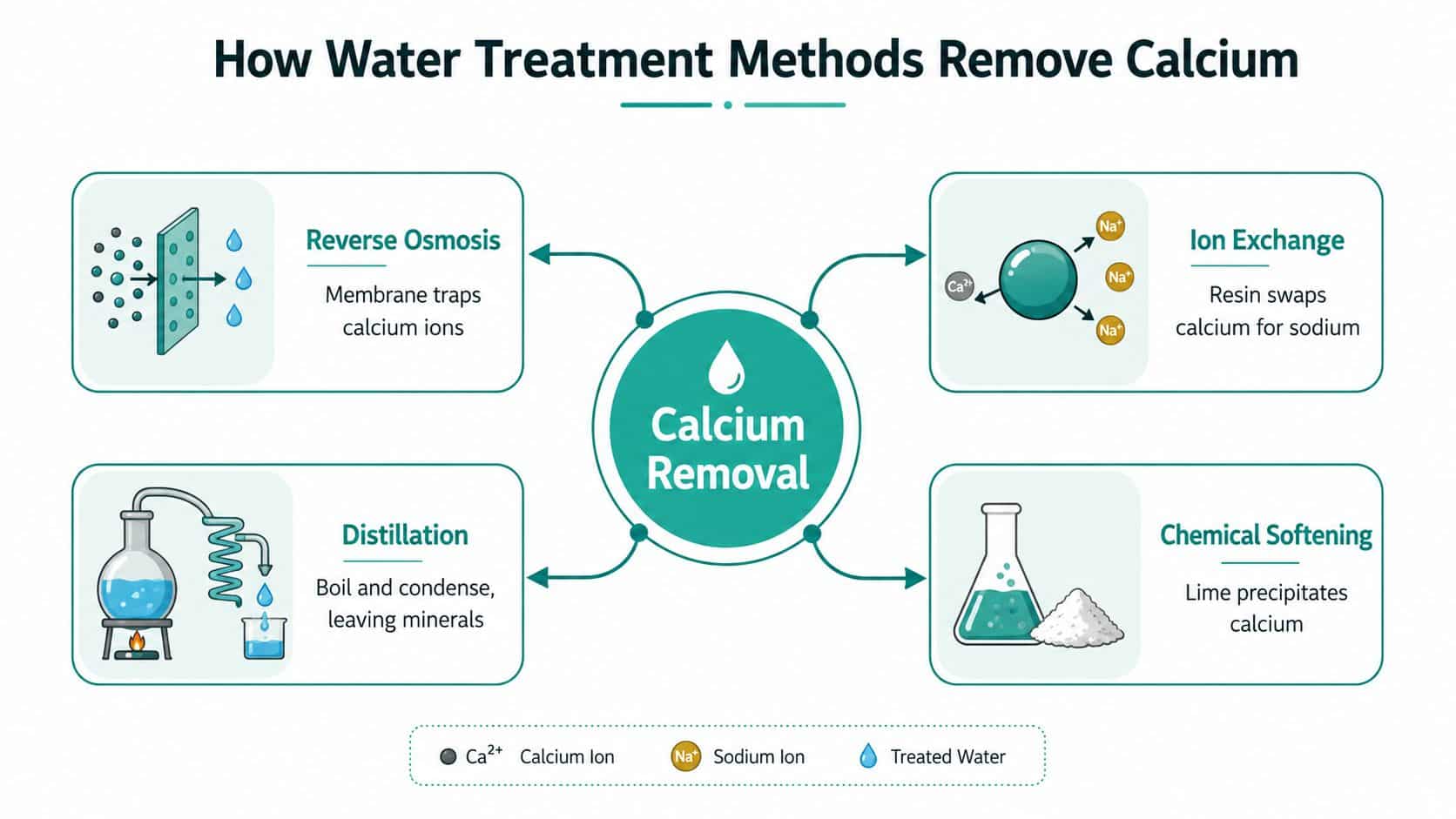
Calcium removal works differently depending on the technology, and that difference decides whether the water is suitable for coffee gear or just tastes a little cleaner.
Reverse osmosis does the heaviest lifting
Reverse osmosis pushes water through a semi-permeable membrane that blocks dissolved minerals. The U.S. CDC says home RO systems may reduce calcium, and a peer-reviewed review reports that RO membranes eliminate 94% to 98% of calcium and magnesium, with an average 97% calcium purification efficacy in one compiled table. That same review notes that in countries relying heavily on RO purification, drinking-water calcium can fall to less than 6 mg/L.
That is a very different outcome from ordinary filtration. In one peer-reviewed study, RO treatment removed 94.1% of calcium from tap water, dropping inlet calcium from 112.2 ppm to 6.6 ppm, while river water and well water showed 95.4% and 97.1% removal, respectively. If you want the strongest dissolved-mineral reduction, RO is the benchmark.
Ion exchange removes hardness at the chemistry level
Ion exchange softeners work by swapping calcium and magnesium ions for sodium or potassium ions. That process is why whole-house softeners are so effective at preventing scale. They change the mineral profile before the water ever reaches your coffee machine.
For a brewer, the drawback is practicality. Whole-home softeners solve an entire plumbing problem, but [the typical user] just wants cleaner water at the counter. That makes ion exchange a strong technical answer, but not always the easiest coffee answer.
Pitcher and faucet filters vary more than people expect
Consumer pitcher filters are the category where marketing gets messy. A laboratory study of pitcher filters found that all but two models significantly reduced calcium concentrations, and one filter type still failed to return to baseline even after 50 L of water had passed through it. Another peer-reviewed study of non-electric household filters found average calcium reduction of 40%, 48%, and 46% across three designs, with peak efficiencies of 93%, 99%, and 91%.
A separate survey reported that filtration removed 89% of calcium on average from drinking water, and a Brita® pitcher removed 89.4% of calcium on average. That same paper also reported post-filtration calcium ranging from 0.8% to 30.3% of the original level, which shows why two filters that look similar on a shelf can behave very differently in a kitchen.
What the chemistry means in daily use
A filter that reduces calcium a little can still help a coffee maker, but it won't behave like reverse osmosis. If you brew often, use a machine with narrow internal pathways, or live in a hard-water area, that difference shows up fast in maintenance frequency and flow stability.
Bottom line: for dissolved-mineral reduction, RO and ion exchange are the serious tools. Pitcher filters can help, but their performance depends heavily on the model, age, and water load.
What the Research Says About Filter Performance
A filter that looks fine on the shelf can still disappoint in a real coffee routine. For home brewers, the useful question is whether the cartridge lowers calcium enough to slow scale buildup, keep flow steady, and avoid turning maintenance into a recurring chore.
Data beats packaging claims
The clearest pattern from the research is that performance varies a lot by design and by how long the filter stays in use. One laboratory study found that all but two consumer pitcher filters significantly reduced calcium, and one filter still had not returned to baseline after 50 L. For anyone choosing a filter for daily coffee use, that points to cartridge life and media design as real buying factors, not just add-ons.
Peer-reviewed work on non-electric household filters reported average calcium reduction of 40%, 48%, and 46% across three designs, with peak efficiencies reaching 93%, 99%, and 91%. Those peak results are useful for comparing claims, but the averages are closer to what matters in a kitchen where water use changes from week to week and cartridges age over time.
Read the label for what it promises, not what it implies
Filter packaging often highlights taste, convenience, or general water improvement, while the numbers that matter for coffee equipment are usually hidden deeper in the spec sheet. Look for language that states hardness reduction, calcium reduction, or mineral removal in plain terms, then check whether the claim is tied to a test method, a water type, or cartridge capacity.
That matters because a filter can improve taste without doing much for scale control. Coffee drinkers who use machines with small boilers, narrow tubes, or delicate valves need a product that reduces dissolved minerals consistently, not just one that makes tap water taste cleaner.
Real use is harsher than lab conditions
The survey that reported 89% average calcium removal also found that Brita-filtered water ranged from 0.8% to 30.3% of the original calcium level. That spread is the part buyers should pay attention to. It means two filters that seem similar can leave very different mineral loads in the cup, and those differences show up later as more frequent descaling, slower flow, or uneven extraction.
That same paper concluded that water passed through the filter could not be considered a viable calcium source. For coffee, the practical takeaway is simpler. Filtered water that still carries a meaningful amount of calcium may be fine for taste, but it can still feed scale inside the machine.
Reverse osmosis sets the low-mineral benchmark
The RO study with 94.1% calcium removal in tap water, 95.4% in river water, and 97.1% in well water gives a clear reference point for buyers who want very low residual hardness. It also showed outlet calcium at 6.6 ppm, which explains why RO is often the standard for people trying to keep mineral buildup to a minimum.
The buying decision comes down to the job you need the filter to do. If your goal is better flavor alone, several treatment options can help. If your goal is protecting a coffee machine from scale and reducing maintenance costs over time, the more useful comparison is how much calcium remains after filtration and how stable that result stays as the cartridge ages.
Choosing the Right Filter for Your Coffee Maker
The right choice depends on the machine, the water, and how much upkeep you're willing to manage. A brewer in soft water and a brewer in hard water need different answers, even if they use the same brand of machine.
Match the filter to the machine, not the marketing
Keurig models like the K-Classic, K-Supreme, K-Slim, and K-Duo typically work with reservoir filters and compatible inline or cartridge-style solutions. Ninja DualBrew owners usually do better with pitcher or faucet-mounted treatment that lowers calcium before water reaches the tank. Breville espresso users often rely on branded charcoal cartridges designed for their espresso systems, though compatible third-party options can work when they meet the same fit and function requirements.
Fit matters because a filter that doesn't seat properly can leak, bypass, or irritate you every time you refill. Compatibility also affects flow. If the cartridge is too restrictive for your routine, you'll stop using it, which defeats the point.
Think in terms of trade-offs
Reverse osmosis gives the deepest calcium reduction, but it is usually a point-of-use setup rather than a casual drop-in accessory. Ion exchange softeners protect the whole house, but most coffee owners don't want to redesign their plumbing for a single brew habit. Standard pitcher filters are easy to use, yet their calcium reduction depends on the media and the cartridge state.
A sensible hybrid for many home brewers is partial calcium reduction plus regular descaling. That combination reduces the mineral load entering the machine while still handling the leftovers that slip through. It's also why a good descaling supply still belongs in the cabinet, even when the water is treated.
A comparison that actually helps
| Option | Calcium removal strength | Coffee machine fit | Maintenance burden | Main objection |
|---|---|---|---|---|
| Reverse osmosis | Highest | Usually point-of-use | Higher setup complexity | Overkill for a single brewer |
| Ion exchange softener | Very strong | Whole-home, indirect | Regeneration and upkeep | Not always practical for coffee-only use |
| Premium compatible cartridge | Moderate to strong | Designed for specific machines | Routine cartridge replacement | Costs more per unit |
| Generic filter | Variable | Often broad-fit | Uncertain performance | May not reduce calcium enough |
For a practical reference on machine-specific filter options and maintenance tools, PureHQ's pitcher filter reviews are useful if you're comparing everyday setups rather than whole-house systems.
Testing Water Hardness and Maintaining Your System
You can't choose the right filter if you don't know what your water is doing. Hardness testing gives you the baseline that tells you whether your current setup is adequate or just convenient.
Start with a simple hardness check
Cheap test strips and liquid kits from hardware stores can show calcium and magnesium levels in minutes. Many municipal water quality reports also publish hardness data, which gives you a free starting point before you spend money on cartridges or treatment hardware.
If your water is already hard, don't judge a filter by taste alone. Coffee can still taste “fine” while scale builds inside the machine. The point of testing is to match the filter to the load, not to guess from flavor alone.
Replace cartridges based on use, not optimism
In harder water, cartridge life shortens because the media works harder. In softer water, a cartridge can last longer before performance drops. What matters is watching both usage and the visible signs of buildup, then replacing the filter before the machine starts paying the price.
Regular descaling still belongs in the routine even with filtration. No consumer filter removes every mineral, and some deposit will always form under heat. A dedicated descaling solution is the safest and fastest way to clean that residue out of the machine.
Keep the sequence simple: test first, filter second, descale on schedule. Skipping any one of those steps usually turns into extra maintenance later.
Where plumbing guidance fits
If you're dealing with recurring mineral buildup, a plumbing pro can help you separate appliance issues from supply issues. The bath & kitchen plumbing experts at Piper Plumbing are a useful reference point when you're deciding whether the problem sits at the faucet, the line, or the coffee maker itself.
For deeper background on buildup cleanup, PureHQ's calcium deposit removal guide is relevant once the machine already needs service. The right maintenance routine keeps you from turning every descaling job into a bigger repair cycle.
Premium Filters vs Standard Options for Coffee Machines
The gap between premium and generic filters shows up in the cup and in the service log. A better cartridge doesn't just sound nicer, it usually keeps more calcium out of the brewer and out of the maintenance schedule.
What you get when the media is better
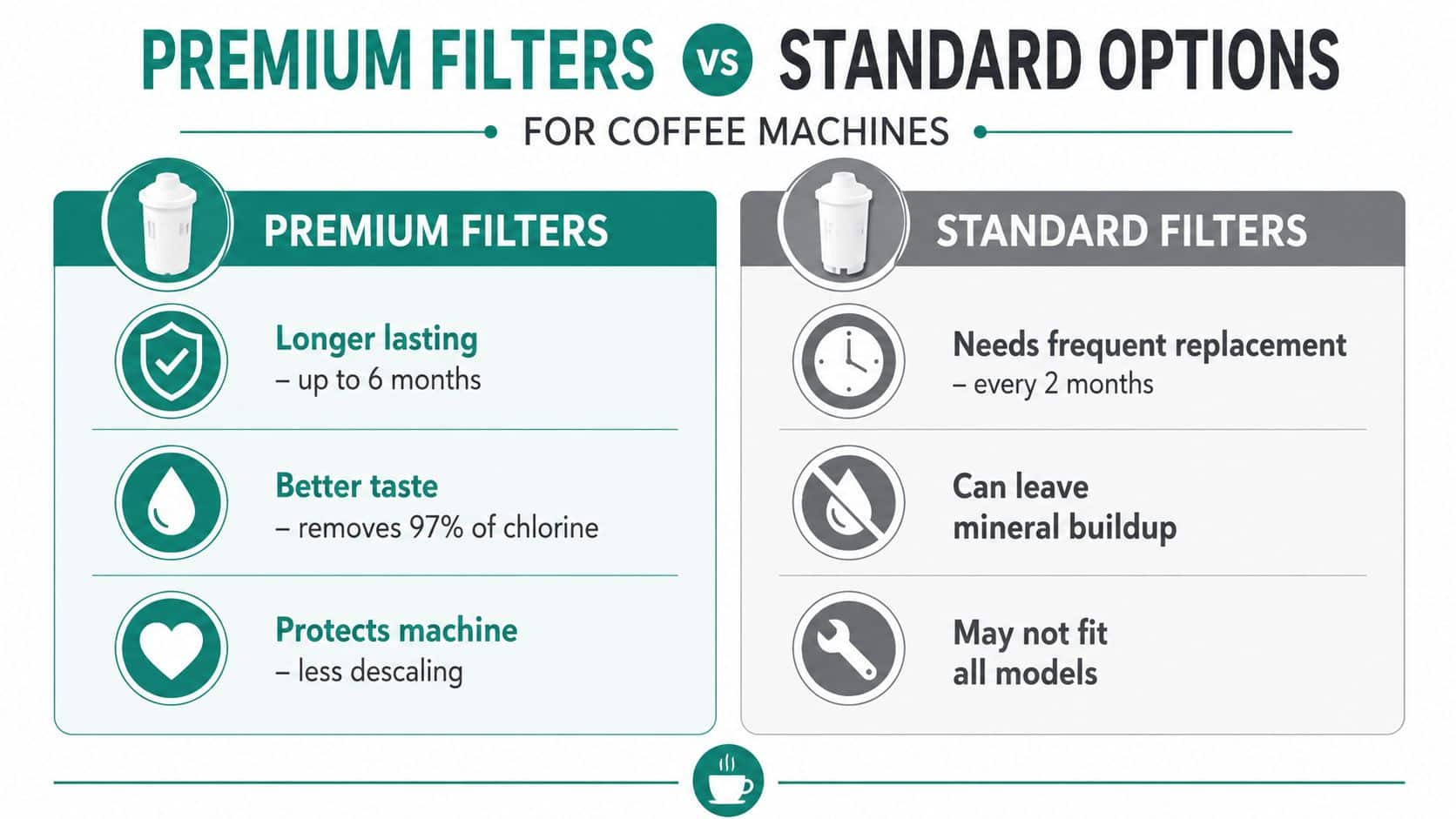
Premium compatible filters for Keurig, Ninja, and Breville systems usually use denser activated carbon and more carefully tuned ion-exchange material. That matters because the cartridge can stay in contact with the water long enough to reduce more calcium before the tank fills. Standard or unbranded filters often move water through too quickly to do much beyond basic taste improvement.
Price is the obvious objection. Budget filters cost less up front, and many shoppers stop there. The problem is that lower-cost cartridges can leave enough mineral load behind to shorten the interval between descales and keep scale pressure on heating parts.
The real comparison is total ownership cost
A premium filter that removes more calcium can justify itself if it helps your machine stay cleaner and reduces downtime. A budget cartridge can still be reasonable in softer water, especially if you already descale regularly and the machine sees light use. What rarely works is assuming all “replacement” filters perform the same job.
One useful rule from practice, not marketing, is that a filter doesn't have to be perfect to be valuable. Even partial calcium reduction can help protect the heating path, improve brew consistency, and stretch the time between cleanings. That is why the smarter purchase is often the one that matches your hardness level, not the cheapest box on the shelf.
For broader guidance on water-heating choices, Engle Services' water heater tips are a good reminder that mineral management matters across the whole home, not just in the coffee corner. The same logic applies to your brewer, where scale protection is part taste, part reliability.
Take Control of Your Coffee Quality Today
Calcium in your water isn't going away on its own, and your coffee machine will keep reminding you until you deal with it. The fastest path is straightforward, test your water, choose a filter that matches your machine and hardness level, and keep a descaling routine in place for what gets through.
If you brew on a Keurig, Ninja, or Breville, PureHQ Inc. offers compatible water filters, reusable K-Cups, and descaling supplies designed to help manage calcium buildup in daily use. Several of those products are made in the USA, and they're built for people who want cleaner brews without making maintenance harder than it needs to be.
PureHQ Inc. makes coffee machine accessories that help reduce calcium buildup, simplify maintenance, and keep your brewer performing the way it should. Visit PureHQ Inc. to shop compatible filters, reusable pods, and descaling supplies for your coffee setup.

