
Coffee Machine Care
Stainless Steel Chemical Compatibility: Your 2026 Guide

Sep
A stainless steel pod can look flawless and still be the wrong material for the job. Stainless steel chemical compatibility depends on the grade, the chemical, the temperature, the exposure time, and the condition of the surface, not on the word “stainless” stamped on a product page. That matters when hot water, descaler, chlorides, welds, scratches, and coffee oils meet inside equipment you use every day.
Coffee gear also sits close to food and drinking water, so material selection isn't only about appearance or service life. A factory-finished component may perform well under ideal conditions, while a welded brew chamber or scratched reusable pod can create local sites where corrosion begins. The practical question isn't this grade, in this condition, exposed to this chemistry and heat cycle, remains suitable.
Why Stainless Steel Chemical Compatibility Matters for Your Coffee
Stainless steel earns its reputation from a thin passive oxide film that forms on the surface and helps separate the underlying alloy from its environment. That film isn't a permanent shield. Incompatible cleaners, chlorides, acidic conditions, high heat, abrasion, or manufacturing damage can weaken or remove it. A food-contact surface review from the International Food Protection Training Institute states that nearly all common stainless-steel grades can lose their passive film when exposed to incompatible cleaners, abrasive pads, or chlorine and oxidizing sanitizers.
The word “stainless” also creates a dangerous shortcut. Stainless steel is corrosion-resistant, not stain-proof or universally chemical-proof. Grade and exposure conditions determine the margin of safety. The wetted-material compatibility guidance identifies the difference between 304 and 316 as a foundational example. Type 316 contains about 2–3% molybdenum, in addition to chromium and nickel, and that addition materially improves resistance to chloride-containing solutions such as seawater, brines, and many cleaning systems.
What reaches the metal in a coffee machine
A reusable pod may contact brewing water, coffee acids, rinse water, detergent residue, and descaling solution. A reservoir or brew path may also encounter dissolved chlorides. Heat makes the situation less forgiving because compatibility changes with temperature as well as concentration.
The FDA-regulated food-contact guidance on chloride-induced pitting explains that higher chloride levels can break down stainless steel's protective oxide layer and promote pitting. Low-chloride fresh water can be suitable, but greater chloride exposure raises the chance of crevice corrosion and pitting.
Practical rule: Treat “food-grade stainless steel” as a starting description, not a complete compatibility verdict.
Before buying a pod or filter, check the stated grade, finish, weld quality, and cleaning instructions. The PureHQ material selection guide offers useful context for comparing materials in coffee equipment. If surface scratching is a major concern, a technical resource on an APEX NANO coating for stainless can help you understand how protective surface treatments fit into a broader materials strategy.
Comparing 304 and 316 Stainless Steel Grades
Type 304 is a practical choice for many coffee components. It offers broad corrosion resistance and is widely used in food-contact equipment. Type 316 adds molybdenum, giving it a wider margin in chloride-bearing environments. That advantage has limits. Heat, concentration, and trapped liquid can challenge either grade, especially after welding or scratching disrupts the factory-finished surface.
The U.S. Nuclear Regulatory Commission technical document compares their chloride tolerance. Type 304 resists crevice corrosion at chloride-ion concentrations below about 200 ppm, while Type 316 resists at levels up to about 1,000 ppm. In freshwater systems within the 20–100 ppm chloride range, the document says 304/304L crevice corrosion is rarely reported. These values are reference points, not guarantees for a coffee machine repeatedly exposed to hot descaler or chloride residue.

Side-by-side selection
| Property | 304 Grade | 316 Grade |
|---|---|---|
| Typical chemistry | Chromium and nickel stainless steel | Chromium and nickel stainless steel with about 2–3% molybdenum |
| Chloride margin | Lower | Higher |
| Suitable coffee role | General reusable pods, housings, and low-chloride water paths | Chloride-exposed parts, demanding brew paths, and higher-risk cleaning environments |
| Availability | Broad | Broad, but specification matters |
| Cost trade-off | Usually the lower-cost option | Usually the higher-cost option |
| Main limitation | Pitting and crevice risk rises with chloride concentration and heat | More resistant, but not chloride-proof under severe conditions |
For clean household water with modest chloride content, 304 or 304L can suit a reusable pod. Type 316 or 316L makes more sense when equipment sees chloride-rich water, brines, aggressive cleaning systems, or repeated wetting that leaves solution in seams and joints.
Weld discoloration, rough finishing, and scratches can narrow the practical margin of either grade. The stainless steel versus black stainless steel comparison separates surface appearance from alloy performance. A colored or coated finish does not automatically mean a different corrosion-resistant alloy.
A premium product should identify its grade rather than say “stainless” alone. Without the alloy, finish, and weld details, a compatibility decision rests on guesswork.
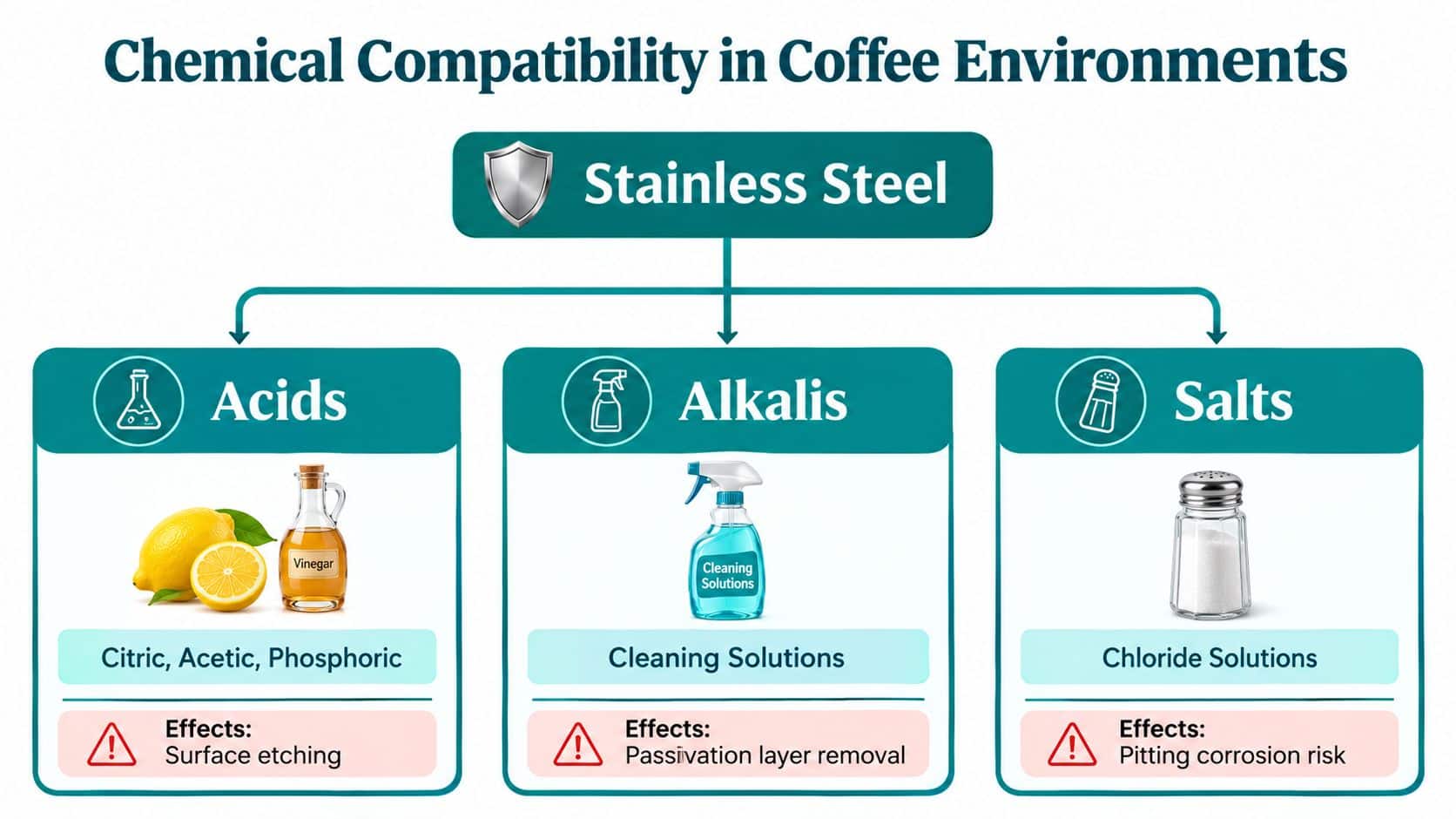
Chemical Categories and Their Effects on Stainless Steel
A stainless component can tolerate one chemical in a factory test yet corrode in coffee service after heat, residue, and poor rinsing enter the picture. Descaler chemistry matters, but so do concentration, temperature, contact time, rinsing, alloy, and surface condition.
Acids behave differently
Citric, acetic, and phosphoric acids commonly appear in descaling and cleaning routines. Dilute acids may suit 316L, while 304 can work in less aggressive service. The stainless steel compatibility reference from AZoM separates acid types instead of assigning one rating to every acid. Hydrochloric acid is generally an acid to avoid. Nitric acid is often compatible with 304L and 430, while phosphoric acid can be manageable for 316 and 317 at many concentrations.
Nitric acid produces a counterintuitive comparison. The British Stainless Steel Association's nitric acid guidance explains that 304 types are often preferable to 316 types for nitric acid service. Its published iso-corrosion guidance places the 0.1 mm/year corrosion-rate lines for 304 and 316 together across a wide concentration and temperature range. It also reports 304 as usable up to about 95% nitric acid for storage applications. Chlorides or fluorides can change that result sharply by increasing pitting risk.
Alkalis and cleaners can remove protection
Alkaline cleaners remove coffee oils, but an unsuitable formula or aggressive scrubbing can disturb the passive film. Chlorine and oxidizing sanitizers need extra care. The food-contact review cited above associates them with passive-film loss, particularly in high-acid, high-salt, or high-temperature conditions.
Follow the equipment and cleaning-tablet manufacturer's instructions. A product that is acceptable for plastic tubing may still be a poor choice for a welded stainless part, especially if hot solution remains against the metal.
Salts create local attack
Chlorides from water, salt residue, or cleaning chemistry can initiate localized corrosion. A small pit deserves more attention than broad discoloration because attack is concentrated at one site and may deepen beneath an otherwise clean-looking surface.
Concentration and temperature do not always produce a gradual response. The Unified Alloys explanation of stainless corrosion notes that some acids may be tolerated at low or very high concentrations yet attack stainless steel within an intermediate range. The same reference shows why a simple good-or-bad label cannot capture real service conditions.
Read the chemical label, then check how hot the solution becomes, how long it can remain trapped, and whether scratches or weld heat effects reduce the practical margin.
Hidden Variables That Compatibility Charts Ignore
Most compatibility charts assume a clean, uniform, factory-finished surface. Your reusable pod doesn't live in that world forever. It gets inserted, rinsed, wiped, dropped in a sink, exposed to brewing heat, and sometimes scrubbed with whatever pad happens to be nearby.
A scratch can create a recessed site that holds moisture and dissolved salts. A seam can behave similarly. The problem becomes more serious when a cleaning solution remains trapped instead of draining and rinsing away.

Welding changes the starting point
Manufacturing can also alter corrosion performance. A 2025 materials report on restoring stainless steel corrosion resistance notes that high-temperature processing such as welding can cause sensitization, which substantially deteriorates corrosion resistance. The same report discusses newer passivation approaches intended to restore resistance.
That distinction matters for coffee accessories. A pod made from formed sheet with clean, well-finished joins may behave differently from a component with rough welds, heat tint, or poorly treated seams. A product page that names the alloy but says nothing about finishing leaves an important part of the risk assessment unanswered.
Heat and repetition expose weak points
A descaler may be acceptable under a controlled, short cleaning cycle yet problematic if the solution is stronger, hotter, or left inside the machine. Repeated exposure also matters because each cycle can test the passive film and the quality of the surface.
Look for practical warning signs:
- Pitting: Small dark points, pinholes, or rough craters indicate localized damage.
- Crevice attack: Discoloration or roughness near seams, lids, mesh edges, and gasket seats deserves attention.
- Heat-affected areas: Weld discoloration or roughness can signal a surface that needs closer inspection.
- Persistent metallic taste: Treat it as a reason to stop using the part and investigate, not as proof of one specific corrosion mechanism.
Replace a pod when corrosion, structural damage, distorted seals, or persistent leakage appears. Cleaning can't reliably restore metal that has already lost material.
Corrosion Mechanisms in Coffee Brewing Environments
Pitting, crevice corrosion, and stress-related cracking don't require a dramatic spill. They can develop where chlorides concentrate, where liquid becomes trapped, or where heat and mechanical loads act on a compromised surface.

Pitting attacks a small area deeply
The AZoM overview of stainless corrosion identifies pitting corrosion as the dominant historical failure mode that shaped compatibility guidance, particularly in chloride-bearing and acidic environments. Stainless steels with higher chromium, nitrogen, and molybdenum generally show better pitting resistance, and ASTM G48 is one of the most common standardized tests used to rank localized corrosion behavior.
A coffee pod's small perforations and mesh can make inspection difficult. A leak that seems to come from a gasket may involve a pinhole in the metal.
Crevices hold the chemistry in place
Crevice corrosion develops in shielded areas where fresh oxygen exchange is restricted. Lid interfaces, gasket seats, folded sheet edges, and tight joints can retain chloride-bearing liquid after the visible surface looks dry. This is why the same water can behave differently on an open plate than inside a narrow joint.
Stress can help open a path
Thermal cycling and mechanical loading can put stress around welds, formed edges, and closures. If corrosion has already weakened those areas, cracking or leakage can follow. The practical response is simple: inspect joints and seals, avoid forcing a distorted pod into a machine, and stop using any part that leaks into an inaccessible water path.
This short visual overview can help connect the chemistry to the failure pattern:
A stainless steel corrosion table also notes that adding 200 mg/L of chlorides to sulfuric acid, or 2,000 mg/L in a more concentrated comparison, caused a dramatic reduction in corrosion resistance. Those figures come from the stainless steel corrosion guidance, and they illustrate why water chemistry and cleaner residue belong in the same maintenance conversation.
Premium vs Generic Stainless Steel Coffee Accessories
The usual objection is reasonable: why pay more for a premium reusable K-Cup when a generic pod appears to perform the same job? The answer isn't that every inexpensive accessory fails. The issue is that a low price often gives you less information about the material, surface treatment, dimensional control, and replacement support.
A premium accessory should make its construction easier to evaluate. Look for an identified stainless grade, food-contact suitability, smooth surfaces, clean joins, a lid that seats consistently, and instructions that match the machine. A generic listing that says only “stainless steel” leaves you guessing about the exact alloy and finishing process.
What the comparison really involves
| Buying factor | Premium specified accessory | Generic or unspecified accessory |
|---|---|---|
| Alloy information | States the grade or gives meaningful material details | May use only “stainless steel” |
| Surface quality | Smooth, clean, and easier to inspect | May have rough edges, scratches, or visible heat effects |
| Fit | Designed around a stated machine family | Fit may vary between machines |
| Seal behavior | Lid and gasket interfaces receive closer attention | Leakage risk may be harder to diagnose |
| Maintenance | Cleaning guidance usually reflects the material | Instructions may be incomplete |
| Replacement decision | Support and product documentation are clearer | Material and warranty questions may be difficult to answer |
The customer usually notices fit first. A pod that sits too high, seals unevenly, or leaks around the lid can create a messy brew and push water into places that weren't designed for it. Precision doesn't guarantee perfect compatibility with every machine, so verify whether the accessory matches your Keurig or Ninja model before ordering.
Durability also depends on care. Even a well-made 316L component can suffer if you use abrasive pads or chlorine-based sanitizer. Conversely, a properly maintained 304 accessory can be suitable in a low-chloride home water system. Premium construction improves the starting margin, but maintenance determines how much of that margin survives.
Filters and a compatible descaler support the same goal. A water filter can reduce unwanted water constituents entering the machine, while a purpose-designed cleaning product helps remove scale without encouraging improvised chemistry.
Maintaining Stainless Steel Passivation in Coffee Equipment
A clean-looking pod can still have a damaged passive film. Factory-finished stainless steel is easier to protect than coffee equipment that has been welded, scratched, heated, and repeatedly exposed to descaler or chlorides. Passivation maintenance therefore starts with controlled cleaning, not aggressive scrubbing. As discussed in the materials section above, incompatible cleaners, abrasive pads, chlorine, and oxidizing sanitizers can undermine surface protection.
A practical cleaning routine
- Remove coffee residue promptly. Rinse the reusable pod after brewing so oils and solids do not remain trapped in mesh, seams, or gasket seats.
- Use a soft tool. Choose a soft brush or non-abrasive cloth. Abrasive pads can create scratches and crevices that hold residue.
- Follow the descaler label. Use the stated dilution, temperature, contact time, and rinse procedure. Do not leave hot solution sitting in the machine after the cycle ends.
- Separate components. Clean lids, gaskets, baskets, and pod bodies individually when the design permits. Interfaces often conceal residue.
- Rinse until residue is gone. Cleaner left in a joint can become more aggressive as water evaporates.
- Dry and inspect. Check pits, roughness, heat tint, distorted edges, weld areas, and leaks before the next brew.
A descaler removes mineral buildup. It does not repair corroded metal. If the surface has pinholes or a gasket no longer seals, replace the part instead of increasing chemical strength.
For routine care, use food-grade cleaning products that match the machine manufacturer's directions. Chlorine-based sanitizers require particular caution when heat, salt, or acidic residue is also present.
Maintenance checkpoint: Inspect the underside, perforations, welds, scratches, and seal contact areas. A pod can look polished while localized corrosion is developing in a hidden joint.
Water filters can reduce the constituents entering the machine, but they do not remove the need for descaling or inspection. Replace filters according to their product instructions, and keep the housing clean so it does not introduce fresh residue.
Quick Reference Guide for Common Coffee Chemicals
Use this table for initial screening, not as a universal approval list. Concentration, temperature, contact time, chloride content, weld quality, scratches, and trapped residue can change the outcome. Factory-finished steel may perform well in a controlled test, while a welded or scratched coffee part faces repeated hot chemical exposure.
| Coffee chemical or condition | 304 response | 316 or 316L response | Practical decision |
|---|---|---|---|
| Dilute citric acid descaler | Often suitable in controlled service | Generally offers a wider margin in dilute acidic service | Follow the product and machine instructions, then rinse thoroughly |
| Vinegar or acetic acid solution | Depends on strength and heat | Often more forgiving, but not immune | Do not improvise stronger or hotter mixtures |
| Phosphoric acid cleaner | Can suit less aggressive service | Often manageable across many formulations | Check the formulation and exposure conditions |
| Hydrochloric acid or chloride-rich acid | Generally avoid | Generally avoid | Choose another approved cleaning chemistry |
| Chlorine or oxidizing sanitizer | Can damage the passive film | Can damage the passive film | Use only when the equipment maker specifically approves it |
| Low-chloride fresh water | Commonly suitable | Suitable with greater chloride margin | Keep the system clean and watch for localized damage |
| Hot, trapped chemical residue | Risk increases | Risk remains | Drain, rinse, dry, and inspect welds, seams, and joints |
The distinction between dilute organic or mineral acids and stronger chloride-bearing media matters more than a single “safe” label. A compatibility chart can help compare wetted materials, but it cannot account for every scratch, crevice, weld, or hot spot in a coffee machine.
If the chemical strength or stainless grade is unknown, treat compatibility as uncertain. Descaler that is acceptable in a cool, smooth vessel can behave differently when heated, concentrated by evaporation, or held against damaged passivation. Choose the lowest effective chemical strength, keep contact time controlled, and inspect the part after repeated cleaning cycles.
Making Informed Decisions for Your Coffee Setup
Choose stainless steel accessories by matching four variables: alloy grade, water chemistry, maintenance chemistry, and manufacturing quality. A 304 pod can make sense for a low-chloride home water system when the surface is smooth, the fit is correct, and cleaning follows the instructions. Type 316 or 316L offers a wider margin when chloride exposure or cleaning severity is a recurring concern, but it still needs proper care.
For reference, a peer-reviewed Materials study on chloride thresholds reported that, at pH 12.5, type-316 austenitic stainless steel had a critical chloride concentration of 1.5–2.0 M, while type-2205 duplex stainless steel reached 3.0–3.5 M under the same conditions. Those laboratory thresholds aren't a household approval rating. They demonstrate that alloy selection can materially change compatibility margins under defined conditions.
A buyer's inspection list
- Confirm the material: Prefer a stated grade over an unspecified stainless label.
- Check the surface: Reject parts with rough welds, sharp burrs, deep scratches, or unexplained discoloration.
- Verify the fit: Match the pod or basket to the exact machine family and closure design.
- Review cleaning instructions: Avoid products that offer no guidance for descaling, sanitizing, or abrasive tools.
- Plan replacement: Retire parts that pit, leak, crack, distort, or remain metallic-tasting after proper cleaning.
- Control the water path: Use an appropriate filter and keep the reservoir, pod, and brew chamber clean.
PureHQ Inc. offers reusable K-Cups, refillable stainless steel pods, water filters, cleaning tablets, and descaling solutions for selected Keurig and Ninja systems. The practical value of any accessory comes from matching its stated material and care requirements to your water and cleaning routine, not from choosing a product based on appearance alone.
Choose a reusable pod and filtration setup with clearly stated materials, machine compatibility, and maintenance guidance, then visit PureHQ Inc. to shop stainless steel coffee accessories, water filters, descalers, and cleaning supplies for a more controlled brew path. Use the product details and fit information to select the parts that suit your Keurig or Ninja system and replace any component that shows pitting, damage, or leakage.

