
Coffee Machine Care
Keurig Water Filter Amazon
Sep
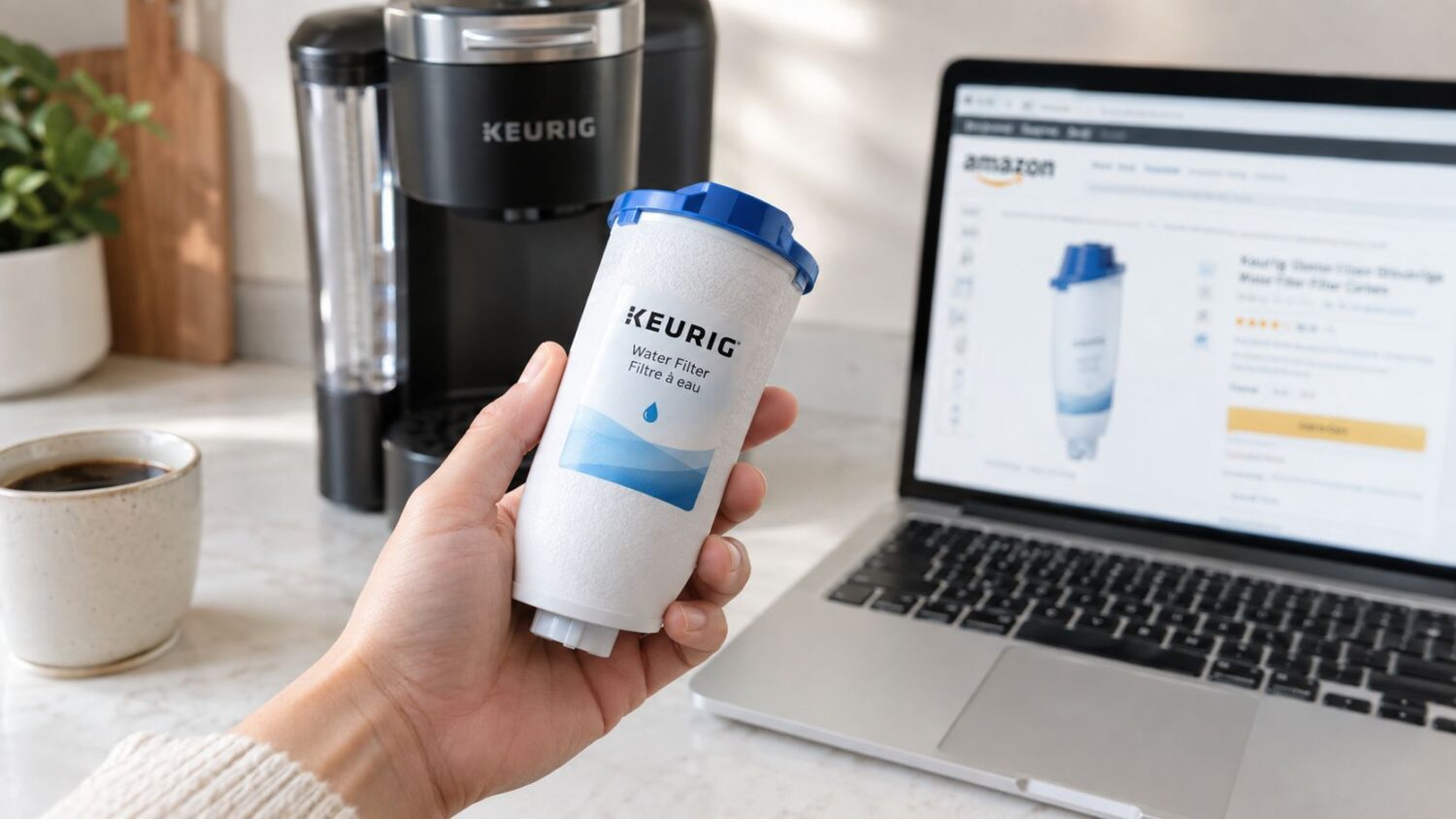
You're halfway through your morning coffee when the familiar disappointment hits. The brew tastes flat, slightly metallic, or faintly like chlorine, and the Keurig descale light is blinking as if the machine has finally filed a complaint. You search Amazon for “Keurig water filter”, find page after page of cartridges claiming universal compatibility, and still have no idea which one belongs in your brewer.
The filter itself is simple. The shopping decision isn't. Amazon's Coffee Accessories category contains more than 60,000 listings, while “coffee bar accessories” exceeds 20,000 results, according to the Amazon coffee accessories marketplace. That crowded funnel includes pod holders, reusable capsules, descalers, cleaning tools, and water filters, so a vague “fits most Keurig machines” label isn't enough.
This guide cuts through the listings. It identifies the filter shape your model needs, separates worthwhile third-party cartridges from flimsy generics, explains how to inspect a suspicious listing, and gives you a maintenance routine that treats filtration and descaling as separate jobs.
Why Your Keurig Coffee Tastes Worse Than It Should
The decline usually arrives gradually. Your Keurig still heats water and fills a mug, but the coffee loses its aroma, develops a papery edge, or tastes vaguely like a swimming pool. Then the descale light appears, and you wonder whether the machine is failing when the actual problem may be neglected water maintenance.
Tap water carries chlorine, dissolved minerals, and fine particles into the reservoir. A brewer-specific charcoal cartridge helps reduce chlorine taste and odor, captures some particulates, and can reduce part of the hardness load before water reaches the heating system. It won't repair a clogged needle or dissolve scale that has already formed, but it's the easiest first step when the coffee tastes wrong.
Water treatment also requires restraint. Coffee-water guidance distinguishes a Keurig-style charcoal and ion-exchange cartridge from reverse osmosis, because near-total demineralization can leave brewing water outside a useful flavor balance. Independent coffee-water treatment guidance reports that reverse osmosis can remove about 94% to 98% of calcium and magnesium, while three non-electric household filter designs in a peer-reviewed study averaged 40%, 48%, and 46% calcium reduction. A reservoir cartridge isn't supposed to turn your water into laboratory-grade blank water.
Practical rule: If your coffee tastes off, replace the cartridge first, then clean the needles and descale according to your water conditions. A filter is the first domino in maintenance, not a magic fix.
Start with the filter because it requires little effort and directly addresses taste. For a broader explanation of how filtration fits into household water care, the Vendmoore Enterprises filtration guide is a useful companion. Once the cartridge is fresh, you can judge whether scale, stale water, or a dirty brew path still needs attention.
Matching the Right Filter to Your Keurig Model
The biggest Amazon mistake isn't choosing official versus third-party. It's choosing the wrong handle and cartridge shape. A cartridge can look close enough in a product photo and still sit loosely, fail to click into place, or leave the reservoir without proper filtration.
Use your brewer family as the starting point, but verify the physical holder before ordering. Amazon listings frequently bundle a handle and cartridges together, even when your machine already has a usable handle. In that case, you only need replacement cartridges.
Keurig Model to Filter Compatibility
| Keurig Model Family | Filter Handle | Replacement Cartridge | Amazon Listing Trap |
|---|---|---|---|
| K-Classic and K-Compact | Smaller handle | Short blue cartridge | “Universal” packs may include the wrong holder |
| K-Select, K-Elite, and K-Cafe | Taller handle | Blue cartridge | A short-handle bundle may not seat correctly |
| K-Supreme and K-Supreme Plus | Slim handle | Shorter cartridge with mesh pre-filter | Standard handles can be the wrong shape |
| K-Duo family | Generally follows the K-Elite path | Blue cartridge | Carafe and reservoir configurations can confuse listings |
| Older 2.0 machines | Model-dependent holder | Match the existing cartridge | Broad 2.0 wording can hide family-specific differences |
The K-Classic and K-Compact use the smaller handle with the short blue cartridge. K-Select, K-Elite, and K-Cafe use the taller handle with a blue cartridge. The K-Supreme and K-Supreme Plus use a slim handle, a shorter cartridge, and a mesh pre-filter. Much of the K-Duo family follows the K-Elite path, but you should still compare the holder in your machine with the listing photos.
Amazon's catalog shows why this gets messy. Some listings call their products “universal,” while the fine print excludes Cuisinart or Keurig-Cuisinart brewers, certain reservoir configurations, or starter kits intended only for reservoirs shorter than 8 inches. The Amazon compatibility listing demonstrates the importance of reading exclusions rather than trusting the headline.
Before buying, perform this quick check:
- Find the exact brewer model printed on the machine or its documentation.
- Remove the reservoir and locate the holder in the base or along the sidewall.
- Compare the holder's width, height, and locking points with the product images.
- Identify whether you need cartridges only or a complete starter kit.
- Recheck compatibility before every reorder, especially after switching from a K-Classic to a K-Supreme-style brewer.
If you're also comparing the ongoing cost of pods and filters, Celmin's resource on CBD pricing for coffee pods provides related context for single-serve coffee buyers. The main buying lesson remains simple: match the hardware first, then compare the cartridge brand.
Comparing Official Keurig, Third-Party, and Generic Filters
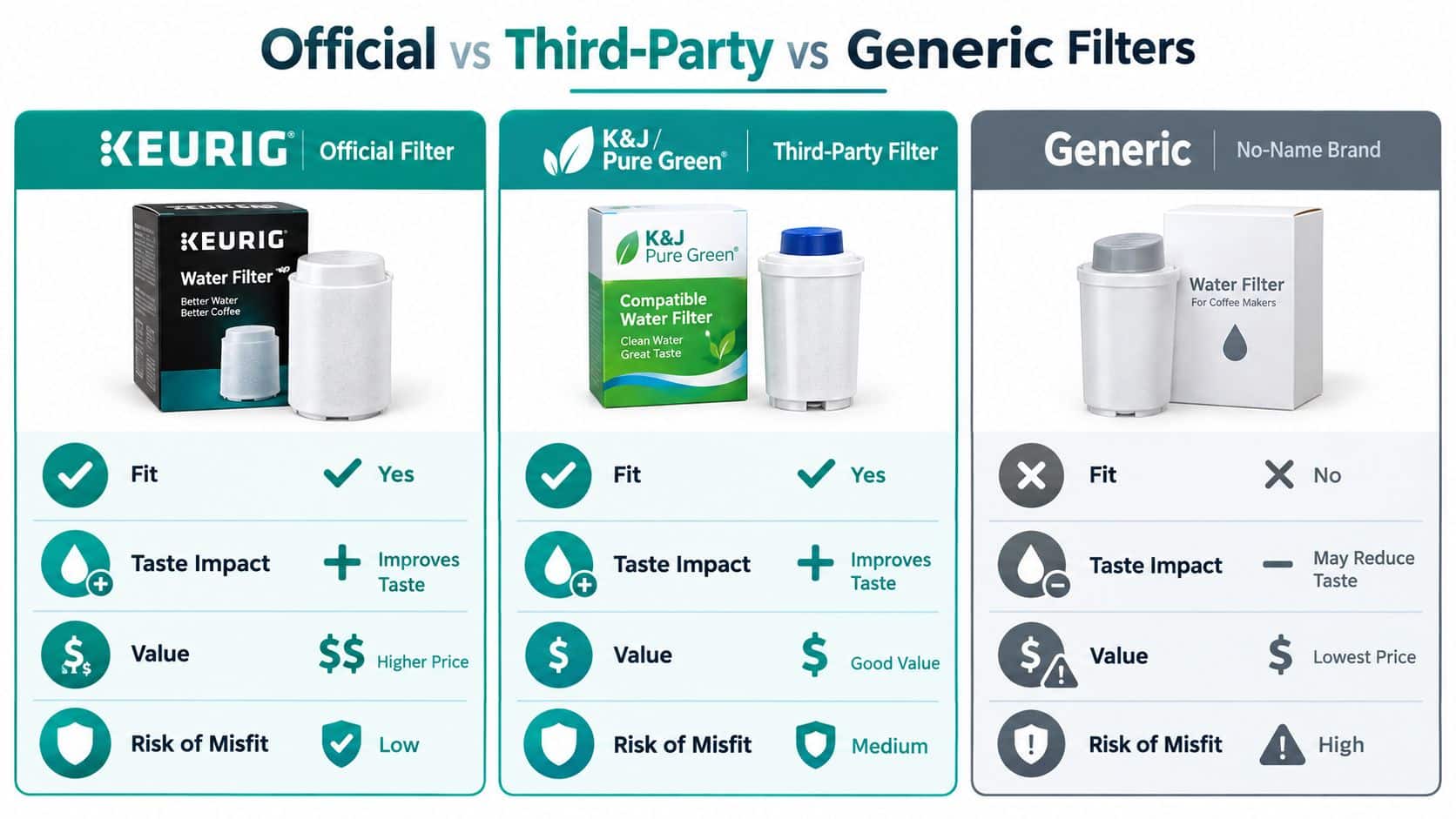
The official Keurig cartridge is the safest fit. A reputable third-party cartridge can be the better everyday value. A no-name generic may save money at checkout, but it gives you the least confidence that the holder will lock properly or that the cartridge will stay positioned in the reservoir.
The official six-cartridge package is described as a 12-month supply, with replacement recommended every 2 months or after 60 tank refills, according to the Keurig-compatible cartridge listing. The same listing describes compatibility with Keurig water filter handles, NSF certification, and BPA-free materials. Those details matter more than a polished product title because they define what the cartridge is intended to do and where it belongs.
My buying verdict
Official Keurig cartridges make sense when exact fit matters more than price, when your brewer is under warranty, or when you don't want to troubleshoot an imperfect holder. They're the conservative choice for owners who want the manufacturer's stated compatibility and maintenance cadence.
Quality third-party cartridges, including established options such as K&J or Pure Green, are my preferred middle ground for daily drinkers. They're worth considering when the listing clearly identifies the compatible Keurig families, shows consistent packaging, and has reviews that confirm a secure fit. Don't buy based on the word “universal” alone.
Cheap generics belong in a narrower use case. They can be acceptable for occasional brewers using softer water, but inconsistent dimensions create avoidable risk. A loose cartridge may click poorly, float inside the reservoir, or leave you wondering whether the filter is working at all.
One-line rule: Choose official for maximum fit confidence, reputable third-party for routine value, and generic only when the savings justify checking every dimension and review.
Water filtration isn't limited to countertop brewers, so readers comparing broader household systems may find JMJ Plumbing's guide to installing a Halo water filter useful for understanding how larger filtration setups differ from small reservoir cartridges.
Spotting Counterfeits and Sketchy Sellers Before You Click Buy
Amazon rewards fast scanning, but water-filter shoppers should slow down for one minute. A high star rating doesn't rescue a listing with the wrong cartridge shape, vague seller information, or packaging that doesn't match the brand.
Start at the top of the page and work downward:
- Verify the seller: Official-looking Keurig products should identify Keurig, Keurig Dr Pepper, or a recognizable authorized distributor such as Zulay. Treat a storefront selling thousands of unrelated products as higher risk, particularly when the listing provides little brand information.
- Read the title carefully: The title should identify a Keurig family or explain the relevant compatibility, such as a known 2.0 series. “Fits all brewers” is not a substitute for model-specific detail.
- Search the reviews: Look for recurring phrases such as “doesn't fit,” “wrong cartridge size,” “cheap plastic,” or “won't click.” Repeated fit complaints matter more than the overall star average.
- Inspect the packaging image: Branded charcoal cartridges should show a Keurig logo, a batch code, and a sealed foil pouch. Loose cartridges in a baggie and blurry printing are strong reasons to skip the listing.
- Compare fulfillment and price: Prime eligibility and Fulfilled by Amazon status can add purchasing protection, while Amazon's A-to-Z Guarantee provides a route for claims involving counterfeit goods. Compare the per-cartridge price with other listings. A dramatically low price can signal compromised quality, while an unusually high price may indicate a middleman.
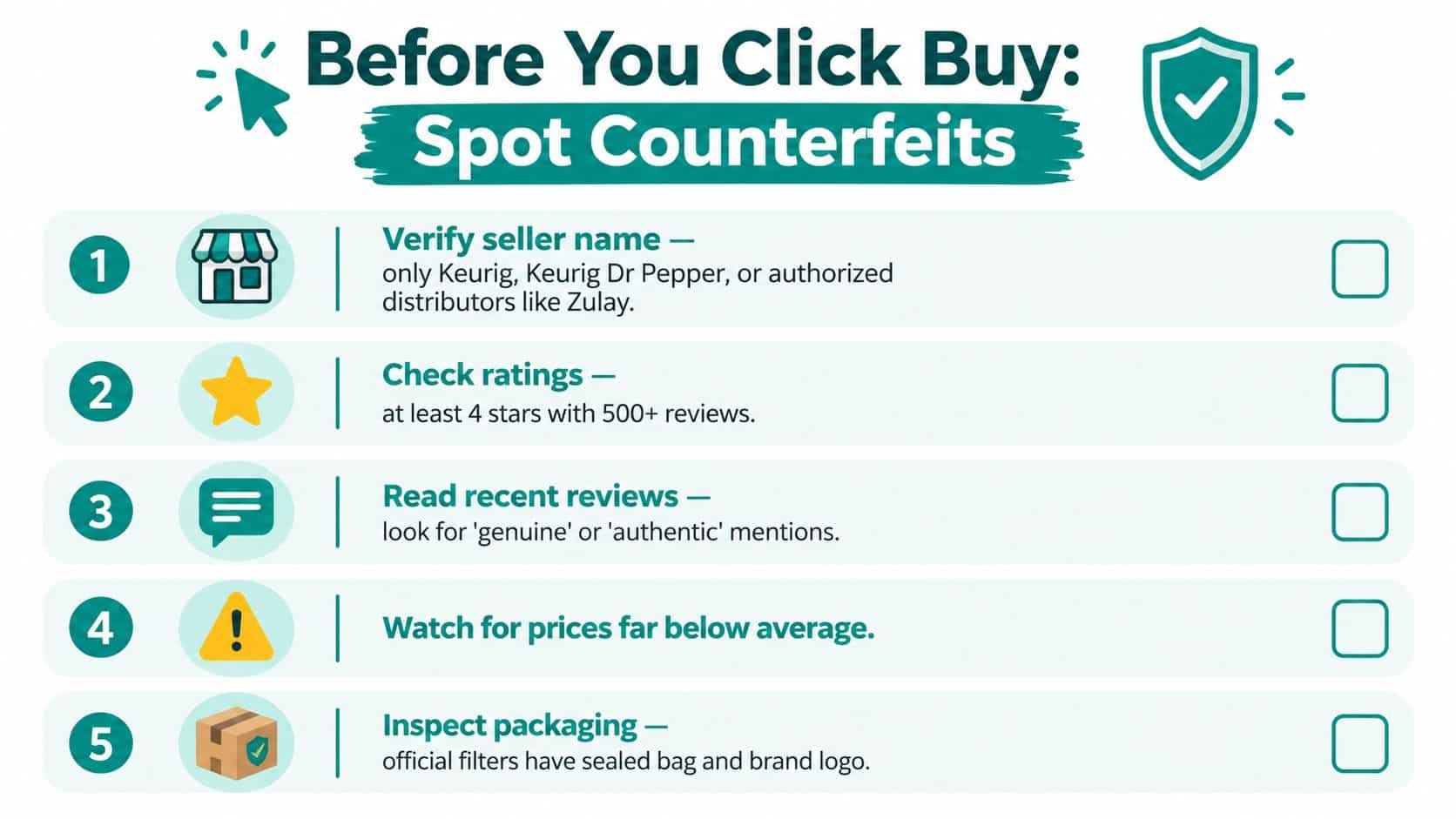
Don't rely on a product photo alone. Sellers can reuse manufacturer images while shipping a different item, so the seller identity, recent reviews, fulfillment details, and physical packaging should tell the same story. For a more detailed authenticity check, use this product authenticity guide.
Installing and Replacing Your Keurig Water Filter the Right Way
A cartridge can be genuine and compatible yet still perform poorly if you install it dry or skip the rinse. Keurig's support guidance says to soak the charcoal cartridge in fresh water for 5 minutes, then rinse it for 60 seconds before installation, as explained in the official Keurig filter preparation instructions.
Use this sequence:
- Remove the reservoir. Lift it away from the brewer and locate the filter handle. Depending on the model, the handle sits in the reservoir base or clips against the sidewall.
- Remove the old cartridge. Pull it from the handle and discard it. Spent charcoal isn't a refillable component, and trying to reuse it defeats the maintenance cycle.
- Prepare the new cartridge. Soak it in fresh water for five minutes. Rinse it under running water for sixty seconds to remove loose carbon fines.
- Seat the cartridge. Place the cartridge into the handle in the same orientation as the old one. Press it into position so the handle sits flat and locks correctly.
- Flush the brewer. Refill the reservoir with fresh cold water and run water-only brew cycles before making coffee. This clears preparation residue from the water path.
The filter holder should feel secure rather than loose or buoyant. If the handle doesn't sit flat, stop and recheck the model, because forcing the wrong part can create a fit problem that a new cartridge won't solve.
This short installation video can help you recognize the holder and cartridge orientation:
Replace the cartridge every 2 months or after 60 tank refills, using whichever milestone arrives first, as specified by Keurig's product guidance. Put the next replacement on your calendar immediately after installation.
Pairing Filters with Descaling for Better Taste and Longer Machine Life
A filter and a descaler don't perform the same job. The cartridge addresses chlorine taste, odor, and some particulate and hardness concerns. Descaling removes mineral deposits that accumulate inside the brewer, especially when local water is hard.
Hard water can change the maintenance interval sharply. Independent coffee-gear guidance notes that very hard conditions may require descaling every 2 to 4 weeks, while softer water can extend the interval to months, as described in this coffee equipment descaling guide. That range is why a fixed calendar alone isn't enough. Watch for slower brewing, unusual noises, reduced flow, or a taste that remains poor after a fresh filter.
What each maintenance step handles
- Filter replacement: Reduces chlorine taste and odor before the water enters the brewer.
- Descaling: Breaks down calcium and magnesium deposits that interfere with the heating and water path.
- Needle cleaning: Removes brewing debris that can restrict the pod entry or coffee exit.
- Reservoir care: Prevents stale water and residue from undermining otherwise clean brewing.
Built-in and inline filters can slow scale buildup, which helps explain why manufacturers provide maintenance ranges rather than one universal date. A coffee gear cleaning guide offers useful context for comparing filtration accessories with generic alternatives on maintenance demands.
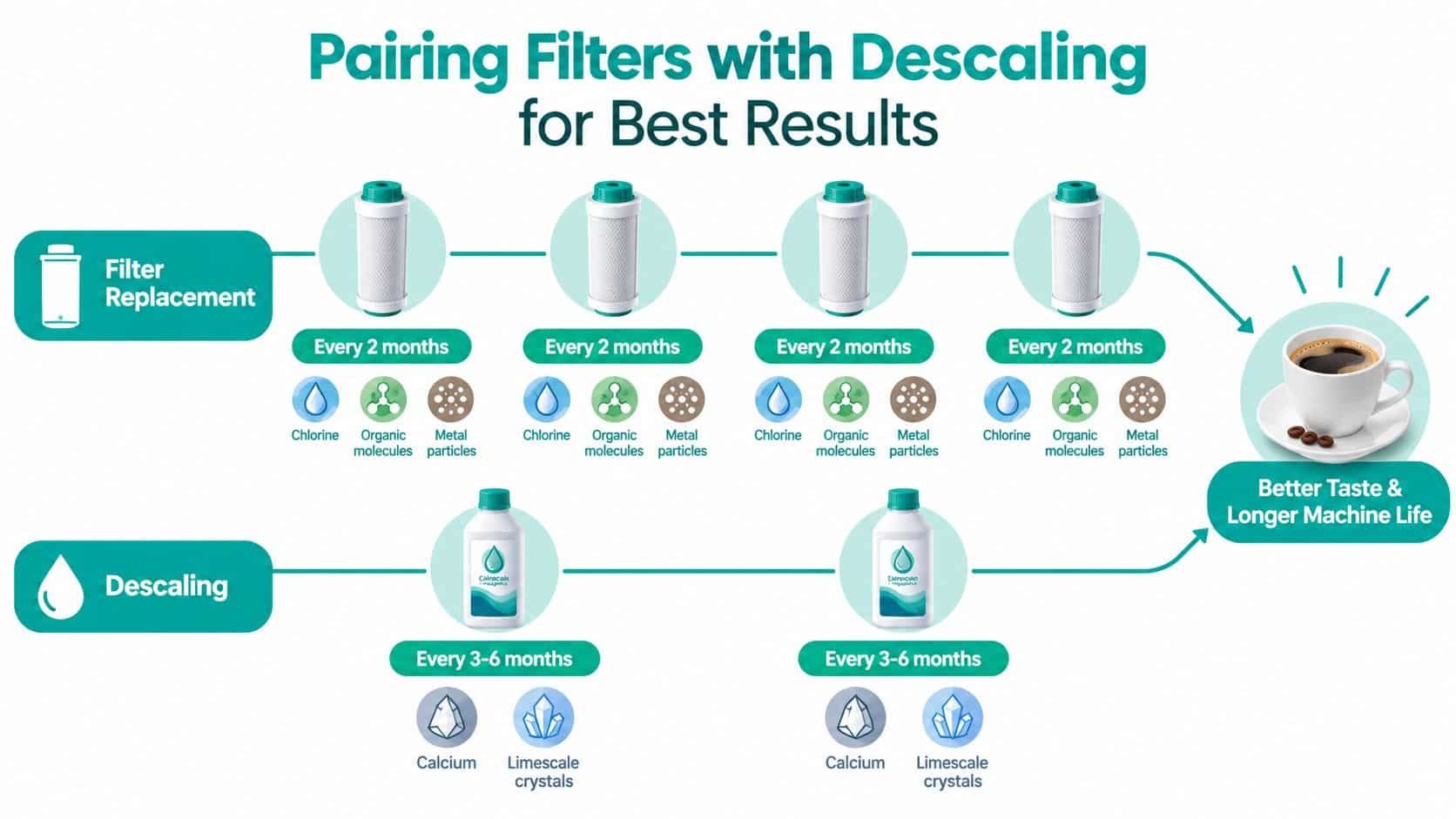
Keep the routine practical: change the cartridge on its Keurig schedule, then adjust descaling based on your water hardness and the brewer's symptoms. If coffee still tastes bitter or weak after both steps, inspect the needles and pod holder instead of buying another filter.
For a focused walkthrough of the second half of this routine, use this guide to descaling a Keurig machine for better coffee taste.
The Smartest Way to Stock Up and Save on Keurig Filters
Buy the correct filter before you buy a large quantity. Bulk cartridges only save money when the handle shape is right, the packaging is trustworthy, and you can store the filters somewhere dry and clean. A large pack of the wrong size is not a bargain.
Amazon's Subscribe and Save option can be useful when it's available for the exact listing you've already verified. The schedule should follow Keurig's stated cartridge rhythm, which is every 2 months or after 60 tank refills, rather than an arbitrary delivery interval. Set a reminder to inspect the model and cartridge before reordering, especially if you replace the brewer.
Search terms such as “Keurig water filter 2 pack” and “Keurig replacement filter cartridges compatible” narrow the results, but they don't replace model verification. Open the listing, check the handle dimensions and exclusions, read recent fit complaints, and confirm whether you're buying cartridges only or a starter kit.
Add maintenance items while the order is open. A pack of rinseable reusable K-Cup pods can reduce single-serve waste, while a small bottle of Keurig descaling solution handles the mineral buildup that a charcoal cartridge can't remove. PureHQ's guide on where to buy Keurig water filters can help you compare direct purchasing with Amazon listings.
My recommendation is straightforward. Daily drinkers should choose a reputable third-party cartridge with verified compatibility, official Keurig cartridges suit warranty-conscious owners, and casual brewers on softer water can consider a generic only after checking the fit evidence. A correctly matched filter is one of the least complicated upgrades you can make to protect coffee flavor and keep routine maintenance under control.
PureHQ Inc. offers Keurig-compatible starter kits and replacement charcoal cartridges for systems including K-Classic, 2.0, K-Supreme, K-Slim, and K-Duo, along with reusable K-Cups and descaling products. Visit PureHQ Inc. to check the filter size for your brewer and choose the maintenance accessories that fit your routine.

