
Coffee Machine Care
Keurig and Cuisinart Compared for Home and Office
Oct
You're standing in the appliance aisle with two machines in front of you. One promises simple K-Cup brewing, the other offers pods, ground coffee, and a carafe. Then you read the reviews and find the same complaints repeated: weak coffee, leaking refillable capsules, confusing compatibility claims, and maintenance lights that seem to appear without explanation.
The frustrating part is that “Keurig versus Cuisinart” isn't one comparison. A K-Classic and a K-Supreme don't use identical accessory requirements, and Cuisinart's single-serve machines don't all use the same pod holder or brewing mechanism. The right choice depends on the exact model, the way you brew, and whether you care more about pod simplicity, full-pot flexibility, or reusable coffee accessories.
This comparison separates three questions that many buying guides blur together: does the accessory physically fit, does it brew reliably, and does the manufacturer officially support it? It also explains why weak coffee often results from extraction or mineral buildup rather than a true compatibility failure.
Why Choosing Between Keurig and Cuisinart Feels Harder Than It Should
Brand-level advice sounds useful until you try to buy a replacement filter or reusable pod. A listing may say “universal,” yet the capsule sits loosely in the holder, the lid refuses to close, or the machine punctures the pod incompletely. You then blame the brewer, the coffee, or the accessory, even though the actual problem may be a mismatch between one specific model and one specific refillable design.
That confusion gets worse when a cup tastes weak. Users often assume the machine and pod are incompatible, but the coffee may have too little ground coffee, an unsuitable grind, excessive flow resistance, or mineral scale inside the water path. The Keurig K-Classic product documentation supports a removable reservoir designed for repeated brewing, but the reservoir alone cannot determine extraction quality. Dose, pod geometry, water volume, and flow all influence the result.
The model number matters more than the logo
Keurig's own documentation treats reusable-ground-coffee compatibility as model-specific. The K-Express Essentials guide names the My K-Cup Universal Reusable Coffee Filter as a compatible accessory, while Keurig's care-kit documentation excludes the MINI PLUS and Rivo systems from a listed compatibility range. Similar-looking brewers can therefore require different filters, holders, or cleaning accessories.
Cuisinart has the same issue from the opposite direction. Many of its single-serve machines accept K-Cup pods, but the pod holder, puncture system, and support for ground coffee can vary. A reusable pod designed around a Keurig chamber may physically enter a Cuisinart machine and still fail to seal correctly.
The practical rule: Treat “compatible” as three separate claims. The pod must fit, brew consistently, and appear on the manufacturer's supported list.
The rest of the comparison focuses on those distinctions. It covers machine design, serving formats, pod fit, reusable filters, water filtration, and descaling. The result is a more useful decision for a kitchen or small office than a simple claim that one brand is better.
Two Different Coffee Philosophies Behind the Brands
Keurig created the single-serve coffee-brewing model that later became a major home and workplace beverage category. The company's modern corporate structure changed in 2018, when Keurig Green Mountain merged with Dr Pepper Snapple Group to form Keurig Dr Pepper, joining the pod-and-brewer platform with a broader packaged-beverage portfolio. The company's annual-report archive documents the combined business from 2018 onward, including reports for 2018, 2019, 2020, 2021, and 2022.
That history matters because Keurig ownership involves more than the machine on the counter. The ecosystem includes brewers, pods, licensed drinks, reusable filters, replacement water filters, and descaling products. Cleaning and compatibility remain recurring ownership tasks rather than one-time setup decisions.
Keurig builds around repeatable pod service
A Keurig brewer makes sense for people who want a familiar workflow. Select a pod, close the lid, choose a serving size, and brew. In a household or breakroom, that simplicity can matter more than the ability to experiment with every coffee variable.
The trade-off is dependence on the pod chamber and its accessory rules. A reusable K-Cup must match the puncture mechanics, lid clearance, and model requirements. A filter that works in one Keurig family may not work correctly in another.
Cuisinart treats coffee as part of a wider kitchen range
Carl and Shirley Sontheimer founded Cuisinart in 1971, and the company presented its first food processor at the National Housewares Exposition in Chicago in January 1973, according to the company history summarized in this Cuisinart industry background document. Cuisinart expanded from food processors into coffee makers, blenders, toasters, cookware, and other countertop appliances. Conair acquired the company in 1988 for a reported $17 million, marking a shift from a founder-led specialist to a larger appliance portfolio.
That identity shapes the buying experience. Cuisinart often appeals to shoppers who want coffee flexibility inside a broader kitchen setup. The brand's combination machines can support single-serve pods and carafe brewing, but that flexibility brings more components to clean and more details to verify.
Keurig is a pod ecosystem company. Cuisinart is an appliance portfolio brand that includes pod brewing. Neither position is automatically superior. The better fit depends on whether you want the least complicated single-cup routine or a machine that can serve several brewing formats.
Machine Types and Brewing Styles Compared
The hardware difference becomes clear when you compare a straightforward Keurig K-Classic with the Cuisinart Coffee Center 10-Cup Thermal Coffeemaker and Single-Serve. The K-Classic focuses on pod brewing and has a removable reservoir specified to support more than six cups before refilling. The Cuisinart Coffee Center uses a 42-ounce removable reservoir, supports 4, 6, 8, 10, and 12 ounces, and accepts any brand of single-cup pod, including Keurig K-Cup pods, according to the official Cuisinart Coffee Center specifications.
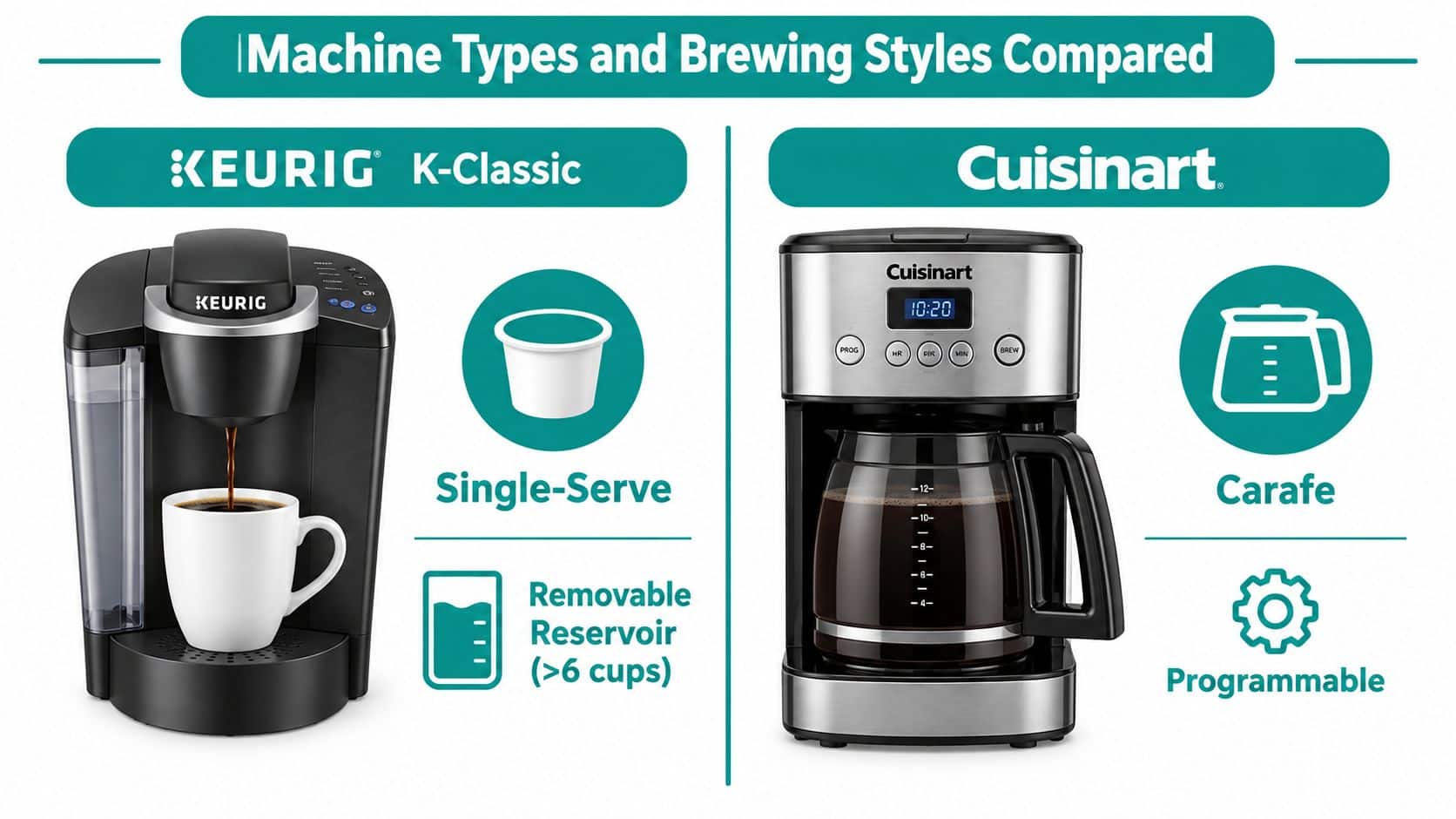
Keurig versus Cuisinart key specs
| Feature | Keurig K-Classic | Cuisinart Coffee Center |
|---|---|---|
| Reservoir | Removable reservoir supporting more than six cups before refilling | 42-ounce removable reservoir |
| Serving options | Single-serve pod brewing | 4, 6, 8, 10, and 12 ounces, plus a full thermal carafe |
| Format flexibility | Primarily pod-focused, with model-specific reusable-filter support | Any brand of single-cup pod, including K-Cup pods, plus HomeBarista reusable filter |
| Best-fit environment | Repeated single-cup service at home or in a small office | Households or offices needing single cups and full-pot brewing |
The K-Classic's larger repeated-service orientation suits a household where several people want individual cups or a small office where users brew throughout the day. It keeps the routine direct, but it doesn't offer the same built-in carafe versatility as the Cuisinart combination design.
The Cuisinart Coffee Center takes more counter space than a compact single-serve brewer, but it gives one appliance two jobs. Its Extreme Brew function produces a full pot up to 25% faster than conventional brewing, a claim that applies to the drip side and not necessarily to single-serve extraction. Its larger reservoir can reduce refill frequency, while its multi-format design lets users keep K-Cup availability without giving up ground coffee or full-pot brewing.
For an office: Choose the format that reduces interruptions. A single-serve Keurig favors fast individual service, while a Cuisinart combination machine favors shared carafe brewing and format variety.
For readers comparing broader countertop options, outfit your café with Oxo is a useful resource for evaluating another coffee-maker format. Still, specifications don't settle cup strength. Coffee dose, grind size, pod shape, water temperature, selected volume, and flow restriction all influence the cup. A larger reservoir can reduce refills, but it cannot compensate for an overfilled reusable pod or a machine that needs descaling.
Pod Compatibility Without the Guesswork
A K-Cup pod can fit inside a Cuisinart single-serve machine without proving that every reusable accessory will work there. The reliable way to evaluate Keurig and Cuisinart compatibility is to separate the question into three levels.
First ask whether the pod physically fits
Check the exact brewer model number, not just the brand name. Then compare the accessory's published compatibility list with the machine's pod holder, lid clearance, and capsule shape. A reusable pod designed for a particular Keurig chamber may sit too low, too high, or at the wrong angle inside a Cuisinart holder.
A loose fit can cause incomplete puncturing or water to bypass the coffee bed. Forcing the capsule into place creates a different risk, because the lid or puncture mechanism may not close as intended. If the pod doesn't sit naturally and the lid doesn't close without pressure, stop there.
Next test whether it brews reliably
A pod that fits can still produce weak coffee, overflow, or inconsistent flow. Start with the coffee load and water volume. Cuisinart's instructions for the HomeBarista reusable filter specify a maximum of 2.5 scoops or 15 grams of ground coffee, with no tamping and no grounds on the upper rim, as detailed in the Cuisinart Coffee Center instruction manual.
That guidance explains several common failures. Too much coffee restricts water movement, tamping makes the coffee bed harder for water to penetrate, and grounds on the rim can interfere with sealing. Use a moderate grind, keep the rim clean, and select a volume that matches the amount of coffee in the pod.
Weak coffee is often an extraction or maintenance issue misread as incompatibility.
Finally verify official support
The K-Express Essentials guide explicitly supports the My K-Cup Universal Reusable Coffee Filter. That support does not automatically extend to every Keurig model, and the MINI PLUS and Rivo systems are excluded from a listed Keurig maintenance-kit compatibility range. Cuisinart's HomeBarista filter is designed for specified Cuisinart systems, but that doesn't make every third-party refillable capsule suitable for every Cuisinart brewer.
For a broader explanation of the difference between K-Cup acceptance and accessory fit, see this guide to coffee makers compatible with K-Cups. Use the exact model number, check the manufacturer's list, and treat “universal” as a marketing description until the fit and support details confirm it.
Water Filtration and Descaling Differences That Affect Taste
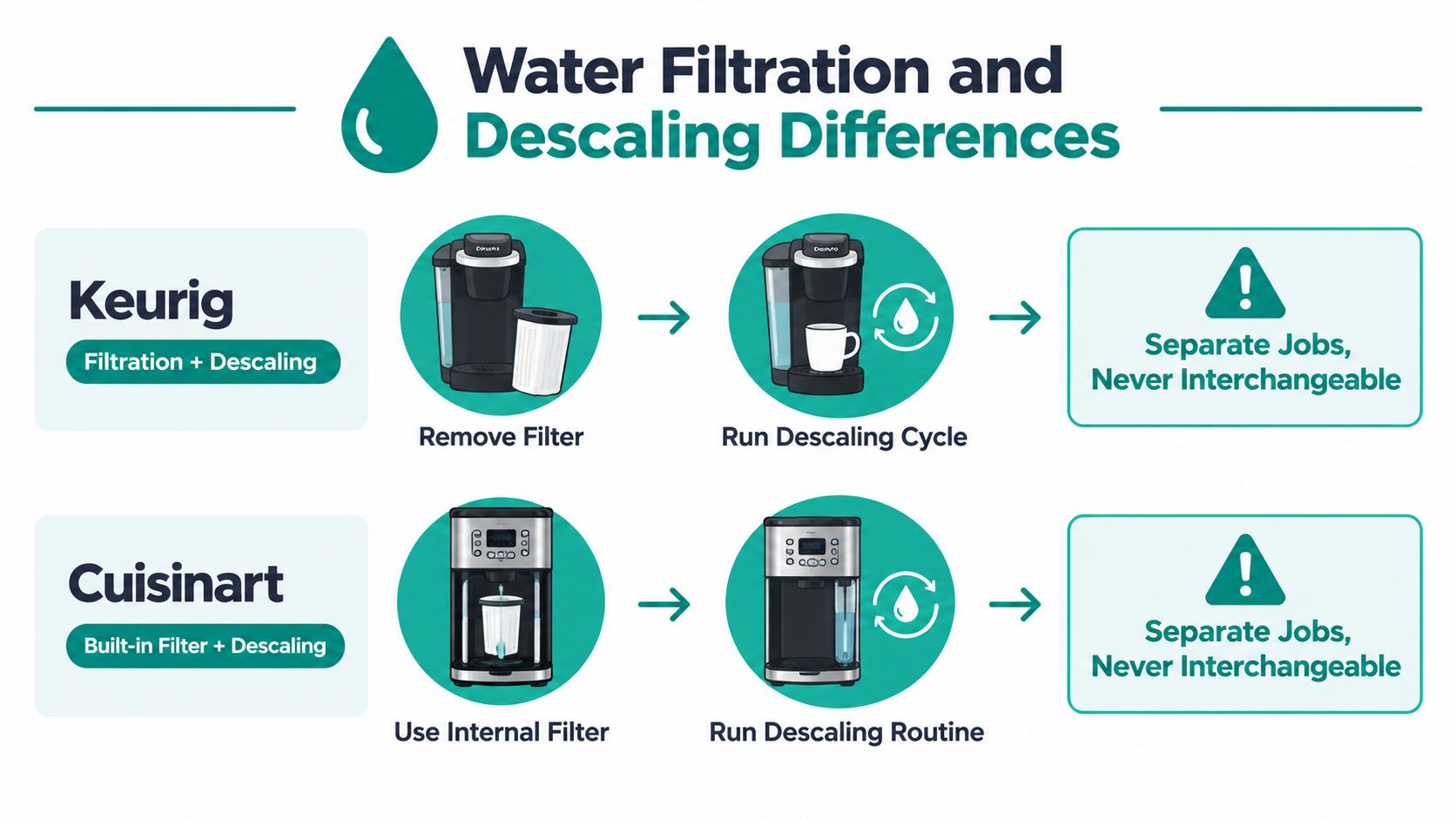
Water filtration and descaling solve different problems. A carbon filter can reduce certain impurities in incoming water, but it can't dissolve mineral buildup inside the heater, tubing, or brew path. Descaler removes accumulated mineral scale, but it isn't a replacement for a water filter.
Keurig requires a defined descaling sequence
Keurig's manufacturer instructions specify that users should remove the water filter before descaling. The standard procedure uses one full bottle of Keurig Descaling Solution, followed by an equal amount of water, then repeated rinse brews without a coffee pod. Some models require the brewer to sit for at least 30 minutes before rinsing finishes, as described in the Keurig K500 user guide.
The filter-removal step matters. Leaving a carbon filter in place during an acidic descaling cycle can contaminate it or reduce its effectiveness. A replacement filter can address water impurities after cleaning, but it can't substitute for the descaler that removes mineral deposits.
Use this sequence:
- Remove the water filter: Take the filter holder out before introducing descaling solution.
- Run the descaling cycle: Use the solution and equal amount of water specified by the instructions.
- Rinse without a pod: Run repeated water-only brews until the solution is cleared.
- Observe the waiting period: If the model requires a resting period, allow it before completing the rinse.
- Reinstall a compatible filter: Put the filter holder back only after the cleaning process is complete.
Cuisinart needs the same separation of jobs
Cuisinart reservoir filters handle water impurities, while mineral scale still requires a separate cleaning routine. The exact procedure varies by model, so follow the brewer manual rather than applying Keurig's sequence automatically to a Cuisinart machine.
A sensible maintenance setup pairs compatible replacement filters with a separate descaling solution. If taste changes, flow slows, the machine leaves more water behind, or the brew volume becomes inconsistent, don't just replace the filter and assume the problem is solved. The distinction between filtration and scale is also explained in this practical guide to how water filters affect coffee taste.
The Real Cost and Waste Math of Reusable Pods
Reusable filters can reduce dependence on disposable pods, but they aren't automatically cheaper or greener. The result depends on whether the user reuses the accessory for a long time, cleans it consistently, fills it correctly, and stops buying disposable pods as a backup.
Industry-market estimates cited by Global Growth Insights in its coffee pods and capsules report put global coffee-pod consumption at more than 32 billion pods in 2024. The same estimates state that approximately 62% remained non-recyclable and about 21% were properly processed. These figures come from market estimates rather than official waste audits, so they provide directional context rather than a precise household waste calculation.
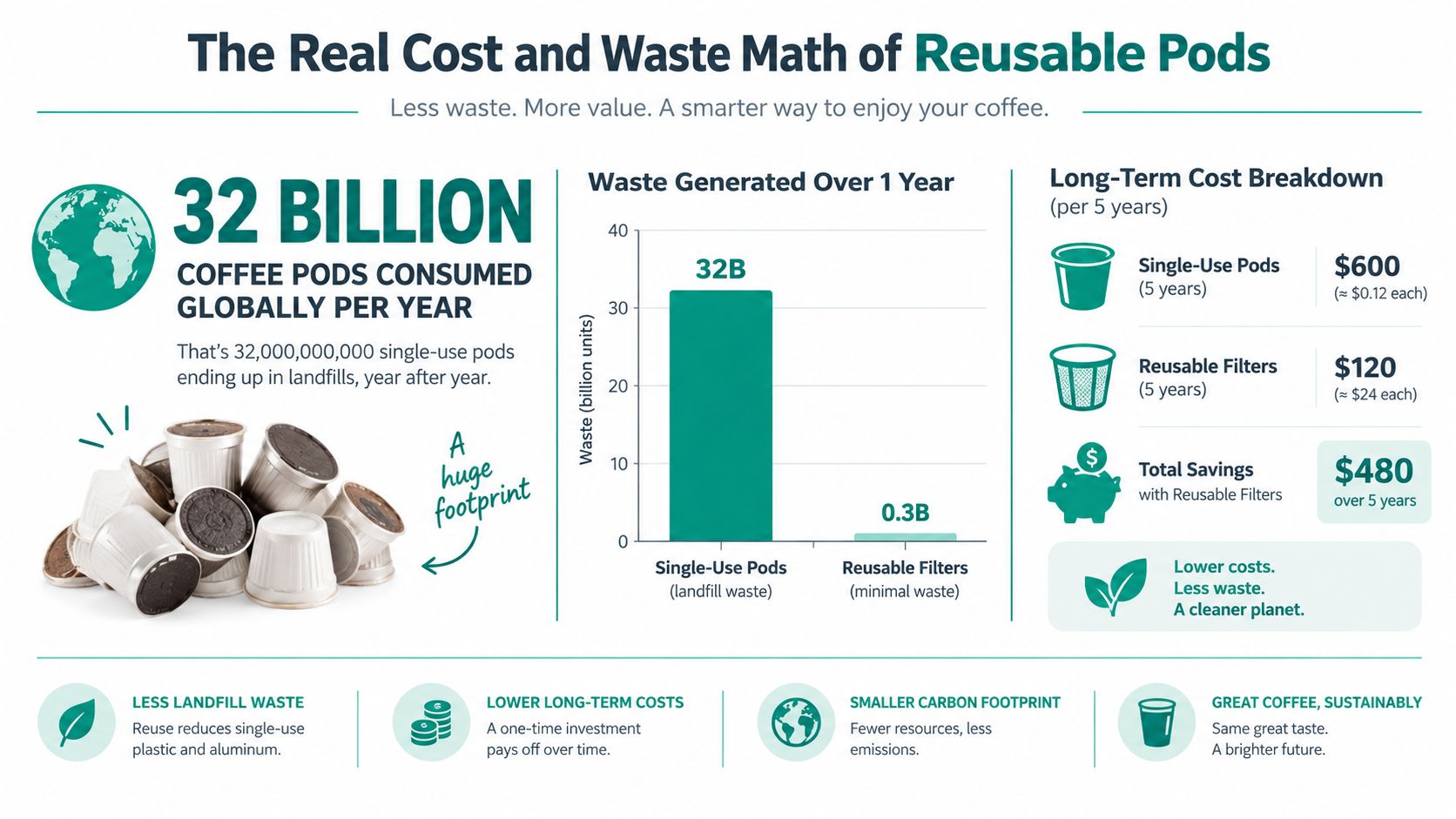
What determines the break-even point
A reusable stainless-steel pod has an upfront cost and requires cleaning. A paper liner can make cleanup easier, but it adds a consumable. Filtered water and descaling products add maintenance cost, while a failed brew wastes coffee and can make a supposedly economical setup frustrating.
The practical calculation depends on:
- Reuse duration: A refillable pod only spreads its cost if you continue using it.
- Coffee dose: Overfilling creates restricted flow, overflow, and wasted grounds.
- Cleaning time: A pod that is difficult to empty may push users back toward disposable capsules.
- Backup behavior: Buying disposable pods for convenience reduces the potential savings.
- Machine condition: Neglecting descaling can lead to poor performance and an earlier replace-versus-maintain decision.
Cuisinart's 15-gram HomeBarista limit gives a useful benchmark for controlled loading. Keep grounds below the upper rim and don't tamp them. A generic capsule with no stated capacity gives you less guidance, which makes failed brews more likely when users try to maximize strength by packing in more coffee.
Premium accessories versus generic parts
A premium stainless refillable pod can offer a defined capacity, a repeatable mesh design, and a more predictable fit for a named brewer family. A generic pod may cost less, but the lower price doesn't answer the important questions: Does the lid close? Does the machine puncture correctly? Does the mesh restrict flow? Can you clean it without leaving sediment behind?
Cuisinart's official coffee-maker information also distinguishes a reusable gold-tone filter from disposable 8–12-cup basket-style paper filters. The permanent filter supports repeated use, while paper filters simplify cleanup and can retain more fine sediment depending on the setup. Basket shape and dimensions determine fit, not the brand name alone.
The environmentally sensible choice is the one you'll use correctly for the long term. Reusables can reduce disposable-pod consumption, but failed brews, neglected cleaning, paper liners, and continued backup-pod purchases all change the result.
Which Brewer Fits Your Life and What to Buy First
For a busy household or small office that values individual servings and repeated pod service, a Keurig setup remains the more direct choice. The K-Classic's removable reservoir supports more than six cups before refilling, and the pod-centered workflow reduces decisions for people who want to brew quickly without preparing a full carafe.
Cuisinart suits a different routine. The Coffee Center combines single-serve brewing with a thermal carafe, accepts K-Cup pods and other single-cup pod brands, and offers a reusable HomeBarista filter. It's the stronger choice when one appliance needs to serve both an individual cup and a shared pot.
Buy accessories according to the brewer
The leak objection has a practical answer. Match the reusable pod, basket, and filter to the exact model number, respect the published fill limit, keep grounds away from the sealing rim, and never force an accessory into the holder. If a pod leaks after correct loading, test the brewer with a standard compatible pod before blaming the refillable accessory.
For a Keurig path, start with a model-specific reusable K-Cup, a compatible water filter, and a separate descaling solution. For a Cuisinart combination machine, consider the supported HomeBarista filter or a correctly sized gold-tone basket, then add the appropriate water filters and cleaning supplies. A disposable liner can simplify cleanup, but it remains an ongoing consumable rather than a permanent replacement for the reusable filter.
Small offices should prioritize predictable maintenance and spare filters over a large collection of interchangeable accessories. This office coffee solutions guide can help frame the choice around service frequency, cleanup, and machine downtime.
Choose Keurig when single-cup convenience and pod availability come first. Choose Cuisinart when carafe brewing and multi-format flexibility matter more than the simplest possible pod workflow. In both cases, the first purchase should follow the model number, not the logo on the front of the machine.
PureHQ offers reusable K-Cups, water filters, gold-tone baskets, paper liners, and descaling products for home brewers and small workplaces. Visit PureHQ Inc. to match maintenance accessories to your Keurig or Cuisinart setup and shop products designed for cleaner, more consistent brewing.

