
Coffee Machine Care
Coffee Maker Charcoal Filters: A Complete 2026 Guide
Oct
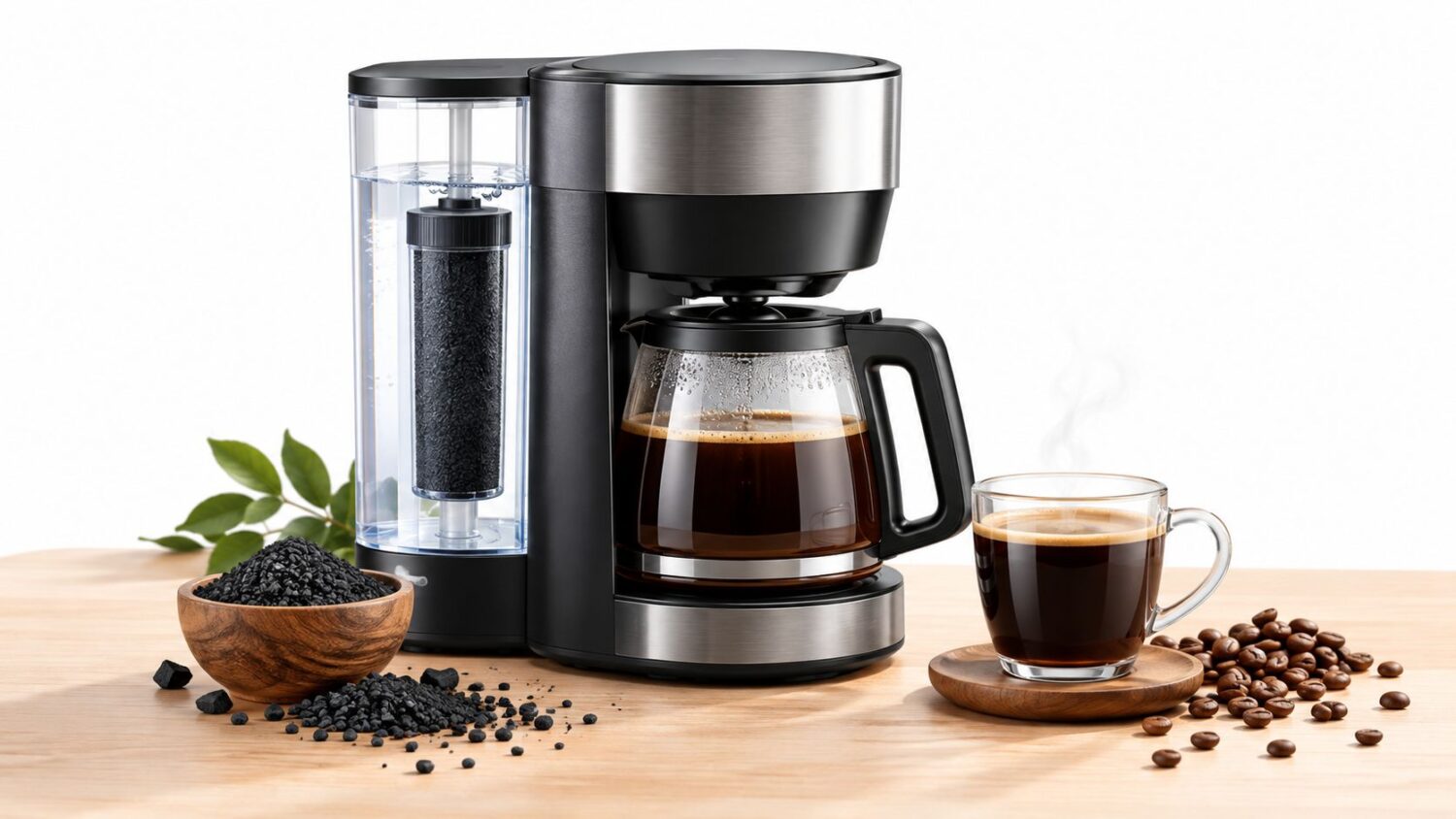
A charcoal filter can improve coffee water without making that water safe for every possible contaminant. That sounds counterintuitive, but it explains why some brewers notice a cleaner cup while still finding scale inside the machine. The useful question isn't whether a cartridge contains charcoal. It's which reduction claim the cartridge has been tested to support.
Activated carbon works mainly through adsorption. Dissolved substances adhere to the carbon's internal pore surfaces, so the cartridge can reduce chlorine, unpleasant tastes, odors, some pesticides, detergents, volatile organic chemicals, and certain other organic compounds. The U.S. Environmental Protection Agency's overview of drinking-water treatment technologies describes granular activated carbon as useful for taste- and odor-producing compounds, natural organic matter, volatile organic compounds, synthetic organic compounds, and disinfection-byproduct precursors, with performance depending on the contaminant and operating conditions.
Why Your Morning Coffee Tastes Off and the Filter You Forgot
You use the same beans, grinder, and coffee maker. Yet the cup tastes flat one morning, bitter the next, or faintly like a swimming pool. You check the usual suspects first: stale beans, an inconsistent grind, or water that isn't hot enough. Those details matter, but the water entering the brewer can change the result before the grounds have a chance to express their flavor.
Municipal water often contains residual chlorine or related compounds from disinfection. Even when the concentration isn't obvious to your nose, chlorine can react with organic coffee constituents and alter aroma and taste. A small charcoal cartridge in the reservoir gives that water another treatment step before it reaches the heating system and coffee bed.
Practical rule: Treat a coffee-machine charcoal filter as a brewing-water conditioner, not as a universal purifier.
The distinction prevents two common mistakes. You might blame good beans for a chlorine note that originates in the tap water. Or you might assume that a filter reducing chlorine also removes hardness minerals, bacteria, nitrate, or every contaminant that concerns you. It doesn't.
A filter also needs attention after installation. New carbon can release fines, exhausted carbon can lose effectiveness, and a cartridge that doesn't match the holder may leak or allow water to bypass the media. Guidance on coffee maker water filter replacement can help you build a simple replacement habit without treating every printed calendar reminder as a complete performance test.
The rest of the buying decision comes down to four questions: what does the filter reduce, which machine accepts it, how much water passes through it, and what certification supports the claim? Once those questions are clear, choosing between a branded cartridge and a generic insert becomes much less confusing.
How Activated Carbon Actually Cleans Brewing Water
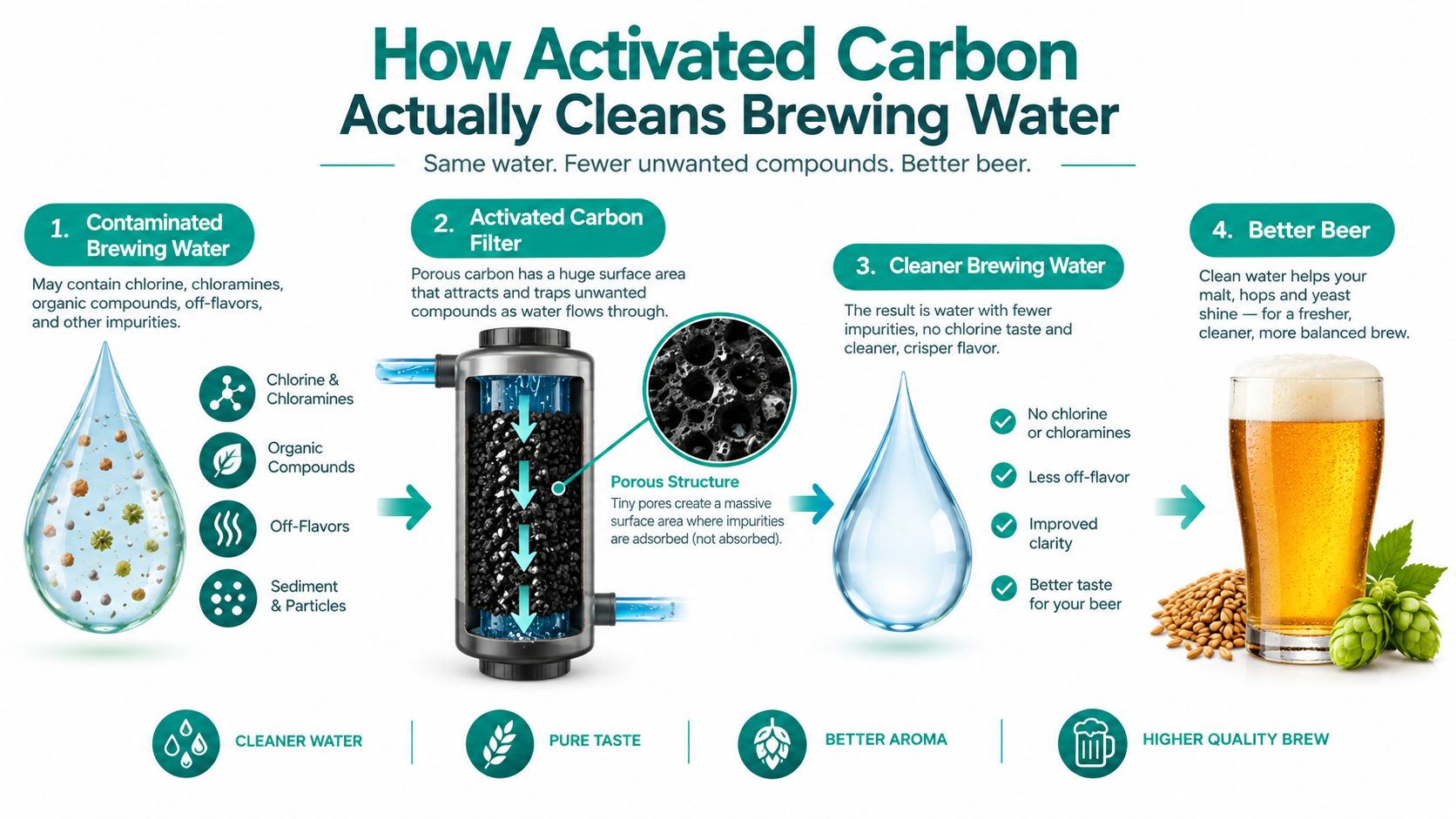
Activated carbon is carbon processed to create a large network of microscopic pores. Picture a sponge, but one that holds dissolved molecules against its internal surfaces rather than merely catching visible particles. Water flows through the carbon bed, and suitable substances attach to those surfaces through adsorption.
That mechanism explains both the appeal and the limits of coffee maker charcoal filters.
What the carbon captures
The University of Massachusetts guidance on activated-carbon treatment identifies chlorine, unpleasant tastes and odors, radon, detergents, pesticides, and volatile organic chemicals among the substances activated carbon can reduce. The result depends on the filter design, carbon quantity, water chemistry, flow rate, and contact time.
A cartridge doesn't remove a substance just because the label says “charcoal.” The carbon needs enough opportunity to contact the water, and its available adsorption sites eventually fill. A fast flow path or a small carbon bed can produce a different result from a deeper, slower cartridge, even when both use activated carbon.
What the carbon leaves behind
Activated carbon generally doesn't remove microbial contamination reliably. It also isn't a dependable method for removing sodium, nitrate, fluoride, or hardness minerals such as calcium and magnesium. University of Nebraska–Lincoln Extension's drinking-water guidance explains that activated carbon can reduce chlorine, some organic compounds, and taste- and odor-causing substances, while remaining ineffective against nitrate, many inorganic contaminants, and microbial contamination.
That distinction matters in a coffee maker. A cartridge can change the water's chemistry enough to improve aroma while leaving calcium and magnesium available to form scale. If you're comparing cartridge construction or learning how carbon media is used in a broader household system, a Living Water carbon filter cartridge offers useful product context. It still shouldn't be treated as evidence that every carbon cartridge has identical contaminant performance.
Three Real Benefits Charcoal Filters Deliver in a Coffee Maker
Charcoal filters are useful for specific water problems, not as all-purpose upgrades. In a coffee maker, their clearest benefits are reducing some chlorine-related taste, making brewing water more consistent, and supporting a cleaner maintenance routine. The right choice depends on your water, the cartridge design, and whether you will replace it as directed.
Chlorine reduction improves the starting water
The EPA identifies activated carbon as a treatment for certain taste- and odor-producing compounds and disinfection-by-product precursors. In coffee, that matters because chlorine-related compounds can compete with the aroma and flavor of the brew. Reducing part of that burden can soften a swimming-pool note and give the coffee more room to show its own character. The EPA treatment technology overview explains the treatment role, but it does not promise identical results from every small coffee cartridge.
Carbon performance depends on the cartridge and the way water passes through it. Contact time, carbon quantity, particle size, and flow path all affect the result. Under controlled conditions, one study reported up to 85% free-chlorine removal and an observed capacity of about 0.12 milligrams of chlorine per gram of carbon for non-acid-washed carbon. The reported study conditions describe that test setup, not a universal household-cartridge rating. A compact insert may contain less carbon and expose it to water for less time.
More consistent water can mean more consistent flavor
Tap water may change in chlorine character, organic content, and mineral profile. A carbon cartridge will not make every supply identical, yet it can reduce some compounds that contribute to odor and flavor. Your beans then start with a more stable baseline, making the same roast easier to recognize from one brew to the next.
The effect is sensory rather than magical. If the incoming water already tastes clean, the difference may be small. A Brita sensory impact paper on tap water and coffee connects tap-water characteristics with coffee's sensory result, which supports treating filtration as a water-quality decision rather than a guaranteed flavor upgrade.
Filtration and machine care do different jobs
A charcoal filter can improve the water entering the brewer, while descaling removes calcium and magnesium deposits that build up in heated parts. Those tasks overlap only in the maintenance schedule. A filter does not show that an aluminum boiler, seal, thermoblock, or pump can skip the manufacturer's cleaning instructions.
| Benefit | What changes in the water | Evidence or limitation |
|---|---|---|
| Chlorine and odor reduction | Activated carbon adsorbs suitable dissolved compounds that affect taste and smell | EPA treatment technology overview |
| More consistent flavor | Some variable taste- and odor-producing substances are reduced before brewing | Brita sensory impact paper |
| Cleaner maintenance routine | Lower chlorine-related exposure may support the brewing experience, while hardness minerals can still form scale | Filtration does not replace descaling |
The last row is a maintenance distinction, not a descaling promise. Choose a filter for the water problem it can address, then keep the brewer's cleaning routine separate.
When to Replace a Charcoal Filter and Why the Calendar Lies
A printed replacement interval is a useful starting point, but it isn't a chemical deadline. Carbon loses useful capacity as adsorption sites fill, and the rate depends on the water and the way the cartridge operates. A household that brews occasionally with relatively low-contaminant water places a different load on its filter from a busy kitchen or breakroom.
Three variables deserve attention:
- Total water volume: Every reservoir refill moves more water through the carbon bed and consumes more available capacity.
- Water chemistry: Chlorine, organic matter, hardness, and other constituents compete for treatment capacity. Hard water still creates scale even when the cartridge improves flavor.
- Flow and contact time: Faster flow gives water less time to interact with the carbon, while a deeper bed provides more media for adsorption.
The EPA's activated-carbon treatment guidance identifies contaminant type, carbon type, bed depth, flow rate, temperature, organic-matter concentration, and other water constituents as factors that affect removal. Its discussion of PFAS treatment also shows that different compounds can reach breakthrough at different points. That principle applies broadly, although a coffee cartridge isn't equivalent to a municipal treatment bed.
A soft-water household that brews two cups daily may find that taste remains stable for longer than a hard-water household running a Keurig repeatedly throughout the day. Neither household should guess indefinitely. Track tank refills, follow the cartridge's stated capacity, and replace sooner if the water develops an odor, the coffee loses its usual character, or flow changes.
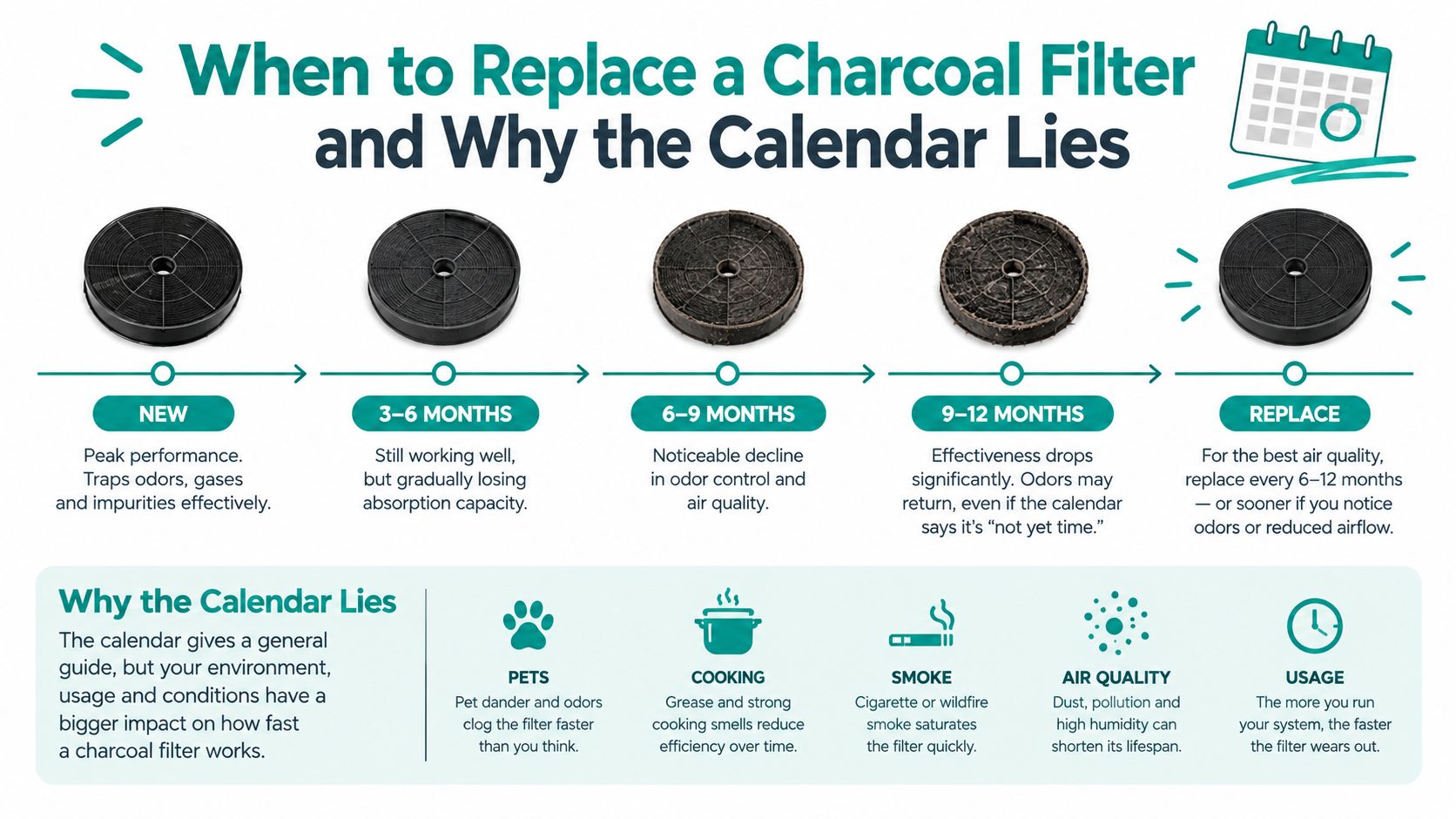
A practical replacement routine should combine the manufacturer's service limit with observations from your own brewer. The guide to charcoal water filter replacement is useful for recognizing the signs of exhaustion, but no calendar can account for every water source or usage pattern.
Which Charcoal Filters Fit Keurig, Ninja, Breville, and Cuisinart
Compatibility is a mechanical question before it becomes a filtration question. A cartridge may contain suitable carbon and still fail if it doesn't lock into the holder, seal against the reservoir, or leave enough room for water to pass through the intended path.
Start with the machine, not the product photograph. Look for the exact model number, reservoir filter holder, cartridge dimensions, and replacement-part reference in the brewer manual. Similar-looking Keurig, Ninja, Breville, and Cuisinart machines can use different holders, and some models may not include a charcoal-filter slot at all.
Keurig
Keurig owners should identify the model family and holder style before ordering. Names such as K-Classic, K-Supreme, K-Slim, K-Duo, K-Elite, and K-Cafe don't by themselves establish cartridge compatibility. Check whether the machine uses a reservoir-mounted handle, a dedicated insert, or no replaceable water filter holder.
A cartridge that floats loose can allow bypass or create leakage around the holder. Confirm the replacement part number and compare the holder shape rather than assuming that every Keurig water filter uses the same insert.
Ninja
Ninja machines also require model-level checking. A Ninja DualBrew may use a different reservoir arrangement from a Ninja Coffee Bar or another brewer in the range. The safest purchase path is to match the exact model listed by the seller with the model printed on your machine.
Breville
Breville owners should distinguish between a tank-mounted water filter and accessories intended for a different brewer component. Espresso machines can have precise holder dimensions, and a cartridge designed for one Barista-family machine may not seat correctly in another. If the manual doesn't list a replaceable reservoir filter, don't force an insert into the tank.
Cuisinart
Cuisinart sells brewers across drip, single-serve, and combination categories. Model names such as DCC-1200, SS-15, and SS-20 should be treated as search terms for verification, not as a guarantee that one generic cartridge fits every related machine. Check the manual, holder, and dimensions before checkout.
| Brand | Compatible Models | Filter Type | Replacement Notes |
|---|---|---|---|
| Keurig | Match the exact model and holder listed by the seller | Reservoir cartridge or model-specific insert | Confirm the holder style and part number |
| Ninja | Match the exact DualBrew, Coffee Bar, or other model | Model-dependent reservoir filter | Don't infer fit from the brand name alone |
| Breville | Check the specific espresso or drip model | Tank-mounted or model-specific insert | Verify that the machine includes a filter slot |
| Cuisinart | Confirm the exact DCC, SS, or single-serve model | Model-dependent charcoal cartridge | Compare dimensions and holder shape |
A buyer's main objection is usually simple: “Will it leak?” A correctly seated, compatible cartridge shouldn't be loose in the holder, but a wrong insert, damaged seal, or incomplete assembly can create a bypass or leak. Replace the part only after confirming the machine's exact compatibility.
Premium Filters vs Generic Inserts and What Certification Really Means
Two charcoal inserts can look nearly identical while making different claims. Carbon source, carbon quantity, bed design, flow path, preparation, and quality control all affect performance. The word “premium” doesn't prove superiority, and the word “generic” doesn't prove failure.
Certification gives buyers a more concrete way to compare products. NSF/ANSI Standard 42 addresses aesthetic effects such as taste and odor, while NSF/ANSI Standard 53 concerns certified reductions for specified contaminants with health effects. The relevant reduction claim must be named. A product certified for chlorine reduction shouldn't be assumed to reduce lead, PFAS, nitrate, or any other pollutant unless that specific claim appears in the certification listing.
NSF's consumer guidance on water-treatment standards explains that the United States has no federal regulations covering residential water-treatment filters, purifiers, and reverse-osmosis systems. Voluntary standards and protocols establish minimum safety and performance requirements, which makes claim verification especially important for small point-of-use cartridges.
Read the label like a buyer
Look for four details:
- Named contaminant: “Reduces impurities” tells you little. “Reduces chlorine taste and odor” is more useful.
- Relevant standard: NSF 42 and NSF 53 answer different questions.
- Rated capacity: Capacity connects the claim to a defined volume and operating condition.
- Exact model compatibility: A tested filter still has to fit your brewer correctly.
Activated carbon also has clear boundaries. It doesn't reliably remove calcium and magnesium, nitrate, fluoride, or microbial contaminants. Lead performance can depend on the carbon source and activation method, and other media may be needed for reliable lead control, as explained in Nebraska–Lincoln Extension's detailed carbon-filtration PDF.
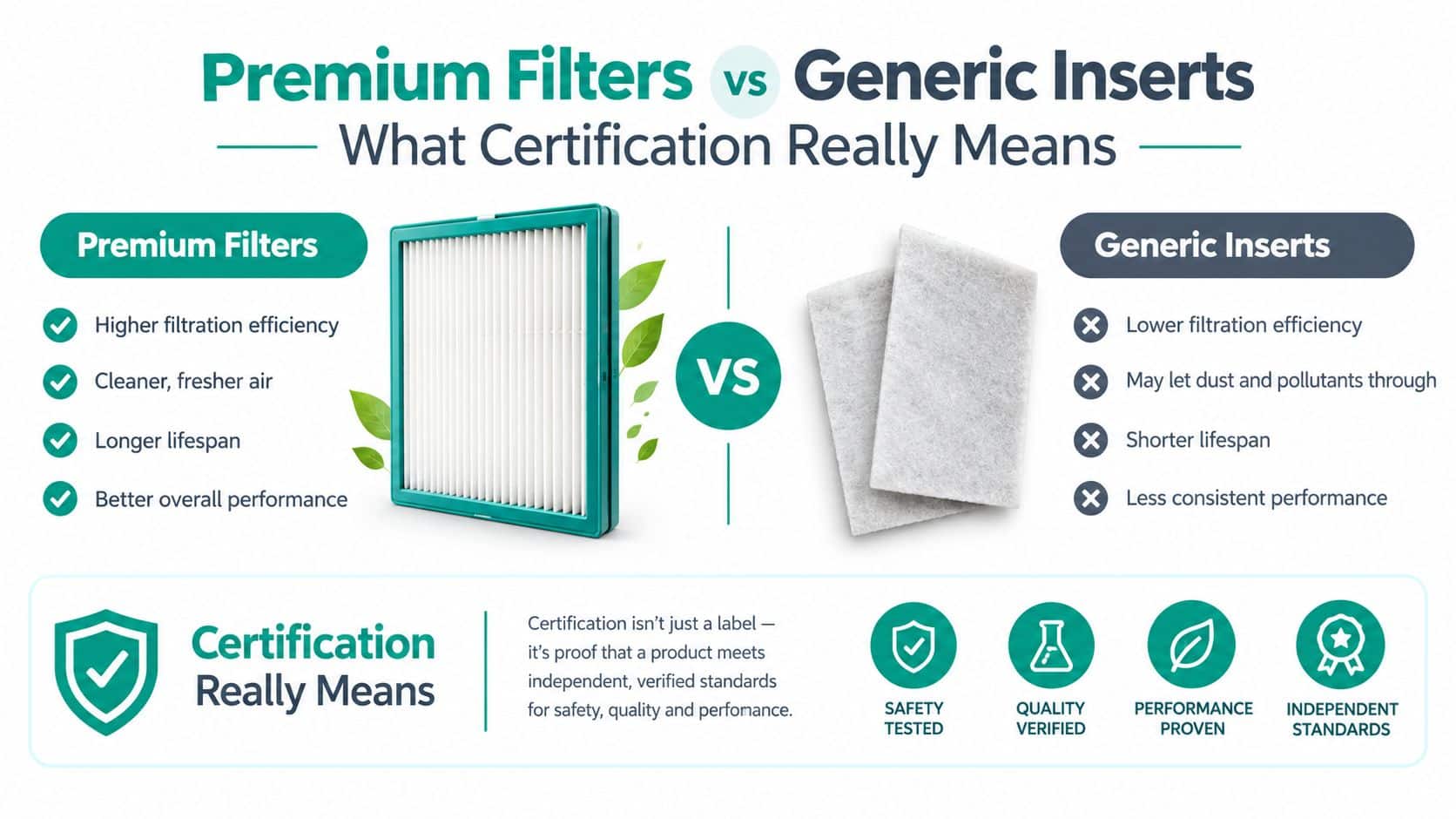
A premium cartridge can be worth considering when it provides clear material information, a documented reduction claim, reliable fit, and a capacity that matches your usage. A generic insert may be adequate when it makes the same verified claim and uses the same effective design. Neither type substitutes for an ion-exchange softener or reverse-osmosis system when hardness or a specific dissolved contaminant is the main problem.
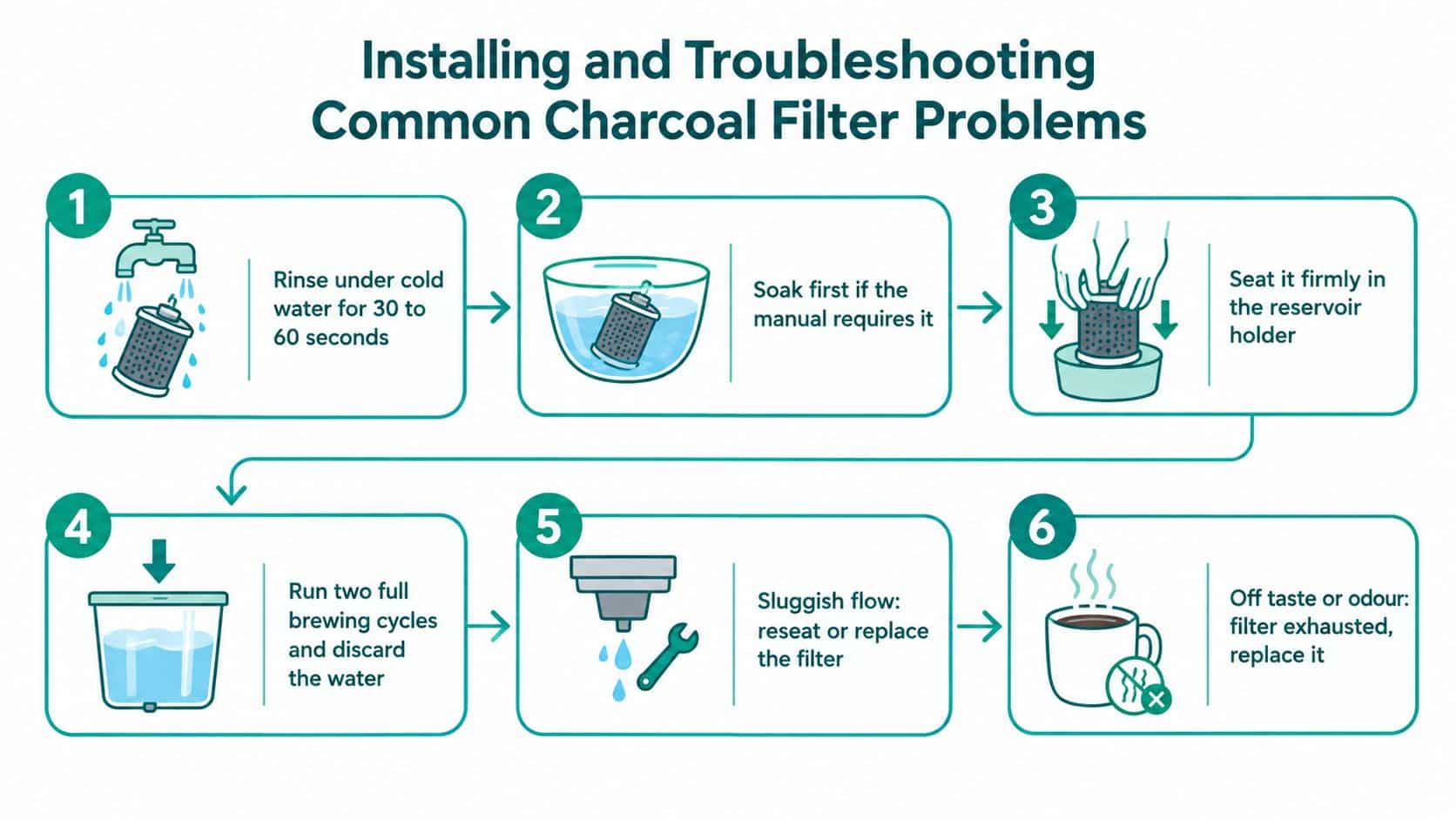
Installing and Troubleshooting Common Charcoal Filter Problems
A good cartridge can perform poorly if air, carbon fines, scale, or a loose holder interferes with water flow. Install it carefully, then treat the first brew as a rinse and fit check rather than a cup to drink.
- Rinse the cartridge under cold water for 30 to 60 seconds. This helps clear loose carbon fines from the surface.
- Soak it first when the machine manual calls for soaking. Some designs need wetting before they can pass water evenly.
- Seat it firmly in the reservoir holder. Press it into place and check that the holder closes without forcing it.
- Run the cleansing brew cycles required by the machine instructions. Discard that water before preparing coffee.
- Inspect the reservoir and holder for leaks. Water around the holder can indicate a mismatch, damaged component, or incomplete seating.
- Replace the cartridge when flow or taste shows exhaustion. A slow drip can also point to scale, air, or an internal blockage.
Fixing the complaints that appear most often
A floating or loose filter usually signals an incorrect cartridge or an incompletely assembled holder. Remove it, compare the part with the manual, and reinstall it without bending the housing.
A leak around the holder can come from an incompatible shape or a damaged seal. Don't solve it by pressing harder. Confirm the part number and inspect the holder for cracks or distortion.
Slow flow doesn't always mean the carbon is clogged. Mineral scale, an air pocket, or a dirty water path can create the same symptom. Descaling on the schedule the manufacturer recommends complements filtration because carbon doesn't remove the calcium and magnesium that form scale. The coffee maker water filter installation guide provides another practical checklist for seating and preparing a replacement.
A bitter or stale-tasting cup can indicate exhausted carbon, but it can also come from old coffee, grind changes, or a dirty brew path. Replace the cartridge if it has reached its capacity or the usual odor returns, then clean and descale the brewer as directed.
Your Charcoal Filter Decision Framework and Where to Buy
Choose the filter by answering four questions:
- What is your water source? Chlorinated municipal water makes taste and odor reduction a logical priority. A known concern about lead, nitrate, microbes, or another contaminant requires a separately certified treatment choice.
- Which brewer do you own? Match the exact Keurig, Ninja, Breville, or Cuisinart model and holder. Brand-level compatibility isn't enough.
- How much do you brew? More refills consume capacity faster. Use the cartridge's rated service limit and watch for changes in flavor or flow.
- Will you replace it on time? If you tend to forget dates, choose a cartridge with clear capacity information and keep a note on the reservoir or maintenance calendar.
For hard water, pair the charcoal cartridge with manufacturer-approved descaling supplies. Filtered water can taste cleaner while mineral scale continues to form inside the heater. If you also use reusable pods, keep a cleaning routine for the pod, basket, and brew path so coffee oils and fines don't create a problem that filtration can't solve.
PureHQ Inc. offers coffee-machine accessories including activated-charcoal replacement filters for selected Keurig, Breville, Ninja, and Cuisinart systems, along with reusable pods, descaling solutions, and cleaning tablets. Before buying, compare the exact model listing, stated reduction claims, capacity, return terms, and any certification information with the needs of your machine and water.
PureHQ Inc. provides replacement water filters and maintenance accessories for home and small-workplace coffee makers, including compatible options for selected Keurig, Ninja, Breville, and Cuisinart brewers. Visit PureHQ Inc. to match a charcoal filter to your machine and keep descaling and cleaning supplies on hand for a more consistent brewing routine.

