
Coffee Machine Care
Mastering Hamilton Beach Coffee Maker Pods
May
You bought a Hamilton Beach because it gives you options. One machine can handle pods, grounds, and in some models even more than that. Then you open the pod drawer or stand in the coffee aisle and encounter the main problem: which pods perform well in your brewer, and which ones just create weak coffee, leaks, or clogs?
That confusion is why so many people end up settling for whatever pod seems safest. It's convenient, but it also leaves flavor on the table and often creates more maintenance than people expect. If you want better coffee from hamilton beach coffee maker pods, the answer usually isn't buying more random disposables. It's understanding compatibility, brew flow, and when a reusable pod gives you more control with fewer headaches.
Why Finding the Right Hamilton Beach Pods is So Confusing
A Hamilton Beach owner usually starts with a simple question. “Will this pod fit?” Very quickly, that turns into three harder ones. Will it brew correctly, will it taste right, and will it cause a mess later?
That's the trap with flexible brewers. Hamilton Beach built the FlexBrew line to handle both single-serve pods and ground coffee, which is a major reason people buy it in the first place. And because Hamilton Beach sells approximately 34 million units annually across its broader household appliance portfolio, a huge number of households are dealing with the same pod confusion at the same time, as noted in this overview of the Hamilton Beach FlexBrew product line.
Too many choices, too little guidance
Walk into any store and you'll see branded pods, generic pods, “compatible” pods, compostable-style pods, and reusable inserts. The packaging often makes broad fit claims, but your machine doesn't brew based on packaging language. It brews based on how the pod sits in the chamber, how the top gets pierced, and how water moves through the coffee bed.
That's why two pods that look almost identical can behave very differently in the same brewer.
Here's what usually happens in real kitchens:
- Branded pods feel safer because they're built around the standard most brewers expect.
- Generic pods look like a bargain until one sits too high, punctures poorly, or drips around the edges.
- Reusable pods sound appealing but many owners worry they'll be messy or hard to dial in.
The frustration isn't just about fit. It's about not wanting to waste coffee, money, or a morning trying to troubleshoot a machine before work.
Why versatility creates uncertainty
Single-purpose brewers are simpler. A Hamilton Beach FlexBrew-style machine gives you more freedom, but that freedom puts more responsibility on the user. You have to match the pod system to the brewer's actual mechanics, not just its marketing label.
That's why hamilton beach coffee maker pods are confusing for so many people. The machine can do more, so the margin for bad pod choices gets wider too.
The practical fix is to stop asking which pod is cheapest or most common and start asking which option gives you the cleanest fit, the most predictable water flow, and the least maintenance burden over time.
Understanding Your Coffee Maker's Pod Compatibility
Pod compatibility starts with the brewer's engineering. If you understand that part, pod shopping gets much easier.
Hamilton Beach FlexBrew models are designed around the K-Cup® pod standard, and the brewer works within an optimal temperature range of 195°F to 205°F. The 1050-watt heating element brings an 8 oz. cup to temperature in approximately 2 minutes, according to the official Hamilton Beach FlexBrew Universal Coffee Maker 49930 specifications. That means your pod has to do more than fit physically. It has to let water move through at the rate the machine expects.
What the machine is actually doing
When you close the brew head, the machine positions the pod so the puncture point and chamber line up correctly. Then the brewer sends hot water through the pod under a controlled flow path. If the pod wall is too rigid, too soft, too tall, or shaped slightly wrong, extraction suffers.
Common results include:
- Weak coffee because water passes too quickly.
- Overflow around the pod because the seal isn't right.
- Partial puncture or clogging because the top material doesn't behave as expected.
A lot of users think compatibility is binary. It isn't. A pod can “fit” and still brew badly.
Why slight pod differences matter
Third-party pod makers don't all use the same lid material, rim shape, or cup depth. Those small design changes affect how the needle punctures the pod and how evenly the water spreads through the grounds.
That's why the safest rule is simple:
Practical rule: If a pod doesn't seat cleanly, close smoothly, and brew without sputtering or side leakage, don't keep testing it just because the box says “compatible.”
Reusable pods change the equation because you're no longer relying on a random disposable pod manufacturer to get every dimension right. You're working with a fixed basket that you control, plus your own coffee and grind.
What this means when you're choosing pods
If you're deciding between pods and refillable options, it helps to understand the broader brewing trade-offs in this guide to pod vs K-Cup differences. The short version is that your brewer rewards consistency. Any option that gives you a stable fit and repeatable flow will usually outperform an inconsistent cheap disposable.
Use this checklist before you commit to any pod style:
- Check the seating first: The pod should sit flush without forcing the lid.
- Watch the first brew: If liquid escapes around the pod area, stop using that style.
- Pay attention to cup strength: Thin coffee often points to poor flow control, not just weak beans.
- Treat “compatible” as a starting point: It isn't proof of good extraction.
The machine already knows how to brew. Your job is to give it a pod that doesn't interfere.
A Head-to-Head Comparison of Your Pod Options
Pods are often compared incorrectly. The comparison often focuses on shelf price. What matters more is how they brew, how often they create cleanup, and how much control you get over the cup.
Troubleshooting guides regularly tell users to stick to recommended or compatible K-Cups to avoid clogs, but they usually stop there and don't explain which third-party or reusable options are worth trying. That gap is one reason hamilton beach coffee maker pods remain confusing for buyers who want less waste without risking machine issues, as described in this FlexBrew troubleshooting discussion.
The real trade-offs
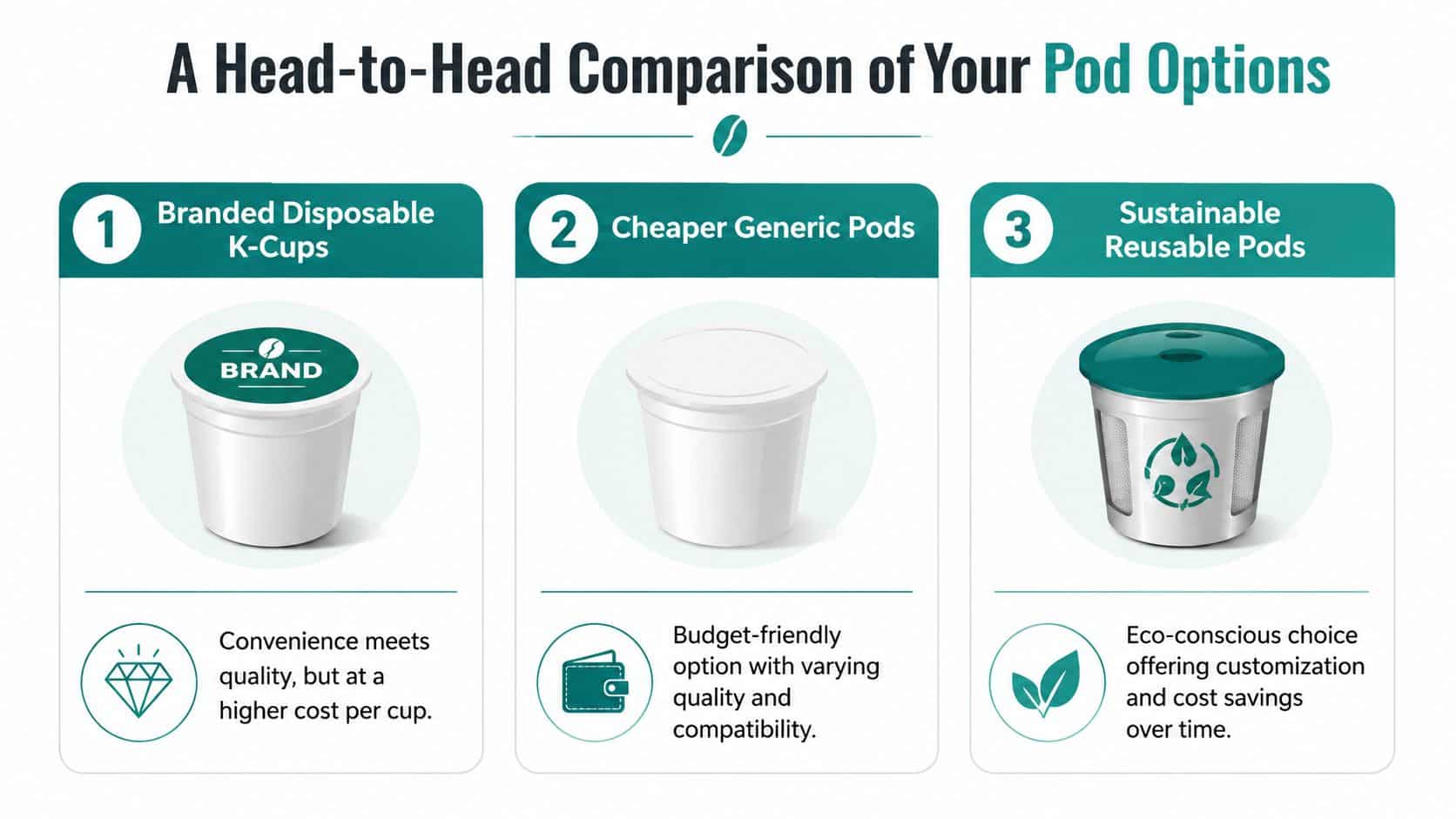
Branded disposable pods are usually the most predictable. Generic disposable pods are where most fit problems start. Reusable pods require a little setup, but they give you control over grind, fill level, and coffee quality.
If you want a broader flavor discussion, this breakdown of coffee pods vs ground coffee is useful because it highlights why fresh grounds often produce a more satisfying cup when the brewer can handle them well.
Pod Comparison Single-Use vs. PureHQ Reusable
| Feature | Branded K-Cup® Pods | Generic Disposable Pods | PureHQ Reusable Pods |
|---|---|---|---|
| Fit consistency | Usually predictable in K-Cup designed brewers | Varies more from brand to brand | Depends on choosing the correct pod design and inserting it properly |
| Flavor control | Limited to what's packed inside | Limited, with uneven results between brands | Full control over bean choice, roast, and grind |
| Waste | Creates single-use pod waste | Also creates single-use pod waste | Reusable format reduces throwaway pod use |
| Mess potential | Low during use | Can leak or overflow if tolerances are off | Low once fill level and grind are dialed in |
| Clog risk | Moderate if pod lid residue builds up over time | Higher when pod materials or dimensions are inconsistent | Lower when the pod is well designed and cleaned properly |
| Coffee freshness | Fixed at packaging | Fixed at packaging | Depends on the coffee you load before brewing |
| Long-term value | Convenient but ongoing repurchase cycle | Lower upfront cost, less predictable results | Better for repeated daily use if you want control and less waste |
The biggest objection to reusable pods
Those who resist reusable pods often voice similar concerns. They're worried about leaks, grounds in the cup, or a weak brew.
Those problems do happen, but they usually come from one of three mistakes:
- Using the wrong grind
- Overfilling the pod
- Using a poorly made reusable basket
A good reusable pod shouldn't need to be packed tightly. It also shouldn't wobble, sit crooked, or require forcing the lid closed. If it does, the issue isn't “reusable pods” as a category. It's that specific pod design or the way it's being filled.
Reusable pods work best when you treat them like a brew tool, not like a trash bin you stuff with as much coffee as possible.
What works and what doesn't
What works
- Fresh coffee with a medium grind
- Filling the pod below the rim
- A pod that seals cleanly in the chamber
- Rinsing the pod right after brewing
What doesn't
- Fine espresso grind in a single-serve reusable pod
- Overpacked coffee that restricts water flow
- Cheap disposable pods with inconsistent foil or rim shape
- Ignoring leaks and continuing to brew anyway
For most serious home users, the best path is simple: keep a few branded pods on hand if you want absolute convenience for guests, but use a quality reusable pod for your normal daily coffee. That setup gives you better flavor control, less waste, and fewer surprises than rolling the dice on random generics.
How to Brew the Perfect Cup with a Reusable Pod
A reusable pod only performs as well as the person filling it. The good news is that the learning curve is short. Once you dial in grind and fill level, the process becomes routine.
Start with the right coffee and grind
The first mistake is using coffee that's too fine. Fine grind slows the water too much and can leave you with bitterness, drips, or stray grounds. Very coarse grind does the opposite and produces a thin cup.
For most Hamilton Beach single-serve brewing, a medium grind is the sweet spot. It gives the machine enough resistance for extraction without choking the flow.
Fill for flow, not for maximum capacity
Open the reusable pod and add grounds until the basket is full but not crowded. Level the coffee gently. Don't tamp it down.
That last part matters. A single-serve brewer isn't an espresso machine, and packing the grounds creates the wrong kind of resistance.
Use this sequence:
- Add medium-ground coffee to the pod.
- Level the top lightly with a finger or spoon.
- Leave a little headspace so the lid can close without compressing the bed.
- Insert the pod evenly so it sits square in the holder.
- Choose an appropriate cup size rather than the largest size every time.
If you want a deeper walkthrough on dialing in taste and basket performance, this guide on better taste and performance with reusable K-Cups covers the same core habits that matter here too.
Match the brew size to the pod load
A lot of “reusable pod failures” are really brew-size mistakes. If you load a moderate amount of coffee and then ask the machine for a very large cup, the result gets watery. The machine didn't fail. You diluted the extraction.
Use the smaller cup setting first when you're dialing in a new coffee. It's easier to expand from a strong baseline than to rescue a weak brew.
A simple repeatable method
Here's the reliable everyday routine I recommend:
- Pick one coffee first: Don't troubleshoot pod fit and bean choice at the same time.
- Brew the same cup size for a few days: Consistency makes it easier to judge changes.
- Adjust one variable only: Either grind, fill level, or cup size.
- Rinse immediately after brewing: Dried coffee oils make the next brew less predictable.
Done right, a reusable pod gives you something disposable pods can't: the ability to tune the cup to your taste instead of accepting whatever roast and dose someone sealed months ago.
Keep Your Coffee Great with Essential Maintenance
You brew a cup that tasted rich all week, then one morning it turns flat, a little hotter, and slightly bitter. On Hamilton Beach pod machines, that swing often comes from buildup, not the coffee itself. Reusable pods make this easier to catch because you are working with fresh grounds and a more exposed brew path.
Features like a programmable timer add convenience, but water left sitting in the machine can leave more mineral residue behind over time. Hamilton Beach FlexBrew models often include a 24-hour programmable timer and 2-hour auto shutoff, and regular cleaning matters if you want stable temperature and steady flow, as shown in this FlexBrew cleaning video discussion.
Why maintenance matters more with reusable pods
Reusable pods are the better long-term option. They cost less per cup, create less waste, and let you choose fresher coffee. They also ask a little more from you.
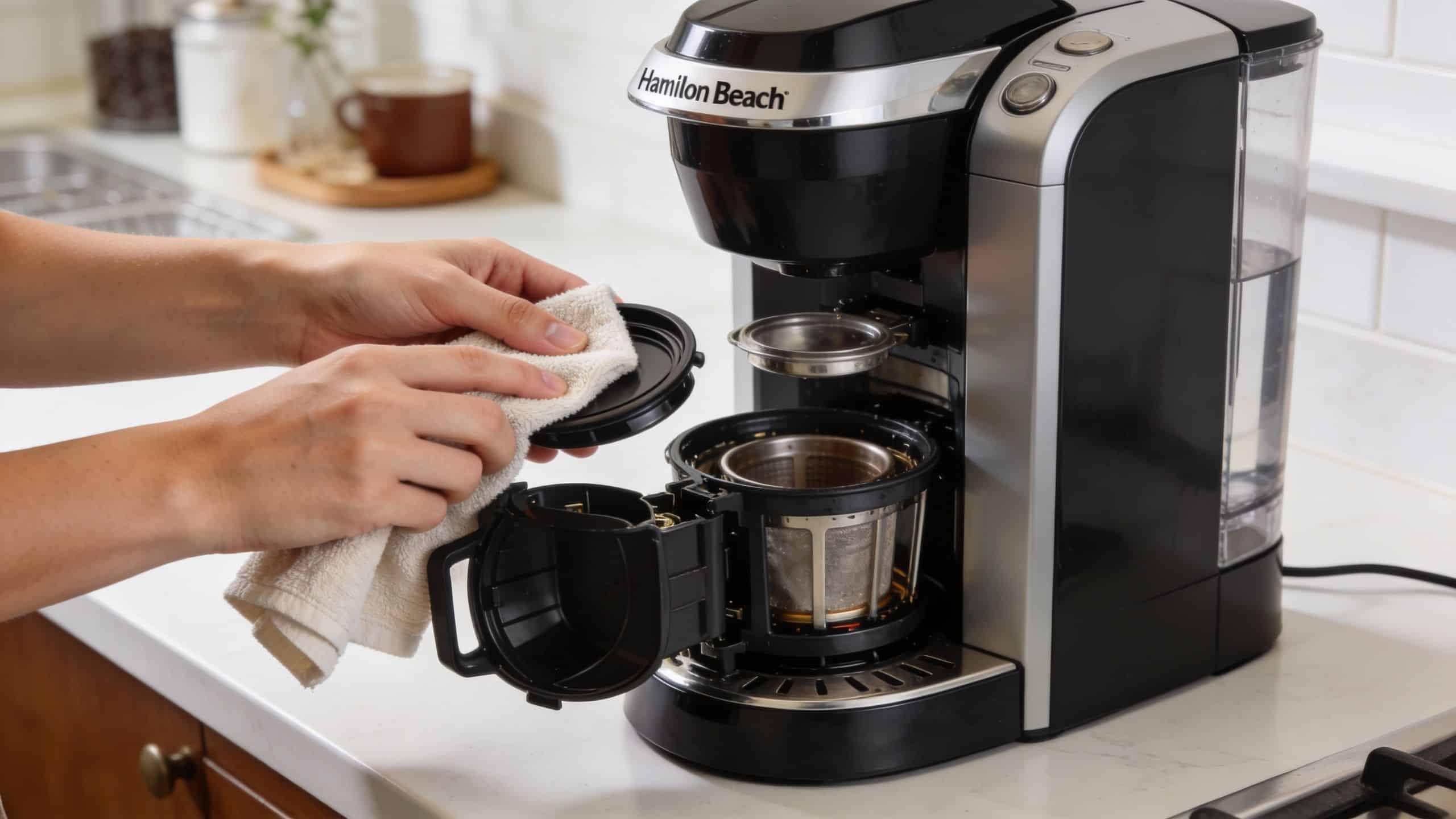
Coffee oils collect on the mesh, fine particles settle around the pod seat, and scale forms inside the brewer if your water is hard. Ignore those three areas and the machine starts to brew inconsistently. Flavor drops first. Flow problems usually follow.
Pay closest attention to these spots:
- The pod holder and surrounding chamber
- The puncture area and brew path
- The drip tray
- The water reservoir
- Any removable basket or insert used with grounds
A routine that actually keeps the cup consistent
Complicated cleaning schedules do not last. Short routines do.
After daily use
- Rinse the reusable pod right away: Dried grounds and oil residue are harder to remove later.
- Wipe the brew area: This stops residue from collecting around the holder and lid.
- Refresh leftover water when practical: Stale reservoir water is never good for taste.
On a regular cleaning cycle
- Wash removable parts fully: Warm water and a complete dry are usually enough.
- Descale the machine: If brewing slows down or your water is hard, do this sooner rather than later.
- Inspect the pod seat and puncture area: Small deposits here can cause poor flow, splashing, or weak extraction.
PureHQ Inc. sells descaling solutions, cleaning tablets, and reusable coffee accessories, which is useful if you want one maintenance routine for both pod brewing and machine care. For a broader machine-care checklist, this guide to coffee maker maintenance covers habits that apply well to any single-serve workflow.
Clean before flavor drops
A lot of owners wait until the machine starts spitting, slowing down, or brewing weak coffee. That approach costs you twice. The coffee tastes worse before the issue becomes obvious, and residue is harder to remove once it has baked on or narrowed the water path.
This walkthrough shows the kind of cleaning process users often need to perform once buildup has started:
Clean machines are easier to diagnose. If the brewer is clean and the cup still tastes wrong, you can focus on pod fit, grind, or brew size instead of guessing.
That is one reason reusable pods are the smarter choice. They give you better control over flavor, but only if the machine stays clean enough to brew consistently.
Troubleshooting Common Hamilton Beach Pod Issues
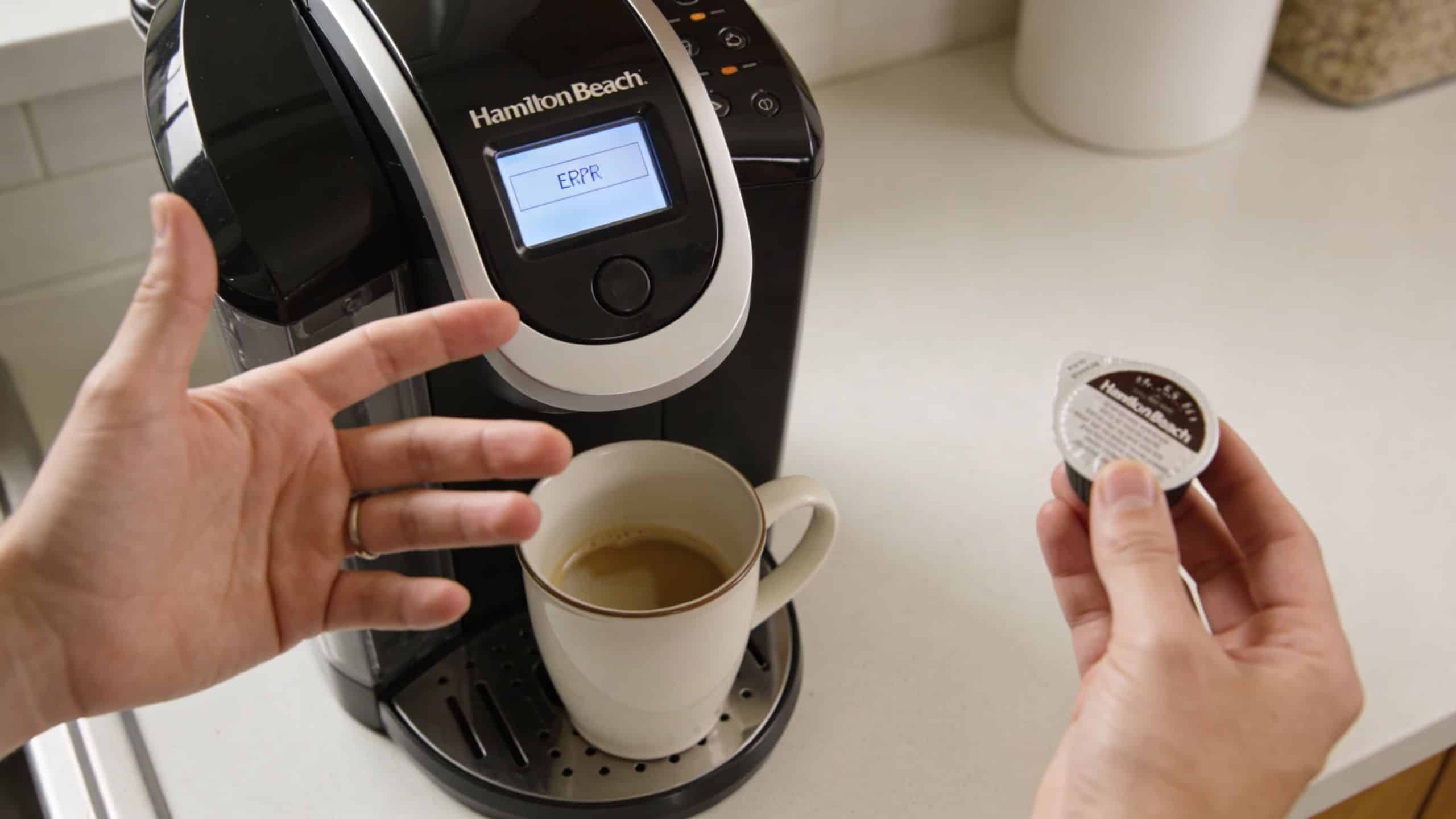
When a Hamilton Beach starts brewing weak coffee, spitting grounds, or flashing an error, the cause is usually less mysterious than it seems. Most of the time, the problem comes down to pod choice, grind choice, or skipped cleaning.
A very common maintenance task on FlexBrew machines is manually clearing a clogged needle with a paper clip, and that clog is often linked to residue from disposable pod lids or the wrong coffee grind, as shown in this Hamilton Beach FlexBrew needle-cleaning video.
Weak or watery coffee
This usually points to one of two issues. Either the pod isn't controlling water flow properly, or the brew size is too large for the amount of coffee being used.
Try these fixes:
- Switch away from suspect generic pods: If the cup suddenly improves, the pod design was the issue.
- Use a medium grind in your reusable pod: Too coarse often tastes flat.
- Brew a smaller cup size first: Then adjust upward only if the coffee stays strong enough.
Grounds in the cup
Grounds almost always mean the coffee is too fine, the reusable pod was overfilled, or the basket wasn't rinsed clean after the previous brew.
Check the simple stuff first:
- Reduce the fill level slightly
- Use a less powdery grind
- Inspect the pod lid and mesh before brewing again
Leaks, splashing, or error messages
Leaks around the brew head usually mean the pod isn't seated correctly or the puncture area is partially blocked. Error messages can also appear when the machine senses poor flow.
Use this order:
- Remove the pod and inspect for deformation.
- Clean the needle area carefully.
- Rinse the pod holder.
- Run a water-only cycle.
- Retry with a properly filled reusable pod or a known-good standard pod.
If a machine works with one pod type and fails with another, believe the evidence. Don't keep forcing an incompatible pod just because it was cheap.
Reliable coffee comes from treating pod choice and maintenance as one system. Choose a pod that fits cleanly, fill it correctly, and keep the brewer clean. That combination solves most Hamilton Beach brewing problems before they start.
If you're ready to stop guessing which hamilton beach coffee maker pods will brew well, shop PureHQ Inc. for reusable pod options and coffee machine maintenance accessories that can help you brew cleaner, reduce waste, and keep your machine working the way it should.

