
Coffee Machine Care
Bulk Water Filters: A Practical Guide for Coffee & Home
Jul
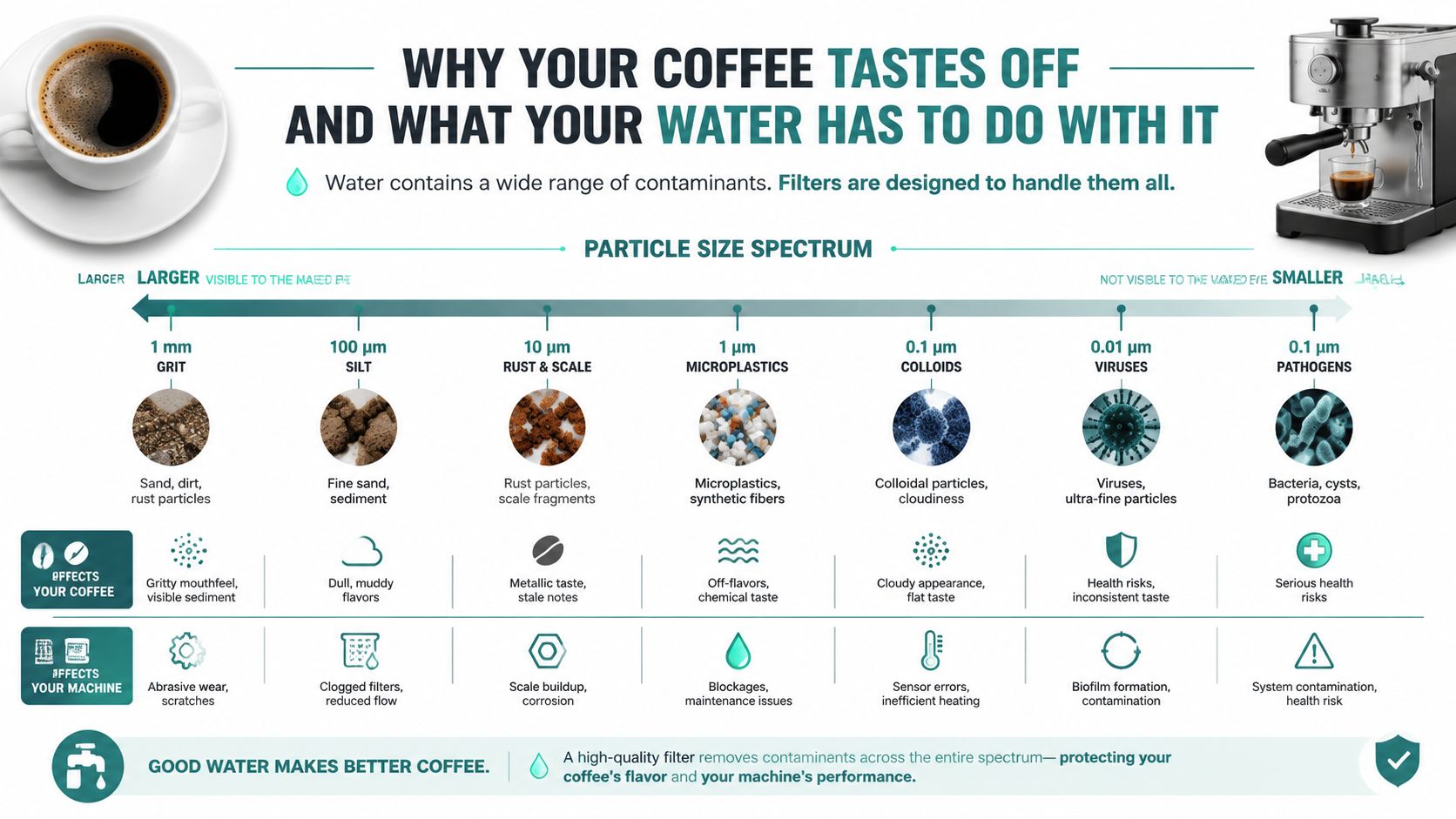
The hardest part of choosing bulk water filters is not the cartridge size or the brand, it's the water itself. Filtration systems are asked to separate everything from grit around 1 mm down to pathogens around 0.1 µm or smaller (Filtsep), and that spread is wide enough to change how coffee tastes, how a machine ages, and how often you end up descaling it.
A café can hide bad water behind milk and syrup. A home brewer can't. If the water coming out of the tap carries sediment, chlorine, odor, or scale-forming minerals, your cup tells on it fast, and the machine does too. The CDC makes the distinction clear, some filters are built mainly to improve taste and smell, while others are meant to address specific safety concerns, and carbon pitcher or refrigerator filters are usually about flavor first, not broad safety claims (CDC).
That's why the right buying decision starts with water-quality matching, not a logo on the box. If you want better coffee and fewer appliance headaches, you need to know what's in your water, what your machine expects, and which filter media handles that problem. For a practical companion to machine care, the guide on cleaning drip and Keurig machines is a useful read once the water side is sorted, and the replacement guidance in the coffee maker water filter replacement guide helps you keep the routine simple.
Why Your Coffee Tastes Off and What Your Water Has to Do With It
The first clue is usually the cup, not the machine. Coffee can taste flat, sharp, or vaguely stale when the water carries the wrong balance of minerals, odor compounds, or sediment, and the brewer often follows with slow flow, scale, or clogged internals. In a house or office where several people make coffee every day, those problems stack up quickly because the water is the ingredient that shows up in every single brew.
Water quality is part of the recipe
A lot of people treat water like a neutral solvent. It isn't. Water can carry suspended particles, dissolved chemicals, and microscopic contaminants, and the filtration job changes depending on which one you're trying to control. That's why a filter that only improves taste and odor can still leave a safety issue untouched, and why a bulk buyer should separate flavor goals from health or contamination goals before ordering cartridges.
Practical rule: if you don't know what's in the water, you don't really know what filter you need.
That's especially important for coffee makers because the machine doesn't care whether the problem is taste or scale. It just sees water passing through valves, heaters, and narrow lines. If the source water is rough, the machine often needs more cleaning, and if the source water is odor-heavy, even a good roast can come out muted.
A simple mental model helps. Sediment affects clarity and flow. Carbon affects taste and smell. Scale affects hardware. Once you think in those categories, bulk water filters stop feeling vague and start feeling like a practical utility item, the same way a brewer thinks about grain crush, water chemistry, and temperature control.
For many home brewers, the biggest mistake is buying a replacement filter for a machine before checking the water report. That's backwards. The better sequence is source water first, machine second, cartridge third. If the water is already clean enough for the intended use, a modest taste-and-odor filter may be enough. If the report or testing suggests more serious contaminants, the cartridge choice needs to reflect that before the first cup is brewed.
What Bulk Water Filters Actually Are and the Main Formats
A bulk water filter is a replaceable filter or filter system meant for repeated use, higher throughput, or longer service life than a small pitcher cartridge. In plain English, it's the kind of filter you buy for ongoing service, not for a one-off jug on the counter. That can mean a fridge cartridge, an under-sink module, or a large-format replacement for a coffee machine or ice system.
The formats buyers actually see
The most familiar version is the inline refrigerator-style cartridge. It sits inside a fridge, sink line, or appliance feed and handles steady water use. Buyers choose this format when they want cold filtered water or when an appliance expects a cartridge hidden in the water path.
The second format is the under-sink module, which may feed a separate faucet or an appliance line. This is the right shape when a household wants filtered water at the sink, or when a coffee bar, breakroom, or multi-unit kitchen needs a more centralized solution. Under-sink systems also make sense when water volume is high enough that a small pitcher would become annoying within a few days.
The third format is the large-capacity replacement cartridge used in coffee equipment, ice makers, and similar systems. This is where the “bulk” idea really shows up in daily use. UNICEF's product guidance for household filters gives a practical benchmark for throughput, saying a filter should deliver at least 20 L in 12 hours, with an ideal performance of 0.5 L/min, and should have a minimum treatment capacity of 4,500 to 5,000 L for a family of five over one year (UNICEF). That doesn't mean every coffee filter must match those exact numbers, but it does show why high-volume users need a different class of product than a pitcher cartridge.
A good bulk filter isn't just “bigger.” It's built for repeatability, service life, and a water path the machine can actually tolerate.
That's the test I'd use when scanning a product page. If the listing talks about flow path, cartridge life, or appliance compatibility, you're likely looking at a true bulk format. If it only talks about convenience and a single jug, you're not.
Filter Media Explained and How to Match Media to the Water You Have
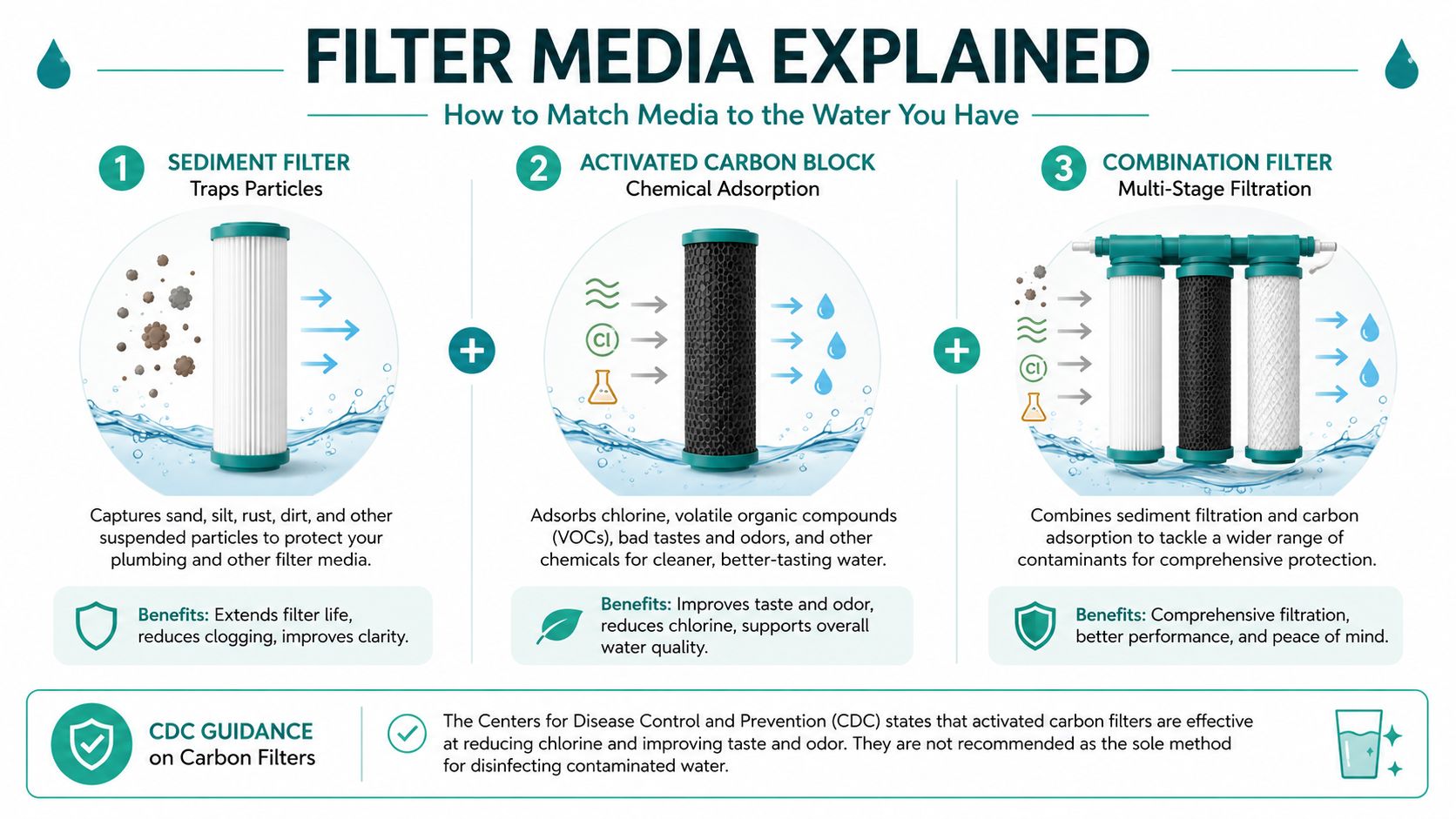
The media inside the filter matters more than the plastic shell around it. For coffee and appliance use, the three media buyers most often run into are sediment, activated carbon, and multi-stage combinations. Each one does a different job, and mixing them up is where many disappointing purchases begin.
Sediment first, then everything else
Sediment filters catch visible or suspended particles. In older buildings, homes on disturbed lines, or properties using well water, a sediment pre-filter can protect the downstream cartridge and slow down clogging. That matters because a cartridge that loads up too fast reduces flow and shortens service life, which means the “cheap” option can become the more expensive one once replacements pile up.
Activated carbon works differently. The CDC explains that carbon-based point-of-use filters are mainly used to improve taste and smell, and that their actual removal performance depends on the contaminant and the product's certified claims (CDC). In other words, carbon doesn't magically remove everything. It works by adsorption, which means dissolved organics and odor-causing compounds stick to the media surface rather than being physically strained out. That's why a generic carbon cartridge can be helpful for chlorine taste but still be the wrong answer for a home that needs a certified chlorine-and-lead solution.
Match media to the water report
A municipal consumer confidence report, or a basic water test, gives you the starting point. If sediment is the issue, lead with a sediment stage. If taste and odor are the complaint, carbon makes sense. If both are present, a multi-stage setup usually fits better than a single cartridge. The useful habit is to map the contaminant to the media, not the brand to the machine.
If the filter's claim is broad but the certification is narrow, trust the certification.
Softening and scale-reduction media sit in a separate bucket. They matter when hard water is the reason coffee gear keeps needing service, because scale doesn't just affect flavor, it changes how heating elements and valves behave. That connection becomes important later when you compare filter changes with descaling frequency, since one handles what enters the machine and the other handles what builds up inside it.
Premium Versus Generic Bulk Filters at a Glance
The market is clearly not flat or stagnant. The global bulk filtration market moved from USD 12.97 billion in 2024 to an expected USD 18.65 billion by 2030, implying about USD 5.68 billion in added market value and a 6.08% CAGR from 2025 to 2030, while a separate estimate places it at USD 15.64 billion in 2025 and USD 16.70 billion in 2026 with a 6.8% CAGR (TechSci Research). In the broader water filters market, sales were estimated at USD 15.96 billion in 2025 and projected to reach USD 27.36 billion by 2034, with a 6.17% CAGR from 2026 to 2034, while another forecast puts the market at USD 16.16 billion in 2024 and USD 33.96 billion by 2033 (Straits Research). That scale means buyers have real options, not just one standard cartridge dressed up in different packaging.
Premium vs Generic Bulk Water Filters
| Factor | Generic Single-Stage | Premium Multi-Stage |
|---|---|---|
| Certified contaminant list | Often narrow, sometimes focused on taste or sediment only | Usually broader, with specific claims tied to certifications |
| Micron rating | May rely on a nominal rating, which can be less strict | More likely to publish an absolute rating when fine particle protection matters |
| Flow in a coffee machine | Can be fine at first, then drop as the media loads | Better engineered for steadier flow across more use |
| Service life | Usually shorter and less predictable | Usually longer and easier to plan around |
| Compatibility confidence | “Fits many models” can hide tolerance issues | More often tied to model lists and documented fit |
| Best use case | Basic taste improvement or low-risk water | Higher-volume homes, offices, and machines with stricter needs |
The key row for coffee drinkers is the micron rating. The EPA says point-of-use filters should remove particles 1 micron or less in diameter, and consumers should look for an absolute 1-micron rating, not a nominal one, for Cryptosporidium protection (EPA). That doesn't mean every coffee setup needs that level, but it shows why the fine print matters when a filter is doing more than improving flavor.
A useful objection to raise is softener service. If your water is already softened or your scale problem is tied to a worn softener, a resource like softener repair by Stultz Plumbing can help you separate a filter problem from a water-treatment problem before you keep buying the wrong cartridge.
Matching Bulk Filters to Keurig, Ninja, and Breville Systems
Coffee machines don't all ask for the same water strategy. Keurig brewers often use charcoal-style water filters in the reservoir, while Ninja DualBrew systems and similar pod-and-carafe machines may use their own compatible cartridges or external filtration approach. Breville and other espresso machines usually care most about hardness and scale, because heated water under pressure exposes mineral buildup fast.
Start with the machine, then check the water
Keurig owners should verify the exact line first. The relevant models in this conversation are K-Classic, 2.0, K-Supreme, K-Slim, and K-Duo. If the brewer expects a charcoal filter, a bulk purchase makes sense when you're servicing several machines in a home or office, because the same replacement pattern repeats and you don't want to reorder every month. The internal guide on Best Water Filter for Espresso Machine is useful if your setup leans toward espresso rather than drip.
Ninja DualBrew users should check whether the machine uses a cartridge in the reservoir, a plumbed connection, or a different water path altogether. The important point is compatibility, not brand loyalty. A filter that fits loosely can let water bypass the media, and that gives you the worst of both worlds, filtered water on paper and untreated water in practice.
Breville owners should think about hardness first. Espresso machines heat water aggressively, so scale becomes the slow thief. That's why filtered water and descaling aren't duplicates, they're partners. One reduces incoming minerals and odors, the other removes what's already built up inside.
A machine can be perfectly clean on the outside and still be full of scale on the inside.
For upkeep, descaling tablets and cleaning tablets belong in the same shopping basket as the filter when the brewer sees daily use. If you replace cartridges but never clear internal deposits, the machine still loses performance over time. If you descale but skip filtration, you keep feeding it the same problem water again and again.
Buying in Bulk Without Buying the Wrong Thing
The objections buyers raise are usually practical, and they're valid. A cartridge that leaks because it isn't seated correctly wastes water and creates a mess. A “compatible” third-party part can be fractionally off and still feel wrong in the housing. Thin plastic housings can crack sooner than expected. And nobody wants a multi-pack that sits on a shelf until the model changes.
What to check before a case pack leaves the cart
- Model-by-model compatibility: Make sure the product lists your exact brewer or housing model, not just a similar family name.
- Certification claims: Look for the specific certification language tied to the contaminant you care about, not a vague “improves water” promise.
- Micron language: Prefer absolute ratings when fine particulate protection matters, especially if contamination sensitivity is part of the purchase.
- Date or lot coding: Buy from sellers who can show a current production run, not mystery stock.
- Storage conditions: Keep unopened cartridges dry, cool, and away from direct heat or sunlight.
- Housing quality: Check whether the shell feels sturdy enough for repeated swaps, especially in office or small-business use.
If you're buying for coffee, reusable accessories often belong in the same order. Refillable pods and reusable K-Cups make sense for bulk buyers because they already think in cycles of use, cleaning, and replacement. That's where the whole maintenance habit becomes easier to keep up.
The other objection is fit. It sounds small until a filter wobbles in the housing or doesn't seal fully. In practice, that can mean reduced performance or a leak, which is why a premium filter often wins on confidence rather than raw price alone. The more repeatable the fit, the less time you spend troubleshooting a machine that should've just brewed.
Installation, Soaking, and Replacement Best Practices
New carbon cartridges can release fine black dust at first, so soaking and flushing matter. If a filter needs pre-soaking, treat that as part of the install, not an optional extra. The goal is simple, clear the initial fines, seat the cartridge correctly, and let the water run long enough that the first cup doesn't taste like packaging.
The mechanical habits that prevent headaches
Start by checking the housing threads and the seal. Cross-threading an inline housing or forcing a cartridge into the wrong orientation causes the kinds of leaks that make people blame the product when the issue is installation. If the fit feels tight, stop and realign it instead of muscling it in.
Then watch the flow after the first flush. Slow flow can mean a clogged pre-filter, a cartridge that's loaded early, or an air pocket that hasn't cleared. A sudden taste shift near the end of service life usually means the media is spent, not that the machine is broken. And if the flow seems sputtery after a swap, you may just be dealing with trapped air.
For step-by-step visuals, the how to install water filters guide can help if you want a more detailed walk-through before you touch the housing.
The easiest replacement habit is still the calendar. Mark the first swap date the day you install the cartridge, then stick with it. That's a lot safer than guessing based on taste, because by the time taste changes, the filter may already be past its useful window.
Filter changes and descaling should run together. The filter handles the incoming water, while descaling tablets or solution handle the mineral residue inside the machine. If you keep both routines steady, you protect flavor, flow, and warranty coverage far better than if you rely on one cleanup step alone.
Shop Bulk Filters and Quick Answers to Common Questions
If you want cleaner-tasting coffee and a simpler maintenance routine, shop the bulk water filter options that match your machine and your water report, then pair them with a descaler and reusable K-Cups for the cleanest brew path and the least guesswork. If you also care about keeping an office or home setup organized, Ring Hot Water filter upkeep offers a helpful maintenance perspective for other hot-water systems that benefit from regular replacement planning.
How often should a bulk filter be replaced? In a single-coffee-drinker home, replacement usually comes down to the cartridge's stated service life and your actual water use. In a small office, the same cartridge may need swapping sooner because more cups mean faster loading of the media.
Are generic cartridges safe if they're certified? A certified generic cartridge can be a reasonable choice if it lists the right appliance and the right contaminant claims. Fit still matters, so a certification label does not replace model compatibility.
What shelf life should unopened filters have? Unopened cartridges should be stored dry, cool, and away from direct sunlight until use. If the packaging is damaged or the storage conditions were poor, don't assume the filter is still in perfect shape.
Will filtered water change extraction enough to matter? Yes, it often does. Coffee is sensitive to what's dissolved in the water, so the right filter can improve taste consistency and reduce the kind of machine buildup that interferes with brew quality.
A CTA for PureHQ Inc..

