
Coffee Machine Care
Are Keurig Cups Recyclable? The Honest Answer
May
If you've stood over the trash can after brewing a pod and wondered, are Keurig cups recyclable, the honest answer is frustrating: sometimes in theory, often not in practice.
That confusion didn't happen by accident. Keurig Dr Pepper said in its January 2021 announcement that, by the end of 2020, all K-Cup pods it produced were made from recyclable #5 polypropylene. That sounds simple. It isn't. A K-Cup can be made from a recyclable plastic and still fail in practice because the pod is small, mixed-material, food-soiled, and dependent on your local recycling rules.
For convenience-minded coffee drinkers, that's the main problem. You bought the machine for speed, not for a daily waste-sorting project. But if you care about what leaves your kitchen, the label on the pod is only the start of the story.
The Daily Dilemma of a Keurig Drinker
The most eye-opening K-Cup number isn't the plastic code on the bottom. It's what happens after the bin.
A sorting study from Recycle BC found that the newer K-Cup design performed better than many people assume inside sorting facilities. On average, 92% of pods made it to container lines, and optical sorters at one facility captured an average of 91% of incoming polypropylene pods. That sounds like a win until you look at the rest of the system. The same broader guidance around pods points to a harder truth: only about one-third of major recycling programs accept this kind of plastic in practice.
Why that answer feels so unsatisfying
The typical consumer isn't asking a chemistry question. They're asking a household question.
Can you toss a used pod into the blue bin and feel good about it? In many places, no. Not unless your local program explicitly accepts small-format #5 polypropylene, and not unless you prepare the pod correctly first.
Bottom line: A pod can be technically recyclable and still be a poor curbside recycling item.
That gap is why so many Keurig owners feel stuck between convenience and conscience. The packaging suggests one thing. Local infrastructure often delivers another. And the burden usually falls back on the person making coffee before work.
What convenience really costs here
Single-serve brewing saves time in the moment, but disposable pods shift effort to the back end:
- You sort the waste by separating materials.
- You check local rules because acceptance varies by city and hauler.
- You deal with contamination from wet grounds and residue.
- You hope the system works after the item leaves your house.
That's a lot to ask from a product sold on simplicity. The practical issue isn't just whether a K-Cup can be recycled. It's whether the process is reliable enough to fit real life.
What Exactly Is a K-Cup Made Of
A K-Cup creates a recycling problem before it ever reaches the bin. It looks like one disposable item, but it is really a bundle of different materials pressed into a very small format.
The parts inside one pod
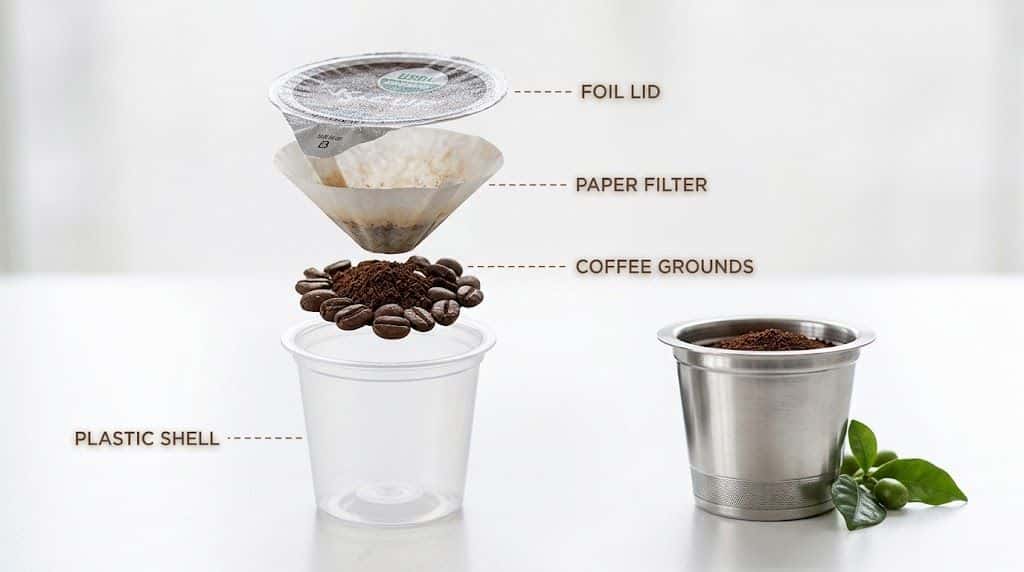
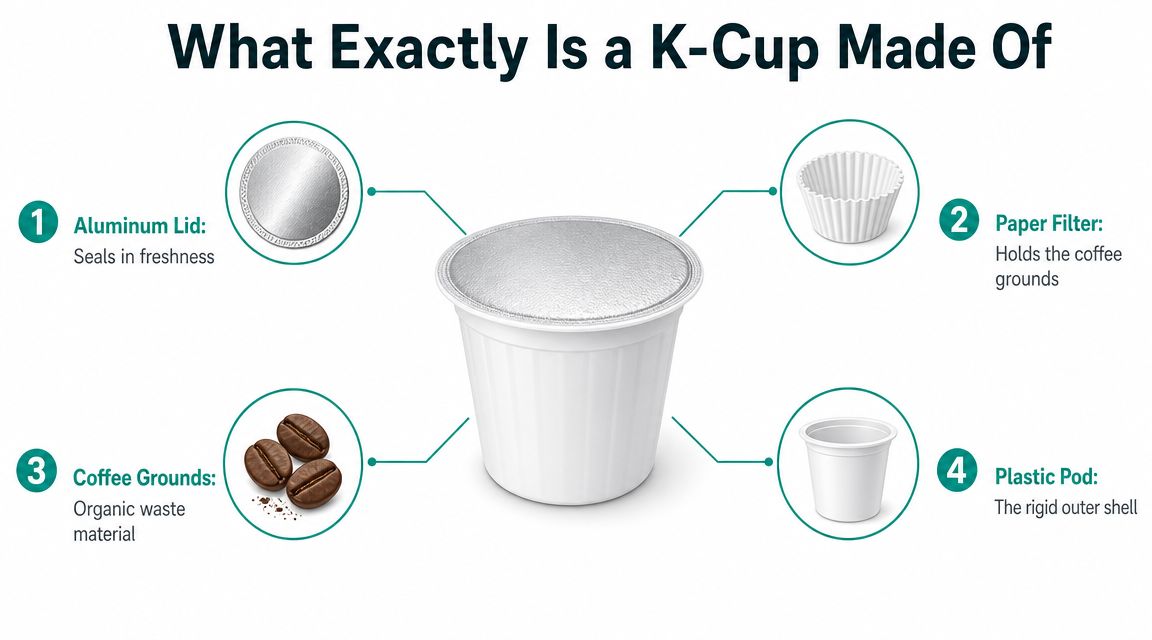
Pull apart a used pod and you will usually find four separate components:
- Foil lid. The sealed top that keeps the coffee fresh before brewing.
- Paper filter. The inner layer that holds the grounds during extraction.
- Coffee grounds. Wet organic waste after brewing.
- Plastic shell. The rigid outer cup, which is the only part people usually mean when they ask if a K-Cup is recyclable.
That construction matters. Recycling programs work best with clean, single-material items that are easy to sort at scale. A used pod is small, mixed-material, and covered in coffee residue. Those are exactly the traits that make curbside recovery unreliable.
Why the “recyclable” label only tells part of the story
As noted earlier, Keurig Dr Pepper switched its K-Cup pods to #5 polypropylene by the end of 2020. That change made the plastic shell more recyclable in theory than older #7 plastic pods.
In practice, the pod itself is still a multi-part package. The shell may be made from a recyclable plastic, but the product you hold in your hand also includes a foil top, a paper filter, and wet grounds. That is why the label can sound simpler than the actual disposal process.
I see this confusion all the time with single-serve coffee. People read “recyclable” and assume “ready for the blue bin.” Those are not the same claim.
If you want a quick primer on pod formats before sorting through recycling rules, this guide on what K-Cups are gives the basic terminology.
A K-Cup shell can be recyclable material. The full used pod is still a hard item for curbside systems to process correctly.
Why the design works against curbside collection
The trouble is not just material choice. It is logistics.
Sorting equipment is designed for larger, common containers that move cleanly through the system. Small pods can fall through screens, get missed on sorting lines, or arrive too contaminated to keep with other plastics. Even before you get to local acceptance rules, the format itself is working against a smooth recycling path.
That is the part many “recyclable” labels leave out. Technically recyclable plastic does not guarantee practical, repeatable recycling at home. For anyone who wants a simple habit they can trust, disposable pods keep adding conditions.
How to Properly Prepare a K-Cup for Recycling
If your local recycling program explicitly accepts small #5 polypropylene pods, preparation matters. A used pod with foil, grounds, and residue still attached is much more likely to be rejected.
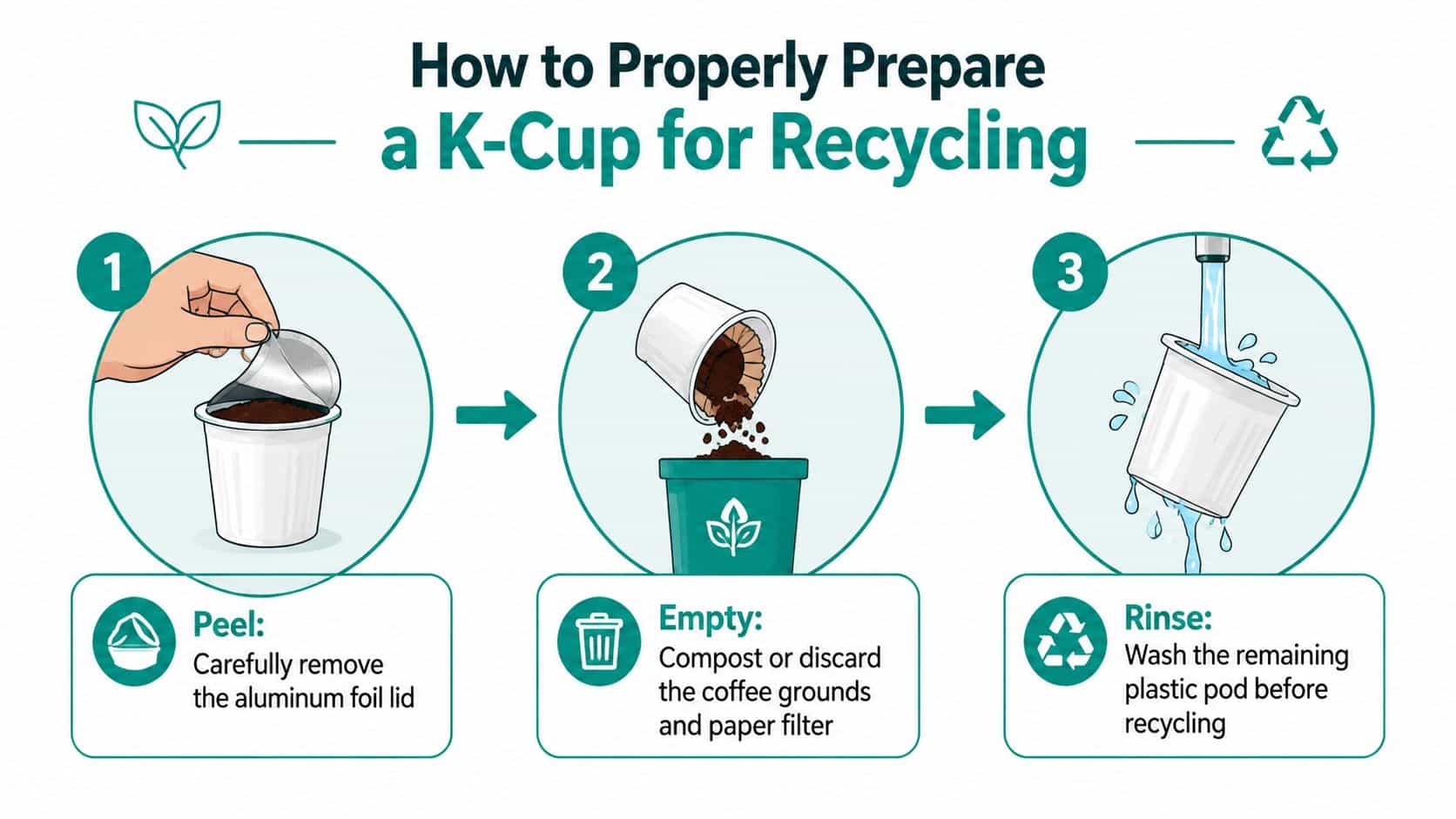
Consumer recycling guidance summarized by Consumer Reports is clear on this point: you need to peel the foil, remove the grounds and filter, rinse the cup, and confirm local acceptance of #5 plastics. Without those steps, the mixed materials and food contamination can get the pod rejected.
The only version of pod recycling that has a chance
Peel off the foil lid completely
Don't leave part of it attached. The goal is to separate the shell from the top layer.Remove the coffee grounds and paper filter
Grounds can go in compost or trash depending on your system. The filter usually won't go in with the plastic shell.
Before the last prep step, this short visual walkthrough can help if you want to see the process in action:
Rinse the plastic cup
You don't need to make it spotless, but you do need to remove obvious residue.Check your local recycling rules
This is the step people skip. “#5” on its own doesn't guarantee acceptance.
What doesn't work
A lot of well-meaning habits still fail:
- Throwing the whole pod in the bin almost guarantees contamination problems.
- Assuming all #5 plastic is accepted ignores local equipment and program limits.
- Relying on brand messaging alone skips the one source that matters most, your hauler or municipal program.
Practical rule: Only recycle the plastic shell if your local program says yes to that exact type of item.
Why this feels like too much work
For one pod, the prep may seem manageable. For a household that brews several cups a day, it turns into a repetitive cleanup task. That doesn't mean the process is wrong. It means disposable convenience comes with hidden labor.
Why Most Recyclable K-Cups Still End Up in Landfills
The biggest misconception in this category is that the word recyclable means a pod has a dependable curbside pathway. It usually doesn't.
The system breaks in ordinary places
The issue isn't only the resin. It's logistics.
Rumpke's guidance on recycling K-Cups and coffee pods lays out the practical curbside problem clearly: many municipal systems don't accept them because they are too small for sorting equipment or otherwise unrecoverable. So even if you did the prep work perfectly, your local materials recovery facility may still not want them in the stream.
That's the part labels rarely explain well. Consumers hear “recyclable” and picture a straightforward blue-bin item. K-Cups are usually conditional, labor-intensive, and infrastructure-dependent.
Official scrutiny changed the conversation
In September 2024, the U.S. Securities and Exchange Commission charged Keurig Dr Pepper over allegedly misleading statements about pod recyclability, and Earth911's coverage notes the action included a $1.5 million penalty. That matters because it moved the debate beyond annoyed consumers and into formal regulatory scrutiny.
The core issue was the gap between a product being technically recyclable and being recycled in existing consumer systems. That's the exact gap shoppers run into at home.
If you want a focused breakdown of that disconnect, this article on K-Cup recycling reality is worth reading alongside your local recycling rules.
You can do everything “right” and still have no reliable curbside outcome.
What about mail-back programs
Mail-back programs can help in places where curbside options are weak. But they also expose the central flaw in disposable pod design. When a product needs a separate collection system, added handling, and consumer follow-through, it stops being simple.
Earth911 also notes that Keurig launched K-Cycle At Home, a fee-based mail-back option with prepaid labels and about 96 pods per bag for communities that don't accept them curbside. For some households, that's better than trash. For many, it's another reminder that the default system still doesn't work smoothly.
The Simple Solution to K-Cup Waste
Once you strip away the marketing, the cleanest answer isn't better sorting technique. It's avoiding disposable pods in the first place.
A reusable pod does three things that single-use K-Cups can't do consistently. It cuts out the daily packaging waste, removes the guesswork around local recycling acceptance, and lets you use whatever ground coffee you want to drink.
Why reusable pods solve the real problem
The appeal is practical, not ideological:
- Less waste at home because you're washing and reusing one pod instead of tossing a new shell every brew.
- Less hassle after brewing because you dump grounds, rinse, and brew again.
- More flexibility because you aren't locked into prefilled pod choices.
That's why I tend to frame reusable pods as the only reliable solution for people who want the convenience of a Keurig without the constant recycling uncertainty. You're no longer asking whether a local facility accepts a tiny plastic item this month. You've removed that question from your routine.
What to buy instead of another box of disposables
A stainless steel or durable reusable K-Cup-style filter is the straightforward swap. Some people prefer all-metal designs. Others like reusable pods paired with paper liners for easier cleanup. PureHQ Inc. sells reusable pods and compatible accessories for several Keurig models, which is one practical route if you're looking to move away from disposables without changing brewers.
This same principle shows up across takeaway packaging more broadly. Good sustainable food-to-go packaging advice usually starts with reduction and reuse, not optimistic assumptions about disposal labels.
The simplest waste stream is the one you never create.
The trade-off most people accept quickly
Yes, reusable pods ask for a few seconds of filling and rinsing. In return, you get a system that's predictable. For most coffee drinkers, that's a better bargain than peeling foil, scraping grounds, rinsing plastic, checking municipal rules, and still wondering whether the pod will be recovered.
Choosing the Right Reusable Pod PureHQ vs Generic Options
The objection I hear most is simple: “I tried a reusable pod once, and it was messy.”
That complaint is real. A bad reusable pod can leak, overflow, fit loosely, or leave sediment in the cup. The fix isn't going back to disposables. It's choosing a pod with better fit, sturdier materials, and a mesh design that manages flow properly.
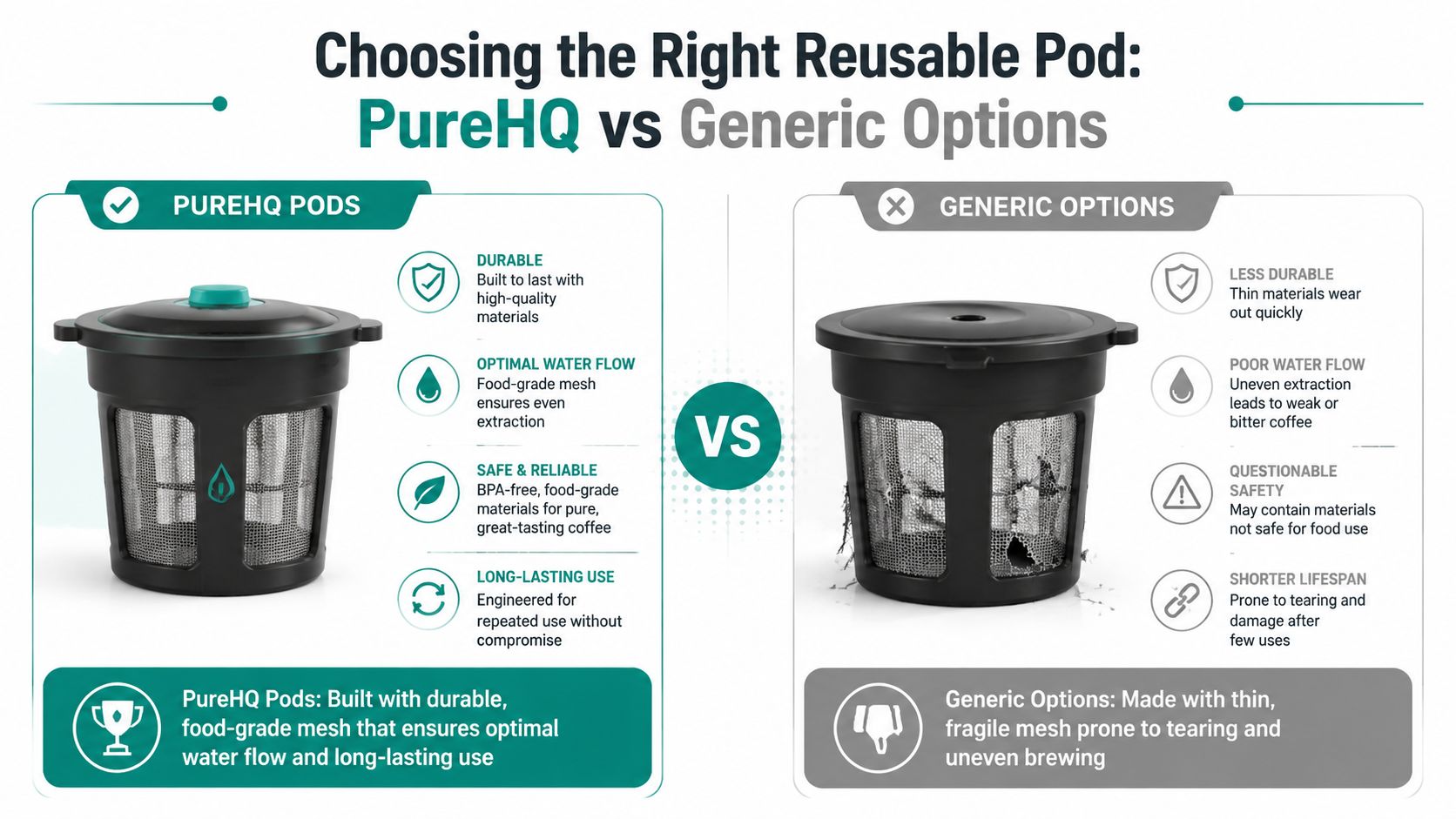
What separates a well-made reusable pod from a frustrating one
Cheap generics often cut corners in places that matter. Thin mesh can deform. Poor seals can let grounds escape. Sloppy tolerances can create fit issues across different Keurig machines.
A more carefully made pod focuses on repeatable basics:
- Stable fit so the brewer closes properly
- Consistent mesh to control extraction and reduce sludge
- Durable materials that hold shape after repeated use
- Easy cleaning so reuse stays convenient
If you're matching a pod to a specific brewer, this guide on choosing the right reusable K-Cup for different Keurig models helps narrow the fit question before you buy.
PureHQ vs. Generic Reusable Pods
| Feature | PureHQ Reusable Pods | Generic Alternatives |
|---|---|---|
| Material quality | Built around durable coffee accessory materials intended for repeated use | Quality can vary widely, sometimes with thinner parts and inconsistent finishes |
| Fit consistency | Designed for compatibility with specific Keurig model groups | Fit can be hit-or-miss across machines |
| Leak control | Better seal design is the main thing to look for when trying to avoid messy brews | Poor sealing is a common reason users give up on reusable pods |
| Brew cleanliness | Mesh and structure are intended to reduce stray grounds in the cup | Some generic pods let fines through more easily |
| Durability | Better suited to regular wash-and-reuse cycles | Lower-cost options may wear out faster |
| User experience | More predictable once you dial in grind and fill level | Often cheaper upfront, but more likely to create trial-and-error frustration |
Two accessories that actually matter
If you want better flavor from any reusable pod, use filtered water. It improves taste and helps limit mineral buildup inside the brewer. Regular descaling matters too, especially if your machine starts slowing down or brewing inconsistently.
Reusable pods work best when the machine itself is clean and the water going in is decent.
That's one reason reusable pods pair naturally with water filters and descaling solution. They don't just cut waste. They make more sense as part of a lower-friction coffee setup.
If you're done gambling on confusing disposal claims and want a simpler routine, shop reusable brewing accessories from PureHQ Inc.. A well-fitted reusable pod, plus the right filter and descaling supplies, gives you a setup that's easier to live with than disposable K-Cups pretending to be a recycling win.

