
Coffee Machine Care
Reusable Coffee Cups Bulk Buying Guide
Nov
A cupboard full of reusable cups can leave an office buying just as many disposables as before. Before you place a reusable coffee cups bulk order, decide who'll use the cups, where they'll return them, and how you'll wash them. The discount matters only after those practical questions have answers.
The Waste a Bulk Cup Order Is Meant to Stop
Germany's Environment Agency reported that consumers used approximately 2.8 billion disposable hot-drink cups annually in 2019, roughly 23 per person, with lids adding about 1.3 billion plastic items; approximately 60% of the cups were plastic-coated paper and 40% were all-plastic, while coated paper cups alone occupied about 400,000 cubic metres of urban waste capacity and up to 15% of urban waste-bin volume, according to the agency's disposable-cup assessment. The agency estimated that reusable systems and related measures could reduce disposable-cup consumption by 50% within three years.
Those figures describe Germany, not your break room. But they make an important purchasing distinction clear: cups and lids belong in the same waste-reduction decision. Replacing the cup while continuing to hand out disposable lids leaves part of the problem untouched.
A bulk delivery is the beginning of that decision, not proof that it worked.
Follow the cup beyond the carton
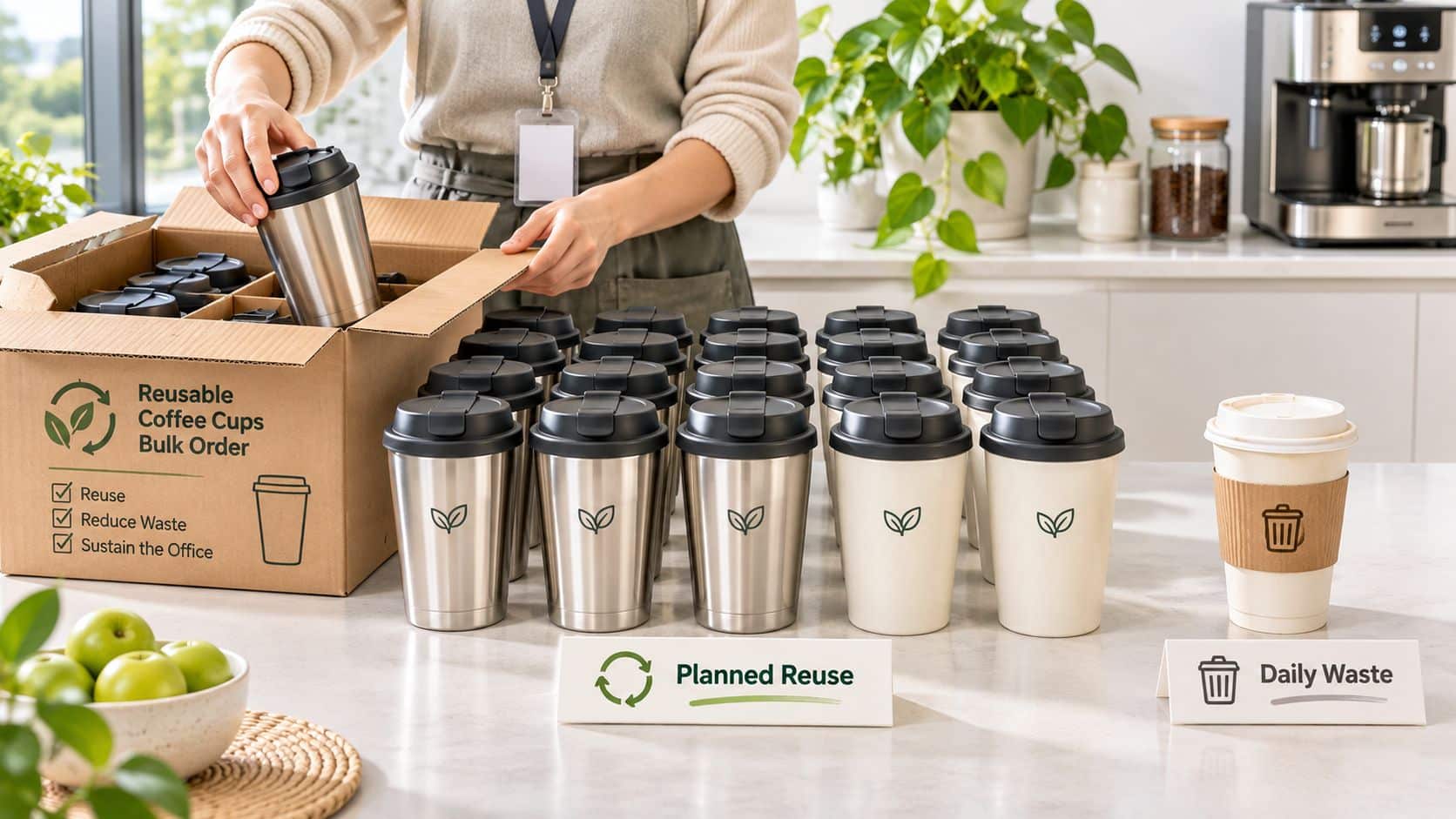
Consider an office that puts reusable mugs beside the brewer but leaves the disposable stack beside them. Employees take the familiar option because the mugs haven't been assigned, the dirty-cup tray isn't marked, and nobody owns the washing task. The buyer has added inventory without changing the coffee routine.
For offices, campuses, cafés, and events, start by identifying the serving occasion you want to change:
- Desk coffee: Put assigned mugs within reach of the brewer.
- Takeaway drinks: Choose a cup and lid together, then provide a return arrangement.
- Shared hospitality: Place collection trays where guests finish their drinks, not just where staff serve them.
Treat cups as part of your wider waste-reduction initiatives, with a named person responsible for collection and replenishment.
Practical rule: Count completed uses, not cups purchased.
A population-wide substitution can sound impressive on paper. Your defensible buying decision is smaller and more concrete: choose cups that people will return, wash, and use again until they pass a relevant reuse threshold.
How Many Uses a Bulk Order Must Reach
Reuse counts before a cup beats disposable service
| Cup and comparison | Break-even | Condition that moves the number | Basis |
|---|---|---|---|
| Ceramic mug vs paper cup with lid | 200–300 uses | Lower potential impact after repeated use under the assessment's assumptions | Québec government LCA |
| Ceramic mug vs paper cup, restaurant cost | 45 reuses | Based on a $4.50 mug price | Québec government LCA |
| Dishwasher ceramic vs paper, no lid | 11 uses | Climate-impact parity | Ceramic-versus-paper LCA |
| Dishwasher ceramic vs paper, with lid | 13 uses | Climate-impact parity | Ceramic-versus-paper LCA |
| Hand-washed ceramic with lid | No parity in the model | Hand washing blocked climate break-even | Ceramic-versus-paper LCA |
| Polypropylene cup vs paper cup | About 36.8 uses | Washing and return-system assumptions differ | Analysis summarized in Scottish government review |
| Reusable cup, higher cited estimate | 250 uses | Another analysis used different system assumptions | Scottish government review of LCAs |
| Reuse assumptions across studies | 132–750 uses | Material, washing, transport, and disposal change results | Scottish government review of LCAs |
| Stainless-steel cup vs single-use | More than 140 uses | Cup mass, manufacturing energy, transport, and washing | Peer-reviewed lifecycle study |
| Reusable cup carbon payback | At least 54 uses | Modeled assumptions, not a universal target | Separate assessment |
| Café-washed reusable plastic vs single-use | 15–20 uses | Dishwasher washing beat hand washing in the model | Western Australia government LCA |
| Circulating reuse system vs single-use PET | 4–8 uses | Up to 77% lower carbon after 25 cycles in the assessed system | Reuse-system assessment |
Separate environmental payback from financial payback
The Québec government life-cycle assessment identified at least 200–300 uses for ceramic mugs to have lower potential environmental impacts than paper cups with lids, but found restaurant costs became lower after 45 reuses, based on a $4.50 mug. Those are different tests. A mug can recover its purchase cost before it reaches the environmental comparison you're using.
The Scottish review entries also need careful reading. Its assumed service lives aren't all break-even findings, and the individual polypropylene estimates describe different operating conditions. Don't average those rows into a supposedly universal target.
For ceramic cups, the ceramic-versus-paper life-cycle assessment found climate-impact parity after 11 dishwasher-washed uses without lids and 13 with lids, while hand-washed ceramic cups with lids didn't reach parity in that model. Climate parity doesn't establish superiority across every environmental measure.
Choose the row that resembles your operation
The stainless-steel entries describe separate environmental and carbon calculations, not competing guarantees. Cup weight, manufacturing, delivery, wash temperature, detergent, drying, electricity, and disposal can change the comparison. Likewise, a café-washed plastic cup isn't interchangeable with a cup that employees wash individually.
At the circulation-system end, Pilario's reuse-system case study reported break-even at four to eight uses and up to 77% lower carbon emissions than single-use PET after 25 cycles. That finding belongs to the assessed system, not every promotional cup.
Estimate annual uses per person, then divide by the chosen row's break-even count to see whether your expected use clears it. If employees rotate between several cups, calculate uses per cup, not per employee. Only then set the order quantity, favoring assigned, retained stock over a giveaway whose future use you can't track.
Materials and Lids That Survive Daily Washing
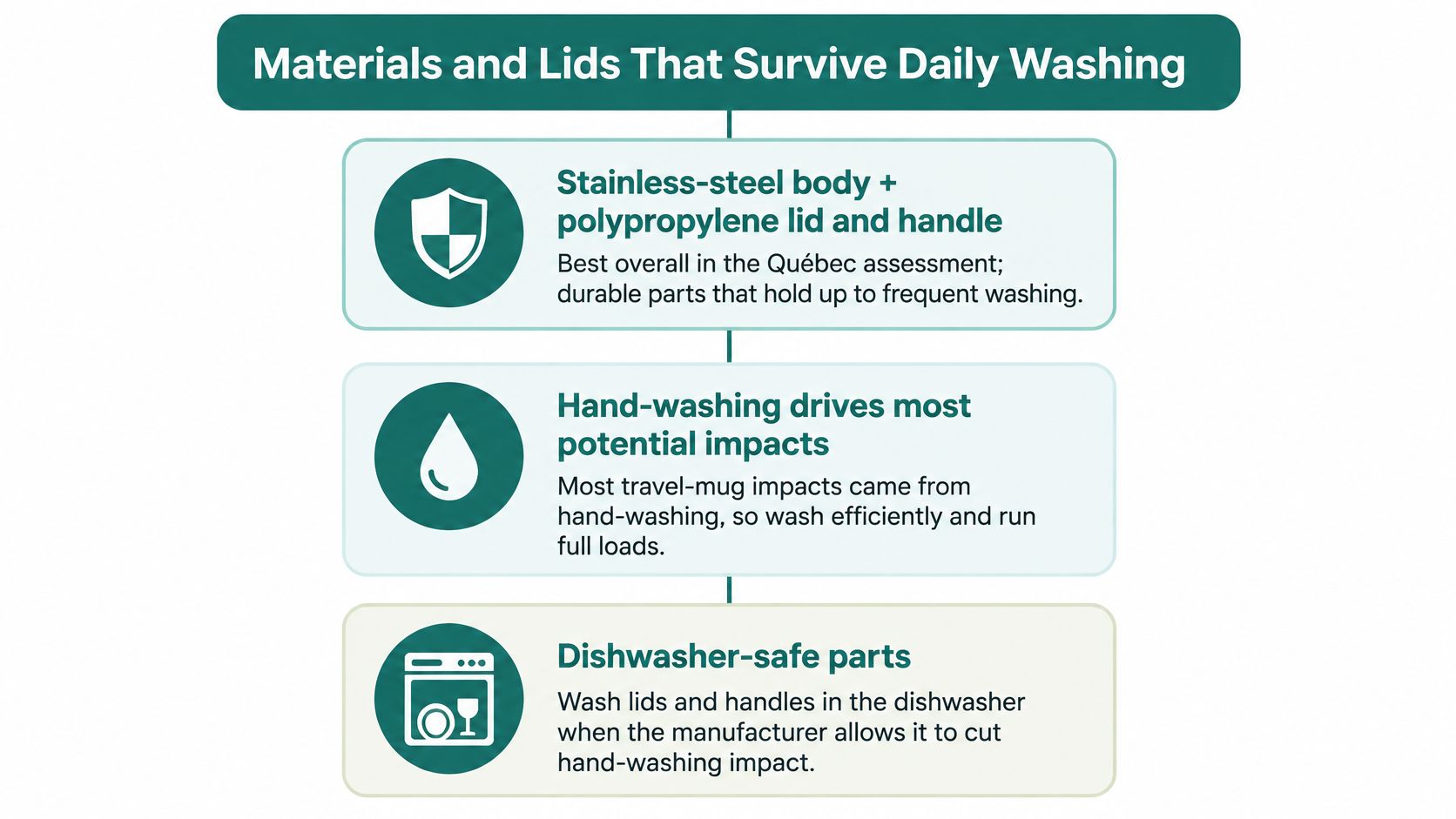
The Québec travel-mug assessment found that most potential impacts came from hand-washing, and stainless-steel bodies with polypropylene lids and handles performed better environmentally than all-polypropylene or polycarbonate alternatives. That's a finding about the assessed designs and washing conditions, not permission to buy any steel cup.
Think of the cup as the durable shell and the sink as the meter that runs every day. Specify both the shell and the cleaning process before you compare quotations.
Use this hierarchy to keep washing requirements beside material requirements.
Put a usable specification in the purchase order
Ask suppliers to document the following rather than accepting a general reusable or eco-friendly description:
- Body construction: Specify corrosion-resistant stainless steel and a smooth, accessible interior.
- Food-contact components: Request polypropylene lid and handle components, with material documentation.
- Lid teardown: Require a removable seal and a small, manageable set of parts that staff can reassemble correctly.
- Cleaning compatibility: Obtain written dishwasher instructions for the body, lid, handle, and gasket separately.
- Temperature limits: Request explicit limits for hot drinks, washing, and any permitted heat treatment.
- Service parts: Confirm that replacement lids and seals can be ordered independently.
Don't assume dishwasher compatibility applies to every component because it applies to the body. Read the instructions as a parts list: what goes on the rack, what must come apart, and what requires a different treatment?
Reject cleaning problems before accepting the carton
Order a sample and take the lid apart over a tray. Check whether you can reach the underside of the drinking opening, remove the gasket without damaging it, and identify the correct orientation when putting it back.
Reject designs with inaccessible coffee-contact recesses, interior coatings that chip during your sample checks, or missing dishwasher limits. Don't accept a lid that staff must pry apart with a knife.
A tough body is useful only if the rest of the cup remains serviceable. Plan dishwasher loads around the existing kitchen workflow rather than asking every employee to invent a separate hot-water routine.
If the specification sheet can't answer how the cup is washed and how the lid comes apart, the unit price isn't yet a usable cost comparison.
Premium Stainless Cups Against Generic Alternatives
Start with the objection buyers hear: Will it leak in my bag? Don't answer with the word premium. Ask for a sample, inspect the closure, and establish whether the supplier means splash-resistant during upright carrying or suitable for sealed transport.
Treat the graphic below as a set of features to verify, not evidence that a price category guarantees leak performance.
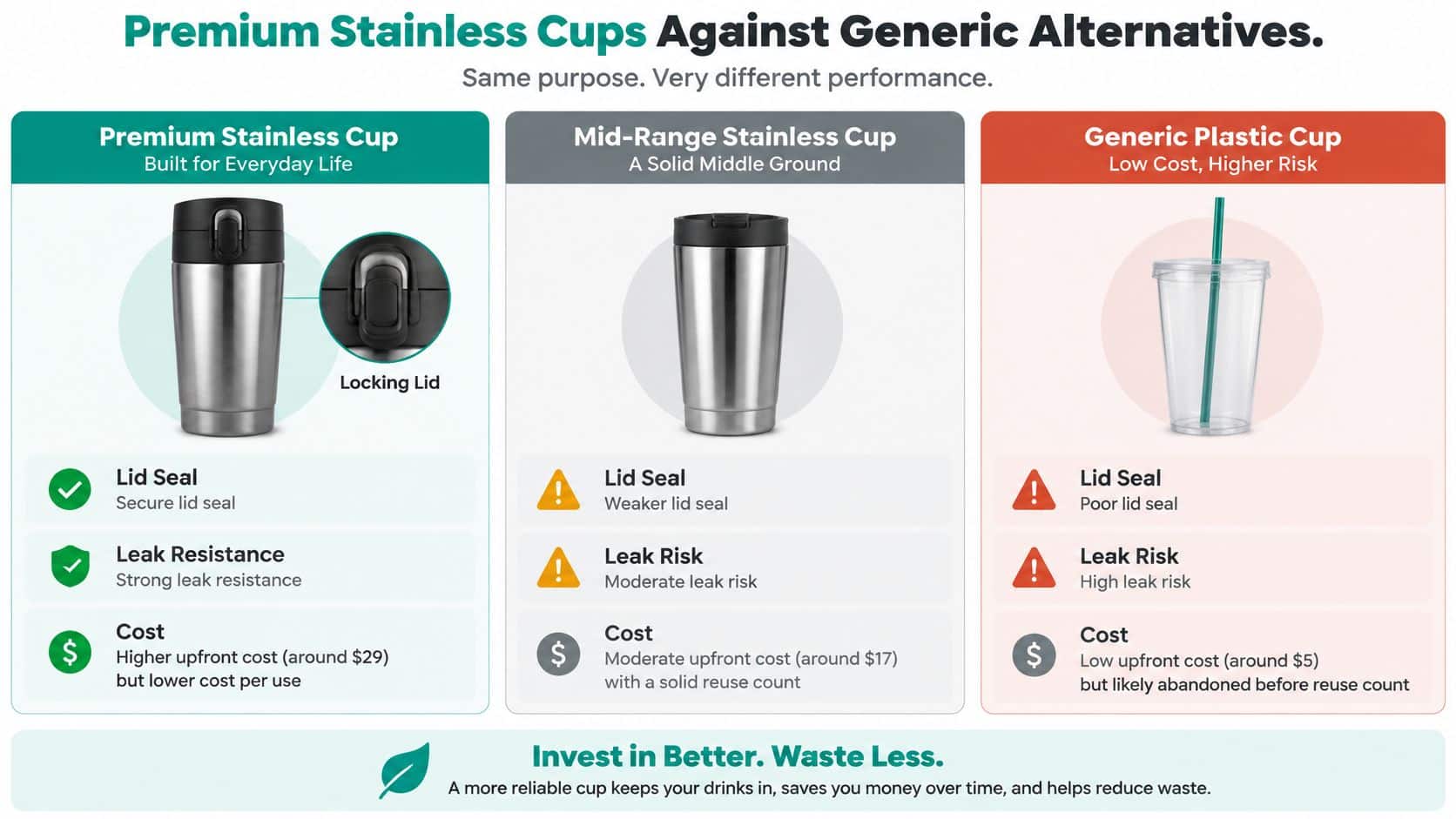
Premium stainless cups versus everyday alternatives
| Buying question | Premium stainless travel mug | Generic plastic travel cup | Basic ceramic mug |
|---|---|---|---|
| Leak and seal | Require a separable, replaceable seal and documented closure performance | Check one-piece lids for sip-hole leakage and inaccessible residue | Open rim, unsuitable for sealed carrying |
| Body durability | Specify corrosion-resistant construction; inspect sample joins and finish | Inspect for distortion and cracks during the intended wash trial | Inspect rims and handles for chips |
| Wash reality | Buy only with documented component-level dishwasher compatibility | Verify heat limits rather than assuming plastic is dishwasher-safe | Choose a dishwasher-compatible model for kitchen batches |
| Best fit | Commuting, controlled-return events, assigned mobile users | A monitored trial with a clear return arrangement | On-site office and café drinks |
| What fails the order | No spare seal or no stated temperature limit | No collection system or unclear cleaning instructions | No plan to retain and inspect cups on site |
Pay for serviceable features, not a label
The lifecycle evidence summarized in the University of Limerick repository paper includes a stainless-steel comparison favoring reuse after more than 140 uses and a separate reusable-cup carbon-payback estimate of at least 54 uses; it also reports UNEP use-stage shares of approximately 91% of greenhouse-gas impact, 99% of water use, and 88% of energy use for modeled reusable cups. These modeled results don't establish that a more expensive mug has a lower footprint than a cheaper mug.
A defensible premium purchase buys something identifiable: replaceable parts, documented washing limits, and a closure that passes your intended-use checks. Don't pay extra for insulation if the cup will sit beside a brewer and never travel.
For a staffed break room, put a basic ceramic mug on the shortlist. For commuters or events with collection arrangements, evaluate stainless travel mugs. Match the design to the job before comparing finish or branding.
Test fit as well as leaks
Check the sample under the brewer's spout with the drip tray in its normal position. Ask intended users to try the handle, drinking opening, and lid closure, then wash and reassemble the sample before approving it.
For an additional visual reference when assessing reusable-cup options, watch the following video.
Keep the sample you approved as the acceptance reference for the bulk delivery. Compare incoming lids, seals, and dimensions against it rather than relying on a matching product photograph.
A Wash Routine Shared Cups Can Trust
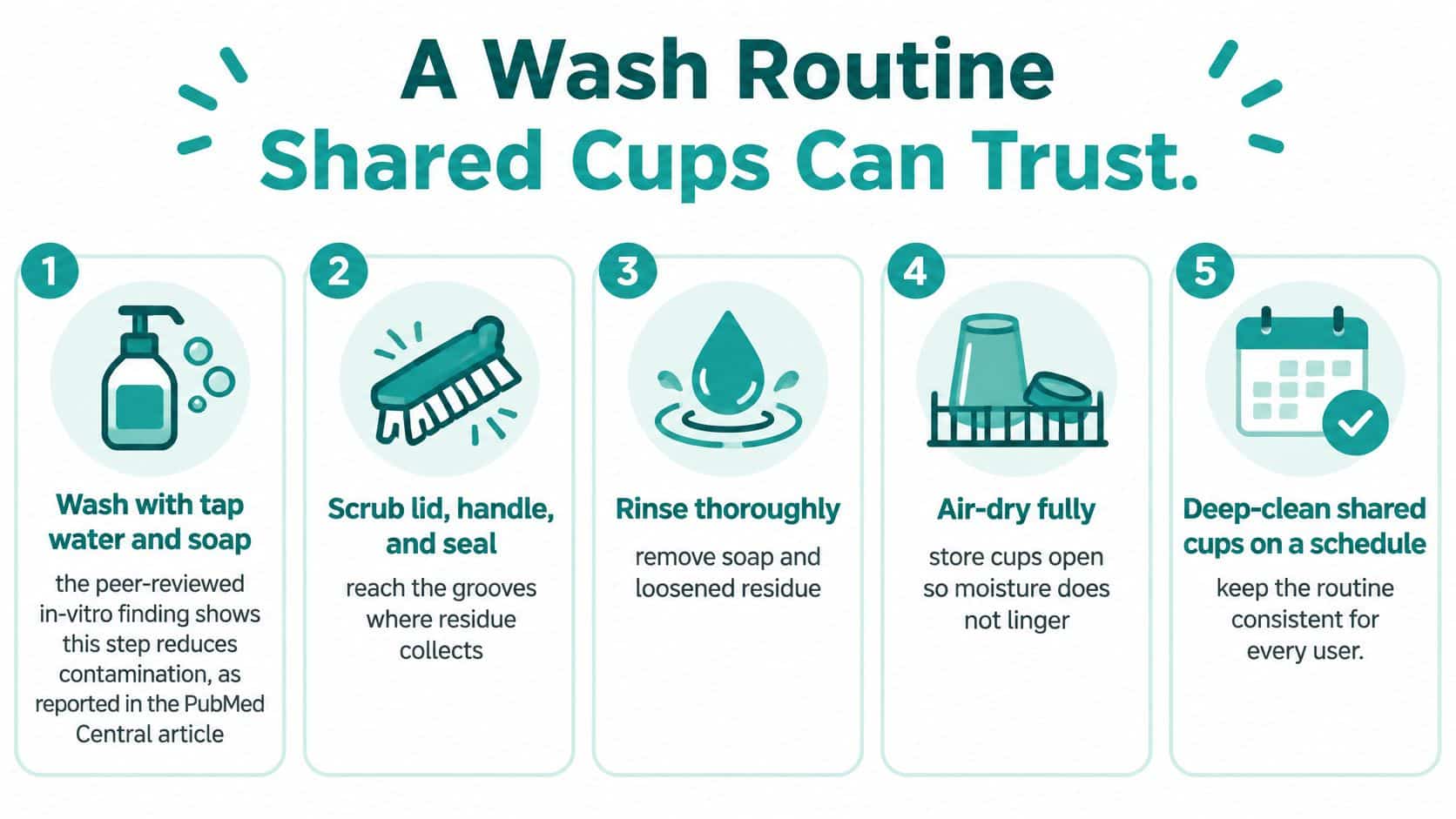
Cleaning is a safety step, not a shine preference. A peer-reviewed in-vitro study of reusable food-contact items found that washing with tap water and soap followed by steeping in boiled water for five minutes was the most effective tested method for reducing viable bacteria; tap-water cleaning followed by five minutes of boiling-water treatment wasn't statistically significantly different from the soap-and-boiling-water method.
That finding doesn't prove that every cup, household method, or office dishwasher produces sterile items. It also doesn't make boiling-water treatment suitable for every plastic lid, coating, seal, or insulated assembly.
Post a visible cleaning checklist beside the collection area.
Give staff a repeatable sequence
- Empty promptly. Pour away the remaining drink and put the cup in the designated dirty-cup area, not back beside clean stock.
- Wash every contact surface. Use soap and tap water for manual washing, reaching the drinking opening, lid underside, threads, and removable seal. Rinse away detergent and loosened residue.
- Use only an approved sanitation method. Where the manufacturer explicitly permits it, the study's boiled-water treatment offers a tested reference. Don't substitute an arbitrary heat cycle or immerse components whose instructions prohibit it.
- Air-dry disassembled. Place the body, lid, and gasket on a clean drying rack. Reassemble them only after they're dry.
- Store clean cups openly and separately. Don't stack wet cups in a closed cabinet or place washed parts on the dirty collection tray.
For café or event service, use the sanitation procedure appropriate to the equipment and local food-service requirements. A household study isn't a replacement for a commercial operating procedure.
Make the routine easy to check
Choose a brush that reaches the bottom of the cup and a smaller brush for lid channels. Keep a separate tray for detached seals so staff can account for them during reassembly.
Hygiene check: A clean-looking cup with an unwashed gasket hasn't completed the cleaning routine.
Assign responsibility for the shared stock rather than assuming the last person at the sink will finish it. Mark personal cups clearly, or consider a deposit arrangement for circulating stock, so users can distinguish assigned cups from the shared pool.
Use labels to clarify ownership, not to replace washing. Every returned cup should follow the same cleaning route before another person receives it.
How Many Cups an Office Café or Event Needs
Build the quantity around peak demand, washing capacity, and returns. A large discount doesn't tell you how much clean stock you'll have when the dishwasher is running.
In the Western Australia government life-cycle assessment, a café-washed reusable plastic hot-drink cup outperformed both modeled single-use systems after approximately 15–20 uses, and dishwasher washing produced lower impacts than hand washing in the modeled scenarios. Use that as a reason to plan circulation, not as a promise that every café cup reaches the same result.
An office with assigned cups
For a hypothetical 20-person office, start with one assigned cup per person plus 25% spares, giving 25 cups. This is a planning example, not a prescribed staffing ratio.
Reserve the spare stock for guests and temporary replacements rather than issuing everyone another mug. Include the collection tray, drying space, and labels in your office break-room supplies list so the cups have somewhere to go after use.
A café washing behind the counter
Suppose a café serves a rush equivalent to 40 seats and needs another 20 cups while used stock moves through washing and drying. That hypothetical operation would start its trial with 60 cups, or 1.5 times its rush seating.
Don't turn that multiplier into a universal rule. Record how many cups are waiting to be washed during your busiest service, then adjust the clean-stock requirement. Mark the circulating stock discreetly so staff can distinguish it from unrelated mugs.
An event with a defined collection route
Suppose an event expects 100 simultaneous drinkers and needs 25 additional cups to cover collection and washing. A hypothetical starting quantity would be 125 cups, provided the venue can clean and recirculate them.
If the event has no washing facility, size the stock around servings before collection, then arrange cleaning and future reuse afterward. Don't order a huge personalized run unless you can explain where the cups go when guests leave.
Keep the inventory check simple:
- Record cups issued: Separate stock handed to users from clean stock held back.
- Record cups returned and washed: Count completed circulation, not just collection-bin contents.
- Investigate missing cups: Check desks, meeting rooms, drying racks, and transport crates before replacing them.
Replace confirmed losses rather than automatically topping up to a larger carton size. Order the quantity you can wash and get back, not the quantity with the biggest discount.
Place the Cup Order and the Matching Brewer Care
Approve the cup order only when the quantity can clear your chosen reuse test, return from service, and survive its documented cleaning routine. For branded or organizational purchases, HYDAWAY's bulk drinkware guide for organizations offers another purchasing reference; keep your own lid, washing, and return requirements in the specification.
Match the brewer supplies to the plan
Our stainless refillable pods, made under our manufacturing oversight, cost $19.95 per 2-pack: the MultiStream pack fits K-Supreme, K-Slim, and K-Crema, while the single-needle pack fits Classic, 2.0, K-Elite, and K-Mini; optional Disposable Paper Filters cost $12.95 per 100-pack and fit Keurig and Ninja DualBrew. Our USA-made Coffee Machine Descaler costs $23.95 for 10 uses and suits Keurig, Nespresso, Breville, and espresso machines, giving you a concrete maintenance item to include when planning wholesale coffee accessories.
Suzie C describes the appeal of refillable pods plainly: “Love This Product, I do not especially like prepackaged coffee pods, I like using the coffee that I buy and these are perfect.” Paper liners remain disposable, so treat them as an optional brewing preference rather than part of a zero-waste claim.
Keep the purchase practical: retained cups, compatible pods, and a written cleaning plan.
PureHQ Inc. offers reusable K-Cups, coffee filters, water filters, and brewer-care supplies for home and small-office coffee stations. Visit PureHQ Inc. to shop the stainless refillable pod pack that matches your brewer, or purchase through our Amazon store, and read the return and warranty terms posted with the product before ordering.

