
Coffee Machine Care
Waste Reduction Initiatives: Proven Savings for Home &
Jul
The world generated 2.6 billion tonnes of municipal solid waste in 2022, and the World Bank projects that figure could hit 3.9 billion tonnes by 2050, a 50% increase if current patterns hold (World Bank). That is not a recycling problem, it's a systems problem. If you run a home, a small office, or even just a coffee routine, you already touch the waste stream every day, which means you also have a real chance to shrink it.
The mistake many make is chasing feel-good gestures instead of tracking outputs. A bin swap without a baseline, a compost caddy without pickup, or a reusable pod without a cleaning routine just shifts mess around. Strong waste reduction initiatives start with measurement, then they target the daily habits that create the most repeat waste, especially the coffee ritual that happens whether anyone is paying attention or not.
That's why the first question is never “What should we recycle?” It's “What can we stop creating in the first place?” For households and small offices, that usually means fewer single-use items, better purchasing decisions, and a coffee setup that doesn't leak waste into the bin every morning. If you're trying to understand the policy side of single-use materials, understanding the plastic ban is a useful companion read because it shows how upstream rules reshape what lands in your trash.
A simple energy and materials review can also surface hidden waste. If you want one operational reference point, the energy consumption reduction guidance is a practical reminder that utility use and waste prevention usually move together, especially when equipment maintenance is part of the plan.
Why Waste Reduction Initiatives Matter in 2026
The scale of the waste problem is already large enough to overwhelm weak systems. The World Bank says the world generated 2.6 billion tonnes of municipal solid waste in 2022, about 30% of global waste is still openly dumped or left uncollected, and the total could rise to 3.9 billion tonnes by 2050 if current trends continue (World Bank). That matters because waste reduction is not only about landfill diversion. It's also about collection capacity, public health, and the materials people keep buying and discarding.
For homes and small offices, the power comes from repetition. One coffee pod, one takeaway lid, one paper towel may look trivial, but the same purchase cycle repeats every day. When you remove the repeat item, you don't just shrink the bin. You cut the purchase, the transport, the handling, and the disposal step too.
Singapore is a useful reminder that waste reduction can be measured, not just advertised. In 2025, each person generated 0.83 kg of waste per day, which was a 21% reduction from 2015, and daily domestic waste per capita fell from 1.06 kg in 2015 to 0.83 kg in 2025 (NEA Singapore). That is the kind of outcome serious programs should aim for, not vague “eco-friendly” branding.
Practical rule: if you can't name the waste stream, you can't manage it. Start with the stuff you buy most often, because that's where the fastest gains usually sit.
Small offices should care for the same reason households should. Office breakrooms, printers, cleaning supplies, and coffee stations create steady waste with very little scrutiny. A breakroom that moves from disposable cups to reusables, and from generic coffee habits to a tracked refill and compost workflow, produces a cleaner bin and a clearer budget.
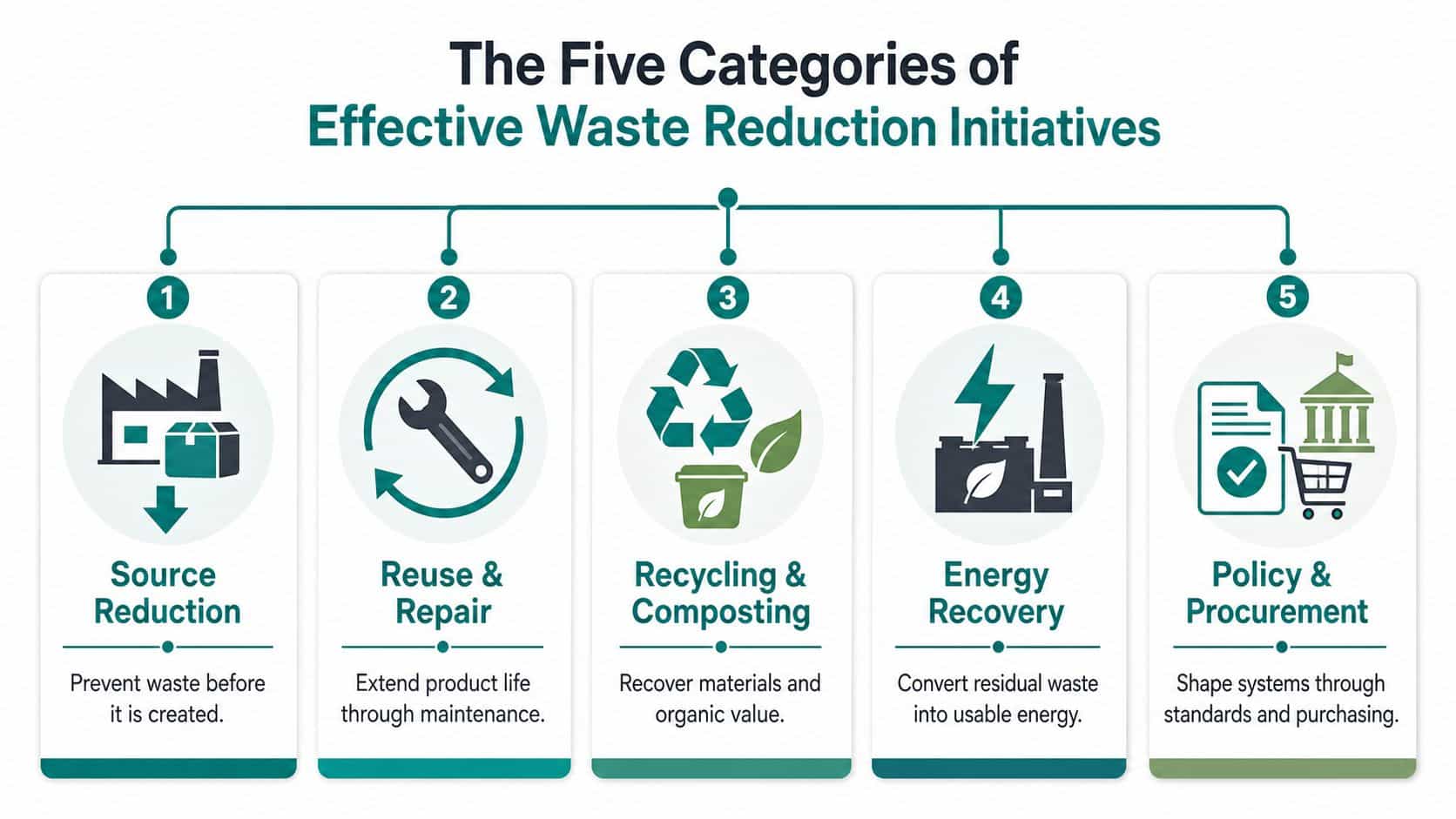
The Five Categories of Effective Waste Reduction Initiatives
Waste reduction initiatives work when they hit the right layer of the system. Some actions stop waste before it exists. Others extend product life, capture material, or change what gets purchased in the first place. The most useful mental model is simple, source reduction first, then reuse, recycling, composting, and sustainable procurement.
Source reduction and reuse
Source reduction is the cleanest win because it removes the item entirely. A household that switches from single-use coffee pods to a reusable pod stops buying the waste stream, not just sorting it later. Reuse keeps products in service longer, which is why a durable mug, refillable soap dispenser, or stainless refillable pod often beats any “recyclable” replacement that still gets tossed after one use.
The trade-off is honesty. A reusable product only reduces waste if people use and clean it. If a reusable pod sits dirty in a drawer and the household goes back to disposables, the program failed on behavior, not concept.
Recycling and composting
Recycling captures material after use, but it only works when the stream is clean and the pickup is real. Composting is different, it diverts organic material like coffee grounds into soil amendment instead of landfill. In a kitchen or breakroom, coffee grounds are the easiest organic stream to route away from the trash because they show up every day and they're easy to collect.
If your office also manages IT gear or mixed surplus, universal waste compliance for IT assets is worth reviewing because the same discipline that keeps coffee waste clean also keeps regulated streams out of the wrong bin.
Sustainable procurement
Procurement decides what enters the building. That makes it the upstream lever many overlook. If you keep buying disposable cups, flimsy filters, or machines that break early, you're creating waste by contract. If you buy a reusable system and set the refill, maintenance, and replacement path up front, you prevent a lot of downstream sorting theater.
A program that fixes buying behavior usually outperforms a program that only adds bins.
The point is not to do all five categories equally. The point is to choose the category that removes the most waste per decision. For most homes and small offices, that's source reduction and procurement, then reuse, then composting and recycling for what's left.
Measuring What Counts With the Right KPIs
Waste programs fail when people track activity instead of outcome. A full bin can look like progress, but a full bin only means material moved somewhere. It does not mean the household or office created less waste, paid less to handle it, or cut emissions. The US EPA says organizations need consistent measurement of waste quantity, composition, avoided disposal cost, and greenhouse gas effects if they want to verify whether a program worked (US EPA).
The four KPIs that matter
Diversion rate tells you how much material left the trash stream and went to recycling or composting. Use it as a system health check, not as your only score.
Cost per pound avoided tells you whether the replacement was worth it. If a reusable item costs more upfront but prevents repeated purchases and disposal, this metric shows the gap in plain language.
Pounds of waste per employee per month works in offices because it normalizes for headcount. A team can grow and still improve if this number trends down.
Greenhouse gas emissions reduced belongs on the same page as the financial metrics because material choice affects both cost and lifecycle emissions. EPA recommends tracking both together.
Here's the trap. Participation rate can rise while waste stays flat. More bins, more stickers, more sign-ups do not prove the bin got lighter. That rebound shows up fast in internal programs, especially when people change where they toss items instead of what they consume.
The equity piece matters too. Waste systems fail when they ignore the people moving waste. EPA guidance on equity says effective systems should identify marginalized stakeholders, expand collection into underserved areas, and include informal recyclers in planning and social protection (US EPA equity framework). In practice, that means your KPI dashboard needs a human owner, not just a spreadsheet.
If you want one line to keep on the wall, use this:
Track less activity, more outcome. If the tonnage, cost, and contamination do not move, the program is decoration.
For a coffee station, measure pod purchases avoided, grounds captured, and filter or descaling replacements that protect the machine. Reusable coffee pods fit that logic well, because they cut disposable pod volume only if people keep filling and cleaning them, not if they sit in a drawer. See the practical trade-offs in reusable coffee pods. If those numbers do not improve, the initiative is cosmetic.
A Practical Six Stage Implementation Plan
Start with a baseline audit. The owner is whoever manages the kitchen, breakroom, or household supplies. Do it once, then repeat monthly for three months. The deliverable is a simple list of what gets thrown away, what gets bought, and what can be stopped at the source.
Set one target that matters. The owner should be the person who pays the supply bill, because that person feels the cost. Make the target specific, tied to a waste stream, and measurable on a monthly cadence. If you can't explain the target in one sentence, it's too fuzzy to enforce.
Run a quick-win pilot next, and don't make it voluntary theater. The OECD reports that recycling collection services are associated with 15% lower mixed-waste generation, and charging schemes have been associated with 18% to 50% reductions across prior studies, with one dataset showing 20% to 22% average reductions in mixed waste (OECD). That's why pilots should change defaults, not ask for hero behavior.
The six stages in plain terms
- Baseline audit. Owner, supply manager. Frequency, monthly. Deliverable, waste log by stream.
- Target setting. Owner, decision-maker. Frequency, quarterly. Deliverable, one KPI goal.
- Quick-win pilot. Owner, site lead. Frequency, two to four weeks. Deliverable, one changed default.
- System redesign. Owner, operations lead. Frequency, after pilot. Deliverable, new purchase and disposal routine.
- Vendor and procurement review. Owner, buyer. Frequency, quarterly. Deliverable, approved product list.
- Quarterly review. Owner, team lead. Frequency, quarterly. Deliverable, scorecard with cost and waste trends.
The point is to make the workflow boring and repeatable. San Francisco's zero-waste push took policy, collection design, and composting infrastructure, not just posters, and the city later reached nearly 80% waste diversion in 2012 (World Bank). You are not building a city system in your kitchen, but the logic is the same.
Where the Coffee Machine Becomes a Waste Reduction Power Tool
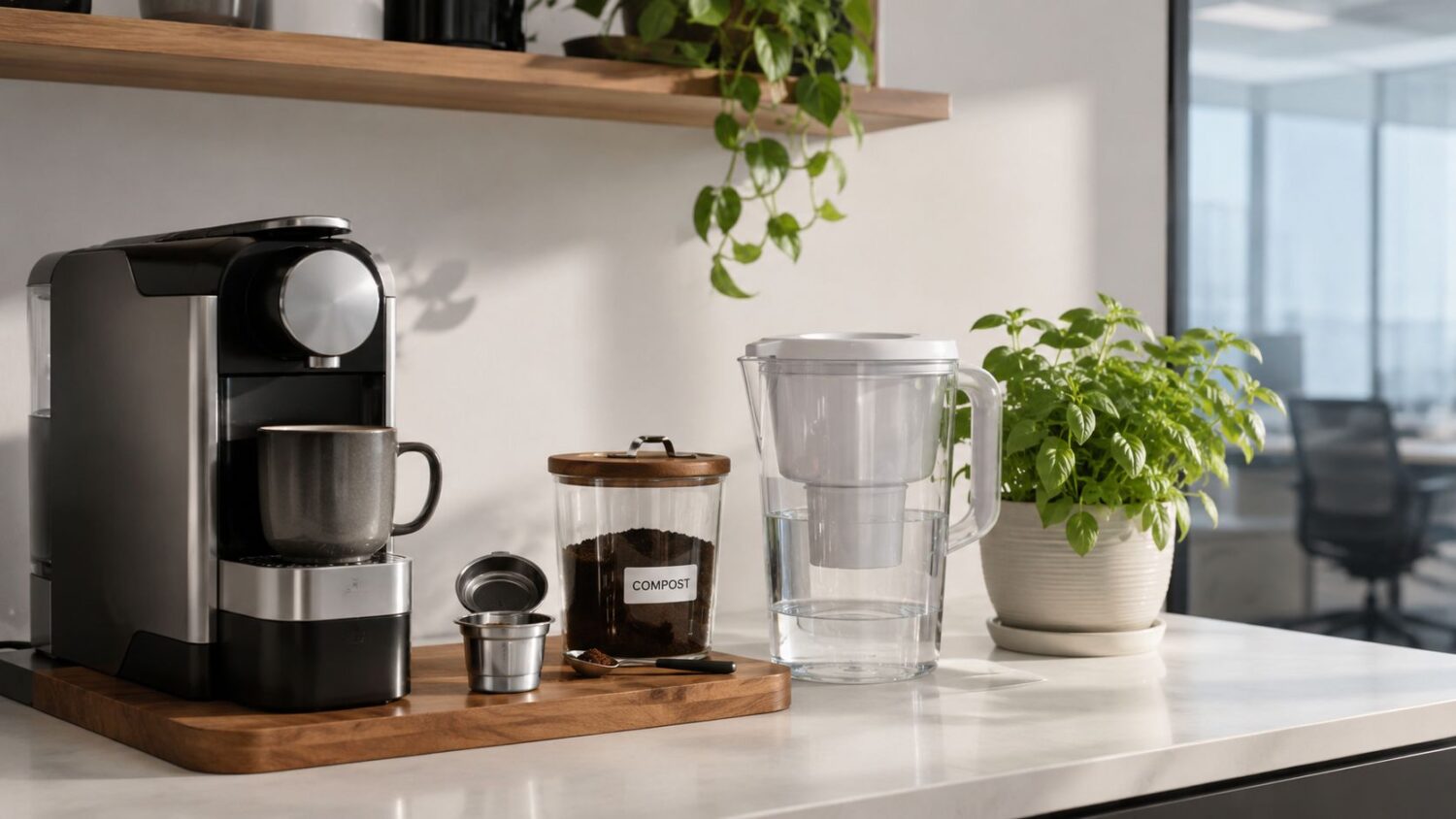
The coffee machine is where waste reduction becomes concrete. It's also where most homes and small offices leak money because they treat the brew routine as separate from the waste routine. It isn't separate. The pod, the water, the cleaning cycle, and the grounds all belong to the same system.
Reusable pods do the heavy lifting because they remove the recurring single-use capsule stream. That is why a stainless steel refillable pod makes more sense than a one-off “eco” substitute that still gets thrown away. If the fit is wrong, though, people hate the result, so the answer is a fit-matched pod and, when needed, a paper liner that helps with cleanup and reduces residue.
A quality water filter replacement routine pulls double duty. It improves taste and reduces the temptation to buy bottled water for the machine, and it also helps protect the brewer from mineral buildup. In a small office, that matters because machine failure creates both repair cost and replacement waste. A filter is not a luxury accessory. It's maintenance that keeps the system alive.
Descaling is the part people skip until the machine starts acting weird. That is the wrong order. A scheduled descaling cadence with a compatible solution extends machine life and helps avoid premature e-waste. If you already changed the pod and filter habits, the descaler keeps the machine from undoing your progress.
The last piece is the easiest to overlook, coffee grounds. They should not go straight into the trash if you have a compost route available, whether that's municipal organics, a backyard bin, or a community drop-off. Grounds are one of the cleanest everyday organics streams in a kitchen, and once you start collecting them, the habit usually sticks.
The common objection is that reusable pods leak or weaken the coffee. That complaint is real when the pod is poorly matched or flimsy. Fit-matched stainless refillable pods and a paper liner system solve most of that problem, while still cutting repeat waste. If you need the maintenance side to keep up, replacement water filters and descaling tablets are the consumables that make the whole setup run cleanly.
PureHQ Inc. fits naturally here because it sells reusable coffee pods, water filters, and descaling supplies built for Keurig and other common brewers. If your goal is to cut disposable waste without giving up a predictable brew, this is the category of accessory to buy once and maintain.
For a deeper product-specific look at pod swaps, reusable K-Cups for Keurig is the right companion resource when you're comparing pod styles and cleanup effort.
Premium Systems Versus Habit Only Approaches
A premium waste reduction system is not about spending more. It's about buying the few products that change behavior and then maintaining them on a schedule. The standard habit-only approach relies on good intentions, which usually means the same waste shows up in a slightly different container.
| Dimension | Premium System | Habit-Only |
|---|---|---|
| Waste stream | Stops recurring single-use items at the source | Keeps buying the same disposable items |
| Coffee setup | Reusable pod, filter routine, descaling schedule, compost route | Disposable pods, random cleaning, no compost plan |
| Measurability | Tracks waste, cost, and maintenance on a schedule | Tracks nothing or only bin fullness |
| Durability | Products and routines designed for repeated use | Short-term fixes that fade when convenience wins |
| Result | Lower residual waste and fewer repeat purchases | Same disposal pattern, just with more guilt |
Singapore's decade-long decline in per-capita waste and the UK government's structured waste benchmarks show the same thing from different angles. The UK government reported that by 2016/17 versus a 2009/10 baseline it had reduced waste by 32%, diverted 87% of waste from landfill, and recycled 59% of total waste, while local authority collected waste sent to landfill fell by 72% by weight since 2010/11 (UK waste strategy). Structured systems outperform loose intentions because they change defaults, procurement, and handling.
The objections usually sound like this. Reusable pods are a hassle. Fine, but so is hauling trash you could have prevented. Filtered water tastes flat. Then your filter or machine setup is wrong. Composting in an apartment feels impractical. Then you use a countertop caddy or a community drop-off instead of pretending the trash can is a compost bin.
San Francisco is the useful reality check. The city announced a zero-waste-to-landfill goal in 2002, built the first and largest urban food-waste composting collection program in the United States, and collected more than a million tons of compostable material for local compost use before reaching nearly 80% waste diversion in 2012 (World Bank). That timeline is a warning and a guide. Good systems take time, but they only work when the parts fit together.
Communicating Results and Taking the Next Step
Report waste reduction the way you'd report any other operating metric. Use a one-page monthly summary, a visible diversion tracker, and a quarterly review that shows cost saved, material avoided, and maintenance items due. That keeps the program from drifting into “nice to have” territory.
If you store replacements or brew supplies in jars or bins, there's another easy habit that supports the same mindset, and how to repurpose candle jars is a practical reference for reusing sturdy containers instead of tossing them. Small reuse decisions like that reinforce the same discipline you need for coffee accessories and compost collection.
The next move is simple. Replace the disposable path with the reusable one, keep the machine maintained, and track the waste you no longer create. That means reusable K-Cups or stainless refillable pods, water filter replacements, descaling solutions, and the compost-friendly accessories that keep the routine clean. Shop the setup that turns a daily habit into a measurable reduction program, not a pile of better-looking trash.
PureHQ Inc. makes reusable coffee pods, water filters, descaling solutions, and related accessories for common Keurig and similar brewers, so you can cut disposable waste without making your morning routine harder. If you want a cleaner brew setup that supports real waste reduction at home or in a small office, visit PureHQ Inc. and choose the parts that fit your machine.

