
Coffee Machine Care
Basket Filter Coffee: What It Is and How to Brew Better
Oct
The most popular advice about basket filter coffee starts in the wrong place. Brewers usually change the grind, dose, or water temperature when a cup tastes weak, bitter, or sour. Yet the basket itself controls how water travels through the grounds, so replacing a flat-bottom basket with a generic alternative can change the coffee before you touch the recipe.
That matters whether you brew with an automatic drip machine, a pour-over setup, or a reusable basket. The right way to think about the equipment is simple: the basket shapes flow, the filter material controls what reaches the cup, and the recipe determines how you tune the result. Even questions such as matcha vs coffee comparison become easier to answer when you understand how brewing method changes the drink, rather than treating coffee strength as a property of the bean alone.
Why Your Coffee Filter Basket Matters More Than You Think
A filter basket isn't just a holder that catches wet grounds. Its bottom shape, outlet pattern, depth, and fit influence how water contacts the coffee bed and how quickly the brewed liquid leaves it. A flat-bottom basket lets water spread across a broad bed, while a semi-conical design directs flow toward a narrower outlet region. Those different paths can produce different extraction behavior with the same coffee.
The practical consequence is easy to miss. You can keep your coffee, water volume, grind setting, and machine unchanged, then install another basket and taste a cup that seems thinner, harsher, or more intense. The equipment hasn't merely changed the appearance of the brewer. It has changed the hydraulic conditions inside it.
Practical rule: Treat basket geometry as part of the recipe, not as a replaceable piece of hardware with no effect on flavor.
This guide answers three useful questions. First, what does a basket filter do? Second, how do flat-bottom, cone, paper, metal, and paper-lined reusable options differ? Third, how can you adjust a basket filter coffee recipe without changing several variables at once?
The historical story helps explain why broad basket shapes became common. The brewing section then turns that history into a physical model you can use at home. Finally, the comparison and troubleshooting sections connect taste, cleanup, cholesterol considerations, waste, and compatibility without pretending that one filter suits every brewer.
The goal isn't to hand you a single universal recipe. It's to give you a reliable way to diagnose the cup. Once you know whether the problem comes from geometry, filtration, flow, or grind, you can make one sensible adjustment instead of chasing equipment randomly.
From Melitta Bentz to the Modern Drip Basket
Modern basket filtration began with a household problem: brewed coffee often carried sediment into the cup. In 1908, German homemaker Melitta Bentz created a paper filter prototype by perforating a metal container and using blotting paper from her son's school notebook to separate brewed coffee from grounds. Germany's Imperial Patent Office registered the invention as utility model No. 347895, describing a coffee filter with a downward-curved base, a drainage opening, and a loose filter insert, as documented by the Museum Digital record of the Melitta filter.
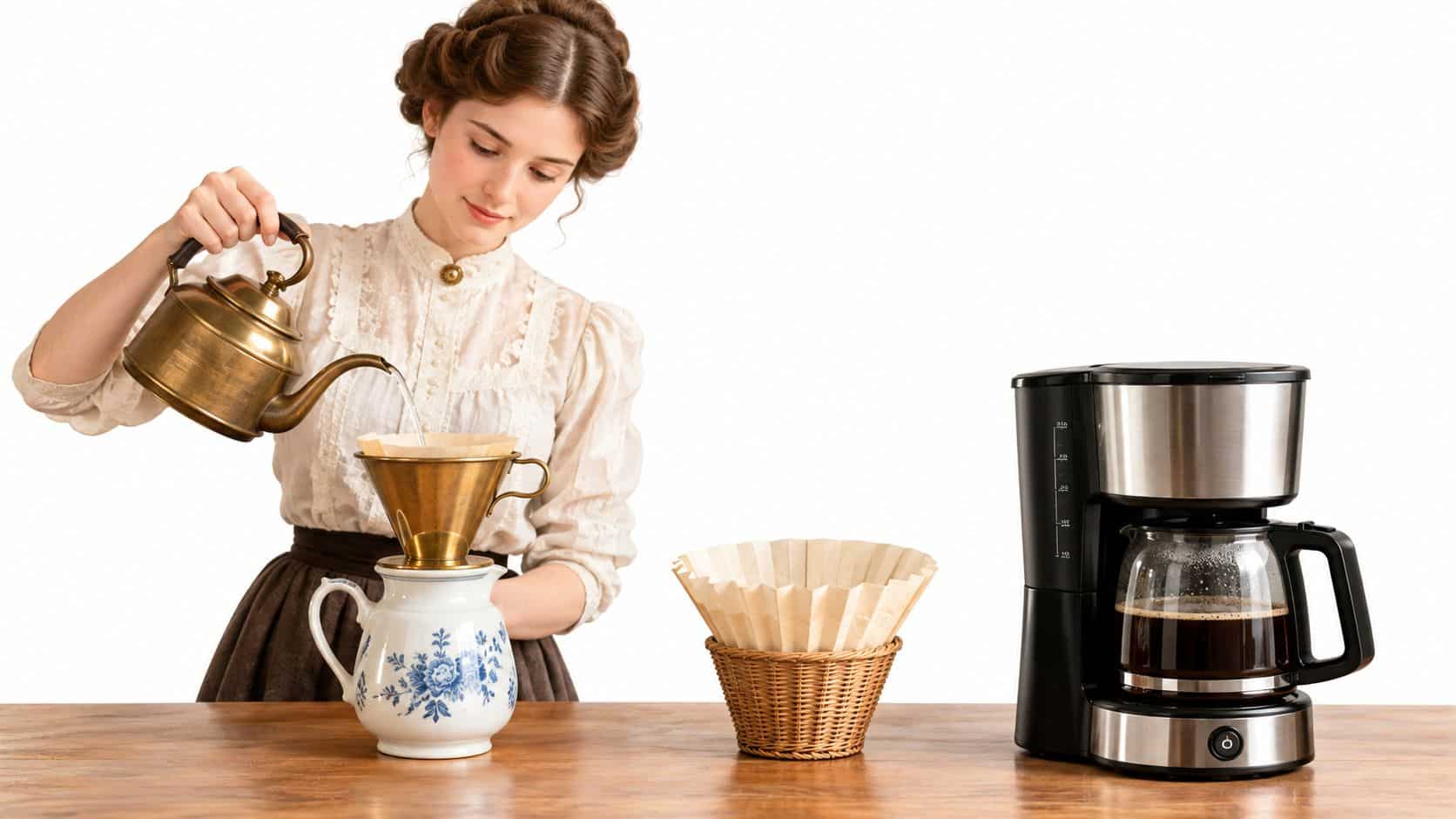
The company producing Melitta filters was established that same year and expanded rapidly. The early round filter stayed in production until the 1970s, while later developments helped establish the flat-bottom and basket-style paper formats used in automatic drip machines.
That evolution changed the brewing action itself. Linen-bag brewing and unfiltered pot methods could allow more grounds and sediment into the drink. A paper-lined basket introduced a disposable porous barrier, allowing gravity to move hot water through a bed of ground coffee while the paper retained much of the solid material.
Why the broad bed still matters
The modern flat-bottom basket isn't a historical accident. Its broad surface supports a relatively even coffee bed, while the paper keeps fine particles and some oils from passing into the cup. Automatic drip machines still depend on that basic relationship between water delivery, coffee depth, drainage, and filtration.
The design is therefore less a relic than a practical engineering solution. Manufacturers can refine the hole pattern, paper, dimensions, and materials, but the central idea remains stable: hot water enters above the grounds, travels through them, and exits through a controlled filter path.
That history also explains why a basket replacement deserves more attention than its shape on a product page might suggest. A small change in the container can change the way water moves through the bed, which brings us to the two parts working together inside every brew.
What a Basket Filter Actually Does During the Brewing
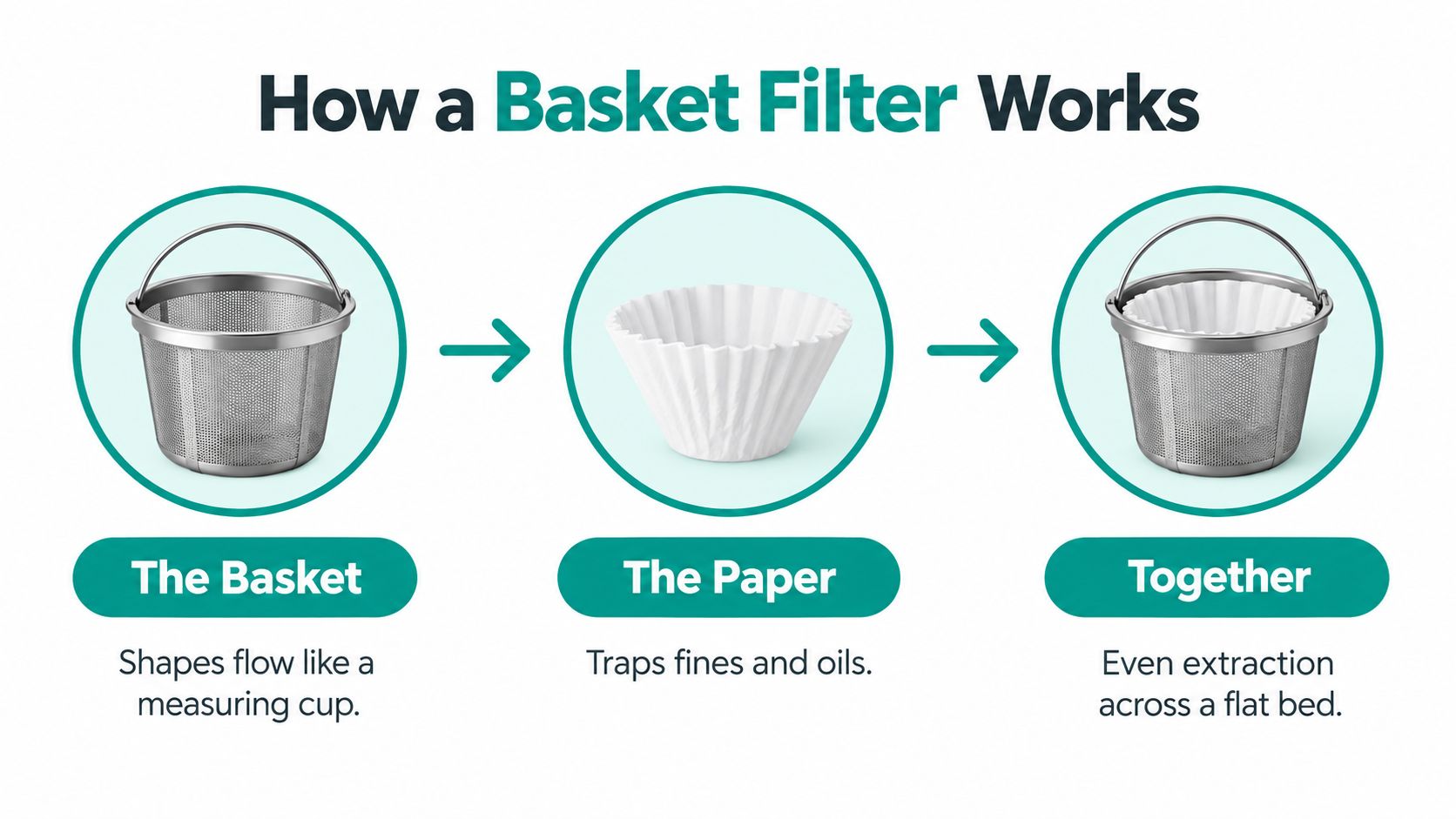
Think of the basket as a measuring cup that shapes flow. Think of the paper as a strainer that holds back fines and some oils. Neither part works alone: the basket supports the bed, and the paper creates the porous barrier that separates brewed coffee from spent grounds.
A typical automatic drip basket uses a broad base with drainage openings. Water entering near the center can spread outward across the coffee before it leaves through those openings. The basket's diameter determines how wide the bed becomes, while its depth affects how water moves through the grounds. The filter paper needs to match the basket closely enough to sit against the walls without folding, collapsing, or leaving channels around the edge.
A single brew in physical terms
Imagine placing ground coffee into a dry paper liner inside the basket. The machine releases hot water onto the center of the bed. The grounds absorb some water and swell, while the remaining liquid moves through the spaces between particles. The paper catches much of the fine material, and the basket openings determine where the liquid can leave.
If the paper sits too loosely, water may bypass the coffee along the sides. If the openings become blocked, the liquid stays in contact with the grounds longer and may produce a harsh or heavy cup. If the basket is too shallow for the dose, the bed can become crowded and restrict drainage.
Many home drip machines use baskets marketed for roughly 8 to 12 cups, but the label alone doesn't tell you whether a replacement fits your brewer. Measure the basket's interior and check the filter's intended compatibility. Diameter, wall shape, base width, hole placement, and machine clearance all matter.
Basket, paper, and coffee form one system
The paper doesn't remove grit after brewing. Its porosity interacts with particle size and affects which compounds pass into the beverage. The basket doesn't support that paper. Its geometry determines how evenly water reaches the coffee before filtration begins.
That system view makes the next comparison more useful. A flat-bottom basket and a cone filter may both hold ground coffee, but they don't send water through the bed in the same way.
Flat Bottom vs Cone Filters and How Geometry Changes the Cup
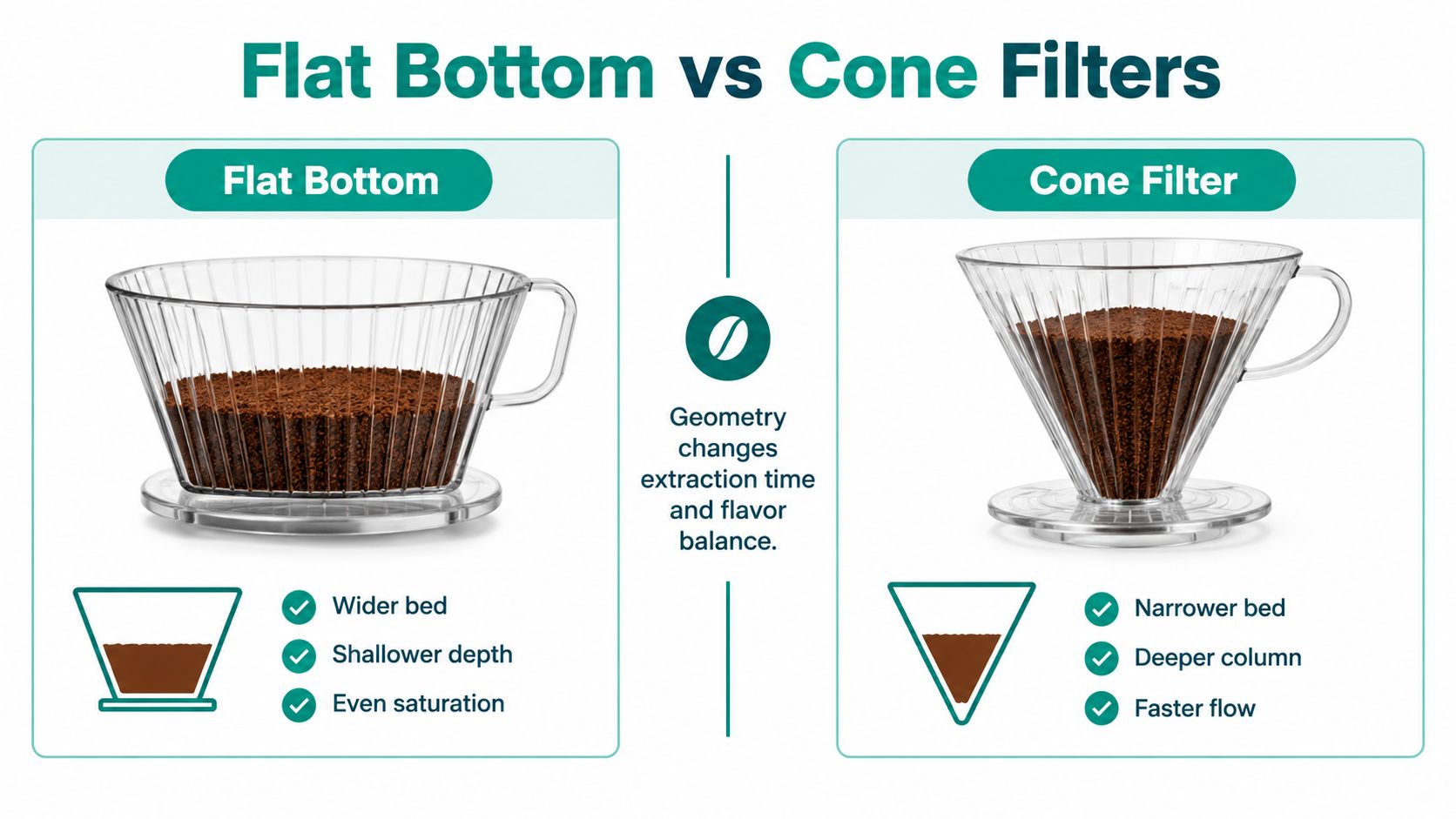
A flat-bottom basket spreads water across a wider coffee bed before drainage. A cone filter creates a narrower, deeper column and directs flow toward a smaller outlet region. Neither format wins every brew, because each one changes the balance between wetting, residence time, drainage, and mass transfer.
Research from the UC Davis Coffee Center found statistically significant sensory differences between semi-conical and flat-bottom baskets. The semi-conical basket produced significantly higher total dissolved solids, or TDS, and the researchers estimated a sensory difference threshold of 0.24 percentage points of TDS in their testing, as reported through the UC Davis Coffee Center publication page.
What the geometry changes
In a flat-bottom basket, water striking the center can move radially across the bed before leaving through central or distributed openings. In a semi-conical basket, the narrower lower region concentrates flow toward the outlet. That changes local wetting and the time water spends moving through different parts of the coffee.
A higher TDS reading means the beverage contains more dissolved coffee material, but it doesn't automatically mean the coffee tastes better. The same coffee can taste stronger yet less balanced, or it can seem more extracted in one basket and more hollow in another. Strength and extraction are related, but they aren't identical.
Change the basket shape first, then re-check the grind and dose. Don't assume the old recipe survived the hardware swap.
A brewer who replaces a correctly fitted flat-bottom basket with a generic cone may also create fit problems. The new basket can sit too high, leave gaps around the paper, or place its outlets in a different position. These issues can create bypass, restricted flow, or inconsistent wetting even when the replacement appears to fit.
For a practical reference on how conical designs alter brewing behavior, see this explanation of the coffee maker cone filter. The useful lesson isn't that cone filters are superior or inferior. It's that geometry belongs in your brewing notes, alongside grind size, dose, water volume, and brew time.
Paper, Metal, and Paper-Lined Reusable Basket Filters Compared
Filter choice creates a real trade-off between cup texture, cleanup, consumable waste, and filtration. Paper usually produces a cleaner cup with less sediment, metal allows more body and oil through, and a paper-lined reusable basket combines a rigid reusable structure with a disposable barrier.
Health considerations deserve careful wording. A peer-reviewed review reports that paper filtration removes most coffee diterpenes such as cafestol and kahweol, compounds associated with LDL-cholesterol concerns, while unfiltered preparations retain more of them. A paper-filter study measured cafestol concentrations from 1.62 to 2.98 milligrams per liter and kahweol concentrations from 0.73 to 1.96 milligrams per liter, with micro-perforated papers producing the highest concentrations among similarly sized papers, according to the peer-reviewed diterpene study.
| Option | Taste & Body | Diterpenoid Transfer | Waste & Cost | Cleanup |
|---|---|---|---|---|
| Paper-only disposable setup | Clean, lighter body, low sediment | Paper filtration removes most diterpenes, but levels vary with porosity and grind | Ongoing paper use creates consumable waste and recurring purchases | Fast disposal, with little rinsing |
| Reusable metal mesh basket | Fuller body and more sediment | More oil and diterpene transfer than a properly fitted paper filter is possible | Lower recurring consumable use, but the basket requires washing and has a manufacturing footprint | Grounds must be emptied and the mesh rinsed |
| Paper-lined reusable basket | Cleaner than open mesh, with more structure than a loose paper setup | Paper liner limits transfer, while the basket supports the filter | Uses paper but retains a reusable support, creating a middle path | Easier than cleaning exposed mesh, though both liner and basket need attention |
Choose according to the problem you're solving
People monitoring cholesterol may reasonably prioritize a properly fitted paper filter or paper-lined reusable basket, but a filter isn't medical treatment. The review of coffee filtration and diterpenes describes the health difference between filtered and unfiltered coffee, while also emphasizing that personal medical context matters.
People who value body and minimal disposable material may prefer metal. They should expect more sediment and a different mouthfeel, not treat those effects as defects. People who want simpler cleanup without giving up a reusable support can consider paper liners.
Environmental performance also depends on the full routine. Paper manufacturing, disposal, washing, basket lifespan, and production materials all matter. A reusable basket isn't automatically greener, and paper isn't automatically wasteful in every household. Compare the option you'll maintain consistently, not an abstract category. A practical guide to that choice is this reusable coffee filter versus paper comparison.
A Repeatable Brewing Baseline for Basket Filter Coffee
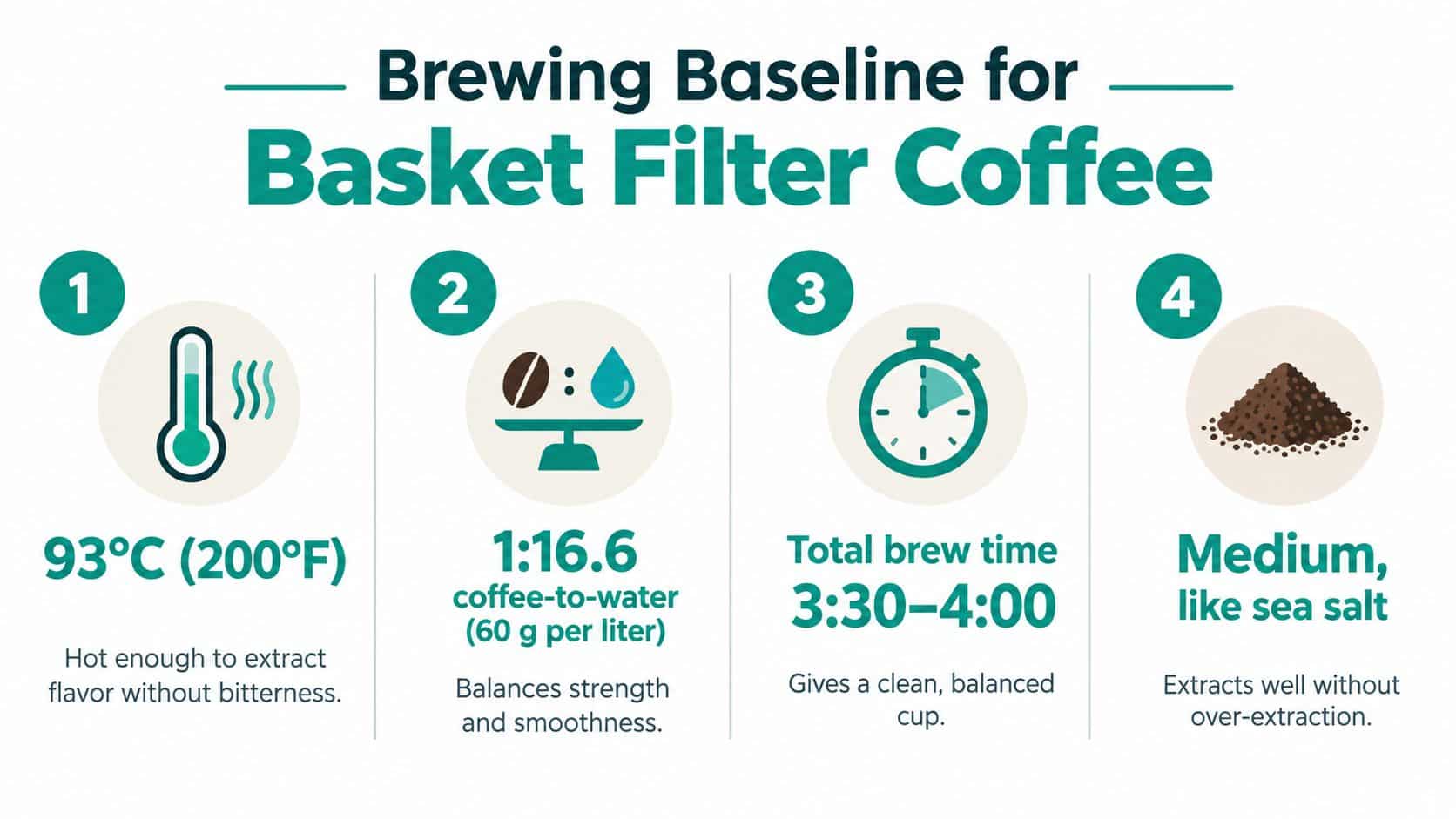
Start with 93 °C water and a 1:16.6 coffee-to-water ratio, equivalent to about 60 grams of coffee per liter, as a controlled baseline. Published filter-coffee research uses these parameters as a reproducible starting point for evaluating basket, grind, and flow effects, as described in the controlled drip-brewing research.
This isn't a magic recipe. It gives you a stable reference so that your next adjustment means something. If you alter temperature, grind, dose, and basket shape at the same time, you won't know which change produced the new flavor.
Use this order of operations
Confirm the dose and water. Weigh both rather than relying on a scoop or a machine's cup markings. Keep the ratio fixed while you diagnose flow.
Check the basket and paper. Make sure the filter sits flat, the basket matches the brewer, and the drain openings are clear. A blocked outlet can imitate an overly fine grind.
Hold the brew conditions steady. Record brew time, beverage mass, and the basket shape. If you measure TDS, compare repeated brews at a similar beverage mass.
Adjust grind before temperature. A weak, fast cup often needs a finer grind or better wetting. A slow, harsh cup may need a coarser grind or less restrictive paper.
Change temperature only after flow behaves consistently. A controlled study tested 87 °C, 90 °C, and 93 °C while adjusting grind and flow to keep TDS and extraction yield constant. Under those conditions, the final sensory profiles changed little, which makes temperature a broad control rather than a precise fix.
The basket is the housing and the recipe is the program. They need to work together. If you change the housing, repeat the baseline before deciding that the coffee itself has failed.
Common Basket Filter Problems and How to Fix Them
Most basket complaints have a mechanical cause before they have a bean problem. Leaks, watery cups, and gritty sediment usually point to fit, flow, paper, or particle size. Diagnose the path first, then change the recipe.
Leaking around the paper
A paper filter that collapses, folds, or leaves a visible gap can let water bypass the grounds. The basket may be the wrong size, or the replacement may have a different wall angle from the brewer's original design.
Remove the paper and compare its base and side profile with the basket. Use a correctly sized liner, seat it flat, and check that the basket locks into the machine without lifting or tilting. Run a water-only cycle and watch whether liquid escapes around the paper or follows the intended drain path.
If your machine accepts a compatible gold-tone carafe basket, PureHQ Inc. offers a reusable basket option alongside disposable paper liners, so you can test the support and filtration components separately.
Weak or watery coffee
A fast brew can result from a grind that is too coarse, insufficient contact, uneven wetting, or a basket that sends water through only one channel. Start by keeping dose and water fixed. Inspect the used bed after brewing. A dry patch suggests bypass or uneven distribution rather than a simple strength problem.
Move the grind slightly finer and repeat the brew. If the result improves without becoming bitter, the previous flow likely moved too quickly. If the cup remains thin while the brew runs slowly, inspect the basket outlets and paper porosity instead of continuing to grind finer.
Gritty sediment
Fine particles can pass through a metal mesh or escape through a poorly fitted paper liner. Very fine coffee can also overload the filter and restrict drainage. Empty the basket, rinse every opening, and check whether the paper has torn or folded.
A reusable filter and a descaling product solve different problems. The filter controls particles and flow through the coffee bed, while descaling helps remove mineral buildup from the brewer's water path. For replacement compatibility, use this guide to replace a coffee filter basket.
Validate every fix with one water-only run or one controlled coffee brew. A changed taste is useful only when the physical change is clear.
Keep Brewed up and Your Basket Brewing Better
A basket filter works best when you treat it as part of a routine rather than as a one-time purchase. Three ideas matter most: basket geometry changes extraction, paper and metal produce different combinations of clarity and body, and a stable baseline makes troubleshooting more reliable than constant equipment swapping.
Maintenance protects that stability. Rinse reusable baskets soon after brewing so trapped grounds don't dry into the mesh or openings. Check the paper seat before each brew, especially after changing brands or basket sizes. Keep the machine's water path clean so mineral buildup doesn't add another source of restricted flow.
A practical setup might combine a reusable gold-tone basket for selected coffees, disposable paper liners when you want a cleaner cup, and a universal descaling solution or cleaning tablets for the brewer itself. Those tools address different parts of the system, so buying one doesn't replace the others.
A consistent basket, a fitted filter, and a repeatable cleaning habit will teach you more than a drawer full of untested replacements.
Record the basket shape, filter material, coffee dose, water volume, grind setting, and sensory result. When a cup changes, compare those notes before blaming the coffee. If you move from paper to metal, or from a flat-bottom basket to another geometry, treat the change as a new recipe and re-check flow.
Visit the PureHQ lineup to compare reusable baskets, disposable liners, and descaling products for your brewer. Pair any new basket with a regular maintenance routine so the machine keeps the intended water path intact.
PureHQ Inc. offers reusable gold-tone carafe baskets, compatible disposable paper liners, and universal descaling and cleaning products for home and small-workplace brewers. Visit PureHQ Inc. to choose the basket-and-filter combination that fits your machine and brewing priorities.

