
Coffee Machine Care
Water Filter Pitcher Lead Removal for Safer, Better Coffee
Jun
Lead in tap water is hard to judge because your senses can't help much. Water can look clear, smell normal, and still pick up lead from plumbing on the way to your glass or your coffee maker. That's why the most useful starting point isn't a flavor claim. It's certification.
A strong benchmark comes from NSF certification testing for lead reduction. To earn certification, products are challenged with water containing 150 ppb lead, which is 10 times higher than the U.S. EPA's maximum allowable level in drinking water, and they must keep performing through the filter's claimed life. That single fact changes how you should shop for a water filter pitcher. Don't ask only, “Does this pitcher improve taste?” Ask, “Is this specific model certified to reduce lead?”
The Hidden Danger in Your Drinking Water
A homeowner fills a glass from the kitchen tap, then tops off a Keurig reservoir before work. Nothing seems wrong. The water is cold. The coffee brews. The day starts. But if the plumbing is the source of contamination, that routine can carry risk without any visual warning.
Lead creates exactly that kind of problem. It's an exposure issue that often feels abstract until you realize how ordinary the pathway is. Water can pick up lead from parts of a home's plumbing system, and the age of the home doesn't always tell the whole story. Renovations, partial repairs, fixtures, and service lines can all complicate the picture. For many families, the hardest part is uncertainty. You may not know whether your tap water is fine, borderline, or something that needs immediate action.
Why a pitcher matters right away
When people hear “lead in water,” they often assume the only real fix is a major plumbing project. Long term, plumbing work may be the right answer in some homes. But public guidance also treats pitcher filters as an immediate point-of-use safeguard.
Denver Water's lead filter program provides pitcher-and-replacement-filter kits to homes with lead service lines. That matters because it shows how utilities use pitchers in practice. Not as a magic cure for infrastructure problems, but as a practical way to reduce exposure at the tap while larger issues are addressed.
Practical rule: If lead is your concern, a generic “better tasting water” pitcher isn't enough. You need a pitcher specifically certified for lead reduction.
That distinction is where many homeowners get tripped up. A basic filter may help with chlorine taste and odor. A lead-removing pitcher is a narrower, more technical category. The useful news is that this category exists, it's widely available, and it gives you a fast first step you can take today without hiring anyone or altering your plumbing.
The concern gets bigger when coffee enters the picture
If you brew coffee at home, your exposure question isn't limited to the water you drink straight. It also includes the water sitting in your machine reservoir, passing through a pod brewer, or heating inside a drip system. So the question becomes practical, not theoretical. Is the water you use every morning both safer and better for flavor?
A certified water filter pitcher can help answer yes, as long as you choose the right model and keep up with filter replacement.
How a Simple Pitcher Filter Removes Lead
Many people look at a gravity-fed pitcher and wonder how something so simple can handle a heavy metal. That skepticism is healthy. A lot of packaging leans on vague phrases like “advanced filtration” or “multi-stage system” without telling you what's happening inside.
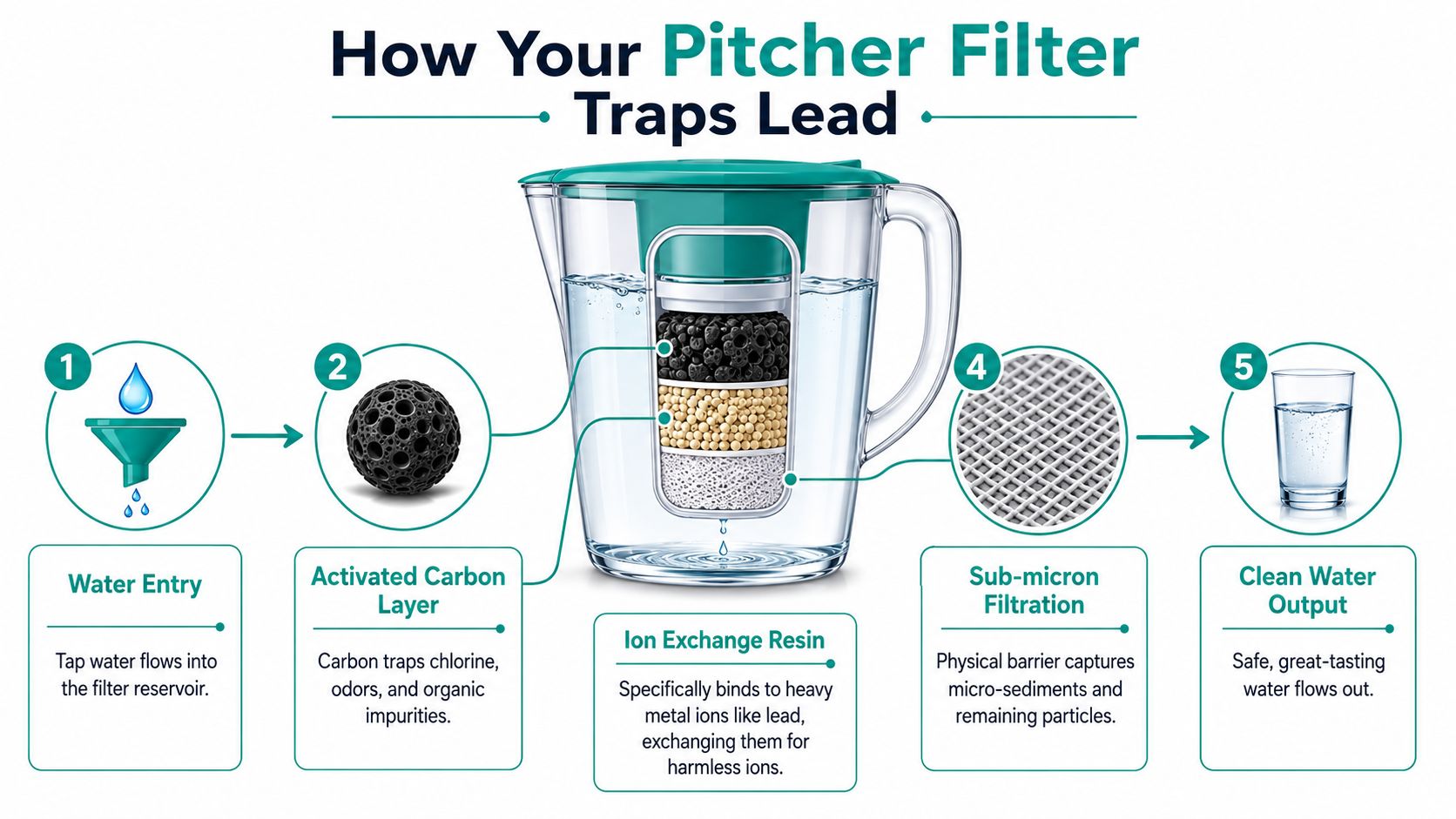
The short answer is that lead-removing pitchers usually rely on a combination of activated carbon and ion exchange media. Each part does a different job.
Activated carbon works like a porous trap
Activated carbon is best known for improving taste. It acts as an enormous sponge with countless tiny holes. As water moves through, the carbon can hold onto chlorine, odor compounds, and some organic impurities.
That's why filtered water often tastes cleaner even before you get into lead removal. If your coffee has a swimming-pool note, a dull finish, or a sharp chemical edge, carbon filtration is often doing the first visible piece of cleanup.
Ion exchange handles lead differently
Lead removal usually depends on ion exchange resin, which works more like a row of tiny trading stations than a screen. The resin beads attract certain dissolved metal ions and swap them for other ions that are less concerning in this context. A simple analogy is a magnetized coat check. Lead comes in with the water, the resin grabs it, and a different ion takes its place.
That's why lead removal isn't the same as straining out sand. You're not just blocking chunks. You're chemically capturing dissolved contaminants.
A pitcher that removes chlorine well isn't automatically a pitcher that removes lead well.
Some products now publish very strong lead-reduction claims. Brita says its Elite filter removes 99% of lead, lasts 6 months, and is equivalent to up to 1,800 16.9-ounce bottles, while Clearly Filtered publishes 99.97% lead removal with a 100-gallon rated capacity. Those figures show how far pitcher filtration has moved beyond basic taste improvement.
Why the “simple pitcher” idea can mislead shoppers
A lead-removing pitcher looks similar to an ordinary pitcher because the housing is simple. The media inside is what matters. That's where marketing can confuse people. Two pitchers can sit side by side on a shelf, look almost identical, and perform very differently.
Use this mental model when you shop:
- Carbon improves flavor: It's often the reason water tastes and smells better.
- Ion exchange targets dissolved lead: This is the part that makes lead reduction possible.
- Certification confirms the design works: Without verification, you're still relying on marketing language.
Once you see a pitcher as a small treatment system instead of just a plastic container, the category makes a lot more sense.
Decoding the Certification That Guarantees Safety
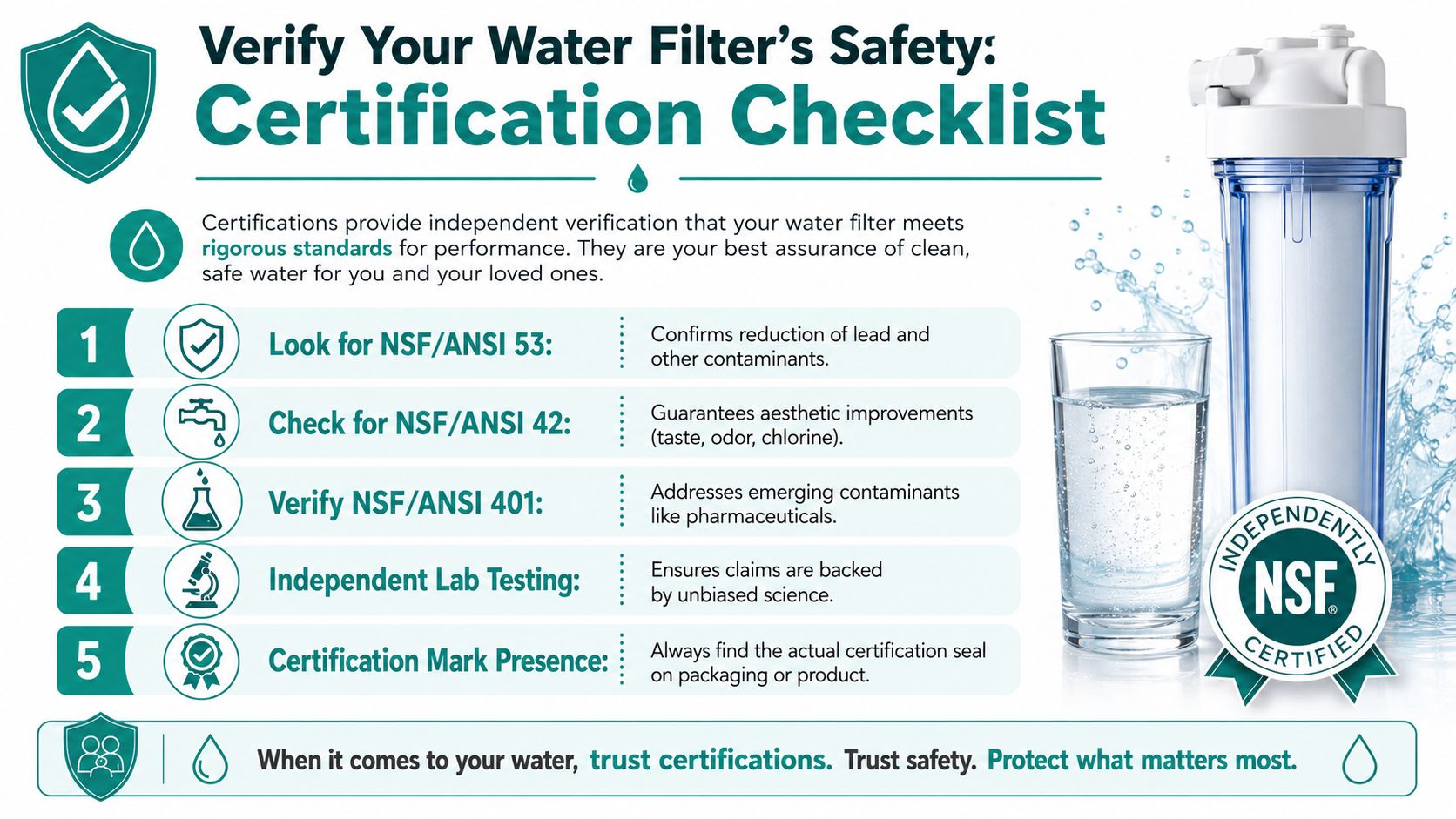
Lead in drinking water has no safe level for children, which is why the label on a pitcher matters more than the shape of the pitcher or the promises on the box. For lead concerns, the certification to look for is NSF/ANSI 53 with lead specifically listed. If that exact claim is missing, treat the product as a taste filter, not a lead filter.
What the standard means in practice
Certification turns a marketing claim into a verified one. The filter has to be tested by an independent certifier such as NSF or WQA under a defined protocol, and the contaminant has to be named in the certification details. “Reduces contaminants” is too vague. “Certified to NSF/ANSI 53 for lead reduction” is specific enough to check.
NSF explains that NSF/ANSI 53 covers health-related contaminant reduction claims, including lead when that claim appears on the product listing or packaging. That distinction trips up many shoppers. A brand can be certified for one contaminant and not another, so the word “certified” by itself is not enough. You need certified for lead.
Why that matters more than the front label
A coffee maker analogy helps here. Buying a Keurig or Ninja does not tell you whether the water going into it is safe. It only tells you how the machine brews. A pitcher works the same way. The container is just the housing. The certification tells you what the filter media inside has been proven to remove.
That matters for coffee quality too. Water that still contains lead can create a safety concern no matter how good the beans are, while water treated only for chlorine may improve flavor but still miss the contaminant many homeowners care about most.
What certification does, and does not, promise
Certification is a performance check over the filter's rated life, not just on the first few fills. In plain terms, the test asks whether the filter can keep reducing lead until it reaches its replacement point, assuming you use it as directed.
It does not mean every filter works forever or under every possible water condition. It means the product met a published standard under specific test conditions. That is why certified claims are more useful than broad phrases like “cleaner water” or “better tasting water.”
A fast label-reading checklist
Use this short screen before you buy:
- Lead is named directly. Do not rely on broad wording like “impurities” or “heavy metals.”
- NSF/ANSI 53 appears on the package or product page.
- The certifier is identified. NSF, WQA, or another accredited organization should be listed.
- The replacement interval is clear. A lead claim only applies through the product's rated service life.
For Keurig and Ninja owners, one more detail helps. If you fill your reservoir from a pitcher, verify the pitcher's lead certification first, then keep up with filter changes on schedule. That gives you two benefits at once: water with verified lead reduction for safety, and better-tasting brew water for coffee that is not dulled by common tap-water off-notes.
Real-World Performance and Proper Maintenance
Many shoppers assume a certified filter will perform the same way forever, no matter how they use it. That's the mistake. Certification tells you the filter can work under tested conditions. Daily protection still depends on correct use, timely replacement, and matching the product to your water situation.
A review of 23 studies on NSF/ANSI 53-certified filters found strong real-world results. In field studies, 99% (1,512 of 1,528) of filters reduced lead to certification benchmarks. In laboratory challenge tests, 61% (91 of 150) met the benchmark, often because researchers pushed conditions beyond certified operating limits. The review also identified major reasons for underperformance, including high lead concentration, particulate form and size, and incorrect use or missed replacement.
What that means in a normal kitchen
The reassuring part is clear. Certified filters can perform very well in homes. The caution is just as clear. They aren't maintenance-free.
If you keep using an expired filter because the water “still tastes okay,” you're judging safety by the wrong signal. Taste can stay acceptable after contaminant performance has weakened. That's why replacement timing matters so much.
Common ways people undercut their own filter
A few habits cause avoidable problems:
- Delaying replacement: The pitcher doesn't know you're trying to save money. Once the filter is spent, protection can drop.
- Using the wrong cartridge: Some brands make multiple filter tiers, and not every cartridge is certified for lead.
- Ignoring unusual water conditions: If lead levels are very high, a pitcher may not be the right endpoint.
- Treating taste as proof: Better flavor doesn't confirm lead reduction.
Maintenance reminder: Put the replacement date on your calendar the day you install a new filter.
Another subtle issue is inconsistency. If one family member fills the coffee machine from the filtered pitcher and another tops it off from the sink, the routine breaks down. The safest plan is simple and repetitive. Use the same filtered source for drinking water, cooking water when appropriate, and coffee brewing water.
Aging filters don't all behave the same way
Different models age differently, and they don't all remove the same extra substances along the way. That means you shouldn't assume one pitcher's behavior predicts another's. The owner's manual and certification listing matter more than brand familiarity alone.
A lead-removing pitcher is at its best when you treat the filter like a consumable safety component, not a permanent insert.
Why Safer Water Is the Secret to Better Coffee
Coffee people often focus on beans, roast level, grind size, and brew temperature. All of that matters. But water decides more than most home brewers realize. If the water tastes off, the coffee usually tastes off too.
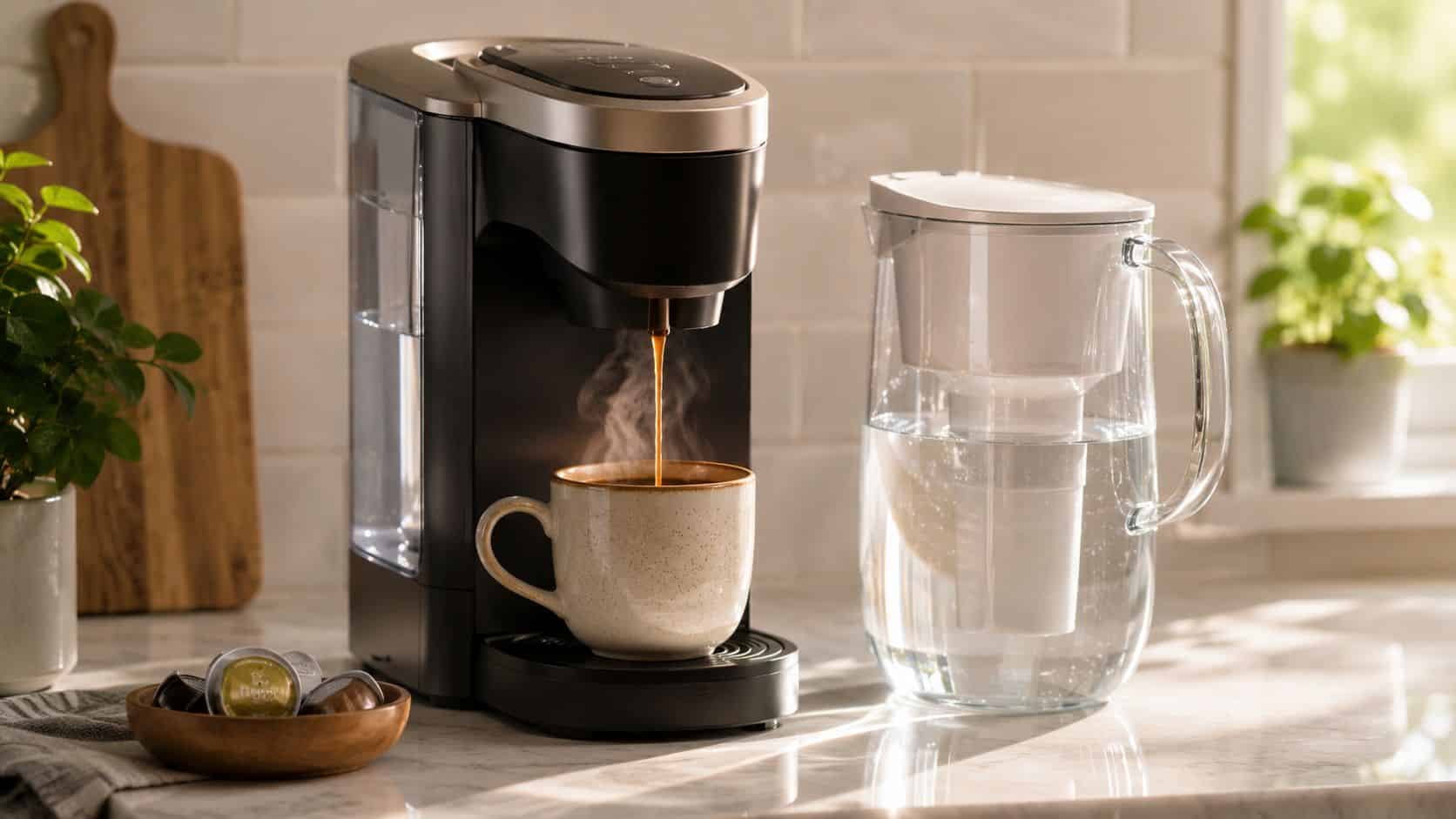
For Keurig and Ninja users, this matters twice. First, you're drinking the water itself after it passes through coffee grounds or a pod. Second, the water becomes the extraction medium that pulls flavor from the coffee. If the source water carries chlorine taste or other unwanted characteristics, the cup can come out flat, harsh, or muddy.
Safety and flavor aren't separate issues
A lot of buying guides split these topics apart. They talk about lead as a health problem and taste as a luxury concern. In the kitchen, they overlap. Water that's chosen carefully for certified lead reduction also often gives you a cleaner base for brewing.
That doesn't mean every lead-certified pitcher will affect flavor in the same way. A peer-reviewed study of nine pitcher models found substantial differences in what they removed beyond target contaminants, including fluoride and minerals such as calcium and magnesium. That's an important point for coffee drinkers because minerals influence how water extracts flavor.
What Keurig and Ninja owners should do
If you use a pod machine or a drip-style home brewer, the practical move is simple. Fill the reservoir with water from a pitcher specifically certified for lead reduction. Don't assume the machine's built-in taste filter, if it has one, does the same job.
For a broader home-brewing routine, this guide to improving water quality for coffee is a useful next read because it connects source water choices to brew quality in a way many general water-filter articles miss.
Here's the plain-language version for daily use:
- For morning coffee: Use pitcher-filtered water, not straight tap, when lead is a concern.
- For pod brewers: Check whether your machine's internal filter is mainly for taste, scale, or both. Don't treat it as automatic lead protection.
- For repeatable flavor: Keep your replacement schedule steady so your coffee doesn't drift from clean to dull over time.
A second layer can also make sense for some brewers. If you already use a certified pitcher for source water, an in-reservoir charcoal filter for a Keurig or Ninja can help with taste management inside the machine itself. Descaling products matter too, because mineral buildup changes brew performance even when your incoming water is safer.
A quick visual walkthrough can help if you want to connect water quality choices with cup quality and machine care.
The common objection from coffee drinkers
Some people worry that stronger filtration will strip too much from the water and leave coffee tasting thin. That concern isn't unreasonable. Filters don't all behave the same way, which is exactly why model-specific certification and replacement guidance matter. The answer isn't to avoid filtration. It's to choose a pitcher for the contaminant you care about and then watch how it performs in your brewer over time.
For most worried homeowners, safer water is not in conflict with better coffee. It's the starting point for it.
Comparing Pitchers with Other Lead Filtration Systems
A typical household is choosing between tradeoffs, not chasing every filter on the market. The right setup depends on three practical questions. How much water do you need each day? Are you allowed to install anything? Has testing or local plumbing history raised concern beyond ordinary caution?
Earlier sections covered why certification matters. Here, the useful comparison is what each system can realistically do in a home kitchen, especially if you are filling a coffee maker every morning.
Lead filtration system comparison
| System Type | Lead Removal Effectiveness | Upfront Cost | Maintenance | Best For |
|---|---|---|---|---|
| Certified pitcher filter | A good fit when the exact model is certified for lead reduction and the cartridge is replaced on schedule | Usually lower than installed systems | Regular cartridge changes and basic cleaning | Renters, small households, quick setup, water for drinking and coffee brewing |
| Faucet-mounted filter | Can reduce lead if the exact model is certified for it | Moderate | Cartridge changes plus fit and compatibility checks | Households that want filtered water on demand |
| Under-sink reverse osmosis | Better suited to higher-concern situations and water conditions beyond what a pitcher is typically tested to address | Highest | More involved filter changes, installation, and ongoing upkeep | Homes with elevated lead concerns or households that want larger-volume treatment |
Where pitchers make the most sense
A pitcher is often the easiest first layer of protection because it asks very little of your kitchen. Fill it, store it, and use the filtered water where it matters most.
That simplicity matters for coffee.
If you own a Keurig or Ninja, a pitcher gives you control over the water going into the reservoir without asking you to modify the machine or your plumbing. That is useful because many brewer filters are designed mainly to improve taste or reduce scale. They should not be assumed to handle lead unless the manufacturer clearly says so. For a household trying to protect both safety and flavor, a certified pitcher can cover the source water while the machine's own filter handles in-machine taste issues.
Pitchers also avoid a common installation problem. Faucet filters only work if the tap shape and threading cooperate. Under-sink systems need space, access, and permission to install. A pitcher works in an apartment, a dorm-adjacent setup, or a small kitchen with one coffee station.
Where other systems pull ahead
A faucet-mounted filter is convenient for families who use a lot of filtered water throughout the day. It removes the wait that comes with refilling a pitcher, which can matter if you cook often, fill several bottles, and brew multiple pots or pods daily.
Reverse osmosis serves a different role. It is closer to treating all the water you draw from one tap, rather than preparing a smaller batch at a time. If a home has known lead plumbing concerns, troubling test results, or several water-quality problems happening together, a higher-capacity system may make more sense than relying on a countertop pitcher alone.
That does not make the pitcher useless. It means the pitcher may be one tool in a larger plan.
A practical way to choose
Choose the pitcher if you want a low-effort way to make safer drinking water and better coffee with no installation. Choose a faucet filter if convenience at the sink matters more than portability. Choose reverse osmosis if your water situation calls for a system that treats a larger volume and addresses more than one concern at once.
If you suspect the problem may be coming from aging fixtures, supply lines, or other plumbing components, it helps to talk with your water utility and a licensed professional. Homeowners in Texas can start with local Boerne plumbing experts to sort out whether the issue is the incoming water, the home plumbing, or both.
Coffee-focused buyers who want to compare filtration choices across different machines can also review this guide to choosing a water filter for an espresso machine. It is a helpful companion if your kitchen includes more than a basic drip brewer and you want water that protects both cup quality and equipment.
Your Guide to Buying and Using the Right Filter
Shopping gets easier when you strip it down to a short checklist. You don't need to memorize technical jargon. You need to verify the claim, match the pitcher to your routine, and keep the filter fresh.
Three buying checks that matter
- Start with certification: Look for NSF/ANSI 53 and make sure lead is explicitly listed, not implied by broad words like “contaminants.”
- Read the filter life carefully: Compare how long the cartridge is rated to last, then consider your use. A household that brews coffee, fills bottles, and cooks with filtered water will move through a filter faster than a casual user.
- Pick a usable size: A large pitcher is only helpful if it fits your fridge and you'll keep it filled.
Daily habits that protect performance
Once the pitcher is in your kitchen, routine matters more than brand excitement. Keep the reservoir and pitcher body clean. Replace the cartridge on schedule. Use the filtered water consistently for the uses you care about most.
If you're unsure about setup, maintenance, or what kind of machine filter belongs where, this water filter installation guide can help you sort out the practical side without overcomplicating the process.
A simple home routine usually looks like this:
- Fill the pitcher with cold tap water.
- Store it properly and refill before it runs dry.
- Use it for drinking water and coffee machine refills.
- Replace the cartridge before the rated life ends.
One last buying caution
Don't confuse “premium” with “lead certified.” Some expensive pitchers focus on flavor, some focus on broader contaminant reduction, and some remove minerals in ways that may or may not suit your coffee preferences. Read the certification details first, then decide whether the pitcher also fits your taste goals and kitchen habits.
For coffee drinkers, a pitcher is often the foundation. After that, accessories like in-machine charcoal filters or descaling solutions can help maintain flavor and machine performance over time.
If you want to build a cleaner coffee routine from the water up, shop PureHQ Inc. for compatible Keurig and Ninja water filters, reusable brewing accessories, and maintenance supplies that support better-tasting home coffee.

