
Coffee Machine Care
The Best Office Coffee Solutions: A Guide for Businesses
May
Office coffee looks cheap until it starts wasting time, supplies, and patience. That's why the jump in spending matters. Crafty's 2025 office coffee trends infographic reported that clients were spending 59% more on office coffee products than the prior year. Teams aren't throwing more money at coffee for fun. They're trying to solve a daily workplace problem that touches morale, workflow, and maintenance.
The mistake I see most often is treating the coffee maker as the whole decision. It isn't. The crucial decision is the system: brewer capacity, water source, filter quality, pod strategy, cleanup routine, and how much staff time the setup consumes every week. The best office coffee solutions aren't always the fanciest machines. They're the setups that people can use without lines, leaks, confusion, or constant rescue from the office manager.
The Hidden Costs of Bad Office Coffee
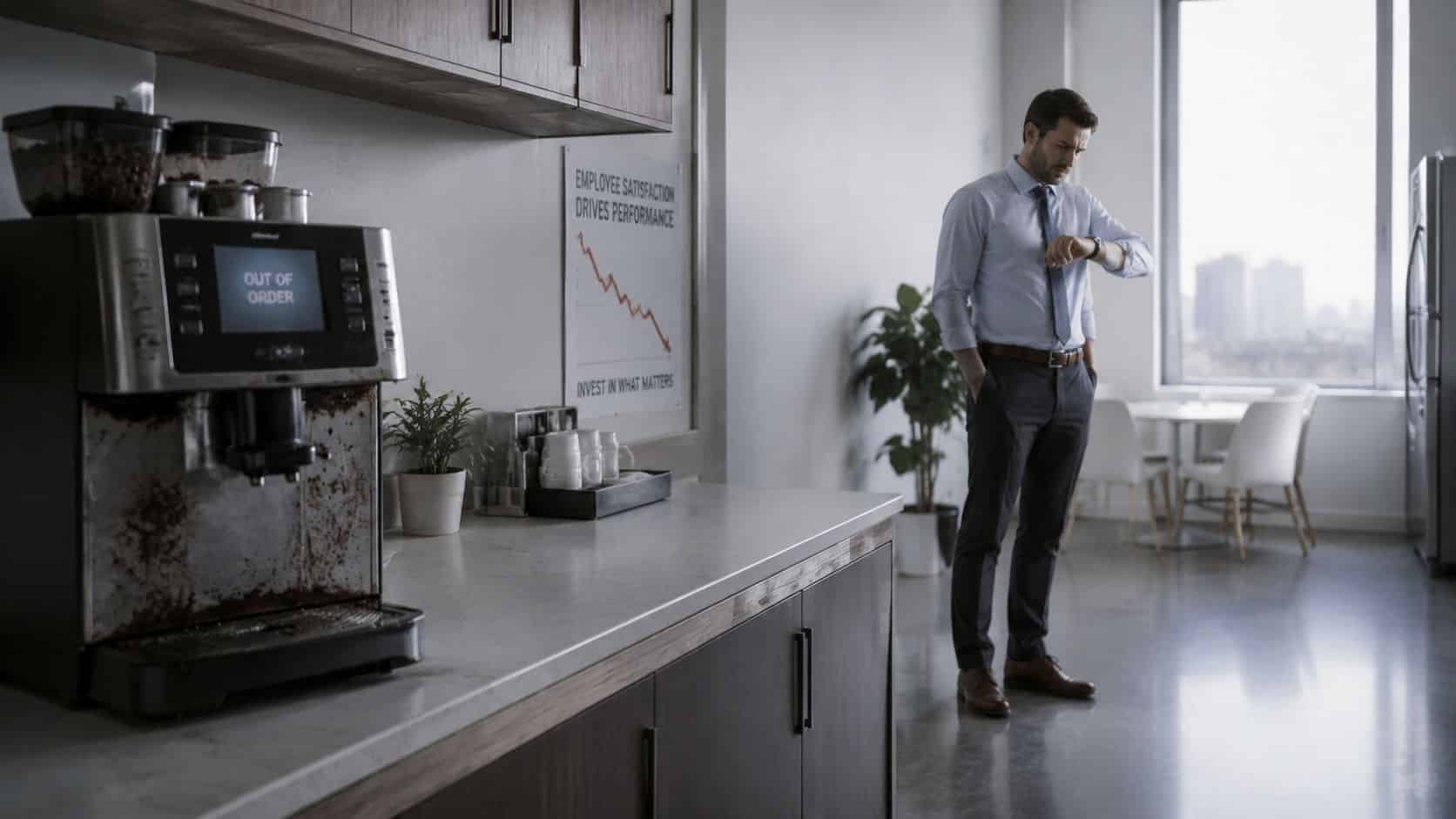
A bad office coffee setup usually fails in slow, irritating ways. Nobody files a formal complaint about refilling a reservoir, wiping splashes off the counter, or finding the pod drawer jammed again. But those small failures stack up. The breakroom turns into one more thing people avoid.
What bad coffee really costs
Most offices don't lose money because the brewer was expensive. They lose money because the setup creates friction.
- Staff waste time: Someone is always refilling water, clearing used pods, or hunting down stirrers and cups.
- Quality drifts: The first cup tastes fine, the next tastes weak, and then someone says the machine is “broken” when it really needs cleaning or a better filter.
- Supplies get messy: Single-use formats are easy to deploy, but they can create clutter and ongoing reordering headaches.
- People leave the office for coffee: Once that habit starts, the breakroom stops doing its job.
That's why coffee belongs in the same conversation as convenience and output. A cleaner breakroom usually supports a smoother day. If you're also tightening operations more broadly, these 11 actionable productivity tips are worth a look because coffee friction rarely exists in isolation.
Bad office coffee doesn't just disappoint people. It creates repeat work for the person who has to keep the station functional.
Why the machine price is only part of the story
A cheap brewer can become expensive if it locks you into disposable supplies, uneven flavor, and constant maintenance. A slightly better setup can cost less to run if it uses ground coffee well, handles daily demand, and stays easier to clean.
That's also where reusable accessories start to matter. Offices that want less waste and more control over coffee choice should look at how reusable coffee pods fit into the bigger system, not as a side accessory but as a way to cut recurring pod purchases and reduce trash volume.
Choose Your Core Brewer Type
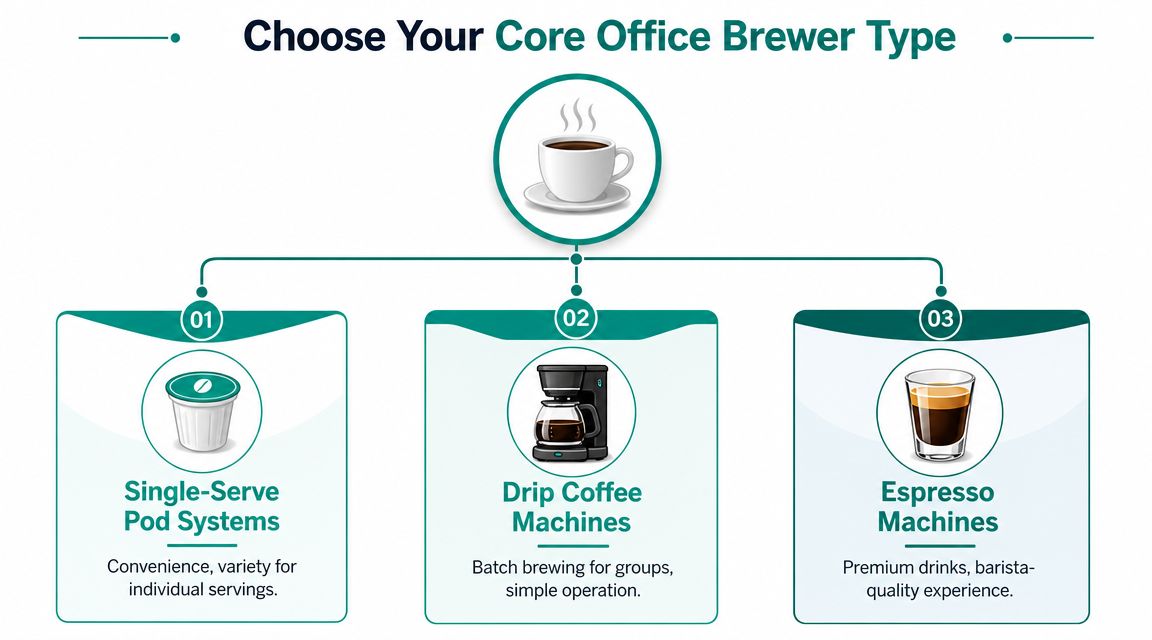
The fastest way to narrow your options is to stop shopping by brand first. Shop by throughput. Aramark Refreshments notes that most single-serve office coffee machines are designed to serve up to 50 employees, while larger models are intended for bigger teams and heavier usage. That's one of the clearest benchmarks in office coffee buying.
Single serve systems
If your office has a smaller team, staggered schedules, or lots of individual preferences, a pod-based machine can work well. It gives people speed and choice with very little training. That's why small offices often start here.
What works:
- Fast individual brewing: Good for teams that don't all break at once.
- Low learning curve: Guests and new hires can usually figure it out immediately.
- Simple drink variety: Different roasts and decaf are easy to offer.
What doesn't:
- Supply sprawl: Pods, cups, creamers, and trash can take over a small counter.
- Higher recurring waste: Convenience often means more packaging.
- Queue issues at peak times: One-cup-at-a-time systems feel slow when everyone wants coffee at once.
Batch brew machines
A drip or carafe brewer makes more sense when people mostly want standard coffee and want it quickly. Offices often overlook this because batch brewers look less exciting than pod systems, but they can be the most practical option for meetings and predictable rushes.
Practical rule: If your team mostly drinks regular coffee and does it in waves, batch brewing is usually easier to manage than making one cup at a time.
Batch brewers fit especially well when you're using fresh ground coffee and want lower per-cup complexity. They're also a strong match for teams that don't need specialty drinks.
A useful side path here is evaluating brewers that support grounds well, especially if you want to move away from disposable pods. This guide to coffee makers for ground coffee is a good reference if your office wants to compare that route.
Later in the buying process, it helps to watch a machine category overview in action:
Bean to cup machines
Bean-to-cup systems are for offices that want a more premium experience and can support a bit more oversight. They grind fresh, offer broader drink menus, and usually present better than a small domestic machine on a crowded counter.
They're a better fit when:
- Coffee quality matters visibly. Leadership, clients, or frequent visitors use the station.
- The team wants variety. Espresso-style drinks, regular coffee, and decaf all matter.
- You can support maintenance. Someone has to refill, clean, and monitor it consistently.
The wrong move is buying one because it looks impressive, then under-supporting it. A neglected bean-to-cup machine becomes everyone's problem very quickly.
A Deep Dive on Keurig and Ninja Systems
For small offices, the contest usually comes down to convenience versus flexibility. Keurig and Ninja systems both show up in that decision, but they solve slightly different problems.
Keurig fits offices that want the simplest possible user experience. Drop in a pod, press a button, move on. Ninja DualBrew-style systems appeal to offices that want more freedom to switch between pods and grounds without maintaining a larger commercial brewer. Neither approach is automatically better. The right choice depends on how your team drinks coffee.
Where Keurig wins
Keurig works well when you need a machine that almost anyone can use without explanation. That matters in shared spaces, reception areas, and offices with rotating staff or visitors.
Its strengths are practical:
- Fast onboarding: People already know how these machines work.
- Easy portion control: One drink, one cycle, less guesswork.
- Predictable footprint: Many models fit small counters well.
The downside is that Keurig owners often end up locked into a convenience habit that raises recurring costs and trash output. If you want to stay in the Keurig ecosystem but reduce that burden, accessory compatibility matters more than most buyers realize. This Keurig coffee makers accessories guide is useful if you're comparing reusable pods, filters, and maintenance items before standardizing on a setup.
Where Ninja often makes more sense
Ninja systems are attractive when the office wants one machine that can handle different brewing preferences. That can reduce the need to keep a pod machine and a separate drip machine on the same counter.
Ninja usually fits better if your office wants:
- Pods and grounds in one workflow
- More control over coffee selection
- A simpler path toward lower waste brewing
That flexibility helps, but it doesn't remove maintenance. Grounds create their own mess if the station isn't organized. A flexible machine still needs a disciplined supply routine.
The water issue most offices miss
Many office coffee setups encounter issues when people compare brew options but overlook the water source. Industry guidance for office coffee stations emphasizes that in-line plumbed water with filtration is the preferred supply method because it eliminates manual refill labor, improves consistency in taste, and reduces service friction.
That advice matters because the water decision affects three things at once:
- Labor: Nobody has to keep topping off tanks or swapping jugs.
- Taste: Filtered water gives the machine a better starting point.
- Maintenance burden: Better water usually means fewer flavor complaints and less frustration around buildup.
If your office uses coffee heavily, manual water refill stops being a small inconvenience and starts becoming a recurring operational task.
Side by side tradeoffs
| System | Best fit | Main advantage | Main drawback | Good office use case |
|---|---|---|---|---|
| Keurig | Small teams that want simplicity | Very easy to use | Ongoing pod dependence if unmanaged | Shared kitchen, reception, quick self-serve |
| Ninja DualBrew | Small teams that want options | Pods plus grounds flexibility | More room for user inconsistency | Offices balancing convenience with lower-waste brewing |
A common objection with reusable accessories is fit. That's a fair concern. Cheap reusable pods can leak, seat poorly, or brew weak coffee if the mesh and lid design are inconsistent. Offices that go this route should buy for compatibility first, not just price.
The Smart Way to Manage Costs and Waste
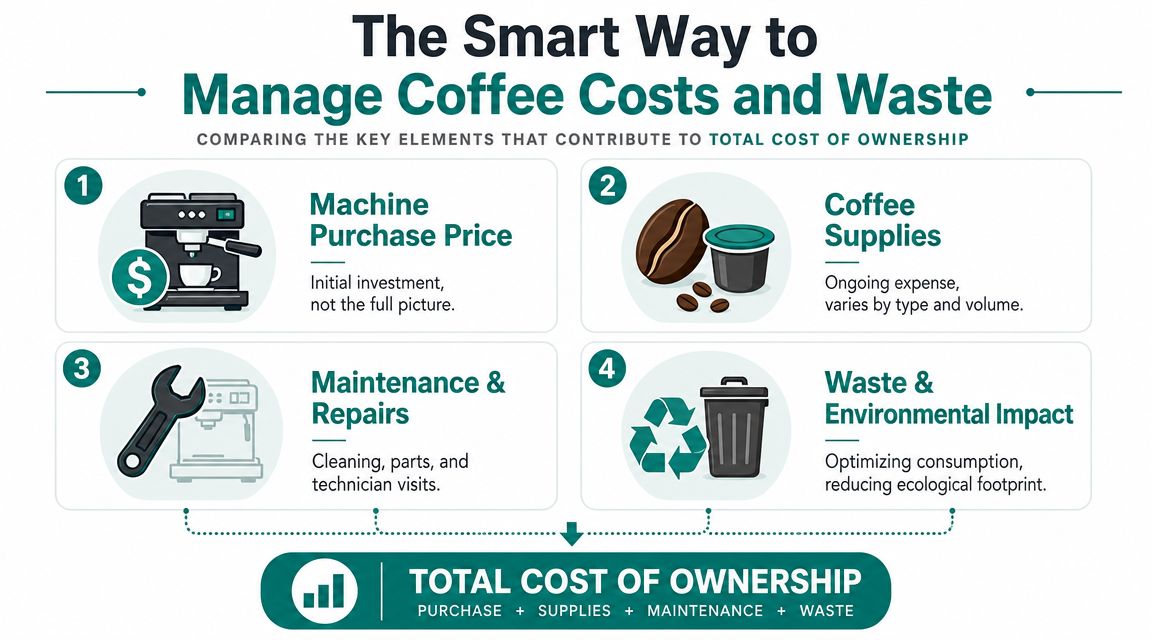
Most coffee guides talk about machine categories and stop there. That leaves out the part office managers deal with every day. Restocking, cleanup, descaling, filter swaps, and trash handling are what determine whether a coffee setup feels smart or exhausting. Cuppers makes that gap clear by noting that most “best office coffee” pages stop short of quantifying lifecycle costs, staff time, or machine downtime, and that the better question is which setup minimizes labor, descaling, filter changes, and waste over 12–24 months.
The buying question that matters more
The wrong question is, “Which machine is cheapest today?”
The better questions are:
- What will this setup require every week?
- How much trash does it create?
- How often will someone need to clean, descale, or troubleshoot it?
- Can we use the coffee we want to buy?
That's why the best office coffee solutions often come from pairing a reasonable brewer with better accessories. A reusable pod, water filter, or gold-tone basket can change the economics of the whole station more than a flashy machine upgrade.
Office Coffee Pod Cost and Waste Comparison
| Pod Type | Est. Cost Per Cup | Environmental Impact | Flavor Customization | Durability |
|---|---|---|---|---|
| Disposable K-Cups | Higher ongoing cost due to repeated single-use purchases | More single-use waste | Limited to purchased pod options | Single use |
| Generic plastic reusable pods | Lower ongoing cost because they can be refilled with ground coffee | Lower waste than disposable pods | High, since you choose the coffee | Varies by build quality |
| Premium stainless steel reusable pods | Lower ongoing cost because they can be refilled with ground coffee | Lower waste than disposable pods | High, since you choose the coffee | Typically stronger and longer-lasting than thin plastic designs |
I'm keeping the cost-per-cup line qualitative for a reason. Offices vary too much by coffee brand, fill level, and employee habits to make up a number here. But the pattern is straightforward. Disposable pods push recurring spend and trash upward. Reusable formats shift the cost toward coffee grounds and cleaning effort.
Why cheap reusable accessories disappoint people
Reusable pods are a good idea. Bad reusable pods are not.
The usual complaints are familiar:
- Poor fit: The pod doesn't seat correctly, so the machine leaks or refuses to brew.
- Weak extraction: A flimsy basket or poor mesh design can produce watery coffee.
- Short lifespan: Hinges, lids, or plastic edges wear down fast in office use.
That's why I'd rather see an office buy fewer, better accessories than a bulk pack of questionable ones. For example, PureHQ Inc. sells reusable K-Cup options, compatible water filters, gold-tone baskets, and descaling products that fit the broader office-coffee TCO approach because they're aimed at reducing waste and supporting machine upkeep rather than replacing the brewer itself.
Cheap accessories often create the exact problem they were supposed to solve. More cleanup, more user complaints, and more replacement buying.
Where sustainable choices actually help
Not every green-sounding option is practical in an office. The best low-waste changes are the ones people will keep using correctly.
The ones I've seen stick are:
- Reusable pods for ground coffee when the office already buys coffee in bulk
- Water filters that support taste and reduce maintenance headaches
- Simple cleaning supplies that make upkeep easier, not more complicated
That's the sweet spot. Less waste, fewer emergency fixes, and better control over what the team drinks.
Designing Your Perfect Coffee Station Workflow
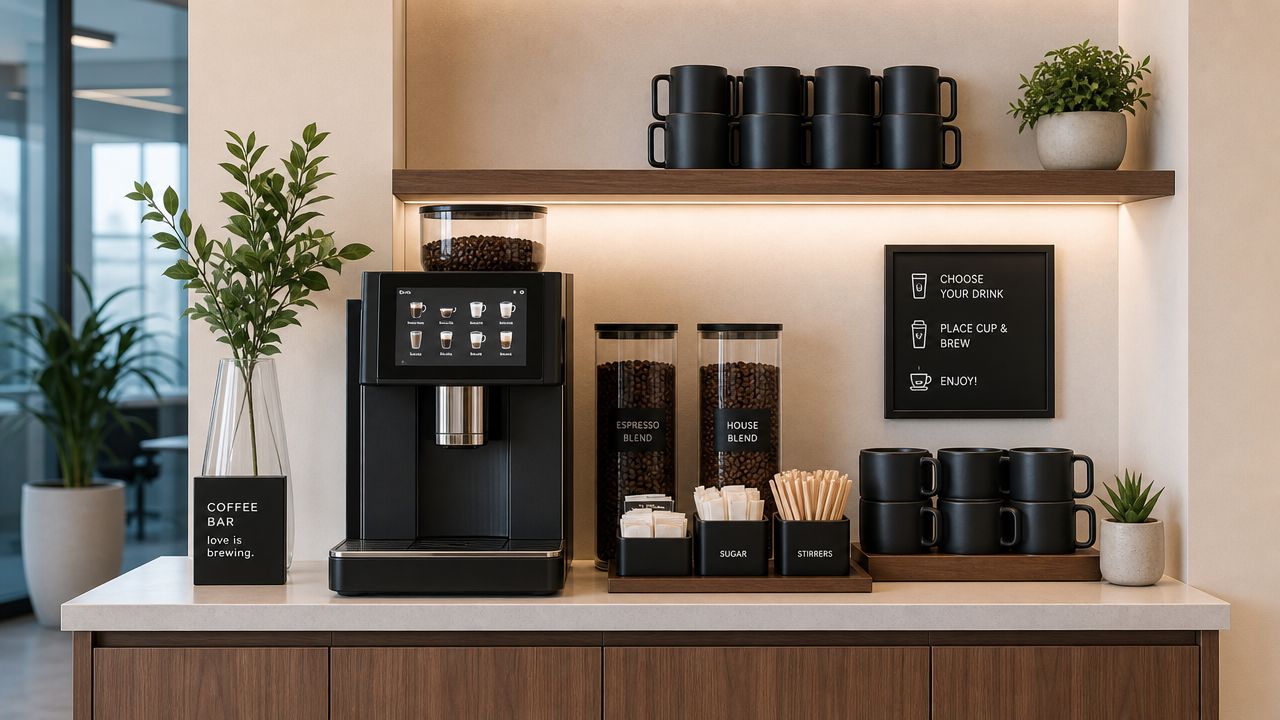
A coffee station fails when it asks too much from users. If people have to guess where supplies are, how to brew correctly, or where to dump used pods, the station gets messy by lunchtime. Good workflow removes decisions.
Match layout to drink volume
One office-machine guide highlights bean-to-cup systems rated for roughly 100 to 150 coffees per day and explains why higher-capacity models are chosen when workplaces want multiple beverage options from one platform, including systems with extra canisters for drinks like hot chocolate or chai or separate bean choices such as regular and decaf, as shown in this office machine walkthrough. That matters because machine capability should shape the station around it.
If your brewer handles a lot of drinks and several drink types, give it room. Don't wedge a high-use machine into a corner with one trash can and no landing space for cups.
Build the station around real behavior
A reliable setup usually includes:
- A clear left-to-right flow: brewer, cups, add-ins, waste bin, wipes
- Visible supply zones: separate areas for coffee, sweeteners, lids, and cleaning items
- Simple instructions: brief signage for reusable pod use, fill lines, or cleanup steps
- A spill plan: a small tray, cloths, and a nearby bin prevent small messes from becoming complaints
The biggest improvement is often boring. Put everything people need in one reach zone and remove everything they don't.
Reduce queueing and user error
Lines form for two reasons. The machine is too slow for peak demand, or the station forces too much decision-making. If your office wants specialty drinks, decaf, and alternate options from one machine, build enough counter space for waiting users and ingredient access.
A cleaner workflow usually looks like this:
| Station element | What works | What causes trouble |
|---|---|---|
| Cups and lids | Kept beside the brewer at hand level | Stored in drawers or separate cabinets |
| Creamers and sweeteners | Grouped in labeled bins | Mixed loosely across the counter |
| Reusable pods or filters | Stored dry with clear refill instructions | Left near the sink or piled beside coffee bags |
| Waste area | One obvious bin close to the exit point | Multiple partial bins and no pod disposal spot |
A coffee station should let people serve themselves without creating work for the person managing the office.
A Simple Maintenance Plan for Better Coffee
Coffee quality drops long before most machines stop working. The usual cause is buildup, neglected filters, and inconsistent cleaning. That's why maintenance isn't a side task. It's part of the brewing system.
Keep the routine simple enough to survive real office life
A workable office plan usually includes three habits:
- Empty and wipe daily: Drip trays, used pod bins, and splash zones get dirty fast.
- Check filters on schedule: Water quality affects both taste and machine strain.
- Descale before the machine starts complaining: Waiting for obvious problems usually means flavor has already slipped.
If you're using a plumbed or filtered setup, stay on top of replacement filters. If you're running reusable pods or baskets, make sure staff can rinse and dry them properly instead of leaving them packed with wet grounds.
Why descaling matters
Mineral scale forms when water leaves deposits behind inside the machine. That buildup can affect heating, flow, and taste. Offices usually notice it as weaker coffee, slower brewing, or inconsistent output.
For teams that want a simple at-home style reference before creating an office routine, these effective vinegar descaling methods are a helpful starting point. In a shared workplace, though, I generally prefer a dedicated descaling product and a compatible filter because the process is easier to standardize and less likely to turn into guesswork.
Good coffee maintenance is mostly prevention. Once the machine tastes off, you're already behind.
A small supply kit makes this easier. Keep replacement filters, descaler, cleaning tablets, and a few spare reusable parts in one labeled bin near the station. That cuts the usual delay between “someone noticed a problem” and “someone finally fixed it.”
If you want to build a lower-waste, easier-to-maintain setup around Keurig, Ninja, or other small-office brewers, shop PureHQ Inc. for reusable pods, compatible water filters, descaling solutions, and other coffee accessories that support the full system, not just the machine.

