
Coffee Machine Care
Keurig Filters Target
Sep
At 6:45 a.m., you shuffle to the Keurig, drop in a pod, press brew, and take a sip. The coffee tastes metallic, chalky, or faintly like a swimming pool. Before you blame the pod, check the water filter. A cartridge that has been ignored for months can stop controlling chlorine taste while hard-water minerals continue building scale inside the brewer.
That combination weakens flavor, restricts water flow, and leaves the reservoir looking cloudy. The fix starts with one decision that Target shoppers often skip: identify the exact Keurig model before buying the filter. This guide covers official charcoal cartridges, third-party replacements, and reusable mesh alternatives, then maps the common brewer families to their filter locations and replacement parts.
When Your Morning Coffee Tastes Off
At 6:45 a.m., the brewer still runs, the pod still punctures, and the first sip tastes wrong. Chlorine, stale water, or a chalky finish usually points to two separate maintenance problems: an exhausted filter and mineral buildup. Before buying another pod, identify the exact Keurig model and inspect its filter holder and reservoir.
Hardness creates trouble that a charcoal cartridge cannot solve. Keurig-style filters generally use granular activated carbon to reduce chlorine and related taste and odor compounds. Independent activated-carbon testing found no meaningful reduction in total dissolved solids, or TDS, and some tests recorded a small increase. Independent activated-carbon testing explains why filtered water can taste cleaner while calcium and magnesium still remain in the brewing system and contribute to scale.
The symptoms I look for first
After replacing a neglected cartridge, I check four areas:
- Taste: Chlorine, stale water, or a chalky finish suggests exhausted filtration or mineral buildup.
- Flow: A weak stream, gurgling, or an incomplete brew suggests restriction in the water path.
- Reservoir: Cloudiness or a chalky ring shows that cleaning has fallen behind.
- Heat and extraction: Scale on the heating path can disrupt water movement and brewing consistency.
A new filter can improve flavor by reducing chlorine before water reaches the brewer. It cannot remove established scale or replace descaling. If the machine has both poor flavor and weak flow, replace the correct cartridge, then clean the reservoir and descale the brewer according to its model requirements.
Keurig has developed from an office-brewer company into a broad household brewing system. The company was founded in 1990, developed an early commercial office brewer in the mid-1990s, and launched its first brewer in 1998. By 2024, Keurig was reported to have just under 40 million households using its coffee brewing system. Keurig's history and product development provides context for the wide range of compatible accessories now sold through major retailers.
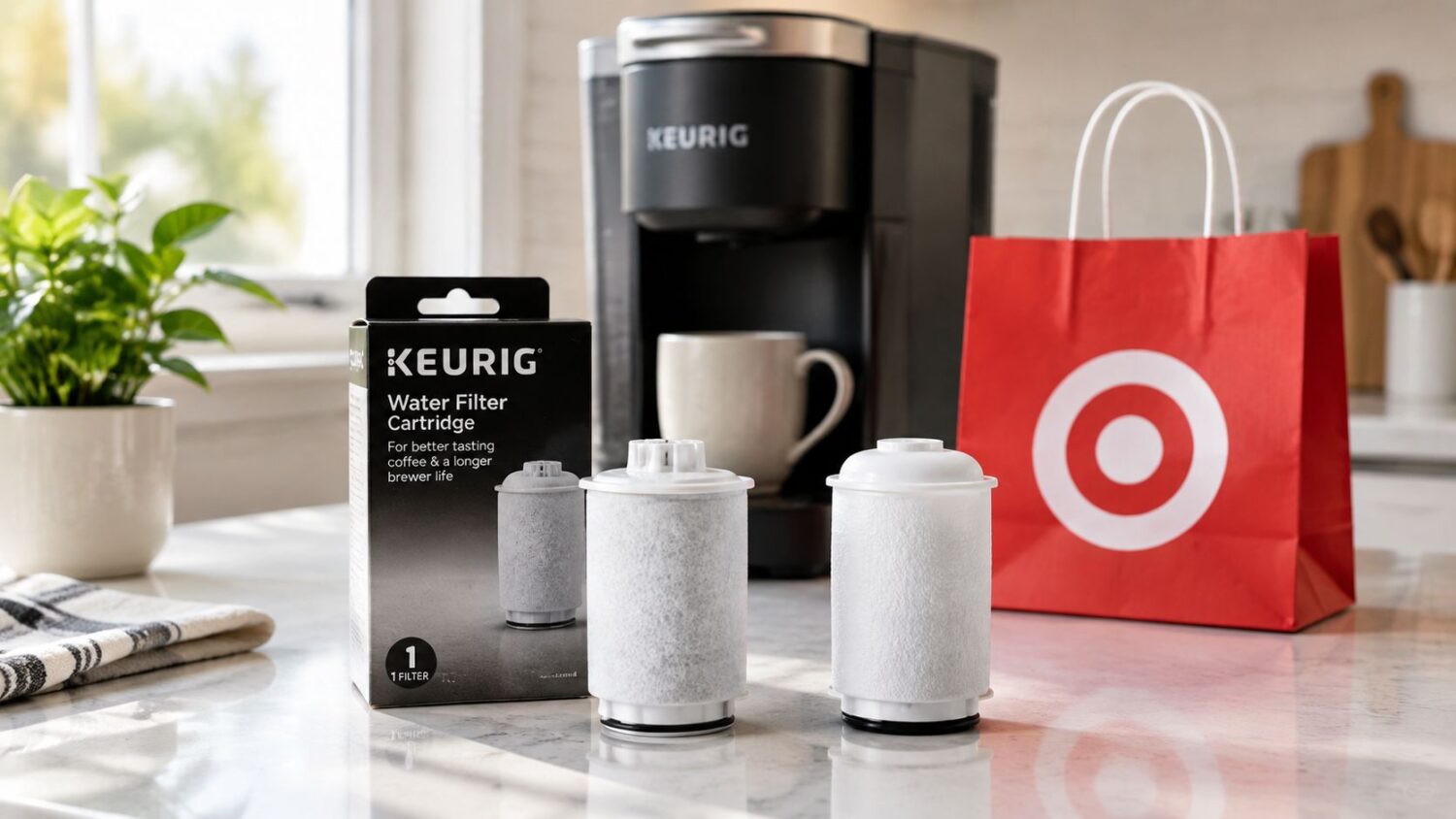
Target lists Keurig water filter cartridge refills and 50-pack paper disposable coffee filters in its Keurig category. Target's Keurig assortment shows the two maintenance paths shoppers commonly compare: a cartridge for the reservoir filter holder, or paper liners used with a reusable pod. Choose by the holder and brewer model inside your machine, not by the logo on the package.
What Keurig-Style Water Filters Actually Do
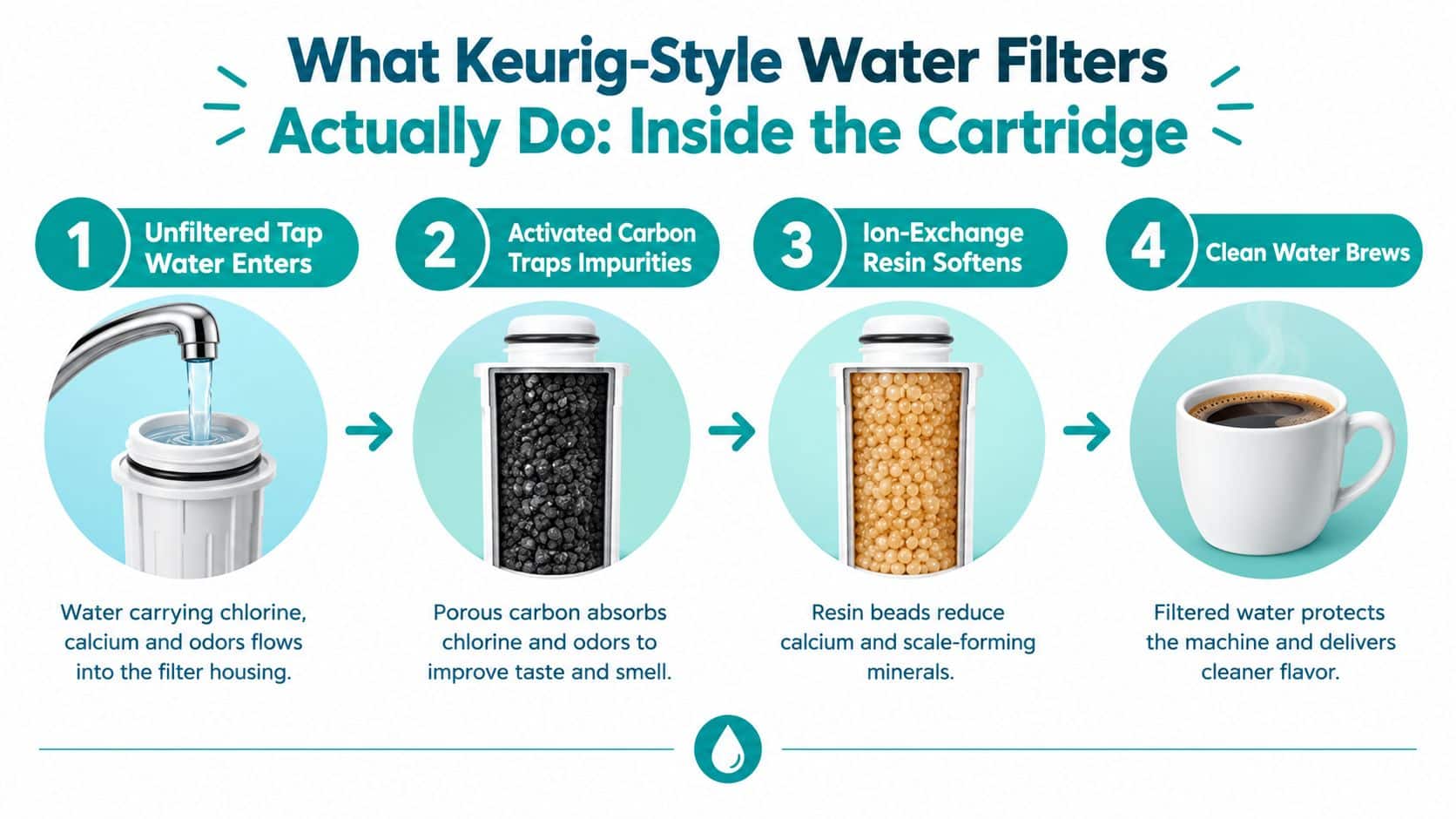
A Keurig-style water filter is a small water-treatment device, not a miniature softener. Most replacement cartridges rely on granular activated carbon, commonly called GAC, to adsorb chlorine and related taste and odor compounds. Some cartridge designs also include ion-exchange resin, but the verified technical point remains the same: these filters focus primarily on improving taste and odor, not broadly stripping minerals from tap water.
TDS, or total dissolved solids, describes dissolved material in water, including minerals and salts. Hardness refers mainly to dissolved calcium and magnesium. Those minerals can contribute body to coffee, but they also create the deposits commonly called limescale. Carbon filtration can leave most of that calcium and magnesium in the water, so it can soften the taste without softening the plumbing inside the brewer.
What the cartridge can and can't handle
The cartridge can reduce:
- Chlorine and related odor compounds, which can interfere with aroma and cup flavor.
- Some taste-causing contaminants, depending on the water and cartridge condition.
- Some carbon fines and sediment, when the cartridge and holder are installed correctly.
The cartridge cannot:
- Remove all dissolved minerals.
- Repair existing scale.
- Replace descaling.
- Guarantee identical performance across every Keurig model.
A filter that has reached capacity stops doing its job effectively. That's why an old cartridge can make coffee taste worse than expected. The carbon media has limited adsorption capacity, and the cartridge needs routine replacement rather than indefinite rinsing.
Keurig's replacement guidance is commonly summarized as every 2 months or after about 60 tank refills, whichever comes first. This replacement guide gives shoppers the timing rule that matters most when building a maintenance routine.
Hard water demands a second track. If your incoming water creates scale quickly, keep filtration for taste and use descaling to address deposits. Keurig's official descaling guidance says to remove the water filter before descaling, add Keurig Descaling Solution with water, and let the brewer stand for at least 30 minutes during the process. Keurig's descaling instructions makes that compatibility requirement explicit.
The choice between official and generic cartridges comes down to fit confidence, packaging clarity, and unit cost. Reusable mesh products belong in a different category because they filter coffee grounds, not chlorine-bearing water.
Official Keurig vs Generic and Reusable Options at Target
Your choice at Target should follow the brewer's filter holder, not the size of the package. Official Keurig cartridges provide the clearest model match. Third-party charcoal cartridges can reduce the ongoing cost when the compatibility list names your exact brewer series. Reusable mesh filters eliminate cartridge purchases, but they filter coffee grounds rather than water and require cleaning after use.
The aftermarket expanded after Keurig's reusable-pod milestone. Green Mountain and Keurig launched My K-Cup in late 2005, allowing owners to fill a reusable pod with any coffee brand. The original K-Cup patent expired in 2012, which helped create more options for refillable pods and compatible accessories. That history matters because a reusable coffee filter and a charcoal water cartridge solve different problems.
The quick comparison
| Filter Type | Typical Target Price | Pack Size | Compatible Models | Replacement Interval |
|---|---|---|---|---|
| Official Keurig charcoal cartridge | Premium per unit | Commonly 2-pack or 6-pack | Match the listed Keurig holder and model family | Every 2 months or about 60 tank refills |
| Third-party charcoal cartridge | Usually lower per unit | Commonly sold in multipacks | Model-specific, depending on holder shape | Every 2 months or about 60 tank refills |
| Reusable mesh coffee filter | No recurring cartridge purchase | Single reusable filter or reusable pod basket | Match the pod, holder, and puncture design | Rinse after use, replace only when worn |
Buy official cartridges when you want the lowest compatibility risk. They are the straightforward pick for owners who do not want to compare holder shapes or model lists. Generic charcoal cartridges are a sound choice only when the package identifies your exact series and the cartridge seats firmly in the existing holder.
Reusable mesh filters suit owners willing to rinse them after every brew. They do not reduce chlorine taste because they contain no carbon water-filter media, and they do not replace descaling or other water treatment. A reusable K-Cup changes how you load coffee. A water cartridge treats the water entering the brewer.
My buying rule: Pay for the official cartridge when model certainty matters more than unit cost. Choose generic only when the packaging identifies your exact series. Choose reusable mesh only when you will clean it after every brew.
Before buying, use this guide to where to buy Keurig water filters to distinguish charcoal cartridges from reusable coffee filters. Product pages also need clear model labels, holder details, and replacement-part information. A Shopify agency in California can help retailers organize those compatibility details so shoppers can make the right selection.
Finding and Replacing the Filter on Your Specific Model
The filter location changes across Keurig generations. Buying a cartridge before locating the holder is how shoppers end up with a box that looks right but cannot seat properly.
Match the holder, not the marketing photo
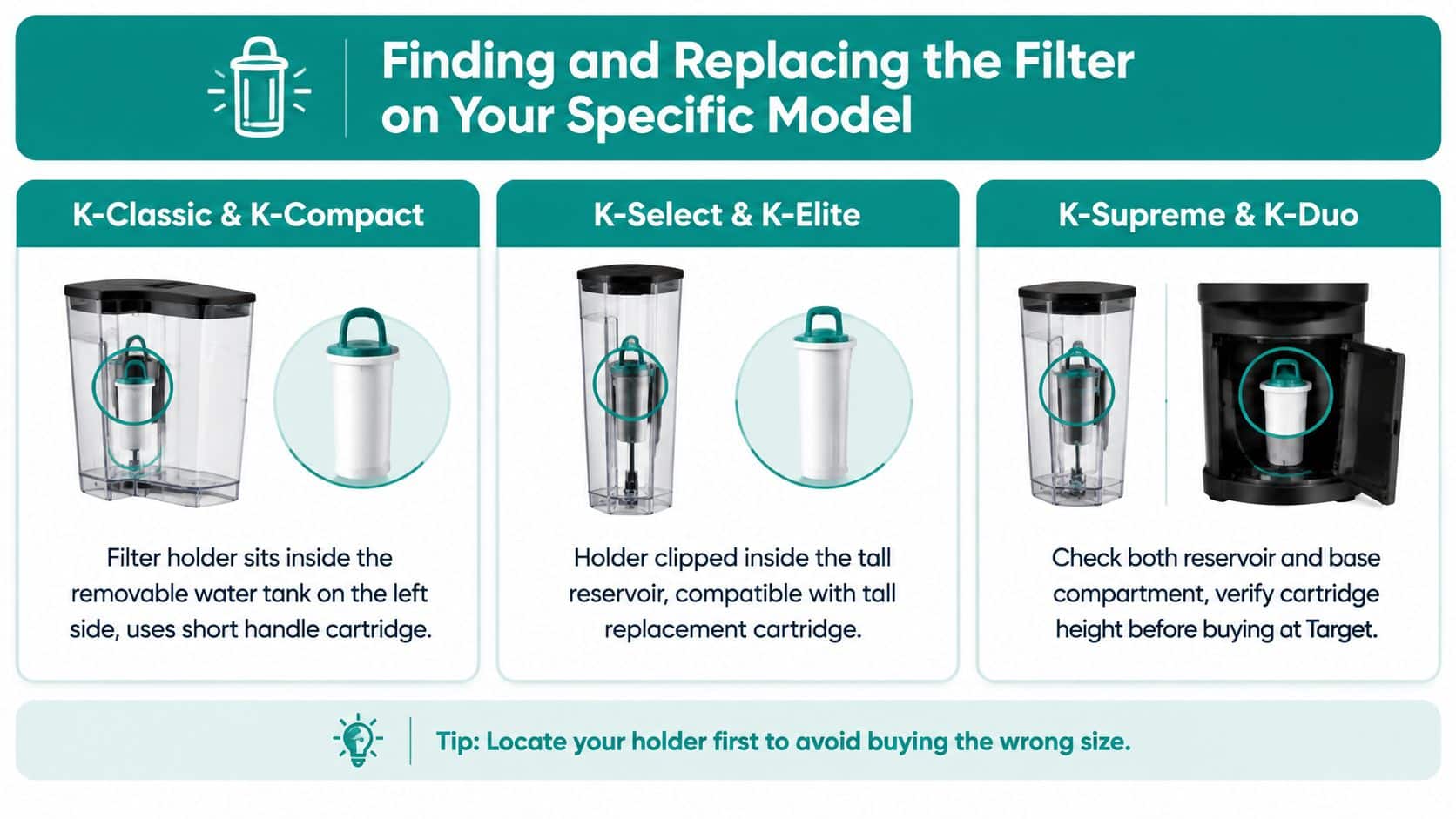
K-Classic and K-Compact models commonly use a filter handle in the upper-right area of the removable reservoir base. The holder pulls upward by its tab, and the cartridge fits inside that handle assembly.
K-Select, K-Elite, and K-Café models commonly place the holder in a taller, top-mounted vertical slot. The holder may snap sideways rather than lifting straight up, so don't force it vertically if the slot resists.
K-Supreme, K-Supreme Plus, and K-Supreme Smart machines use a different slim charcoal-stick arrangement behind a small door near the bottom of the tank. Don't buy a traditional pod-shaped cartridge until you confirm the compartment.
K-Duo reservoirs follow a layout closer to the Classic family, but the dual-tank design can block access. Remove the reservoir completely before trying to reach the holder.
Keurig 2.0 units may use a round disc-style filter positioned near the drip-tray area. The mug platform may need to be lowered to access it.
Once you identify the holder, replacement is straightforward:
- Remove the old cartridge and rinse the holder.
- Soak the new cartridge according to its packaging directions.
- Insert it without crushing or bending the media.
- Reattach the holder and confirm that it sits securely.
- Flush the brewer before drinking the first cup.
For plumbed Keurig systems, official documentation specifies flushing at least 4 gallons through the Omnipure KQ8A filter before use. The guide also specifies 1/4-inch OD LLDPE tubing, showing why startup priming and pressure control matter in a connected installation. Keurig's K3500 documentation supports the practical rule to purge air and carbon fines thoroughly after installation.
Use the model number printed on the brewer base when a package list seems vague. The Keurig water filter location guide is useful when the reservoir design doesn't match the cartridge photos.
Before buying at Target, confirm three things: the holder shape, the cartridge height, and whether you need a replacement cartridge or a complete holder kit. The holder assembly may be reusable even though the carbon cartridge is disposable.
How Often to Replace Keurig Filters and What to Stock Up On
Set 2 months or 60 tank refills, whichever comes first as your baseline. Replace the cartridge earlier if chlorine flavor returns, the brew stream weakens, or coffee develops a chalky aftertaste. Those changes usually justify checking both the filter and the brewer instead of waiting for the calendar.
Water quality determines how quickly a cartridge wears out. Hard or scale-prone water demands closer monitoring, while treated municipal water generally follows the standard schedule. Sediment or noticeable chlorine is another reason to replace sooner when flavor or flow changes.
A practical stocking schedule
| Water Type | Replace Every | Stock Quantity | Cost Tier at Target |
|---|---|---|---|
| Hard or visibly scale-prone water | Follow the 2-month or 60-refill rule, replace sooner if taste or flow changes | Keep a spare multipack available | Official cartridges cost more per unit, generic options can reduce ongoing cost |
| Typical treated municipal water | 2 months or 60 tank refills, whichever comes first | Buy enough cartridges for the next scheduled changes | Compare official and compatible third-party multipacks |
| Water with noticeable chlorine or sediment | Monitor flavor and flow closely, then follow the earlier trigger | Keep replacement cartridges ready | Choose based on fit certainty before unit cost |
Target's Keurig assortment includes cartridge refills and paper disposable coffee filters, allowing you to restock water-maintenance parts and reusable-pod supplies together. Keurig Dr Pepper's sustainability reporting described reuse models as available in Northern America and reported that 50% of plastic packaging was reusable, recyclable, or compostable in 2020. That context explains why reusable filters and related maintenance accessories appear alongside brewers and replacement cartridges.
Buy by compatibility first, then compare cost. Official cartridges cost more per unit, while generic multipacks can lower ongoing expense when the box clearly lists your brewer series. Skip a cheaper pack if its model information is vague.
If you operate more than one Keurig, keep a spare cartridge pack in the cabinet. The backup prevents a sudden flavor change from forcing an emergency purchase during a busy week.
Reusable K-Cup owners still need the same water-side routine. A refillable pod changes the coffee filter, not the minerals entering the heater. Pair it with the correct water cartridge and regular descaling, because neither accessory replaces the other.
Why the Wrong Filter Fits Wrong
A Target shelf label that says “Keurig filter” doesn't guarantee universal compatibility. Keurig changed holder shapes and reservoir layouts across generations, and a cartridge can look close enough while failing to seal or sit at the correct depth.
The most common objection is simple: “If it drops in, it fits.” That assumption is wrong. A cartridge that sits loosely can allow water to bypass the carbon media. A cartridge that creates excessive resistance can reduce flow, produce weak streams, or interrupt a brew cycle.
What a mismatch looks like
- Leaks: A holder that doesn't seal can send water around the cartridge instead of through it.
- Pressure loss: Excess resistance can create weak flow or an incomplete brew.
- Taste drift: Bypass allows chlorine and untreated water to reach the brew path.
- Physical damage: Forcing a K-Supreme-style charcoal stick into a Classic-style slot can crack the housing or holder.
Third-party compatibility guidance for Keurig 2.0 replacements warns that a poor fit can lead to leaks or reduced filtration. This model-fit guide reinforces why packaging details matter more than a generic “universal” label.
Use the model number printed on the brewer base, then check the cartridge box for that exact series. Skip multipacks that list a long string of models without explaining which holder each cartridge uses. A reputable package should name supported units precisely.
The same discipline applies to online shopping. Search intent can be broad, but the purchase decision is narrow. A resource on keyword types in SEO explained is relevant here because “Keurig filters Target” describes a shopping destination, while a model number describes the actual compatibility need.
If the holder is cracked, warped, or missing, don't insert a loose cartridge and hope the reservoir will compensate. Replace the holder assembly or buy a complete starter kit. The Keurig water filter holder replacement guide addresses that specific part decision.
The Complete Keurig Maintenance Routine
A filter swap works best inside a broader routine. Carbon filtration improves incoming water, but descaling removes deposits that the cartridge cannot touch, and reusable pods need cleaning to prevent old coffee oils from affecting the next cup.
Use a simple weekly rhythm
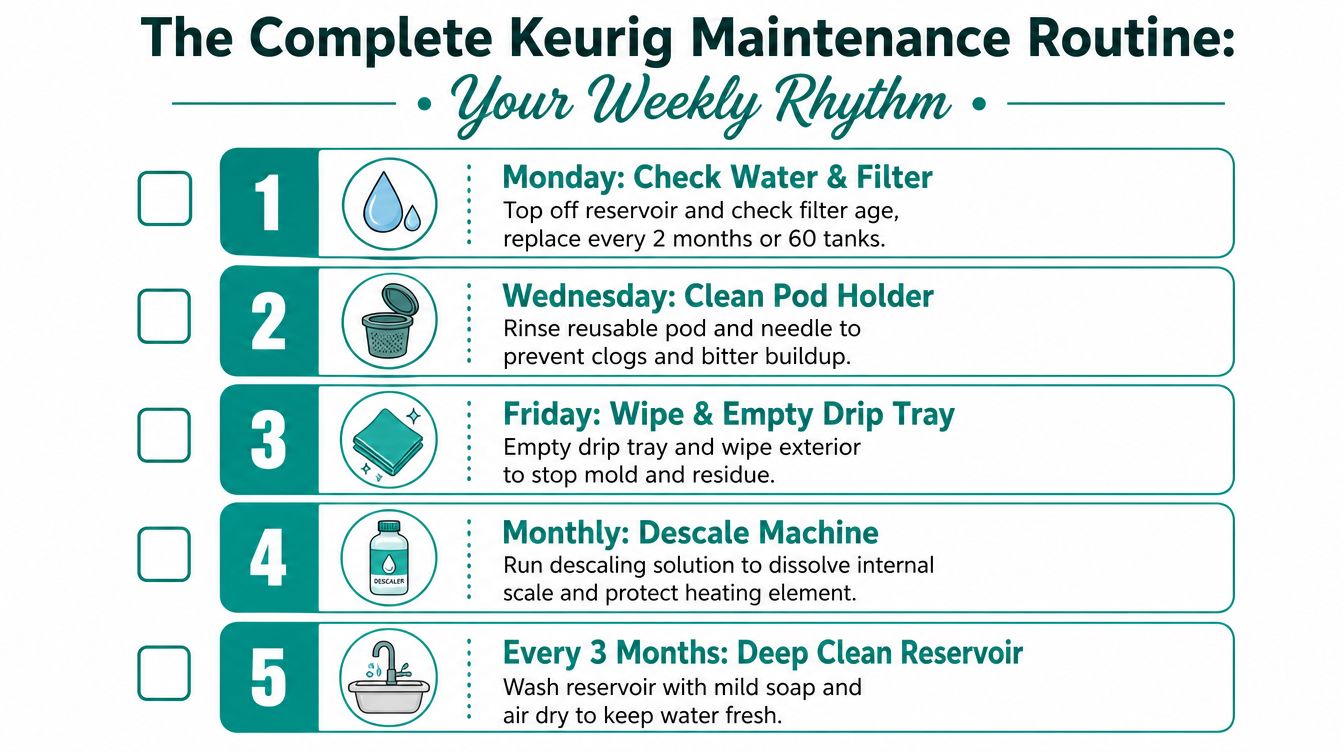
Monday: Check the reservoir level and inspect the filter age. If the cartridge is approaching the replacement schedule, put the next one beside the brewer instead of waiting for bad flavor.
Wednesday: Rinse the reusable pod, coffee basket, and exit needle with warm water. Remove grounds before they dry into the mesh.
Friday: Empty and wipe the drip tray. Clean the exterior and pod holder so residue doesn't accumulate around the brew area.
Monthly: Run a descaling cycle when the brewer or your water conditions call for it. Keurig's Elite documentation describes an approximately 45-minute descaling procedure using a full bottle of solution mixed with water, repeated rinse cycles, and a final fresh-water rinse. The K-Elite user guide provides that workflow.
Every other month: Replace the water cartridge at 2 months or 60 tank refills, whichever comes first. Remove the cartridge before descaling, then install a fresh one after the rinse cycle is complete.
Watch for signs that the routine has slipped:
- Slow brewing: Scale or debris may be restricting the water path.
- Gurgling: Air or obstruction may be interrupting flow.
- Chalky residue: The reservoir or internal system needs cleaning.
- Stale flavor: The pod, cartridge, or brew path may be carrying old residue.
Keep two compatible cartridges available if you rely on the brewer daily. For a complete care kit, pair a correctly matched Target replacement filter with a reusable K-Cup, paper liner, and descaling solution. PureHQ Inc. offers reusable K-Cups, replacement water filters, paper liners, and descaling accessories for coffee-machine maintenance. Visit PureHQ Inc. to match the accessory to your Keurig model and order the parts you'll use.

