
Coffee Machine Care
K Cup for Keurig Vue: Your 2026 Adapter Guide
Apr
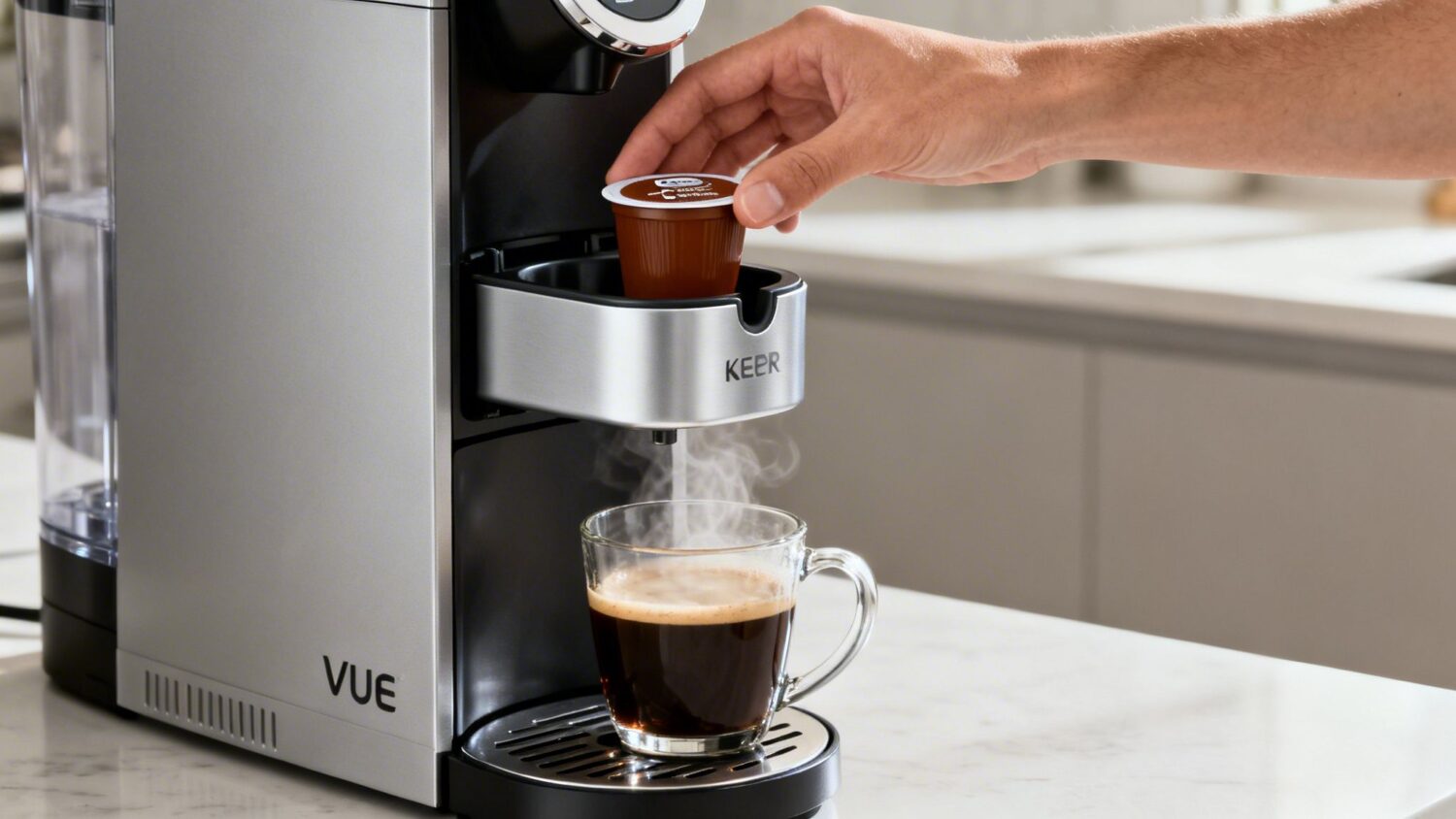
You open the cabinet, grab a box of K-Cups, lift the handle on your Keurig Vue, and then remember the problem. The pod you bought at any normal store does not fit the machine you already own.
Many Vue owners encounter this difficulty. The brewer still works. It still makes a larger, stronger cup than many older Keurig models. But the original pod format vanished fast, and that turned a capable machine into a headache.
The good news is simple. Your Vue is still usable if you approach it the right way. The wrong accessories cause leaks, weak coffee, and stress on an aging brewer. The right adapter and a durable reusable pod bring the machine back into daily service without forcing you to chase discontinued packs.
Your Keurig Vue Is Not Obsolete
The Vue was never a bad brewer. It became an inconvenient one.
Keurig launched the Vue brewer in February 2012 as a premium system with larger brew sizes up to generous brew sizes and more customization, but the machine only accepted proprietary Vue packs, not standard K-Cups. Keurig then discontinued the line in 2014, leaving owners with limited pod choices while the wider Keurig ecosystem produced $4.5 billion in sales that year, including $3.6 billion from K-Cups, according to the Keurig product history summary on Wikipedia.
Why Vue owners still hang onto these machines
I understand why people keep them. The Vue was built for drinkers who wanted more control than the basic K-Cup machines offered.
Common reasons owners still want to use a Vue:
- Larger cup brewing: A Vue can handle a bigger mug without the usual workaround of brewing twice.
- Better control: Strength and temperature adjustments matter when you prioritize cup taste.
- Solid hardware: Many of these brewers still power on, heat properly, and brew fine if the pod system problem gets solved.
The frustration starts when people think the machine itself failed them. In most cases, the machine did not fail. The format did.
What left owners stranded
Keurig made the Vue around a proprietary pack. That decision made sense for Keurig at the time, but it aged badly for owners. Once official Vue packs became hard to find, every morning cup started depending on old stock, inflated prices, or luck.
That creates a familiar pattern:
- A Vue owner finds a few remaining packs online.
- The price feels unreasonable.
- Standard K-Cups look like an easy substitute.
- They do not fit.
- The machine gets pushed to the back of the counter.
Practical takeaway: If your Vue still heats, pumps, and closes correctly, do not throw it out just because Vue packs are scarce. The appropriate fix is compatibility, not replacement.
The workable path forward
You have two realistic ways to keep a Vue alive:
- Use a Vue-compatible adapter that holds a standard K-Cup
- Use a reusable pod setup designed to work inside that adapter system
Both approaches can work. Neither should be treated casually. Older Vue machines are less forgiving than people expect, especially if the seal is poor or the pod sits crooked in the chamber.
That is why fit matters more than marketing. Cheap parts can turn a working brewer into a leaking brewer quickly.
Why Standard K-Cups Don't Fit a Vue Brewer
The problem is mechanical, not cosmetic. A standard K-Cup and a Vue pack are not close enough for the machine to improvise.
The pod shape is wrong for the brew chamber
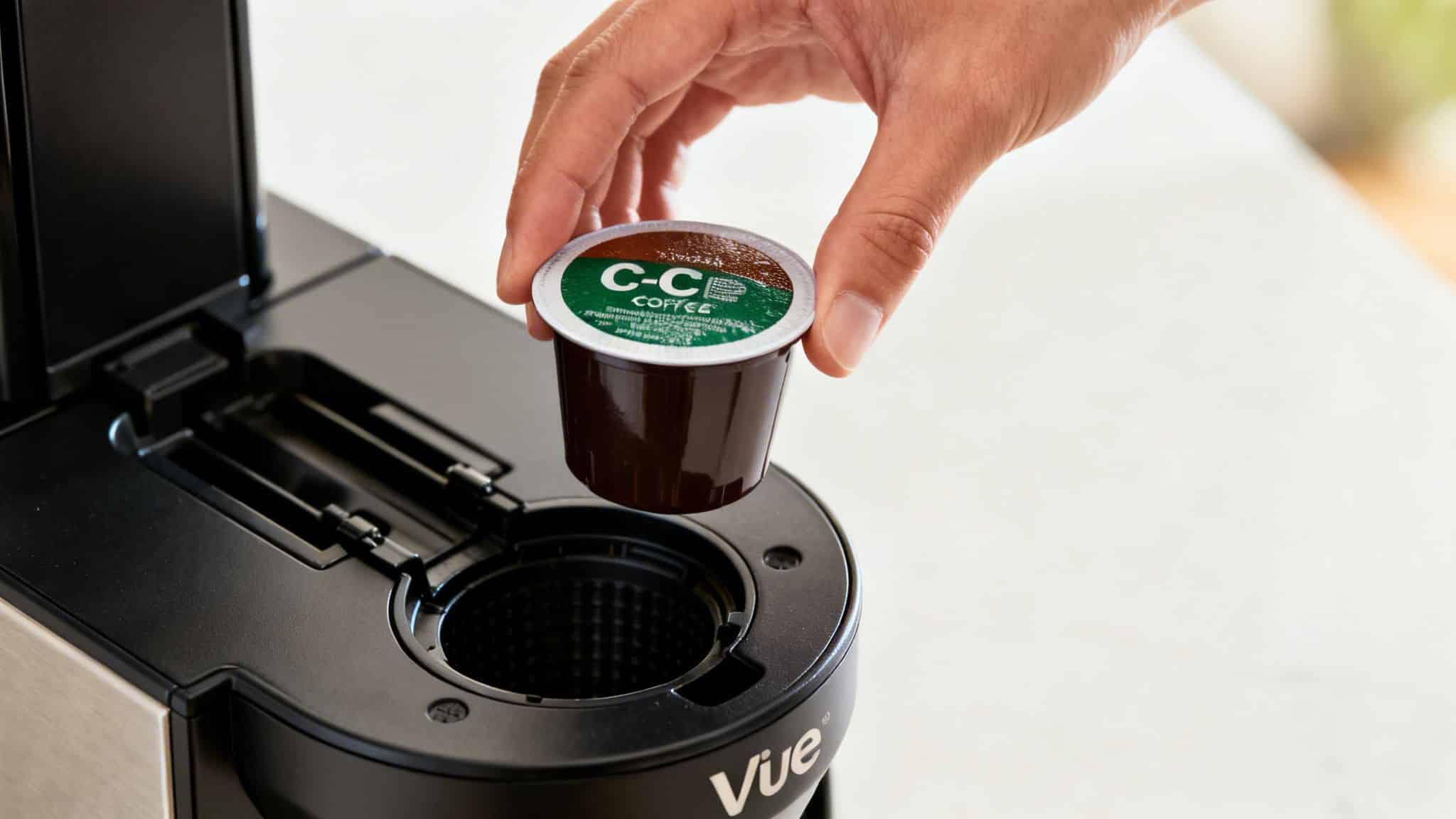
A Vue brewer expects a pod with Vue dimensions and a Vue sealing surface. A standard K-Cup has a different profile. That means the pod does not sit where the machine expects it to sit, and the needles do not meet it the way they should.
In real use, that causes a few ugly results:
- Bad puncture alignment: The entry and exit points do not line up correctly.
- Poor sealing: Water escapes around the pod instead of moving through the coffee bed.
- Uneven extraction: Some grounds get over-saturated while other grounds barely get touched.
The Vue brew head works differently
Vue brewers were designed to do more than the older basic K-Cup systems. They support settings such as strength selection, temperature control, and larger cup sizes. That means the pod system has to handle the machine’s water delivery and puncture pattern correctly.
A standard K-Cup on its own cannot do that inside a Vue chamber. If you force the issue, you risk:
- grounds in the cup
- watery coffee
- leaking into the pod area
- wear on the puncture area or sealing surfaces
That last point matters. On an older brewer, repeated bad seating is one of the fastest ways to turn a compatibility problem into a hardware problem.
Pods: A lock and key system
A lot of owners assume the pod is only a container. It is not. In a single-serve machine, the pod is part of the brew system.
The Vue needs:
| Machine part | What it expects | What a standard K-Cup does |
|---|---|---|
| Brew chamber | Vue-sized outer shape | Sits incorrectly |
| Piercing system | Proper puncture points | Misses or punctures poorly |
| Water flow path | Tight seal and controlled flow | Allows bypass or leaks |
| Extraction cycle | Stable pod under pressure | Can deform or brew weakly |
If you want a broader view of model-specific reusable options across Keurig machines, this guide on which reusable K-Cup fits my Keurig model is useful, but the Vue is its own category because the chamber design is so different.
Technician’s rule: Never drop a standard K-Cup straight into a Vue and hope the lid pressure solves the fit. It does not.
What works and what does not
What works:
- a purpose-built adapter that creates a Vue-compatible outer shell
- a reusable fill cup that is made to seat correctly inside that shell
What does not:
- trimming pods
- stacking parts loosely
- using warped plastic cups
- forcing the handle closed when resistance feels wrong
If the handle takes extra force, stop. The machine is telling you the fit is off.
Using an Adapter for K-Cups in Your Vue
A proper adapter is the bridge between a standard K-Cup and a Vue brewer. Without it, the machine and the pod are speaking different mechanical languages.
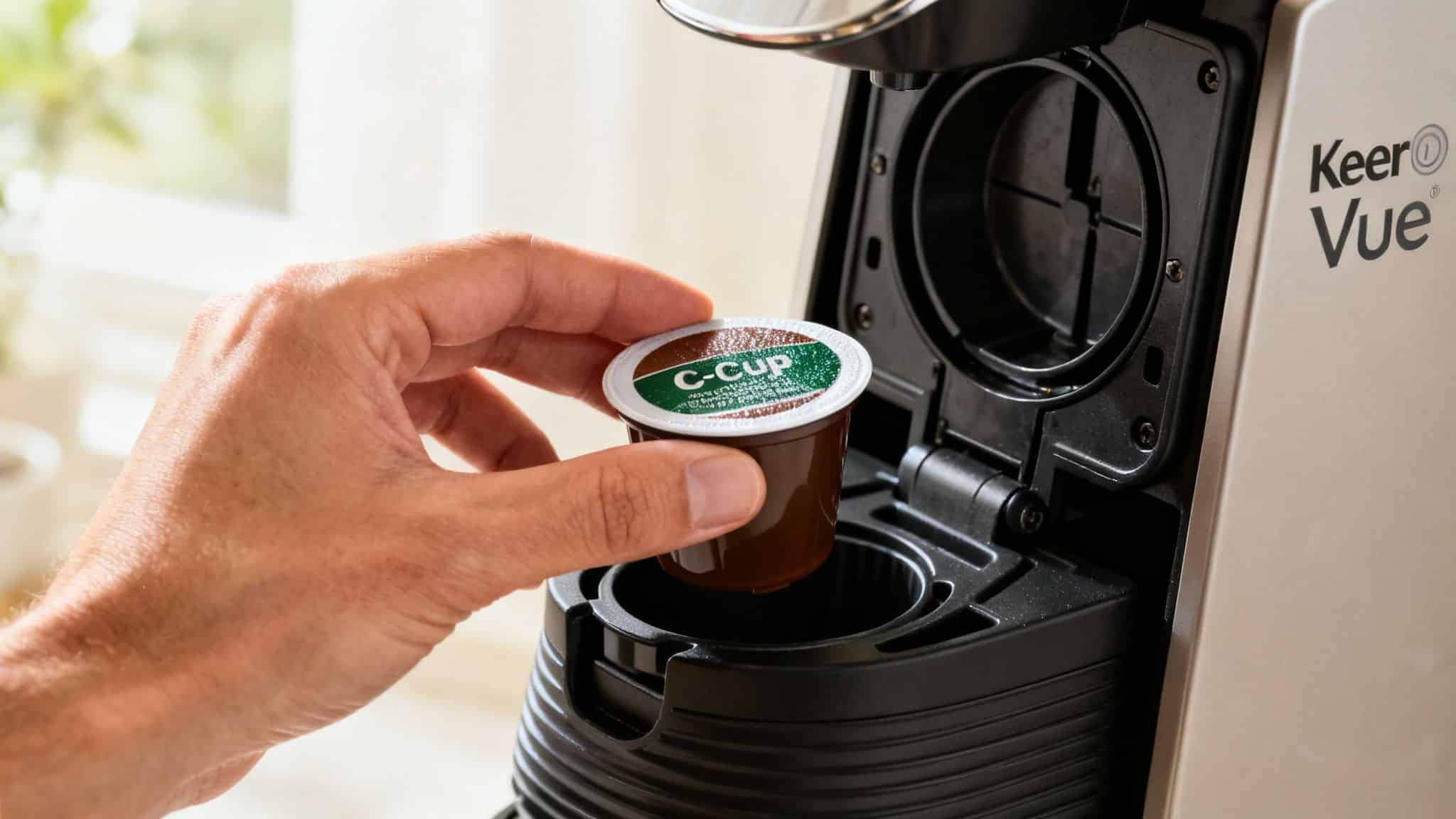
Third-party adapters such as the K2V-Cup work as a 2-in-1 conversion vessel that holds a standard K-Cup inside a Vue-compatible outer shell. That lets the Vue piercing mechanism and water delivery system work correctly while preserving features like brew strength and temperature control. The common compatibility range includes Vue v500, v600, and v700 models, while listings for this style of adapter specifically exclude the v1200, as shown in the K2V-Cup product listing.
Check your model before you buy anything
This matters more than commonly recognized. “Keurig Vue” is not specific enough when you are buying an adapter.
Before ordering, confirm:
- Model number on the brewer: Look at the back, base, or label area.
- Adapter compatibility list: Do not assume all Vue machines share the same chamber details.
- Closure action: Some incompatible setups physically fit partway but fail once the handle comes down.
If you own a v1200, do not buy an adapter that clearly excludes it. That usually ends in a jammed fit or an unreliable seal.
How the adapter functions
The adapter solves three problems at once:
- It gives the pod the outer dimensions the Vue chamber expects.
- It positions the K-Cup where the piercing system can hit correctly.
- It creates the seal path that directs hot water through the pod instead of around it.
That is why a decent adapter can brew well and a flimsy one can make a mess even when it “technically fits.”
How to brew with a K-Cup adapter
Use this method the first few times. It prevents most user-caused leaks.
Inspect the adapter
Make sure the shell is clean, the hinge or lid area closes evenly, and the rim is not cracked.
Seat the K-Cup fully
The pod should sit flat inside the adapter. If it rocks, do not brew.
Insert the assembled unit into the Vue chamber
Set it down carefully. Do not twist aggressively. It should rest in position without needing force.
Lower the handle slowly
Feel for smooth resistance. Sudden hard resistance usually means the pod is misaligned.
Choose a moderate brew setting first
For a test brew, avoid the largest cup size. Start in the middle range and check performance.
Open and inspect after brewing
Look for side leaks, bent edges, or incomplete punctures.
Good sign: The used pod shows clean puncture points and the adapter rim stays mostly clean.
Bad sign: Coffee sludge on the outer shell usually means bypass water or a poor seal.
A quick visual helps
If you want to see the general style of Vue pod handling and adapter use, this video gives useful visual context before your first brew:
What usually goes wrong with adapters
Most failures come from one of four issues:
| Problem | Likely cause | Fix |
|---|---|---|
| Water around pod area | Rim not sealing | Re-seat adapter and inspect the edge |
| Weak coffee | Pod not punctured correctly | Check pod position inside shell |
| Handle hard to close | Wrong model or bad alignment | Stop and verify compatibility |
| Grounds in cup | Damaged pod or poor puncture pattern | Replace pod and inspect needles |
A good adapter can keep a Vue useful. A bad one wastes coffee and puts stress on an older machine. If the fit is inconsistent from one brew to the next, retire that adapter before it creates a bigger repair issue.
Unlocking Savings with Refillable Pods in Your Vue
An adapter gets standard K-Cups working. A refillable pod gives you actual freedom.
That is the setup I usually recommend for a Vue owner who plans to keep the machine in service. Once you stop depending on discontinued Vue packs and stop buying disposable pods for every cup, the brewer becomes practical again.
Many Vue adapters include an interchangeable Eco-Fill cup that accepts ground coffee instead of pre-packaged pods. For that setup to work well over time, the reusable pod materials need to tolerate the Vue system’s heat and pressure, including high temperatures, without warping or leaking, as demonstrated in this Vue adapter and Eco-Fill overview video.
Why refillable pods make more sense in older Vue machines
With a refillable pod, you control the coffee, the fill level, and the cleanup routine. That matters because older Keurig brewers often become picky about flow. A reusable setup lets you correct problems more easily than a sealed disposable pod does.
The main advantages are straightforward:
- Any ground coffee works: You are not limited to whatever pod format is still floating around online.
- You control strength: The coffee dose and grind matter more than the logo on the pod.
- Less waste: You are not throwing away a plastic pod every time.
For users comparing coffee costs more broadly, this article on how to save money with reusable K-Cups for Keurig covers the logic behind switching from disposable pods to refillable options.
How to fill a reusable pod correctly
Many people create their own leak problem at this stage.
Use a medium grind. Not espresso-fine, not coarse like French press. Fill the pod until it is nearly full, then leave a little headspace so the lid or top surface can close without compressing the grounds too hard.
A reliable process looks like this:
- Add ground coffee slowly instead of dumping it in.
- Level the top with a fingertip or spoon.
- Do not tamp hard.
- Check the rim for loose grounds.
- Close the pod fully before placing it in the adapter.
If grounds sit on the rim, the seal is compromised before the brew starts.
Tip: When a reusable pod leaks, overfilling is often the first thing to check. People blame the pod, but the actual issue is usually the coffee bed packed too tight.
The grind and fill mistakes that ruin the cup
A reusable setup only works well if water can move through the coffee bed evenly.
Avoid these common mistakes:
- Too fine a grind: Slows flow, raises pressure, and encourages overflow.
- Too much coffee: Blocks water and causes weak extraction because the brew path gets disrupted.
- Too little coffee: Produces a fast, thin cup.
- Warped lid or body: Breaks the seal even if the fill is correct.
Cleanup matters more than people think
Coffee oils build up fast. Once that happens, the pod can smell stale, the mesh can clog, and flow can become inconsistent. Rinse the pod right after use. Do not leave wet grounds sitting in it until evening.
For easier cleanup, paper liners can help keep fines and oils off the reusable pod walls. They are especially useful if you brew darker roasts or flavored coffee that leaves more residue behind. That is one of the few accessories that reduces maintenance instead of adding clutter.
One product example that fits this use case
One option in this category is the PureHQ reusable Vue cup, which is described by the publisher as a Vue-compatible reusable pod with BPA-free plastic, a stainless steel micro-mesh filter, and a locking lid for use with ground coffee. In practical terms, that kind of construction is what you want to look for in any reusable setup for a Vue: a stable body, a consistent rim, and a filter that can survive repeated cleaning.
Comparing Your Brewing Options for the Keurig Vue
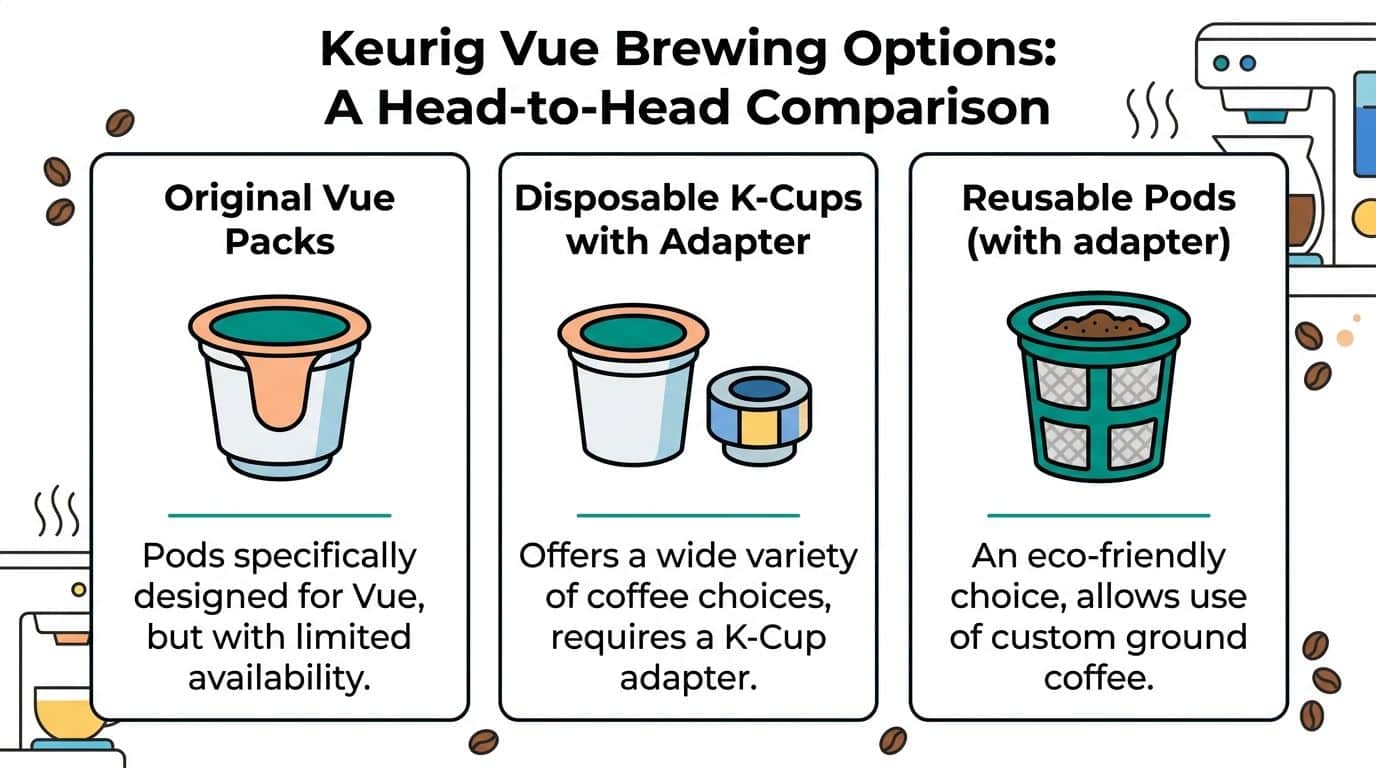
Vue owners usually end up choosing between three paths. Chase original Vue packs, use disposable K-Cups with an adapter, or run a reusable pod inside an adapter.
Each path works differently in practice.
A major blind spot in this category is durability. Online guides often stop at “rinse after use,” but they rarely address long-term wear. The published gap summary from PureHQ notes recurring concerns about degraded seals, plastic fatigue, and possible machine damage after 6-12 months, and it also states that durable tested reusables can reduce waste by over 90% compared with disposable methods in this use case, according to the PureHQ overview on Keurig Vue reusable pod durability.
Side-by-side trade-offs
| Option | What works | What does not |
|---|---|---|
| Original Vue packs | Native fit in the brewer | Hard to find, limited choice |
| Disposable K-Cups with adapter | Wide pod variety, simple routine | Ongoing pod waste, adapter quality matters |
| Reusable pods with adapter | Full coffee freedom, less waste | Requires proper filling and cleaning |
What I would choose for different users
If you only brew occasionally and want the least learning curve, a decent adapter with standard K-Cups is the easiest path.
If you use the machine regularly, a reusable setup makes more sense. You get better control over taste, and you stop depending on whatever pod inventory happens to exist.
If you still have a stash of original Vue packs, use them up. I would not build a long-term plan around them.
Premium vs generic reusable options
Most buying mistakes happen at this point. People compare all reusable pods as if they are interchangeable. They are not.
A premium reusable pod usually gives you:
- more consistent dimensions
- a sturdier hinge or lid
- a filter that resists deformation
- cleaner seating in the adapter
A generic cup often looks fine on day one and starts causing trouble later. The body can soften, the rim can distort, or the seal can stop closing evenly after repeated hot cycles.
Here is the practical comparison:
| Feature | Premium reusable pod | Generic reusable pod |
|---|---|---|
| Fit consistency | More reliable | Can vary from unit to unit |
| Leak resistance | Better when filled correctly | Often inconsistent |
| Cleaning | Usually easier because the mesh and body hold shape | Can trap oils and grounds in weak seams |
| Long-term use | Built for repeated thermal cycling | More likely to warp or crack |
Answer to the common objection about leaks: Reusable pods do not leak just because they are reusable. They leak when the seal is poor, the pod is overfilled, or the plastic has started to deform.
The primary decision
Choose based on how you drink coffee.
- Convenience first: Adapter plus disposable K-Cups
- Control and lower waste: Adapter plus reusable pod
- Collector mentality: Original Vue packs if you already have them
For many users aiming to keep a Vue functional, the third option is not realistic long term. The second one usually gives the machine the longest useful life with the least dependence on discontinued inventory.
Troubleshooting Common Adapter and Pod Issues
When a Vue setup fails, it usually fails in obvious ways. Coffee on the counter. Grounds in the mug. A weak cup that tastes like hot water. Most of these problems have a direct cause.
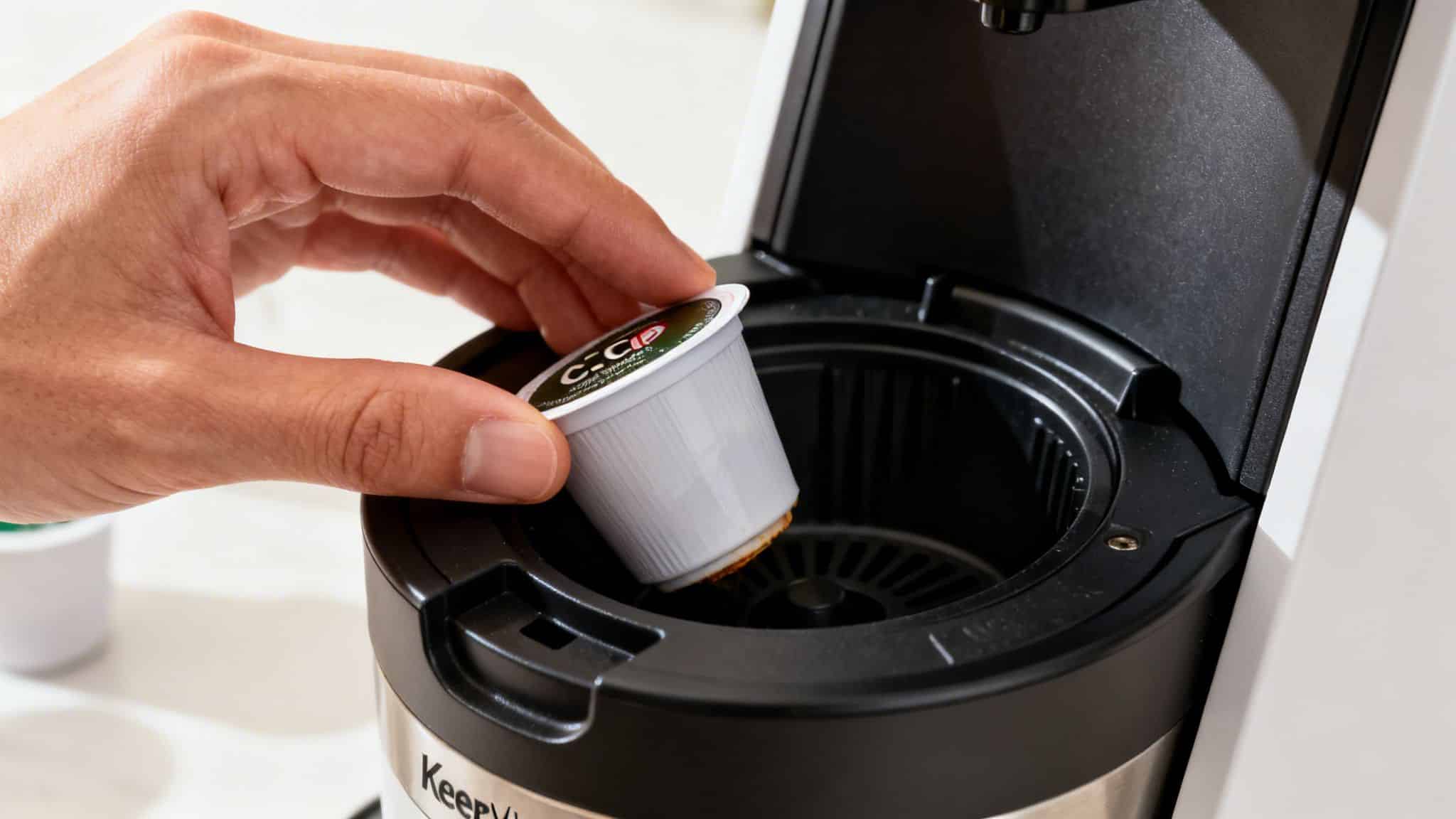
For a broader overview of reusable pod problems across Keurig systems, this guide on issues you may experience when using reusable K-Cups is a useful companion, but Vue owners need to pay extra attention to fit and seal quality because the platform is less forgiving.
If coffee leaks around the pod area
Start with the simplest cause. Most leaks come from poor seating.
Check these points:
- Rim cleanliness: One stray ring of grounds can break the seal.
- Pod fill level: If the pod is packed too high, the top cannot close correctly.
- Adapter alignment: The shell must sit flat in the chamber.
- Seal wear: If the edge looks rounded, split, or permanently bent, replace the part.
If you see coffee outside the pod after brewing, do not keep testing cup after cup. Remove the adapter and inspect it dry under good light.
If the coffee is weak or watery
Weak coffee usually means one of two things. Water is bypassing the grounds, or the coffee bed is wrong for the machine.
Try this sequence:
- Use a medium grind.
- Add enough coffee to fill properly without compressing it.
- Choose a smaller brew size for your test cup.
- Inspect the puncture pattern after brewing.
If the used pod looks barely pierced or unevenly soaked, the adapter may not be positioning the cup correctly.
If grounds end up in your mug
Some fines are normal with certain reusable filters. A lot of grounds are not.
Likely causes include:
| Symptom | Likely cause | Fix |
|---|---|---|
| Heavy sediment | Mesh damage | Replace the reusable pod |
| Grounds plus leaking | Seal failure | Clean rim and inspect lid |
| Grounds with weak coffee | Overfilled pod causing channeling | Reduce fill slightly |
| Grounds after many months of use | Wear from repeated cleaning and heat | Retire the worn part |
If the machine struggles or shows odd behavior
An older Vue can react badly when scale builds up inside the water path. Flow slows down, temperature suffers, and the brewer may behave inconsistently even when the pod setup is fine.
That is why maintenance matters just as much as pod choice.
A good routine includes:
- Rinsing the reusable pod after each use
- Removing coffee oil buildup regularly
- Descaling the machine on a regular schedule
- Using a water filter if your machine supports it
A universal descaling solution is one of the few maintenance products I recommend without hesitation because mineral buildup changes brew performance in ways that people often blame on the pod. If taste has fallen off and brew times have stretched, descale before replacing half your accessories.
Technician’s shortcut: If a setup brewed well for months and suddenly got slow, do not assume the adapter failed first. Check for scale and coffee oil buildup before buying new parts.
When to stop troubleshooting and replace the part
Do not keep nursing a bad pod or adapter forever. Replace it if you find:
- visible cracks
- a lid that will not lock squarely
- a warped rim
- recurring leaks after careful cleaning and correct filling
- mesh damage that lets grounds through
Older Vue brewers can keep working for a long time, but they do not benefit from worn accessories. A tired adapter puts extra stress on a machine that already has limited replacement parts.
Brew Your Favorite Coffee in Your Vue Today
A Keurig Vue is only obsolete if you insist on using it the old way.
The machine still has value. It can still produce a satisfying cup. What changed is the pod ecosystem around it. Once you switch to the right adapter and a durable reusable setup, the Vue becomes useful again instead of frustrating.
That is the fundamental fix for the k cup for keurig vue problem. Do not force a standard pod into a machine that was never built for it. Use an adapter that matches your specific Vue model, keep the pod clean, watch for wear, and replace any part that starts leaking or warping.
If your brewer still heats and pumps, it probably deserves to stay on the counter.
If you want to keep your Vue brewing with less waste and fewer fit problems, shop compatible reusable pods, paper liners, water filters, and descaling supplies from PureHQ Inc..

