
Coffee Machine Care
The Perfect French Press Coffee to Water Ratio for a Flawless Brew
Mar
Have you ever stared into an empty French press, spoon in hand, and just guessed how much coffee to use? That single moment of guesswork is often the difference between a rich, satisfying brew and a cup of bitter disappointment. In fact, for the 62% of Americans who drink coffee daily, inconsistent flavor from home brewing methods remains a top complaint.
This brewing lottery is a frustrating way to start the day. You invested in a French press to enjoy that full-bodied, coffee-shop quality experience, but your results are wildly unpredictable. One morning it’s weak and watery; the next, it’s a sludgy, aggressive mess. You're wasting expensive beans and precious morning minutes on a gamble, wondering if you’ll ever escape the cycle of bad coffee.
The solution is simpler than you think: embracing a precise French press coffee to water ratio. The gold standard, recommended by the Specialty Coffee Association, is the 1:15 ratio—that is, 1 gram of coffee for every 15 grams (or mL) of water. Moving from guessing with scoops to measuring with a scale is the single most important step you can take to achieve a consistently delicious, perfectly balanced cup every single time.

Why Your French Press Brew Is So Inconsistent

You follow the steps. You grind fresh beans. But your French press coffee remains stubbornly unpredictable. Some mornings it’s perfect—rich, aromatic, and bold. Other days, you’re met with a cup that’s either a sludgy, bitter mess or as disappointingly thin as tea.
This frustration is more than just an inconvenience; it sours the entire morning ritual. You start to doubt your equipment and your abilities, wondering if that perfect cup is only achievable by a professional barista. The inconsistency makes you feel like you're throwing money away on premium coffee beans only to ruin them with sheer bad luck.
The real culprit is a common blind spot for home brewers: an imprecise French press coffee to water ratio. An improper ratio is the direct cause of the two most dreaded coffee outcomes: under-extraction (weak, sour coffee) and over-extraction (bitter, harsh coffee). Using scoops or eyeballing it introduces massive variance because a "scoop" of a dense light roast weighs far more than an oily dark roast. This guarantees an inconsistent foundation, turning your daily brew into a frustrating game of chance. By moving from guesswork to a repeatable process, you can finally gain control.
How to Brew with the Golden 1:15 Ratio
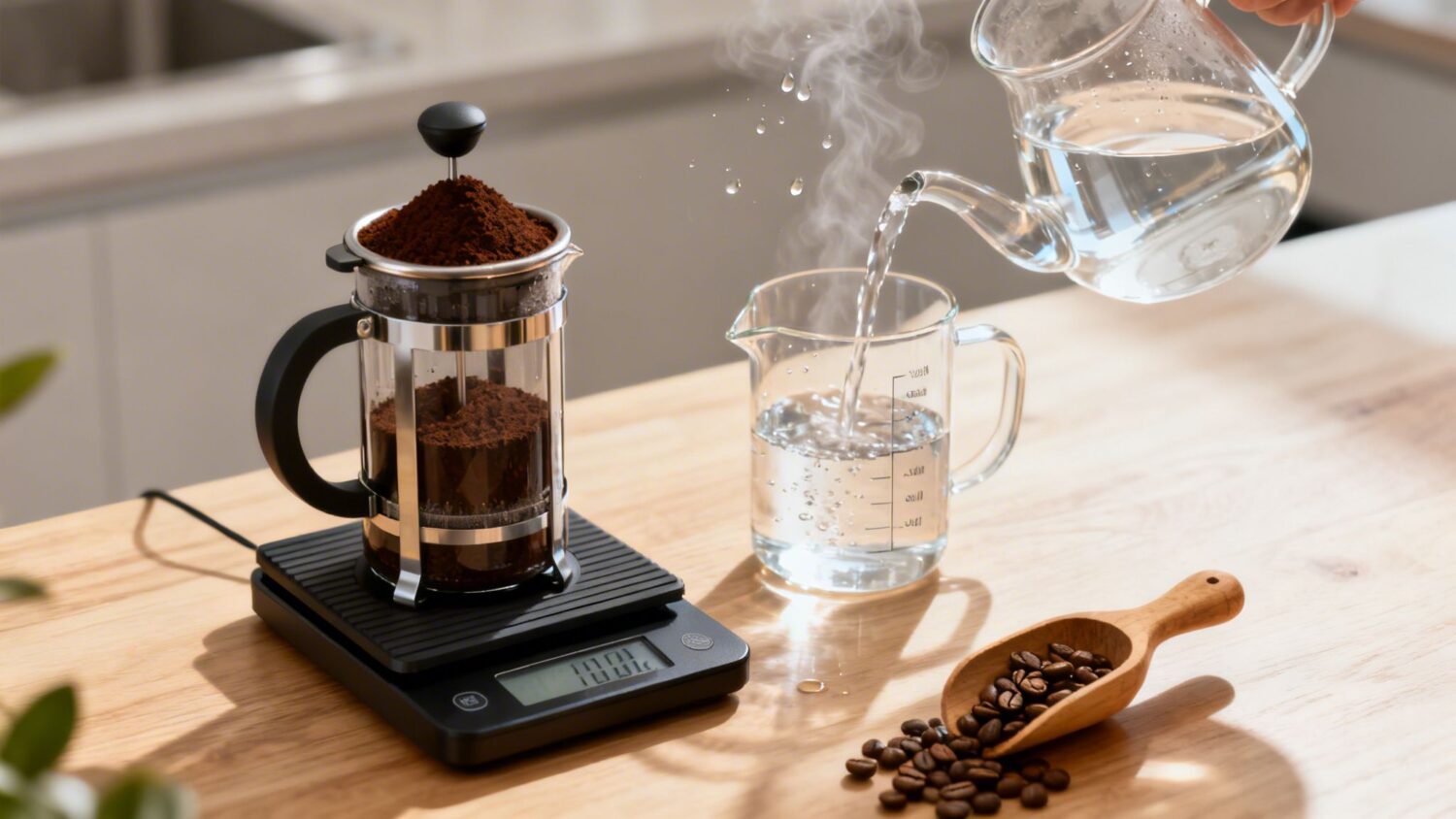
The secret to ditching brew inconsistency isn't a fancy gadget; it’s a simple, repeatable process built on the "golden ratio" that guarantees a fantastic cup. The key is what coffee pros call the 1:15 ratio, meaning for every 1 gram of coffee, you'll use 15 grams of water. The most reliable way to nail this is with a digital kitchen scale. This one tool is the single biggest step toward a consistently amazing cup.
Step 1: Measure and Grind
First, let's measure. Place your empty French press carafe on a scale and zero it out. For a standard 34 oz (1-liter) press, add 60 grams of coffee beans. Next, grind the beans to a coarse consistency, resembling chunky sea salt. A coarse grind is non-negotiable; if it's too fine, sediment will pass through the filter, creating a muddy, bitter brew. A quality burr grinder ensures the uniform particle size needed for a clean, balanced extraction.
Step 2: Bloom the Coffee
While grinding, heat your water to between 195-205°F (90-96°C). The National Coffee Association notes that this temperature range is ideal for optimal extraction. An easy method is to bring water to a boil and let it cool for 30-60 seconds. Now, for the "bloom":
- Add your coarse grounds to the press.
- Start a timer for 4 minutes (your total brew time).
- Pour just enough hot water (about 120g) to saturate the grounds and let it sit for 30 seconds. You will see the coffee bed puff up as it releases CO2, a critical step for unlocking a richer flavor.
Step 3: Steep and Plunge
After the bloom, pour in the remaining 780 grams of water to reach your 900-gram target (60g coffee x 15). Place the lid on top, but don't plunge yet. Let the coffee steep until your timer hits the 4-minute mark. Then, press the plunger down slowly and steadily. Rushing this step will kick up sediment, so take a full 20-30 seconds to press. Decant the coffee immediately to stop extraction and prevent bitterness.
This precise method transforms your coffee from a random gamble to a reliable ritual. For more details on the fundamentals, explore our guide on how to brew quality coffee.
Adjusting the Ratio to Your Personal Taste
So, you’ve nailed the classic 1:15 ratio, but what if it doesn't quite hit the spot for you? Sticking to a single recipe is like never adding salt to your food—you're missing the chance to make it truly yours. Your coffee might taste good, but it doesn't have your signature on it yet.
This is where the real craft of brewing begins. Think of that 1:15 ratio as your starting point, not the final destination. By making small, deliberate tweaks to your French press coffee to water ratio, you can unlock the exact flavors you want and tailor every cup to your personal preference.
The beauty of the French press lies in its forgiving nature, making it perfect for experimentation.
- For a Bolder Cup: To create a stronger, more concentrated brew, tighten the ratio to 1:14 or even 1:13. This uses more coffee relative to water, amplifying the deep, rich notes characteristic of a bold French Roast coffee.
- For a Milder Cup: If you prefer a more delicate flavor, loosen the ratio to 1:16 or 1:17. This gives the brew more room to breathe, highlighting subtle fruity and floral notes without overwhelming the palate.
Start with the 1:15 standard and adjust from there. If your brew is consistently too strong, try a 1:16 ratio. If you want a bigger kick, go down to 1:14. If you find your adjustments are leading to bitterness, it may be time to investigate other factors, like water temperature or grind size, to figure out why your coffee might taste bitter. Finding your perfect cup is part of the fun.

Essential Tools and Common Troubleshooting

You’ve nailed your ratio and steep time, but your coffee is still wrong—maybe it's sour, or worse, full of that gritty sludge at the bottom of your mug. This final hurdle is incredibly frustrating. It’s tempting to blame your press, wondering if a more expensive one would magically fix the problem.
The secret is that the issue rarely lies with the press itself. It’s almost always your tools and technique. A "good enough" approach with a blade grinder and volume scoops ends up costing you more in wasted beans and unsatisfying coffee. A one-time investment in a quality burr grinder and a digital scale eliminates the two biggest variables that ruin a brew, paying for itself in consistency.
Let's solve the most common issues:
- Problem: My coffee is muddy and gritty. This is a direct result of a grind that is too fine. The press's mesh filter cannot catch these tiny particles. Solution: Adjust your grinder to a coarser setting. Our complete guide on the best grind for French press can help you dial this in.
- Problem: My coffee tastes sour or weak. This sour tang indicates under-extraction. Solution: Ensure your water is between 195-205°F and you are steeping for a full four minutes.
- Problem: My coffee is bitter and harsh. Bitterness is a clear sign of over-extraction. Solution: Let boiling water cool for 30-60 seconds before pouring, and don't steep for longer than four minutes.
Precision vs. Standard Brewing Tools
| Tool | Premium Option (Burr Grinder & Digital Scale) | Standard Alternative (Blade Grinder & Scoop) | Impact on Coffee Quality |
|---|---|---|---|
| Grinder | A burr grinder creates uniform, consistently sized particles. | A blade grinder produces an uneven mix of fine dust and large chunks. | Objection Addressed (Durability/Consistency): While cheaper, a blade grinder's inconsistent output causes both bitterness (from fine dust) and sourness (from large chunks), ruining the brew. Burr grinders deliver a balanced, clean flavor every time. |
| Scale | A digital scale measures coffee and water by weight for exact, repeatable ratios. | Scoops measure by volume, which is highly inconsistent between different coffee beans. | Guarantees a perfect French press coffee to water ratio. This means no more weak or overpowering brews—just repeatable, delicious results. |
Precision tools remove the guesswork, giving you control. For an even cleaner flavor, using PureHQ's premium water filters provides a neutral base, ensuring the only thing you taste is your coffee. Don't forget, keeping your kettle clean is also vital for pure flavor.
Shop Our Descaling Solutions to Keep Your Equipment in Top Shape
Your French Press Ratio Questions Answered
Even with the right knowledge, questions pop up. You might be in a kitchen without a scale or want to brew just a single cup in a large press. These small roadblocks can turn a relaxing ritual into a game of chance. Let's clear the air and give you the confidence to handle any scenario.
How Can I Measure Without a Scale?
While a digital scale is best for a perfect coffee to water ratio, you can get close with volume. As a reliable rule of thumb, use two level tablespoons of ground coffee for every six ounces of water. Remember this is an approximation, as bean density varies, but it's a great trick in a pinch.
Can I Make a Single Cup in a Large Press?
Absolutely. This is where knowing your ratio shines. To make a single 12-ounce cup (about 340g of water), just stick to the 1:15 ratio:
- Water: 340g (or 12 fl oz)
- Coffee: Divide your water weight by 15 (340 / 15 = ~23g of coffee), which is roughly four and a half level tablespoons. Follow the same brewing steps for a perfectly extracted single serving.
When Should I Change the 4-Minute Steep Time?
The four-minute steep is a guideline, not a strict rule. If your grind is a bit too fine and the coffee tastes bitter, try cutting the steep time to three minutes. If your grind is extra coarse and the coffee tastes weak, let it steep for five minutes to pull out more flavor.
What about other brewing methods like cold brew?
The principle of ratios applies everywhere. For instance, this popular cold brew guide starts with a super-concentrated 1:4 coffee-to-water ratio, which is then diluted to taste. Your French press ratio is just one application of a universal coffee principle.
At PureHQ Inc., we believe great coffee should be simple and accessible. Our accessories are designed to give you that coffee-shop quality experience right at home, from premium water filters to easy-to-use descalers that keep your equipment pristine.
Shop PureHQ for all your coffee accessory needs today!

