
Coffee Machine Care
Espresso Machine Accessories: What You Need in 2026
Nov
Up to 75% of coffee-equipment problems are water-related, according to manufacturers cited in Pentair's industry water-management overview, and those problems may fall outside warranty coverage. That's a better starting point for buying espresso machine accessories than another polished distribution tool: identify what's changing before paying for something that doesn't address it.
A shot that runs differently every morning doesn't automatically mean the machine needs replacing. Start by treating the setup as a measurable system: check the water, weigh the coffee, inspect the basket, and buy the accessory that addresses the variable you can identify.
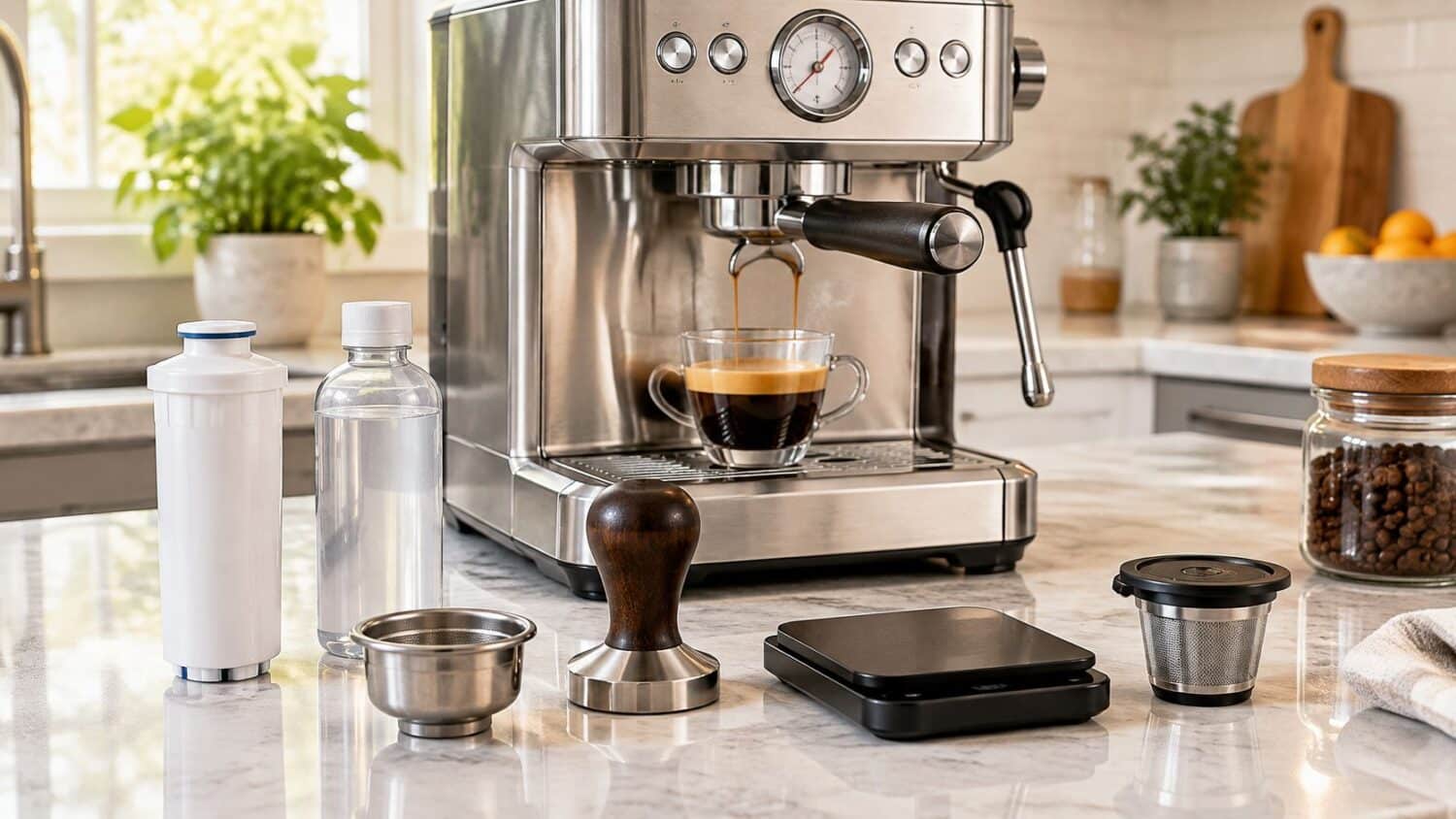
Essential Espresso Machine Accessories at a Glance
Your shopping cart can fill up faster than your diagnosis improves. A new basket won't correct unsuitable water, and a fresh filter won't straighten a damaged tamper. The useful accessory is the one that fixes a repeatable problem.
Organize the kit into these groups before comparing products:
- Essentials for every portafilter machine: A portafilter basket, a correctly sized tamper, and a dosing scale.
- Essentials in hard water: A suitable water filter cartridge and a machine-compatible descaler.
- Recommended for routine care: Cleaning tablets and a blind basket, but only where the manufacturer permits backflushing.
- Optional tuning tools: A thermometer and a distribution tool, selected to investigate a specific inconsistency.
Core and Optional Espresso Accessories
| Accessory | Main job | Priority | Replace or service when |
|---|---|---|---|
| Portafilter basket | Sets dose and puck shape | Essential | Rim or base is damaged or worn; investigate unexplained shot-time drift |
| Tamper | Compresses grounds evenly | Essential | Base is bent, uneven, or no longer flat |
| Dosing scale | Confirms dose and beverage output by weight | Essential | Readings drift against a known test weight |
| Water filter cartridge | Reduces scale-forming minerals and shapes water chemistry, where designed to do so | Essential in hard water | Replacement interval based on cartridge capacity, measured hardness, and cups brewed is reached |
| Descaler | Removes mineral deposits that have already formed | Essential maintenance supply where approved | Descale light appears or the hardness-based service interval is reached |
| Cleaning tablets | Remove coffee oils and residue | Recommended | Use during the machine's specified routine cleaning cycle |
| Blind basket | Enables group-head backflushing | Recommended for compatible machines | Insert is damaged or its seal wears; use for manufacturer-approved backflushing |
| Thermometer | Helps check brewing-water temperature | Optional | Investigate taste changes without a grind or dose change |
| Distribution tool | Redistributes or levels grounds before tamping | Optional | Needles, bristles, or wedges are damaged, or uneven extraction needs investigation |
The table is a service checklist, not a requirement to replace everything. Shot-time drift alone doesn't prove that a basket is worn. Inspect it, clean it, and check dose and grind before ordering another.
Likewise, don't buy a blind basket just because it fits inside the portafilter. Confirm that the machine supports backflushing, then use its specified procedure. A cleaning accessory isn't suitable merely because you can physically install it.
Buying rule: Keep a functioning part until you can name the problem its replacement will solve.
Before buying anything new, test your water hardness and log two weeks of shots on a scale. Record dry dose, beverage weight, shot time, and taste. Those checks give you a practical basis for deciding which rows apply to your machine instead of assembling a collection of attractive duplicates.
Why Water Quality Decides Your Filter Choice
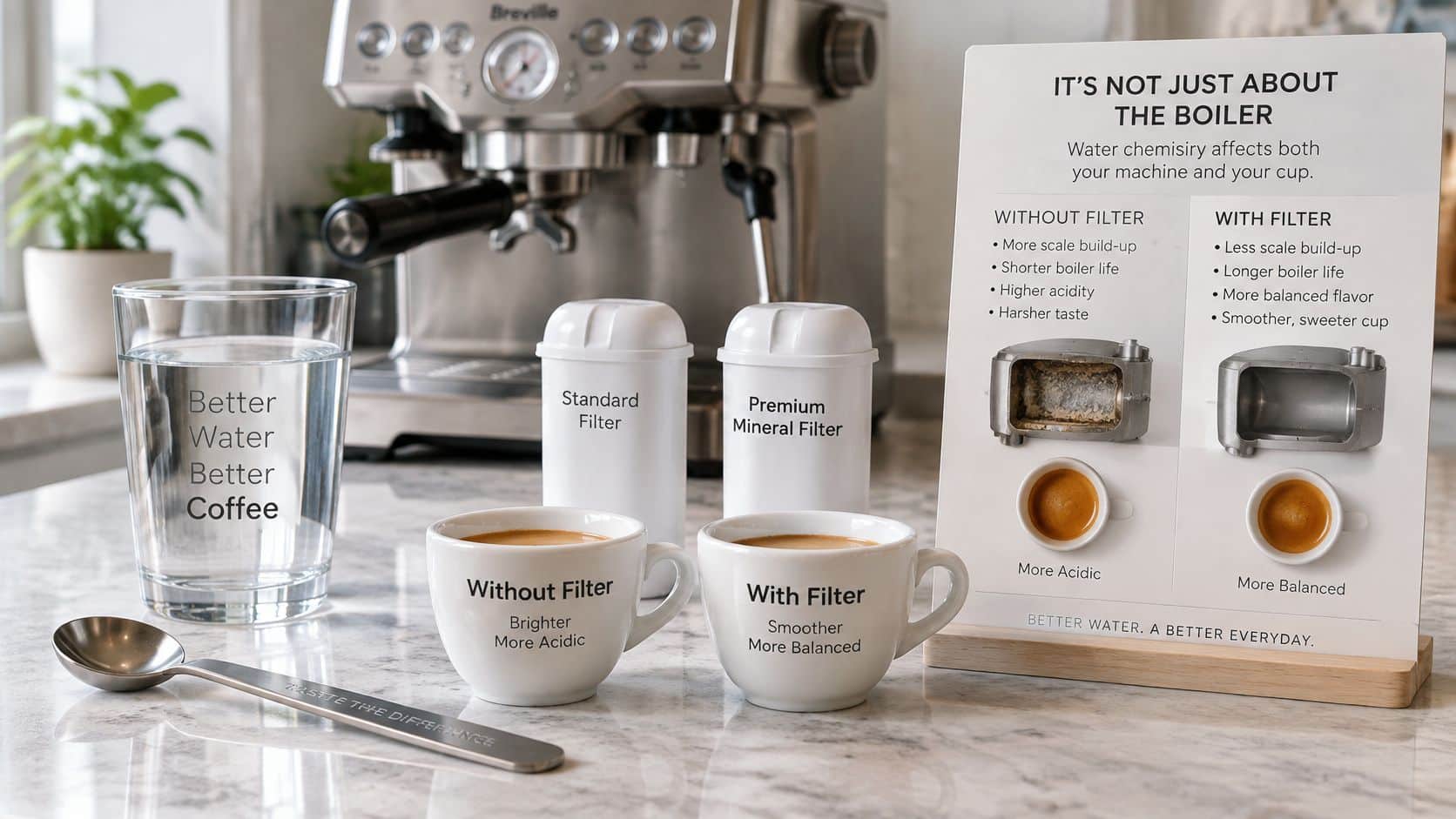
The belief that filters only protect the boiler misses their effect on flavor. The Specialty Coffee Association's discussion of water and acidity explains that alkalinity can influence perceived acidity several hundred times more than pH when pH is near neutral, at 6–8, and alkalinity exceeds roughly 20 ppm as calcium carbonate.
A cartridge therefore needs a water-chemistry job, not just a matching shape.
Match Treatment to Your Water
Use this sequence rather than assuming maximum mineral removal is best:
- Get both readings. Check your utility's water report or use separate hardness and alkalinity tests.
- Interpret the hardness band. The SCA discussion associates hardness above approximately 250 ppm as CaCO₃ with over-extracted flavor and levels below about 40 ppm with under-extraction tendencies. Within roughly 20–250 ppm, extraction efficiency may change little even when sensory balance changes.
- Choose an appropriate treatment. Compare the cartridge's stated treatment capability with your readings and the machine's water requirements. These overlapping bands describe tendencies, not universal pass-or-fail limits.
Don't substitute a TDS reading for those tests. The SCA's TDS-meter guidance says dissolved-solids measurements don't identify individual substances and that an NaCl-calibrated meter can read about 30% lower than one calibrated to the SCA 442 Natural Water standard in typical potable water, with increasing error as concentrations rise.
Say you install a filter in a hard-water home and the coffee tastes thinner. Retest before declaring the cartridge defective, then keep a two-week taste log with the coffee and recipe unchanged. Look for repeatable balance and flow, not just a lower meter reading.
For cartridge selection, use our espresso-machine water-filter guide. If you're changing plumbing too, SouthRay Kitchen & Bath's resource on planning filtration during a kitchen remodel offers useful installation context, but your machine's water specifications should still govern treatment.
Shot Targets Your Tools Should Hold Steady
Accessories need a target before you can judge whether they help. Contemporary practice summarized in Coffearium's discussion of extraction benchmarks draws on SCA survey data: a typical double uses an 18–20 g dose, approximately 36.5 g beverage output, roughly a 1:2 ratio, 9 bar, water near 200°F (93.3°C), and 25–30 seconds.
Treat those as starting coordinates, not a promise that every coffee tastes best there. The same discussion gives a broader traditional window of 90.5–96.1°C, 9–10 atmospheres, and 20–30 seconds.
Keep the core targets visible beside the machine.
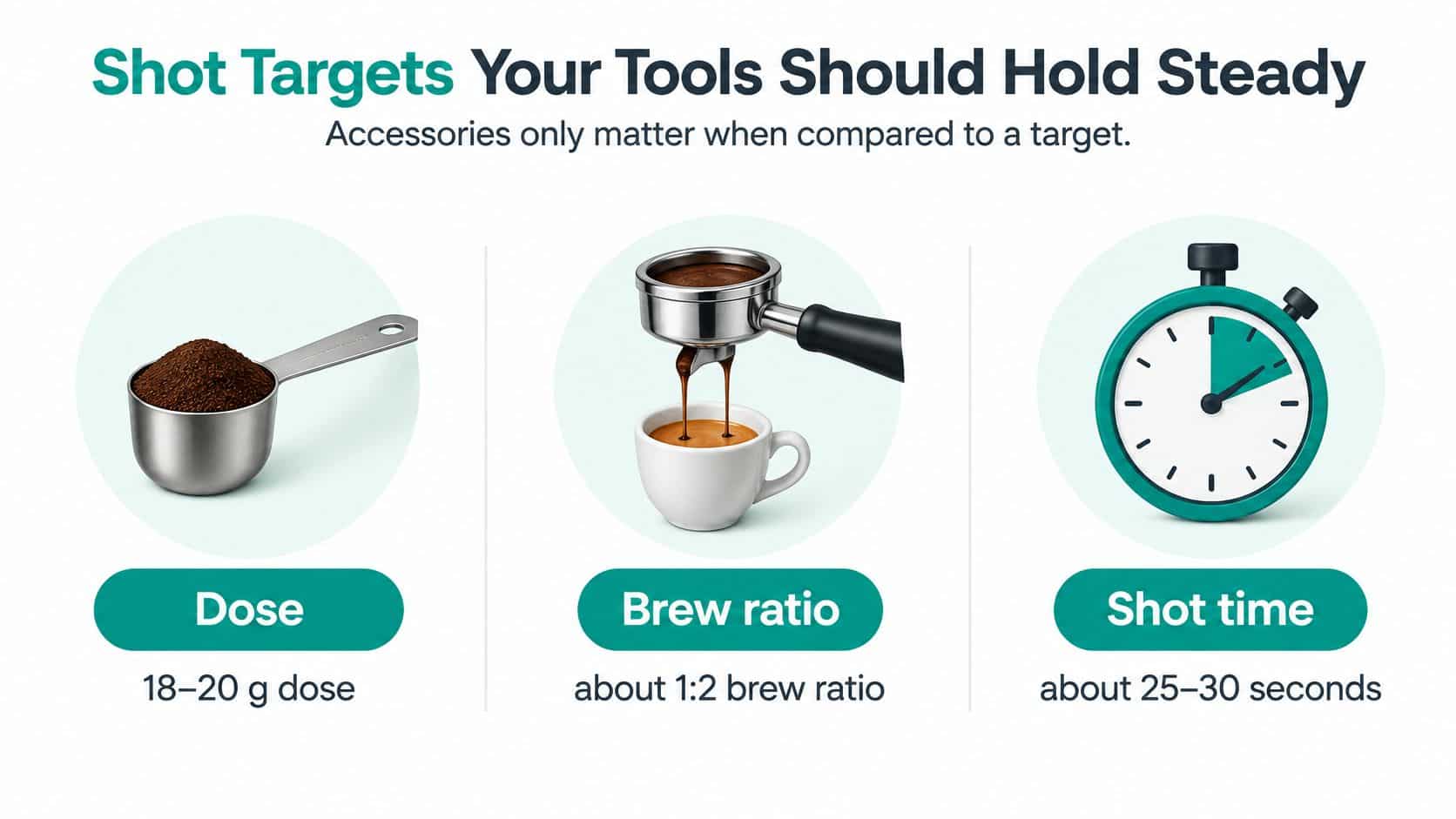
Double-Shot Targets and the Tools That Hold Them
The table applies those benchmarks to the checks you can make at the counter.
| Variable | Target for a double shot | Measure with | Accessory that holds it steady |
|---|---|---|---|
| Dose | 18–20 g | Dosing scale | Matched precision basket and calibrated tamper |
| Beverage output | About 36.5 g, approximately a 1:2 ratio | Scale; graduated cup for volume checks only | Dosing scale and consistent basket |
| Pressure | 9 bar | Machine pressure gauge or readout | Matched basket and sound seal support consistent resistance |
| Water temperature | About 93.3°C (200°F) | Suitable thermometer or temperature readout | Thermometer checks performance; machine controls temperature |
| Extraction time | 25–30 seconds | Timer | Consistent distribution and tamping support repeatability |
Measurement and control aren't the same thing. A thermometer checks temperature; it doesn't stabilize the heater. A basket influences resistance, but it doesn't regulate pump pressure. Weigh beverage output rather than treating cup volume as an equivalent measurement.
A replacement basket can change puck depth, headspace, and flow resistance even when its advertised capacity matches the original. A distribution tool can change how the grounds settle, but it doesn't reduce headspace. If the new preparation lengthens shot time, hold the dose steady and adjust grind before condemning the basket.
For tamping options, our automatic espresso tamper guide can help you assess whether repeatability justifies another tool.
Use the demonstration alongside your own measurements, not instead of them.
Weigh dose and output, record time, and change one variable at a time. Otherwise, you can mistake a preparation change for a machine fault.
Premium Replacements Versus Generic Parts
“Will the cheaper basket leak around the rim?” is a sensible objection. The answer comes from dimensions, seating, and the condition of the sealing surfaces, not the word premium.
The Specialty Coffee Association's espresso definition establishes a controlled brewing process. A replacement that changes dose, restricts flow, or prevents proper sealing changes that process even if the pump and heater are working correctly.
Use the comparison as a buying checklist rather than assuming every expensive part passes and every generic part fails.
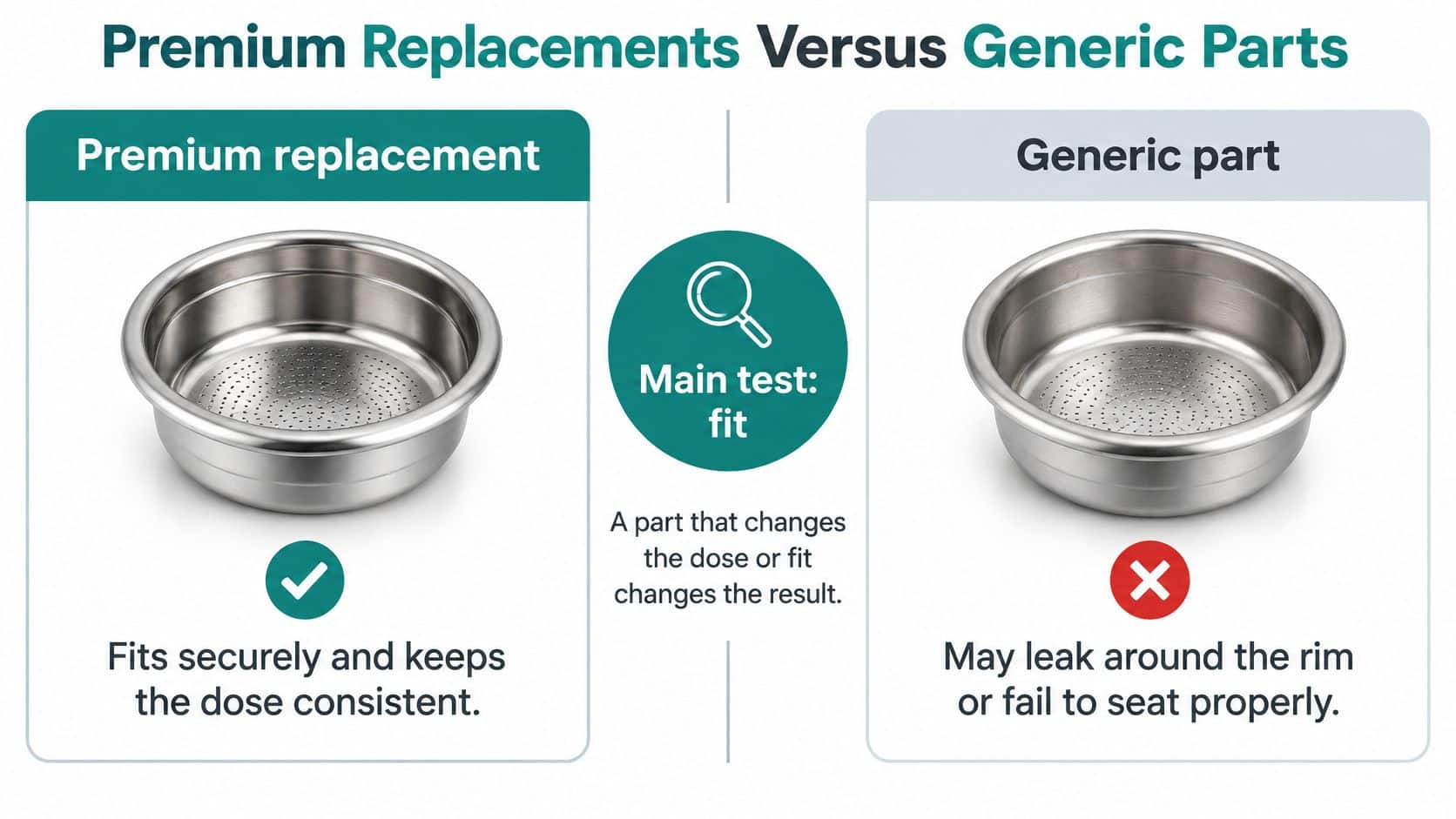
Premium Replacement Versus Generic Espresso Parts
| Criterion | Premium replacement | Generic alternative |
|---|---|---|
| Fit to machine | Look for dimensions checked against named machine models | Universal sizing may leave gaps or fail to seat; don't trim a metal basket to force compatibility |
| Seal and leaks | Look for a rim or seal designed for the listed portafilter or group | A model-unmatched part may leak around the rim |
| Dose and flow | Verify the intended dose range and basket geometry | Different depth and headspace may shift shot time |
| Materials | Require stated materials on the product page | Check the listing before purchase; don't infer material from appearance |
A premium replacement earns its price when the seller provides information you can verify. A generic part can be a reasonable purchase when its dimensions match, its construction is sound, and it passes the same checks.
Neither label establishes durability by itself. Inspect the rim, base, finish, and any supplied sealing component. Don't accept a distorted rim because the product description emphasizes polished steel.
Run a Fit Test Before Dialing In
- Measure the existing basket. Compare diameter, depth, and rim profile, not just the headline size. Check that the tamper also suits the replacement's internal diameter.
- Confirm exact compatibility. Match the machine model and portafilter arrangement to the listing. If the seller doesn't identify the model or provide usable dimensions, leave the purchase unresolved.
- Test seating and brewing separately. Run a water-only cycle to look for obvious drips, then observe the seal during a normal coffee extraction. A water-only pass doesn't reproduce brewing resistance.
Compare shot time using the same coffee, dose, and grind after checking fit. If the rim stays dry but the shot changes, investigate basket geometry and grind rather than assuming the seal failed.
A well-fitting generic basket is more useful than an expensive basket that won't seat correctly.
Don't force the handle farther than normal to make a questionable replacement seal. Stop, let the machine cool, and compare the new part with the original.
Single-Serve Pods and Carafe Baskets
Single-serve and drip machines need different accessories from a portafilter setup. Start with the listed machine model and holder dimensions: a reusable pod that sits too high deserves a fit check before you close the lid or brew.
Credence Research valued the global coffee-pods market at USD 24.145 billion in 2024, with hard or capsule pods accounting for approximately 76%. That market share doesn't establish reusable-pod compatibility, so don't use popularity as a substitute for checking your manual.
Use a short acceptance test:
- Match the model and size. Compare the reusable part's listing with the machine manual, including the brewer generation.
- Run a water-only cycle. Watch the lid, holder, and surrounding area for drips or water bypass.
- Brew a comparison cup. Compare flow time and taste with your recent baseline before changing the coffee or fill level.
A reusable filter changes how you hold the coffee, not the machine's exposure to dissolved minerals. Keep its cleaning routine separate from the brewer's mineral-maintenance routine.
Set the descaling interval using measured hardness, weekly beverage volume, and the machine's instructions. Don't postpone maintenance because you stopped using disposable capsules.
How to Descale and Rinse Without Residue
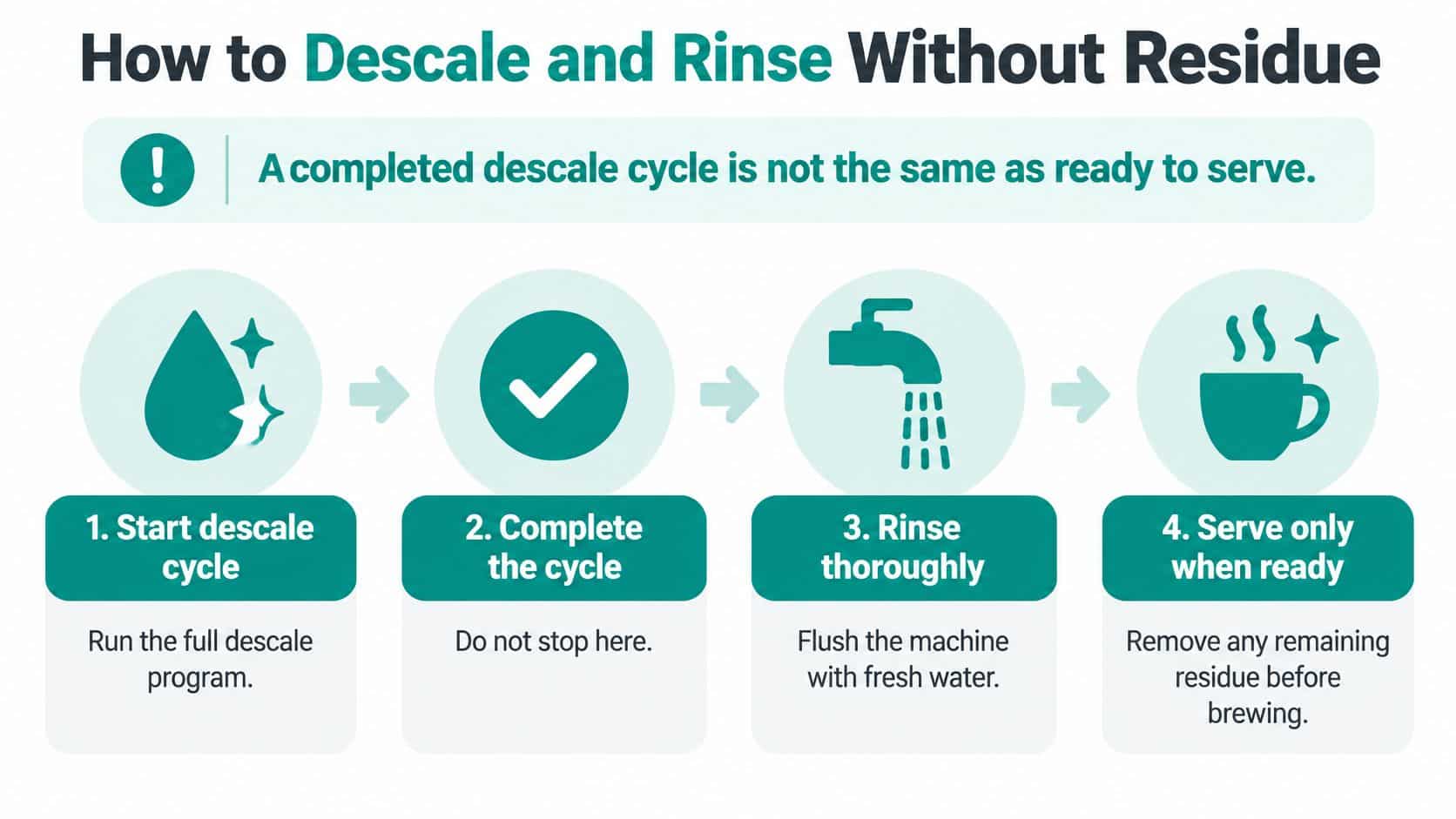
The descale-complete signal isn't permission to serve coffee immediately. Rinsing is a separate step, and an automatic program finishing doesn't prove that every treated water path has been adequately flushed.
Coffearium's espresso-machine-care review discusses German risk-assessment guidance emphasizing thorough rinsing and water-only flushing before beverage preparation. The independent review also notes that available studies haven't adequately compared descaling acids for scale removal, residue, metal release, and silica-scale performance, so there isn't a sound basis for declaring one acid universally superior.
Keep the post-treatment steps as visible as the descale instructions.
Follow the Model-Specific Rinse Procedure
- Prepare the machine. Empty the reservoir, remove the water filter cartridge where the manual directs, and locate the correct descale mode. Check which outlets the procedure treats so you don't overlook a water path.
- Measure the descaler. Use the product's specified dose for the reservoir volume and confirm machine compatibility. Don't strengthen the mixture or substitute vinegar without explicit approval.
- Complete the program. Let the machine finish and observe any waiting period specified in its manual. Interrupting the cycle leaves you without a reliable completion point.
- Rinse the reservoir and flush. Empty and rinse the tank, refill with fresh water, and run at least two full water-only rinse cycles unless the manufacturer specifies a different protocol. Follow any larger required rinse volume and flush every outlet identified by the manual.
- Check before serving. After completing the required rinse, inspect dispensed water for abnormal odor; only taste a cooled sample once the prescribed flushing is complete. If anything remains abnormal, rinse again and seek manufacturer guidance if it persists, since taste alone cannot establish chemical safety.
- Return the machine to service. Reinstall or replace the cartridge as directed, reset the indicator when appropriate, and record the service date. In a shared workplace, make the completion record visible to the next user.
Keep Cleaning and Descaling Separate
Descaler addresses mineral deposits. Coffee-oil cleaning products address brewing residue, and backflushing is appropriate only for machines designed for it. Our espresso-machine cleaning-kit guide helps organize those separate tasks.
Don't choose the next service date from the calendar alone. Habilytics' maintenance guidance recommends measuring hardness, configuring the machine accordingly, and adjusting maintenance to usage.
Service checkpoint: A completed treatment needs a completed rinse before anyone makes the next drink.
Diagnosing Common Shot Problems and Their Fixes
A fast shot is a reason to check the recipe, not an immediate instruction to buy a basket. Start with the symptom, make the simplest reversible adjustment, and test again before replacing hardware.
The table gives working diagnoses, not guarantees. Use the shot-target measurements to separate a preparation issue from a fit, water, or cleaning issue.
Shot Symptoms, Likely Causes and Fixes
| Symptom | Likely cause | Accessory or fix |
|---|---|---|
| Fast shot with pale crema | Dose too low, grind too coarse, or basket too large for the dose | Check dose on the scale and adjust grind; confirm the basket suits the dose and portafilter |
| Slow or choked shot | Dose too high or grind too fine | Reduce dose or coarsen grind; check distribution technique |
| Water leaks at the rim | Worn seal, dirty sealing surface, or mismatched portafilter or basket | Clean the contact surfaces; confirm model fit and replace a worn seal |
| Flat or bitter taste after a filter change | Water chemistry shifted from its prior balance | Retest hardness and alkalinity, then reconsider the filter approach |
| Slow water flow or scale marks | Mineral deposits are a possible cause | Run approved maintenance when due and confirm the filter schedule |
| Chemical taste after descaling | Incomplete flushing is a possible cause | Stop serving and complete additional water-only rinsing; investigate persistent abnormalities |
| Oily or stale taste | Coffee oil and residue in the brew path | Use approved cleaning tablets and a blind basket only where backflushing is permitted |
Make the Diagnosis Reversible
If a shot chokes after a basket change, return to the original basket without changing the recipe. That comparison is more informative than changing grind, dose, tamp, and basket together. Once you establish which change matters, make the smallest useful adjustment.
For a water-related taste shift, retest hardness and alkalinity rather than guessing. Complete the cartridge's conditioning procedure before judging it, and allow the machine to exchange its previously stored water. Don't assume a lingering taste is harmless because the filter is new.
Mechanical defects need a different response. Replace a visibly bent tamper or damaged seal rather than trying to compensate with extra force.
Write down which symptom appeared first, what changed immediately beforehand, and which adjustment resolved it. If approved cleaning and recipe checks don't restore normal operation, stop adding accessories and arrange a machine inspection.
Build Your Accessory Kit and Shop Now
Build the kit around your water-test result and machine requirements, not the brand name alone. Use the hardness and alkalinity checks you started in Essential Espresso Machine Accessories at a Glance to choose the purchase order.
For hard water, prioritize a suitable cartridge and an approved descaler before optional preparation tools. For softer water, start with the cleaning and descaling supplies your manual specifies, then add a dosing scale if you can't yet explain day-to-day shot changes. Softer water isn't a reason to abandon maintenance.
Buy for the Next Task
- Protect the water path. Select a cartridge with the right fit and treatment capability.
- Prepare for maintenance. Keep compatible descaler and coffee-residue cleaner available so you can complete the correct routine.
- Measure before tuning. Add preparation tools only when your shot log identifies a problem they can address.
Our Water Filters for Breville Espresso Machines come as a 12-pack of compatible replacement filters for $15.95. Our Coffee Machine Descaler provides 10 uses, costs $23.95, and is made in the USA.
Keep the purchase practical: confirm compatibility, record installation, and set a replacement reminder using measured hardness, cartridge instructions, and cups brewed.
PureHQ Inc. offers Water Filters for Breville Espresso Machines and coffee-machine maintenance supplies for building a more consistent brewing routine. Shop Water Filters for Breville Espresso Machines at PureHQ Inc. today, then set your replacement schedule from measured hardness and cups brewed.

