
Coffee Machine Care
Auto Espresso Tamper Guide: How It Works and Who Needs One
Sep
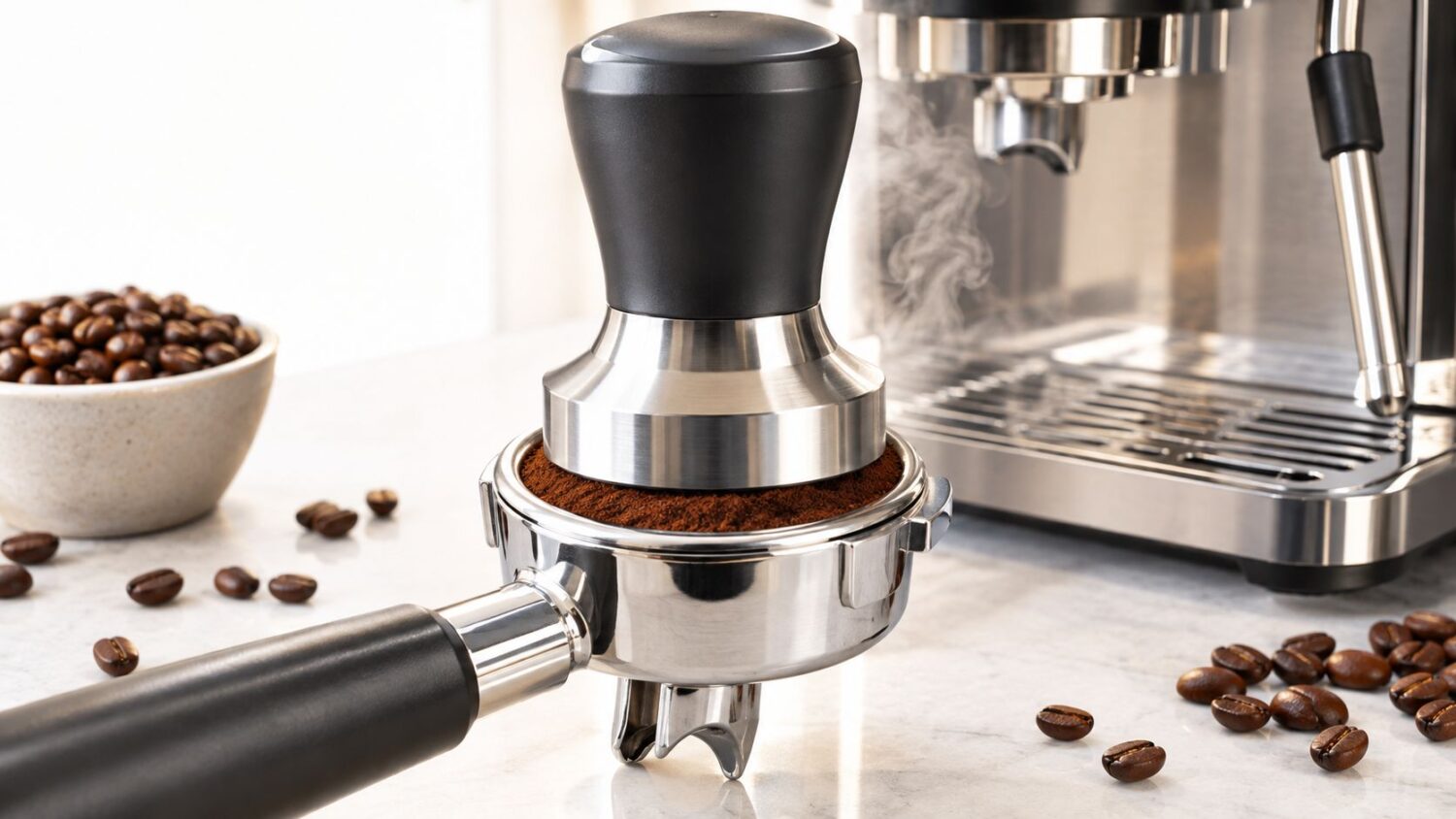
The popular advice is simple: an auto espresso tamper only makes sense in a busy café. That advice misses the hardest home problem. If you pull just a few shots, speed may not matter, but repeatability still does, especially when you're dialing in unfamiliar coffee or sharing one machine with other people.
Tamping isn't a contest to see who can press hardest. A level, repeatable puck matters more than brute force, and an automatic tamper earns its counter space only when it removes a variable you struggle to control. For a one-drink-a-day brewer, it can be expensive overkill. For a shared workstation, it can become a practical workflow stabilizer.
Why Tamping Inconsistency Is the Real Espresso Problem
More tamp pressure doesn't automatically produce better espresso. Independent guidance summarizing controlled testing reports no significant difference in TDS or extraction timing across tamping pressures from roughly 5–20 kg, or 11–44 lb, when the puck is already level and adequately compacted, as described in this espresso tamping pressure analysis. The useful lesson is blunt: levelness and consistency beat muscular effort.
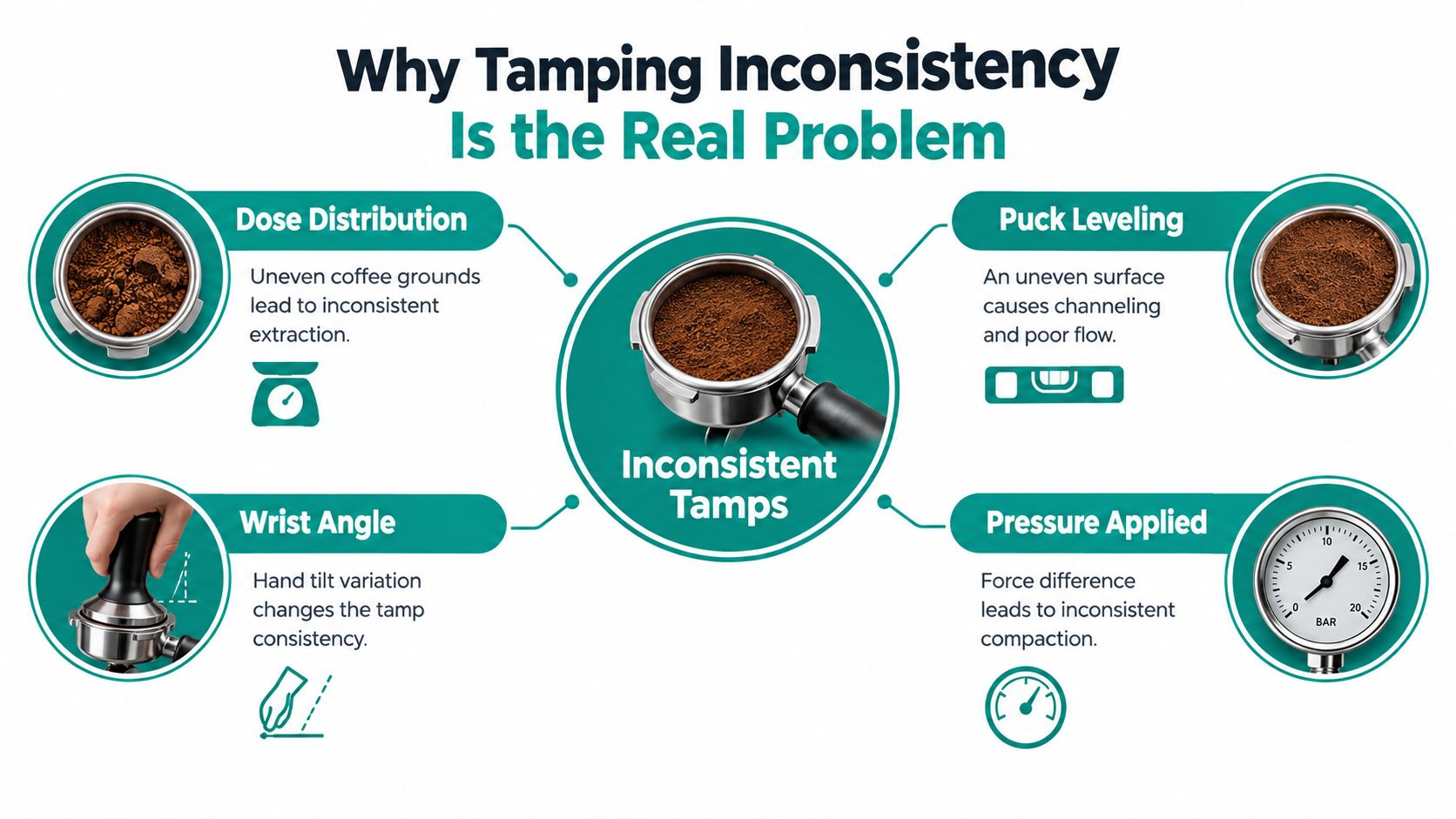
A practiced barista can still change several variables from one shot to the next. Grounds may sit higher on one side, the wrist may tilt slightly, or the tamper may contact the bed unevenly before the barista finishes the press. Those differences create density variations inside the puck. Water then finds the easier paths, which encourages channeling and lets some coffee extract too much while other coffee extracts too little.
That's why two pucks can look nearly identical and taste completely different. One shot may have thin crema, a sharp finish, and a hollow middle. The next may taste muddy and bitter because water spent too much time moving through a dense region while bypassing a weaker one. If your coffee sometimes tastes bitter, this guide to bitter coffee can help you separate tamping problems from grind, water, and extraction issues.
What changes inside the puck
Dose distribution comes first. Tamping compresses the coffee bed, but it doesn't magically move clumps into low-density pockets. A distribution tool, careful dosing, or a consistent preparation routine may solve more of the problem than pressing harder.
Puck levelness comes next. A tilted tamp leaves a sloped resistance bed, and that geometry can produce uneven flow even when the total force feels substantial. Specialist espresso guidance reaches the same practical conclusion, once the bed is sufficiently compacted, extra pressure has diminishing returns, as explained by Espresso Academy's tamping guidance.
Practical rule: Use tamping to create a stable, level puck. Don't use it as a repair tool for poor distribution.
An auto espresso tamper targets that repeatability problem. It applies a programmed or calibrated force and keeps the tamping surface level, rather than promising better extraction through higher pressure. That distinction matters more at home than marketing language suggests. If your current manual tamp is already level and consistent, automation may change very little in the cup. If your wrist angle and puck geometry vary, the device addresses a real source of shot variance.
How an Auto Espresso Tamper Actually Works
An automatic tamper is a compact press, not a robot barista. Set the portafilter beneath the tamping head, and the machine aligns its contact surface with the grounds before pressing the coffee bed through a controlled stroke. For a home user making one drink a day, that repeatability is the main benefit. Speed matters far less than getting the same result without depending on wrist angle.
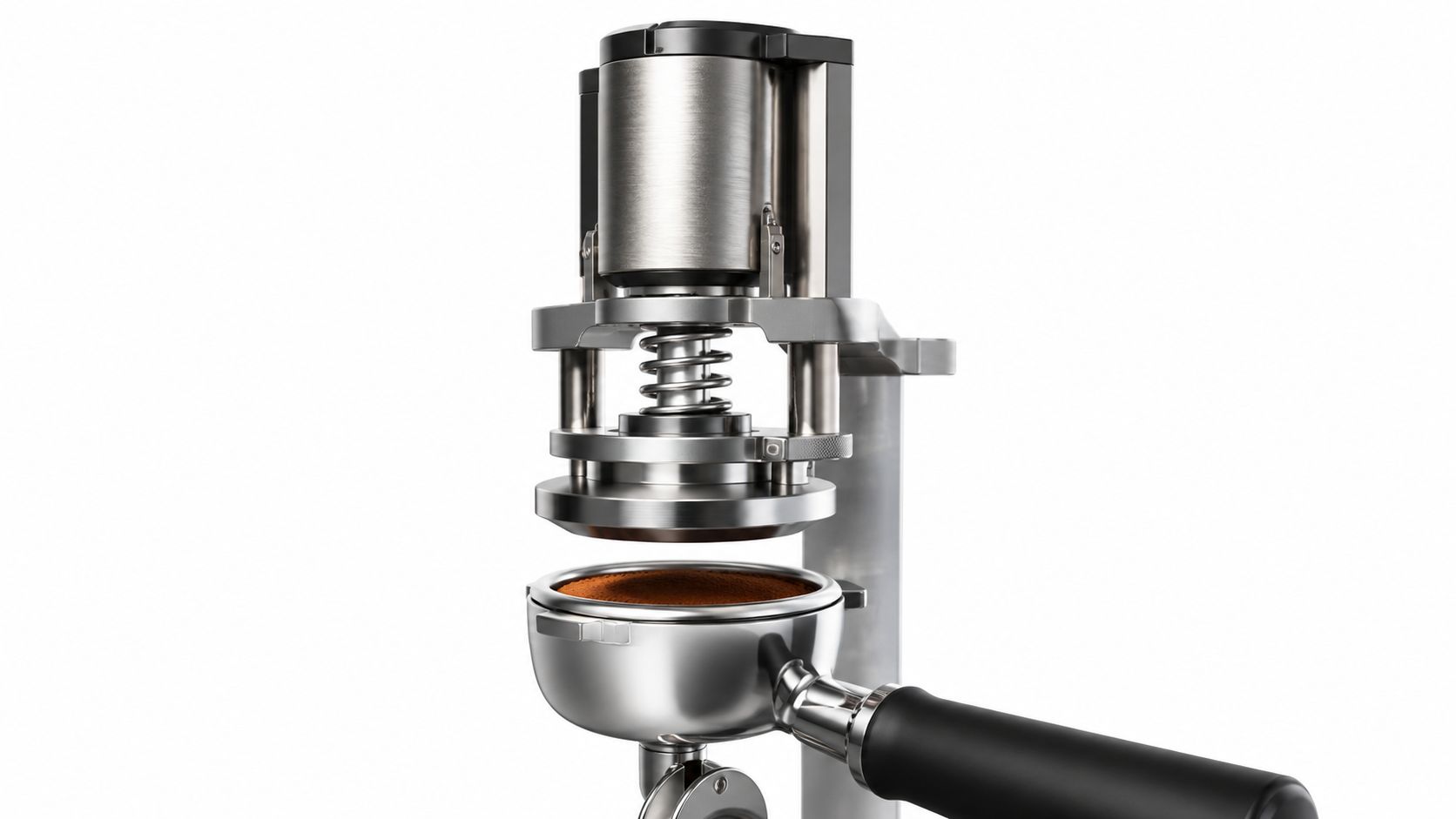
The mechanism usually follows one of two designs. A spring-assisted design stores force in a calibrated spring stack and releases it during the tamp. A motorized design moves the tamping head through a programmed cycle. Both standardize the stroke, while motorized models generally provide more control over force, timing, and cycle behavior.
The mechanical stack
The drive mechanism creates the downward force. One commercial automatic unit lists adjustable force from 5–20 kg, or 11–44 lb, plus controls for contact time, tamp count, leveling time, and vibration strength, according to Sprudge's equipment coverage. Another commercial listing specifies a 10–30 kg range in 1 kg steps, showing that force adjustment is a central feature rather than decoration, as shown by PUQpress product information.
The tamping head presses the coffee. Its diameter must match the basket, and its base must sit flat instead of rocking across the puck. A poor fit can leave an untamped edge or catch against the basket wall. The machine cannot deliver consistent results if the hardware is wrong.
The leveling plate or ring positions and flattens the coffee before the main press on models that include one. It can reduce the effect of an uneven surface, but it does not replace careful distribution.
The controls and indicator show the selected setting and cycle status. Buttons, LEDs, or a display may communicate force, cycle count, or completion. In a shared kitchen, that feedback keeps users on the same setting instead of relying on memory.
Spring units can be smaller and mechanically simpler, while motorized units usually need more counter space and produce a brief mechanical burst during each cycle. Neither design corrects a badly distributed dose, an unsuitable grind, or a basket that does not match the tamping head.
The category also has a long mechanical history. A documented U.S. patent trail reaches at least 1994, with later designs addressing automatic tamping, calibrated handheld tools, force control, and repeatability. The espresso tamper patent record shows development over roughly 30 years, from basic manual tools toward more engineered devices. For a low-volume home bar, the question is whether that engineering solves a recurring consistency problem, not whether it makes tamping faster.
Auto Tamper vs Calibrated Manual Tamper
A calibrated manual tamper solves one problem well. It gives your hand a repeatable force cue, often through a click or spring mechanism. It doesn't automatically keep your wrist level, center the portafilter, or correct uneven grounds before the press.
An auto espresso tamper removes more of the operator from the final tamp. That advantage matters when multiple people prepare coffee, when a user has limited wrist comfort, or when repeated dialing-in requires every puck to receive the same preparation. The trade-off is obvious in a home kitchen: you pay with money, counter space, cleaning, and another device in the workflow.
| Criterion | Auto Espresso Tamper | Calibrated Manual Tamper |
|---|---|---|
| Force consistency | Applies a preset or adjustable force through a programmed or calibrated cycle | Provides a repeatable force cue once the user learns the mechanism |
| Puck levelness | The machine controls the tamping angle when the portafilter and head fit correctly | The user controls wrist angle and must keep the base parallel |
| Dose-to-dose repeatability | Strong across operators when everyone uses the same setting | Strong for one disciplined user, less reliable across several users |
| Distribution correction | May include a leveling feature, but doesn't replace proper distribution | Requires a separate distribution routine |
| Workflow speed | Can simplify repeated tamping, especially in shared or busy stations | Fast for a practiced user and requires no machine cycle |
| Learning curve | Lower for the final tamp, but the operator must learn setup and settings | Higher at first, then straightforward once technique stabilizes |
| Counter footprint | Larger and heavier than a hand tool | Small and easy to store |
| Maintenance | Requires cleaning and attention to moving parts or calibration | Minimal, usually limited to keeping the base clean |
| Best use | Shared stations, ergonomic needs, and persistent tamp variance | Most single-user home setups |
A manual tamper such as a Reg Barber or Pesado Click can be the smarter purchase if you already distribute grounds evenly and tamp level. It keeps the preparation step tactile and leaves less equipment on the counter. A premium finish won't compensate for a poorly matched basket, either.
The real choice isn't old technology versus new technology. It's whether you need to control your own wrist or remove that wrist from the equation.
For a solo brewer, the calibrated manual option usually wins on value. For a shared workstation, the auto tamper's higher cost can buy something a manual tool cannot fully guarantee, the same puck geometry from one operator to the next.
Who Genuinely Needs One at Home or in a Small Office
The buyer profile matters more than enthusiasm. A one-drink-a-day household usually doesn't need an auto espresso tamper. One person controls the dose, distribution, and tamp, so the workflow has fewer sources of variation. A well-fitted calibrated tamper is generally enough if the user can keep the press level.
The recommendation changes when several people use the same espresso machine. One operator may tamp firmly and levelly, while another may press at a different angle or stop early. The resulting shots can vary even when both users follow the same broad recipe. In that environment, automation provides a shared preparation standard rather than adding convenience.
Match the tool to the workload
Independent café guidance places the commercial economics around 50 or more drinks per hour, with faster service, reduced waste, and lower injury risk potentially supporting payback in 6–9 months, as discussed in this automatic tamper discussion. That benchmark belongs to high-throughput service, not a quiet home kitchen, but it clarifies why café recommendations often sound more enthusiastic than home advice.
For home and office buyers, use the following practical bands:
- One operator and one drink a day: Buy a manual or calibrated tamper. Automation is usually excess equipment.
- One operator with frequent recipe testing: An auto tamper can help if you want to isolate grind, dose, and yield changes without tamping becoming another moving variable.
- Several household users pulling shots back-to-back: Consider automation when technique differences keep producing inconsistent results.
- Small offices with recurring shared use: A standardized cycle can reduce the need to retrain every person who uses the machine.
- Aesthetic-driven buyers: Don't buy one just because it looks professional. A tool that doesn't remove a problem will occupy space without improving your routine.

Where repeatability alone earns its place
Roasting hobbyists often change beans, roast levels, and grind settings while trying to understand extraction. Consistent tamping makes those experiments easier to interpret because the final puck preparation stays stable. The device won't tell you whether the grind is too coarse, but it can stop tamping from obscuring the answer.
Small offices have a different problem. Staff turnover makes technique difficult to standardize, and users rarely approach puck preparation with the same care as a dedicated home barista. If you're equipping a shared breakroom, this office coffee solutions guide helps place the espresso setup alongside the broader maintenance and workflow needs.
Compatibility, Fit, and Common Objections
Fit decides whether an auto tamper belongs on your counter. Confirm that the tamping head matches the exact basket inside your portafilter. A unit can be well built yet unusable if the head scrapes the basket, leaves the perimeter untouched, or cannot clear the portafilter lip.
58 mm baskets cover much of the prosumer market, including machines from Profitec, ECM, La Marzocco, and Rocket. Some Breville Dual Boiler configurations also use that size. 54 mm Breville Barista models and the 53–54 mm Bambino line need the correct head and may not accept every unit. Check the current product specification rather than relying on a broad machine-family label.
| Machine Category | Portafilter Size | Clearance Needed | Compatibility Note |
|---|---|---|---|
| Prosumer machines from Profitec, ECM, La Marzocco, and Rocket | 58 mm | Verify the unit's vertical working space | Often a natural fit when the basket and portafilter geometry match |
| Breville Dual Boiler configurations | Commonly 58 mm | Check the exact portafilter and basket | Compatibility varies by configuration |
| Breville Barista models | 54 mm | Confirm the matching head | A 58 mm unit won't provide the correct fit |
| Breville Bambino line | 53–54 mm | Confirm model-specific support | Some automatic tampers won't physically accommodate the setup |
| Portafilters with deep spouts or recessed rims | Varies | Measure the working area, not just the basket | The lip or spout can collide with a leveling ring |
Clearance, noise, and weight
Vertical clearance can end the evaluation before basket size does. Many units need roughly 15–20 cm above the portafilter. A cabinet or low shelf may therefore make installation impossible. Measure from the drip tray or portafilter position to the obstruction, then leave enough room to insert and remove the handle without twisting it.
Noise is a fair objection, especially in a quiet home kitchen or small office. The motor usually produces a brief 1–2 second burst, rather than the longer, harsher sound of grinding. That short cycle rarely justifies rejecting a suitable unit, but it can matter if someone prepares a single drink early in the morning.
Weight affects placement and daily handling. Units commonly sit in the 3–5 kg range, so a model under a cabinet or on a narrow shelf needs a stable surface. The support must tolerate the downward force transferred through the portafilter supports without shifting.
Leaks are rarely the deciding fit problem because the tamper does not carry brewing water. Returns more often result from the wrong head diameter, insufficient clearance, an interfering portafilter lip, or a footprint that crowds the grinder and knock box. For a low-volume home user, measure the workspace first. Repeatability has value, but it does not justify a costly device that cannot fit the basket or leaves the rest of the preparation area awkward to use.
Maintenance and Long-Term Care
An auto tamper sits directly above loose coffee grounds, so its care resembles grinder maintenance more than milk-pitcher care. Fine particles collect around the tamping head, leveling ring, and moving surfaces, where they can affect alignment or make the mechanism feel sluggish.
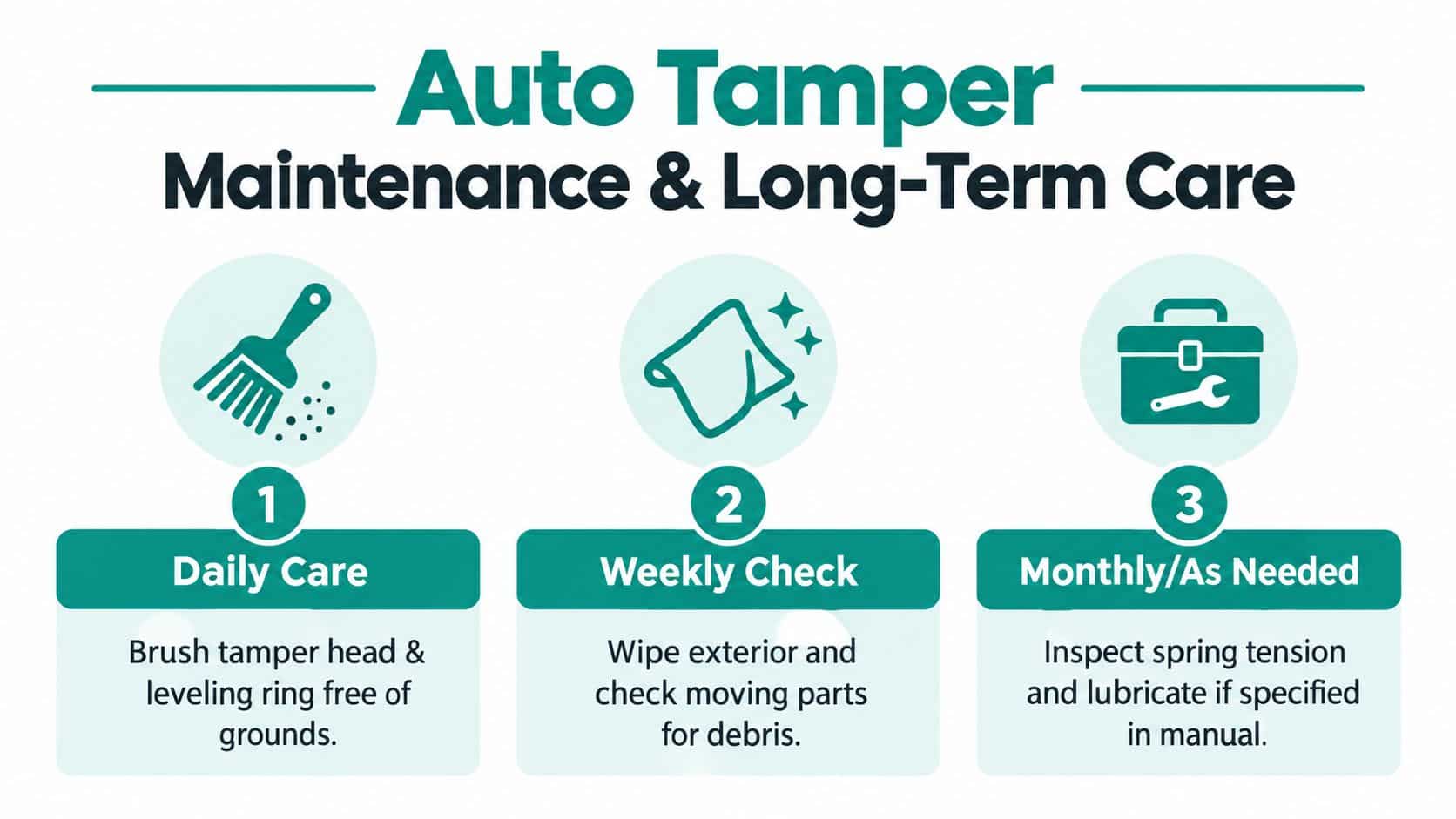
Start with a short daily routine:
- Brush the contact area: Remove grounds from the tamper head and leveling ring after service.
- Wipe the exterior: Keep loose coffee from migrating into seams and controls.
- Clear the cycle path: Check that no compacted grounds obstruct the portafilter position.
- Use a blank cycle only if the manual allows it: Never force the mechanism without confirming the manufacturer's procedure.
A practical care schedule
Weekly, remove the tamping head if the design permits it and wash the removable part with mild soap and warm water. Dry it fully before reinstalling it, and never soak the electrical base or any component the manual identifies as non-washable.
Monthly, compare the machine's result with a calibrated hand tamp and a bathroom scale if the manufacturer's instructions permit that check. Motor-driven units may hold their settings differently from spring-assisted designs, but either mechanism can change with wear and repeated use. Treat calibration as a verification step, not a promise that the machine will remain perfect indefinitely.
Hard water adds another concern. Mineral buildup can affect moving components, so follow the device's manual before applying any descaling solution. For broader espresso equipment care, use this coffee machine maintenance checklist to keep the tamper, machine, and water system on one schedule.
Belt drives, motor brushes, and springs are the likely service items when a unit starts behaving differently. If the machine offers a cycle counter, record the count and note changes in sound, travel, or tamping behavior. Don't lubricate a mechanism unless the manual specifies the lubricant and application point. Coffee dust and excess oil already create enough contamination risk without adding an unsuitable product.
Is an Auto Espresso Tamper Worth It for You
Make the decision with five questions, not with café glamour.
How many shots do you prepare? Low volume weakens the speed argument, but it doesn't eliminate the consistency argument. If you prepare only one or two shots and your puck preparation is stable, a calibrated manual tamper is the sensible choice.
How many people use the machine? One disciplined operator can repeat a manual routine. Several operators introduce different wrist angles, force habits, and interpretations of “level.” Shared use is where automation starts solving a real systems problem.
How much tamp variance do you see now? Look at puck levelness, extraction behavior, and preparation records. If grind distribution and dose are controlled but shots still swing because different users tamp differently, an auto espresso tamper deserves consideration.
Can your counter hold it? Measure the footprint, vertical clearance, portafilter position, and space needed to work around the grinder and knock box. A device that forces awkward movement can make the station worse even if the tamp itself improves.
Does the budget sit above the grinder and machine essentials? Don't buy automation before you've handled the fundamentals. A correctly fitted basket, distribution tool, fresh coffee, reliable water, and a capable grinder affect the full workflow. The tamper should solve the remaining problem, not distract from larger ones.
Decision rule: If at least three answers point toward shared use, persistent variance, or a genuine ergonomic need, automation stops looking like a luxury and starts looking like workflow equipment.
Protect the investment with accessories that support the station. A properly sized knock box gives the portafilter a clear place to empty, while a tamping mat absorbs force and protects the counter. If your model uses serviceable springs, keep replacement calibration springs available, and follow the manufacturer's cleaning schedule rather than improvising with water or lubricant.
For water and machine care, PureHQ Inc. offers Breville-compatible water filters and a descaling solution described for espresso makers, including Breville machines. Those products address water and mineral maintenance, not tamping, but they belong in the same equipment-care conversation.
A solo home barista with a consistent hand should buy the calibrated manual tool. A shared home station, small office, or serious dialing-in workflow should shop for the auto espresso tamper that matches its basket, clearance, and operator needs.
If you're ready to remove tamping variance from a shared or demanding espresso workflow, visit PureHQ Inc. to explore compatible filtration and maintenance accessories for espresso machines. Choose the auto tamper separately by basket fit and workspace measurements, then use the right water filter and descaler to keep the machine supporting consistent coffee preparation.

