
Coffee Machine Care
Can You Use a French Press for Tea? Brewing Guide 2026
Jul
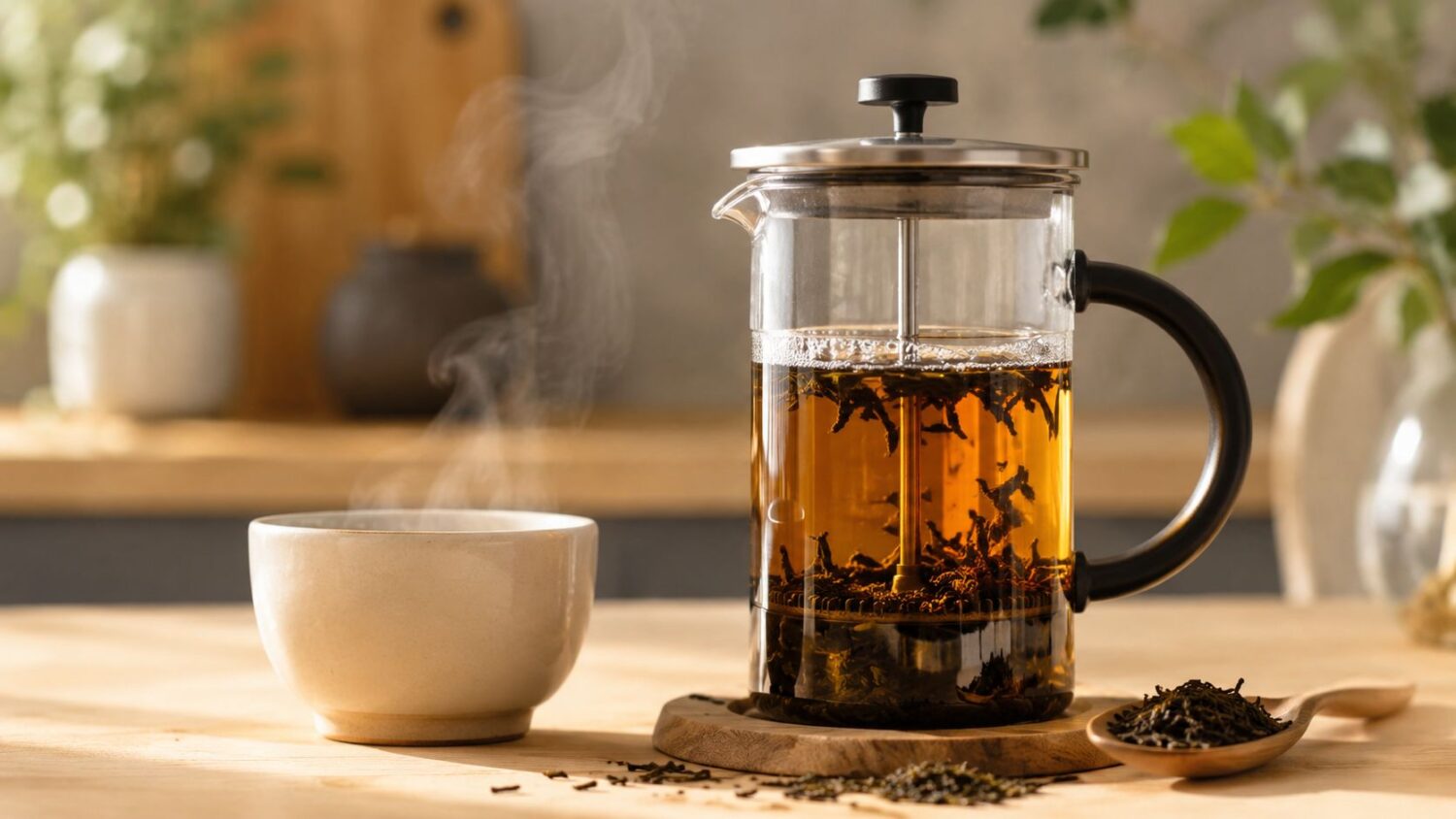
Yes, you can use a French press for tea. Green and white teas steep for 2 to 3 minutes, oolong and black teas for 3 to 5 minutes, and herbal teas for 5 to 7 minutes.
That simple answer matters more than it seems. Many people already own a French press, but they keep using cramped infusers or teabags because they assume a press is only for coffee. At the same time, single-origin loose-leaf tea retail sales rose by 35% between 2018 and 2023, which tells you something important: more home brewers want better flavor and less waste, but they still need a practical tool.
The problem is familiar. A basket infuser can crowd the leaves. A teapot can keep steeping after the pour starts. A French press solves both issues when you use it correctly. The leaves sit fully submerged, then the plunger separates them from the liquor in one move.
Most guides stop there, and that's where people get into trouble. They don't explain why old coffee oils can mute a delicate tea, and they rarely explain how plunger pressure changes the taste of fragile whole-leaf teas. Those two details often decide whether your cup tastes clean and layered or flat and bitter.
Introduction to Tea Brewing with a French Press
A French press works for tea because it gives the leaves room to open and puts you in control of the one thing that matters most in home brewing: contact time. If you've ever made tea that tasted weak at the top and harsh at the bottom, your brewing tool probably created uneven extraction.
That's why so many tea drinkers start looking beyond the usual mug infuser. The press uses full immersion, so the leaves and water stay in steady contact until you stop the brew. If you need a quick refresher on the tool itself, this guide on what a French press coffee maker is gives useful background on the basic design.
Why the usual tools frustrate people
A small infuser ball is a bit like brewing soup ingredients in a sealed metal cage. The leaves can't fully unfurl, so flavor extraction often feels incomplete. A teapot gives leaves more room, but it doesn't separate them as cleanly at the exact moment you want to stop steeping.
That gap creates two common outcomes:
- Thin tea: leaves don't have enough room to release flavor evenly.
- Bitter tea: leaves stay in hot water too long while you're pouring or chatting.
- Messy tea: strainers miss small fragments and leave debris in the cup.
Practical rule: A French press works best for tea when you treat it as a timing tool, not just a strainer.
Why the French press fits modern tea habits
Loose-leaf drinkers often want fewer disposable products and more control over taste. A French press meets both goals. It's reusable, easy to handle, and adaptable across tea styles.
It also helps beginners because the process is visible. You can see the leaves expand, watch the timer, and press when the tea is ready. That kind of feedback makes it easier to improve cup by cup.
How a French Press Works for Tea
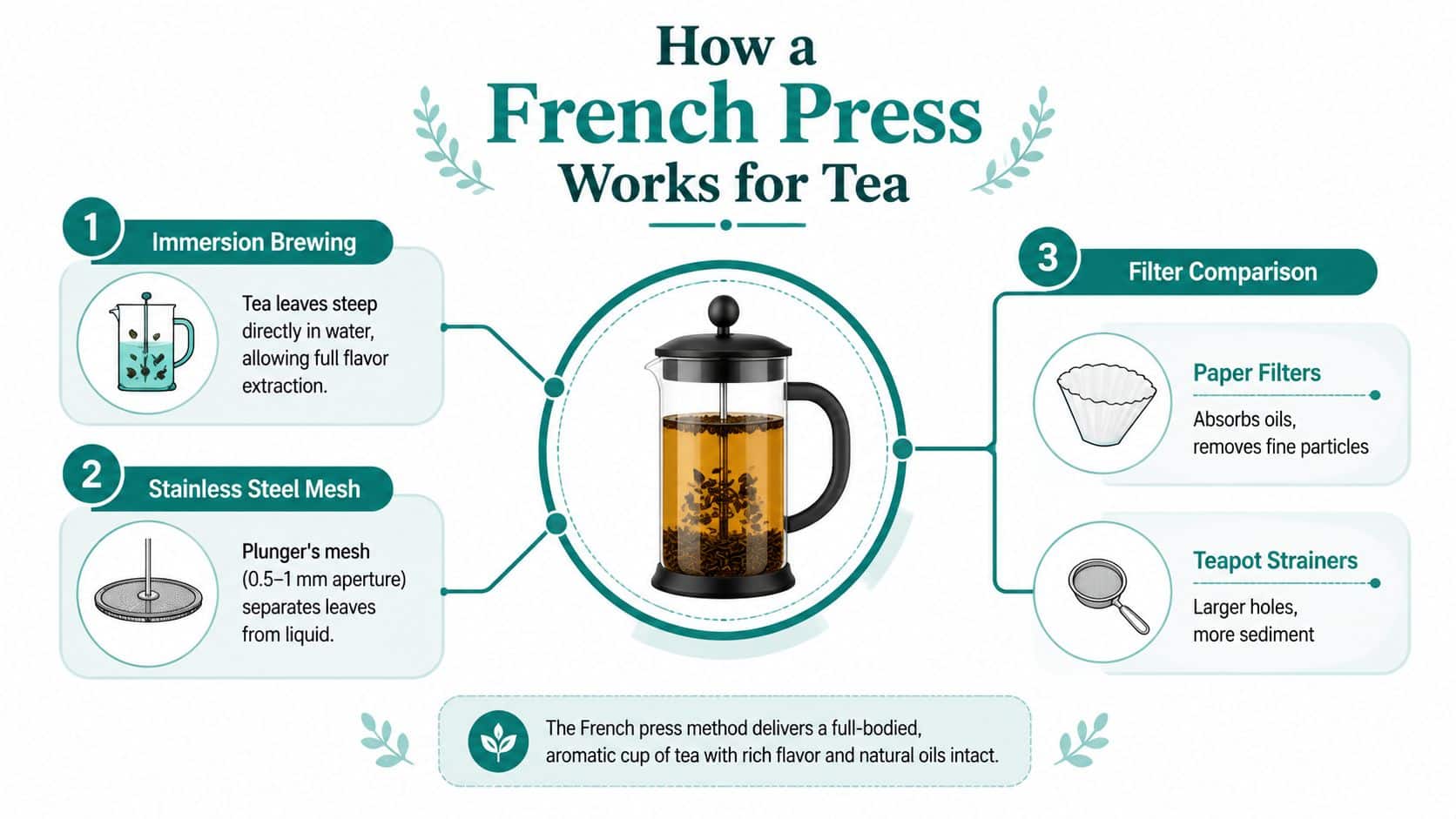
A French press brews tea by immersion. You add leaves and water to the carafe, let them steep together, and then lower the plunger to separate most of the leaves from the liquid. That's different from drip methods, where water passes through the tea bed and can extract unevenly.
The filter matters too. The stainless steel mesh in a French press typically has a 0.5 to 1 mm aperture, which allows even extraction while trapping most leaf particles, though paper filters catch finer sediment.
What immersion changes in the cup
With immersion brewing, every leaf stays surrounded by water for the full steep. That reduces the uneven flow problem that can happen in drip setups. In plain terms, the tea tends to taste more consistent from one brew to the next.
A simple analogy helps here. A tea bag in a mug is like trying to marinate food in a tiny pouch. A French press is more like using a full bowl where everything can make contact evenly.
Mesh filter versus paper filter and teapot strainer
Here's the tradeoff. Metal mesh lets through more fine particles than paper. That can create a slightly cloudier cup, especially with broken leaves or very fine herbal material. But the mesh also keeps the process simple and reusable.
| Filter style | What it does well | What to expect |
|---|---|---|
| French press mesh | Separates most leaves while allowing full immersion | More body, possible fine sediment |
| Paper filter | Catches finer particles | Cleaner cup, less reusable |
| Basic teapot strainer | Stops larger leaf pieces | More sediment if holes are wide |
The French press doesn't make tea taste like coffee by default. Residue and technique cause that problem, not the brewing format itself.
Brewing Guidelines for Different Tea Types
Tea responds to time and temperature the way vegetables respond to heat in a pan. Delicate greens need gentler treatment. Black teas can handle hotter water. Herbal blends often need longer contact to fully open up.
The core hot-brew ratio is 1 teaspoon, about 2 grams, per 8 ounces or 240 ml of water. For cold brew, use 2 teaspoons per cup and give the leaves much more time.
Start with setup, not just the leaves
Before adding tea, preheat the empty press with hot water and swirl it around. That step helps stabilize brewing temperature, which matters most with delicate teas.
Use this sequence:
- Preheat the carafe: swirl hot water inside, then discard it.
- Measure the leaves: use the right leaf amount for hot or cold brewing.
- Add water at the correct temperature: don't treat every tea like black tea.
- Set a timer immediately: guessing usually leads to over-steeping.
- Plunge gently and pour soon after: don't leave brewed tea sitting on the leaves.
Steeping parameters by tea type
| Tea Type | Water Temperature | Leaf Amount | Steep Time |
|---|---|---|---|
| Green tea | 170 to 180°F | 1 teaspoon per 8 oz | 2 to 3 minutes |
| White tea | 170 to 180°F | 1 teaspoon per 8 oz | 2 to 3 minutes |
| Oolong tea | Moderate heat, below black-tea range | 1 teaspoon per 8 oz | 3 to 5 minutes |
| Black tea | 200°F | 1 teaspoon per 8 oz | 3 to 5 minutes |
| Herbal tea | Boiling or near boiling | 1 teaspoon per 8 oz | 5 to 7 minutes |
| Cold-brew tea | Refrigerated water | 2 teaspoons per cup | 6 to 12 hours |
One source gives a tighter target for green tea. Green tea does best at 175°F (80°C) for 2 to 3 minutes, while black tea needs 200°F (93°C) and a 4 to 5 minute steep. That's useful if you want to dial in green tea with more precision.
Where readers usually get confused
Oolong sits in the middle. It isn't as delicate as green tea, and it usually doesn't want the same intensity as black tea. If you don't know the exact style of your oolong, start conservatively and taste early.
Herbal blends confuse people for a different reason. Many of them need more time, not less. Flowers, roots, and fruit pieces often need the full window to taste rounded instead of watery.
A timer is more important than confidence. Even experienced brewers miss the mark when they brew by feel alone.
For cold tea, the French press is especially handy. Add the larger leaf dose, fill with cold water, and refrigerate for the steep. If you already use a press for chilled drinks, this guide to making cold brew coffee with a French press shows the same steep-and-strain logic in another context.
Advantages and Limitations of Using a French Press
A French press is a strong tea tool, but it isn't magic. It gives you control, body, and simplicity. It also asks you to pay attention.
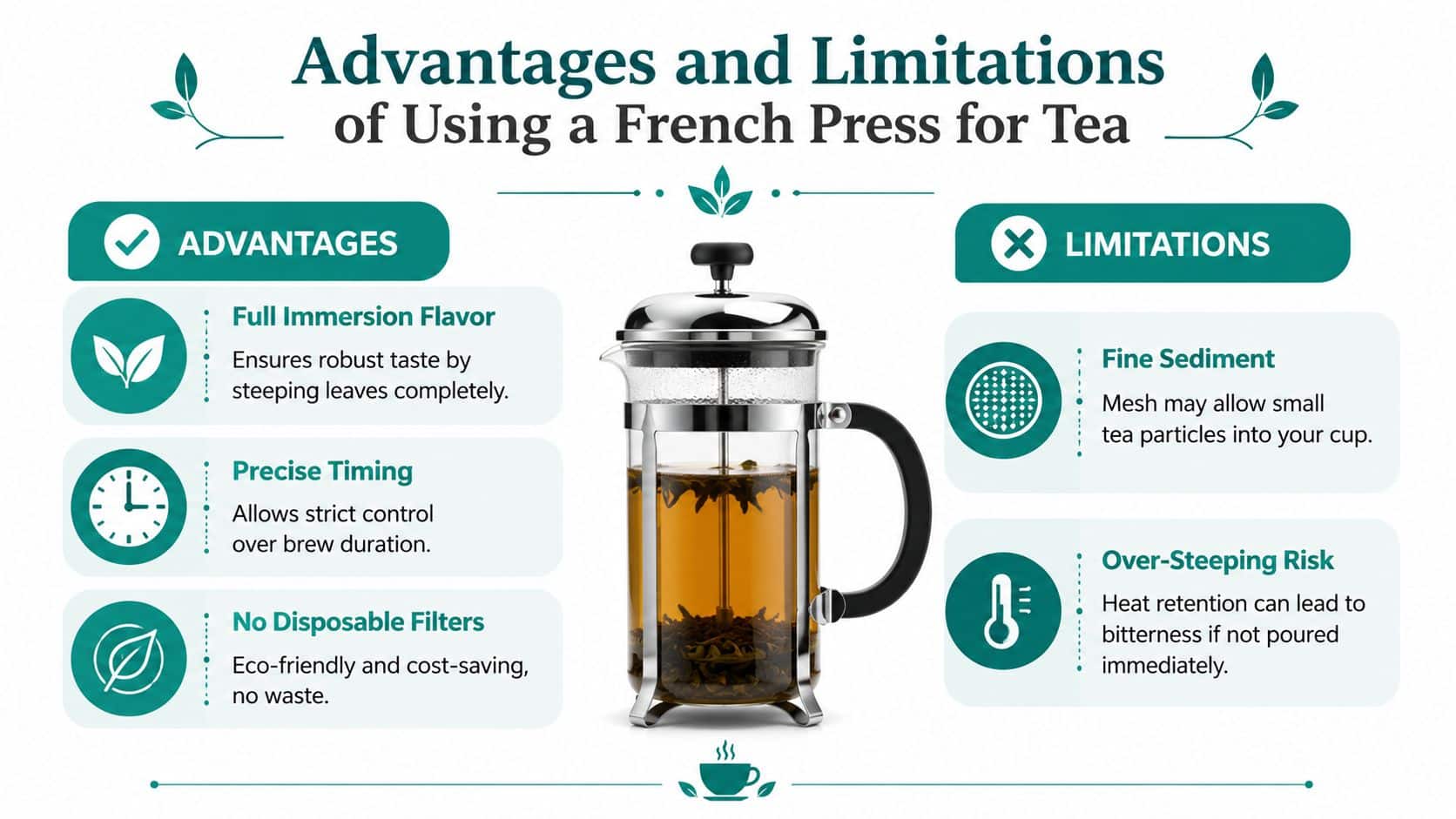
One major strength is thermal stability. One major weakness is also thermal stability. French press carafes retain heat for 15 to 20 minutes, which helps extraction but can also push a tea into bitterness if your starting temperature is too high or you leave brewed tea sitting too long.
What the French press does especially well
The press shines when you want a fuller brew without disposable filters. It also helps people who like to brew different tea styles in one familiar vessel.
- Full immersion flavor: the leaves steep evenly in open water.
- Clear stopping point: you control the finish with the plunger and the pour.
- Reusable setup: no paper filter is required for everyday brewing.
Where it can frustrate you
The mesh doesn't catch every tiny particle. That means some teas will look a little hazy, especially if the leaves are broken or dusty. If you prefer a crystal-clear cup, another method may suit you better.
A second limitation is habit. Coffee drinkers often press and leave the brewed beverage in the carafe. Tea punishes that routine more quickly, especially with delicate leaves.
| Consideration | French press result | Standard infuser result |
|---|---|---|
| Leaf expansion | Spacious | Often restricted |
| Timing control | High | Moderate |
| Sediment | Possible | Usually lower, depending on filter |
| Waste | Low | Varies by setup |
A common objection is compatibility. People ask whether one press can really handle both coffee and tea. It can, but only if you clean it completely and adjust your technique. If you skip that part, the tool isn't the problem. The residue is.
Cleaning Tips to Prevent Flavor Cross Contamination
This is the most overlooked part of French press tea brewing. A quick rinse may remove visible grounds, but it doesn't reliably remove coffee oils from the mesh and metal surfaces.
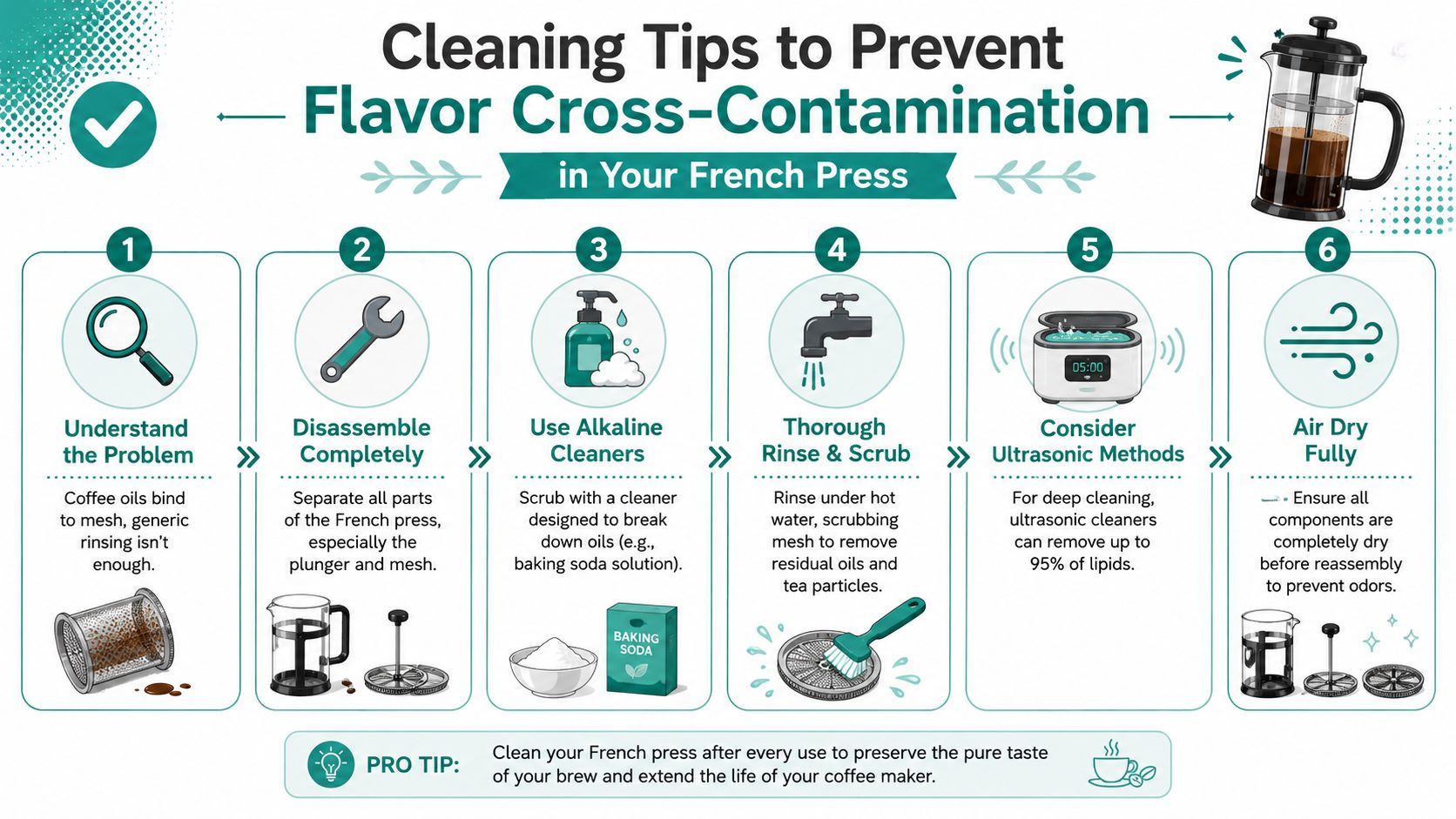
That matters because coffee lipids such as cafestol adhere to stainless steel mesh and require multiple alkaline or ultrasonic cleaning cycles to remove 95% of residue. If you brew jasmine green tea after coffee residue has settled into the plunger assembly, that tea can pick up a dull, oily note.
Why rinsing falls short
Coffee oils cling to the mesh, not just the glass. Standard rinsing often clears the obvious residue while leaving behind an invisible film. Tea is more delicate than coffee in this respect. Subtle floral, grassy, or honey-like notes fade fast when that film sticks around.
A practical cleaning routine
Use this method when switching a press from coffee to tea:
- Take the plunger apart fully. Separate the mesh, spring, and plate if your model allows it.
- Wash with an alkaline cleaner. The goal is to break down oily residue, not just rinse off particles.
- Scrub the mesh thoroughly. Work along both sides of the screen where oils tend to hide.
- Rinse with hot water. Make sure no cleaner remains in the mesh or around the rod.
- Repeat if coffee odor remains. The source above notes that multiple cleaning cycles may be needed for high residue removal.
- Air-dry completely before reassembly. Trapped moisture can hold odors.
Clean for aroma, not appearance. A press can look spotless and still carry enough coffee oil to change the taste of tea.
If you prefer a machine-care routine for your broader brewing setup, this guide on how to clean a coffee maker is a useful companion for maintenance habits. A descaling product can also help with mineral buildup in your kettle or brewer, which supports cleaner-tasting water for tea.
One press or two
If you drink dark roasted coffee daily and delicate tea often, using separate presses is the simplest answer. But plenty of home brewers only have one press, and that's workable if you treat deep cleaning as part of the brew ritual.
A second helpful habit is storage. Let every part dry fully before putting the press back together. Closed, damp equipment can trap stale smells that transfer into your next brew.
Creative Tea Recipes and Troubleshooting
A French press isn't only for straight tea. It's useful for floral blends, chilled brews, and quick iced tea when you want easy leaf removal.
Three easy ideas to try
- Blooming-style floral infusion: Use a loose flower-forward tea and watch the leaves expand in the clear carafe. This works well when you want a visual brew and gentle extraction.
- Hot-to-iced black tea: Brew black tea in the press, plunge, then pour over ice right away for a bright, brisk glass.
- Cold-brew concentrate: Use the cold-brew ratio from earlier, steep in the refrigerator, and pour a stronger base over ice when you want a refreshing drink.
Why tea gets bitter in a French press
Temperature can cause bitterness, but plunger technique can do it too. That part surprises many beginners. Excessive or premature plunging can crush fragile whole-leaf teas, releasing tannins and causing bitterness, while partial plunge methods can reduce that problem.
That means you don't always want the same forceful coffee-style push. Delicate green teas and high-quality whole-leaf oolongs often respond better to a gentler approach.
Try these adjustments:
- For fragile whole leaves: lower the plunger only partway, then pour carefully.
- For larger twisted oolong leaves: wait until the steep is complete, then press slowly.
- For dusty herbal blends: use a steady, gentle plunge to avoid forcing extra particles through the mesh.
A short demonstration helps make the cleaning issue clearer before you brew your next tea:
Fixing common cup problems
| Problem | Likely cause | Better move |
|---|---|---|
| Bitter tea | Water too hot, steep too long, or plunge too hard | Lower temperature, shorten steep, press more gently |
| Cloudy cup | Fine particles passing through mesh | Pour slowly and avoid aggressive plunging |
| Flat aroma | Coffee oil residue or stale leaves | Deep-clean the mesh and use fresh tea |
If your parameters look right but the cup still tastes harsh, your plunge may be the culprit.
Choosing the Right French Press and Mesh Size
Not all French presses behave the same way. Material, fit, and filter construction affect both brewing and cleanup. If you're shopping with tea in mind, focus on durability, seal quality, and how well the mesh handles fine leaf particles.
A stainless steel model usually gives more protection against bumps and better heat retention. A glass carafe makes it easier to watch leaf expansion and color development. Neither is automatically better. The right choice depends on whether you value visibility or durability more.
What to look for first
A good tea-friendly press should have a plunger that moves smoothly without wobbling. If the rod feels loose or the screen doesn't seat evenly, more particles can escape into the cup.
This is also where a common objection comes up: leaks. A poorly fitted lid or a rough plunger track can make pouring messy. That doesn't mean all presses leak. It means cheap tolerances create problems that show up during daily use.
Comparison of premium and standard French presses
| Feature | Premium Press | Standard Press | PureHQ Accessory |
|---|---|---|---|
| Carafe material | Often insulated stainless steel or thicker glass | Often lighter glass or basic metal | Maintenance items can help keep brewing equipment cleaner |
| Mesh quality | Better fit and more consistent filtration | More variable filter fit | Gold-tone filter accessories can support cleaner everyday brewing in compatible setups |
| Leak resistance | Lid and plunger parts usually fit more securely | Fit may vary more from unit to unit | Cleaning tools help preserve seals and moving parts |
| Durability | Better for frequent use | Better for occasional use | Descaling and cleaning accessories support long-term upkeep |
| Tea compatibility | Better if you brew often and want consistent results | Fine for casual use with careful technique | Reusable filtration accessories suit brewers who prefer less waste |
Choosing by brewing style
If you brew mostly black tea or herbals, a standard press can work well if the fit is decent and the mesh is intact. If you brew delicate green or whole-leaf oolong often, a better-made press usually pays off in smoother plunging and more predictable filtration.
If clarity matters most, pay close attention to the screen assembly. Even small differences in mesh fit can change how much fine sediment ends up in the cup.
Conclusion and Next Steps
A French press can make excellent tea. The key is using tea-specific parameters instead of coffee habits. Give each tea the right water temperature, respect the steep window, and adjust your plunge so you don't crush delicate leaves.
Often overlooked is flavor purity. Coffee oils can cling to the mesh and flatten a fresh tea, so deep cleaning matters just as much as timing. Once you handle both variables, the French press becomes one of the simplest and most flexible tea tools in the kitchen.
If you've been asking can you use a French press for tea, the answer is yes. You just need a cleaner press, a gentler hand, and a timer.
PureHQ Inc. makes it easier to keep your brewing gear clean and consistent. Shop PureHQ Inc. for reusable brewing accessories, filters, and descaling solutions that help support cleaner flavor and smoother daily brewing.

