
Coffee Machine Care
Best Descaler for Keurig: Top Picks for 2026
Aug
If your Keurig uses very hard water, waiting for a generic three-month reminder can leave the brewer struggling long before the calendar says it's time. A 2026 maintenance guide estimates that soft water may allow about 1,000 brews between descales, while moderate water may reduce that to roughly 750 brews, hard water to about 500 brews, and very hard water to around 350 brews, or a descaling interval of about six weeks. The technical guidance behind these benchmarks connects mineral load with white crust, weak flow, and gurgling.
That's why the best descaler for Keurig isn't the fastest bottle or the cheapest tablet. The right choice depends on your water hardness, brewing volume, buildup severity, and willingness to rinse thoroughly. This guide compares practical options, explains what works and what doesn't, and builds a maintenance schedule around the conditions your brewer faces.
Why Most Keurig Descaling Advice Fails
A fixed calendar sounds convenient, but it can mislead Keurig owners. Water hardness varies substantially between homes, and calcium and magnesium create scale faster as mineral concentration rises. Guidance used in water-hardness classifications identifies 61–120 mg/L as moderate and 121–180 mg/L as hard, which means two households following the same three-month reminder can experience very different internal buildup. Independent Keurig maintenance guidance likewise links shorter descaling intervals with harder water.
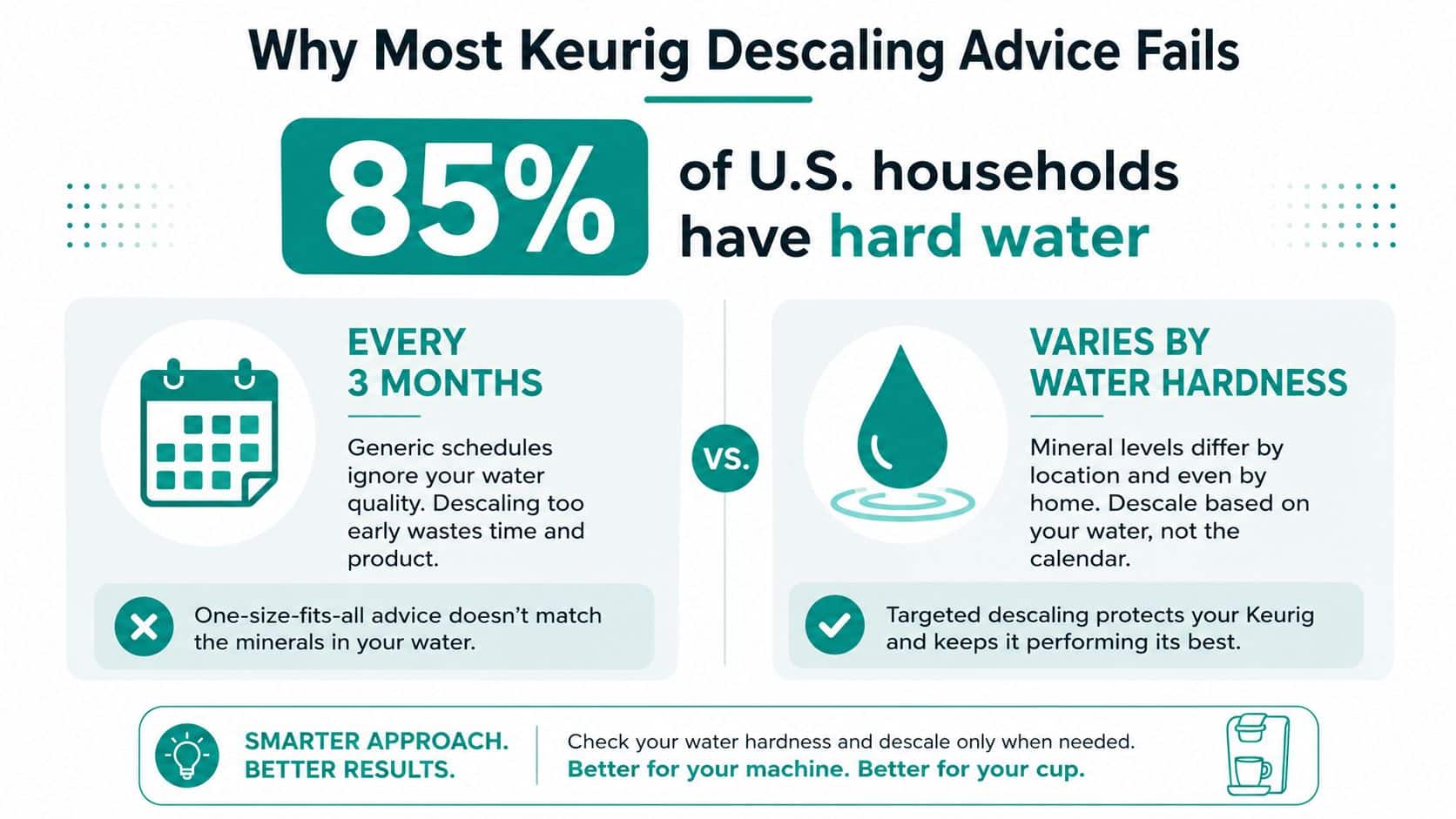
A household with soft water may over-maintain its machine if it follows an aggressive schedule without symptoms. A busy office or a home with hard tap water can do the opposite, allowing deposits to narrow the heating path and fluid passages until the machine brews weakly, makes unusual noises, or struggles to move water.
The calendar misses the machine's workload
Usage matters because every brew introduces another volume of mineral-bearing water into the system. A rarely used vacation brewer supplied by soft water faces a different maintenance burden from a daily-use Keurig connected to hard municipal water or well water. Keurig's official descaling instructions specifies using the full bottle of Keurig descaling solution in the reservoir and running the brewer through its descaling process. The manufacturer also uses the machine's descale signal as a maintenance trigger.
Neglect creates symptoms before failure
Mineral scale can restrict water movement through the brewer's internal path. Owners commonly notice:
- Weak or incomplete brews: Restricted flow prevents the brewer from delivering water normally.
- Gurgling or unusual sounds: The pump may struggle to move water through narrowed passages.
- Error or descale indicators: The machine can signal that maintenance is due.
- Inconsistent output: A partially obstructed path can make brewing less predictable.
Using an unsuitable or overly aggressive cleaner can introduce a separate risk, especially if the formula leaves residue or receives inadequate rinsing. The practical lesson is simple: match the descaler chemistry and treatment frequency to mineral concentration rather than relying on one universal calendar.
How Descalers Work
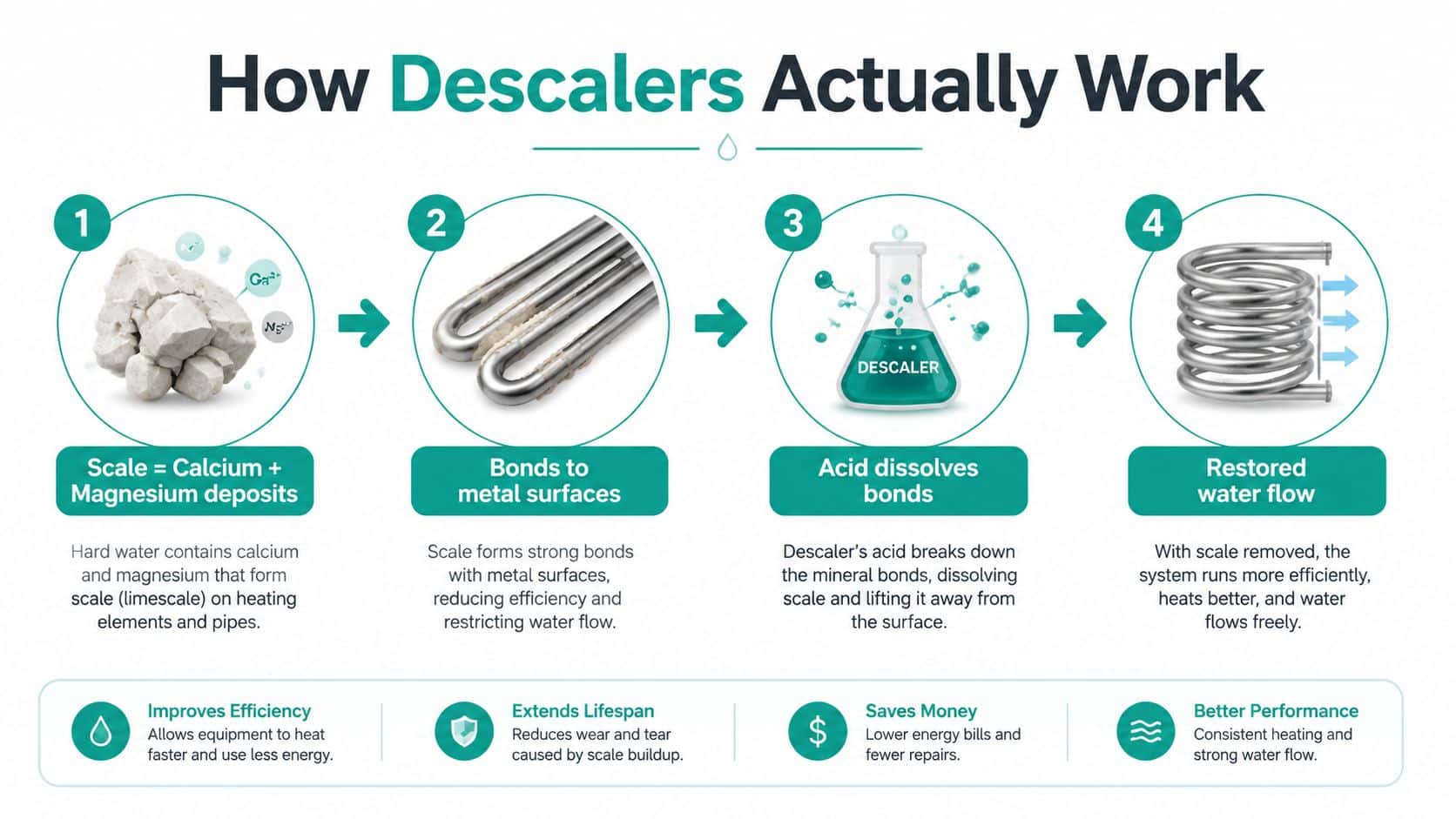
Scale develops when dissolved minerals in water settle on heated and narrow components. Calcium and magnesium form the chalky deposits that collect on heating surfaces, tubing, needles, and other parts of the water path. Cleaning the reservoir or drip tray cannot reach scale inside those components.
Acidic descalers react with carbonate deposits and break their solid structure into compounds that flushing water can carry away. Some formulas also use chelating ingredients, which bind mineral ions and help keep them dispersed as the solution moves through the brewer.
Acid strength affects the cleaning experience
Sulfamic acid formulas generally address stubborn scale efficiently, but they require careful handling and thorough rinsing. Citric and acetic acid are familiar options for lighter or moderate deposits. Heavier buildup may need longer contact time or another treatment.
Water hardness should guide both formula choice and frequency. Hard water adds minerals faster, so waiting for severe symptoms can leave a brewer with deposits that a gentle treatment struggles to remove. Softer water usually allows more time between treatments, while a stronger formula is not automatically the right choice for routine maintenance.
A highly aggressive solution may place more stress on seals and tubing. A gentler one may take longer to dissolve stubborn deposits, but can reduce residue and rinsing effort when used before scale becomes severe. Review this guide to Keurig descaling solution ingredients when comparing a formulated product with pantry substitutes.
Practical rule: Choose a purpose-made coffee-machine descaler, follow its label, and judge the result by restored flow and neutral rinse water, not by how harsh the solution smells.
Comparing Descaler Types for Real Performance
Keurig owners typically choose among citric acid solutions, sulfamic acid products, white vinegar, and tablets. The right option depends on mineral load, deposit severity, component care, convenience, and how much rinsing the brewer can handle.
Citric acid suits light to moderate buildup and routine maintenance. Measured correctly, it is relatively forgiving and usually avoids vinegar's strong lingering odor. Heavy deposits may require longer contact or repeated treatments, so citric acid performs best when owners descale according to their water hardness instead of waiting for restricted flow.
Sulfamic acid products are better suited to stubborn scale and demanding maintenance. They can work faster, but the label's dilution and contact instructions matter. Careless dilution or incomplete flushing undermines even the strongest formula.
White vinegar is accessible, yet it remains a compromise. Its odor may linger, and household vinegar was not formulated specifically for the seals, tubing, and heating components in a Keurig. It may help with limited buildup, but a purpose-made coffee-machine descaler is the more predictable choice for regular care.
Tablets emphasize storage and portioning convenience. They are easy to keep on hand, but the active amount may not match every water profile or a brewer carrying substantial deposits. A tablet fits a light, scheduled routine. A concentrated liquid offers more flexibility when mineral accumulation is high.
Owners making a citric-acid cleaner at home can review eco-friendly cleaning recipes for background on preparation and handling. Measure consistently and use homemade mixtures cautiously. A household recipe may not have the same compatibility testing as a coffee-machine formula.
Descaler type comparison matrix
| Descaler Type | Effectiveness | Safety | Ease of Use | Cost per Treatment | Best For |
|---|---|---|---|---|---|
| Citric acid solution | Good for light to moderate scale, slower on heavy deposits | Generally forgiving when properly prepared | Requires measuring and mixing | Usually economical | Routine home maintenance |
| Sulfamic acid product | Strong on stubborn buildup and restricted flow | Requires careful handling and thorough rinsing | Simple if pre-mixed, less forgiving if concentrated | Varies by formula | Hard-water homes and busy brewers |
| White vinegar | May help with lighter deposits, less reliable on severe scale | Odor and long-term component concerns make it a compromise | Widely available, but rinsing can be demanding | Low | Emergency fallback |
| Descaling tablet | Convenient for light scheduled cleaning | Depends on the product and correct dissolution | Very easy to store and portion | Varies by product | Quick routine maintenance |
The practical choice follows the problem. For regular use, select a machine-oriented formula that rinses cleanly and adjust treatment frequency to local water hardness. For heavy buildup, prioritize dependable mineral removal and allow time for a more thorough rinse.
Step-by-Step Descaling Process
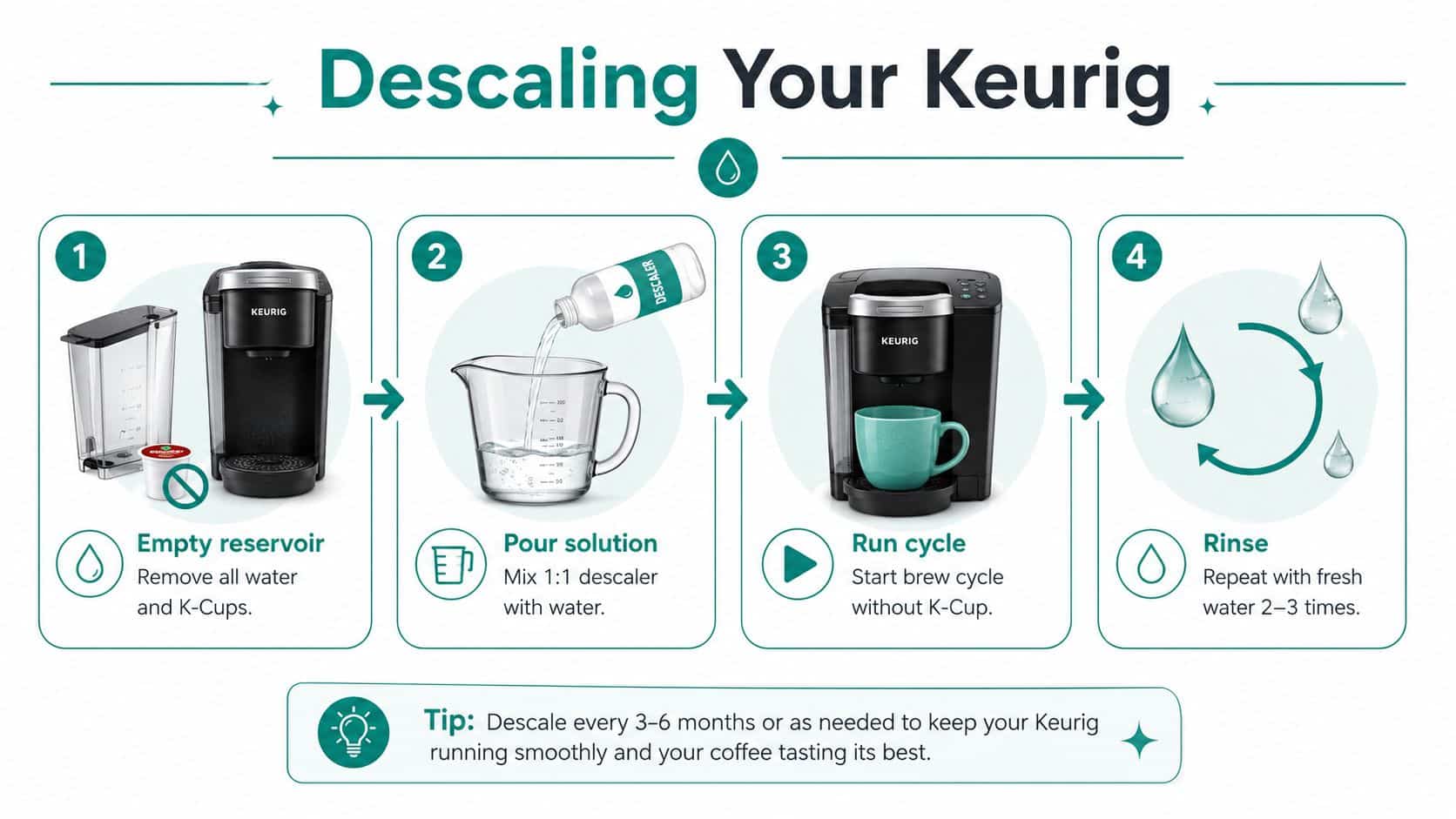
Start with the manufacturer's instructions for your specific brewer. Keurig's official method calls for the full bottle of Keurig descaling solution in the reservoir, followed by the brewer's descaling process, so don't improvise the bottle volume when using that product.
Prepare the brewer
- Remove the K-Cup: Check the pod holder and take out any capsule.
- Empty the reservoir: Discard standing water so the descaler doesn't become unintentionally diluted.
- Remove the water filter: Take out the charcoal filter before introducing an acidic solution.
- Wash removable parts: Clean the drip tray and pod holder separately.
- Place a large mug under the outlet: The container should hold the liquid from each brew cycle.
Use the product label for dilution. The infographic's 1:1 descaler-to-water example applies only when the chosen product specifies that ratio. A concentrated formula, tablet, or manufacturer-branded bottle may require a different preparation.
Run, pause, and rinse
Run brew cycles without a K-Cup until the solution has passed through the system. If the machine allows it, pause after the solution has circulated so the acid can contact deposits inside the heating path and tubing. Don't drink or reuse the discharged liquid.
Then wash the reservoir and fill it with fresh water. Run repeated water-only cycles until the water has no chemical odor or unusual taste. If a flavor remains, continue rinsing rather than masking it with coffee.
Watch this Keurig descaling demonstration for a visual reference, but use your model's controls and manual for the exact button sequence.
Troubleshoot common problems
- The brewer won't pump: Turn it off, check that the reservoir is seated correctly, and inspect the pod area and exit needle for obstruction. Don't force the pump through a dry reservoir.
- The descale light remains on: Complete the full solution and rinse process without interruption, then power-cycle the brewer. Some models require a dedicated descale-mode sequence.
- Chemical taste persists: Wash the reservoir again and continue fresh-water cycles. Replace the charcoal filter only after the solution has been flushed.
K-Classic, K-Elite, K-Supreme, and K-Mini controls differ, so the correct sequence isn't universal. Keep the manual nearby, ventilate the area, and avoid eye contact with the solution. Wear protective gloves if the product label recommends them.
Matching Descaler to Your Water Hardness
Water hardness gives you a more useful starting point than a generic reminder. You can check a municipal water report, use water-hardness test strips, or follow the testing method in this guide to test water hardness. Record the result in mg/L or ppm, then combine it with your brew volume and the machine's symptoms.
The practical categories below use the ranges provided in independent maintenance guidance. Soft water falls at 0–60 mg/L, moderate water at 61–120 mg/L, hard water at 121–180 mg/L, and very hard water above 180 mg/L. Hardness guidance also places soft-water maintenance near six months, moderate water around three to four months, and hard to very hard water as often as every six to eight weeks or every two to three months. This overview of mineral deposits offers helpful visual context for how dissolved minerals leave visible residue on household surfaces.
| Water Hardness Level | Hardness Range (mg/L) | Recommended Descaler Type | Descaling Frequency | Expected Buildup Severity |
|---|---|---|---|---|
| Soft | 0–60 | Citric acid or balanced liquid formula | About every six months, adjusted for usage and signals | Low |
| Moderate | 61–120 | Citric acid for routine care, liquid formula for heavier deposits | About every three to four months | Moderate |
| Hard | 121–180 | Balanced liquid or sulfamic-based formula for stubborn scale | About every two to three months, sometimes sooner | High |
| Very hard | Above 180 | Stronger purpose-made liquid formula, with careful rinsing | About every six to eight weeks, or as symptoms appear | Very high |
A vacation home with well water can have a different mineral profile from the owner's primary residence, even if both machines are the same model. A daily-use brewer in a hard-water city may need more frequent attention than a lightly used machine in a soft-water area.
Citric acid remains sensible for moderate routine buildup because it balances effectiveness and handling comfort. Sulfamic-based products become more attractive when deposits cause weak flow, crust, or gurgling. The stronger option still needs complete rinsing, and no descaler should be used outside its label directions.
PureHQ Descaler and Accessories
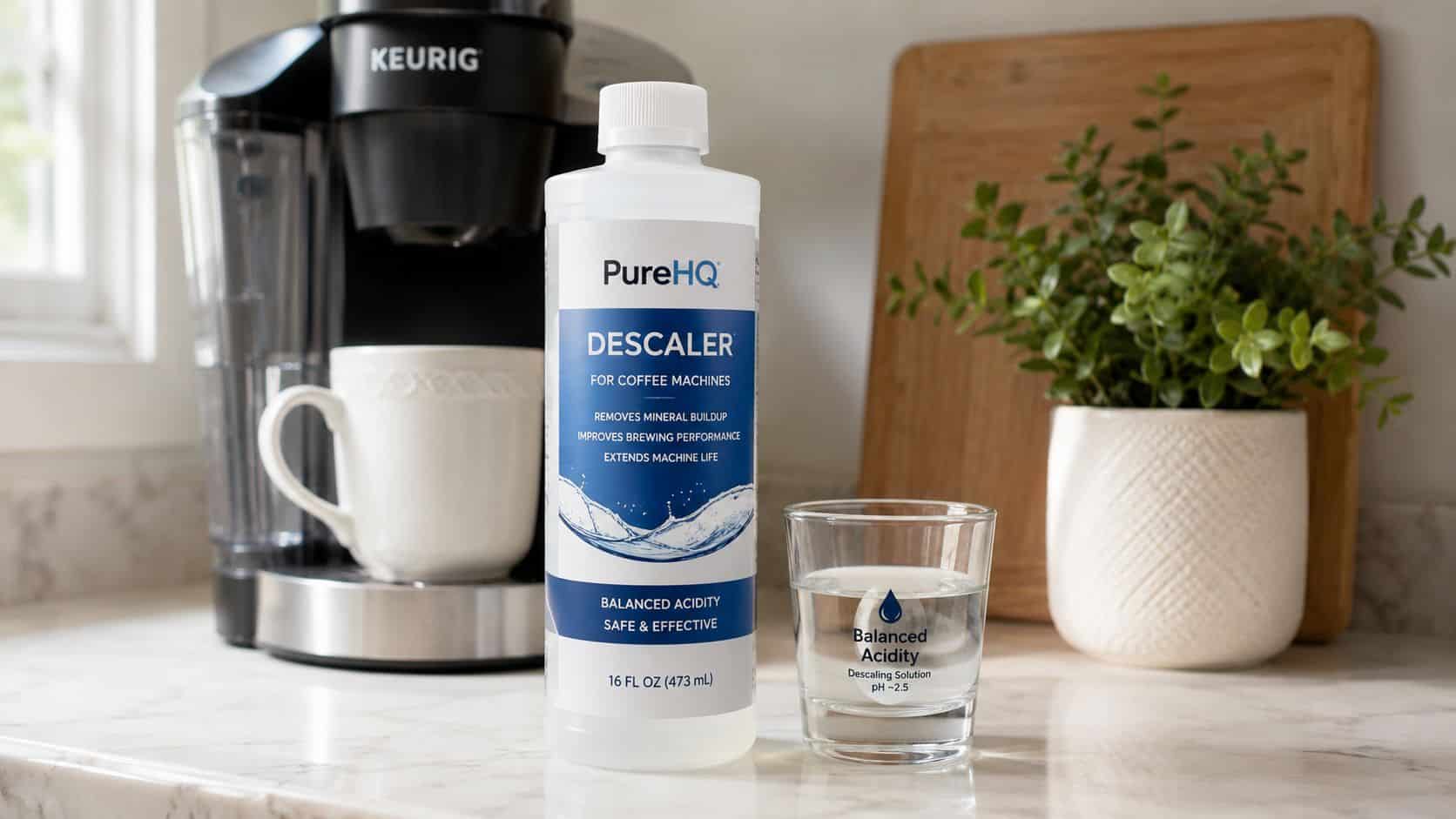
PureHQ Inc. offers a universal coffee-machine descaler positioned for Keurig maintenance, including a product page specifically labeled Best Descaler Solution for Keurig Coffee Makers. Its practical role in this guide is straightforward: provide a purpose-made liquid option for owners who want consistent dosing rather than measuring pantry ingredients.
The value of a universal formulation is flexibility. Owners can use one compatible product across supported coffee equipment instead of keeping separate cleaners for each brewer. The product's labeling and use guidance also make it easier to connect treatment intervals with the water-hardness schedule above.
Where it fits
PureHQ's descaler is a reasonable candidate for owners who want:
- A liquid format: Liquid products avoid the dissolving step required by tablets.
- Broad compatibility: A universal product reduces model-specific guesswork, although the label and machine manual still control final use.
- Routine maintenance: Clear dosing supports repeating treatment on a calendar or brew-count reminder.
- Accessory pairing: A fresh water filter can help manage incoming water quality, while cleaning brushes and tablets address removable or surface areas that descaling doesn't reach.
The product should be stored according to its label, kept closed, and handled away from eyes and children. Don't assume a universal label removes the need to follow dilution, contact-time, and rinsing instructions.
The main trade-off is that product-specific claims such as exact treatments per bottle, shelf life, included accessories, or disposal instructions should come from the package and current product page. Check those details before purchase, especially if you're comparing cost per treatment with Keurig-branded liquid, citric acid powder, or tablets.
Your Maintenance Schedule
A useful schedule combines water hardness, daily brew volume, and warning signs. The available guidance supports a broad three-to-six-month range for many owners, with harder water shortening the interval and very hard water potentially requiring treatment every six weeks. Heavy use can justify acting earlier, because the machine processes more mineral-bearing water between calendar reminders.
| Water Hardness | Light Use (1–2 cups/day) | Moderate Use (3–4 cups/day) | Heavy Use (5+ cups/day) | Recommended Descaler Type |
|---|---|---|---|---|
| Soft | About every six months | Shorten the interval if flow changes | Use brew count and symptoms, not the calendar alone | Citric acid or balanced liquid |
| Moderate | About every four months | Around every three months | Consider the shorter end of the range | Citric acid for routine care, liquid for heavier scale |
| Hard | Around every two to three months | Use a shorter interval if symptoms appear | Frequent monitoring, potentially around every six to eight weeks | Balanced liquid or sulfamic-based formula |
| Very hard | Around every six to eight weeks | Monitor closely and treat at the first warning sign | Monthly or more frequent care may be necessary | Purpose-made stronger liquid formula |
These rows are starting points, not guarantees. Independent guidance identifies 61–120 mg/L as moderate and 121–180 mg/L as hard, while the 2026 brew-count guide estimates roughly 1,000 brews for soft water, 750 for moderate water, 500 for hard water, and 350 for very hard water between descales. Use the lower end of a range when the brewer runs heavily or your water varies seasonally.
Track the machine, not just the date
Put a recurring reminder in your calendar and note the water-hardness result beside it. A small office can track brew volume, while a home user can record the date, product, and symptoms before each treatment.
Descale immediately if you notice:
- Slower brew times
- Gurgling or unusual pump sounds
- Weak flow or incomplete output
- Temperature inconsistency
- A descale light or maintenance signal
A complete 12-month care plan should also include external cleaning, reservoir washing, pod-holder and needle maintenance, and timely water-filter replacement. Descaling removes mineral scale from the internal water path, but it doesn't replace ordinary cleaning of coffee residue or worn accessories.
PureHQ Inc. offers universal coffee-machine descaling products and compatible maintenance accessories for Keurig owners who want a more consistent care routine. Match the product to your water hardness, follow the label, and visit PureHQ Inc. to shop the descaler and filtration supplies for your brewer.

