
Coffee Machine Care
Office Break Room Supplies: A Stocking Guide for 2026
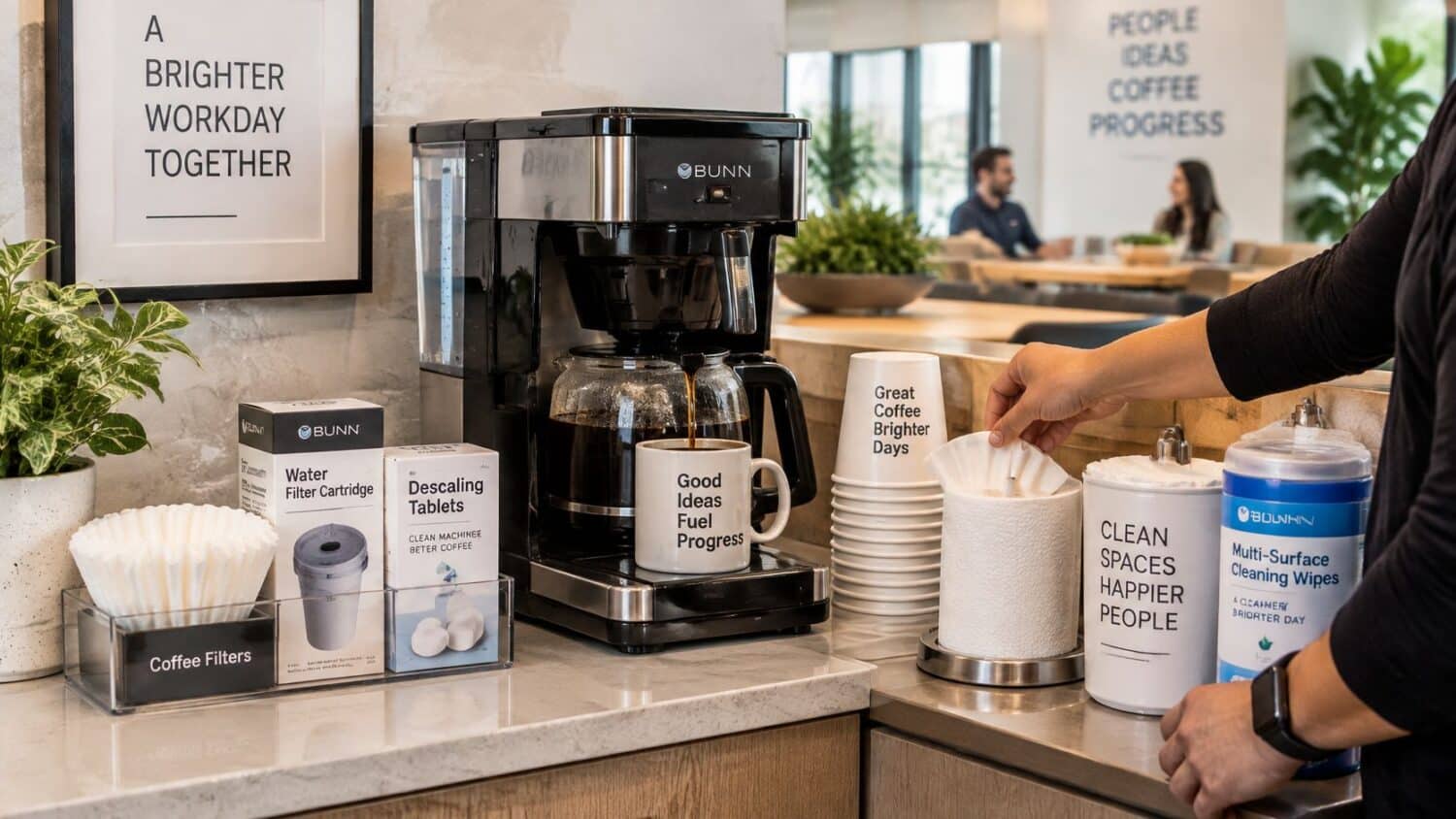
Nov
In 2025 the average worker spent 50 hours a year buying coffee drinks during the workday, according to a OnePoll survey reported by 100.3 WHEB. That's a full working week spent queuing for something the office already has room to make.
Space was never the missing piece. Break room research from Staples, citing Society for Human Resource Management data, found that 91% of employer organizations offered a break room or kitchenette. What separates a station people use from one they walk past is duller than design: filters that fit, cups that are individually dispensed, a descaler that runs on a date, and somebody who checks the shelf before it empties.
Treat the break room the way a small café treats its counter. Office break room supplies aren't décor. They're what makes the machine usable, cleanable and trustworthy, and they belong on a compliance and cost-per-use footing instead of a shopping list.
Essential Break Room Supplies at a Glance
A coffee station with no filters, no cups and a cartridge two months past its replacement date has already stopped working. People reach for it, find nothing usable, and walk out to a café. In 2025, 65% of workers reported drinking coffee at work, according to Coffee Dasher data reported by WHIO, so the station can expect roughly two out of three people on staff at some point during the workday.
That volume puts the break room on food-service footing. Judge each supply by cost per use and restock condition, and let a par-level sheet carry the load: every row sets a minimum, and the minimum triggers the reorder instead of the morning somebody finds the shelf bare.
| Supply | Purpose | Restock trigger |
|---|---|---|
| Drip coffee filters | Keep grounds out of the carafe | One week of stock left |
| Water filter cartridges | Reduce chlorine and taste defects | Replacement date reached or flow slows |
| Universal descaler or cleaning tablets | Remove mineral scale from the brewer | Scheduled descale due or visible deposits |
| Single-use cups and lids | Keep drinking vessels individual | One week of stock left |
| Stirrers, sugar packets and creamer | Support self-service with no shared utensils | Two weeks of stock left |
| Paper towels and hand soap | Keep the counter and sink usable | One week of stock left |
| Disinfectant wipes or sanitizing spray | Clean counters, handles and seals | Two weeks of stock left |
| Disposable gloves | Protect staff during machine cleaning | One box left |
| Lidded waste bin for pods and grounds | Stop used grounds sitting in the machine area | Bin lid or liner missing |
Triggers beat reminders. A reminder depends on somebody remembering; a trigger fires on a condition anyone can verify in seconds. That difference shows up during holiday weeks, when the person who normally orders is on leave and the machine still runs.
Practical rule: if a supply has no trigger, it has no owner, and a supply with no owner runs out on the busiest morning of the month.
Snacks and pantry items sit outside the beverage list, and Rip Van's workplace snack picks cover that half of the stock list once the coffee station holds steady.
Copy the table into a shared order document, add columns for par level and last order date, and assign the Monday check to one named person. A few minutes of shelf-reading a week is the entire job once the triggers are written down, and it costs far less than the emergency supply run that follows a bare shelf.
Choosing Water Filters and Descalers by Water Hardness
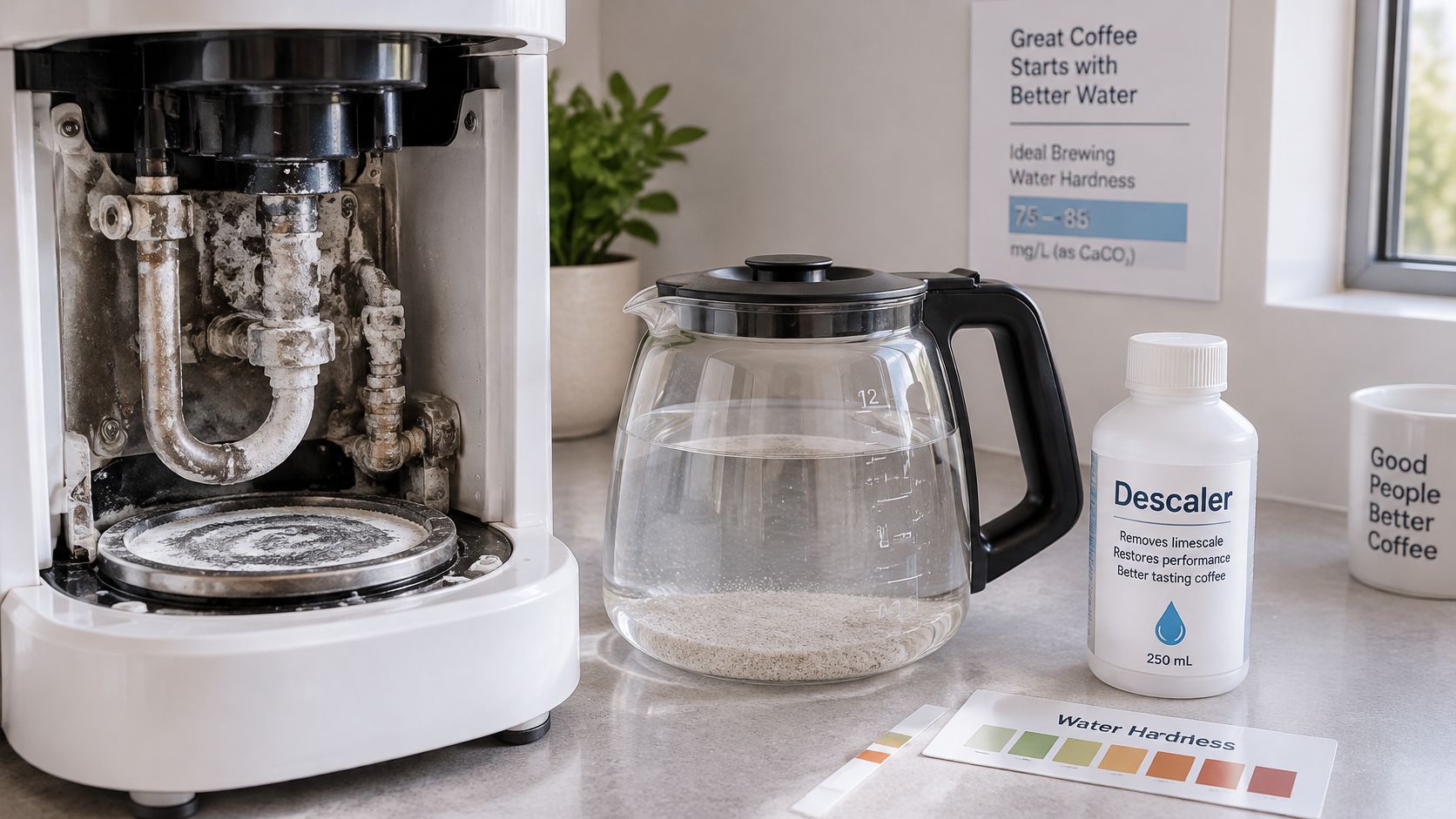
Scale builds where nobody looks. Calcium and magnesium come out of solution as water heats, and the deposit lands on heating elements, valves and internal hot-water paths. Flow slows, brew time stretches, and the element works harder for a cooler cup.
Brewing water has a usable window. Guidance summarized from Specialty Coffee Association specifications places it near 75 to 250 mg/L total dissolved solids, 17 to 85 mg/L calcium hardness, pH 6.5 to 7.5, and roughly 40 to 75 mg/L alkalinity, according to this published review of coffee brewing water.
A white ring on the element is the visible end of the problem. Test first, so the cartridge you buy matches the water you have.
| Water reading | What it means | Supply to stock |
|---|---|---|
| 75-250 mg/L TDS and 17-85 mg/L calcium hardness | Within the recommended brewing window | Carbon filter cartridges and periodic test strips |
| Above 250 mg/L TDS or high calcium hardness | Scale risk on heating elements and valves | Hardness reduction cartridges plus a descaler on a set schedule |
| Below 75 mg/L TDS or alkalinity under 40 mg/L | Low minerals, possible corrosion risk | Test again and confirm with the water supplier before adding treatment |
| pH outside 6.5-7.5 | Taste or corrosion issues | Full water analysis from the supplier before choosing a treatment |
Reading the numbers into a purchase
Carbon filtration handles chlorine and the flat, plasticky taste it leaves in a cup. Hardness reduction is the right call where local water carries heavy mineral content. Stripping minerals from already-soft water swings the other way, because very low alkalinity raises corrosion risk on metal parts. Removing minerals isn't automatically the goal; matching the treatment to the reading is.
Cartridges don't stay effective forever. EPA guidance on maintaining a water filter explains that cartridges wear out and lose effectiveness with use, and it tells users to record days or gallons when the system has no replacement indicator and to fit a cartridge compatible with the housing. The same document warns never to run hot water through a faucet filter or put hot water in a pitcher filter, since heat damages the media, so keep brewer-hot water on one side of the setup and cold filtration on the other. If you'd rather confirm your numbers before ordering, this walkthrough on how to test water hardness covers strips, meters and what each reading changes.
Watch for slower flow, longer drawdown, visible deposits and weaker heating. Set the descale date from three inputs: the manufacturer's instructions, the water test result and monthly beverage volume.
Two dates on the wall: filter replacement and descale. One protects taste, the other protects the heating element, and neither survives being remembered.
The same mineral chemistry scales building plumbing, not just a brewer. If supply lines are suspect, this guide to descaling clogged water pipes covers the larger version of the job.
Cups, Dispensers and Safe Drinking Water Supplies
OSHA settles the shared-mug question quickly. The agency's drinking water FAQ prohibits shared drinking cups, dippers and water bottles, and allows drinking water from a fountain, a covered container with single-use cups kept in a sanitary receptacle, or single-use bottles. It also requires employers to set and follow a schedule for servicing, cleaning and supplying sanitation facilities.
The general industry sanitation standard adds the equipment detail. Portable drinking-water dispensers must be designed and serviced to stay sanitary, must be capable of being closed, and must include a tap. Open containers that workers dip into or pour from are out.
Count the cups before ordering. A 20-person office where each person drinks two cups a day needs 40 cups daily, about 200 across a five-day week. Set the par level at two weeks of that figure rather than one, because the week a delivery slips is the week everyone notices.
Placement matters as much as inventory. OSHA requires employers to keep food, beverages and tobacco out of areas where employees may be exposed to hazardous or toxic substances, so the coffee station doesn't belong beside the cleaning chemical shelf, the toner store or the maintenance cupboard.
Run this check every Friday:
- Containers covered. Every water container has a lid and every reservoir is closed between uses.
- Cups individually dispensed. Sleeves or wrapped cups in a sanitary holder, never a stack of loose mugs by the sink.
- Taps on dispensers. Anything without a tap gets replaced, not improvised with a jug.
- Chemistry kept separate. The coffee area sits apart from cleaning products and their fumes.
This guide to setting up a K-Cup dispenser covers the storage and rotation side of the same routine.
How to Clean the Coffee Station on a Schedule
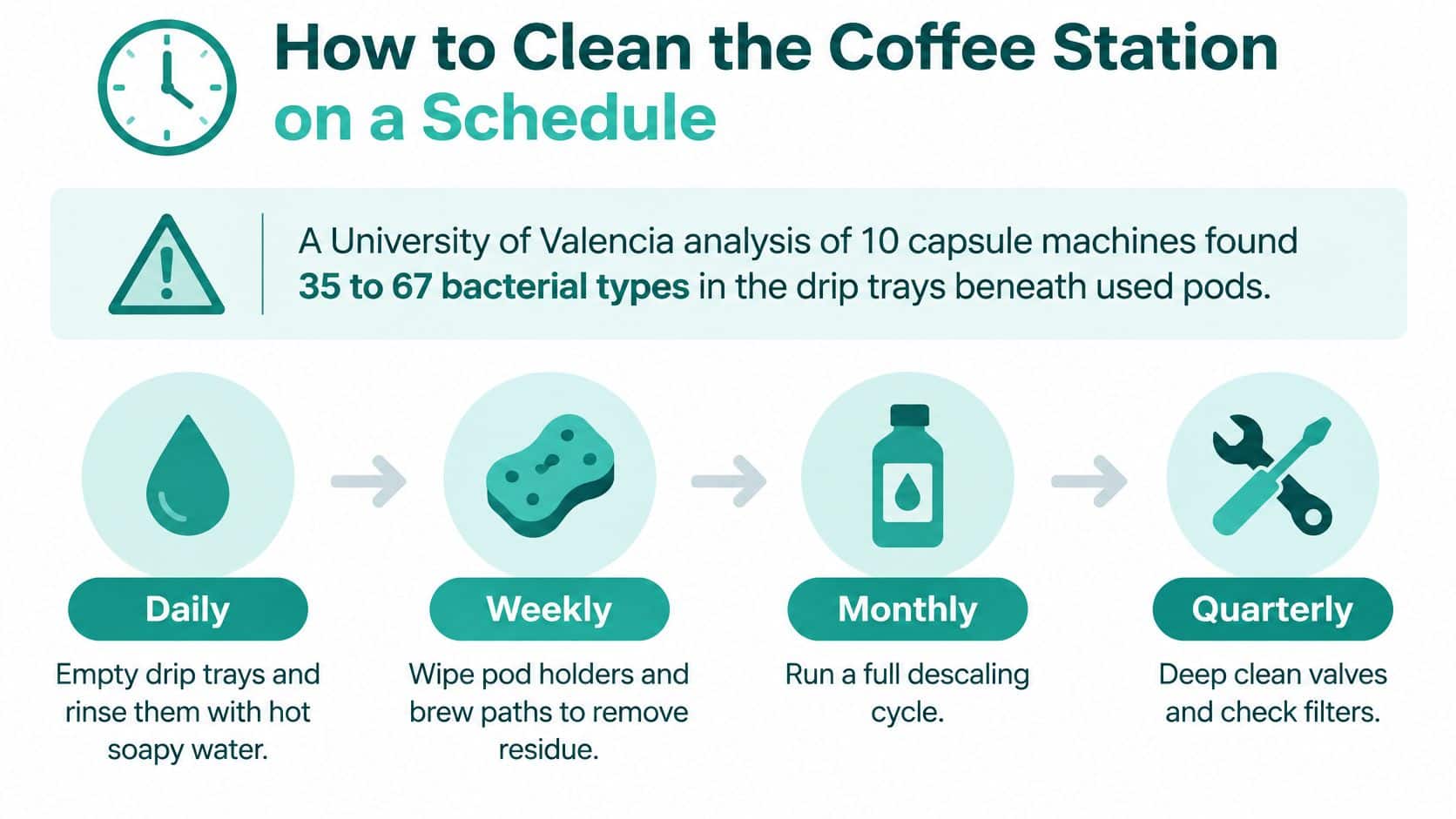
A University of Valencia analysis of 10 capsule machines found 35 to 67 bacterial types in the internal drip trays beneath used pods, with Enterococcus and Pseudomonas detected in 9 of the 10 machines, as reported in this coverage of the study. Similar patterns appeared in machines used about three times daily for two months, which is exactly the profile of a small office brewer rather than a laboratory rig.
The exterior wipe doesn't reach any of that. A workable routine treats each component as its own sanitation point.
- Unplug the machine, empty the reservoir, remove the drip tray and pod holder. Cutting power first means no heating cycle can start mid-wash.
- Wash the drip tray and pod holder daily in warm, neutral detergent. Detergent lifts the coffee oils and milk film that a plain rinse pushes around.
- Wash removable parts, then sanitize them. The FDA Food Code requires food to contact only equipment whose food-contact surfaces have been cleaned and sanitized, and specifies immersion for at least 30 seconds in hot-water manual operations. That covers carafes, baskets and reusable pods.
- Rinse the reservoir and refill it with clean water. Standing water left overnight is where the film starts.
- Run a brew cycle with a cleaning tablet or descaler. Follow the brewer manufacturer's sequence, since backflushing and tablet cycles differ between machines.
- Run two cycles of plain water to rinse. Residual cleaner shows up as a soapy edge on the next cup.
- Wipe the exterior, handles and seals with a sanitizing wipe, then let parts dry before reassembly. Drying matters because moisture is the condition the bacteria need.
- Record the date and your initials on the checklist. A tick with a date is the only proof the job happened.
Set the schedule as daily for trays and pods, weekly for removable parts, and monthly for descaling, then adjust to water hardness and how many cups the office draws. Hot water alone doesn't sanitize a brewer. Heat rinses a surface; it doesn't remove the film that forms where moisture sits between uses.
Cups matter too, and this method for cleaning coffee cups keeps the drinking vessels out of the same gray zone as the tray.
Will Reusable Pods Leak or Fit Your Brewer?
Say the objection out loud, because it's why offices keep buying disposables. Reusable pods leak, grounds end up in the cup, and the machine ends up with a puddle underneath it. Most of that comes down to three things.
- Gasket sitting too high on the needle. Water escapes around the seal instead of passing through the pod.
- Pod not fully seated. A quarter turn short is enough to break the seal and channel water sideways.
- Mineral buildup in the brew path. Scale narrows the exit, pressure backs up, and overflow follows.
Work the fix in that order. Seat the pod, check the gasket position against the manufacturer's description, then run a water-only cycle and watch where it escapes. If the machine has been descaled recently and the pod is seated properly, the pod itself is usually the worn part.
Fit is a purchase question, not an installation one. Match the brewer model against the listed compatibility before ordering. PureHQ provides accessories for Keurig, Cuisinart and Breville machines, so the model list on the product page is the thing to check, not the product photo.
Durability comes next. Mesh pods wear out, so replace one when the mesh tears or the seal stops holding, and put that replacement date on the station checklist beside the descale date. Keep one spare pod and one spare filter set on the shelf, and write down which model each part fits so the next person to order gets it right without running a test.
Premium Supplies Compared and Where to Buy
Expectations are set before anyone tastes anything. In 2025, 65% of employees expected high-quality office coffee, according to a Nespresso study cited in Crafty's office coffee trends report. The supply choice shows up in the cup, and the cup is what people use to judge the whole amenity.
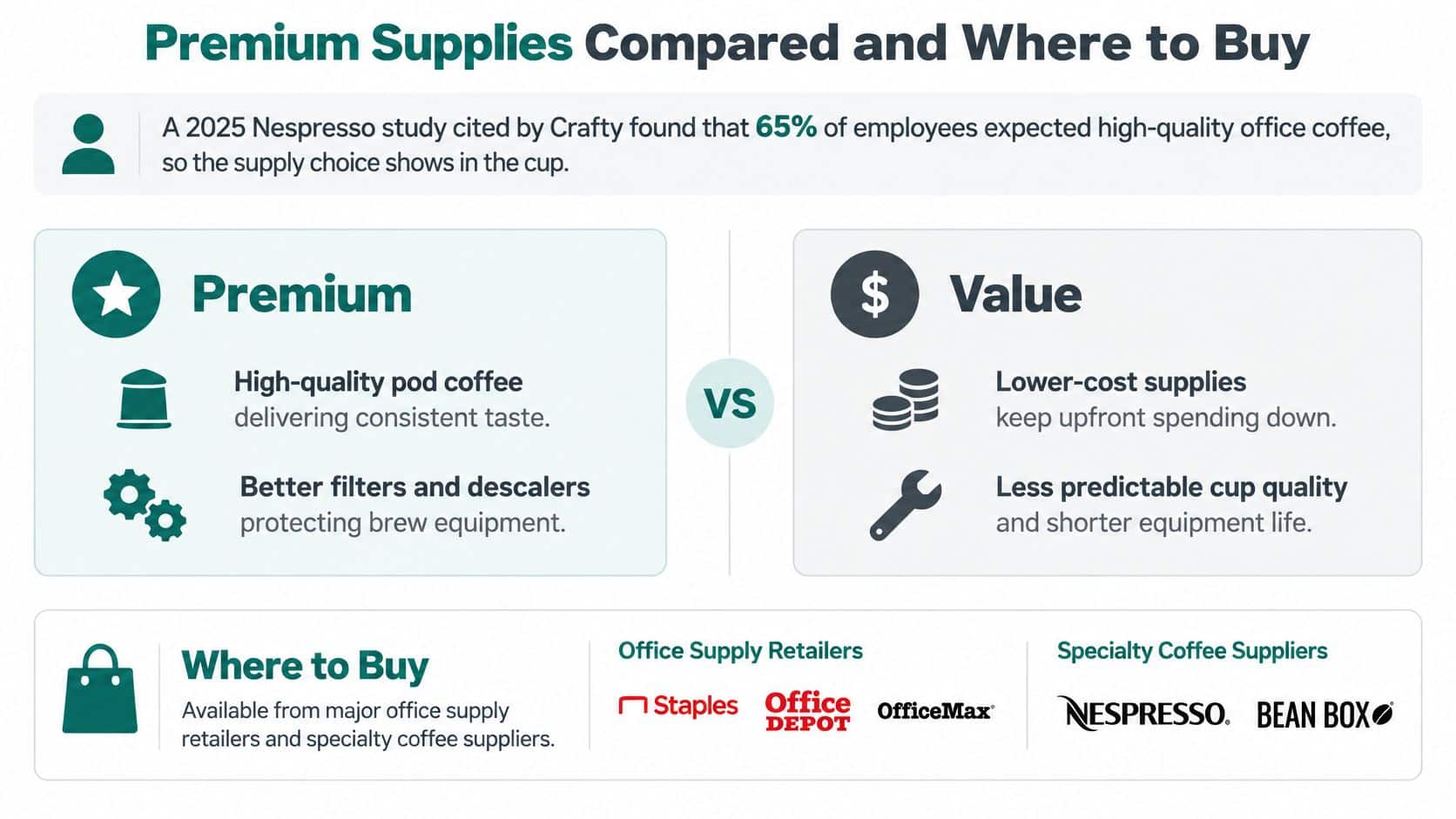
The trap is buying on sticker price. A box of filters at half the cost that clogs in three weeks is the more expensive box.
| Criterion | Premium option | Standard generic option |
|---|---|---|
| Compatibility | Checked against listed brewer models | Universal fit, often unverified |
| Manufacturing oversight | Brand oversees its own filter and pod production | Varies by supplier |
| Replacement tracking | Dated cartridge logs per manufacturer instructions | Often untracked |
| Descaling | Universal descaler with stated uses per bottle | Uses per bottle often unstated |
| Cost per use | Higher purchase price, divide by stated uses | Lower purchase price, more frequent replacement |
| Waste from reusable parts | Lower only with consistent use and cleaning | Depends on disposable volume |
Cost per use, worked through
Divide the purchase price by the stated number of uses, not by the box. A descaler sold as ten doses at $23.95 works out to about $2.40 per descaling cycle, a figure that compares across brands in a way a shelf price never does. When a bottle doesn't state its uses, you can't compare it at all, and if a cheaper product needs two doses per cycle, the math inverts.
The same logic applies to filters. A 12-pack of compatible replacement filters for a Breville espresso machine at $15.95 lands near $1.33 per cartridge. That number only holds if each filter lasts the interval it claims, so write the install date on the cartridge housing with a marker and check flow at the midpoint.
Test before you commit
Buy one batch of generic filters, run a full week on them, and watch flow, taste and any visible sediment in the reservoir. Then decide about bulk. Compatibility is the objection buyers raise most often, and the honest answer is that it lives on the model list rather than in reviews. Verify the exact machine name, including the generation, before the order goes in.
Verdict by usage: for a shared machine drawing daily traffic, divide the price by the stated uses and let that figure pick the supply. For a two-person office making a few cups a week, verified-compatible generics are the sensible buy.
Some staff want a fast cup that never touches the brewer, and a shelf option like clean instant coffee for busy professionals covers those afternoons without extra equipment.
PureHQ oversees its own manufacturing of its water filters and reusable coffee pods, which means specifications and compatibility come from one source instead of three. The Keurig and Breville Descaling and Cleaning Tablets come in a 24-count pack with 6 compatible water filters for $19.95, so a single order covers both the descale schedule and the filter changes. New email subscribers also receive a coupon code for 10% off Coffee Machine Accessories on their next order at PureHQFilters.com.
Shop the descaling and cleaning tablets with the compatible filters at PureHQFilters.com today and put both dates on the station checklist before the next Monday check.
PureHQ Inc. supplies the maintenance side of a shared coffee station: reusable K-Cups, compatible water filters for Keurig, Cuisinart and Breville machines, and descaling and cleaning tablets that keep a brewer performing at the quality your staff expect. If your filter date has passed and the flow has slowed, the tablets and cartridges matched to your machine model are the most direct fix for that brewer. Visit PureHQ Inc. to match the right parts to your brewer and keep the break room running all year.

