
Coffee Machine Care
Best Deals on K Cups: How to Compare Cost Per Pod
Nov
A single-serve brewer feels cheap until the pods pile up. In 2023, 27 percent of U.S. coffee drinkers used a single-serve machine on a given day, and that pattern lines up with an estimate of about 50 million to 60 million coffee pods used daily in the United States, as the Statista single-serve coffee market overview reports from National Coffee Association figures cited by Consumer Reports. The box on the shelf is a small charge. The year is a bill you keep paying.
Best deals on K Cups are not the loudest percentage off a 24-count. They are the lowest delivered cost per pod after shipping, a second capsule for a big mug, flavors that go stale, and the upkeep the brewer still needs. The arithmetic below shows which offers clear that test, and when a refillable pod beats the bargain box.
What a Good K Cup Price Looks Like Per Pod
A good K-Cup price is the dollars you pay divided by the pods in the box. Pod coffee has long been an expensive way to buy grounds. A contemporary analysis covered by Waste Dive estimated that standard K-Cups sold for roughly $40 per pound of coffee, even though each capsule held only about 11 grams of grounds. That premium over a bag of ground coffee is why pack size and multi-packs change the bill for anyone who brews every day.
More brands on the same shelf did not make the boxes comparable. Similar art can still hide a wide spread in cost per pod. Rank an offer by delivered cost per pod, then add what the sticker leaves out: shipping, a second capsule when one pod is too small for the mug, and the filters or descaler the brewer still uses.
Ten cents becomes a yearly bill
A household using two pods a day consumes roughly 730 pods a year. A 10-cent gap per pod is about $73 over that year. The advertised box price hides that gap. Divide the price you pay by the pod count, then compare the result with the bands below.
| Offer type | Listed price | Cost per pod | What it signals |
|---|---|---|---|
| Store-brand 100-count Colombian | about $32 | $0.32 | Major-market low in independent tracking |
| Other widely available pods | about $51 to $54 on a 100-count | $0.51 to $0.54 | Independent price tracking range |
| Standard Keurig-compatible pods | about $12 to $22 on a 24-count | $0.50 to $0.90 | Ordinary retail range |
| Bulk-purchase pods | about $50 on a 100-count | about $0.50 | Bulk price reference |
| Store-brand option | about $39 on a 100-count | about $0.39 | Lower store-brand reference |
| Four 20 to 24-count packs | $48 total | $0.50 to $0.60 | $12 a box against typical $15 to $20 boxes |
Practical rule: Anything above $0.54 per pod needs a reason you can name, such as a flavor you cannot find cheaper, or a subscription that pulls the delivered price back under that line.
A $12 box of 24 is $0.50 a pod, the same neighborhood as a $50 100-count. Four boxes at $48 only look like a win if the count is closer to 96 pods ($0.50) than 80 ($0.60). The $0.32 store-brand 100-count is the aggressive end of those bands, not the price to expect on a flavored 24-count. A second pod for a larger mug turns a $0.50 capsule into $1.00 for that cup, which is enough to erase a year of the $73 you thought you had saved.
Calculate the True Cost of Each Cup
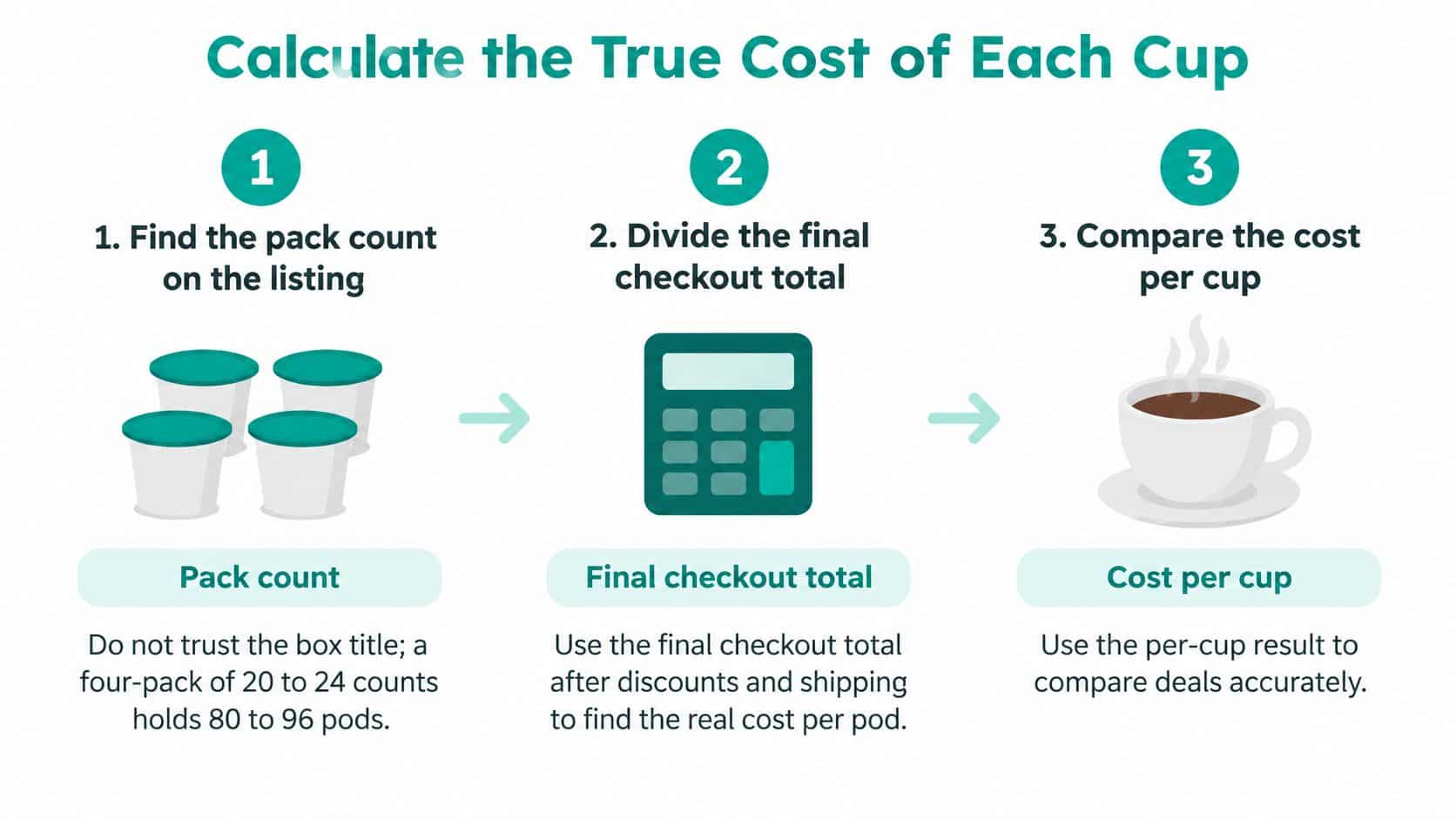
Sticker price is the wrong denominator. Brewsift's K-Cup price tracking put a major-market low near $0.32 per pod for a 100-count store-brand Colombian, with other widely available pods around $0.51 to $0.54. A 100-count near $32 is competitive. A cheaper-looking 24-count is not, until you divide.
The same checkout habit applies outside coffee. Shoppers who compare a jar of honey by origin and how it was produced, rather than by the sticker, are doing this work already, which is why weighing origin and production when buying honey from Topanga Quality Honey is a useful parallel when a small package hides a high unit cost.
Seven checks before you trust a discount
- Read the pod count on the listing, not the box title. A "four-pack" of 20 to 24 counts holds 80 to 96 pods. People divide by 24 and then wonder why the unit price looks twice as good as it is.
- Divide the final checkout total by that count. Coupons, shipping, and tax all belong in the numerator. The common slip is using the shelf price. A $32 100-count with $6 shipping is $38, or $0.38 per pod, six cents above the $0.32 headline.
- Match the marketed cup size to an 8-ounce brew. Price comparisons that standardize on 8 ounces show the trap. A pod sold for a larger mug can taste thin, or it can push you to a second capsule.
- Count the weak-brew allowance. If one pod cannot make a cup you will finish, the second pod is part of the cost of that cup. At $0.50 each, a doubled mug is $1.00, not a bargain.
- Add forced extras and stale pods. A minimum order that makes you buy a second box, and a variety carton you will not finish, are wasted servings. Subtract pods you will throw out before you call the unit price real.
- Plan the machine's time, not only its capsules. Most Keurig brewers should be descaled every three to six months, and Keurig's descaling instructions put the job at about 15 to 20 minutes on some brewers and about 45 minutes on a K55. No pod deal removes that appointment.
- Turn the per-pod result into a year. Multiply by pods per day, then by 365. Two pods a day is the 730-pod year. A nominal 20 percent subscription discount dies if shipping or a minimum order puts unused boxes in the cabinet.
A thirty-two dollar box that is not thirty-two cents
Say the listing shows a 100-count at $32 with a 20 percent subscribe-and-save tag. The discount drops the goods to $25.60. Add $6 shipping and you are at $31.60, or $0.32 a pod, which only ties the major-market low and does not beat it. If you brew 12-ounce mugs and use two pods each morning, that "tie" becomes $0.64 a satisfactory cup. Compare the finished number with the bands in the table above, then with a refillable setup priced on the same 730 brews.
A percentage off the box is not a discount until the delivered cost per satisfactory cup is lower than the pod you already buy.
Where Real K Cup Discounts Show Up
Prices move in four places: the manufacturer site, the retailer site, third-party marketplace listings, and subscription deliveries. A sale counts only when the price after the tag lands at or under the per-pod band for that coffee. A holiday banner, including a Black Friday event, does not do that by itself.
Check the history, then the pack count
Before you buy, open the listing's price history. If last month's ordinary price was already $0.52 and the "sale" is $0.55 after shipping, the tag restored a regular price rather than cutting it. Note the seller on each listing and compare the same pod count. A 12-count at a low box price is not a rival to a 24-count.
Bundles are worth a look once the division works. Four packs of 20 to 24 counts at $48 total, or $12 a box, sit under typical box prices of $15 to $20, as Yahoo's pod price comparison lays out. On 80 pods that is $0.60. On 96 pods it is $0.50. Buy the bundle only if you will drink every flavor. A variety carton you abandon is a discount you paid not to use, which is the trap covered in our variety pack Keurig K-Cup guide.
Treat a subscription as a tool only when the delivery cycle matches how fast the household drinks. Unused pods go stale and erase the percent off. Set a price alert, write down the per-pod figure and the date, and buy when that figure drops under the band for the pod you want. A dated note is how you tell a markdown from a price that came back.
New email subscribers at our shop get a coupon code for 10% off coffee machine accessories on the next order. Use that on filters, a descaler, or refillable pods. Do not let it talk you into a disposable carton whose delivered pod price is still above the line.
Reusable Pods Compared With Disposable Pods on Cost
Disposable pods and a refillable pod only compare on the same year. Two brews a day is 730 brews. On that count, a reusable pod wins only when ground coffee plus a liner costs less per cup than the disposable pod you would have bought.
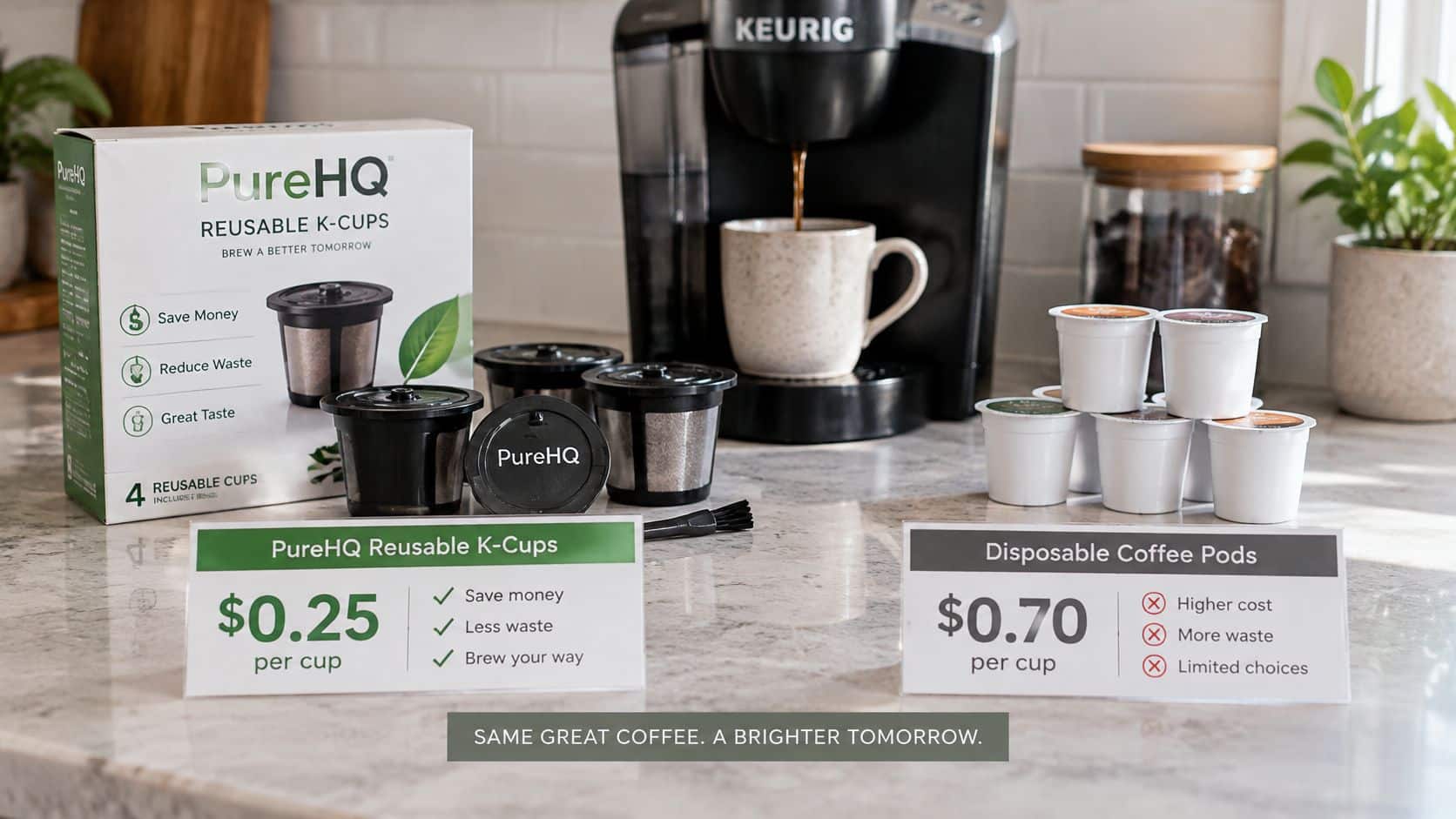
Our reusable K-Cups for Keurig coffee makers, a 4-pack at $19.95, are listed for K-Supreme, K-Slim, and K-Duo Gen 2. The recurring piece is the liner. Disposable paper filters for reusable K-Cups, a 100-pack at $12.95, come to about $0.13 each. One liner on each of 730 brews is about $94.50 a year. Add the $19.95 4-pack and year one is about $114 before the coffee in the bag.
| Option | Cost per cup | Notes |
|---|---|---|
| Disposable pods at $0.90 each | $0.90 | About $657 a year, upper end of ordinary pricing |
| Disposable pods at $0.50 each | $0.50 | About $365 a year, typical bulk-level price |
| Store-brand 100-count pods at $0.32 each | $0.32 | About $234 a year, major-market low |
| PureHQ 4-pack reusable K-Cups plus paper liners | about $0.16 before ground coffee | Year one about $114, ground coffee cost per cup comes from your own bag |
Where the refillable pod wins
Against $0.90 pods, the hardware and liners are paid for many times over, even after you add a modest bag of coffee. Against a true $0.32 store brand, the gap shrinks. If your ground coffee costs $0.20 a cup, the refillable cup is about $0.36 once the liner is in, which loses to that $0.32 pod on money alone. If your coffee is $0.15 a cup, the refillable cup is about $0.31 and it wins by a hair, with fewer capsules in the trash.
The trade is honest. You choose the coffee and you throw away a paper liner instead of a plastic cup, lid, and filter. You also dose, empty, and wash. Reusable brewing pays when you already buy ground coffee and you use the pod every day. It does not pay if spills and weak cups send you back to sealed pods by week two. Our reusable coffee pod breakdown walks through that daily fill-and-rinse routine.
Record grams per cup and what you spend on pods for two weeks. Then put both numbers next to the table. That test beats a headline that calls every refillable pod free.
Fit, Leaks and Upkeep Before You Buy Reusable Pods
The objection is fair. A reusable pod that leaks, will not close, or brews weak coffee is not a saving. Most of those failures have a cause you can see before the second brew.
| Symptom | Likely cause | Fix |
|---|---|---|
| Grounds leak into the cup | Pod overfilled or not seated fully | Fill below the rim and seat the lid fully before brewing |
| Weak, watery coffee | Too few grounds for the cup size | Add grounds or brew a smaller cup for the 8-ounce benchmark |
| Pod does not fit or close | Listing matched to the wrong brewer model | Match the listing to the exact model and check clearance under the handle |
| Descale light stays on | Mineral buildup from hard water | Descale every three to six months with a descaling solution |
Match the brewer, then keep the water path clear
Start with the model name on the brewer, not the word "Keurig" alone. A pod built for one family does not behave the same way in another. The 4-pack above is the match for K-Supreme, K-Slim, and K-Duo Gen 2. Confirm the handle clears the lid before you brew. Overfilling is the other leak. Stop below the rim, close the lid until it seats, and do not brew if the handle fights you.
Scale is a separate bill from the pod. Descale on the three-to-six-month rhythm, or when the descale light comes on, and wash the pod holder, funnel, and drip tray on a weekly pass so residue does not masquerade as a bad capsule. Our Coffee Machine Descaler is $23.95 for 10 uses, a universal solution for Keurig, Nespresso, Breville, and espresso machines, made in the USA. If you would rather keep filters in the same kit, the Keurig and Breville descaling and cleaning tablets are a 24-count with 6 compatible water filters for $19.95. A low pod price that lets the brewer clog is not the lowest cost per cup.
Is the Cheapest Pod Worth the Disposal Trade-Off
34 percent of coffee-pod buyers already let recyclability influence the purchase, and another 30 percent say it plays some role, according to consumer research reported by Letsrecycle. More than a quarter of surveyed consumers called pod disposal complicated. Separate estimates in that reporting put historical landfill rates for capsules at 75 to 90 percent. Those rates vary by market and are not a current universal figure.
Disposal is already in the price, even when the carton hides it.
A peer-reviewed study summarized by NPR reported that pod coffee can carry higher lifecycle emissions than some alternatives because of packaging and waste handling. Other lifecycle analyses reach different conclusions depending on how much coffee you use and how you brew. Filter coffee often uses a larger dose of grounds than a capsule for a similar cup, so farm production, not only the plastic, can dominate the footprint. A cheap pod that makes you brew twice erases that smaller dose. You pay for two pods, you handle two cups of waste, and the sticker price per advertised cup is no longer the cost of the drink in the mug.
Many single-serve cups are recyclable only where local programs accept that plastic. Lids and filters often have to come off before the cup can go in a bin. A pod can say recyclable on the label and still be trash at your curb. If the deal's pods are hard to recycle where you live, count that sorting time against every cup, the same way you would count shipping or a second pod for a larger mug, or compare the offer with a refillable pod that takes the disposable cup out of the brew. The K-Cup recycling guide spells out what needs to come apart.
The lowest advertised price is the lowest cost only if you can dispose of the pod without a second project.
Pick the Lowest Cost per Cup for Your Brewer
Buy the lowest delivered cost per cup that fits your exact brewer. Fit comes first, because a pod that will not close is not a deal at any price.
- Confirm the model printed on your Keurig before you add a pod to the cart.
- Calculate delivered cost per cup, including shipping, any second pod for a larger mug, and any minimum-order add-on.
- Set that number against the per-pod bands and against the 730-brew yearly figures.
- Run the two-week test of grams per cup and monthly pod spend, then see whether a reusable pod beats your best disposable cup.
- Choose from the test. If you brew daily and you already buy ground coffee, take reusable pods when they win. If you brew only a few cups a week, take the lowest disposable per-pod price that clears the band.
The 4-pack of universal refillable K-Cups, $19.95, fits K-Supreme, K-Slim, and K-Duo Gen 2. Shop that pack when the test says the liner-plus-coffee cup beats the carton you are buying now.
PureHQ Inc. makes reusable K-Cups, paper liners, water filters, and descaling supplies for Keurig brewers and other single-serve machines, so the cost-per-cup math in this guide has a product behind it. If your two-week test shows a refillable pod beating the carton, the 4-pack is the place to start. Visit PureHQ Inc. to compare the pods, liners, and descaler that match your brewer.

