
Coffee Machine Care
Best Reusable Cup for Keurig: Fit, Cleaning and Value
Oct
More than 3 billion K-Cups were sold in 2010, a figure reported in Smithsonian magazine's history of coffee pods. That scale explains the appeal of a refillable cup, and it also explains the frustration when one doesn't work. You buy a cup labeled universal, it drops into the holder, and the brew still leaks, tastes thin, or leaves grounds in your mug.
The best reusable cup for Keurig brewers isn't chosen by material first or by capacity first. It's chosen by exact model match, then by how cleanly it rinses and how often you'll use it in practice. A cup that physically fits can still misalign with the needles, bypass the grounds, and waste good coffee.
Which Reusable Cup Fits Your Keurig Brewer
Keurig brewer families use different water-entry patterns, so a cup that fits the holder may still be the wrong match. Match the cup's lid to the brewer's needles, then confirm compatibility by the exact model name. That check helps prevent poor water distribution, leaks, and interrupted brewing.
Keurig's original pod patents expired in 2012. In 2014, the 2.0 system added pod authentication, which affected compatibility with reusable cups. Wikipedia's Keurig history outlines the 2.0 transition, but an individual cup's fit still depends on its design and the brewer model. Check the manufacturer's compatibility guidance rather than assuming that a cup for an older machine works in a newer one.
The Lookup Table to Use First
| Brewer family | Water entry | Cup type to look for | Check before buying |
|---|---|---|---|
| K-Classic, K-Elite, K-Compact, K-Café, K-Select | Single needle (single-stream) | Cup built for a single-stream lid and puncture | Exact model name on the listing |
| K-Supreme family | Five-point MultiStream | MultiStream-compatible lid | Model-specific compatibility statement in the use guide |
| K-Slim MultiStream variants | Five-point MultiStream | MultiStream-compatible lid | Variant name, not only the series name |
| K-Duo Hot & Iced Gen 2 | Not confirmed here | Cup named for the exact model | Check the brewer guide and cup listing |
| K-Brew+Chill | Not confirmed here | Cup named for the exact model | Check the brewer guide and cup listing |
| Keurig 2.0 brewers | Authentication-era design | Cup listed for 2.0 operation | Model listed on the cup, not generic K-Cup wording |
| K-Mini Go | Not stated in the guidance cited here | Cup named for the exact model | Read the Use and Care Guide before buying |
Treat water-entry details as model-specific. Keurig's K-Supreme SMART Use & Care Guide identifies the K-Supreme's multiple entrance needles and calls for a compatible filter with five lid holes. Don't extend that specification to another family without checking its own guide. The K-Duo Hot & Iced Gen 2 and K-Brew+Chill entries remain unconfirmed here, so verify their manuals and the reusable cup maker's listing before choosing a design.
The K-Slim name also needs a closer check. Some variants use MultiStream, so the series name alone may not identify the water-entry pattern. Find the full model name on the brewer base or in its manual.
Practical rule: Match the cup to the exact brewer model and lid pattern. A cup fitting into the holder does not confirm compatibility.
Run the Fit Check in Order
- Find the exact model name. Check the brewer base or manual and copy the full variant name. If the cup listing names specific models, compare those names directly.
- Confirm the water-entry pattern. Keurig models may use a single-needle path or the five-needle MultiStream system. GoodCups explains in its Keurig reusable cup compatibility guide which patterns it associates with specific models. Use that as a cross-check, then confirm the match in the brewer's own guide, especially for newer or variant models.
- Check the lid design. Compare the cup's lid with the compatibility details for your model. Don't assume a five-hole design will work in a single-stream brewer, or that a one-hole design will work with MultiStream.
- Close the handle without force. Seat the empty cup and close the brewer normally. If the handle resists, stop and recheck the model rather than pressing harder.
- Run a water-only test. Brew plain water and watch for drips around the lid. Confirm the cycle finishes before adding coffee.
For K-Supreme owners, use Keurig's model-specific guidance as the deciding reference. The guide says the brewer is compatible only with the newly designed My K-Cup Universal Reusable Coffee Filter and warns that older versions or other reusable filters may damage the brewer. It links that requirement to the machine's multiple entrance needles and the filter's five lid holes.
The guide also warns against testing with an already-punctured pod. Grounds may escape through the extra holes, and an incompatible filter may prevent the brewer from closing or brewing. Follow the use guide's instructions for your model instead of relying on a general marketplace claim.
If the model name or water-entry pattern is unclear, compare your manual with the model-by-model guide to which reusable K-Cup fits your Keurig. Verify the fit before weighing mesh, capacity, or price. A well-made cup with the wrong lid pattern won't solve a compatibility problem.
Premium Reusable Cup vs Generic Alternatives
A reusable cup's value depends first on whether it matches the brewer, then on whether it is easy to use and clean. Stainless steel or another material cannot compensate for a cup that misses the model's water-entry pattern. Keurig's K-Express Essentials instructions identify the My K-Cup Universal Reusable Coffee Filter for brewing users' own ground coffee. They also distinguish it from recyclable pods, whose foil lids users should not remove. The brewer lid, needles, and holder handle these formats differently.
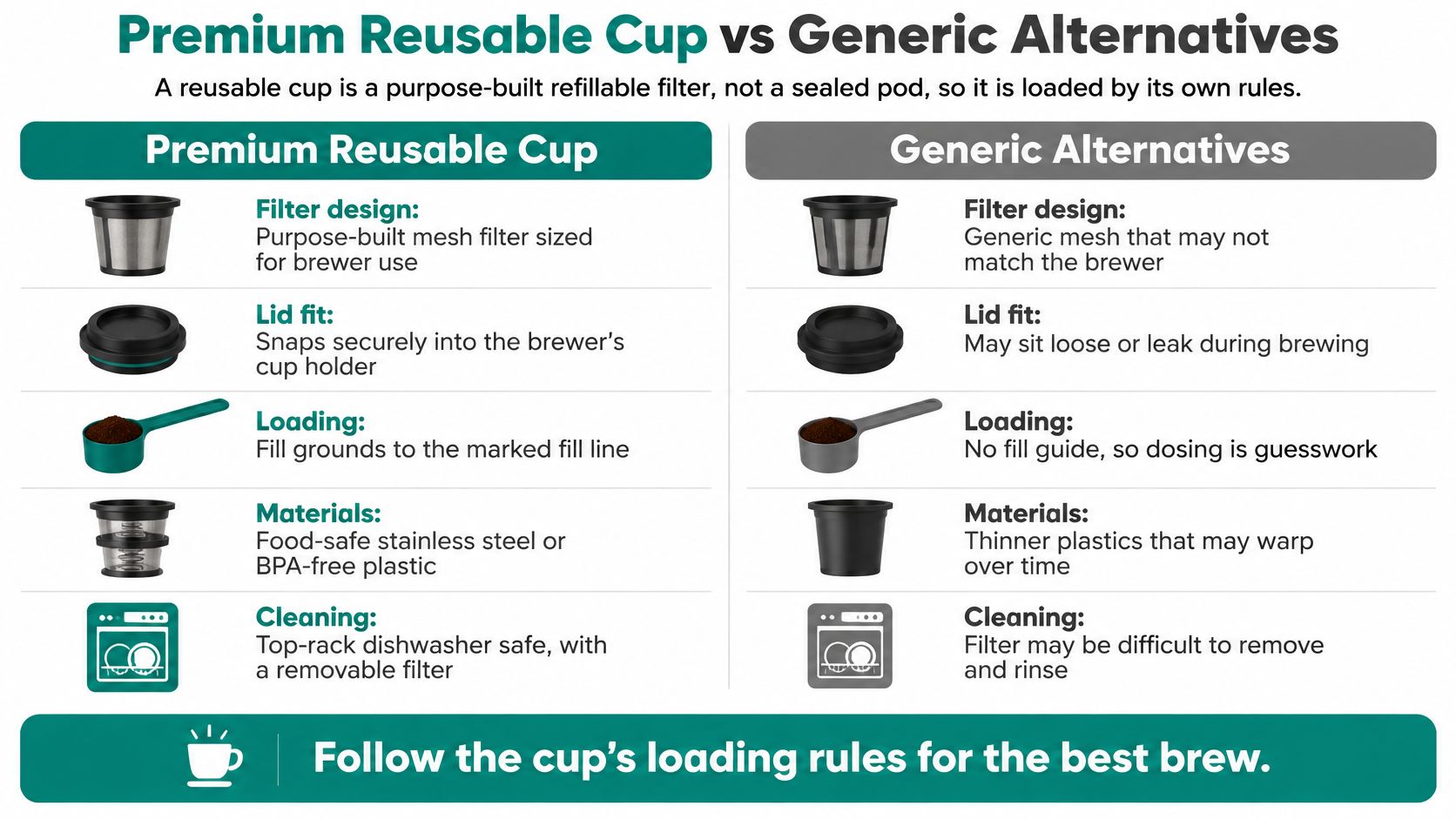
Use the comparison to check what a seller actually confirms, rather than treating “premium” or “universal” as proof of fit. A clear model list and practical care instructions tell you more than a material label alone.
Questions to Ask Before Buying
| Check | Ask the seller | What you can verify |
|---|---|---|
| Brewer match | Does the listing name your exact Keurig model? | Compare the model with the brewer manual and the product's fit list. |
| Water entry | Is the lid designed for your brewer's needle arrangement? | Check that the product instructions identify the compatible brewer family. |
| Grounds and lid | How should the lid close, and what grounds or coffee type does the maker recommend? | Follow the instructions; do not force the lid shut. |
| Filter construction | What is the filter made of, and can you inspect the mesh? | Look for a clear material description and an intact, accessible filter. |
| Fill guidance | Where is the maximum fill line? | Follow the marked limit rather than guessing from the cup's capacity. |
| Cleaning | What cleaning steps does the maker specify? | Choose instructions you can follow after each brew. |
| Reuse | Does the seller explain how to check the cup for wear? | Inspect the lid, mesh, and fit as you continue using it. |
A listing that names a material but not compatible brewer models leaves the key question unanswered. Ask for the exact model match and the maker's instructions before buying. PureHQ is one source of Keurig reusable-cup products; its mention here does not establish that any particular cup fits your brewer or produces better coffee.
Convenience is part of the comparison, too. A cup that takes extra effort to fill, rinse, or clean may be a poor everyday choice even if its stated material appeals to you. Check the seller's care directions and consider whether they fit your routine. The ownership trade-off is repeated handling and cleaning, not just the price of a single pod.
The demonstration below shows how a refillable cup is handled differently from a sealed pod. Use it to understand the format, then rely on the product's model-specific instructions to assess fit.
This comparison does not establish that one material or design tastes better. That would require side-by-side testing with the same grind, dose, and brewer settings. Until then, buy on confirmed model fit and workable upkeep, not an unsupported flavor promise.
Why Leaks and Weak Coffee Happen and How to Fix Them
Most buyers raise the same objection after switching. The cup leaks, or the coffee tastes thin. Those symptoms usually point to water resistance and seating, not to a mysterious brewer fault.
PureHQ's reusable cup brewing guidance explains that overfilling or an excessively fine grind increases resistance, slows flow, and can cause overflow or grounds in the beverage. The opposite error also hurts. A coarse grind or an underfilled basket reduces contact time and weakens extraction.
What Bypass Means in Practice
Poor seating, missed needles, damaged screens, and incorrect sealing cause bypass, where water skips part of the grounds. The coffee bed never gets evenly wetted, so the cup tastes hollow even when you've used enough coffee. That's why changing the dose alone won't fix a badly seated cup.
A reusable cup can sit in the holder and still miss the water path your brewer was built to use.
Start with four corrections and change one thing at a time. Keep grounds below the maximum fill line, use a medium grind, avoid tamping, and rinse the filter immediately after brewing. Prompt rinsing matters because coffee oils left in the mesh build up and interfere with later flow and flavor.
Symptoms Causes and Fixes
| Symptom | Likely cause | Fix |
|---|---|---|
| Weak or hollow coffee | Coarse grind, underfilled basket or wrong needle pattern | Use a medium grind, fill below the line and confirm the model match |
| Grounds in the cup | Poor seating, damaged screen or lid bypass | Reseat the cup, check the screen and lid holes, replace a damaged part |
| Leaking or overflow | Overfilled basket or very fine grind raising resistance | Fill below the maximum line and switch to a medium grind |
| Handle will not close | Incompatible filter or lid | Stop, do not force it, and use a cup built for the brewer model |
| Off or oily flavor | Coffee oils left in the mesh | Rinse the filter immediately after each brew |
Work through the table in order of safety first. A handle that won't close is a compatibility signal, not a technique problem. A leak with a closing handle points next to fill level, grind, seating, and screen condition.
There's an evidence limit here. The guidance cited in this article doesn't provide controlled laboratory extraction-yield or flow-rate benchmarks. Any claim of better flavor or measured savings for a particular cup should be checked through standardized side-by-side testing rather than treated as settled performance data.
Cleaning and Descaling Schedule to Follow
A reusable cup needs cleaning after every brew. The brewer needs separate upkeep: rinsing the cup clears grounds and oils, while descaling removes mineral deposits inside the machine. Follow the interval for your specific brewer when its guide provides one.
Keurig's official descaling guidance recommends descaling many brewers every three to six months. The K-Express guide specifies a maintenance alert after every 250 brews. Follow that alert for a K-Express rather than applying a calendar interval. The K-Mini Go Use & Care Guide calls for descaling every three months or when its notification turns on. For other supported models, use the model guide or brewer alert; if neither gives a specific interval, use Keurig's general guidance. Scale can build faster under some water conditions.
The Schedule in One Place
| Task | Frequency | Applies to |
|---|---|---|
| Rinse the reusable cup filter | After every brew | Reusable cups, to clear grounds and coffee oils |
| Hand-wash reservoir, reservoir lid and drip tray | Weekly, with warm, soapy water | K-Mini Go |
| Use a rinse pod to reduce flavor carryover | Weekly, following the pod instructions | K-Mini Go maintenance guidance |
| Replace supported water filter | Every 2 months, where the model guide specifies | Supported models; check the brewer guide |
| Descale the brewer | Every 3 months or when its notification turns on | K-Mini Go |
| Descale the brewer | After every 250 brews, when the alert appears | K-Express |
| Descale the brewer | Every 3 to 6 months | Many Keurig brewers without a more specific model interval |
The K-Mini Go guide specifies weekly hand-washing for the reservoir, reservoir lid and drip tray. It also includes weekly rinse-pod use to help reduce flavor carryover. A rinse pod cleans the brewer's internal water path; it is separate from rinsing a reusable cup filter after brewing. Use the pod as directed, and do not treat that step as a substitute for washing the cup.
Keurig recommends replacing water filters every two months on supported models. The interval is not established here as a K-Mini Go requirement, so check whether your brewer uses a filter and follow its guide for replacement. Where a model alert or manual gives a different descaling interval from the general range, follow the model-specific instruction.
For the cup itself, follow the step-by-step guide to cleaning reusable coffee pods and rinse the filter after each brew. Keep the cup routine separate from machine maintenance. A clean filter does not remove scale from internal parts, and a descale cycle does not clear coffee grounds from the cup.
When a Reusable Cup Actually Saves Money
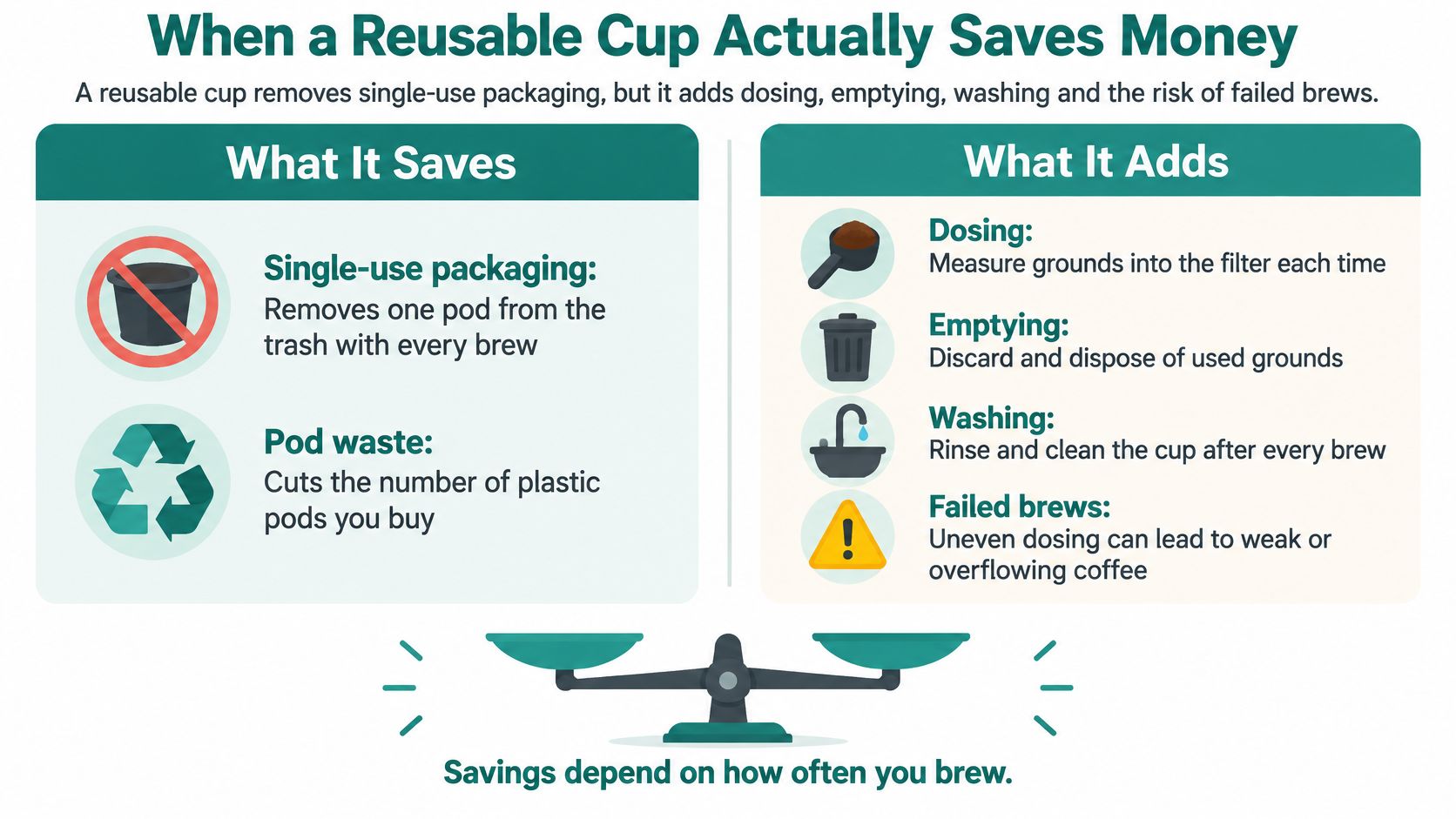
A reusable cup saves money when the cost of the grounds, cleanup time, and occasional failed brew stays below the disposable pods it replaces. More weekly brews make it easier to recover the cup's purchase cost, but only if you keep using it. True ownership cost includes dosing, emptying, washing, and drying, not just the price of one pod.
A life-cycle assessment of reusable stainless-steel capsules for a different capsule design reported more than 1,000 uses, an average 5.2-gram fill, and 0.1 grams of coffee waste per charge. Those figures do not establish the lifespan or waste level of a Keurig reusable cup. The assessment also notes extra work for dosing, emptying, and cleaning. A cup left unused after a few messy brews cannot save money or packaging.
The comparison below shows the trade-off: reusable cups avoid single-use packaging, while each brew adds handling and cleanup.
Work Out Your Own Break-Even
- Price the disposable cup. Divide the pod-pack price by the number of cups in the pack.
- Price the coffee you load. Multiply your coffee price per gram by the amount you use in the reusable cup.
- Value your time. Add the time spent dosing, emptying, washing, and drying, using an hourly value you consider fair.
- Include failed brews. Count wasted coffee, repeat brews, and any replacement cup bought during your trial.
Your break-even point arrives when the disposable-pod cost you avoid exceeds the reusable cup's purchase price plus its added coffee, time, and failure costs. There is no single threshold that fits every household: pod and coffee prices, cup use, and cleanup habits change the result. Use your receipts and routine to calculate the number of brews needed. For a worked calculation, see the guide to saving money with reusable K-Cups for Keurig, then replace its example inputs with your own.
| Usage profile | Illustrative cups per week | Reusable cup pays off when | Main cost to watch |
|---|---|---|---|
| Occasional drinker | 4 | The avoided pod cost covers coffee, cleanup time, and the cup over repeated use | Labor per cup and wasted grounds |
| Heavy home user | 14 | Regular use keeps the cumulative avoided pod cost above added costs | Cleaning time and any replacement cup |
| Small office break room | 35 | The group shares the avoided pod cost and assigns cleanup | Descaling and filter costs shared across users |
These weekly counts are examples for comparison, not measured usage or guaranteed savings. Occasional drinkers have fewer brews to spread the cup's purchase cost across, so cleanup can outweigh the savings. Frequent home use is more likely to reach break-even when the cup fits and the routine is manageable. A shared brewer can also pay off when users share the costs and someone takes responsibility for upkeep.
A poor fit can push the break-even point further away. Failed brews waste coffee, water, and time, and may lead to brewing a replacement cup. Choose a cup that matches your brewer and keep using it; consistent use is what turns avoided disposable pods into savings.
Choose the Cup That Matches Your Situation
Single-needle owners should buy the cup built for the single-stream lid and puncture, then run the fit check covered above. Don't pay extra for a MultiStream claim your brewer can't use. Your decision rests on named model compatibility, a free-draining mesh, and a seal you can test with water before loading coffee.
That fit check is quick once you know the exact model. Seat the empty cup, close the handle without force, and run water only. If the handle resists or water drips at the lid, return to the model listing instead of adjusting the grind to compensate for a hardware mismatch.
MultiStream Owners and Shared Brewers
MultiStream owners should treat the five-point lid as a must-have and match the exact variant name. Series-level wording isn't enough when one family name covers different water-entry designs. Recheck the manual statement for your model, especially where the manufacturer names a specific reusable filter design.
Small offices should choose for the routine, not only the cup. Pick a design your team can rinse immediately, assign cleaning and descaling to one person, and post the schedule near the brewer. Shared use multiplies both the avoided disposable pods and the mess when nobody owns the cleanup.
- Single-stream home brewer: Prioritize the named model match and easy rinsing.
- MultiStream home brewer: Prioritize the five-hole lid and exact variant listing.
- Small office: Prioritize an assigned cleaning owner and shared maintenance costs.
The decision rule stays the same in every case. Match the model first, then compare material, capacity, cleaning, and value. Reversing that order produces the familiar result, a durable cup that brews badly in the machine you own.
Buy the reusable K-Cup listed for your exact Keurig model, then run the water-only test before your first coffee. Check the model listing against the name on your brewer base before adding the cup to your cart. That final check prevents most leaks, weak brews, and returns.
PureHQ Inc. offers reusable K-Cups, water filters, descaling solutions, and cleaning accessories for Keurig owners who want to brew their own ground coffee with a model-matched setup. Check your exact brewer model against the product listing, choose the single-stream or MultiStream design your machine requires, and shop the reusable cup through PureHQ Inc..

