
Coffee Machine Care
Decaf French Roast Coffee: Flavor, Brewing, and Buying Guide
Oct
An 8-ounce cup of decaf can still contain approximately 2–15 milligrams of caffeine, according to reporting that cites FDA guidance on decaffeinated coffee. That's enough to challenge the assumption that an evening mug of decaf French roast coffee is automatically caffeine-free.
The other trap is confusing a dark taste with a low caffeine content. You might buy the smokiest bag on the shelf, pack it into a reusable pod, and end up with a bitter cup without learning anything useful about its remaining caffeine. My recommendation is simple: choose the decaffeination process for caffeine control, the roast for flavor, and the pod setup for brewing consistency.
What Decaf French Roast Coffee Actually Means
Decaf describes caffeine reduction, not complete elimination. The U.S. threshold requires manufacturers to remove at least 97% of the beans' original caffeine before marketing the coffee as decaffeinated, as explained in this overview of how decaf coffee is produced. A percentage reduction doesn't promise an identical caffeine dose from every bag or every brewed cup.
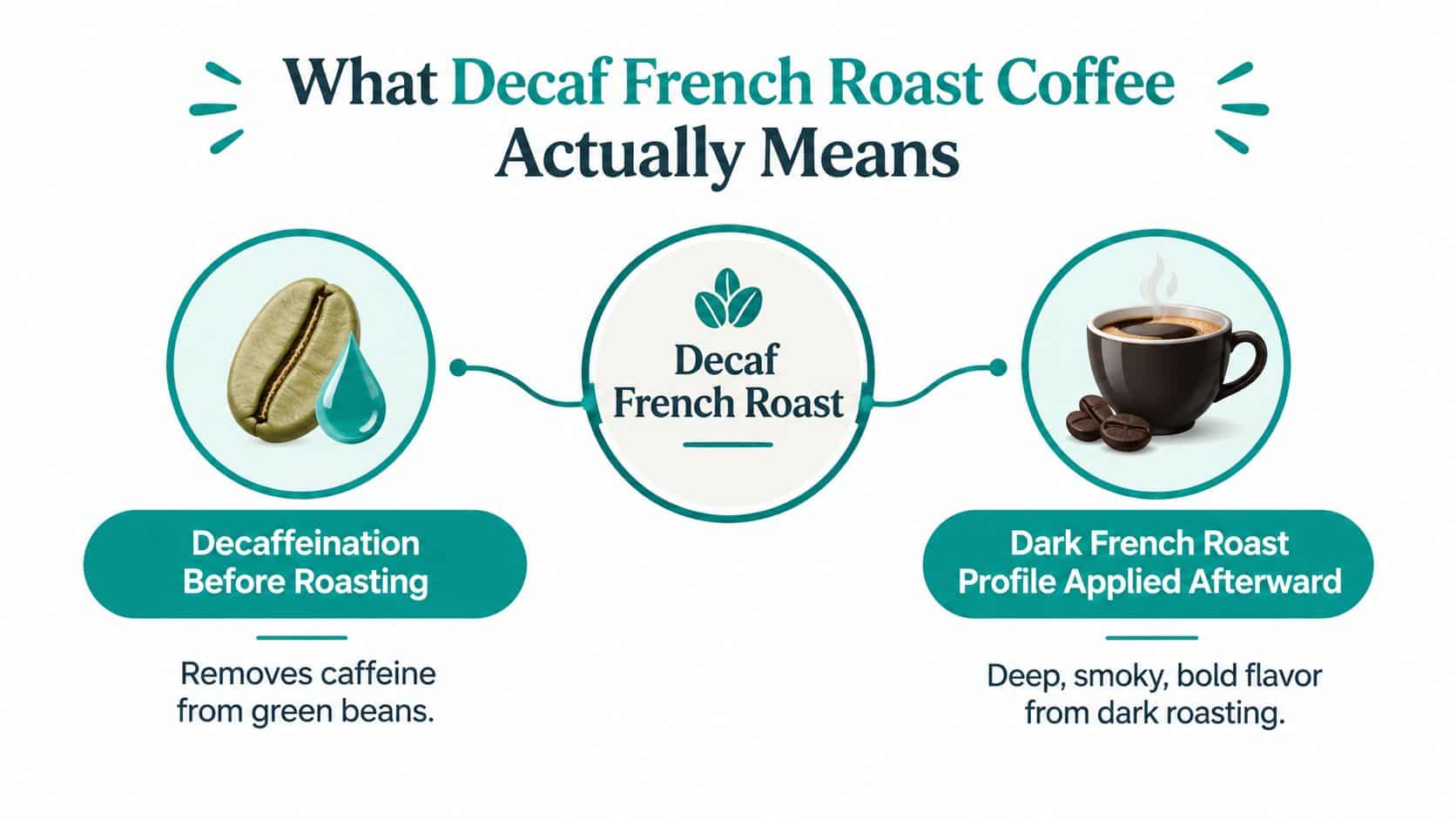
French roast describes a different production decision. The processor removes caffeine from green beans first, and the roaster applies the dark profile afterward. You're buying coffee with both a caffeine-removal history and a roast style, not a special roasting technique that somehow burns away all the caffeine.
The distinction looks like this:
Read the bag as separate decisions
When I evaluate a bag, I want its label to answer different questions:
- Caffeine reduction: Does the seller identify the decaffeination process or provide product-specific caffeine information?
- Flavor direction: Does the roast description match the smoky, heavily roasted cup I want?
- Brewing suitability: Can I buy whole beans or a grind that works with my brewer instead of forcing an unsuitable grind into a pod?
Don't let bold packaging substitute for those answers. A dark bean tells you about its roasting history, not the exact caffeine content of your next mug.
Buying rule: Treat “decaf” as a reduction claim and “French roast” as a flavor choice.
For evening drinking, that distinction helps you make a deliberate decision rather than relying on the word decaf alone. If you're pregnant, highly caffeine-sensitive, or following medical advice about caffeine, ask your clinician how residual caffeine fits your circumstances. Ask the manufacturer for information about the specific coffee, too.
Decaf French roast isn't caffeine-free by definition. It's coffee whose producer reduced caffeine before the roaster developed its dark flavor.
How Decaf French Roast Is Made Step by Step
The production chain starts with ordinary, unroasted green coffee. Processors hydrate the beans so they can remove caffeine before roasting, using solvent extraction, water-based processing, or supercritical carbon dioxide, as documented in the history and commercial methods of decaffeination.
That history includes German coffee merchant Ludwig Roselius, who developed the first commercially successful process around 1905 after observing the effects of seawater on coffee beans. His method used benzene, which is no longer used because it's recognized as a carcinogen. Chemist Kurt Zosel patented supercritical carbon dioxide decaffeination in 1970, while the Swiss Water Process entered commercial use during the 1970s, as the same historical account explains.
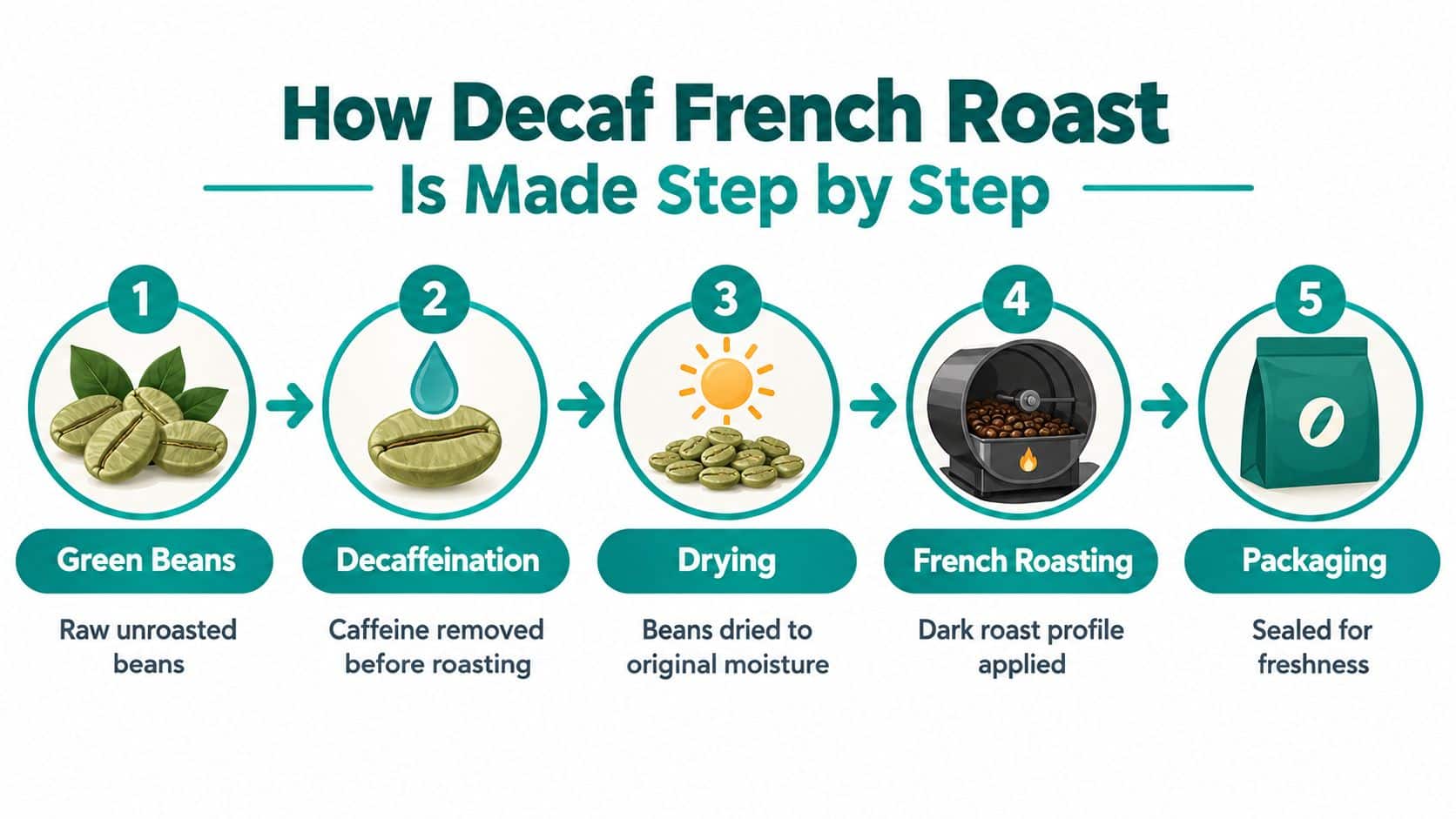
The production sequence separates caffeine removal from flavor development:
From green beans to a dark roast
- Start with green coffee: The processor works on beans that haven't yet developed roasted coffee flavor.
- Remove caffeine: The chosen process extracts most caffeine before the roaster receives the coffee.
- Prepare for roasting: The production sequence includes drying between decaffeination and roasting.
- Develop the French roast: The roaster applies the dark profile.
- Protect the finished coffee: Packaging prepares the roasted coffee for storage and sale.
Traditional French roast profiles commonly reach approximately 465–470°F, producing advanced dark roasting and intense smoky character, as described in Scientific American's explanation of decaffeinated coffee. That roasting stage matters enormously to the eventual cup.
Decaffeination doesn't remove every compound in the same way. Controlled roasting work distinguishes comparatively unchanged chlorogenic acids after decaffeination from their later degradation under substantial heat; it also found caffeine comparatively thermally stable, as summarized in research on decaffeination and roasting chemistry.
My practical takeaway is that you shouldn't judge the process in isolation. The processor and roaster perform different jobs, and a successful bag needs both jobs done well. A desirable process label can't rescue roasting that tastes excessively burnt to you.
The Flavor Profile You Can Actually Expect
I'd approach a decaf French roast expecting smoke and roast intensity, then look for something enjoyable underneath them. Dark chocolate, charred wood, and toasted nuts are useful tasting comparisons, not ingredients or guaranteed notes on every bag. Use them to describe your cup rather than assuming the label promises them.
The chemistry explains why the cup tends away from bright, delicate flavors. Research found that summed caffeoylquinic acids declined from approximately 4,661–4,946 milligrams per 100 grams in green coffee to approximately 234–377 milligrams per 100 grams at darker roast levels, as reported in research on coffee composition across roast degrees. That work connects greater roast intensity with lower chlorogenic-acid concentration.
Smoke should leave room for enjoyment
My quality test isn't whether a coffee tastes dark enough. It's whether I want another sip.
Some drinkers perceive less sweetness or body after decaffeination. A strong roast profile can make that coffee feel more satisfying, but I wouldn't accept a dry, hollow cup just because someone calls it bold.
- Look for balance: A smoky finish can be enjoyable when you can still identify sweetness or a rounded mouthfeel.
- Question harshness: A lingering, mouth-drying finish is a reason to adjust brewing before blaming the beans.
- Reject empty intensity: If the cup tastes burnt and watery at the same time, don't mistake that combination for strength.
A good dark roast should give you something to enjoy besides evidence that the beans got hot.
Compare bags without changing the brew
Taste candidate bags using the same brewer, coffee dose, water, and cup setting. Try them without additions first, then with the milk or sweetener you normally use. Write down whether each cup feels smoky, sweet, thin, or drying instead of reaching for elaborate tasting vocabulary.
Use this guide to making coffee taste better to organize adjustments rather than changing everything at once. My recommendation is to buy the bag that tastes satisfying in your everyday setup, not the one with the most impressive flavor description.
Decaf French Roast vs Regular French Roast
Choose regular French roast when you want coffee without deliberately selecting caffeine reduction. Choose decaf French roast when you want the dark-roast experience while reducing caffeine intake. Neither choice earns extra points for being more serious coffee.
The roast name alone won't tell you which bag has better body, freshness, or balance. Compare the actual products rather than assuming regular coffee must taste fuller.
Decaf French Roast vs Regular French Roast
| Attribute | Decaf French Roast | Regular French Roast |
|---|---|---|
| Caffeine per cup | Reduced, but not eliminated; the exact amount needs product and brewing information | Not deliberately decaffeinated; the roast label doesn't provide an exact amount |
| Flavor intensity | Choose it for the dark profile, then judge the brewed cup | Choose it for the same roast preference, not presumed superiority |
| Body | Evaluate the specific bag and brewing setup | Evaluate it under matching brewing conditions |
| Acidity | Don't confuse a softer-tasting cup with caffeine absence | Don't infer caffeine content from perceived brightness |
| Best use case | A dark-roast routine with intentional caffeine reduction | A dark-roast routine without that reduction requirement |
“Decaf always tastes stale” is an objection I'd challenge before buying another bag. Air, heat, light, and moisture degrade ground coffee, and coffee storage guidance recommends an opaque, airtight container at room temperature. That guidance places freshly opened or freshly ground coffee's typical peak freshness at about 1–2 weeks under suitable conditions.
Premium versus generic is a separate comparison
I'd pay more for useful information and a coffee I prefer, not a premium label. A standard bag with transparent process details and appropriate packaging deserves consideration.
| Buying criterion | Premium option worth considering | Standard or generic alternative |
|---|---|---|
| Process transparency | Clearly identifies how the coffee was decaffeinated | Ask the seller if the package doesn't say |
| Freshness information | Gives you a usable basis for judging freshness | Don't treat a best-by date as a roast date |
| Brew suitability | Offers a suitable grind or whole-bean choice | Check the grind before committing |
| Value | Earns the extra cost through your taste test | Wins when it delivers the cup you prefer |
My advice is to fix storage and brewing before deciding you need a pricier coffee. A premium purchase should solve an identifiable problem.
Brewing Tips for Keurig and Reusable Pods
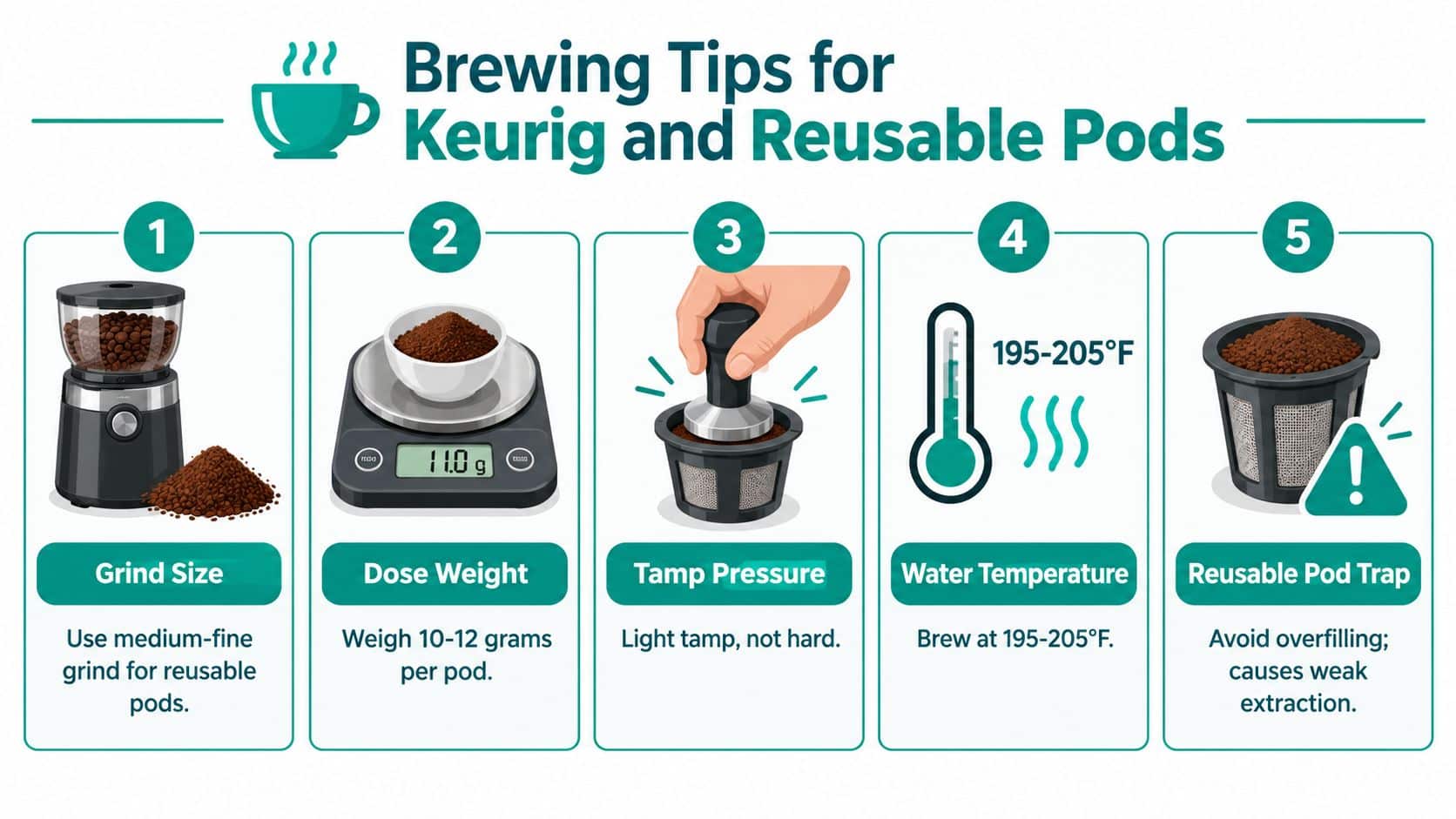
A reusable pod isn't an espresso basket. Don't borrow the habit of hard tamping and assume it belongs in your Keurig routine. For dark-roasted decaf, I'd start with a loose, consistent fill and adjust the grind before trying to force more coffee into the pod.
The visual checklist highlights the variables to watch. Treat its numerical settings as illustrations, not universal specifications, and follow your pod and brewer's operating instructions.
Adjust the grind before increasing the dose
Research comparing roast levels and particle sizes reported coffee caffeine concentrations of 1.30–1.53 grams per 100 grams, with dark roast and coarse grind at the lower end and light roast and fine grind at the higher end. The researchers connected finer particles with greater extraction efficiency in this study of roasting and grinding effects. Those measurements aren't caffeine estimates for your decaf pod, but they show why grind deserves attention.
Try this practical sequence:
- Grind slightly coarser: If supermarket pre-ground coffee produces a drying cup, compare it with a coarser grind.
- Keep the fill consistent: Use a scale if you have one, or the same level scoop each time. Stay within the pod manufacturer's capacity.
- Skip the hard tamp: Level the grounds gently rather than compressing them into a dense puck.
- Test a smaller cup setting: If your coffee tastes diluted, compare a smaller brew using the same fill.
- Adjust temperature if available: Try a lower setting when the cup tastes harsh, and change nothing else during that comparison.
For selecting grounds rather than troubleshooting blindly, consult this guide to ground coffee for Keurig brewers.
Check fit before blaming the coffee
If you're worried about leaks or compatibility, verify your exact machine model against the reusable pod's compatibility list. Don't assume a pod that fits one Keurig also fits another, and don't force a lid closed over excess grounds.
Consider paper liners specified for your reusable pod, plus a compatible water filter or descaling product when maintenance is due. Choose accessories by documented fit and follow their instructions rather than improvising.
Watch the reusable-pod setup in operation before changing your routine:
Troubleshooting priority: Change the grind, fill, or cup setting individually so you can identify what helped.
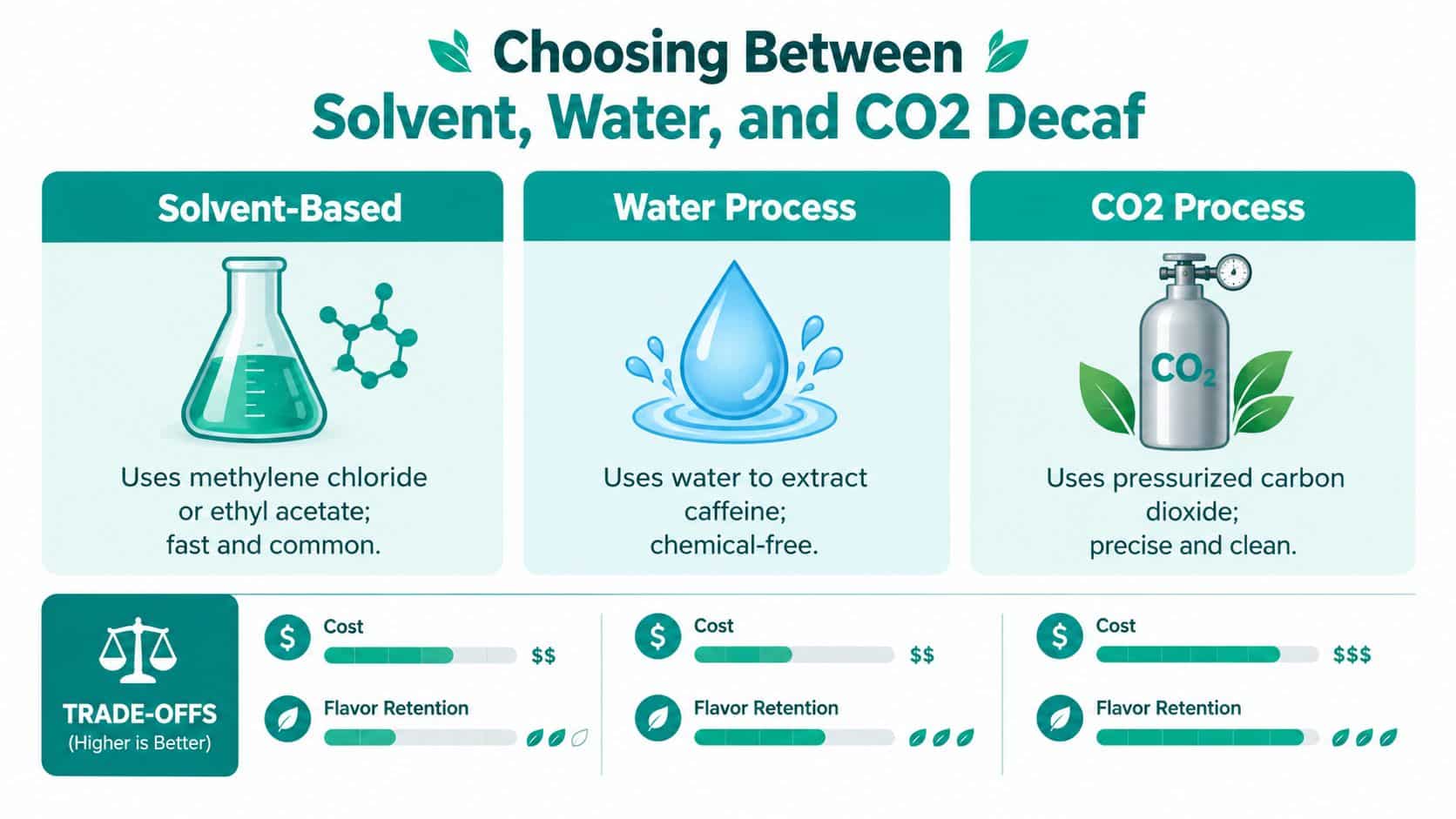
Choosing Between Solvent Water and CO2 Decaf
Pick a process that matches your priorities, but don't confuse a process preference with proof of better flavor or lower environmental impact. Solvent, water, and supercritical carbon dioxide processing are distinct commercial pathways, as discussed in a life-cycle assessment of coffee decaffeination.
The comparison is useful, but simplified labels need interpretation:
Read beyond the marketing shorthand
Solvent-based processing includes methods using methylene chloride or ethyl acetate. Don't reject a coffee solely because its label names a solvent, and don't accept it solely because the seller uses reassuring natural-language marketing. Ask what process the product uses.
Water-based processing, including the Swiss Water Process, is worth considering when avoiding added extraction solvents is your purchasing priority. But chemical-free is poor shorthand: it doesn't explain the whole process, establish the finished coffee's taste, or prove a smaller environmental footprint.
For supercritical CO2, I'd make the same distinction between method and outcome. A premium-positioned process name isn't enough reason to pay more without useful product information or a cup you prefer.
Match the method to your reason for buying
| Your priority | What I'd check | What I wouldn't assume |
|---|---|---|
| Flavor | Taste under matching brewing conditions | One method always tastes best |
| Processing preference | The named extraction method | “Natural” explains everything |
| Environmental impact | Process-specific supporting evidence | No added solvent means lower impact |
| Budget | The product's price and your taste test | A premium process guarantees value |
Methods can differ in energy demand, cost, flavor retention, and availability. Those trade-offs make blanket rankings less useful than clear disclosure.
My shopping order is process, origin, then roast date. Process addresses your extraction preference, origin tells you what coffee you're considering, and the date helps you judge the purchase against your routine. If a seller can't explain the process, choose another seller rather than filling the information gap with assumptions.
Does Dark Roast Really Mean Less Caffeine
Dark roast is a weak caffeine-control strategy. The sensible question isn't whether a smoky cup feels less stimulating. It's whether the coffee underwent verified decaffeination and what your brewing routine puts into the cup.
Published findings don't support a simple rule that darker always means less caffeine. A 2024 quantitative study reported more caffeine in espresso made from light- and medium-roasted beans than from dark-roasted beans, while another analysis found slight caffeine increases across city, French, and Italian roasts, as discussed in research examining roast level and caffeine measurements.
Similar labels don't mean identical servings
Those findings aren't a reason to ignore research. They're a reason to pay attention to how researchers measured coffee and prepared the drink.
Bean density, dosing by mass versus volume, grind size, brewing method, and extraction yield can all affect the comparison. A scoop-based recipe and a weighed recipe don't necessarily compare coffees on the same basis.
- For caffeine management: Prefer product-specific manufacturer or laboratory information over assumptions about roast color.
- For repeatability: Keep your coffee dose and brewing setup consistent.
- For interpretation: Distinguish caffeine concentration in coffee from total caffeine in the beverage you drink.
The strong taste is a sensory experience, not a caffeine meter. Don't use bitterness as a way to estimate stimulation.
Compare serving sizes honestly
An 8-ounce mug and a 12-ounce mug are useful examples, but the larger cup doesn't automatically contain a predictable extra caffeine dose. If you pour both from brewed coffee with the same concentration, the larger serving contains more total caffeine. If your machine instead pushes more water through the same grounds, that's a different extraction situation.
I wouldn't manufacture an exact estimate from the cup setting alone. You need the coffee's caffeine information and a defined preparation method to make that calculation meaningful.
Better question: Which process reduced the caffeine, and how much of this coffee am I actually brewing?
Choose decaf because you want deliberate caffeine reduction. Then control the serving and preparation instead of expecting a darker roast to perform a second caffeine-removal job.
How to Pick a Quality Bag and Brew It Well
Buy coffee with enough information to support your decision. I'd rather choose a clearly described bag that suits my brewer than an expensive mystery bag covered in reassuring adjectives.
Use this guide to coffee bean quality to sharpen your buying criteria, then keep the final decision practical. Your everyday cup matters more than a label's prestige.
Use a short buying checklist
- Check the process: Find the named decaffeination method, especially if processing is your main concern.
- Look for freshness information: Prefer a stated roast date when available, and remember that a best-by date serves a different purpose.
- Choose manageable quantities: Buy an amount that fits your drinking routine instead of leaving a large opened bag beside the brewer.
- Match the format: Choose whole beans when you want grind control, or ground coffee suited to your equipment.
- Plan storage: Use an opaque, airtight container at room temperature, away from heat, light, and moisture.
For a contrasting shopping reference, Saporia's Equal Exchange organic coffee 200g gives you another product listing to examine. Don't substitute it for decaf French roast without checking its caffeine status and roast description.
Let the brewed cup make the final decision
Brew the new bag with your established setup before adjusting anything. If it tastes thin, harsh, or flat, change one brewing variable and compare the result.
My final filter is straightforward: clear process information, sensible freshness practices, compatible equipment, and a cup you enjoy. Keep the bag that passes those checks, and stop paying extra for claims that don't improve your decision.
PureHQ Inc. offers reusable K-Cups, paper liners, water filters, and descaling accessories for a more consistent home coffee routine. Visit PureHQ Inc. to shop reusable K-Cups and matching maintenance accessories, checking your machine's compatibility before ordering for your daily decaf French roast brew.

