
Coffee Machine Care
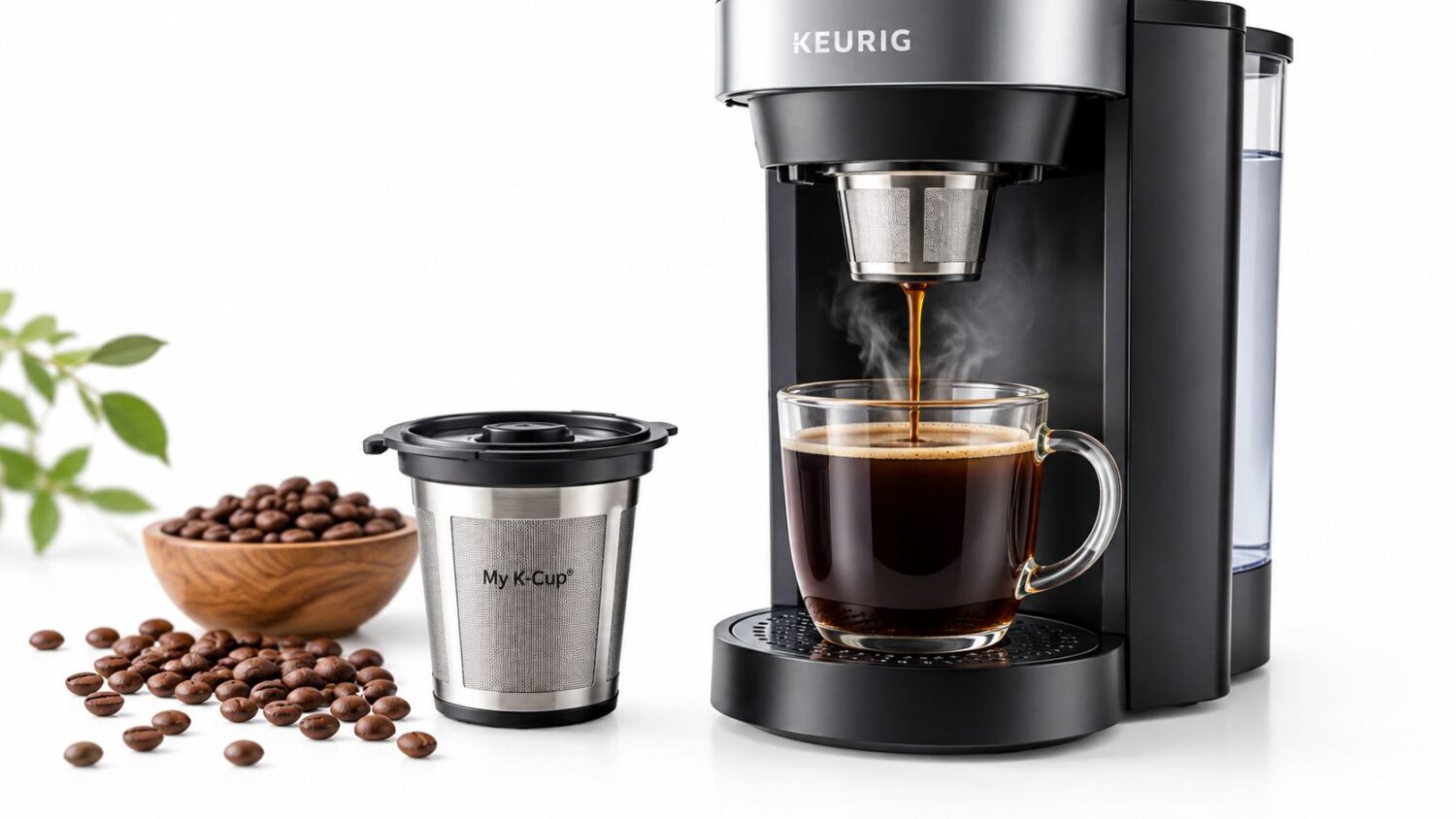
Universal My K Cup Reusable Coffee Filter
Oct
A reusable coffee filter can remove a disposable pod from every brew, but “universal” doesn't mean universally good. Around 56 billion coffee pods reach landfills each year, according to Earth911's overview of coffee-pod waste, while only about 6–9% of plastics are recycled in the United States. The sustainability case is clear, but a filter that sits incorrectly, drains too slowly, or produces thin coffee won't deliver a practical improvement.
The buying decision has three parts: physical compatibility, brewing performance, and maintenance. A universal My K-Cup reusable coffee filter must match the brewer's lid and needle geometry, hold a permeable coffee bed, and stay clean enough to maintain reliable flow. The sections below separate those issues instead of treating “fits my Keurig” as the end of the evaluation.
Why a Universal My K-Cup Reusable Filter Matters
Single-serve coffee creates a waste problem that a recyclable label doesn't solve by itself. Earth911 reports that coffee-capsule waste reaches approximately 576,000 metric tons globally each year, and estimates that about 56 billion pods go to landfills annually. Collection, sorting, and coffee contamination can keep technically recyclable polypropylene out of an actual recovery stream.
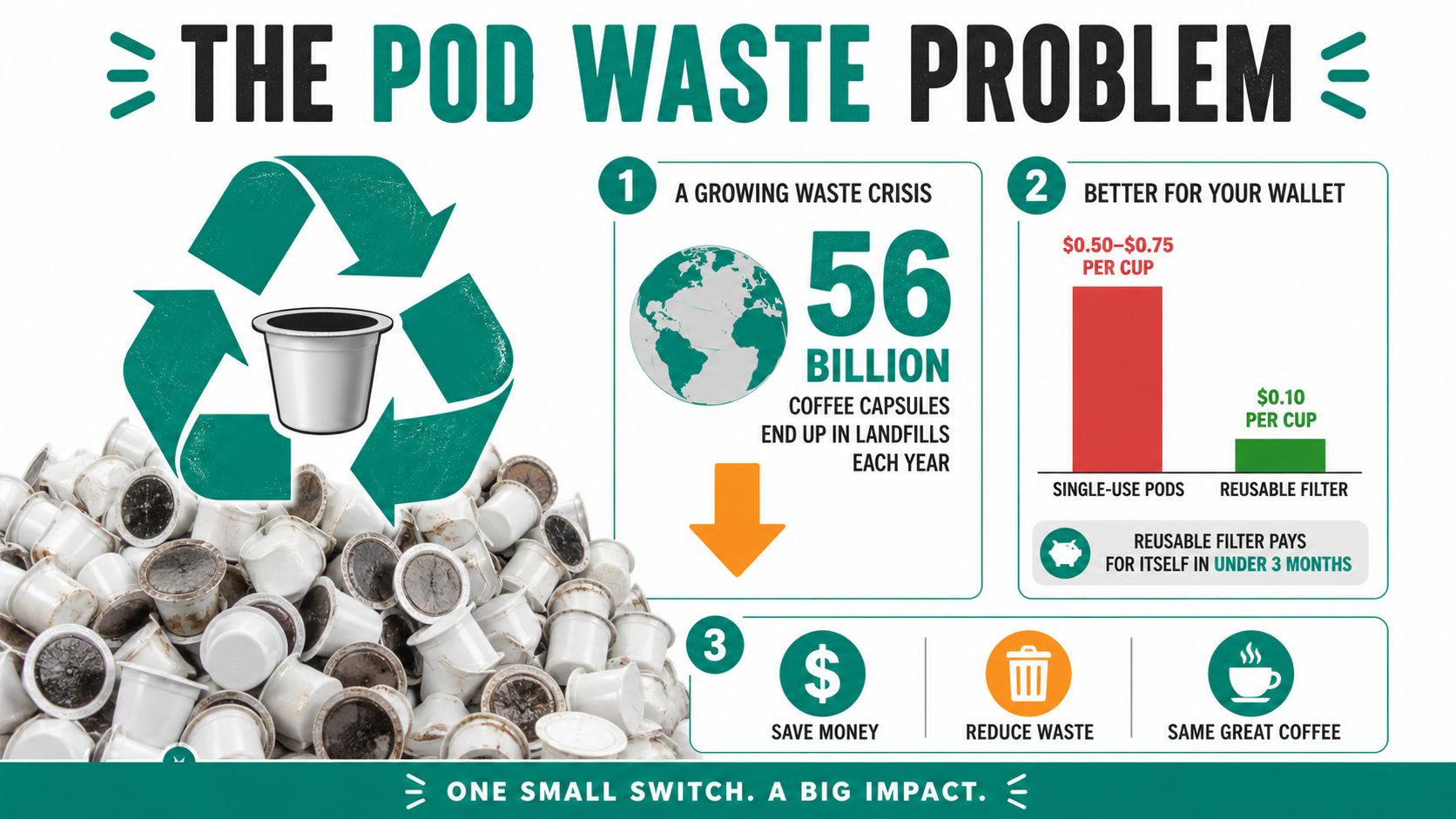
A durable refillable filter changes the material flow. Instead of discarding a pod after one drink, you add ground coffee to a washable basket, brew, empty the grounds, and rinse the filter. The environmental benefit depends on repeated use and proper cleaning, but the design removes the disposable capsule from the brewing step and leaves used coffee grounds as the primary recurring waste.
Practical rule: Treat “universal” as a compatibility claim, not a promise that every brewer will extract coffee identically.
That distinction matters because Keurig machines use different holder arrangements, puncture patterns, water paths, and brew timing. A filter can physically sit in a K-Supreme and still produce watery coffee if its lid doesn't align with the machine's entrance needles or if the coffee bed restricts the MultiStream flow. A generic basket can also fit a traditional K-Classic chamber while leaking or leaving grounds behind when moved to another brewer.
The useful question isn't whether a universal My K-Cup reusable coffee filter fits. Ask whether it seats safely, drains consistently, and produces a cup you can tune. The history of the format explains why that question became necessary.
The History Behind the Reusable K-Cup Format
Keurig and Green Mountain introduced the original My K-Cup reusable, refillable pod in late 2005, allowing users to fill the accessory with ground coffee from any brand. The product gave Keurig owners control over coffee selection while preserving the convenience of a single-serve brewer. It also established the basic format still used today, a removable basket, a lid, and a brewer-specific holder.
The format became more complicated when Keurig 2.0 launched in fall 2014. Keurig discontinued the original My K-Cup in August because the new system was designed not to accept it. Consumer backlash followed, and Keurig announced in May 2015 that My K-Cup would return with compatibility for 2.0 brewers. That interruption showed buyers that a reusable filter's shape and lid aren't interchangeable details. They form part of the brewer interface.
Why the word universal appeared
The broader K-Cup platform began commercially in 1998, and Keurig's original K-Cup patent expired in 2012, according to the Keurig history overview. Those milestones helped open the market to compatible pod designs, third-party filters, and refillable alternatives.
Modern “universal” branding responds to that fragmented history. It generally signals cross-generation compatibility within supported home-brewer families, not a guarantee that one basket works in every Keurig or Ninja machine. A filter designed for an older single-needle brewer may not align with a newer MultiStream brew head, even if the basket looks nearly identical.
What buyers should take from the timeline
The important lesson is simple: compatibility changed when Keurig changed the brewer platform. Older My K-Cup versions may fail in newer machines, and a generic filter may copy the basket shape without reproducing the required lid geometry.
That's why a buyer should verify the exact brewer model and inspect the filter's lid before brewing. The word universal narrows the search, but it doesn't eliminate the need to check the hardware.
Which Keurig and Ninja Models a Universal Filter Actually Fits
Start with the brewer family, then inspect the holder and lid. K-Classic and other traditional home brewers generally use a single-needle arrangement, while K-Supreme machines use a MultiStream design that distributes water through multiple entrance points. K-Slim, K-Duo, and Ninja DualBrew configurations can require closer attention because model generation and holder setup affect how the filter sits.
For a broader model-by-model reference, use this reusable K-Cup compatibility guide. It helps distinguish the brewer family from the filter format, which prevents a common mistake: buying a pod based only on its basket diameter.
The five-hole check for K-Supreme SMART
Keurig's K-Supreme SMART care guide states that the brewer accepts only the newly designed My K-Cup Universal Reusable Coffee Filter and warns that older versions or other reusable filters may damage the machine. The correct filter lid has five holes, matching the brewer's multiple entrance needles.
That physical marker matters more than a product title. An older lid or generic pod may appear to fit the basket but fail to close, brew, or align safely. Never force the handle shut. If resistance appears, remove the filter and verify the model, holder, adapter, and lid arrangement.
Compatibility by brewer family
| Brewer family | Universal fit | Key fit note | Common symptom if forced |
|---|---|---|---|
| K-Classic | Generally supported for the appropriate home-brewer format | Traditional single-needle setup | Leaks or grounds if the basket sits unevenly |
| Keurig 2.0 | Some models require the correct Universal configuration | Verify the holder and adapter arrangement | The brewer may fail to close or brew |
| K-Supreme and K-Supreme SMART | Requires the newly designed Universal filter | Look for the five-hole lid | Misalignment, weak flow, or machine damage |
| K-Slim | Confirm the exact model and holder seating | Compact hardware leaves less room for error | Weak coffee or a lid that won't close |
| K-Duo, including Gen 2 and Essentials | Model-dependent | Pod-holder and basket configurations can differ | Overflow or incorrect seating |
| Ninja DualBrew | Requires a compatible filter design and setup | Don't assume Keurig fit transfers automatically | Poor extraction or a blocked brew path |
Commercial brewers, K-Crema machines, and certain 2.0 models may remain unsupported. MultiStream and K-Duo systems can also change how water reaches the coffee bed, so a filter that physically seats may still need a different grind, fill level, or holder configuration.
Universal Filter vs Generic Alternatives
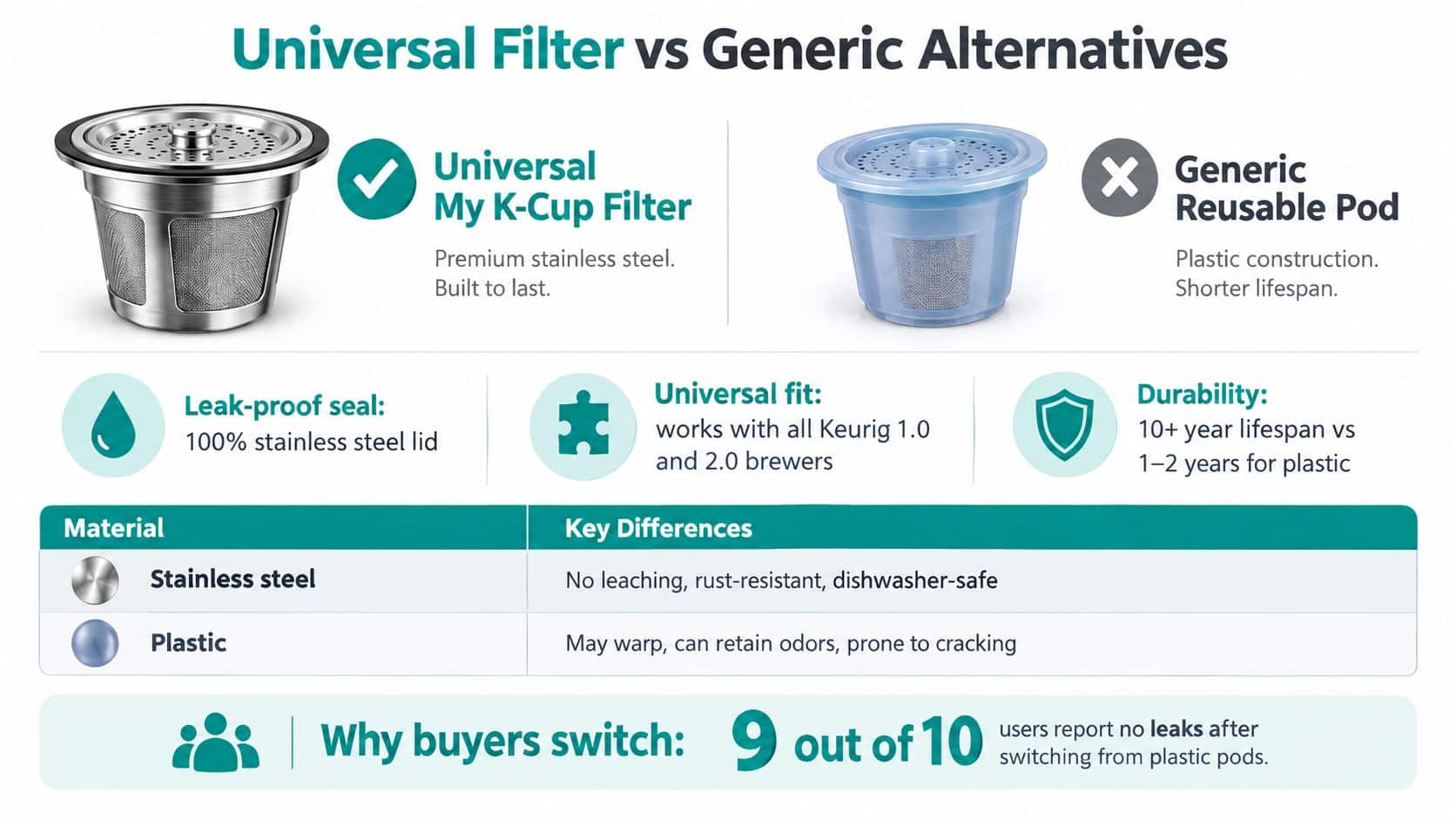
The most useful comparison isn't “stainless steel versus plastic” in isolation. It's engineered fit versus uncertain fit, followed by basket construction, lid security, and ease of cleaning. A stainless filter can be durable, but it still needs the correct lid geometry for the brewer. A plastic pod can be inexpensive, but a loose seal or thin mesh can turn a normal brew into a leaking, gritty cup.
Where generic pods usually fall short
Generic reusable pods vary in basket depth, lid fit, mesh, and sealing surfaces. A pod can enter the chamber but sit too high, miss the puncture path, or allow water to escape around the holder. Thin mesh can also retain fines and coffee oils, which slows drainage over time.
A stainless universal filter typically offers a rigid basket and a more stable cleaning surface. That doesn't make every stainless option compatible with every brewer. The product must still identify the relevant Keurig generation, MultiStream support, or Ninja configuration.
| Buying priority | Stainless universal filter | Generic plastic reusable pod |
|---|---|---|
| Fit | More predictable when the lid and holder match the brewer | Depends heavily on the listing and model details |
| Leakage risk | Lower when the seal and lid geometry are correct | Higher when the lid is loose or the pod sits too high |
| Cleaning | Rigid mesh can be rinsed and brushed | Thin screens and seams may retain residue |
| Durability | Resists the cracking associated with repeated handling better than thin plastic | Can deform or crack, depending on construction |
| Brewing consistency | Depends on grind, dose, and water path | Often changes when mesh or lid geometry varies |
The common objection is straightforward: “Why pay more when a cheap pod fits?” Because physical entry isn't the same as a safe, sealed brew. If the lid misses the entrance needles, the brewer can leak. If the basket restricts the flow path, the machine can drain slowly or overflow. A properly matched stainless filter addresses construction concerns, but the buyer still needs to verify the model.
For offices or frequent home use, a second filter can reduce the temptation to reuse a wet basket before it dries. Paper liners can also simplify cleanup for users who dislike brushing fine grounds from mesh. PureHQ's paper liners and descaling tablets are relevant accessories for that maintenance routine, although neither product compensates for an incompatible filter.
Grind Size, Dose, and Extraction for a Better Cup
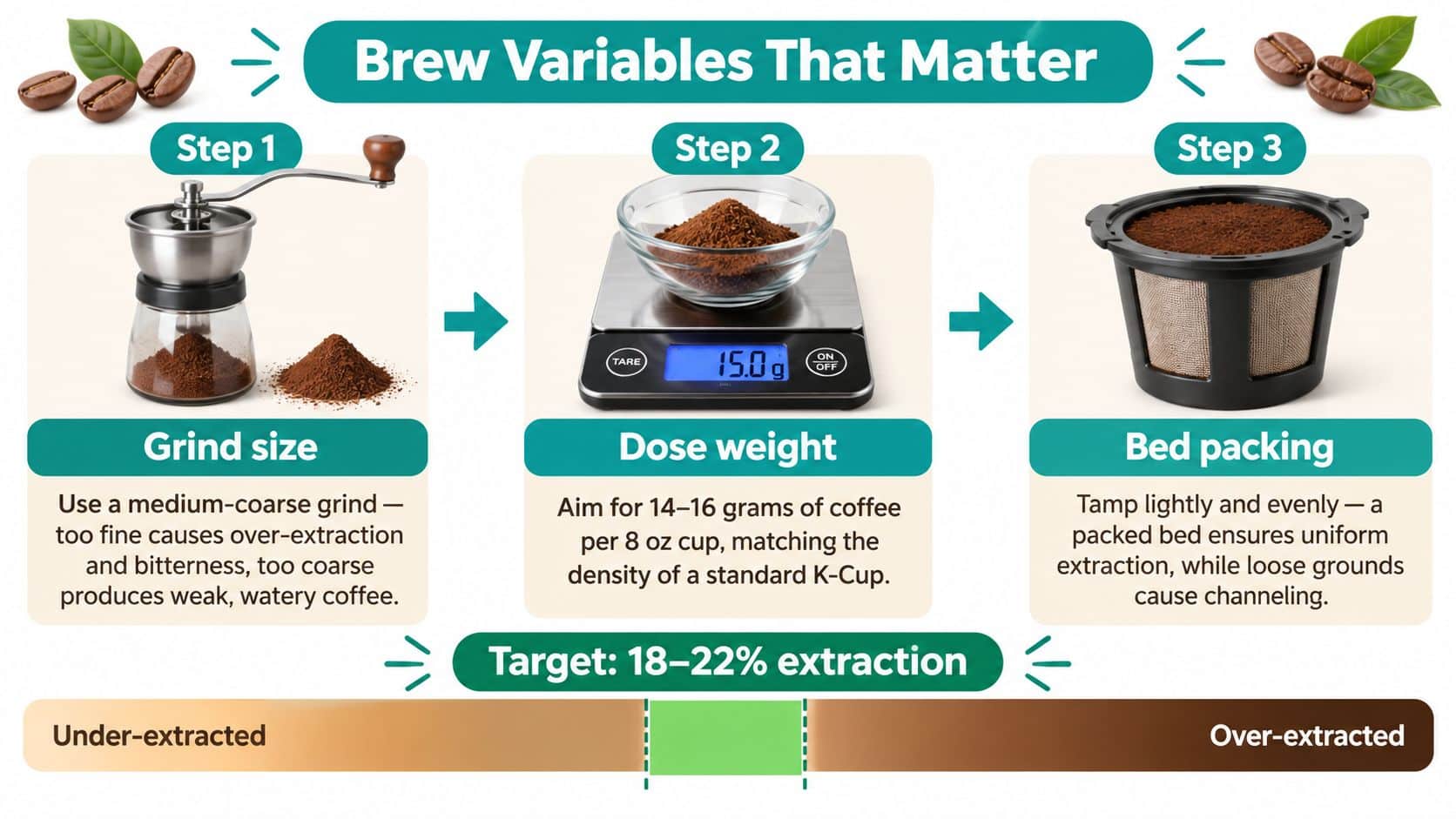
Reusable filters expose the coffee bed directly to the brewer's water path. That makes grind size, dose, and bed density the main controls behind the cup. Research on coffee-bed extraction found that smaller particles increase pressure drop, while fines can reduce permeability, slow flow, and extend contact time. Coarse grounds create the opposite problem, water passes quickly and can leave the drink thin.
Start with a permeable coffee bed
Use a medium to medium-fine grind as the baseline. Avoid espresso-fine coffee, especially in a MultiStream-compatible filter, because fines can block the mesh and make the brewer work against a dense bed. Avoid tamping. Level the grounds gently and leave headspace so they can swell without pressing against the lid.
A consistent dose matters because a deeper coffee bed raises hydraulic resistance. You don't need laboratory equipment to establish repeatability. Fill each brew to the same marked level, use the same brew-size setting, and change one variable at a time.
Brewing rule: Sour or watery coffee usually needs more contact or extraction. Bitter, astringent coffee or slow drainage usually needs less resistance.
The science supports that practical adjustment. A peer-reviewed model tested water temperatures from 4 to 93°C and median particle sizes from 139 to 1,747 micrometers, finding that higher temperature and smaller particles increased extraction during an initial fast phase followed by a slower phase. Keurig commercial documentation lists beverage temperatures of approximately 158–185°F, or 70–85°C, so grind and bed preparation are the more accessible controls for most users. The extraction findings are detailed in this peer-reviewed coffee-bed modeling study.
Use taste and flow as your diagnostic tools
If the cup tastes sour or watery and drains quickly, move slightly finer or select a smaller brew volume. If the coffee tastes bitter or astringent, or the machine drains slowly, move coarser, reduce the dose, or clear fines from the basket. If a brewer overflows, don't keep grinding finer. Check the mesh, needle, fill level, and lid first.
Anyone wanting deeper coffee fundamentals can explore how to become a barista for structured instruction on extraction and preparation. For a Keurig-specific loading routine, see how to use coffee grounds in a Keurig.
The key is to tune the filter to the machine, not to assume that one recipe transfers perfectly from a K-Classic to a K-Supreme or Ninja DualBrew. The water path changes the result even when the basket appears identical.
Cleaning, Maintenance, and Troubleshooting
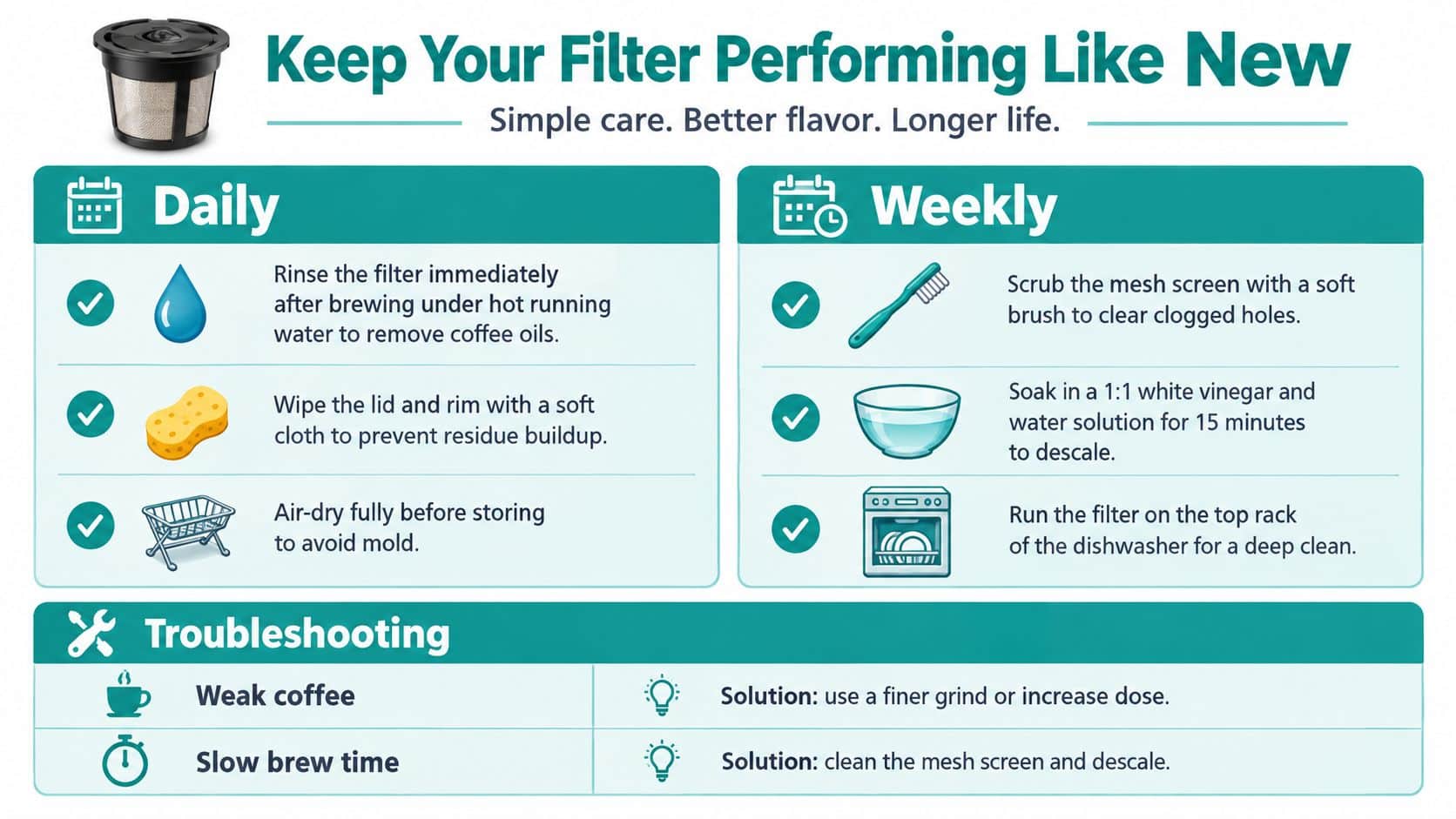
Coffee oils and fine particles accumulate where the brewer moves water, so rinsing the basket alone isn't enough. After brewing, empty the grounds, rinse the filter, and leave the lid open while the basket dries. Clean the lid rim and holder as well, because residue on those surfaces can interfere with seating.
Keurig's K-Supreme care guidance instructs users to rinse the drip tray and water reservoir regularly or as part of daily cleaning. It also directs users to clear grounds from the entrance needles with a straightened paper clip before running a cleansing brew. The pod holder and funnel must both be installed for brewing.
A maintenance routine that prevents most failures
- After every brew: Tap out the grounds, rinse the basket under running water, and inspect the mesh for trapped fines.
- During regular machine care: Rinse the reservoir and drip tray, then check that the holder and funnel remain installed.
- When flow changes: Wash the filter with mild detergent and use a soft brush on the mesh. Clear the entrance needles before testing another cup.
- After deep cleaning: Run a cleansing brew with no coffee so loosened residue doesn't remain in the water path.
PureHQ's descaling tablets and cleaning tablets can support routine machine care, particularly when mineral buildup or stale oils affect flavor. They should complement, not replace, immediate rinsing of the reusable basket.
Match the symptom to the mechanical cause
| Symptom | Likely cause | Fastest fix |
|---|---|---|
| Overflow | Clogged entrance needle, blocked mesh, overly fine grind, or heavy dose | Clear the needle, rinse the mesh, then use a coarser grind or less coffee |
| Grounds in the cup | Damaged mesh, torn seal, overfilled basket, or excessive fines | Inspect the basket, stay below the fill line, and replace damaged parts |
| Weak coffee | Coarse grind, low dose, or excessive brew volume | Use a slightly finer grind, a consistent fill, or a smaller brew setting |
| Slow brew | Coffee oils, fines, mineral buildup, or excessive bed resistance | Clean the mesh, check the needle, and descale the machine |
| Handle won't close | Wrong lid, missing holder configuration, or filter sitting too high | Remove the filter and verify the exact model setup |
The fastest troubleshooting order is fit, holder, cleanliness, grind, then dose. Changing coffee first can hide a mechanical problem, especially when a filter suddenly begins overflowing after months of normal use.
The Real Case for Going Reusable and Where to Start
A reusable filter offers a credible way to reduce disposable pod waste, but it shouldn't be sold as a guarantee of zero plastic exposure. A 2025 capsule-coffee study examined three home machines and detected 7–17 synthetic microplastic particles per cup. Researchers also traced some particles to machine components, with the oldest machine producing the highest result, as reported in this summary of the microplastics research.
That evidence separates three questions. A reusable filter can reduce pod-derived plastic, but it doesn't prove that every machine component is particle-free. Material labels such as stainless steel or BPA-free also don't establish zero migration under brewing conditions. Owners of older machines should inspect aging tubing, tanks, seals, and filter parts, replace damaged components, and keep mineral buildup under control.
For practical buying, follow this order:
- Confirm the exact brewer model and supported holder configuration.
- Match the filter lid to the machine, including the five-hole design required by K-Supreme SMART.
- Start with a medium grind, a moderate fill, no tamping, and the same brew size for each test.
- Keep a spare liner or filter available if daily cleaning interrupts your routine.
- Use a descaler and regular needle cleaning when flow or flavor changes.
The broader reusable coffee pods guide covers the operating trade-offs. For most home and small-office users, the strongest case is control: you choose the coffee and reduce disposable-capsule use without giving up the convenience of a Keurig-style brewer.
PureHQ Inc. offers universal and stainless reusable K-Cup filters, compatible options for Keurig and Ninja brewing systems, paper liners, water filters, descaling solutions, and cleaning tablets. Visit PureHQ Inc. to match a reusable filter to your brewer and shop the maintenance accessories that keep the basket, needles, and water path working cleanly.

