
Coffee Machine Care
Charcoal Water Filter Replacement Guide for Better Coffee
Sep
You fill the brewer, press start, and expect the same dependable cup. Instead, the coffee tastes flat, slightly bitter, or faintly like a swimming pool, even though the water in the reservoir looks perfectly clear. That's the frustrating part of charcoal water filter replacement: the cartridge can lose performance long before it looks dirty or stops water from flowing.
A reliable schedule depends on water volume, water quality, and the filter's rated capacity, not the calendar alone. The practical guide below covers the signs of exhaustion, device-specific replacement for Keurig brewers, pitchers, and under-sink units, plus the fit and leak details that separate a clean installation from a frustrating one.
Why Your Coffee Tastes Off Even When Water Looks Fine
The problem usually starts with a subtle flavor change. Your morning coffee still looks normal, the machine still fills its cup, and the water still runs at a familiar speed. Yet the brew tastes duller than it did a few weeks earlier, or a clean finish has turned harsh.
Activated charcoal helps by adsorbing chlorine compounds that affect taste and odor. The carbon doesn't act like a simple screen that visibly fills with debris. It provides sites that hold targeted compounds, and those sites are finite. Once the carbon reaches its adsorption capacity, chlorine can pass through even when the cartridge remains intact and water continues to flow. Nebraska Extension's filter-maintenance guidance also identifies taste, odor, flow, and sediment changes as useful replacement signals.
That hidden saturation explains why waiting for visible failure doesn't work well. A cartridge can look clean while its chlorine-reduction performance has declined. The returning taste may show up first in delicate light roasts, pour-over-style brews, or coffee made with a Keurig's smaller water volume, where unwanted flavor becomes more noticeable.
The practical takeaway: Clear water and normal flow don't prove that a charcoal cartridge is still performing.
Water chemistry adds another variable. Carbon mainly addresses chlorine, odor, and taste. Calcium control requires ion-exchange resin or a scale inhibitor, not carbon alone. If your machine operates with hard water, mineral deposits can affect the heating path even when chlorine flavor isn't obvious. A useful overview of broader filtration choices is available when you compare water filter options, especially if you're deciding between a coffee-maker cartridge, pitcher, or under-sink system.
The solution is a replacement plan based on actual use. Track the volume your household or office runs through the cartridge, account for hard or heavily chlorinated water, and treat changes in taste or flow as warnings rather than waiting for the filter to fail visibly. For a coffee-specific reference, see this guide to coffee maker water filter replacement.
How Often to Replace Charcoal Water Filters Without Guessing
The most useful starting point for small coffee systems is a two-month replacement baseline, but that date should act as a guardrail rather than a universal law. Independent guidance converges on common ranges of two to three months, four to eight weeks, or six to ten weeks, depending on hardness and brew volume. CoffeeFile's replacement schedule also identifies about 50 liters, around 13 gallons, of filtered water as a practical threshold, while another endpoint places normal replacement at 50 to 60 liters.
Use the first limit you reach. A low-use home brewer may reach the calendar limit before the volume limit. A busy breakroom can consume the cartridge's capacity sooner, particularly when the source water carries more chlorine or hardness.
Match the schedule to actual use
Estimate how much water passes through the filter each day. Include brewing, reservoir refills that use filtered water, and any water dispensed for tea or hot water. Then compare that estimate with the cartridge's published capacity. NSF's consumer guidance explains that service life may be stated in gallons or months, with the manufacturer's rated capacity serving as the key limit.
Hard water deserves a shorter interval because mineral conditions increase maintenance pressure on the machine. In harder-water regions, the practical replacement cycle can shrink to four to six weeks, as noted in the coffee-filter schedule above. Heavy office use can create the same result through volume alone.
Use a simple decision check
- Home brewer: Replace around the two-month mark unless the manufacturer gives a different rated capacity. Replace sooner if taste or flow changes.
- Small office brewer: Track refill frequency and don't rely on a household calendar. High daily volume can exhaust a cartridge earlier.
- Hard-water location: Choose a cartridge that states scale-control capability, then monitor the machine for slower heating or flow.
- Lightly used pitcher: Compare elapsed time with gallons used. A cartridge can sit in a damp environment while receiving little volume, so follow the product's instructions rather than assuming low use makes it indefinite.
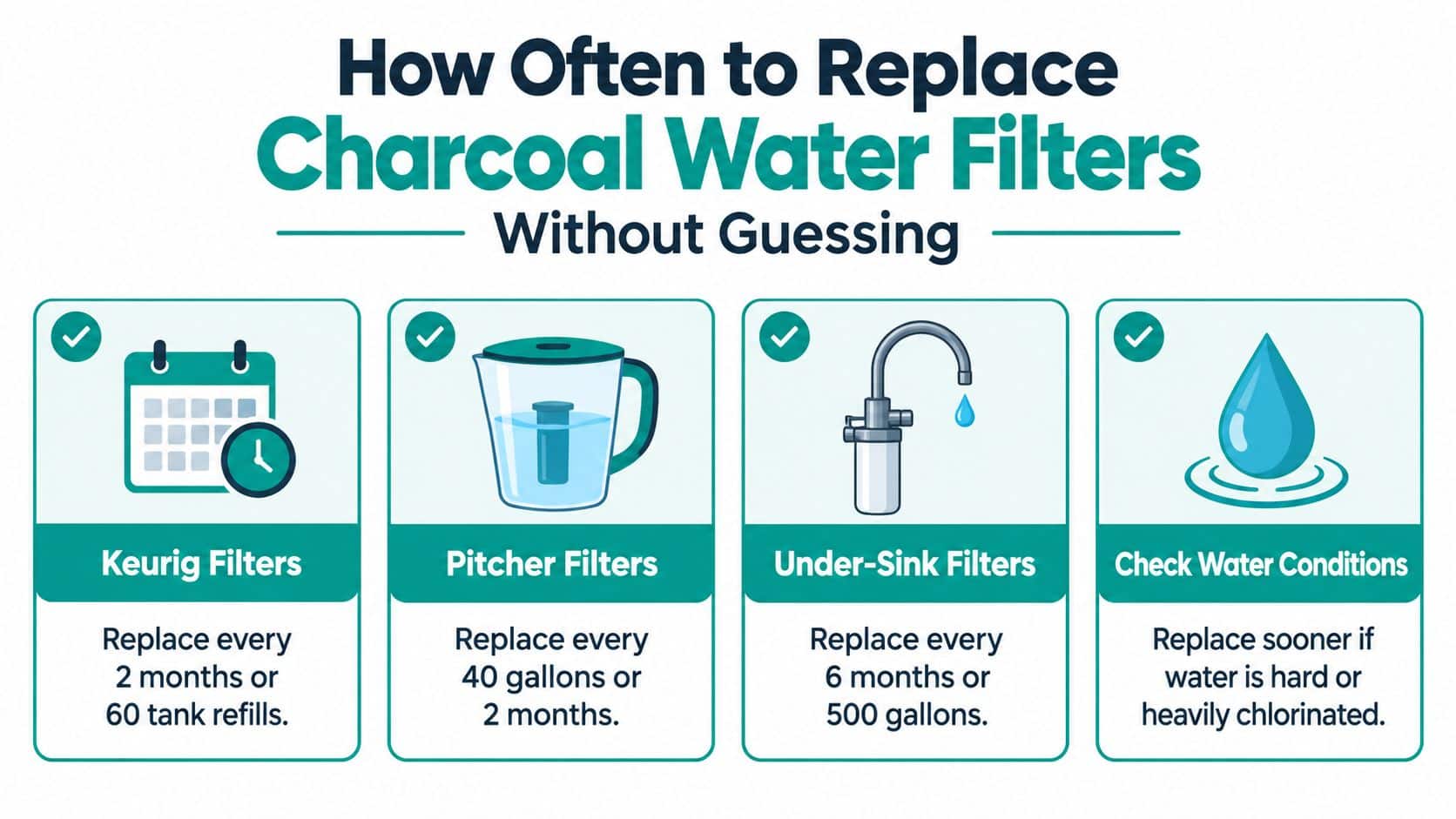
A peer-reviewed study of water-filter pitchers found product capacities ranging from 25 to 30 gallons up to 150 gallons, which reinforces the need to follow the specific cartridge specification instead of applying one generic schedule to every filter. The published pitcher-filter study provides that model-specific context.
For larger granular activated carbon and carbon-block systems, industry guidance often places replacement in a six-to-twelve-month window, while smaller coffee and pitcher cartridges commonly require more frequent changes. Neutral cartridge guidance from SpringsV describes that distinction and points to returning chlorine taste or reduced chlorine removal as end-of-life indicators.
Replacing Charcoal Filters in Keurig Pitchers and Under Sink Units
Good charcoal water filter replacement depends less on force and more on preparation. A cartridge that sits slightly crooked, traps air, or releases carbon fines can create the exact problems you were trying to solve, including weak flow and an odd first cup.
Keurig filter holders
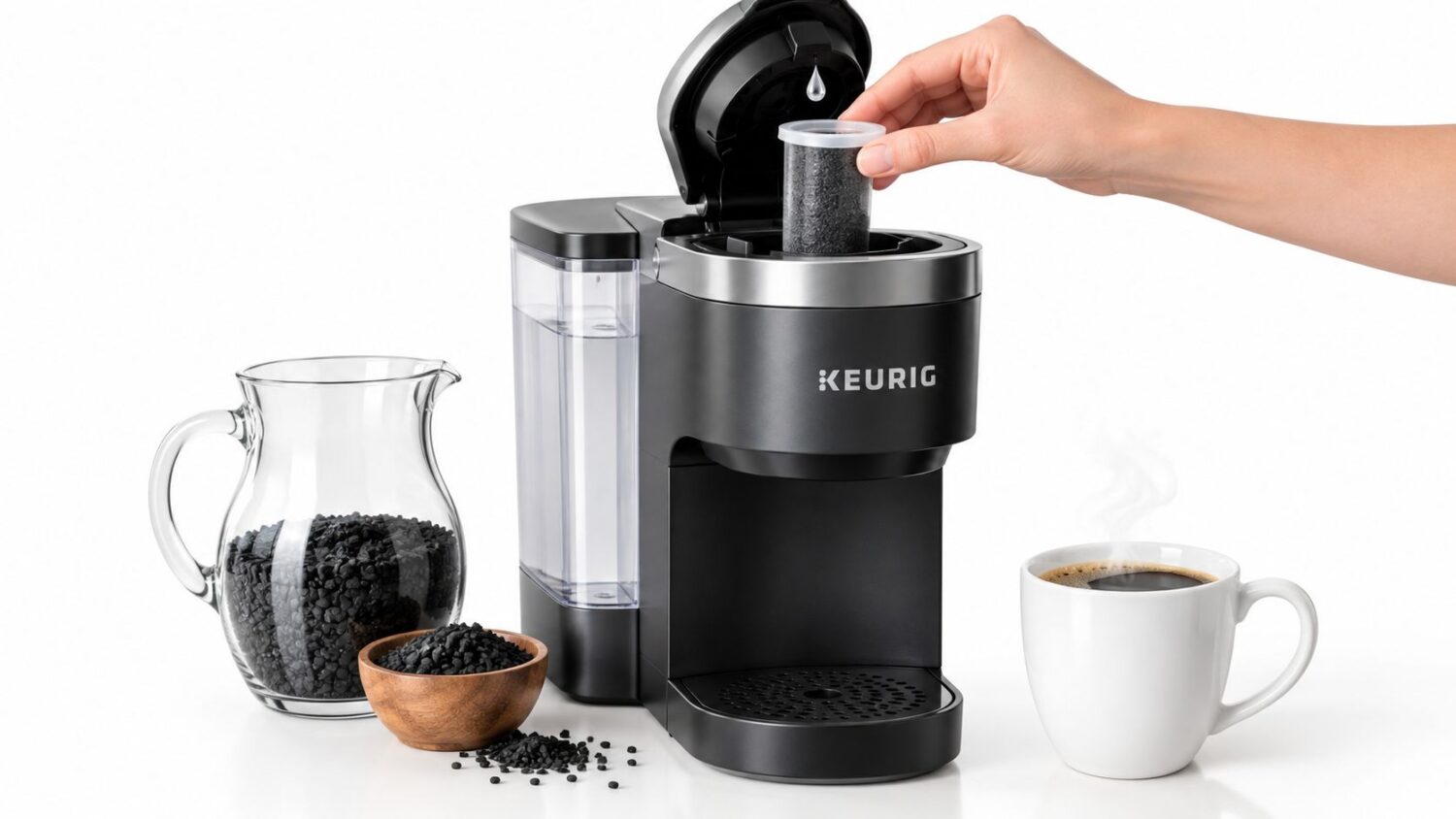
Remove the filter holder from the reservoir and separate the old cartridge from its lower support. Rinse the new charcoal cartridge under cold water, then soak it in clean cold water for five minutes if the product instructions call for that preparation. The soak wets the media before installation and helps reduce trapped air.
Place the cartridge into the holder and make sure the support locks into position. The holder must sit fully in the reservoir's designated slot. A loose fit can allow the cartridge to move, while an incompletely seated holder can restrict water entry.
Run several reservoir cycles through the machine before brewing coffee. This flushes loose carbon dust and air from the cartridge. If the first water appears gray or tastes dusty, keep flushing rather than trying to mask the problem with coffee.
Pitcher cartridges
Remove the old filter and wash the pitcher components with the care recommended by the manufacturer. Rinse and soak the replacement cartridge, then press it into the filter opening until it sits evenly. The cartridge shouldn't rock, float, or leave a visible gap around its sealing surface.
Fill the pitcher with cold water and discard the first filtered batches according to the cartridge instructions. A slow initial drip often reflects trapped air, but persistent restriction usually points to poor seating, an unprepared cartridge, or a cartridge that doesn't match the pitcher.
Under-sink housings
Turn off the supply valve before opening the housing, then release pressure through the connected faucet. Remove the old cartridge, check the housing seal, and install the replacement in the correct orientation. A damaged or displaced O-ring can cause leaks even when the cartridge itself fits.
Reassemble the housing by hand and open the supply slowly. Inspect the connections while the system pressurizes, then flush the cartridge before using the water for coffee. For a broader installation reference, use this guide to water filter installation.
Pro tip: If flow remains weak after flushing, remove and reseat the cartridge before buying another one. Air and an uneven seal cause more “bad filter” complaints than many owners realize.
Clean handling matters around coffee equipment. Moisture and residue inside neglected components can create hygiene concerns, so this overview of coffee maker bacteria health risks is useful alongside regular cleaning.
Premium vs Generic Charcoal Filters and What Really Matters
A premium cartridge isn't automatically better because its packaging looks more polished. The meaningful differences are documented media, certification, capacity, scale-control claims, and physical fit.
NSF/ANSI 42 is the relevant benchmark for aesthetic chlorine reduction. One certified replacement cartridge claims 99% chlorine reduction under IAPMO and NSF-related certification language, as shown in Home Depot's product documentation. Look for the certification statement and the exact model compatibility rather than assuming that every black carbon cartridge performs identically.
Premium vs Generic Charcoal Water Filters Compared
| Feature | Premium Filter | Generic Alternative |
|---|---|---|
| Chlorine reduction | Clearly stated performance claims and certification details where available | May list “activated carbon” without a specific certification |
| Media | Often combines coconut-shell activated carbon with ion-exchange resin | May rely mainly on carbon, with limited scale-control information |
| Scale protection | Explicit scale-inhibitor or resin capability can support hard-water use | Carbon-only designs may not address calcium deposition |
| Fit | Designed around named brewer and holder dimensions | Fit can vary across batches and models |
| Leak resistance | Correct seating and compatible seals reduce movement and bypass | A loose or imperfect fit can create bypass, drips, or low flow |
| Durability information | Product specifications explain intended use and replacement timing | Capacity and service-life details may be unclear |
PureHQ Inc. offers compatible activated charcoal replacement options and coffee-machine accessories for systems including K-Classic, K-Supreme, K-Slim, K-Duo, and compatible Ninja DualBrew models. Compatibility still requires checking the exact holder and brewer version before ordering. A filter can be well made and still be wrong for a particular housing.
The common objection is, “Will it leak?” A cartridge normally doesn't create a leak by itself. Leaks usually result from an incorrect holder, a displaced seal, a housing that wasn't fully tightened, or a cartridge that doesn't sit at the intended height. For more detail on the role of carbon in chlorine reduction, see this explanation of water filters that remove chlorine.
Pro Tips to Keep Water Fresh and Coffee Flavor Bright
The best replacement routine starts before installation. Rinse every new cartridge as directed, soak it in cold water when required, and flush the system before brewing. That small amount of preparation removes loose carbon fines and reduces the chance that your first cup tastes dusty or metallic.
Store spare cartridges sealed in a clean, dry place away from heat and strong odors. Don't leave unused cartridges sitting in standing water. Once a cartridge is installed, write the installation date on the holder, housing, or package so you can compare elapsed time with your volume estimate.
Use filtered water during descaling cycles when the machine instructions allow it. Filtering doesn't replace descaling, because carbon primarily addresses chlorine and taste while scale control depends on resin or inhibitors. Descaling solution and cleaning tablets remain separate maintenance items, and pairing them with fresh filtration helps address both water quality and residue inside the brew path.
PureHQ Inc. sells universal descaling solutions and cleaning tablets alongside coffee-machine filters, while reusable K-Cup accessories can help owners use ground coffee with less disposable waste. Choose accessories that match your brewer and cleaning routine rather than adding products that don't solve an observed maintenance problem.
Useful maintenance beats impressive maintenance: Replace the cartridge on a defensible schedule, flush it properly, and descale when the machine requires it.
That approach protects flavor without turning coffee care into a complicated ritual. It also gives you useful evidence when something changes, because you'll know whether the filter is new, whether the system was flushed, and how much water has passed through it.
Troubleshooting Common Issues and Your Next Brew
A new cartridge can produce gray water, a dusty taste, or weak flow immediately after installation. Carbon fines and trapped air usually cause those symptoms, so remove the cartridge, rinse or soak it as directed, reseat it firmly, and flush additional water before brewing.
If flow stays low, inspect the holder, inlet, housing seal, and cartridge orientation. A compatible cartridge should sit securely, and an under-sink housing should pressurize without dripping. Persistent chlorine taste means the cartridge may be exhausted, incorrectly installed, or not designed for the water condition.
A descale light may remain active after a filter change because filtration and descaling perform different jobs. The filter addresses chlorine and related taste concerns, while descaling removes mineral buildup according to the machine's maintenance system.
Replace again when you reach the cartridge's rated capacity, the recommended service interval, or a clear change in taste, odor, flow, or sediment. Don't wait for visible failure when the manufacturer has already defined the cartridge's limit.
PureHQ offers charcoal filter replacements and coffee-machine maintenance accessories for compatible Keurig, Ninja DualBrew, Cuisinart, and other home-brewing setups. Match the filter to your exact model, flush it before use, and visit PureHQ Inc. to shop the right replacement for your next better-tasting brew.

