
Coffee Machine Care
K Cup Filters Made in USA: Your Complete Buying Guide
Sep
A reusable K-Cup filter can look like a simple plastic cup with a mesh bottom, but the category sits inside a much larger waste stream. Global coffee capsule waste is estimated at about 576,000 metric tons annually, and one source estimates that roughly 29,000 pods are discarded every minute worldwide (Earth.org's overview of coffee capsule waste). That scale changes the buying question. You're not only choosing between a cheap accessory and a premium one. You're choosing how reliably one small filter will fit, brew, clean, and survive repeated use.
The phrase K-Cup filters made in USA can help narrow the search, but country of origin alone doesn't guarantee better coffee. The useful details are hidden in the construction: food-contact materials, mesh structure, lid geometry, gasket design, manufacturing transparency, and compatibility with your specific Keurig generation. This guide separates those details from vague marketplace language so you can buy a filter that works in your machine and keeps working after the novelty wears off.
Why the Origin of Your K-Cup Filter Actually Matters
The original Keurig platform began in Massachusetts in 1992, its first brewing system reached offices in 1998, and a home-use brewer arrived in 2004. Keurig launched the reusable and refillable My K-Cup pod in late 2005, creating an early domestic baseline for the reusable K-Cup filter category (Keurig history). The sequence matters because reusable filters developed alongside the shift from office brewing to widespread home use, not as an unrelated accessory category.
That history also explains why shoppers now face a crowded marketplace. The U.S. coffee pod and capsule market was projected to reach $10.1 billion by 2028, compared with $8.4 billion in 2021, according to market context reported by CNBC. A reader searching an Amazon page can easily find dozens of filters that claim to be universal, leakproof, durable, or American-made, often without enough information to verify what those words mean.
The failure usually appears after the first few brews
The cheapest reusable pod may work on day one and still disappoint you later. A thin shell can retain a plastic taste, a seam can split after repeated hot-water cycles, and a lid that sits slightly too high can interfere with the brewer's puncture mechanism. Those failures cost more than the listed purchase price because they waste coffee, interrupt your morning, and can leave grounds or water in places that are difficult to clean.
A filter's quality compounds through use. The mesh controls how quickly water moves through the grounds. The lid and gasket control the seal. The polymer controls how the cup handles repeated heat and washing. Domestic production can make those details easier to trace, especially when a brand identifies the material and manufacturing location instead of relying on a broad “designed in the USA” statement.
Practical rule: Treat “Made in USA” as a reason to investigate the product, not as proof that every part is superior.
Origin is most useful when it comes with documentation
A manufacturer that controls molding, assembly, and quality checks in the United States can often provide clearer answers about resin, mesh, replacement parts, and model fit. That doesn't mean every imported filter is poor, or every domestic filter is flawless. It means the origin claim can function as a supply-chain signal when the seller also explains what happens in the factory and which brewer generations the filter supports.
For buyers, the most meaningful result is often compatibility. A filter designed around the Keurig models sold in the domestic market may match local lid heights, puncture points, and basket dimensions more consistently than a generic design intended to cover several unrelated machines. You still need to verify your model, but a specific U.S. manufacturing claim can point toward a more accountable product rather than a disposable listing.
What “Made in USA” Really Means Under FTC Rules
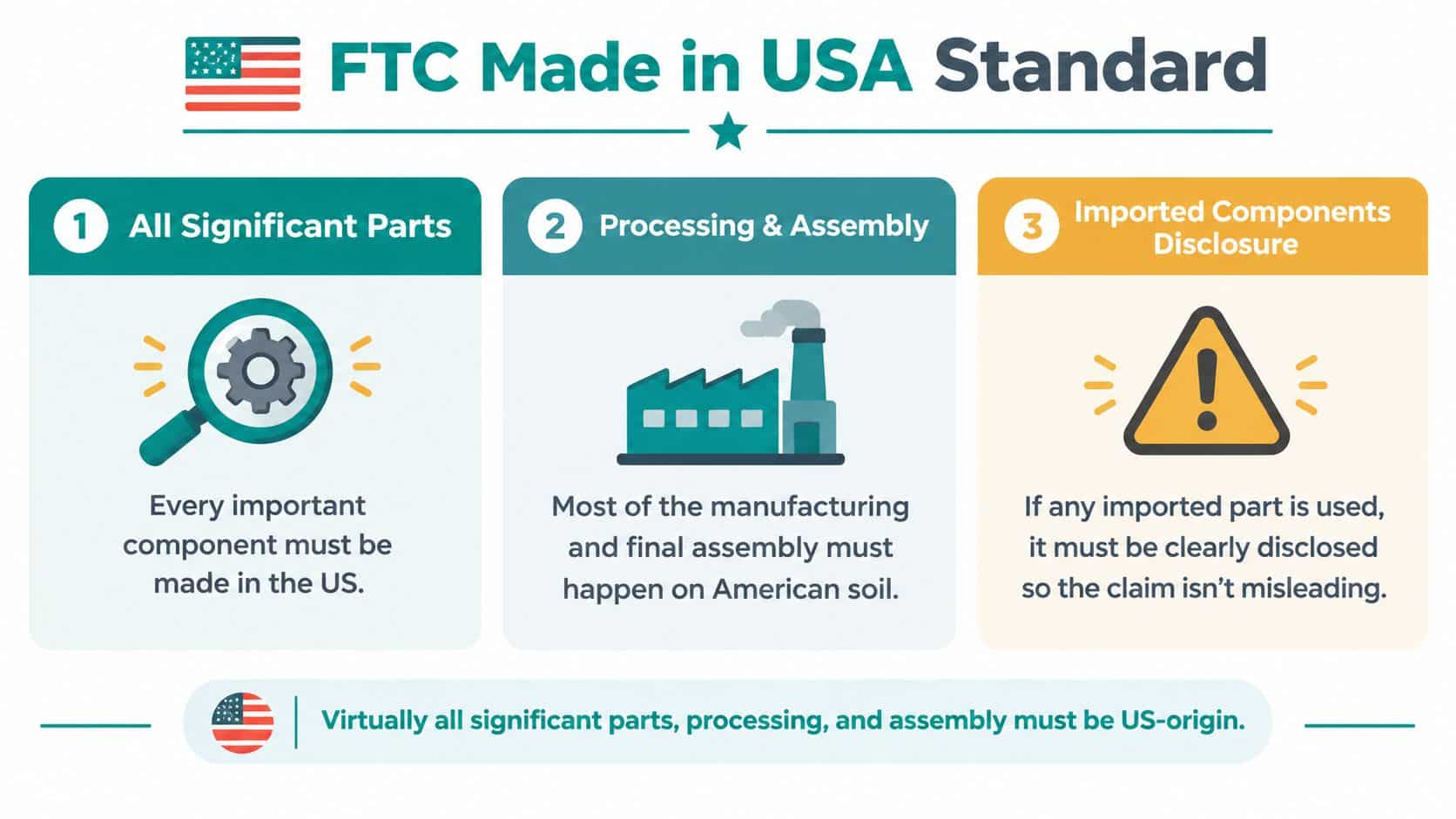
The Federal Trade Commission's Made in USA standard examines more than the location of final packaging. An unqualified “Made in USA” claim generally means that virtually all significant parts, processing, and assembly come from the United States. For a reusable K-Cup filter, that includes the components that affect brewing and durability, such as the body, mesh, lid, and gasket.
The practical review has two requirements:
- Final assembly must take place in the United States.
- Foreign content must be negligible, so imported materials or components cannot represent a meaningful share of the product's value or function.
A hypothetical filter could use food-grade plastic molded in Ohio, fine stainless-steel mesh produced in Connecticut, and a silicone O-ring molded in California. Those details, together with U.S. final assembly, could support a domestic-origin claim if the manufacturer's full supply chain meets the applicable standard. A filter with a U.S.-made shell and Chinese stainless mesh stitched into the basket requires more careful disclosure. The shell's location alone does not establish that the finished filter is meaningfully domestic.
Read the qualifier, not just the headline
These descriptions carry different implications:
- Made in USA: An unqualified claim suggesting that the product meets the FTC's domestic-content standard.
- Assembled in USA: Final assembly occurs in the United States, while significant parts may come from elsewhere.
- Made in USA with globally sourced materials: The brand acknowledges that some materials or components originate outside the country.
Qualified wording is useful when it accurately describes the product. The problem is vague language paired with an American flag, leaving shoppers to assume that the entire filter, including its mesh and gasket, originated domestically. A careful buyer should treat the wording as a supply-chain disclosure, not as a quality rating.
Ask for the parts that affect brewing
A credible seller should explain where the filter body, mesh, lid, gasket, and final assembly originate. You do not need a legal brief to buy a coffee accessory, but a listing that says only “American company” or “designed in the USA” provides limited manufacturing information. Those phrases describe the business or design process, not necessarily the origin of the finished filter.
The FTC's updated enforcement approach makes an unqualified claim a compliance matter rather than casual marketing language. A manufacturer that meets the full standard has grounds to state it clearly. An importer or reseller may choose softer wording that sounds domestic without making a direct country-of-origin commitment. For reusable pods, that distinction matters because the component source can affect accountability, replacement support, and how confidently you can evaluate a filter's construction.
Material Quality and Construction Differences
Made in USA identifies a manufacturing claim, not a brewing result. A reusable K-Cup still depends on its filter media, body, lid, gasket, and dimensional accuracy. Poor construction can cause leaks, uneven flow, plastic or metallic taste, or a muddy cup. For K-Cup-style brewing, filter media is commonly engineered around roughly 10 to 30 microns of effective pore size, with many premium paper filters near 10 to 20 microns (coffee filter micron guidance). Smaller pores generally retain more fine grounds, but the media must still allow soluble coffee compounds and some oils to pass.
Material selection affects how the pod behaves after repeated heating and washing. Food-safe polypropylene is used in food-contact brewing parts because it is rigid and heat-tolerant, as described in AeroPress's material FAQ. In a reusable K-Cup, that stability helps the shell, basket, lid, and puncture points remain aligned through repeated hot-water cycles. It does not rescue a badly designed pod, but a stable body gives the sealing and puncture features a better chance of working as intended.
Mesh, body, and seal work together
Stainless steel mesh produces a different result from plastic mesh or paper. A reusable K-Cup filter guide identifies fine stainless-steel mesh as a common feature in well-designed reusable filters and notes that some official reusable filters use plastic mesh instead. Steel can provide a firm filtration surface and long service life, but it needs clean forming, secure attachment, and regular cleaning. A rough edge can scratch the brewer, catch grounds, or create a leak.
The lid gasket needs the same scrutiny as the mesh. A silicone seal should press evenly against the brewer's basket and puncture area. If the lid is loose, pressurized water can flow around the grounds, leaving a weak cup and grounds near the rim. If it sits too high, the brewer may resist closing or fail to puncture the pod correctly. These fit details can matter more than the country printed on the package, particularly across different Keurig model generations.
| Spec | U.S.-Made Filter | Generic Import |
|---|---|---|
| Body material | Often specified as food-safe polypropylene or another disclosed polymer | Material may be listed vaguely or not at all |
| Filter media | Mesh construction and pore structure are more likely to be documented | Mesh thickness and pore consistency can vary |
| Lid and gasket | Tighter molding tolerances can support a more predictable seal | Loose lids, uneven rims, or fragile hinges are common buyer concerns |
| Repeat-use behavior | Designed around cleaning and repeated brewing when the manufacturer documents the materials | Performance depends heavily on the individual factory and batch |
| Verification | Seller may provide origin and food-contact information | Marketplace copy may focus on “universal” fit without component details |
A higher price makes sense when the manufacturer connects material choices to a documented brewing or fit benefit. Domestic production may improve traceability, assembly control, and support, but the label alone does not prove better resin, mesh, gasket material, or compatibility. A transparent specification from a reputable maker can provide stronger evidence than an American flag graphic.
For a closer examination of fine metal media, extraction, and cleanup, compare the construction principles in this stainless-steel reusable coffee filter guide. The practical takeaway is direct: mesh consistency and seal geometry matter more than a patriotic graphic on the package.
How to Verify a K-Cup Filter Is Truly Made in the USA
Start with the exact wording on the product page and package. The strongest claim is an unqualified “Made in USA.” Phrases such as “American company,” “designed in the USA,” or “assembled in USA” communicate something different. A qualified statement such as “Made in USA with globally sourced materials” may be accurate, but it tells you that some components are imported.
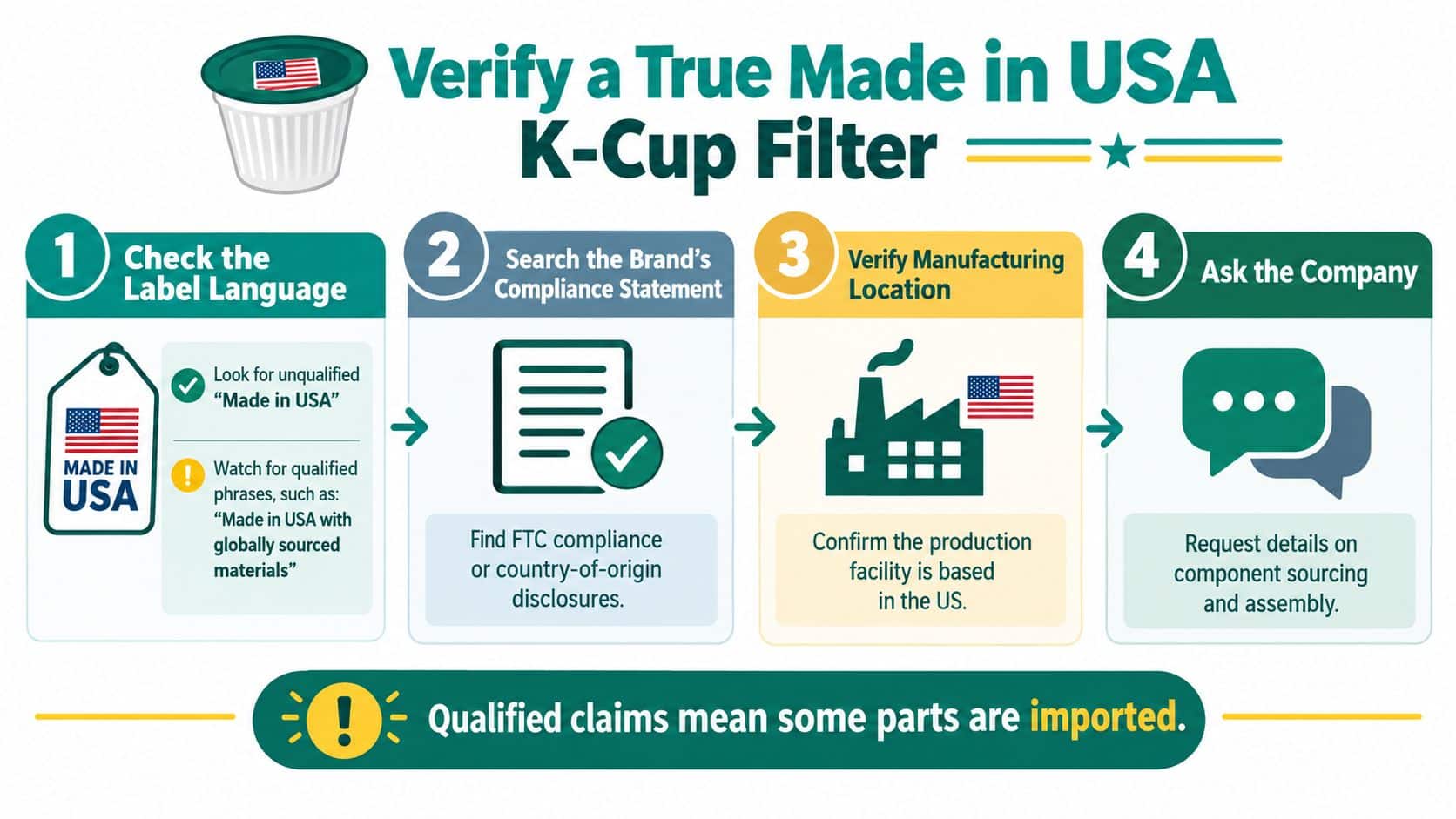
Use a short verification sequence
First, inspect the label language. Look for a direct country-of-origin statement rather than a flag, map, or “American quality” slogan. If the wording is qualified, read the qualification as part of the claim.
Next, search the brand's compliance information. A serious manufacturer may publish a country-of-origin statement, a compliance page, or a description of its domestic assembly process. Product authenticity guidance can help you distinguish a manufacturer's own listing from copied marketplace language in this product authenticity resource.
Then, confirm the physical location. A corporate mailing address doesn't necessarily identify the factory. Look for a manufacturing or assembly address in the United States, and check whether the brand explains which steps occur there.
Finally, ask a direct question. Request a Certificate of Origin or a written country-of-origin statement. Ask where the plastic body, filter mesh, gasket, and final assembly originate. A seller doesn't need to disclose proprietary suppliers, but it should answer basic origin questions without changing the subject.
Don't overread the barcode
A barcode can identify a company's GS1 registration prefix, but it doesn't prove where a product was manufactured. Some listings discuss prefixes in the 890 to 899 range as non-U.S. GS1 prefixes, yet barcode information alone can't establish the finished filter's country of origin. Use packaging language and the manufacturer's written statement as your primary evidence.
Third-party marketplace listings create another risk. A reseller can copy a claim from a different listing, inherit outdated specifications, or combine photos from several products. Before buying, run this checklist:
- Claim: Is the wording unqualified or clearly qualified?
- Components: Does the seller identify the origin of the body, mesh, and gasket?
- Factory: Can you verify a U.S. manufacturing or assembly location?
- Seller: Are you buying from the manufacturer or an unverified third party?
- Fit: Does the listing name your exact Keurig model and generation?
- Returns: Can you return the filter if the lid or basket doesn't fit?
USA-Made Reusable Pods vs Generic Alternatives
A useful comparison separates three distinct choices: a U.S.-assembled reusable pod, a stainless-steel mesh filter, and a low-cost generic import. Domestic assembly can provide clearer manufacturing accountability, but it does not automatically prove superior brewing performance. Stainless steel offers a rigid filtration surface, while generic imports usually win on upfront cost. Their material specifications, batch consistency, and compatibility may be harder to verify.
PureHQ's U.S.-made reusable pod range is one domestic example designed for reusable brewing and Keurig compatibility. Evaluate it by the same practical criteria as any competing product: disclosed materials, lid geometry, gasket performance, cleaning instructions, model fit, and return support. The country-of-origin statement should begin the comparison, not settle it.
| Feature | PureHQ USA-Made | Stainless Steel Mesh | Generic Imports |
|---|---|---|---|
| Primary construction | U.S.-made reusable pod design with a focus on compatible Keurig use | Fine stainless-steel filter media, sometimes paired with a plastic rim or body | Frequently molded plastic with variable mesh materials |
| Filtration behavior | Depends on the specific model and mesh design | Rigid mesh can support consistent flow when properly formed | Flow can vary between products and batches |
| Food-contact disclosure | Look for the manufacturer's stated material and compliance information | Steel grade and surrounding plastic still need verification | Listings may omit resin, steel grade, or gasket details |
| Hinge and lid | Fit and durability depend on the brewer-specific design | Some models use a separate lid, which adds another interface | Thin hinges and loose lids remain common objections |
| Keurig fit | Must be checked against the named Keurig generation | Compatibility varies widely by body height and lid shape | “Universal” claims may cover fewer machines than advertised |
| Price | Usually higher than the cheapest listing | Often higher when the steel and forming quality are good | Usually the lowest upfront cost |
| Best reason to choose it | Traceable domestic production and targeted compatibility | Durable mesh and a more defined filtration surface | Low entry cost for buyers willing to accept uncertainty |
Address the two common failure points
Leakage around the rim usually reflects a mismatch between the pod rim and the brewer's basket, uneven lid closure, or a flattened gasket. Fine mesh cannot compensate for a poor seal. Fill the basket without tightly packing the grounds, close the lid completely, and retire the pod if its rim warps.
Brittle plastic after washing rarely appears in product photos. Dishwasher cycles, harsh detergents, and repeated heat can stress thin plastic and hinges. Stainless steel may last longer in this area, but it can add weight and may not suit every brewer's clearance or sensor arrangement.
Compatibility deserves a separate check because Keurig machines differ in body height, lid shape, piercing arrangement, and clearance. A pod that works in one generation may sit too high, close poorly, or interfere with another model. Treat “universal” as a claim to verify, not a fit guarantee.
Imports are not automatically poor performers. Some provide reliable brewing at a low initial cost. Their weaker point is often documentation rather than function. Domestic options justify a higher price only when tighter tolerances, clearer material and origin information, and responsive support reduce replacement or compatibility problems. For buyers comparing total ownership cost, those factors matter more than the label alone.
The Sustainability Question Most Buyers Skip
Reusable filters can reduce disposable pod demand, but reusability by itself doesn't guarantee a lower-impact routine. The filter must stay intact, brew consistently, and remain convenient enough for regular use. A cracked or warped pod discarded after limited use may provide little benefit compared with the material and manufacturing invested in it.
As noted earlier, capsule waste is substantial. The practical question here is whether a reusable filter stays in service long enough to offset its own material impact. Domestic manufacturing can support better production controls and clearer product information, but the country-of-origin label alone does not establish a lower total footprint.
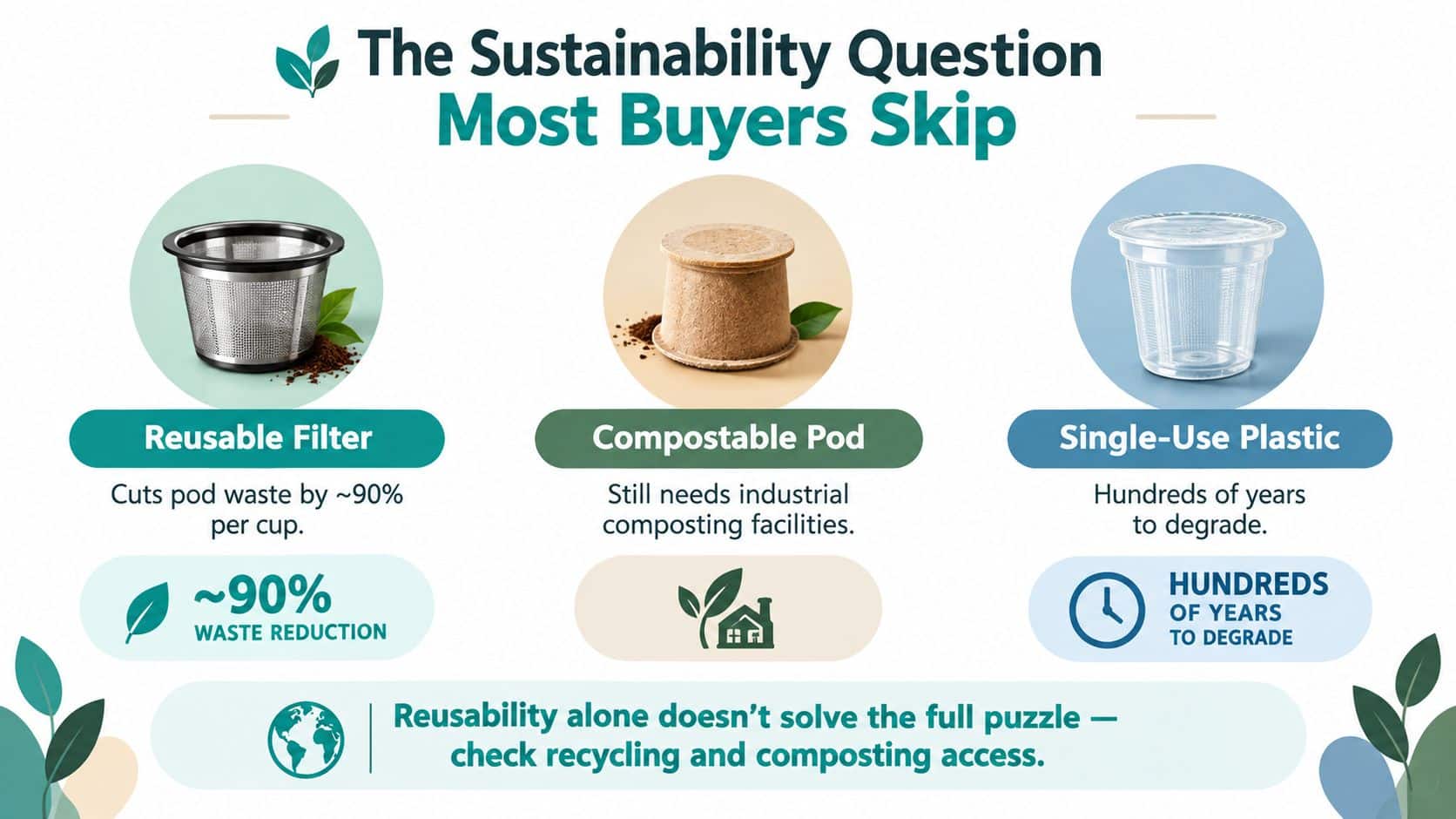
Compare the whole routine
A reusable filter creates a different waste profile from a compostable pod. Compostable products may reduce persistent material waste, but their benefit depends on certification, local collection, and access to the correct composting facility. Paper filters also carry processing claims. For example, mainstream cone filters are marketed with FSC-certified pulp, BPI-certified compostability, and chlorine- and bleach-free processing (Melitta product information).
“Made in USA” does not mean compostable or recyclable. Many reusable pods still contain plastic components, and disposal depends on the resin, local recycling rules, and whether a facility can separate combined materials. A domestic product may involve shorter shipping from manufacturer to buyer and clearer information about production controls. Those advantages do not remove the material's impact.
The strongest sustainability case is simple: a filter that survives repeated brewing, cleaning, and handling without losing compatibility.
When origin matters
Origin matters more when it supports long service life, transparent materials, replacement parts, repair options, and consistent use. It matters less when the label is the only sustainability feature and the manufacturer provides no useful information about durability, recyclability, or cleaning.
Manufacturing method also affects the material story. Readers examining lower-waste production can review why 3D printing is sustainable, while keeping the relevant conditions in view: material choice, energy source, production volume, and product lifespan.
For daily use, brew with a reusable filter when cleaning fits your schedule, compost grounds only where local facilities accept them, and maintain the brewer so the accessory does not fail early. PureHQ's guidance on sustainable reusable coffee filters is useful because the waste calculation starts with repeated use, not the label on the box.
Choosing the Right USA-Made Filter for Your Machine
A USA-made claim cannot compensate for a filter that does not fit your brewer. Keurig identifies its My K-Cup Universal reusable filter as the only Keurig-designed reusable filter approved for all Keurig home brewers. The product listing also describes BPA-free plastic and MultiStream compatibility (Keurig My K-Cup Universal listing). Treat “universal” on a third-party package as a claim to verify, not a guarantee.
Brewer generations create real compatibility limits. The My K-Cup 2.0 filter does not fit pre-2.0 K-Cup brewers, Vue brewers, Rivo brewers, or commercial brewers. Retailer compatibility information associates it with specific 2.0 models, including the K200, K250, K300, K350, K400, K450, K460, K475, K500, K550, K560, and K575. A filter manufactured domestically still needs the correct lid profile, basket depth, and needle clearance.
Match the pod to the brewer
| Keurig Model | Compatible Filter Type | Lid Height Needed | K-2.0 Sensor Safe |
|---|---|---|---|
| K-Classic | Pre-2.0 compatible reusable filter | Standard pre-2.0 lid profile | Not applicable |
| K-Select | Filter listed for Select and related pre-MultiStream designs | Standard basket clearance | Not applicable |
| K-Elite | Model-specific or confirmed compatible reusable filter | Verify lid and needle clearance | Not applicable |
| K-2.0 | 2.0-compatible filter with the correct lid geometry | 2.0-specific height | Confirm with the manufacturer |
| K-Supreme and K-Slim | MultiStream-compatible reusable filter | Slim, brewer-specific profile | Confirm with the manufacturer |
Test one pod before buying several. It should sit level in the funnel, close without pressure, and clear the exit needle. Run a small brew cycle and check for leaking, grounds in the cup, or a lid that lifts during operation. A usable return policy helps because two brewers can look similar while accepting different pod dimensions.
For continued use, keep cleaning practical. Rinse the basket after each brew and inspect the rim, hinge, mesh, and gasket for deformation or buildup. A compatible paper liner may simplify cleanup. Descaling solution and cleaning tablets maintain the brewer, but they cannot fix a pod with incorrect geometry.
Choose a filter whose domestic manufacturing statement, materials, and model coverage are documented. PureHQ Inc. offers reusable K-Cup filters and related Keurig accessories, including model-focused options, paper liners, water filters, descaling solutions, and cleaning tablets. Compare the stated fit with your brewer's generation and confirm lid clearance before ordering.

