
Coffee Machine Care
Coffee Maker Baskets: A Buyer’s Guide to Types and Fit
Aug
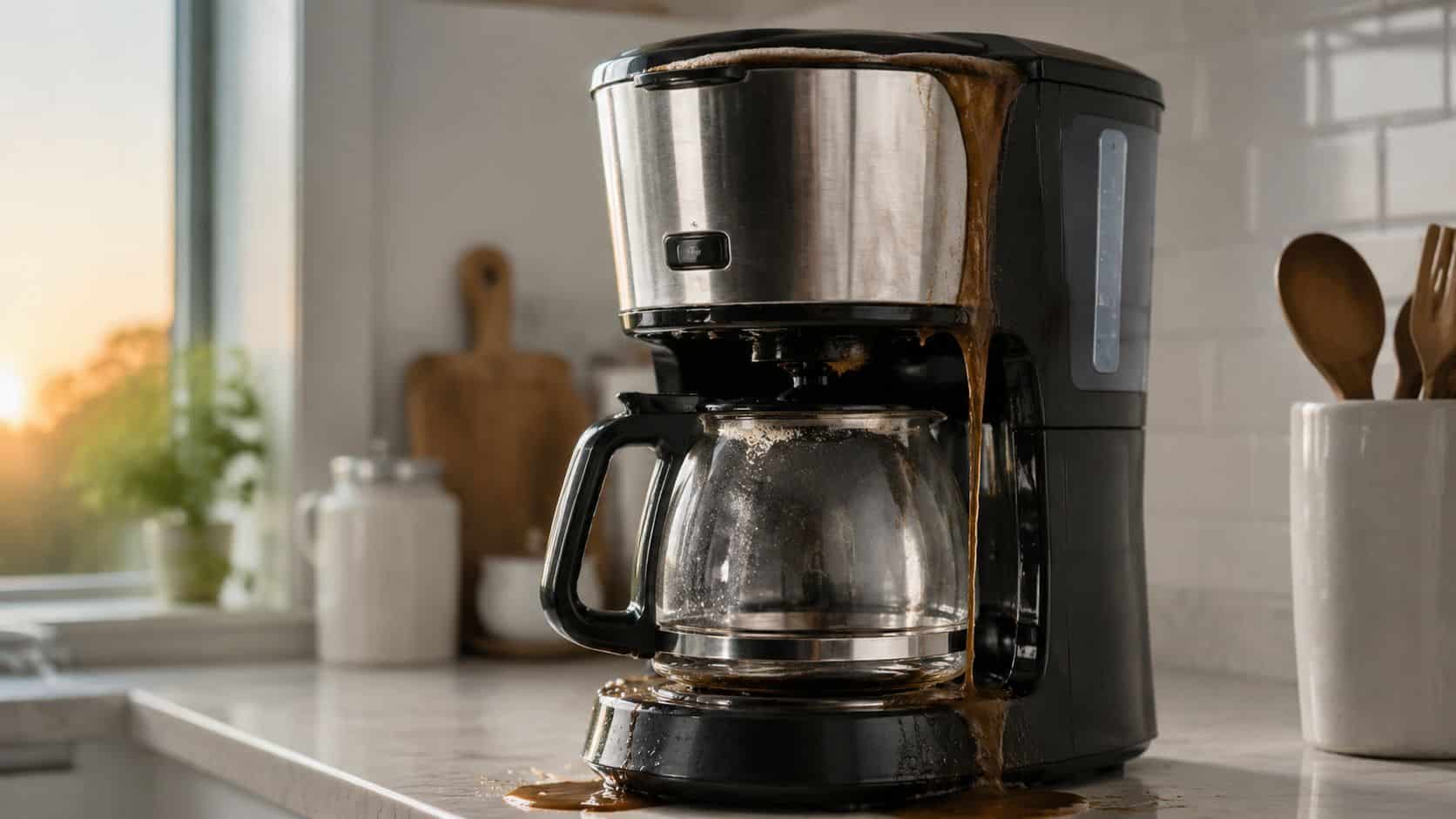
The alarm goes off, the drip brewer starts gurgling, and coffee begins creeping over the rim onto the hot plate. You lift the lid and find a swollen bed of grounds, a fine mesh basket struggling to drain, or a warped plastic holder that no longer sits squarely under the showerhead. The result is familiar, a sour smell, muddy coffee, and a counter that needs cleaning before breakfast.
A coffee maker basket looks simple, but it controls the meeting point between water, ground coffee, and time. Its depth, material, filter opening, and hole layout can change how quickly water leaves the coffee bed. Coffee maker baskets also have a long engineering history, with documented patent references reaching back to designs from the early 1960s and continued innovation into the 2020s, including a 2025 patent publication for a flow-rate-controlled brew basket (U.S. Patent 7,021,198, 2025 drip coffee maker basket patent).
The Morning Your Basket Ruins Your Coffee
Overflow usually starts with resistance that the basket cannot shed quickly enough. Water meets a coffee bed, drainage slows, and the machine continues adding more. Fine gold-tone mesh packed with powder can hold back the flow until brown liquid reaches the rim. An overfilled basket creates the same pressure, even when its frame and filter surface remain undamaged.
Taste provides another clue. A clogged basket forces water through an uneven path, leaving parts of the grounds overworked while other areas receive less contact. The cup may taste sour or muddled. An underfilled bed can produce the opposite pattern: water cuts open channels, passes through too quickly, and leaves some grounds dry, resulting in weak flavor.
Grounds in the carafe point to a separate failure. A torn mesh, a poorly fitted paper filter, or a basket that no longer sits correctly can let fines bypass the intended barrier.
The basket is part of the brew system
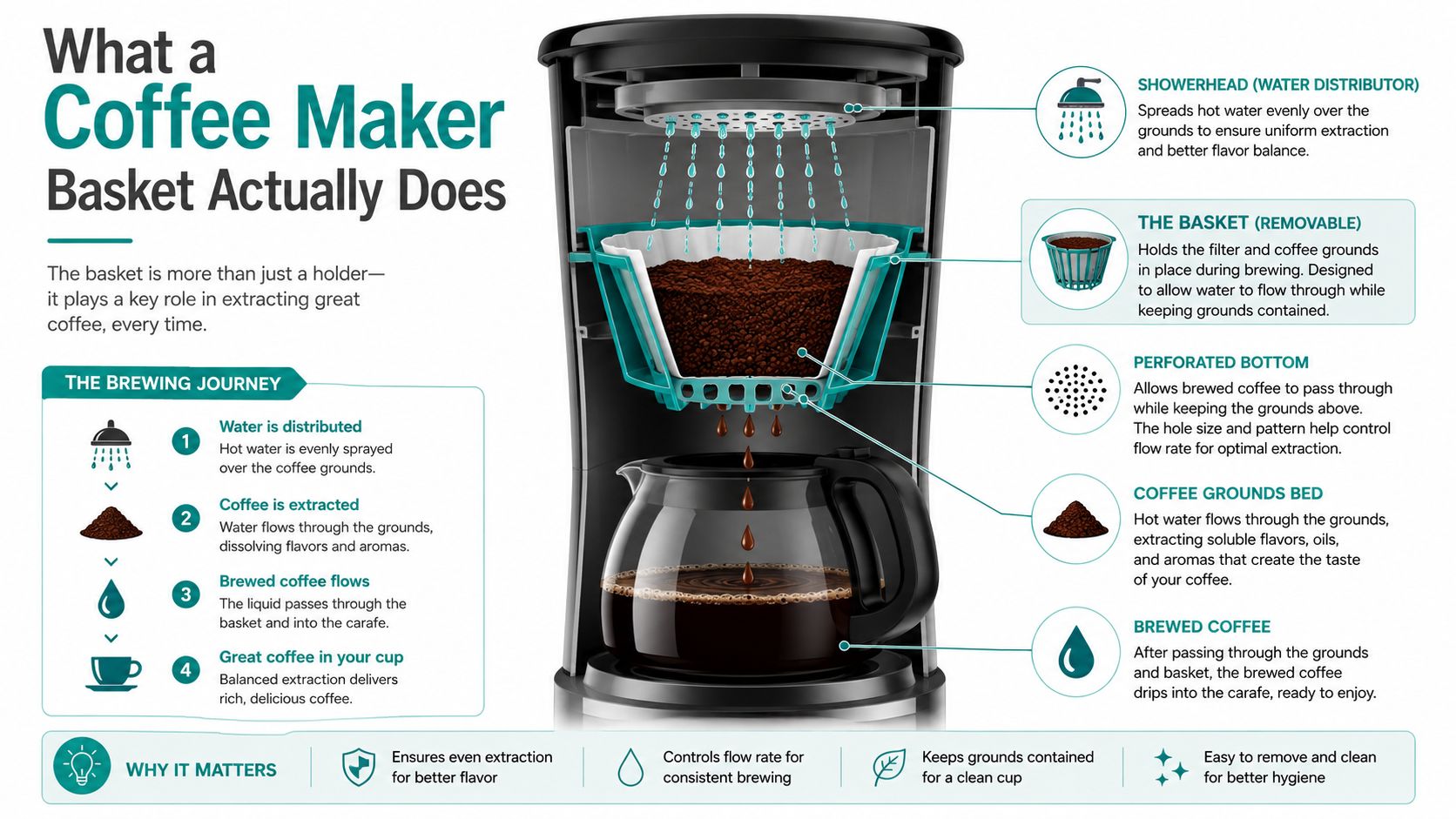
The basket is the hydraulic interface between the showerhead and the carafe. Its depth gives wet grounds room to expand, its material affects support and durability, and its hole layout controls how readily water leaves the coffee bed. Together, those features shape dispersion, resistance, contact time, and extraction consistency. Patent records document refinement around overflow control, splash reduction, filter-pack compatibility, and water movement, reflecting the mechanical work this small component performs (brew basket patent history).
Separate the likely causes before replacing parts:
- The grind is too fine. Powder can cover mesh openings and restrict drainage.
- The dose is too high. Swollen grounds fill the available space and obstruct the outlet.
- The basket fit is wrong. A raised rim, warped frame, or drip-prevention valve can disrupt the designed flow path.
This check prevents the wrong repair. A new basket cannot correct an overloaded dose, and a coarser grind cannot fix a rim that no longer seals. Observe the hole pattern, basket depth, and fit alongside the overflow or flavor symptom, then match the diagnosis to the part that is restricting flow.
What a Coffee Maker Basket Does
The coffee maker basket is the junction where water volume, grind size, and contact time meet. Hot water from the showerhead spreads across the grounds, moves through the coffee bed, reaches the perforated base or mesh, and then drains toward the carafe. Basket depth, hole layout, and outlet design determine how much resistance that path creates.
Dose capacity
A deeper basket gives wet grounds room to expand without pressing against the showerhead. A shallow basket reaches its limit sooner, so the same scoop can crowd the bed and restrict drainage. Capacity therefore includes the space needed after the grounds absorb water, not only the amount the basket holds while dry.
If the basket overflows during brewing, check the dose and the available depth together. Grounds that swell into the outlet can slow drainage even when the dry dose seemed to fit.
Flow resistance
Hole diameter, hole density, mesh fineness, and the base shape all affect how readily water leaves the basket. Water favors the least-resistance routes, so uneven openings can send more flow through some areas of the coffee bed. That uneven movement can contribute to weak sections, bitter pockets, or overflow when clogged openings force water toward the rim.
More uniform hole geometry can spread flow more evenly, while larger or less restricted openings can alter brew speed and extraction balance, as explained in this guide to basket hole geometry and extraction.
Contact time
Water that remains among the grounds longer has more opportunity to extract soluble material. A flat-bottom basket creates a wider, shallower bed. A cone-style basket concentrates coffee toward a narrower lower point, changing bed depth and resistance. Neither shape guarantees better coffee. Showerhead coverage, grind, dose, and outlet design also determine whether water reaches the bed evenly.
Practical rule: Treat a replacement basket as a flow-control component. If its depth or openings differ from the original, adjust the grind or dose instead of assuming the old recipe will drain and taste the same.
Gold Tone, Plastic, and Stainless Baskets Compared
Material changes more than appearance. It affects how the basket retains oils and fines, how easily openings clog, how well the frame tolerates heat and cleaning, and how much maintenance the brewer demands.
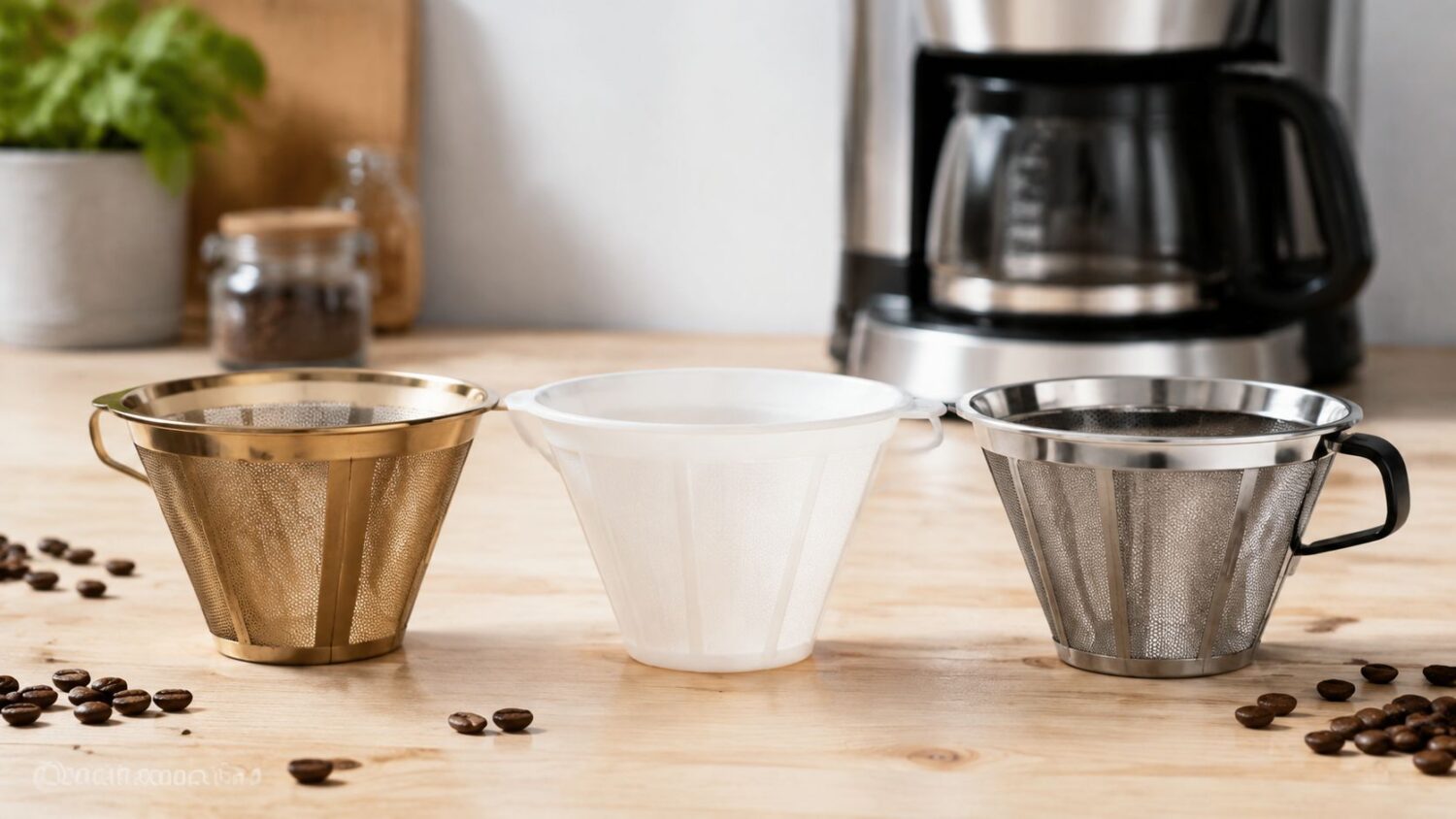
A gold-tone basket usually combines a fine mesh with a plastic support frame. The fine filtration can retain more oils and small particles, giving coffee a fuller mouthfeel. That same filtration can slow drainage when the user grinds too finely or leaves oily residue in the mesh. The gold-tone coffee filter guide provides useful background on this style.
Plastic baskets commonly arrive as the original equipment in drip brewers. They're light and easy to replace, but heat, repeated use, and some descaling chemicals can eventually affect the frame. Stainless mesh handles heat and scrubbing better, though its openings may allow more fines into the carafe and can still collect oils if the owner rinses it poorly.
| Attribute | Gold Tone | Plastic | Stainless Mesh |
|---|---|---|---|
| Cup profile | Fuller body, more retained oils and sediment | Depends heavily on the paper or liner used | Often cleaner and brighter, with potentially more fines |
| Flow behavior | Fine mesh can restrict flow when clogged | Perforations can remain predictable while the frame is sound | Mesh geometry controls flow, and residue can block openings |
| Durability | Mesh can last, but the frame and finish need care | Light and practical, but vulnerable to warping | Strong resistance to heat and routine scrubbing |
| Cleaning difficulty | Requires careful rinsing of fine openings | Usually easiest to wash | Needs attention to oily residue trapped in mesh |
| Paper compatibility | Can accept compatible liners when the dimensions match | Often designed around the machine's original paper size | Works with paper only when the shape leaves room for a proper seat |
Choose for behavior, not color
Gold tone isn't automatically premium, and stainless steel isn't automatically cleaner. Match the basket to your coffee and routine. If you prefer body and don't mind rinsing promptly, fine mesh can suit you. If you use a very fine grind, stainless mesh with more open geometry may drain more readily, but you may notice more sediment. If simplicity matters most, the original plastic basket paired with correctly sized paper can be the least troublesome arrangement.
Paper liners also change the material comparison. Paper retains more solids than an open reusable mesh, while a reusable basket reduces disposable filter use but puts the cleaning responsibility on you. The right choice is the one whose retention, flow, chemical stability, strength, reusability, and cleanability fit your priorities (coffee basket filter material considerations).
Matching Baskets to Keurig, Ninja, and Drip Brewers
Nominal machine capacity won't tell you enough. A replacement basket must sit correctly under the brew head, leave room for the showerhead path, and engage any machine-specific valve or rim feature. Measure the original basket's outside diameter, inside diameter, depth, rim shape, and outlet position before ordering.
Keurig systems deserve extra caution. Keurig 2.0 and K-Carafe formats can use proprietary rim features and notches that generic mesh baskets won't engage. A basket can look close enough on a countertop yet fail to trigger the brewer, sit too high, or interfere with the lid. Check the exact model family rather than relying on the word “Keurig” alone. For reusable pod selection, this Keurig reusable K-Cup compatibility guide explains why model matching matters.
Ninja DualBrew permanent filters sit deeper than some standard drip baskets. The replacement needs sidewalls that support the coffee bed during pre-infusion, otherwise the filter can settle, distort, or leave a gap around the edge. Standard drip machines from Mr. Coffee, Black+Decker, and Cuisinart often use cone-shaped paper, but the correct paper size still depends on the basket's lip angle and depth.
| Machine Family | Basket Diameter | Compatible Basket Type | Paper Filter Size |
|---|---|---|---|
| Keurig 2.0 and K-Carafe | Measure the original rim and notch pattern | Model-specific reusable pod or carafe basket | Use only the size specified for that brewer |
| Ninja DualBrew | Measure the deeper permanent-filter cavity | Tall-sidewall permanent filter | Match the machine's stated cone or basket format |
| Mr. Coffee, Black+Decker, and Cuisinart drip | Measure the cone or flat basket opening | OEM-style basket or correctly shaped reusable filter | #2 commonly serves about 2 to 6 cups, while #4 commonly serves about 8 to 12 cups (filter size guide) |
| Espresso portafilter systems | Measure the inner basket, not only the handle | Basket matched to the portafilter's internal geometry | A 55 mm paper filter can be marketed for the bottom of many 58 mm baskets, so nominal size alone isn't enough (espresso paper filter compatibility) |
Perform a three-part fit check
- Seat the rim. The basket should rest evenly with no rocking, raised edge, or interference with the lid.
- Test the paper dry. Place the intended liner inside and check that it reaches the walls without folding over the outlet.
- Pour water without coffee. Run a small water test and watch for side leaks, delayed drainage, or a valve that fails to open.
A basket advertised for a larger cup count isn't automatically right for your machine. The practical dose depends on the basket's depth and the coffee's grind, so physical fit comes before capacity claims.
Diagnosing Overflow, Leaks, and Weak Flavor
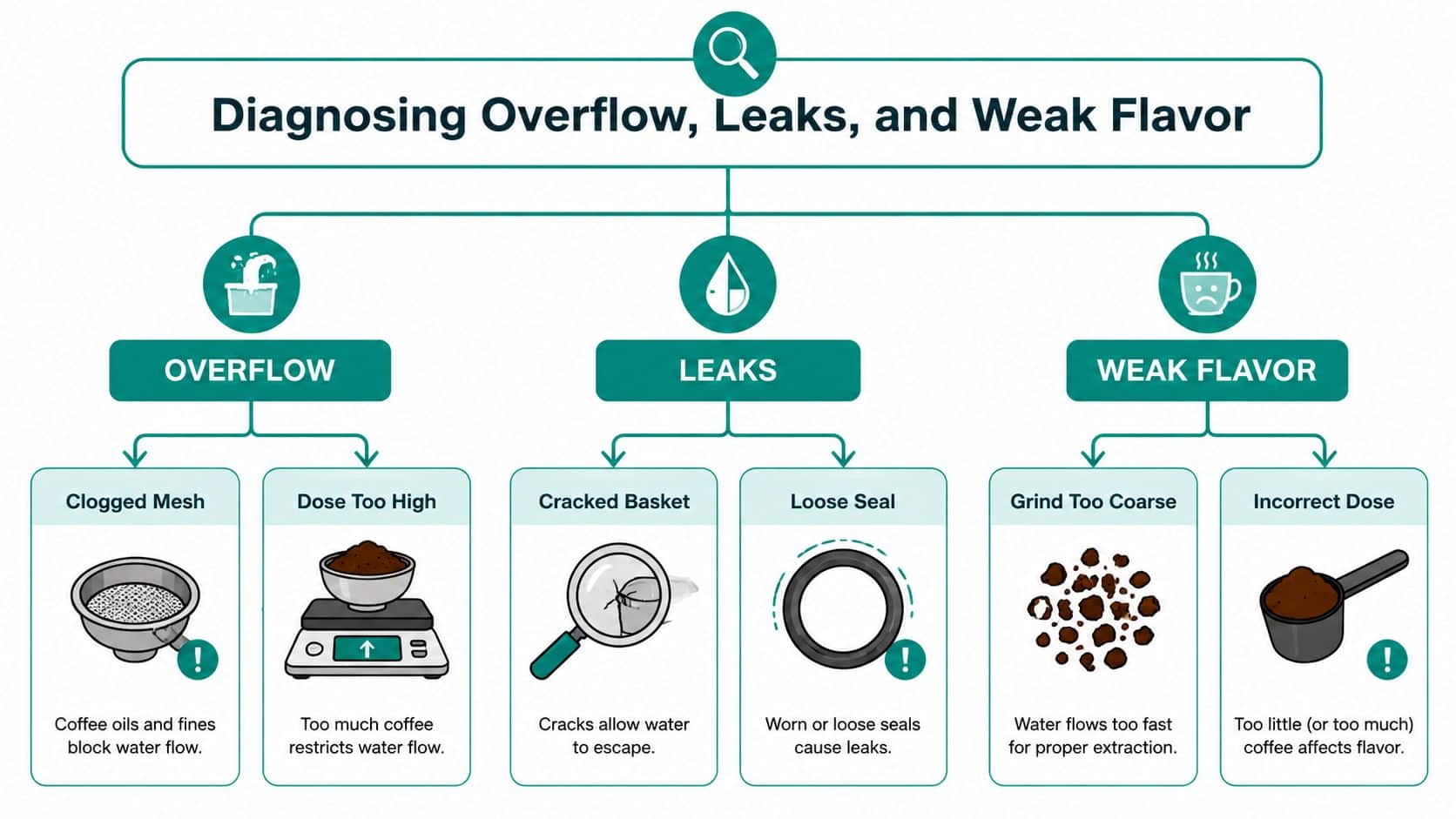
A basket can reveal the fault before the coffee does. If the brew runs over, leaks around the brew head, or tastes weak and sour, test the basket empty first. Then check the grind and dose, followed by a water-only cycle. This sequence separates coffee-bed resistance from a seating or drainage problem.
Start with the symptom
Overflow usually means restricted drainage or too much coffee. Fine particles can seal a fine mesh, while an overloaded basket expands into the showerhead. A drip-prevention valve that is assembled incorrectly can also contribute to overflow, as described in manufacturer guidance on basket overflow. Check the valve, basket depth, and hole layout before changing the coffee.
A leak at the brew-head area usually indicates a fit problem. Inspect the rim for warping, the frame for cracks, and the basket for a missing valve or an incorrect seating height. If water leaks during a coffee-free test, changing the grind will not correct it.
Slow flow with sour flavor signals too much resistance. The holes are acting like a narrow doorway: a fine grind, compacted bed, or clogged mesh leaves water too little room to pass. Clean the openings, confirm that the dose is not touching the top of the basket, then try a grind one step coarser. A technical comparison reports about 9 to 12 mL/s for standard baskets and about 25 to 30 mL/s for IMS precision baskets under its test conditions (technical flow comparison). Those figures apply to the comparison setup, but they show why hole openness can change flow substantially.
Use the cup and machine together
| Symptom | Likely cause | First response |
|---|---|---|
| Grounds in the carafe | Open, damaged, or poorly seated mesh | Replace the basket or add correctly fitted paper |
| Sloshing or hissing | Water pooling against a clogged bed or overloaded basket | Clean the mesh, grind coarser, or reduce the dose |
| Weak crema in a reusable espresso pod | Pod geometry, grind, or fill level provides too little resistance | Confirm pod compatibility and adjust grind or dose |
| Steam without a normal drip | Outlet or basket path is blocked | Stop the cycle, let the machine cool, and clean the basket and brew path |
If the basket repeatedly rises toward overflow, reduce the dose by 2 to 3 grams and use a scale for a consistent adjustment. When the basket passes the dry water test but the brew remains slow, try one coarser grind before replacing a component that still fits and drains correctly.
Cleaning and Descaling Routine That Extends Basket Life
Coffee residue and mineral scale restrict a basket in different ways. Oils coat mesh openings, while hard-water minerals narrow the tiny passages over time. The result can be slower drainage, water rising around the basket, or a cup that tastes flat because the coffee bed stays saturated too long.
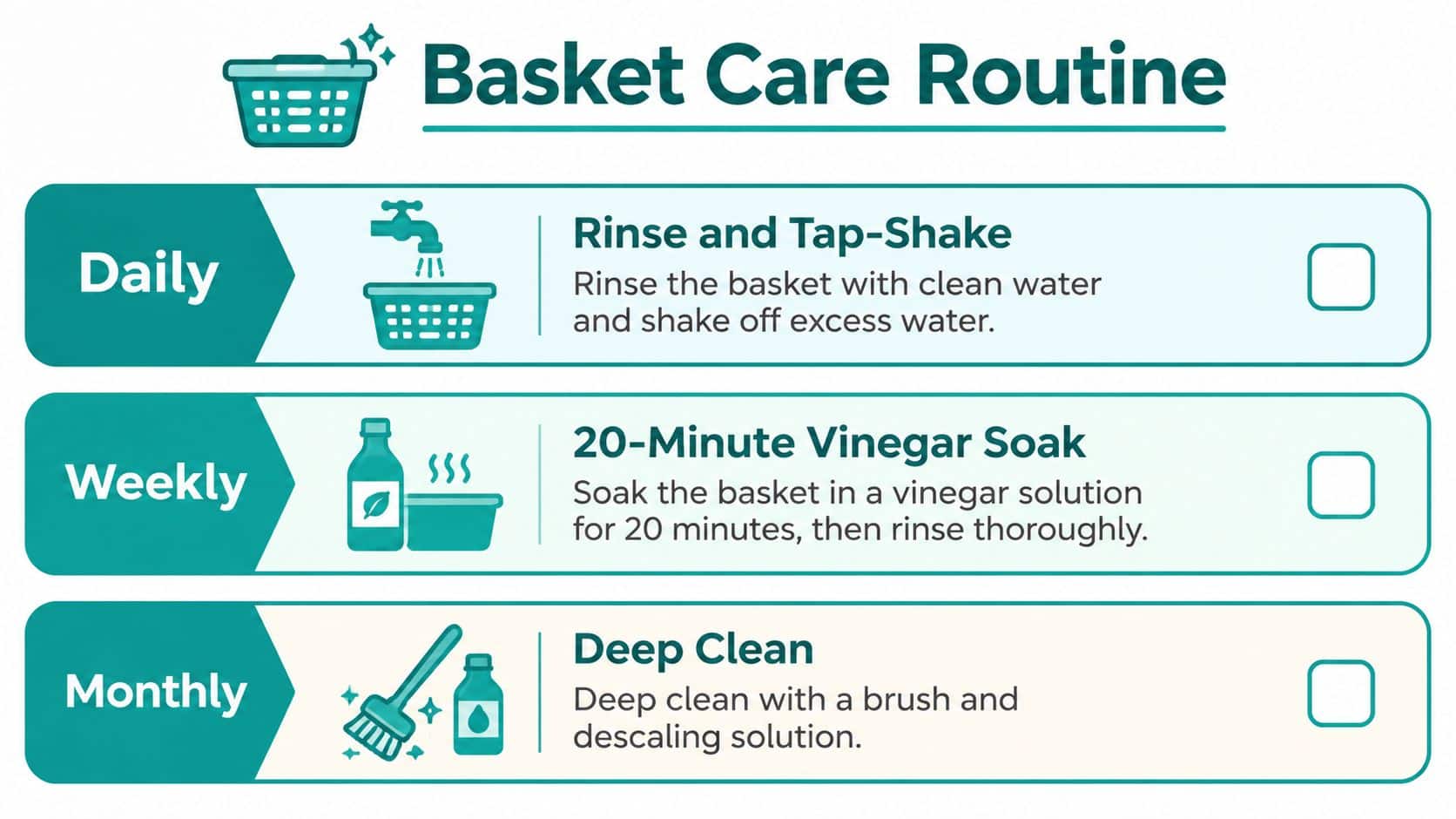
Daily care
Remove the basket after brewing and rinse it under running water. Tap it gently over the sink to release fines from the mesh or perforations, then inspect the underside for trapped grounds. Air-dry it upside down so moisture does not remain against the frame.
Weekly care
Wash the basket with a warm cleaning solution suited to its material. White vinegar may loosen residue when the manufacturer allows it, but do not assume every finish, seal, or machine part tolerates vinegar. Rinse thoroughly, since leftover cleaner can carry an odor into the next pot.
A soft toothbrush can clear the rim, support frame, valve, and outlet without widening the openings. Avoid metal tools, which can deform thin mesh or scratch plastic.
Monthly care
Run the brewer's approved descaling solution through the brew path, then flush it with clean water according to the product directions. Descaling needs vary with water hardness and machine use, so follow the brewer's indicator or a documented coffee maker cleaning schedule.
Gold-tone mesh needs gentle handling because abrasive scrubbing can damage its finish. Stainless mesh tolerates firmer brushing, but its openings still collect oily residue. Plastic baskets are generally easy to wash. Replace one with a distorted frame instead of forcing it back into shape, since a changed rim or angle can affect seating and drainage.
Clean storage matters: Air-dry the basket upside down, do not nest it while wet, and keep a second basket available if you brew daily.
For care that includes the brewer and its removable parts, follow this coffee maker cleaning schedule. A compatible paper liner, cleaning tablet, or descaler can help when the reusable basket's flow begins to change. If rinsing no longer restores normal drainage, inspect the holes and outlet before increasing the grind size or replacing the basket.
Common Objections and Why the Right Basket Pays You Back
“A third-party basket might leak.” That concern is reasonable. A basket can look compatible and still fail if its rim height, notch pattern, sidewall angle, or drip valve differs from the original. Check the complete machine model, compare the old and new baskets side by side, and perform the dry-run water test before brewing a full pot.
“Stainless mesh will clog and make a bigger mess.” Mesh doesn't eliminate maintenance. It changes the maintenance task from replacing paper to clearing oils and fines from the openings. Your grinder output matters too. A powder-heavy grind places more stress on fine mesh, while a more even grind usually gives the basket a clearer drainage path. If the basket clogs repeatedly after cleaning, choose a different hole pattern or use a paper liner inside a compatible reusable frame.
“Paper filters are cheaper.” They may be cheaper per purchase, but the useful comparison is your recurring filter spend against how long a durable basket remains functional. Write down what you spend on filters during a typical month, then compare that with the purchase price and expected service life of the replacement. The calculation is personal because coffee volume, filter size, and basket durability vary.
Look for these buying signals
- Model compatibility: The listing should name your exact brewer family, not only a broad brand name.
- Physical dimensions: Confirm diameter, depth, rim shape, and outlet position.
- Hole or mesh design: Match filtration to your grind and preferred amount of body.
- Cleaning access: Choose a basket whose underside and valve area you can rinse and brush.
- Paper support: If you want a cleaner cup, confirm that the basket accepts a liner without folding or blocking drainage.
A well-matched reusable basket can turn repeated overflow troubleshooting into a stable routine. It won't compensate for a damaged brewer or unsuitable grind, but the correct material, depth, and perforation pattern can make those variables easier to control.
Measure your current basket, confirm your Keurig, Ninja, drip, or espresso model, and choose a replacement that matches both your grinder output and taste preference. Then visit PureHQ Inc. to shop compatible reusable baskets, paper liners, descalers, and cleaning accessories for a cleaner, more predictable brew.

