
Coffee Machine Care
4C Certification Coffee Explained for Conscious Buyers

Aug
4C certification coffee is easy to misunderstand because it sits at the scale of a global industry standard, not at the level of a boutique retail badge. By the end of 2024, 4C covered 196 producing groups in 19 countries, reached about 300,000 coffee producers, and represented 29.1 million 60-kg bags of certified green coffee, with 94% of those producers classified as smallholders and about 800,000 hectares under certified management (4C in numbers). That makes 4C less like a premium consumer label and more like the industry's baseline safety rail, a system built to keep trade moving while pushing farms toward better practices over time.
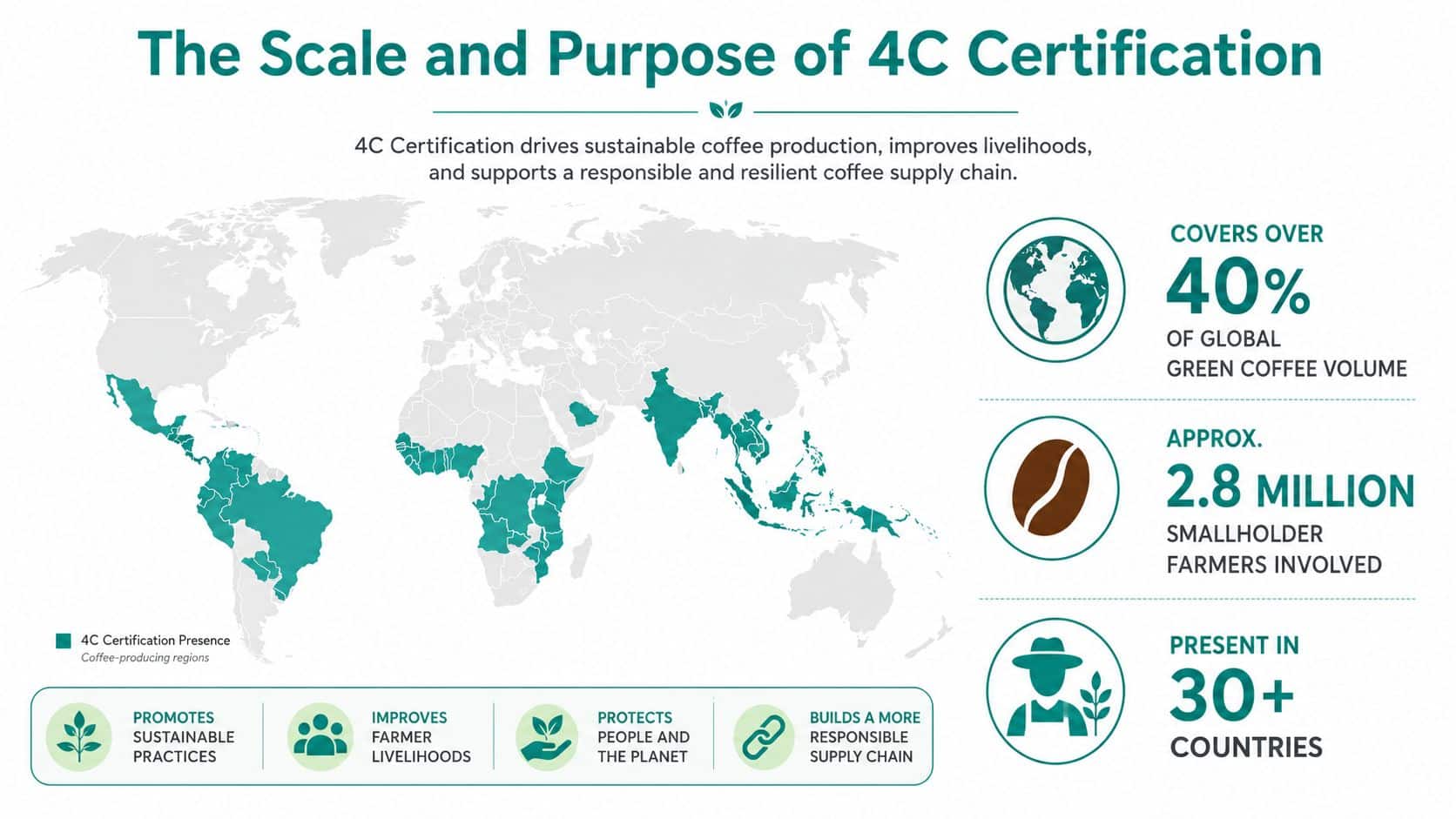
The Scale and Purpose of 4C Certification
4C's scale is the clearest clue to its purpose in coffee trade. A system that covers 196 producing groups across 19 countries and reaches about 300,000 producers is not built to behave like a narrow retail badge. It works as a widely used baseline standard for sourcing and supply chain organization (4C in numbers).
What the scale means in practice
That scale changes the question buyers should ask. A roaster usually does not choose 4C to tell a romantic origin story on-pack. They use it to organize sourcing, reduce risk, and bring more suppliers into a recognized sustainability framework. That is why the system is usually treated as a baseline sustainability standard rather than a premium label.
The production figures make that role more concrete. In 2024, certified green coffee production reached 29.1 million 60-kg bags, and the certified area stretched across about 800,000 hectares of sustainably managed farms. Those numbers show reach, but they also show the limits of interpretation, the same figures cited above. A large footprint does not automatically mean a luxury positioning, a minimum-price guarantee, or a consumer-facing promise of exceptional quality.
Why consumers get confused
Most confusion starts with the word certification. In coffee, certification can mean anything from a strict retail claim to a broad sourcing framework. 4C sits closer to the latter, a system that helps producers enter sustainable trade and helps buyers verify basic compliance across complex supply chains.
A simple way to read it is this: 4C is the industry's compliance floor, not its top shelf. Like a building code, it is there to keep the structure sound and the trade system usable. It does not promise a special cup profile, a premium price signal, or the kind of exclusive positioning that shoppers may associate with other labels.
That distinction matters because buyers and drinkers often compare 4C to more visible schemes and expect the same benefits from each one. 4C is better understood as a foundation layer, something that helps a supply chain stay organized and accountable before it tries to signal anything luxurious to the end consumer.
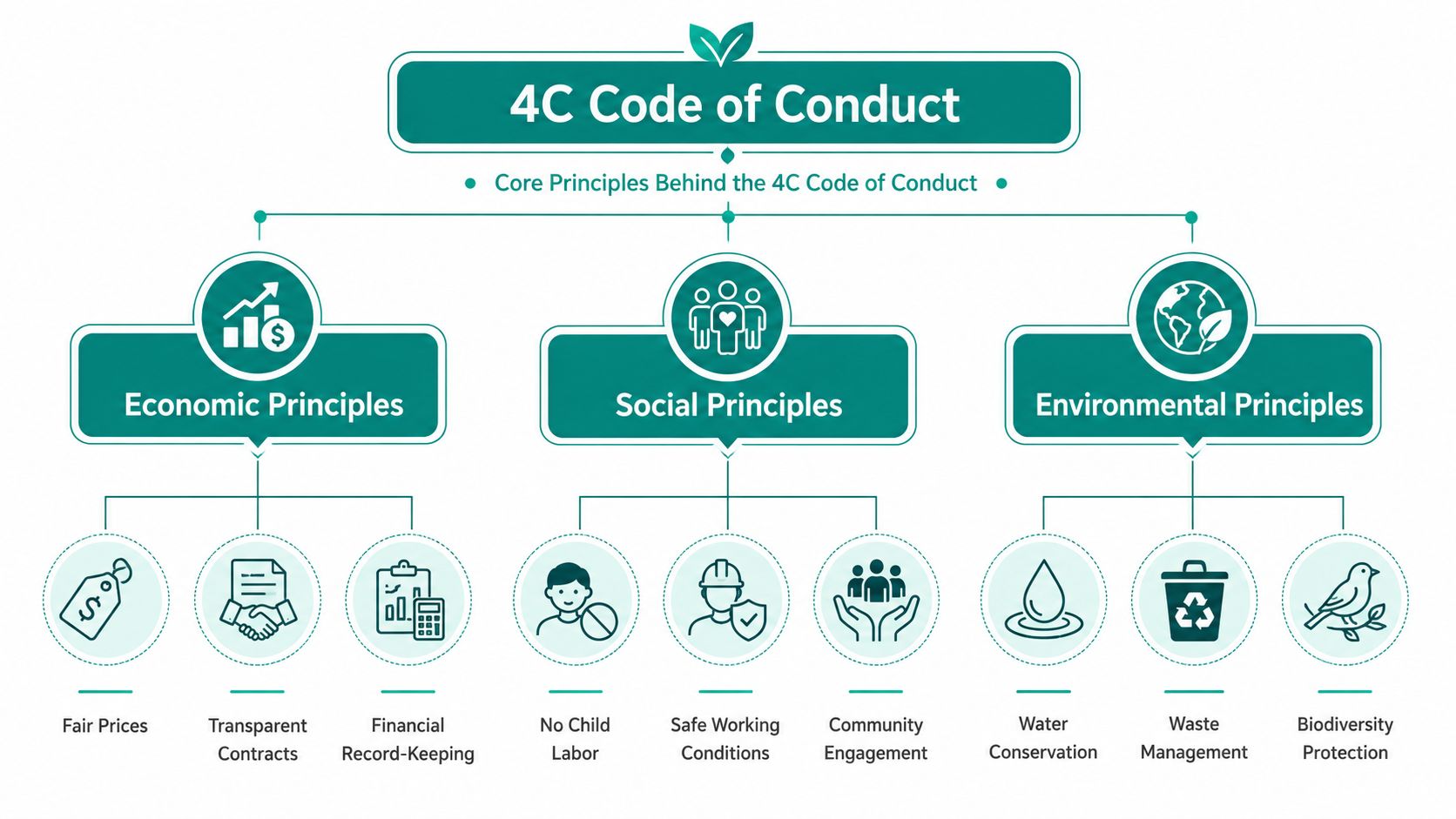
Core Principles Behind the 4C Code of Conduct
The 4C Code of Conduct works like a building code, not a luxury home specification. A building code stops the structure from being unsafe or unfit to use. It does not promise marble floors, custom cabinets, or a designer kitchen. 4C follows the same logic in coffee, it sets baseline expectations across economic, social, and environmental principles, then asks producers to improve continuously rather than achieve perfection on day one.
The three pillars in plain language
The economic side focuses on how coffee business gets organized, including fairer commercial relationships and better record-keeping. The social side looks at people, which is where issues like child labor, safety, and community engagement belong. The environmental side covers the farm's physical footprint, including water use, waste, and biodiversity.
That structure helps explain why 4C appeals to large buyers. It gives them a practical framework they can apply across many origins and supplier types. Instead of asking every farm to reach a highest-tier benchmark immediately, the system asks whether the worst practices are being pushed out and whether a credible improvement path exists.
Entry requirements buyers should know
The entry rules are concrete. A 4C Unit must be able to supply at least 20 tonnes of green coffee and have a Managing Entity responsible for implementing the 4C Code of Conduct (4C certification in Kenya overview). That matters because 4C is not just about farms, it is about governance.
Here's the practical reading of that requirement:
- Minimum volume: the unit needs enough product to make the system operational.
- Managing Entity: someone has to take responsibility for the code, records, and implementation.
- Continuous improvement: the point is to move the supply chain forward, not to declare it finished.
4C works best when buyers treat it as an operating system for sourcing, not as a final destination.

How 4C Compares to Fairtrade and Rainforest Alliance
4C, Fairtrade, and Rainforest Alliance all sit in the sustainability conversation, but they solve different problems. 4C is a baseline compliance tool. Fairtrade is built around stronger trading protections and consumer-facing premium positioning. Rainforest Alliance leans more heavily into environmental conservation and marketplace visibility. The right choice depends on what a buyer wants the certification to do.
Coffee Certification Comparison
| Criteria | 4C | Fairtrade | Rainforest Alliance |
|---|---|---|---|
| Core purpose | Baseline sustainability and market access | Trading model with stronger buyer protections | Sustainability with strong environmental emphasis |
| Pricing model | No minimum-price guarantee | Includes minimum-price guarantees | No minimum-price model in the way Fairtrade is structured |
| Buyer use | Sourcing coverage and compliance | Premium consumer claims and sourcing ethics | Retail-facing sustainability signal |
| Supply chain role | Entry standard and risk management | Values-driven trade framework | Environmental and broader sustainability framework |
The comparison is useful because it clears up a common objection. Some readers assume 4C is “lesser” because it is more inclusive and easier to enter. That misses the point. A baseline system is supposed to be easier to adopt. It creates a floor, not a luxury ceiling.
For a deeper look at how pricing and trade models differ, see this explanation of direct trade vs fair trade. That comparison helps separate sourcing philosophy from the practical job a certification is meant to do.
Where 4C fits
4C often makes sense when a company wants broad supplier participation and a manageable compliance structure. Fairtrade makes more sense when the business wants a stronger consumer story tied to pricing commitments. Rainforest Alliance fits buyers who want a visible sustainability seal with a stronger environmental identity.
The right comparison is not about which label is “best.” It's about which one matches the buyer's goal, supply chain reality, and customer promise.
Traceability and Supply Chain Controls
Traceability is where 4C becomes operational instead of abstract. Certified coffee must be physically separated from non-4C coffee, and the system uses operational standard procedures to track certified product through the supply chain (4C Code of Conduct and Audit Checklist). That separation protects claim integrity. If certified coffee gets mixed carelessly with non-certified coffee, the label stops meaning what it claims to mean.
Why segregation matters
Think of segregation like keeping one brewer basket for a specific grind and another for everything else. If the two get mixed, you can't trust the result. In coffee logistics, the same logic protects certified lots from contamination before they reach export or roasting channels.
Independent audits sit on top of that system. The 4C system says certification lasts three years, includes two Annual Surveillance Audits, and requires a recertification audit every three years. It also says an independent Certification Body accredited under ISO/IEC 17065 must perform the audit (4C Services). That's the part that keeps the standard from becoming a paper-only claim.
What buyers should ask
Buyers don't need to memorize audit terminology, but they should know what evidence to request. A credible 4C claim should come with documentation that shows the coffee stayed identifiable from origin onward. If a supplier can't explain the chain of custody clearly, the certification loses much of its value.
The process is also why 4C works better as a supply-chain discipline than as a vague sustainability slogan. It asks for records, separation, and outside verification, not just good intentions.
Real Impact and Honest Limitations
4C is designed to improve living and working conditions, but it doesn't promise a floor price the way some buyers expect from stronger trade models. That is the core limitation, and it's why the label needs to be understood for what it is. A certification can improve process discipline without automatically transforming farm income.
What the evidence gap means
Independent and trade-facing commentary describes 4C as a baseline sustainability system built around continuous improvement and broader market inclusion. The harder question is whether that inclusion translates into measurable gains for farmers in every context. The answer isn't uniform, because outcomes depend on local demand, buyer relationships, and whether certification arrives with training or extension support.
A 2023 Brazilian comparative study noted a literature gap in multidimensional comparisons of coffee certifications, including 4C, across social, environmental, agronomic, management, and market dimensions (Public Eye report). That gap matters. It means many marketing claims move faster than the evidence base.
Why the standard still has value
4C's value may lie less in premium pricing and more in access, consistency, and risk management. For a buyer, that can mean fewer blind spots in procurement. For a producer, it can mean a more realistic entry point into sustainable trade, especially when certification is paired with support.
The newer Gender Equality add-on also signals that 4C is trying to move beyond basic environmental and labor checks toward more specific social outcomes. That evolution is important, but it doesn't erase the central trade-off. 4C is broad and practical, not a guarantee of higher farm income.
The question isn't whether 4C is good or bad. The question is whether your sourcing goal needs a baseline compliance tool or a premium trade promise.
For a related lens on how sustainability claims connect to farm-level stewardship, see coffee and conservation. The common thread is that certification can support better systems, but it doesn't replace the need to ask how benefits reach producers.
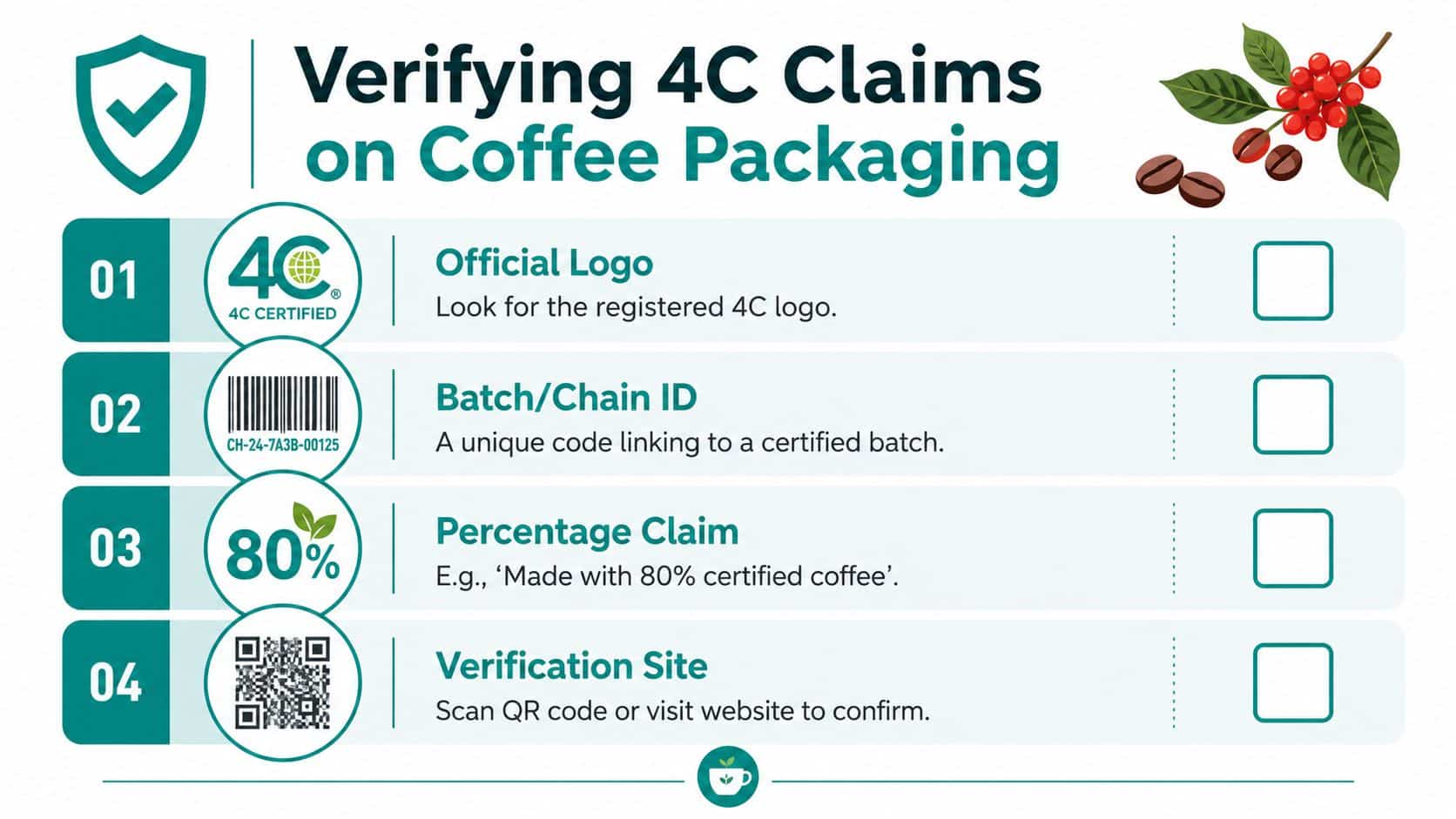
Verifying 4C Claims on Coffee Packaging
Packaging claims can be confusing because the logo tells only part of the story. Ecocert says 4C logo or related claims can be used on-pack only when the product contains at least 90% 4C certified coffee, and packages may begin at 30% with a maximum of three years to reach the 90% threshold (Ecocert 4C certification detail). That's a concrete rule, and it gives shoppers a way to read labels more carefully.
What to check before you buy
Look for the official logo first, then read the percentage claim. If a package says it is made with certified coffee, the share matters. A small blend with a sustainability claim is not the same thing as a fully certified product.
- Official Logo: Look for the registered 4C mark.
- Batch or Chain ID: Check for a code that ties the package back to a certified lot.
- Percentage Claim: Read whether the package is fully certified or partially certified.
- Verification Site: Use the brand's website or QR code if it's provided.
On-pack and off-pack claims are not the same
Ecocert also notes that the logo can appear off-pack on materials like bags, brochures, and websites. That distinction matters because marketing can be broader than packaging. A roaster can talk about certification in one channel while still needing to meet strict product-content rules on the shelf.
If you want a broader framework for evaluating labels, the basics of USDA organic coffee certification are helpful because they show how different standards can regulate different parts of the product story. The lesson is simple, don't trust the logo alone, read the claim behind it.
Brewing Better Coffee at Home with Quality Accessories
Coffee certification helps you judge where beans come from. The right gear helps you taste what you bought. Water quality, machine maintenance, and clean brewing parts shape the cup just as much as origin story or sustainability claim.
A reusable pod, a good filter, or a reliable descaling routine doesn't change 4C itself, but it does protect the flavor and consistency of the coffee you brew at home. If you enjoy pairing coffee with a richer drink experience, a resource like bourbon coffee pairing can be a useful reminder that preparation and pairing both influence how a coffee presents.
Clean machines also last longer and brew more predictably. If you use a Keurig, Ninja DualBrew, or espresso setup, the right accessories help keep the system running the way it should, so the coffee in your cup reflects the beans you chose rather than avoidable machine problems.
PureHQ Inc. helps home brewers and small workplaces keep coffee equipment clean, consistent, and easier to use every day. If you care about better coffee choices, including certified beans and reliable brewing, visit PureHQ Inc. to explore reusable K-Cups, water filtration, and maintenance accessories that support a better cup.

