
Coffee Machine Care
Natural Descaling Solution for Keurig and Coffee Machines
Aug
The first clue is usually small. Your Keurig blinks at you, the brew sounds slower than last week, and the cup that should taste bright and clean comes out flat, a little metallic, or just plain off. That's the moment people realize the machine isn't “getting old” so much as it's getting coated inside with limescale, the hard-water buildup that clings to tanks, lines, and heating parts until flavor and flow both start to suffer.
A natural descaling solution can fix that routine problem without turning maintenance into guesswork. The key is choosing the right acid for the machine, the right strength for your water, and the right rinse routine so you clear out the mineral film without leaving sour leftovers behind. If you've ever wondered whether vinegar is enough, whether citric acid is safer, or when a branded descaler makes more sense, the answer comes down to a few practical choices you can make tonight.
The Morning Your Coffee Tastes Off and Your Machine Whispers for Help
The warning usually doesn't arrive all at once. One day the brew light takes longer to finish, the next day the cup tastes dull, and then the machine starts sounding like it's working harder than it should. If you own a Keurig, Ninja, or Breville, that little change is often the machine asking for a descale cycle before the buildup gets worse.
Limescale doesn't stay polite. It settles where water moves, around the tank, in the narrow lines, and on the heating element, then it keeps layering until the machine has to push water through a tighter path. The result is simple, slower flow, less efficient heating, and coffee that loses the clean extraction you expect from a fresh brew.
Practical rule: if the cup tastes flatter and the cycle sounds strained, the problem is usually inside the machine, not in your beans.
That's why waiting rarely helps. The fix is usually small, measured, and repeatable, but only if you use a solution that dissolves mineral scale instead of just masking the smell. A good natural descaling solution should be easy to dose, easy to rinse, and appropriate for the way your machine is built.
A lot of coffee owners stop at “use vinegar” and call it done. That advice isn't wrong, but it leaves out the part that matters most, which ingredient fits your machine, your water, and your tolerance for odor and extra rinse cycles. The next steps make those choices clear so you can clean with confidence instead of guessing.
What Limescale Actually Is and Why It Wrecks Your Coffee
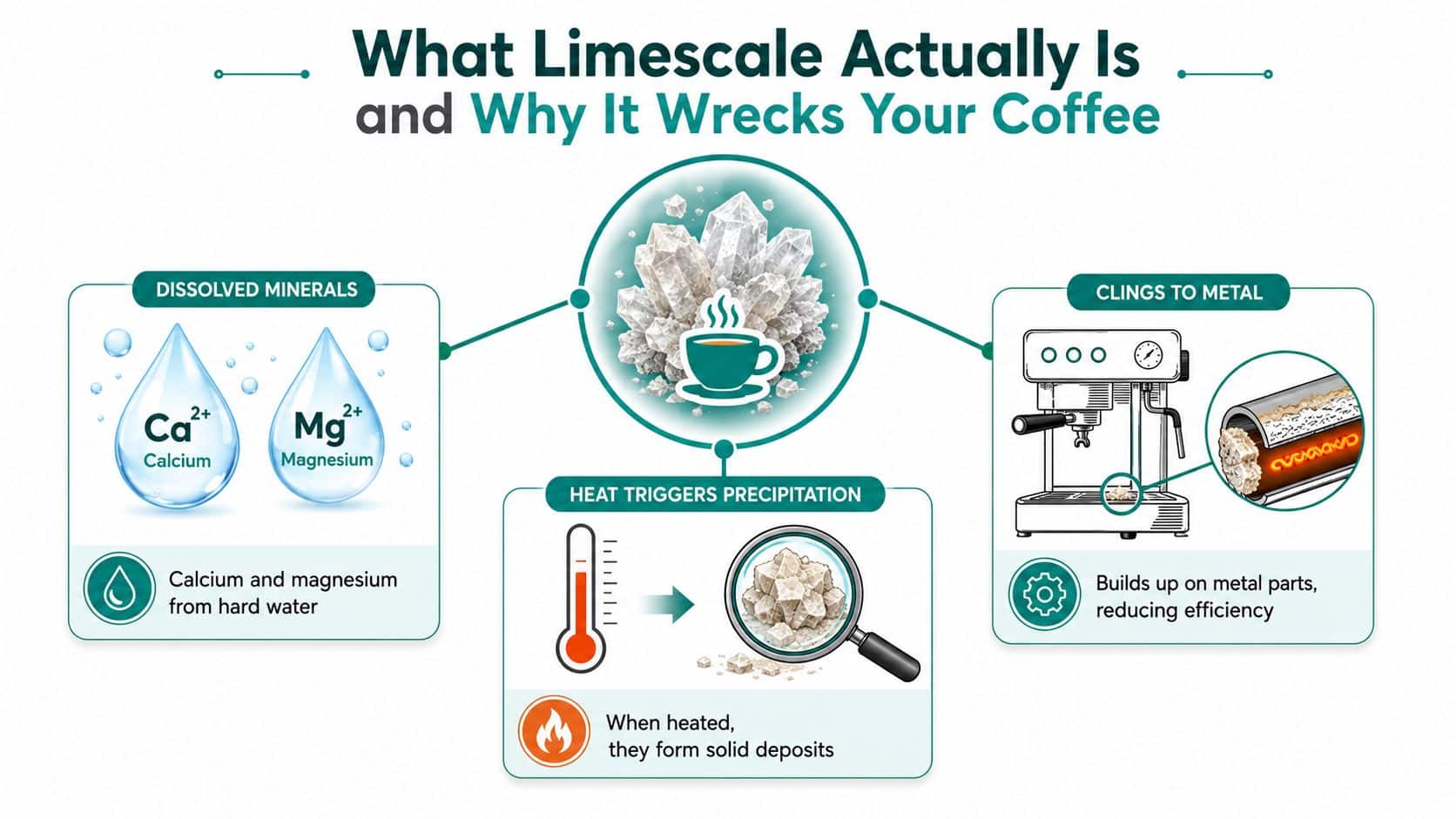
Limescale is the chalky mineral deposit that forms when hard water leaves calcium and magnesium behind on the inside of a machine. Those minerals don't stay dissolved forever, especially once heat pushes the water through a brewer's tank, tube, or heating path. Over time, the deposit hardens into a coating that clings to surfaces and narrows the spaces water needs to move through.
Why that hurts extraction
Coffee machines rely on steady water flow and stable heat. When scale builds up, water can't move as freely, so brew times stretch out and the machine often has to work harder to reach the same result. That can leave the cup tasting weak in one brew and oddly bitter or chalky in another, because mineral residue changes how water meets the grounds.
Single-serve machines and dual-boil or thermoblock designs are especially sensitive because they use smaller internal paths and frequent heating cycles. Tiny passages don't have much room for mineral film, so a little scale goes a long way toward creating slow drips, uneven temperature, and extra strain on pumps and heaters.
Plaque in arteries is a good analogy. The flow doesn't stop on day one, but the narrowing changes the way everything moves, and the machine has to push harder to do the same job. A proper natural descaling solution has to dissolve calcium carbonate, because that's the actual deposit behind the problem, not just clean the visible stains around the brewer.
Hard water doesn't just leave a cosmetic mark. It changes how the machine behaves from the inside out.
That's why descaling isn't the same thing as rinsing. A rinse clears loose debris. A descaler attacks the mineral buildup itself, which is what restores flow and helps the coffee taste like coffee again.
Citric Acid, Vinegar, Baking Soda, and Ascorbic Acid Compared
Citric acid is the workhorse for coffee machines because it's easy to measure, low in odor, and practical for repeat maintenance. Vinegar can also dissolve scale, but the smell lingers long enough that you usually need more rinse cycles to get the cup back to neutral. Baking soda goes the other direction chemically, so it's better for deodorizing and oil cleanup than for breaking down true limescale. Ascorbic acid can help as a lighter-touch cleaner, but it's not the first thing I'd reach for when the buildup is obvious.
Natural Descaling Ingredient Comparison
| Ingredient | Acidity | Odor | Best For | Watch Out For |
|---|---|---|---|---|
| Citric acid | Strong enough for routine scale removal | Low | Keurig, Ninja DualBrew, Breville, and other coffee machines that need a repeatable recipe | Use the right dilution so you don't overdo it |
| White vinegar | Effective, but less pleasant to live with | Strong | Quick DIY cleaning when smell isn't a problem | Needs thorough rinsing, and it's not ideal for every material |
| Baking soda | Weak base, not a true descaler | Mild | Deodorizing and surface cleaning | Doesn't do the main job on calcium carbonate |
| Ascorbic acid | Mild | Low | Light maintenance or a finishing rinse in some setups | Too gentle for heavy buildup |
For a deeper breakdown of machine-specific ingredient choices, the Keurig descaling solution ingredients guide is a useful reference. It helps separate “works in a pinch” from “makes sense for routine maintenance.”
A clean way to think about it is this. If you want the least odor and the most predictable dose, choose citric acid. If you need the cheapest pantry option and don't mind the smell, vinegar gets the job done, but it asks for more rinsing. If the goal is scale removal rather than fragrance, baking soda is the wrong tool.
Short version: citric acid for routine descaling, vinegar for emergency DIY cleaning, baking soda for odor, and ascorbic acid for light finishing work.
How Water Hardness Changes Your Descaling Routine
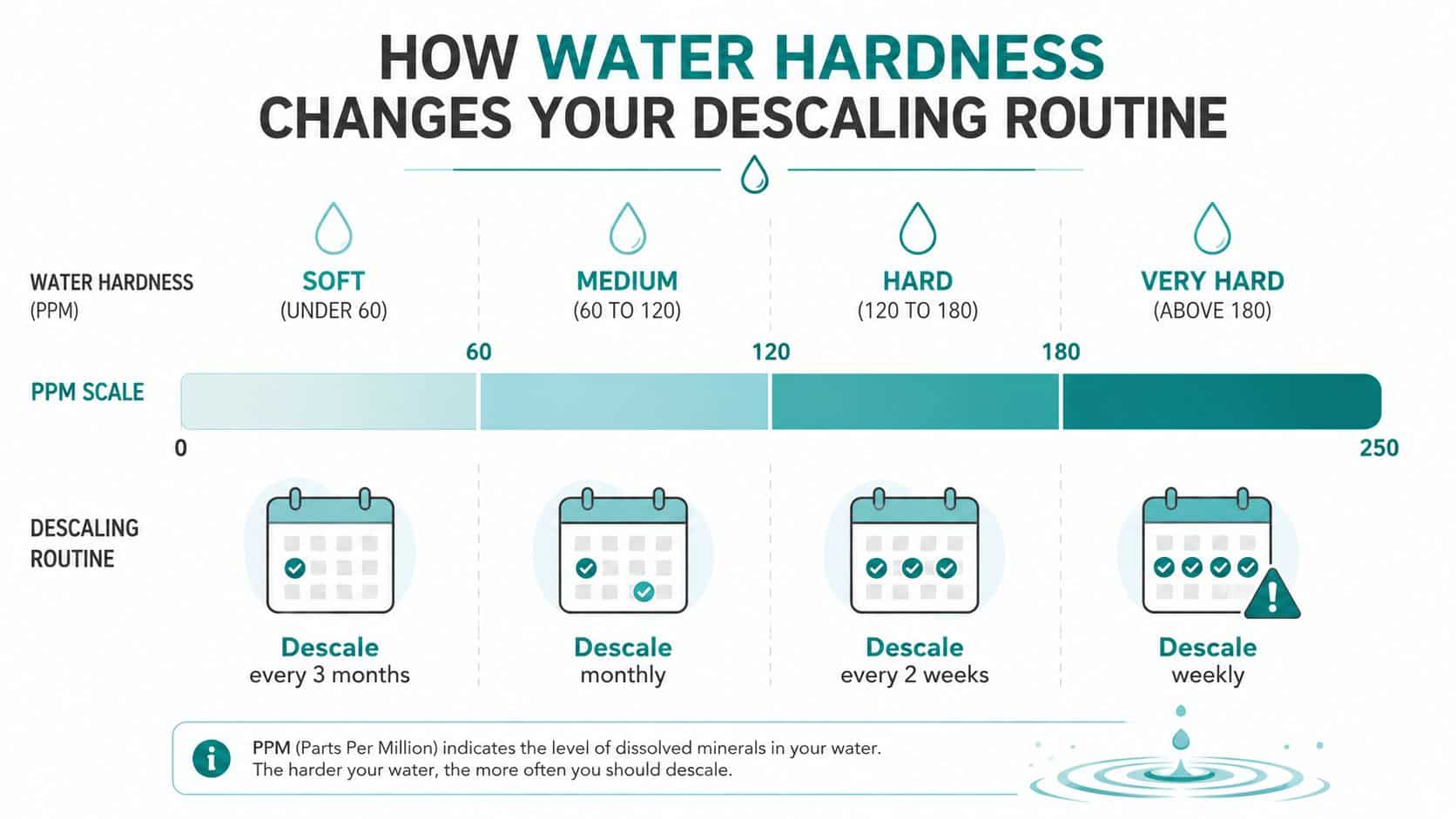
Water hardness changes the whole schedule. Soft water is generally under 60 ppm, medium water is 60 to 120 ppm, hard water is 120 to 180 ppm, and very hard water sits above 180 ppm. That matters because two machines can get the same natural descaling solution and still behave very differently, because one kitchen sends in more minerals than the other. For a plain-language reference on water treatment and mineral content, PureHQ's how to improve water quality guide is useful, and the chart below shows how hardness levels affect descaling frequency.
Read your water before you pick a routine
A softer-water home can usually stay on a calmer maintenance cycle, while a hard-water household has to watch scale much more closely. A practical schedule is every 3 months for soft water, every 1 to 2 months for medium hardness, and every 3 to 4 weeks for water above 180 ppm hardness. That is the difference between occasional upkeep and a machine that needs regular attention.
If you are unsure where you land, start with your local water report or a home hardness test strip. If your tap water tastes mineral-heavy, leaves white spots on glass, or makes kettle residue show up fast, your coffee maker probably needs more frequent descaling than a casual monthly reminder.
Filtered or softened water usually slows scale formation because fewer minerals reach the machine in the first place. If you want a clearer picture of how input water changes maintenance, the distilled water equipment guide is a helpful background reference, because it explains why lower mineral load reduces cleaning needs. The choice is simple. More minerals in the water means more buildup in the brewer.
Practical rule: harder water means more frequent descaling, and a fixed calendar reminder only works if it matches your actual water.
DIY Natural Descaling Recipes and Step-by-Step Instructions
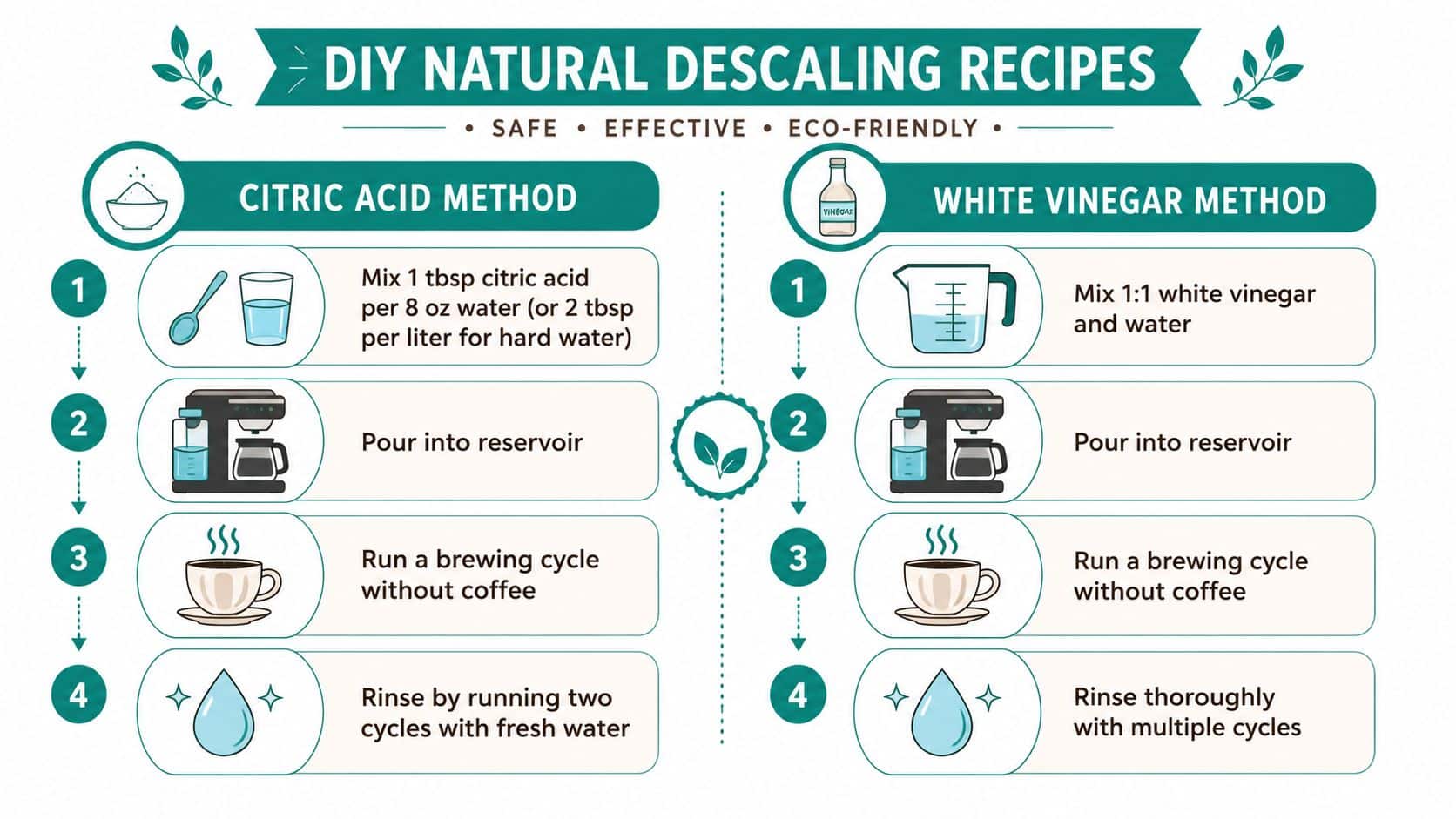
For routine cleaning, I reach for two recipes most often. Citric acid gives you the cleaner, more controlled option. A common mix is about 1 tablespoon per 8 ounces of water, or about 2 tablespoons per liter for harder water, which matches the dosing guidance in the brief. White vinegar still works, and the usual DIY mix is 1:1 vinegar and water, but it leaves a stronger odor and usually needs more rinsing.
A quick rule helps with the choice. If you want less smell and a more predictable result, citric acid is usually the better fit. If you already have vinegar in the pantry and the machine only needs light maintenance, vinegar can do the job, as long as you rinse carefully and accept the extra odor.
One process that fits most brewers
Start by emptying the reservoir and rinsing out any loose grounds or residue. Fill it with the solution you picked, citric acid or vinegar, then run a brew cycle until the machine is partway through the liquid. Pause the cycle and let the solution sit for about 30 minutes, because the acid needs time against the mineral film, the same way a stain remover has to sit on a mark before it loosens.
After the soak, finish the cycle and dump the used solution. Then run 2 to 3 full rinse cycles with clean water so the machine stops smelling like acid and the cup tastes normal again. That rinse step does more work than people expect, because leftover vinegar or citric acid can make plain water taste off if you rush it.
If you use a stronger mixture for hard water, stay with the same soak-and-rinse pattern. Do not keep increasing the acid just because the scale looks stubborn. A longer contact time is usually safer than a harsher mix, especially on smaller home machines that have narrow internal passages.
Machine-specific notes that save headaches
Keurig K-Classic, K-Supreme, K-Slim, and K-Duo owners can usually follow the same basic pattern, but the exact brew path and reservoir size change how much solution you need. Ninja DualBrew users should pay attention to the carafe side as well as the pod side, since the machine can move water through different internal paths. Breville owners should be especially careful with thermoblock care, because those smaller heating paths benefit from gentler maintenance rather than harsh chemistry. If you want a broader reminder on ingredient handling, the food-grade cleaning products guide is a useful reference for choosing safer cleaning inputs around kitchen equipment.
A simple check tells you if the rinse is done. If the reservoir no longer smells vinegary and a plain hot-water cycle tastes neutral, the machine is ready to brew again. If not, keep rinsing.
A quick wipe of the drip tray and a clean-out of the pod holder help keep the rest of the machine from dragging down the benefit of the descale. That small cleanup keeps old coffee oils from mixing with fresh scale residue and making the next cup taste stale.
For machines with heavier buildup, a natural descaling solution can handle regular upkeep, but it works best before the scale turns into a thick layer. Once residue has hardened around valves, sensors, or tight heating channels, a commercial product made for coffee equipment may clear the path faster and with less trial and error.
Warranty, Material Safety, and When to Reach for a Commercial Descaler
The warranty question is the first one asked, and it is a fair one. A natural descaling solution can be a good fit for routine care, but the ingredient still needs to match the machine. Citric-acid recipes are usually compatible with stainless steel, glass, ceramic, and many food-grade plastics. Vinegar needs more caution around some rubber seals and aluminum parts, and it should stay away from natural stone surfaces.
The same basic rule applies to any cleaner you pour into kitchen equipment, use ingredients meant for food contact and follow the product directions. A useful reference is the guide to food-grade cleaning products, which explains why ingredient choice matters around appliances, hoses, and seals. For a more technical example, the neutral product sheet for a natural-origin descaler lists citric acid and lactic acid as active acids, notes that it is phosphate- and nickel-free, and shows a pH below 2.0 in the formula sheet (product sheet).
Purpose-built descaler sheets also show how commercial formulas are tuned for appliance maintenance. One coffee-machine descaler sheet specifies 30 to 50% lactic acid, a 1:10 dilution, and a finished-use pH 2.5 ± 0.5. That kind of specification matters because a boiler, pump, and thermoblock do not all react the same way to the same cleaner. A solution that clears scale in a straight water path may be too aggressive, or too weak, for a machine with tighter channels and more sensitive parts.
How to choose between natural and commercial
Use a natural recipe for regular upkeep when the machine is still in normal shape and the buildup is light. A commercial coffee-machine descaler makes more sense when the scale is heavy, the brewer has sat unused for months, or the manual points you toward a branded cleaner. The choice is a little like picking the right wrench. A standard wrench works for routine fixes, while a specialty tool is safer when the part is stuck, delicate, or shaped in a way that needs a better fit.
Machine design matters here too. Keurig, Ninja, and Breville owners should avoid harsh unapproved acids because those are the ingredients most likely to create warranty trouble. The safest path is to follow the machine's descaling procedure, match the chemistry to the materials in the brewer, and rinse until the water runs neutral again.
For readers who want a measured maintenance product instead of mixing their own each time, PureHQ sells a universal descaling solution and cleaning tablets. Its food-grade cleaning products page gives more context on what that category is meant to do. That can help when you want a cleaner that is already formulated for appliance care rather than guessing at a DIY ratio.
Bottom line: a natural descaling solution is usually enough for light, routine scale. Heavy buildup, tight internal channels, or a manufacturer-specific cleaning requirement can make a commercial formula the better call.
Cost, Environmental Impact, and Your Long-Term Maintenance Plan
The DIY route is appealing because it's simple, repeatable, and easy on the budget. A bulk bag of citric acid lets you mix only what you need, while a commercial bottle gives you convenience at a higher per-use cost. If you run descaling on schedule, the bigger savings usually come from consistency, not from chasing the cheapest bottle on the shelf.
Natural solutions also keep the maintenance footprint lighter. Citric acid is a familiar food-related ingredient, and when you're not buying a new plastic bottle for every cleaning cycle, you're cutting down on packaging waste too. Vinegar works in the same general category, but it usually asks for more rinsing and leaves a stronger smell, which is why I still prefer citric acid for most coffee gear.
A good routine doesn't stop at the descaler. Reusable K-Cups, paper liners, and water filtration accessories all help slow scale formation upstream, so the machine has less mineral load to fight downstream. PureHQ's accessory lineup sits in that practical lane, and when you pair cleaner input water with regular descaling, the machine usually stays easier to live with.
If you want a broader maintenance framework outside coffee, the DPP Grid maintenance advice page is a useful reminder that regular care usually beats reactive repair. Coffee machines follow the same logic, just with hotter water and smaller internal paths.
Keep the schedule simple. Use citric acid for routine maintenance, check your water hardness, rinse until the smell is gone, and move to a commercial descaler when the machine needs more than a light reset.
PureHQ Inc. offers coffee machine descaling solutions, reusable pods, water filters, and maintenance accessories for Keurig, Ninja, Breville, and other home brewers. If you want a measured routine that helps your machine stay cleaner and your coffee taste closer to what you intended, visit PureHQ Inc. and choose the descaling and filtration tools that fit your setup.

